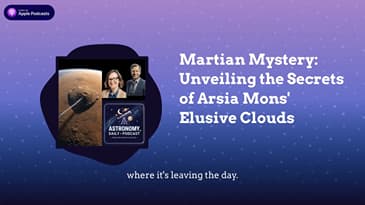
Martian Mystery: Unveiling the Secrets of Arsia Mons' Elusive Clouds
Show notes A cloud on Mars that forms only if textbook-theoretical physics really happens; Webb maps a hot Jupiter's edge angle by angle; multi-planet systems turn out to come in two families tied to their stars; and the Sagittarius dwarf galaxy's original disc is rebuilt from its own debris. Plus Hera's first braking burn, the station's final solar arrays, NASA ADS hands over to SciX, and a both-hemispheres skywatch. The Cloud That Shouldn't Exist Every morning in Mars's southern spring and summer, the Arsia Mons Elongated Cloud stretches up to 1,800 km from the 20 km volcano and vanishes within the day. A team led by Jorge Hernández-Bernal (LMD/CNRS/Sorbonne Université) could only reproduce it by adding homogeneous nucleation, in which vapour freezes with no dust seed, at supersaturation more than 100,000 times everyday Earth levels. A model result: sufficient, not yet observed directly. Nature Geoscience, 7 October 2026. A Map Around a Hot Jupiter's Edge Using JWST's NIRISS, NIRSpec and MIRI and the transmission strings method, Lili Alderson, Hannah Wakeford and colleagues mapped WASP-17 b's limb in 20° steps: ~860 K at the morning edge, ~1,520 K at the evening edge, the largest limb contrast yet. Data from March 2023. Nature Astronomy, 14 October 2026. Planetary Systems Come in Two Families Diego Turrini (INAF), Camilla Danielski and colleagues find 298 well-measured multi-planet systems split into a calm, compact low-mass family and a heavyweight family around metal-rich stars with about ten times more dynamical excitation. Nature Astronomy, 13 October 2026. Rewinding a Shredded Galaxy Zixi Guo, Xiang-Xiang Xue (NAOC) and colleagues reproduce a vertical metallicity gradient across the Sagittarius streams only if the dwarf began as a disc with an inverted-V metallicity profile, seen in 3 of 217 MaNGA dwarfs. Nature Astronomy, 13 October 2026. Quick hit Hera's 93-minute braking burn (BRM-1); CRS-35 and the ISS's final roll-out solar arrays; NASA ADS closes in November and becomes SciX. Skywatch Mercury and Venus in the southern evening sky; Venus inferior conjunction 24 Oct; crescent Moon in Ophiuchus; Sagittarius and WASP-17 high from Australia; Saturn all night; Mars and Jupiter closing pre-dawn toward 1.2° on 16 Nov; Orionids peak 21–22 Oct. Links · ESA: Mars's oddest cloud may be even odder than we thought (7 Oct 2026): https://www.esa.int/Science_Exploration/Space_Science/Mars_Express/Mars_s_oddest_cloud_may_be_even_odder_than_we_thought · Hernández-Bernal et al., Nature Geoscience (2026), DOI 10.1038/s41561-026-02089-9: https://doi.org/10.1038/s41561-026-02089-9 · Preprint: arXiv 2609.37259: https://arxiv.org/abs/2609.37259 · Alderson et al., A spatial map of the atmospheric limb of a hot Jupiter, Nature Astronomy (2026): https://www.nature.com/articles/s41550-026-02986-4 · Turrini, Danielski et al., Two families of multi-planet systems, Nature Astronomy (2026): https://www.nature.com/articles/s41550-026-02990-8 · INAF Media: Due famiglie di sistemi planetari (13 Oct 2026): https://www.media.inaf.it/2026/10/13/famiglie-esopianeti-stella-madre/ · Guo, Xue et al., A ∧-like metallicity profile in the disk of the Sagittarius dwarf galaxy, Nature Astronomy (2026): https://www.nature.com/articles/s41550-026-02996-2 · ESA: Brake! Time for ESA's Hera asteroid mission to go slow (7 Oct 2026): https://www.esa.int/Space_Safety/Hera/Brake!_Time_for_ESA_s_Hera_asteroid_mission_to_go_slow · Spaceflight Now: CRS-35 launch (13 Oct 2026): https://spaceflightnow.com/?p=74541 · Nature Astronomy editorial: Farewell NASA ADS (12 Oct 2026): https://www.nature.com/articles/s41550-026-03009-y astronomydaily.io · @AstroDailyPod · Bitesz.com Podcast Network
Sponsor Details: Ensure your online privacy by using NordVPN . To get our special listener deal and save a lot of money, visit You'll be glad you did!
Get the best secure and private email on the planet. Stop your Government, google and who knows who else spying on every email you write. Do what we did and use ProtonMail. They beleive in privacy and there are no ads in their business model...yet they still provide a free forever service. Check them out and get out special deal at www.astronomydaily.io/protonmail (https://www.astronomydaily.io/protonmail)