
To grab our special money saving NordVPN deal - Click Here
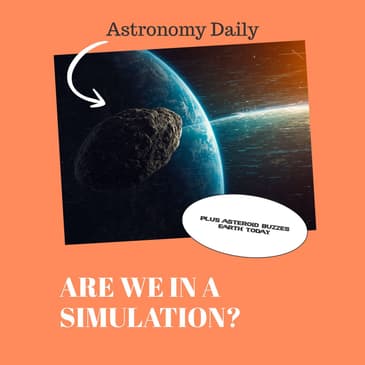
In today’s episode, Anna and Avery cover a blue whale-sized asteroid making a close pass of Earth today, the imminent debut of SpaceX’s most powerful rocket yet, NASA’s Psyche spacecraft successfully completing its Mars gravity assist, fresh science arriving at the ISS, a new physics paper challenging the simulation hypothesis at its foundations, and Congress pushing back hard against proposed cuts to NASA’s science budget. Story 1 — Asteroid 2026 JH2 Newly discovered asteroid 2026 JH2 (first spotted 10 May 2026) makes a close Earth flyby today at ~90,000 km — within the orbital radius of many satellites. Estimated size: up to ~35 metres (blue whale-sized). Zero impact risk confirmed. Observable with binoculars at peak magnitude ~11.5. Live stream available via the Virtual Telescope Project. Orbital period: 3.7 years between Earth and Jupiter. Story 2 — Starship V3 / Flight 12 SpaceX targets May 19, 2026 for the debut of Starship Version 3 (Flight 12) from Pad 2 at Starbase, Texas. Launch window opens 6:30 PM EDT. Key upgrades: Raptor 3 engines (250 tf SL thrust, up from 230 tf), three larger grid fins, new integrated hot-stage design, updated propellant systems. No tower catch on this flight; booster splashes in Gulf of Mexico. Upper stage (Ship 39) targets Indian Ocean after 65 minutes. Payload: 22 Starlink simulator satellites. Critical step toward Artemis lunar landings. Story 3 — NASA Psyche Mars Flyby On 15 May 2026 at 3:28 PM EDT, Psyche completed its Mars gravity assist at 4,500 km altitude travelling at 12,333 mph. Passed inside the orbits of both Martian moons. Confirmed by Doppler shift monitoring. Mission: en route to metal-rich asteroid 16 Psyche (arrival July 2029). Thousands of Mars observations gathered for science calibration. Story 4 — SpaceX CRS-34 SpaceX’s 34th Dragon cargo mission docked at ISS at 6:37 AM EDT on 17 May 2026, delivering ~6,500 lb of cargo for Expedition 74. Science payloads include: microgravity simulator validation study, wood-based bone scaffold (osteoporosis research), red blood cell/spleen spaceflight study. Dragon will return to Earth mid-June splashing down off California coast. Story 5 — Simulation Hypothesis Paper Paper: ‘Non-algorithmic physics and the limits of the simulation hypothesis’, published in the Journal of Holography Applications in Physics. Authors: Mir Faizal (UBC Okanagan), Lawrence Krauss, Arshid Shabir, Francesco Marino. Core argument: using Gödel’s incompleteness theorems, the team argues any theory of quantum gravity would be non-algorithmic — containing truths no computation can capture. Since any simulation requires algorithms, reality cannot be fully simulated. Note: this is a theoretical paper, not an experimental result. The authors acknowledge no complete quantum gravity theory currently exists. Story 6 — NASA FY2027 Budget House Appropriations Committee approved $24.438 billion for NASA in FY2027 — matching FY2026 and rejecting the White House’s proposed $18.8 billion (a 23% cut). The proposal would have cut the Science Mission Directorate by 46%, terminating 50+ missions. Committee protects science, Habitable Worlds Observatory, and STEM education funding. Bill still needs Senate passage and reconciliation. Skywatching TONIGHT — Moon-Venus conjunction: look west after sunset for the crescent Moon close to brilliant Venus. Earthshine visible on dark lunar limb. Southern Hemisphere: look west-northwest, best in first hour after sunset. Blue Moon on 31 May (second full Moon of the month).
Become a supporter of this podcast: https://www.spreaker.com/podcast/astronomy-daily-latest-space-news--5648921/support.
Sponsor Details:
Ensure your online privacy by using NordVPN. To get our special listener deal and save a lot of money, visit www.astronomydaily.io/nordvpn. You'll be glad you did!
Get the best secure and private email on the planet. Stop your Government, google and who knows who else spying on every email you write. Do what we did and use ProtonMail. They beleive in privacy and there are no ads in their business model...yet they still provide a free forever service. Check them out and get out special deal at www.astronomydaily.io/protonmail
Become a supporter of Astronomy Daily by joining our Supporters Club. Commercial free episodes daily are only a click way... Click Here
This episode includes AI-generated content.
00:00:00 --> 00:00:03 Anna: Right now, as you listen to this, a chunk of
00:00:03 --> 00:00:05 space rock the size of a blue whale is
00:00:05 --> 00:00:08 hurtling past Earth at, uh, 20 miles per
00:00:08 --> 00:00:09 hour,
00:00:09 --> 00:00:12 Avery: closer than some of our own satellites. And
00:00:12 --> 00:00:14 nobody knew it existed eight days ago.
00:00:14 --> 00:00:17 Anna: Plus tomorrow, the most powerful
00:00:17 --> 00:00:20 rocket ever built takes its biggest leap
00:00:20 --> 00:00:21 forward yet.
00:00:21 --> 00:00:23 Avery: And later today, we find out whether the
00:00:23 --> 00:00:25 entire universe might just be a very
00:00:25 --> 00:00:27 elaborate computer program.
00:00:29 --> 00:00:29 Probably not.
00:00:30 --> 00:00:32 Anna: Bizik says. Definitely not. That
00:00:32 --> 00:00:35 conversation is coming. You're listening to
00:00:35 --> 00:00:36 Astronomy Daily.
00:00:36 --> 00:00:38 Avery: I can hear the discussion starting now.
00:00:39 --> 00:00:41 Anna: Hello, and welcome to Astronomy Daily, your
00:00:41 --> 00:00:44 daily guide to what's happening in space and
00:00:44 --> 00:00:46 the science behind it. I'm Anna.
00:00:46 --> 00:00:49 Avery: And I'm, um, Avery. It is Monday, the
00:00:49 --> 00:00:52 18th of May, 2026, and we
00:00:52 --> 00:00:54 have a seriously packed episode for you
00:00:54 --> 00:00:54 today.
00:00:55 --> 00:00:57 Anna: We've got the asteroid that's buzzing our
00:00:57 --> 00:00:59 planet right now, the Starship
00:00:59 --> 00:01:02 V3 launch that's just hours away.
00:01:02 --> 00:01:05 And NASA's Psyche spacecraft, fresh
00:01:05 --> 00:01:07 off a stunning, uh, Mars flyby.
00:01:08 --> 00:01:10 Avery: Plus new science arriving at the space
00:01:10 --> 00:01:12 station, a fascinating physics challenge to
00:01:12 --> 00:01:14 one of the Internet's favorite thought
00:01:14 --> 00:01:16 experiments, and the latest chapter in the
00:01:16 --> 00:01:18 battle over NASA's future funding.
00:01:18 --> 00:01:20 Anna: Let's get into it.
00:01:20 --> 00:01:21 Avery: We're starting with something that is
00:01:21 --> 00:01:24 happening literally right now, today.
00:01:24 --> 00:01:26 As you listen to this, a newly discovered
00:01:26 --> 00:01:29 asteroid called 2026 JH AH2
00:01:30 --> 00:01:32 is making a close pass of Earth.
00:01:32 --> 00:01:35 Anna: And when we say close, we mean genuinely
00:01:35 --> 00:01:38 close. This space rock is coming within about
00:01:38 --> 00:01:41 90 kilometers of our planet. To
00:01:41 --> 00:01:43 put that in perspective, the moon is roughly
00:01:43 --> 00:01:46 380 kilometers away.
00:01:46 --> 00:01:48 We're talking about less than a quarter of
00:01:48 --> 00:01:49 the lunar distance.
00:01:50 --> 00:01:52 Avery: Now, before anyone starts worrying,
00:01:52 --> 00:01:54 astronomers have confirmed there is
00:01:54 --> 00:01:56 absolutely zero chance of impact, but the
00:01:56 --> 00:01:59 proximity is remarkable. It's actually closer
00:01:59 --> 00:02:02 than many of the satellites we rely on every
00:02:02 --> 00:02:02 day.
00:02:02 --> 00:02:05 Anna: What makes this even more striking is the
00:02:05 --> 00:02:08 timeline. 2026 JH2 was
00:02:08 --> 00:02:11 only first spotted on 10 May. Just
00:02:11 --> 00:02:14 eight days ago. It went from discovery to
00:02:14 --> 00:02:16 closest approach in under a fortnight.
00:02:17 --> 00:02:20 Avery: So how big is this thing? Estimates put it
00:02:20 --> 00:02:22 somewhere around 35 meters across at
00:02:22 --> 00:02:25 most, roughly the length of a blue whale,
00:02:25 --> 00:02:26 which is the comparison everyone's been
00:02:26 --> 00:02:29 running with. And honestly, it's a pretty
00:02:29 --> 00:02:31 vivid one at that size.
00:02:31 --> 00:02:33 Anna: Even if it were headed our way, which, again,
00:02:33 --> 00:02:36 it is not, it would most likely burn up in
00:02:36 --> 00:02:38 the atmosphere before causing any real
00:02:38 --> 00:02:41 surface damage. NASA's general rule of
00:02:41 --> 00:02:44 thumb is that objects under about 25 meters
00:02:44 --> 00:02:46 usually disintegrate on entry.
00:02:46 --> 00:02:48 Avery: But this one is right at that interesting
00:02:48 --> 00:02:51 threshold. And the close pass is actually
00:02:51 --> 00:02:54 fantastic for science Observatories around
00:02:54 --> 00:02:56 the world have been tracking it. The Virtual
00:02:56 --> 00:02:58 Telescope project is running a livestream
00:02:58 --> 00:03:00 today, so you can watch it in real time if
00:03:00 --> 00:03:01 you're near a computer.
00:03:01 --> 00:03:04 Anna: At its closest approach, 2026
00:03:04 --> 00:03:07 JH2 is expected to reach a brightness of
00:03:07 --> 00:03:10 around magnitude 11.5, which means
00:03:10 --> 00:03:12 it's just within reach of decent amateur
00:03:12 --> 00:03:15 binoculars if you know exactly where to look.
00:03:15 --> 00:03:18 The orbit is a looping ellipse that takes it
00:03:18 --> 00:03:20 between Earth and Jupiter, swinging around
00:03:20 --> 00:03:23 The sun every 3.7 years.
00:03:23 --> 00:03:26 Avery: It's a good reminder of just how dynamic the
00:03:26 --> 00:03:27 neighborhood is and how much we're still
00:03:27 --> 00:03:28 finding out there.
00:03:29 --> 00:03:32 Anna: Absolutely, the sky is never boring.
00:03:32 --> 00:03:34 Avery: Now to a story that has the entire space
00:03:34 --> 00:03:37 community watching. SpaceX is targeting
00:03:37 --> 00:03:40 tomorrow, Tuesday the 19th of May, for the
00:03:40 --> 00:03:43 debut launch of Starship version 3. This
00:03:43 --> 00:03:46 is flight 12 for the Starship program, and it
00:03:46 --> 00:03:48 is a genuinely major milestone.
00:03:49 --> 00:03:51 Anna: So just how different is V3 from what we've
00:03:51 --> 00:03:54 seen? Because SpaceX has been using the word
00:03:54 --> 00:03:57 sweeping a lot, and in this case, I think
00:03:57 --> 00:03:58 it's earned.
00:03:58 --> 00:04:00 Avery: It really is. Let's go through the
00:04:00 --> 00:04:02 highlights. The super heavy booster has been
00:04:02 --> 00:04:05 redesigned with three grid fins instead of
00:04:05 --> 00:04:08 four, but each one is 50% larger and
00:04:08 --> 00:04:10 significantly stronger. They've also been
00:04:10 --> 00:04:13 repositioned lower on the booster to reduce
00:04:13 --> 00:04:15 heat exposure during the hot staging burn.
00:04:15 --> 00:04:18 Anna: And the engines themselves. These are Raptor
00:04:18 --> 00:04:21 3 engines. Now, the sea level variants are
00:04:21 --> 00:04:23 producing 250 tons of force, up from
00:04:23 --> 00:04:26 230. The vacuum variants are even more
00:04:26 --> 00:04:29 impressive. And the engines have shed about
00:04:29 --> 00:04:31 100kg each, with sensors and
00:04:31 --> 00:04:33 controllers now integrated internally.
00:04:34 --> 00:04:36 Avery: What SpaceX says about all of this is that
00:04:36 --> 00:04:39 the changes together, the new booster design,
00:04:39 --> 00:04:42 the new engines, the new pad, the new upper
00:04:42 --> 00:04:45 stage improvements are intended to unlock the
00:04:45 --> 00:04:48 vehicle's core functions. Full and
00:04:48 --> 00:04:50 rapid reuse in space, propellant
00:04:50 --> 00:04:53 transfer, starlink deployment, and
00:04:53 --> 00:04:56 eventually sending people and cargo to the
00:04:56 --> 00:04:57 moon and Mars.
00:04:57 --> 00:05:00 Anna: This flight is also the first launch from pad
00:05:00 --> 00:05:02 two, which is the updated launch
00:05:02 --> 00:05:05 infrastructure. And notably, SpaceX
00:05:05 --> 00:05:07 will not be attempting to catch the booster
00:05:07 --> 00:05:10 back at the tower this time. Given how many
00:05:10 --> 00:05:13 new systems are being tested, they're opting
00:05:13 --> 00:05:15 for a, uh, controlled splashdown in the Gulf
00:05:15 --> 00:05:18 of Mexico, or if you prefer, the Gulf of
00:05:18 --> 00:05:19 America.
00:05:19 --> 00:05:21 Avery: Instead, the upper stage ship 39
00:05:22 --> 00:05:24 will continue on a suborbital path and splash
00:05:24 --> 00:05:27 down in the Indian Ocean about 65 minutes
00:05:27 --> 00:05:30 after launch. Among its test objectives,
00:05:30 --> 00:05:32 deploying 22 Starlink simulator
00:05:32 --> 00:05:35 satellites, a Raptor engine relight in
00:05:35 --> 00:05:38 space, and heat shield assessments, including
00:05:38 --> 00:05:41 some intentionally painted white tiles for
00:05:41 --> 00:05:42 imaging the
00:05:42 --> 00:05:45 Anna: launch window opens at 6:30pm Eastern
00:05:45 --> 00:05:47 Time. That's on the 19th. That's early
00:05:47 --> 00:05:49 morning Wednesday for Australian listeners.
00:05:49 --> 00:05:51 We'll have full coverage in tomorrow's
00:05:51 --> 00:05:53 episode. Worth staying up for honestly, or
00:05:53 --> 00:05:55 setting an alarm?
00:05:55 --> 00:05:57 Avery: This is the rocket that's going to take
00:05:57 --> 00:05:59 people to the moon under Artemis 3.
00:05:59 --> 00:06:01 Tomorrow's test matters enormously.
00:06:02 --> 00:06:03 Anna: Let's check in with one of our favorite
00:06:03 --> 00:06:06 spacecraft on a very long journey. NASA
00:06:06 --> 00:06:09 Psyche probe has just completed a critical
00:06:09 --> 00:06:11 gravity assist maneuver at Mars and the
00:06:11 --> 00:06:13 results are in. It went perfectly.
00:06:14 --> 00:06:16 Avery: On May 15th. At around 3:28
00:06:16 --> 00:06:19 in the afternoon Eastern time, Psyche
00:06:19 --> 00:06:22 reached its closest point to Mars. Just
00:06:22 --> 00:06:25 4 kilometers above the surface.
00:06:25 --> 00:06:28 It was traveling over 12 miles per
00:06:28 --> 00:06:30 hour relative to the planet.
00:06:30 --> 00:06:32 Anna: To put that proximity in perspective, Psyche
00:06:32 --> 00:06:35 flew closer to Mars than either of its two
00:06:35 --> 00:06:37 moons, Phobos and Deimos. It threaded right
00:06:37 --> 00:06:39 through the inner Martian neighborhood.
00:06:39 --> 00:06:42 Avery: And why does this matter so much? The entire
00:06:42 --> 00:06:45 six year mission trajectory was designed
00:06:45 --> 00:06:47 around this single gravitational exchange.
00:06:48 --> 00:06:50 Mars orbital velocity did something the
00:06:50 --> 00:06:53 spacecraft's ion thruster simply couldn't do
00:06:53 --> 00:06:56 alone. It tilted Psyche's orbital plane
00:06:56 --> 00:06:59 and boosted it towards the main asteroid belt
00:06:59 --> 00:07:02 where its target, the metal asteroid 16
00:07:02 --> 00:07:03 Psyche, is waiting.
00:07:03 --> 00:07:06 Anna: Mission controllers confirmed the success by
00:07:06 --> 00:07:08 monitoring the Doppler shift in Psyche's
00:07:08 --> 00:07:10 radio signals. Changes in frequency that
00:07:10 --> 00:07:13 revealed changes in speed. Everything matched
00:07:13 --> 00:07:14 the predictions precisely.
00:07:15 --> 00:07:17 Avery: The spacecraft was also busy doing science.
00:07:17 --> 00:07:20 During the flyby, the team used Psyche's
00:07:20 --> 00:07:22 multispectral imager to gather thousands of
00:07:22 --> 00:07:25 observations of Mars, their first real
00:07:25 --> 00:07:27 calibration opportunity with something larger
00:07:27 --> 00:07:30 than a few pixels. Those images will be
00:07:30 --> 00:07:31 processed in the coming weeks.
00:07:31 --> 00:07:34 Anna: There was also a watch for a faint dusty ring
00:07:34 --> 00:07:36 thought to orbit Mars, produced by tiny
00:07:36 --> 00:07:39 micrometeorite impacts on Phobos and Deimos.
00:07:39 --> 00:07:41 We'll be watching for those results.
00:07:41 --> 00:07:44 Avery: Psyche is now on a direct confirmed
00:07:44 --> 00:07:47 course for arrival at 16 Psyche in
00:07:47 --> 00:07:50 July 2029. The asteroid is
00:07:50 --> 00:07:52 thought to be an ancient planetary core
00:07:52 --> 00:07:54 stripped of its rocky outer layers by
00:07:54 --> 00:07:57 billions of years of coll. Giving us a rare
00:07:57 --> 00:08:00 window into what the interior of a rocky
00:08:00 --> 00:08:02 planet actually looks like. It's going to be
00:08:02 --> 00:08:03 extraordinary.
00:08:04 --> 00:08:06 Anna: Three years and counting. Great to see it on
00:08:06 --> 00:08:09 track. And it's time now for a quick sponsor
00:08:09 --> 00:08:11 mention. When you're ready to secure your
00:08:11 --> 00:08:14 online life, make sure you get NORDVPN
00:08:14 --> 00:08:17 just like we did. And make sure you use our
00:08:17 --> 00:08:19 special money saving link. That way you get
00:08:19 --> 00:08:22 the best in online protection for much less
00:08:22 --> 00:08:25 and help support the show. Uh, a win win I
00:08:25 --> 00:08:27 would say. Check out the link in the show
00:08:27 --> 00:08:28 notes for the details.
00:08:28 --> 00:08:30 Avery: Alright, back to today's space and astronomy
00:08:30 --> 00:08:33 news. Closer to home than our last story, or
00:08:33 --> 00:08:35 at least closer to Earth's orbit.
00:08:35 --> 00:08:38 SpaceX's CRS 34 Dragon cargo
00:08:38 --> 00:08:41 capsule docked successfully at the
00:08:41 --> 00:08:42 International Space Station Yesterday
00:08:42 --> 00:08:45 morning, Sunday the 17th of May.
00:08:45 --> 00:08:48 Anna: This was the 34th Dragon mission under
00:08:48 --> 00:08:51 NASA's Commercial Resupply Contract and it
00:08:51 --> 00:08:54 delivered nearly 6 pounds of science
00:08:54 --> 00:08:56 equipment and supplies to the Expedition
00:08:56 --> 00:08:57 74 crew.
00:08:57 --> 00:09:00 Avery: The Dragon docked autonomously to the Harmony
00:09:00 --> 00:09:03 Module's forward port at, uh, just after
00:09:03 --> 00:09:06 6:30 in the morning Eastern, with NASA
00:09:06 --> 00:09:08 astronaut Jack Hathaway and ESA astronaut
00:09:08 --> 00:09:11 Sophie Adenot monitoring the arrival from the
00:09:11 --> 00:09:12 cupola.
00:09:12 --> 00:09:15 Anna: So what's in the cargo hold? Science wise,
00:09:15 --> 00:09:17 there are some genuinely interesting
00:09:17 --> 00:09:20 experiments. One project looks at how well
00:09:20 --> 00:09:22 Earth based microgravity simulators actually
00:09:22 --> 00:09:25 replicate conditions in space, important
00:09:25 --> 00:09:27 for developing experiments before we launch
00:09:27 --> 00:09:28 them.
00:09:28 --> 00:09:31 Avery: There's also a bone scaffold made from wood.
00:09:31 --> 00:09:34 Yes, wood that researchers hope could lead
00:09:34 --> 00:09:37 to new treatments for fragile bone conditions
00:09:37 --> 00:09:39 like osteoporosis. The idea is that the
00:09:39 --> 00:09:42 natural porous structure of wood creates a
00:09:42 --> 00:09:45 useful scaffold for bone tissue regeneration
00:09:45 --> 00:09:46 in microgravity.
00:09:47 --> 00:09:49 Anna: And equipment to study how red blood cells
00:09:49 --> 00:09:51 and the spleen change during spaceflight,
00:09:51 --> 00:09:53 which is important for the longer missions
00:09:53 --> 00:09:55 we're planning. We know space does
00:09:56 --> 00:09:58 interesting and not always pleasant things to
00:09:58 --> 00:10:01 human physiology. The more we understand it,
00:10:01 --> 00:10:03 the better prepared we'll be.
00:10:03 --> 00:10:05 Avery: Dragon will stay attached to the station for
00:10:05 --> 00:10:08 about a month, then return to Earth in mid
00:10:08 --> 00:10:10 June, splashing down off the coast of
00:10:10 --> 00:10:12 California, bringing back time sensitive
00:10:12 --> 00:10:15 research results. It's worth remembering that
00:10:15 --> 00:10:18 Dragon is currently the only cargo ship that
00:10:18 --> 00:10:20 can bring significant mass back down from the
00:10:20 --> 00:10:21 station.
00:10:21 --> 00:10:24 Anna: Routine mission by the numbers, but the
00:10:24 --> 00:10:26 science inside is anything but routine.
00:10:27 --> 00:10:29 Avery: Now here's a question for you, Anna. Um, are
00:10:29 --> 00:10:30 we living in a simulation?
00:10:32 --> 00:10:34 Anna: I mean, I've definitely had moments where the
00:10:34 --> 00:10:37 algorithm seemed a little too on the nose,
00:10:37 --> 00:10:39 but I'm guessing you're about to tell me that
00:10:39 --> 00:10:41 physics has something to say about this.
00:10:41 --> 00:10:44 Avery: Physics has quite a lot to say, as it turns
00:10:44 --> 00:10:46 out. A new paper published in the Journal of
00:10:46 --> 00:10:49 Holography Applications in Physics, co
00:10:49 --> 00:10:51 authored by physicists Mir Faisal at AH UBC
00:10:51 --> 00:10:54 Okanagan and Lawrence Krauss. Yes,
00:10:54 --> 00:10:57 that Lawrence Krauss argues that the universe
00:10:57 --> 00:11:00 fundamentally cannot be simulated. Not
00:11:00 --> 00:11:03 it would be very hard to simulate. It cannot.
00:11:04 --> 00:11:06 Anna: That's a strong claim. What's the argument?
00:11:07 --> 00:11:08 Avery: It goes back to the foundations of
00:11:08 --> 00:11:11 mathematics. In the 1930s, the logician
00:11:11 --> 00:11:14 Kurt Godel proved something genuinely strange
00:11:14 --> 00:11:16 about formal that Any
00:11:16 --> 00:11:19 mathematical framework rich enough to include
00:11:19 --> 00:11:21 basic arithmetic will contain true
00:11:21 --> 00:11:24 statements that can never be proven from
00:11:24 --> 00:11:26 within that system. There are truths that are
00:11:26 --> 00:11:28 real but unreachable by proof.
00:11:29 --> 00:11:31 Anna: Which is already a bit of a mind bender on
00:11:31 --> 00:11:32 its own.
00:11:32 --> 00:11:35 Avery: It is. And Feisal and his co authors apply
00:11:35 --> 00:11:38 that same logic to quantum gravity, the
00:11:38 --> 00:11:40 long sought theory that would unite
00:11:40 --> 00:11:43 Einstein's general relativity with quantum
00:11:43 --> 00:11:45 mechanics. They argue that any such
00:11:45 --> 00:11:48 theory by its nature would need to
00:11:48 --> 00:11:51 satisfy the conditions that trigger Godel's
00:11:51 --> 00:11:53 incompleteness theorems, which means it would
00:11:53 --> 00:11:56 inevitably leave some physical truths out.
00:11:57 --> 00:11:59 Anna: So the universe contains facts that no
00:11:59 --> 00:12:01 algorithm can ever fully capture.
00:12:02 --> 00:12:04 Avery: Exactly. And, and here's where the simulation
00:12:04 --> 00:12:07 hypothesis comes in. Any simulation
00:12:07 --> 00:12:10 runs on algorithms. If reality is
00:12:10 --> 00:12:13 fundamentally non algorithmic, if truths
00:12:13 --> 00:12:15 built into the fabric of the universe that no
00:12:15 --> 00:12:18 computation can reproduce, then a simulation
00:12:18 --> 00:12:21 by definition could never be complete.
00:12:21 --> 00:12:24 It would always be missing something real.
00:12:24 --> 00:12:26 Anna: Lawrence Krauss puts it pretty starkly in the
00:12:26 --> 00:12:27 paper, doesn't he?
00:12:27 --> 00:12:30 Avery: He does. He says the fundamental laws of
00:12:30 --> 00:12:33 physics don't exist inside space and time,
00:12:33 --> 00:12:36 they create it. And any simulation would have
00:12:36 --> 00:12:38 to run within a computational framework,
00:12:38 --> 00:12:41 which means it could never express the true
00:12:41 --> 00:12:43 structure of reality. The laws would always
00:12:43 --> 00:12:45 be outside the box you're trying to put them
00:12:45 --> 00:12:46 in.
00:12:46 --> 00:12:47 Anna: There's also an interesting thread in the
00:12:47 --> 00:12:49 paper about consciousness, isn't there?
00:12:49 --> 00:12:51 Echoing Roger Penrose.
00:12:51 --> 00:12:54 Avery: Right. The authors do gesture toward the idea
00:12:54 --> 00:12:56 that human thought itself might be non
00:12:56 --> 00:12:59 algorithmic in some sense. That perhaps
00:12:59 --> 00:13:02 our ability to recognize certain truths goes
00:13:02 --> 00:13:04 beyond what formal computation can do.
00:13:04 --> 00:13:06 That part is more speculative, and the
00:13:06 --> 00:13:08 authors themselves flag it as such.
00:13:08 --> 00:13:11 Anna: So how solid is this as a debunking?
00:13:11 --> 00:13:14 It does feel like strong headline language
00:13:14 --> 00:13:15 for a theoretical paper.
00:13:15 --> 00:13:18 Avery: That's a fair point and worth flagging for
00:13:18 --> 00:13:20 our listeners. This is a theoretical
00:13:20 --> 00:13:23 argument, not an experimental result. The
00:13:23 --> 00:13:25 authors themselves acknowledge that no
00:13:25 --> 00:13:27 complete theory of quantum gravity even
00:13:27 --> 00:13:29 exists. Yet what they've shown is that if
00:13:29 --> 00:13:32 such a theory exists and has certain
00:13:32 --> 00:13:34 properties, which seems very likely, then it
00:13:34 --> 00:13:36 cannot be purely algorithmic, rhythmic.
00:13:36 --> 00:13:39 Anna: So it's less we've proven the universe
00:13:39 --> 00:13:42 isn't a simulation and more we've
00:13:42 --> 00:13:43 shown that the conditions for, uh, a complete
00:13:43 --> 00:13:45 simulation can never be met.
00:13:45 --> 00:13:48 Avery: In principle, that's probably the most
00:13:48 --> 00:13:50 accurate framing. Fiesel himself puts it
00:13:50 --> 00:13:53 beautifully. He says that understanding these
00:13:53 --> 00:13:55 limits doesn't end science, it gives it a new
00:13:55 --> 00:13:58 direction. Nature, he says, is larger than
00:13:58 --> 00:13:59 any equation.
00:13:59 --> 00:14:02 Anna: I love that. And honestly, whether or not the
00:14:02 --> 00:14:04 simulation hypothesis is your thing, the
00:14:04 --> 00:14:06 underlying ideas could Goddell's
00:14:06 --> 00:14:08 incompleteness, the limits of formal systems,
00:14:09 --> 00:14:11 what it even means for something to be true
00:14:11 --> 00:14:13 in physics. That's genuinely fascinating
00:14:13 --> 00:14:14 territory.
00:14:14 --> 00:14:15 Avery: Drop your thoughts on this one in the
00:14:15 --> 00:14:17 comments. We have a feeling people will have
00:14:17 --> 00:14:18 opinions.
00:14:18 --> 00:14:21 Anna: And finally, back to the ongoing Saga of, uh,
00:14:21 --> 00:14:23 NASA's budget. If you've been following this
00:14:23 --> 00:14:26 story, the headline is Congress has done it
00:14:26 --> 00:14:26 again.
00:14:27 --> 00:14:29 Avery: The White House's proposed budget for fiscal
00:14:29 --> 00:14:32 year 2027 asked for $18.8
00:14:32 --> 00:14:35 billion for NASA, a 23%
00:14:35 --> 00:14:37 cut from current funding. The House
00:14:37 --> 00:14:39 Appropriations Committee has now responded by
00:14:39 --> 00:14:42 approving 24.4 billion instead,
00:14:42 --> 00:14:45 the same level as FY2026.
00:14:45 --> 00:14:47 Anna: This is essentially an exact replay of what
00:14:47 --> 00:14:49 happened last year when the administration
00:14:49 --> 00:14:52 proposed similarly deep cuts and Congress
00:14:52 --> 00:14:53 rejected them.
00:14:53 --> 00:14:55 Avery: The proposed cuts would have been
00:14:55 --> 00:14:57 particularly severe for NASA's science
00:14:57 --> 00:14:59 dimensional, facing a, uh, 46%
00:14:59 --> 00:15:01 reduction that the Planetary Society
00:15:01 --> 00:15:03 described as. And um, I'm paraphrasing here,
00:15:04 --> 00:15:06 an extinction level event for space Science.
00:15:07 --> 00:15:09 More than 50 missions could have been
00:15:09 --> 00:15:09 terminated.
00:15:09 --> 00:15:11 Anna: Congress, though, seems to have a different
00:15:11 --> 00:15:14 view. The House bill specifically protects
00:15:14 --> 00:15:16 science funding, mandates continued support
00:15:16 --> 00:15:18 for the Habitable Worlds Observatory and
00:15:18 --> 00:15:20 pushes back on the proposed elimination of
00:15:20 --> 00:15:23 NASA's STEM education office, which received
00:15:23 --> 00:15:26 bipartisan criticism across the aisle.
00:15:26 --> 00:15:28 Avery: Now, to be clear, this is the House
00:15:28 --> 00:15:30 appropriations markup. It still needs to go
00:15:30 --> 00:15:32 through the Senate and ultimately be
00:15:32 --> 00:15:35 reconciled and signed into law. And so this
00:15:35 --> 00:15:37 is a positive signal, not a done deal.
00:15:37 --> 00:15:39 Anna: But it does suggest that the political
00:15:39 --> 00:15:42 Appetite to gut NASA's science programs is
00:15:42 --> 00:15:44 not there, at least in Congress. Human
00:15:44 --> 00:15:47 exploration, Artemis Moon missions, the
00:15:47 --> 00:15:50 Mars trajectory has strong support on both
00:15:50 --> 00:15:52 sides. The science programs appear to have
00:15:52 --> 00:15:53 strong support as well.
00:15:53 --> 00:15:56 Avery: Well, keep watching this one. The decisions
00:15:56 --> 00:15:58 made in the next few months will shape the
00:15:58 --> 00:15:59 scientific agenda for the rest of this
00:15:59 --> 00:16:00 decade.
00:16:00 --> 00:16:03 Anna: Before we go, a uh, quick look up at the sky
00:16:03 --> 00:16:05 because tonight is genuinely worth stepping
00:16:05 --> 00:16:06 outside for.
00:16:06 --> 00:16:09 Avery: Tonight, Monday the 18th of May, look
00:16:09 --> 00:16:11 west just after sunset and you'll find a
00:16:11 --> 00:16:14 beautiful pairing. A slim crescent moon
00:16:14 --> 00:16:16 sitting very close to brilliant Venus in the
00:16:16 --> 00:16:17 sky.
00:16:17 --> 00:16:19 Anna: Venus is one of the brightest objects visible
00:16:19 --> 00:16:22 to the naked eye, often the first star you
00:16:22 --> 00:16:24 see after the sun goes down. Tonight, the
00:16:24 --> 00:16:27 crescent Moon is acting as a natural pointer,
00:16:27 --> 00:16:29 making Venus very easy to find. Even if
00:16:29 --> 00:16:31 you're new to sky watching
00:16:31 --> 00:16:33 Avery: through binoculars, the view should be
00:16:33 --> 00:16:36 especially striking. Look for earthshine.
00:16:36 --> 00:16:38 That's the faint glow on the dark portion of
00:16:38 --> 00:16:41 the Moon's disk caused by sunlight reflecting
00:16:41 --> 00:16:44 off Earth onto the lunar surface. It gives to
00:16:44 --> 00:16:46 crescent a beautiful three dimensional look.
00:16:47 --> 00:16:49 Anna: For our listeners in Australia and New
00:16:49 --> 00:16:51 Zealand, look to the west northwest shortly
00:16:51 --> 00:16:54 after local sunset, the pair will be
00:16:54 --> 00:16:56 relatively low on the horizon, so you'll want
00:16:56 --> 00:16:59 a clear western view. Best viewing window is
00:16:59 --> 00:17:01 probably the first hour after sunset before
00:17:01 --> 00:17:02 they drop too low.
00:17:03 --> 00:17:05 Avery: A great night to grab the binoculars or just
00:17:05 --> 00:17:07 step outside with a cup of tea.
00:17:07 --> 00:17:10 Anna: That is Astronomy Daily for Monday 18
00:17:10 --> 00:17:13 May 2026 what a lineup. An
00:17:13 --> 00:17:16 asteroid flyby, a rocket on the pad, a
00:17:16 --> 00:17:19 spacecraft slung around Mars, and a genuine
00:17:19 --> 00:17:21 philosophical challenge from the world of
00:17:21 --> 00:17:21 physics.
00:17:21 --> 00:17:24 Avery: Make sure you're back tomorrow. Starship
00:17:24 --> 00:17:27 V3 is targeting its launch window
00:17:27 --> 00:17:30 Tuesday evening US time, which means
00:17:30 --> 00:17:32 Wednesday morning for many of our Southern
00:17:32 --> 00:17:35 Hemisphere listeners. We'll have the updates
00:17:35 --> 00:17:36 and let us
00:17:36 --> 00:17:37 Anna: know what you think about the simulation
00:17:37 --> 00:17:40 hypothesis discussion. Find us on socials,
00:17:40 --> 00:17:42 leave a comment or leave us a review.
00:17:42 --> 00:17:44 Wherever you listen, we genuinely love
00:17:44 --> 00:17:45 hearing your take.
00:17:45 --> 00:17:48 Avery: Until tomorrow, keep looking up clear skies
00:17:48 --> 00:17:50 everyone. Astronomy Day
00:17:52 --> 00:17:53 Stories we told
00:17:55 --> 00:17:55 Love.