
🌐 astronomydaily.io | 🎙️ Part of the Bitesz.com Podcast Network 📱 @AstroDailyPod on Twitter/X, Instagram, TikTok, YouTube & Tumblr
Become a supporter of this podcast: https://www.spreaker.com/podcast/astronomy-daily-latest-space-news--5648921/support.
Sponsor Details:
Ensure your online privacy by using NordVPN. To get our special listener deal and save a lot of money, visit www.astronomydaily.io/nordvpn. You'll be glad you did!
Get the best secure and private email on the planet. Stop your Government, google and who knows who else spying on every email you write. Do what we did and use ProtonMail. They beleive in privacy and there are no ads in their business model...yet they still provide a free forever service. Check them out and get out special deal at www.astronomydaily.io/protonmail
Become a supporter of Astronomy Daily by joining our Supporters Club. Commercial free episodes daily are only a click way... Click Here
This episode includes AI-generated content.
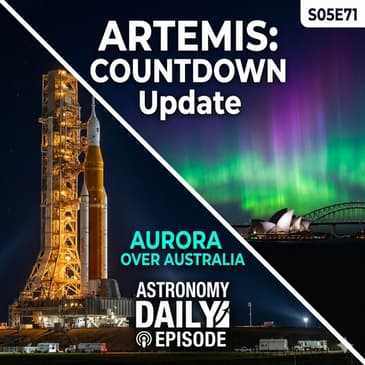
Good day stargazers, and welcome back to Astronomy Daily. I'm Anna and I'm Avery, and honestly, this might be our most packed episode of the season so far. Between a rocket still sitting on a pad in Norway waiting for its shot at history, a cargo ship that needed a human hand on the wheel, and an entirely different kind of sky show happening over Australian cities last night. Today really has it. All, plus fresh science off to James Webspace telescope that has astronomers questioning everything they thought they knew about lava worlds. We've got news about sealed moon rocks finally giving up their secrets after fifty years, and we'll walk you through one of the busiest weeks in global rocketry in recent memory. And with less than two weeks to go until the most historic human spaceflight in half a century, the countdown to Artemis two is well and truly on, though not everyone agrees it should be. There's a scientist out there saying NASA should hold off. We'll get to that without further ado. Then let's dive in. Let's start with a big one. As of today, NASA is officially targeting April first, and yes, we know how that sounds as the launch date for Artemis two. The six day window runs April first through to the six and just. To be clear for anyone just joining us on the show, Artemis two is the first time human beings will travel to the vicinity of the Moon since Apollo seventeen in December nineteen seventy two, over fifty years. This is genuinely historic. Or Astronauts aboard the Orion spacecraft launched on the Space Launch System or SLS from Kennedy's Space Center in Florida. The crew is Commander Reid Wiseman, pilot Victor Glover, Mission Specialist Christina Coach, and Canadian Space Agency astronaut Jeremy Hansen. Victor Glover will become the first person of color to travel beyond Earth orbit, Christina Coach will be the woman, and Jeremy Hansen will be the first non American citizen to leave low Earth orbit. This mission is full of first. The crew entered quarantine at Johnson's Space Center in Houston on March eighteenth, and they traveled down to Florida on March twenty seventh. From there, it's really just a matter of weather systems and that launch window. Now, the road to get here has had its bumps. There were liquid hydrogen leaks helium flow issue that caused a roll back to the vehicle assembly building. Just last month, engineers found a blocked seal in a cable connecting the rocket to the ground systems. That's fixed now. A successful wet dress rehearsal in late February cleared the way. And the mission itself, once it launches, will be a ten day free return trajectory around the Moon. They'll swing out to about five thousand miles beyond the looter surface, giving the crew and the world a view of the Moon that no human has had since Gene Cernan and Harrison Schmidt where they're in person now. Avery, you mentioned earlier that not everyone thinks this is the right moment to go. Yeah, this is a genuinely interesting wrinkle. A researcher at Mexico's National Autonomous University, Victor Velascorrera, has published a new analysis suggesting that we are currently in a window of elevated solar superflare risk. His models point to a high activity period running from mid twenty twenty five through to mid twenty twenty six focus on the Sun's southern hemisphere. He's recommending NASA delay the mission until the second half of this year at the earliest. And you can see why he'd be concerned. We've had a G three geomagnetic storm this week, which we're going to get to in a moment. The Sun is extremely active right now. Right though NASA has assessed the risks and all teams pulled go for launch. Lori Glaze from NASA's Exploration Systems Directorate said, and I'm paraphrasing that an incredible amount of work has gone into preparing for this, and they've had very open, transparent discussions about risk posture and mitigation. Oh, the mission is proceeding. But it does add a certain tension to an already extraordinary story, doesn't it. The Sun is at the peak of its eleven year cycle. We're heading back to the Moon, and a scientist is saying, are you sure you want to do this? Now? Humanity doing bold things anyway, fuels on brand. Honestly, we'll have everything you need to watch the launched live in our show notes fingers crossed for April to first. Okay, so, speaking of the Sun, let's talk about what it's been doing to our skies this week, because it has been spectacular. A series of coronal mass ejections or CMEs that left the Sun on March sixteenth and eighteenth, arrived at Earth around the equinox, and they drove geomagnetic storming to G three levels on the NOA scale that's classified as strong and. The result we're auror visible from an extraordinary range of latitudes. We're talking reports of vivid displays from New York, London, northern France, even parts of Scotland lit up. And when you see aurora reports from Scotland, you're already dealing with something significant. But the story closest to home for many of our listeners, the Aurora Australis was visible across major Australian cities last night. The Australian Bureau of Meteorology issued a severe geomagnetic storm warning and the southern lights were reported from Melbourne, Sydney, Brisbane and Adelaide. That is remarkable. Sydney is not what you'd call a typical aurora viewing destination. If you were outside last night and happened to look south, especially from somewhere with a clear horizon, you may well have caught it. As of today, March twenty fourth, conditions are easing. We're dropping back to KP three to four unsettled to active with a slight chance of isolated Ga one minor storm intervals. So there may still be some activity tonight, but the peak has passed. Now, why is March such a good month for auroras? This is something a lot of people don't know. It's called the equinox effect. Around the March and September equinoxes, the geometry of Earth's magnetic field relative to the solar wind becomes particularly favorable. The field lines are better aligned to allow charged particles, in which means you can get strong auroral activity even from moderate solar events. Combined with the current solar maximum the peak of solar cycle twenty five, and we're living through what could genuinely be the best aurora viewing period until the mid twenty thirties. So if you've been meaning to chase the lights, the message from scientists is this is your window. The sun will start winding down from here, and the next solar maximum is over a decade away. We'll have aurora forecast links in the show notes so you can track what tonight looks like from your location. I'm sure our producer, who lives in Sydney will be out and looking up. Now let's head into deep space and into one of the most genuinely surprising pieces of planetary science we've seen in a while. James Webb has done it again. I love a story where the headline is basically, scientists found something they were almost certain couldn't be there. So the planet in question is called TOI five six' ONE. B it's a super, earth about twice the mass of our, planet orbiting a star around two hundred and eighty light years. Away and when we say close to its, star we mean, absurdly almost comically. Close it completes a full orbit in just ten point five six hours a year on this, world is shorter than the average working. Day it orbits at one fortieth the distance that mercury sits from our. Sun the day side is in, permanent unrelenting. Sunlight the planet is likely tidally, locked same, face always towards the, star same, face always in. Darkness the surface is thought to be a global ocean of molten. Rock and under those, conditions extreme, radiation extreme, heat extreme proximity to the. Star the scientific consensus was that any atmosphere this planet might have once had would have been stripped away long. Ago it should be a, bare airless. Rock except it. Isn't A Carnegie institution's led team Used webb's near infrared spectroscope NEAR speck to take the planet's temperature by measuring how much light the system emitted WHEN toi five six' one b passed behind. Its star if it were a, bare rock the day side should reach something close to four nine hundred degrees fahrenheit around twenty seven. Hundred, celsius instead. They measured around thirty two hundred degrees fahrenheit or eighteen, hundred celsius still, extraordinarily hot but significantly cooler, than expected and the only explanation that fits the data is that there's an atmosphere up there redistributing heat from the day side to the. Night side the, Lead Researcher johanna Tesca At carnegie science describe the planet As en this is a, direct quote really like a wet. Lava ball the idea is that there's a feedback loop. Happening ball little gases bubble up from the magma ocean into, the atmosphere while the magma ocean simultaneously pull some gases. Back in it's a. Strange equilibrium what makes this scientifically significant beyond the, wow factor is what it tells us about rocky. Planet evolution we've assumed for a long time, that, small hot close in worlds can't. Hold atmospheres poi five SIX' one b suggests the reality is more complicated and. Potentially more interesting the. Team is now analyzing the full data set to map ten temperature patterns all the way around the planet and try to narrow down what the atmosphere is, actually, made, of water, vapor carbon dioxide silicate clouds all. On the table one of JWST's core missions is finding atmospheres, around rocky worlds because as far, as we know an atmosphere is a. Prerequisite for life poi five six' one b is certainly not habitable, in any conventional sense but understanding how a world this extreme hold on to its air could tell us a great deal about rocky planets that. Are far more temperate. There's something genuinely poetic. About today's next story We're going back to. December nineteen seventy two the last time Humans, walked on the moon and discovering that some of what they brought home has been quietly waiting fifty years to. Tell Us Something Unexpected. The Apollo Next generations SAMPLE analysis program or angsa. Was set up. Specifically for This purpose when the apollo Astronauts, RETURNED from the moon nasa deliberately sealed some of the samples, and set them aside knowing that future scientists with better tools would be able to extract more from them than the technology of the, nineteen seventies ever could and that. Moment has now arrived for a double drive tube pushed into the Lunar Surface at the Taurus Littau region By Gene cernan And harrison, schmid during apollo seventeen A Team led By James doddon at brown university used a technique called secondary ion mass spectrometry, to measure sulfur isotopes and what they found was. Not what anyone, Expected. So for Context earth and the moon have remarkably, similar oxygen isotope signatures scientists have long assumed that sulfur would follow the Same pattern that the moon's interior would Look. Chemically similar to, Earth's in this regard dotton's team expected. To, confirm that assumption. Instead the volcanic material in the sample is strongly depleted, in sulfur thirty three one of. Four stable sulfur, isotopes The values are, in dotton's own words very different from Anything. We find, on earth he said he. Simply wasn't expecting that so? What does it mean there, are two leading explanations. And neither is boring the first is that this is evidence, of very ancient chemistry sulfur that interacted with ultraviolet light in an early thin lunar atmosphere. Billions of years ago the implication there would be that material somehow cycled from the lunar, surface into the mantle a kind of proto plate tectonics on a world we don't think has. Ever had plate tectonics. The second explanation. Reaches even further back the Leading theory of the moon's origin IS The giant impact a MARS sized body called thea Collided, with the early earth and the debris Eventually. Coalesced INTO the moon if thea had a very Different, sulfur composition from earth that signature might still be locked inside. THE lunar mantle today a fingerprint from a collision that happened four and a. Half billion years ago. The data doesn't currently favor one. Explanation over the other dotton is hoping that Comparisons with samples from mars and other planetary bodies. Will help resolve it but the. Broader message is clear these samples are still yielding genuine surprises decades, after they were collected and There are more sealed apollo containers. Still to be opened. There is something remarkable about the fact that astronauts who have been gone for over, fifty years are still in a very real sense contributing to Our Understanding. Of the, solar system. All right let's steal a lap, of the launch pads because this week is genuinely exceptional. For space Activity worldwide nasaspaceflight dot com, published their, weekly preview and honestly it reads like the greatest hits of. The current space age let's start. WITH what's already happened SpaceX kicked off The week with the Falcon nine Launch from Vandenberg, in california today Tuesday carrying twenty Five starling satellites to sun SYNCHRONOUS orbit boots saster b ten eighty one flying for the twenty third time, routine at this point but still remarkable when you. Say It out loud. Tomorrow wednesday is arguably the biggest single. Day In The schedule esar aerospace's spectrum rocket has its WINDOW at Eight pm Utc. From andoya in norway we'll talk about that more. In the update segment AND At Nine Fourteen amutc rocket Labs Electron Launches From new zealand's MAHIA Peninsula carrying. Two esa celeste satellites those are the first of ten planned navigation demonstration satellites that will test Positioning technology. In Low, Earth orbit. Also wednesday China launches A chang Zhang Two c, from taiwan hayload classified which will be that. Rocket's, eighty SEVENTH mission OVERALL the cz two c has been flying, since nineteen eighty two which puts it in. Some pretty distinguished Company. Thursday brings Another Falcon, nine from cape Canaveral carrying, twenty nine starling satellites and this one has A record attached booster b ten sixty seven will be making, its thirty fourth flight setting A new record for. Falcon nine booster reuse this Rocket first flew in june twenty twenty one on a cargo Resupply Mission To. The international space station it's now flying for. THE thirty fourth time facex has fundamentally. Changed what reusability. Means friday is enormous china's Commercial launch company Cast space flies its kinnecticut one Solid rocket from ju one, with an Undisclosed payload and ross cosmos launches the first Ever flight of the soyuse five rocket From. Baikanor also called Irtish this rocket is russia's long Awaited replacement. For the zenit family it carries a mass simulator, on this debut flight launching from a pad that hasn't seen an orbital, launch since twenty Seventeen big moment for. Russian launch vehicle development. And the Week closes out on sunday WITH two more ULA's atlasv Five Launching twenty nine Amazon Leo satellites from cape canaveral in its powerful five. Point fifty one configuration that's five solid rocket boosters for what will be that rocket's one hundred. And seventh overall mission and SpaceX Wraps things, up with transporter sixteen A rideshare mission from vandenberg carrying dozens of small Satellites that Will be SpaceX's fortieth falcon nine launch of, twenty twenty six alone and the seventy third orbital launch. Attempt worldwide this, year. So five, Countries six, Different Rockets FALCON nine, electron Spectrum cz, two C connetico, One SOY use five atlas V, Five, Launching From, California, florida new zealand Norway two Sites in china and. Kazakhstan in one. Week the age of. Routine spaceflight is here it's. Just also occasionally, extraordinary. Before we wrap a quick follow up on two stories we covered yesterday because both. Have had developments today LET'S. Start with the Iss you'll remember That RUSSIA launched the progress ms thirty three Cargo ship also called Progress ninety four On Sunday, from the baikanor cosmodrome carrying about two and a half tons of supplies for the seven person, expedition, seventy, four, crew, food fuel water. Oxygen the good stuff but. There was a. Complication shortly after launch one Of the spacecraft's two kurs automated docking. Antennas failed to deploy the curve system is the. Normal hands off approach the ship guides itself in with only one intena working, full automation wasn't AVAILABLE. So This morning Iss commander sergei kud sverrshkov took OVER manually using the touru system that's the, telerobotically operated rendezvous system a Control panel inside. The zvezda's service module the spacecraft flew itself to within two hundred meters of the Station and from the. Kudsvrchkov guided it in docking was scheduled For nine. Thirty Four eastern. Time ross cosmos were quick to point out that manual approaches are. Routinely practiced during cosmonautraining, this was a, contingency not a crisis and there's a second layer to. This story worth noting this was The first launch from Site thirty one at baikenor since that pad Was DAMAGED during the soyuse ms Twenty eight launch last november when part of. The launch infrastructure Collapsed that pad is russia's only one capable of sending crude missions and CARGO. Ships to the iss its return to. Service is genuinely significant. We'll keep watching, and with any luck progress ninety four is Safely berthed. At the poist module as you listen to this. And, on the other story. We promised to follow. It's our aerospace's spectrum rocket is, still on The pad whether at andoya Pushed the attempt from. Sunday then from yesterday The current, window is wednesday night eight PM. To nine pm utc we'll have. Update in tomorrow's, episode. If it succeeds it will be the first, time a rocket designed built And launched from continental european. Soil has reached orbit that is a headline we very much want to. Be able to Read fingers crossed for Esar and the. Whole, European space industry. Again we'll update any new. Developments and tomorrow. Show That is Your, Astronomy daily for. Tuesday march twenty fourth we've got a lot of threads in, The air right now artemis two, approaching, its launch window spectrum, waiting for the weather a sun that doesn't. Want to sit still so it's a great time to make sure you're subscribed wherever. You get your, podcast. All the sources links and reading for today's stories are. In the show notes and if today's episode, sparks something For you, whether it's aurora chasing Or thinking, about those apollo samples or just looking. Up at the moon tonight and Doing the. Maths on april first we'd love. To hear from You find. Us on twitter And instagram, at astro daily, pod and, on TikTok Talk x YouTube and tumblr. At the same Handle The website is astronomy daily dot io and we're proud to be part of the bites. Dot Com, Podcast Network. For anna i'm avery keep looking up and. We'll See you tomorrow sunday stars Start