
Become a supporter of this podcast: https://www.spreaker.com/podcast/astronomy-daily-latest-space-news--5648921/support.
Sponsor Details:
Ensure your online privacy by using NordVPN. To get our special listener deal and save a lot of money, visit www.astronomydaily.io/nordvpn. You'll be glad you did!
Get the best secure and private email on the planet. Stop your Government, google and who knows who else spying on every email you write. Do what we did and use ProtonMail. They beleive in privacy and there are no ads in their business model...yet they still provide a free forever service. Check them out and get out special deal at www.astronomydaily.io/protonmail
Become a supporter of Astronomy Daily by joining our Supporters Club. Commercial free episodes daily are only a click way... Click Here
This episode includes AI-generated content.
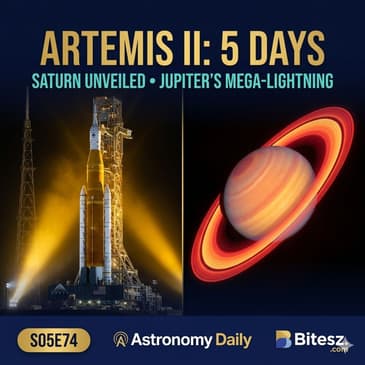
Hello, and welcome to Astronomy Daily. I'm Anna and I'm Avery. It is Friday, March twenty seventh, twenty twenty six, and our producer has given us an absolutely stacked show. Today. We are literally five days from a crew of four astronauts launching around the Moon for the first time in over fifty years, and today those four people touched down in Florida. We've also got the most detailed look at Saturn ever, captured lightning on Jupiter that makes Earth storms look like a birthday sparkler, and a fifty year stellar mystery finally cracked open by a Japanese space telescope. Plus, we're narrowing down the shortlist of exoplanets most likely to harbor alien life. And we have a juicy update on that dramatic rocket scrub from yesterday. Boiler, it was a boat. It was absolutely a boat. Let's get into it. Let's go then, all right, story one and Avery, this one is really happening today as we record the art Miss two crew is flying into Kennedy's Space Center. Commander Reid Wiseman, pilot Victor Glover, mission specialist Christina coach All from NASA and Canadian Space Agency astronaut Jeremy Hansen, four people, one rocket, and they are now officially on site. NASA Administrator Jarrett Isaacman and Canadian Space Agency President Lisa Campbell were there to greet them on the tarmac this afternoon. The crew also answered questions from the media. Now, just to set the scene, the SLS rocket and the Orion capsule are already sitting on launch Pad thirty nine B at Kennedy Space Center. They rolled out on March twentieth. Everything is in place. The target launch window opens Wednesday, April first, at six twenty four pm Eastern Time. And April first is not a joke. This is genuinely happening, a two hour window on the first, and if they need it, opportunities continue through April sixth. The crew has been in quarantine since March eighteenth, keeping their head health locked down. Before this ten day mission. They spent the quarantine reviewing procedures at Johnson Space Center in Houston, Texas, and now the rest of the countdown happens here in Florida. This mission is going to take them farther than Earth than any human has been since Apollo thirteen in nineteen seventy, about five thousand miles beyond the Moon. It won't land, but it will swing around the back of the Moon on a free return trajectory and come screaming back to Earth at around twenty five thousand miles per hour. Victor Glover will become the first person of color, Christina Coach the first woman, and Jeremy Hanson the first non American to travel beyond Low Earth orbit. And for Canadians listening, Jeremy Hanson arrives in Florida today for what is going to be the ride of his life. We are going to be covering this story right through launch. Stick with US Astronomy Daily is your front row seat to the most exciting human spacelight moment in a generation. Dory two, and this one is visually stunning. NASA has released a new set of Saturn images and they are genuinely the most comprehensive view of Saturn ever created. This is a collaboration between two of humanity's greatest telescopes, the James Web Space Telescope and Hubble Space Telescope. Now, these two observatories were launched thirty one years apart. Hubble went up in nineteen ninety web in late twenty twenty one. But when you combine their observations you get something extraordinary. Hubble observes Saturn invisible light in August twenty twenty four, capturing all those familiar golden cloud bands and the iconic rings. You get the colors, the subtle atmospheric variations, the sheer beauty of the thing. Then Webb looked at it in infrared in November twenty twenty four, just fourteen weeks later, and the picture completely transforms. The rings glow brilliantly because they're made of highly reflective water ice. You can see deep atmospheric storms, jet streams, and a mysterious gray green glow at the poles that scientists think may be linked to auroral activity or hide altitude aerosols. One of the most poignant details in this release, Saturn's famous hexagonal jet stream at the north pole is just barely visible in these images, and sciences say this could be among the last clear views of it for decades, because the pole is heading into a long winter darkness that won't lift until the twenty forties. NASA describes what the two telescopes together can do as slicing through Saturn's atmosphere at multiple altitudes. Like peeling back the layers of an onion, Hubble covers the upper clouds web dives deeper into the chemistry. Together, they give researchers a three dimensional picture of how this whole system works. And Webb's wide angle view captured six of Saturn's moons in the same frame, including Titan, which is massive and hazy, and Enceladus, that little world with a subservice ocean that astrobiologists find so tantalizing. We will link to these images in the show notes. They are genuinely worth five minutes of your time just to look at them. Saturn is out there looking absolutely magnificent. Story three and I want everyone to picture the most dramatic lightning storm you have ever seen on Earth, A real cracker thunder rattling the windows. Now imagine that but a million times more powerful. That is potentially what is happening in Jupiter's atmosphere, according to new research from the University of California, Berkeley published this week in the journal AGU Advances. The study used data from NASA's Juno spacecraft, which has been orbiting Jupiter since twenty sixteen. Specifically, it's microwave radiometer. That instrument was designed for studying the planet's atmosphere, but it turns out it's also brilliant at detecting the radio signatures of lightning. The clever bit was that the team focused on a period in twenty twenty one and twenty twenty two when a normally storm filled belt on Jupiter went unusually quiet. That meant JUNO could pinpoint individual isolated storm systems, what the researchers call stealth superstorms, and directly measure the power of lightning within them. The results are remarkable. From six hundred and thirteen detected lightning pulses, the power rains from roughly comparable to an Earth lightning bolt all the way up to one hundred times more powerful. But because of uncertainties and how radio frequencies compare across the two planets, some of those bolts could be up to a million times stronger than anything on Earth. And these storms were generating around three lightning flashes per second. On one flyover, JUNO detected two hundred and six separate microwave pulses in a single pass. Lead researcher Michael Wong described it really well On Earth, moist air rises because water makes it more buoyant in a nitrogen atmosphere. On Jupiter, the atmosphere is mostly hydrogen, so moist air is actually heavier and sinks. It takes enormous energy to push it upward, and when those storms finally break loose, they release all of that stored energy in extraordinary ways. What I love about this is that the Juno mission has been delivering incredible science for a decade now, and even as the spacecraft ages, it's still finding ways to rewrite our understanding of the Solar System's biggest planet. Okay, onto our next story today. Story four, and this is one of those stories where astronomers get to say we finally did it after fifty years. The star in question is Gamma Cassiopeia. If you look up at the distinctive W shape of the constellation Cassiopeia on a clear night, the middle star of that W that's it visible to the naked eye about five hundred and fifty light years away, and since nineteen seventy six it has been blasting out X rays around forty times more powerful than you'd ever expect from a star like that. The plasma generating those X rays was hotter than one hundred million degrees, and for decades nobody could agree. Why was it magnetic activity on the star itself? Was there a hidden companion pulling in material? The debate has raged it across multiple research groups for half a century. Now, thanks to Japan's XRIISM space telescope that stands for X Ray Imaging and Spectroscopy Mission, developed by JAXA in collaboration with NASA and ESA, the answer is finally in the culprit is a hidden white dwarf companion. The key instrument is called Resolve, a high precision microclorimeter on XRIISM that can measure X ray spectra with extraordinary accuracy. The team observed Gamma Capia three times in December twenty twenty four, February twenty twenty five, and June twenty twenty five, covering the full two hundred and three day orbit of the binary system. What they found was that the superheated plasma generating the X rays was moving in sync with the hidden companion, not with the bright b star. Everyone could see. That's the clincher, first direct proof that it's the white dwarf not the star. Itself driving all that high energy activity. And it turns out this white dwarf is magnetic. Its field is funneling material from the star's surrounding disc toward its pulls, where it releases all that energy as X rays like a tiny but ferocious cosmic vacuum cleaner. The implications go well beyond this one star. Astronomers have long predicted that about fifty to seventy percent of B type binary stars might have white dwarf companions, but solid evidence has been hard to pin down. This result confirms a whole new clas of binary systems that had previously only existed in theory. Lead researcher Yayel Naz at the University of Liege put it beautifully. There has been an intense effort to solve the mystery of gamma cassiopeia across many research groups for many decades, and now, thanks to XRIIM, we have finally done it. A very good Friday for Stellar Astrophysics. Story five, and this one comes with a movie tie in which I am absolutely here for. If you haven't seen Project Hail Mary yet, the Ryan Gosling film based on Andy Weir's novel. It's currently in cinemas, and it is excellent. The premise is that humanity discovers a tiny micro organism called astrophage is consuming the Sun's energy, and one scientist is sent on a desperate solo mission to find the answer at a distant star. And this week, real astronomers at Cornell University's Carl Sagan Institute have published the paper that asks essentially the same question the movie poses. If we were building a real Hail Mary spacecraft, where would we send it? Lead researcher Professor Lisa Koltngeger, alongside a team of undergraduate students, comb through data from the European Space Agency's Gaya mission and the NASA Exoplanet Archive. There are over six thousand known exoplanets. From that enormous list, they've narrowed it down to forty five rocky worlds sitting in their star's habitable zones where liquid water could potentially exist on the surface. The list includes some names that will be familiar to our regular listeners. Trappist one DEFNG about forty light years away, Proxima Centauri b our nearest stellar neighbor at just four point twenty five light years LHS one one four zero B, a dense super earth about forty eight light years out, and quite a few lesser known candidates that could prove just as interesting. What's powerful about this paper is that it's not just a list, it's a strategic roadmap. It tells you which worlds are best suited for transmission spectroscopy with JWST, which worlds are targets for future direct imaging missions, and which have the tightest constraints on habitability. There's also a more conservative list of just twenty four world within a tighter three dimensional habitable zone, and if you account for the uncertainties in stellar measurements, the forty five could expand to as many as seventy three. Haltenngeger summed it up perfectly. Our paper reveals where you should travel to to find life if we ever build a hail Mary spacecraft. The search for alien life just got a short list. I find that genuinely thrilling. Finally, today, the boat story we tease at the beginning of the show. Story six, and yesterday we told you about that extraordinary scrub at t minus three seconds for Esar Aerospace's Spectrum rocket, the most dramatic last second halt you could imagine right on the edge of potentially making European space history. And we didn't know why the countdown got all the way to three seconds before engine ignition. Then nothing. Controllers called the scrub. We knew there was a hold in the countdown, but the exact cause wasn't confirmed when we recorded yesterday. Well, now we know it was a boat. An unauthorized vessel entered the danger zone around and Doya Spaceport in northern Norway during the countdown. The range had already been delayed when the boat first appeared, and by the time the boat cleared and the range was reopened, the propellant temperatures on board the rocket had shifted, the window was gone. To add insult to injury, the countdown had actually cleared t minus three seconds the engines were moments from igniting. ESAR Aerospace would have potentially become the first company ever to launch a rocket to orbit from European soil and a boat said no. No new launch date has been announced as of now. ESAR has said they're working to determine a suitable window and they'll need to assess the propellant situation and any technical reviews before they can reset for another attempt. Now we should note this kind of range safety protocol exists for a reason. Keeping people out of danger zones during rocket launches is genuinely critical. No one is blaming range control here, but the timing could not have been more painful. We'll keep tracking this one. Esar's Spectrum rocket is a genuinely significant vehicle twenty eight meters tall, capable of carrying up to a ton of payload to low Earth orbit, designed and built almost entirely in house near Munich. When it does reach orbit, it will be a historic moment for European space capability. The mission is called onward and Upward, and that is exactly what ESAR will have to be. We're rooting for them. And that is your Astronomy Daily for Friday, March twenty seventh. What a week it has been, and honestly, with Artemis two five days from launch, next week is going to be even bigger. We will be covering every step of the countdown right through to lift off and beyond. Make sure you're subscribed so you don't miss a single episode. You can find us on all the usual platforms at Astronomy Daily, dot io and across social media at astro Daily Pod on x, Instagram, TikTok, YouTube, Facebook, Rumble, and Tumblr. And if today's episode sparked something for you, a question, thought, a theory about whether that rogue boat was actually a disgruntled rocket enthusiast, drop us a message we love hearing from you. From all of us here at Astronomy Daily, keep looking up. The universe is not done surprising us. See you tomorrow Sunday Star Star