
Become a supporter of this podcast: https://www.spreaker.com/podcast/astronomy-daily-latest-space-news--5648921/support.
Sponsor Details:
Ensure your online privacy by using NordVPN. To get our special listener deal and save a lot of money, visit www.astronomydaily.io/nordvpn. You'll be glad you did!
Get the best secure and private email on the planet. Stop your Government, google and who knows who else spying on every email you write. Do what we did and use ProtonMail. They beleive in privacy and there are no ads in their business model...yet they still provide a free forever service. Check them out and get out special deal at www.astronomydaily.io/protonmail
Become a supporter of Astronomy Daily by joining our Supporters Club. Commercial free episodes daily are only a click way... Click Here
This episode includes AI-generated content.
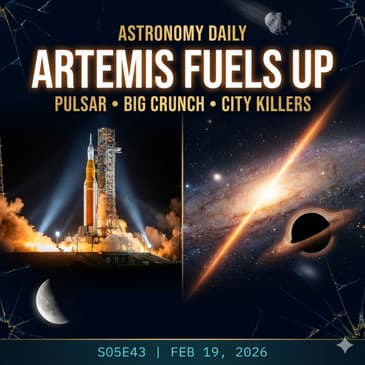
Welcome to Astronomy Daily. I'm Anna and I'm Avery. It is Thursday, the nineteenth of February twenty twenty six, and we are recording this episode while NASA is literally fueling a rocket at this very moment, and we cannot wait to tell you about it. That's right. This is one of those days where space news isn't just something that happened somewhere out there in the universe. It is happening right now on a launchpad in Florida. But that's not all today. We're also asking what lurks in the darkness between us and our nearest cosmic neighbors. Could there be a cosmic clock ticking next to the most extreme object in our galaxy? And brace yourselves? Is the universe actually going to end? Plus, we have a story that will make you want to check the sky tonight, a warning from NASA that is genuinely a little unsettling, and we're going to space with a music video. All of that is coming up on Astronomy Daily. Let's start with the big one, and I mean big in every sense of the word. As we speak, NASA's Space Launch System, the most powerful rocket ever built, is being loaded with more than seven hundred thousand gallons of cryogenic propellant at Launch Complex thirty nine B at Kennedy's Space Center in Florida. This is the second wet dress rehearsal for Artemis two, the mission that will carry four astronauts on a loop around the Moon, the first time humans have ventured to lunar distance since Apollo seventeen back in nineteen seventy two. The crew are Commander Reidwiseman, pilot Victor Glover, mission specialist Christina Cokes from NASA, and Jeremy Hansen from the Canadian Space Agency. Now. The reason they're doing this rehearsal and the reason there have been so many eyes on it today, is that the first attempt, back on the second and third of February, did not go as planned. Engineers detected a liquid hydrogen leak during fueling, which forced them to halt the test before they could complete the full countdown sequence. In the week, sense technicians have replaced seals around two fueling lines, swapped out a filter in the ground support equipment, and added an extra hour of buffer time into the countdown to allow more room for troubleshooting. It's the kind of painstaking, unglamorous engineering work that rarely makes headlines, but it's exactly what keeps astronauts alive. Today's rehearsal targets a simulated launch window opening at eight thirty this evening Eastern Time. The test is expected to run until around twelve thirty Friday morning, and the stakes are high. NASA has said it won't set a formal launch date until after a successful wet dress rehearsal campaign. March sixth remains the earliest possible crude launch date. NASA Administrator Jared Isaacman put it well when he said, we anticipated encountering challenges. That is precisely why we conduct a wet dress rehearsal. These tests are designed to surface issues before flight. This safety of the crew comes first. So tonight we watch and we wait. We will be keeping a close eye on this one, and we'll bring you the results intomorrow's episode. Fingers crossed for a clean test, no leaks, and a March launch that puts humans back in the vicinity of the Moon for the first time in over fifty years. All right from a rocket at Kennedy Space Center to the absolute heart of our galaxy, and this story is one of those discoveries that, if it's confirmed, could fundamentally change how we understand the universe. Researchers from Columbia University, working with the Breakthrough Listen initiative, which is best known for searching for signs of intelligent life beyond Earth, have announced the detection of a candidate millisecond pulsar very close to Sagittarius, a star that's the super massive black hole sitting at the center of the Milky Way, roughly four million times the mass of our own Sun. So let's unpack what a pulsar is, because it's one of the most extraordinary objects in the universe. When a massive star reaches the end of its life and explodes as a supernova, what's left behind is an incredibly dense core called a neutron star. Some of those neutron stars spin rapidly and emit beams of radio waves like a cosmic lighthouse sweeping through space. When those beams sweep past Earth, we detect them as regular pulses, hence pulsar. And what makes millisecond pulsar special is their extraordinary precision. They spin hundreds of times per second with almost perfect regularitydientists have called them the most accurate clocks in the universe, more stable than atomic clocks here on Earth. This candidate, nicknamed BLPSR, completes one full rotation every eight point one nine milliseconds. Now here's why finding one near Sagittarius a star is such a big deal. A pulsar next to a four million solar mass black hole would be operating in one of the most extreme gravitational environments imaginable, and Einstein's general theory of relativity makes very specific predictions about what happens to space and time in such extreme environments, predictions that have never been tested at this level of precision. And if a pulsar is orbiting close to Sagittarius astar, the black hole's gravity would warp space time so severely that those precise pulsar pulses would arrive at our telescopes with tiny but measurable distortions. As researcher Slovko Bogdanov from Columbia put it, any external influence on a pulsar would introduce anomalies in the steady arrival of pulses, which can be measured and modeled. In other words, a confirmed pulsar next to a super massive black hole would be a natural laboratory for testing Einstein's series in the most extreme conditions possible. It could also help us understand things like the massive Sagittarius astar, the geometry of space time near a supermassive black hole, and potentially even offer clues about dark matter. Now it's important to be clear this is still a candidate. The team published their findings in the Astrophysical Journal, and Breakthrough Listen has released all the observational data publicly, so researchers around the world can do independent analyses. Confirmation will require extensive follow up observations, but the scientific community is buzzing. This is the kind of discovery that reshapes entire research programs. If it holds up, keep watching the skies and the galactic center. This story is far from over. So we've talked about what's happening in Florida tonight and what might be happening at the center of our galaxy. Now let's zoom all the way out farther than you've probably ever thought about, and ask how does the universe end? For most of the past few decades, the scientific consensus has been pretty clear the universe expands forever. Dark energy, that mysterious force making up roughly sixty eight percent of the mass and energy in the cosmos, was thought to be a constant, relentlessly pushing everything apart. Eventually, galaxies would drift so far from each other that the night sky would go dark, stars would burn out, everything would fade into a cold, silent void. Scientists call this the Big Freeze or heat. Death, but new data is challenging that picture in a dramatic way. Physicist Henry Tie at Cornell University has published new calculations using data from two of the world's most powerful dark energy observatories, the Dark Energy Survey in Chile and the Dark Energy Spectroscopic Instrument in Arizona, and his conclusion is striking. The universe may be heading not for a frieze, but for a crunch. Here's how it works. Both surveys are finding evidence that dark energy isn't actually constant. It appears to be weakening over time. If that's true, then the force pushing the universe apart is gradually fading, and at some point gravity takes over. The expansion slows, stops, and then reverses Everything that has been flying apart for billions of years, begins falling back together. A TIES model introduces a hypothetical particle called an ultra light axion, combined with what's known as a negative cosmological constant to explain how dark energy could behave this way. The math suggests the universe is currently about thirteen point eight billion years old and approaching the halfway point of its total lifespan. It would continue expanding for roughly another eleven billion years, reach its maximum size, and then begin to contract, ultimately collapsing into a single point of unimaginable density. The Big crunch total elapsed time approximately thirty three billion years. Now before anyone starts updating their bucket lists, this is one model. It's not yet scientific senses. There's healthy debate about how to interpret the dark energy data, and upcoming messions from the European Space Agency's EUCLID Telescope, NASA SPHEREx project and the Veraice Reuben Observatory will provide much better measurements over the coming years. But the very fact that two independent observatories, one in the southern hemisphere one in the northern are converging on similar results about dark energy evolving. That's significant. As TI himself put it, for the last twenty years, people believed the universe would expand forever. The new data may be telling us something very different. The universe might be mortal after all. Quite the thought to sit with on a Thursday evening. And now, because apparently one existential revelation isn't enough for one episode, let's talk about City Killer asteroids. Those two words together are doing a lot of work. They really are so. At the American Association for the Advancement of Science conference in Arizona this week, NASA's Planetary Defense Officer, and yes, that is a real job title, Doctor Kelly Fast, gave a presentation that's been making headlines ever since, and for good reason. Doctor Fast explained that when it comes to asteroids, there are essentially three categories of concern. At the small end, things are hitting Earth all the time, meteors burning up in the atmosphere, the occasional fireball, We're not particularly worried about those. At the large end, the extinction level rocks the movie asteroid kind. Scientists are actually fairly confident about where those are. We track them, we know their orbits. It's the middle ground that keeps doctor fast up at night. Asteroids in the range of one hundred and forty meters and larger, large enough to devastate an entire city or a wide region, but small enough to be difficult to detect with current telescopes. Her estimate there are around twenty five thousand of these objects in the vicinity of Earth's orbit. And how many have we found about forty percent, meaning there are potentially fifteen thousand city killing space rocks out there right now that we simply do not know about. To add some context to that and to the challenge of actually doing something about it if we did spot one. Doctor Nancy Shabbitt, the planetary scientist who led NASA's Dart mission, the spacecraft that successfully changed the orbit of an asteroid back in twenty twenty two, was also at the conference. She pointed out that Dart was a breakthrough demonstration, but there isn't another one sitting on a launch pad ready to go. She specifically referenced the asteroid why Are four, which caused some anxiety earlier this year, with a small but not zero probability of a lunar impact in twenty thirty two. She said, if something like Why R four had been headed towards the Earth, we would not have any way to go and deflect it actively. Right now, the hope on the horizon is the Near Earth Object survey or telescope, which is planned for launch next year. Unlike conventional optical telescopes, it uses thermal infrared signatures to detect darker asteroids that are essentially invisible to conventional instruments, potentially a game changer for the detection side of the problem. But doctor Schabbot's point stands. Detection is one thing, having an active, ready to deploy deflection capability is another, and that investment, she says, is simply not being made at the level that needs to be something worth thinking about. Given that planetary defense is probably the one area of space science that is quite literally about survival. Sobering stuff. Let's come back down to Earth for a moment, or rather, let's look up from it. Here's something wonderful and wonderfully timely, because this one is happening right now to night as you listen. To this, Mercury, the innermost planet of our Solar system and the one most people have never actually seen with their own eyes, is tonight reaching what astronomers call its greatest eastern elongation. That's the point in its orbit where it's at its maximum angular distance from the Sun as seen from Earth, meaning it appears as far from the Sun in our sky as it ever gets. And why does that matter for observers because Mercury is normally incredibly difficult to spot. It's always close to the Sun in the sky, so you're either trying to catch it just before sunrise or just after sunset, with very little time before it follows the Sun below the horizon. But at greatest elongation you get the best window. Tonight, look to the western horizon shortly after sunset. Mercury will be visible as a moderately bright point of light, shining steadily rather than twinkling like a star. You won't need any special equipment, though binoculars will give you a much nicer view. This is Mercury's first greatest elongation of twenty twenty six, and the best evening viewing opportunity will get for the year so far. There's also a bonus tonight, the crescent moon, Saturn, and Neptune are all gathering in the same part of the sky, with Saturn and Neptune very close together near the western horizon. Now, Neptune will need a telescope and you'll need to wait until the sun is fully set. Do not point any optical instrument toward the horizon until the sun has cleared it completely. But the overall scene is really quite beautiful this evening. And for those of you keeping track of the upcoming six planet parade on the twenty eighth of February, Mercury reaching greatest elongation tonight is actually a key milestone in that build up. By the twenty eighth, Mercury will have improved its position enough to join Venus, Saturn, Jupiter, Uranus, and Neptune, all visible in the same sky. We'll have a full guide to that event closer to the date, but tonight is your previous go look west. And now to close out the episode, we have something that we absolutely love, a reminder that even on a space station in orbit, humans will find a way to celebrate. The crew of China's shen Zoo twenty one mission, currently living and working aboard the Tionggong space station, have released a music video to mark the lunar New Year, the Year of the Horse, and honestly it is delightful. Filming a music video in microgravity is, as you might imagine, a unique creative challenge. Everything floats, hair floats, props float, but the crew apparently embraced all of it, and the result is one of those lovely, warm, deeply human moments that cuts right through all the geopolitical complexity of the space race and reminds you that the people up there are just people celebrating a holiday with their families watching from below. Tionggong, which means Heavenly Palace, currently has a crew of three aboard. Following the shen Zu twenty one mission, has been steadily expanding its space station program, and moments like this one shared with the world are a reminder of why humans go to space in the first place, not just for science or national prestige, but for the sheer joy of being up there. Don sifa chai to all of our listeners celebrating the lunar new Year. May the Year of the Horse bring you good fortune and hopefully fewer hydrogen leaks. And on that note, that's your Astronomy Daily for Thursday, February nineteenth, twenty twenty six. What a lineup today? A live rocket fueling test a cosmic clock near a black hole, the possible end of the universe, city killing asteroids, mercury in the evening sky, and a music video from Orbit. If you want to follow along with the Artemis two fueling test tonight, NASA has a live stream at NASA dot gov. We'll link everything in the show notes, and if you spot mercury tonight, tag us on social media at hame stro Daily Pod. We would love to see your photos. Subscribe, leave a review if you're enjoying the show, and we will be back tomorrow with the results of tonight's fueling test. Until then, keep looking up clear skies everyone, Sunny. Day star ist so starst