
Become a supporter of this podcast: https://www.spreaker.com/podcast/astronomy-daily-latest-space-news--5648921/support.
Sponsor Details:
Ensure your online privacy by using NordVPN. To get our special listener deal and save a lot of money, visit www.astronomydaily.io/nordvpn. You'll be glad you did!
Get the best secure and private email on the planet. Stop your Government, google and who knows who else spying on every email you write. Do what we did and use ProtonMail. They beleive in privacy and there are no ads in their business model...yet they still provide a free forever service. Check them out and get out special deal at www.astronomydaily.io/protonmail
Become a supporter of Astronomy Daily by joining our Supporters Club. Commercial free episodes daily are only a click way... Click Here
This episode includes AI-generated content.
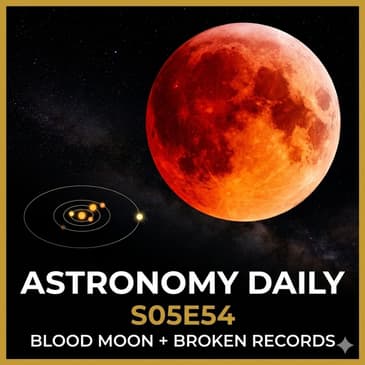
Last night, the moon turned red and bled across the sky for nearly an hour. A spacecraft is being prepped for the most daring crude mission in half a century. And somewhere out there, four stars are dancing together in a space so tight it would fit inside Mercury's orbit. And apparently no aliens are coming to visit physiccesso. Dot even a postcard. This is Astronomy Daily. I'm Anna and I'm Avery. Let's get into it. Welcome to Astronomy Daily, the podcast bringing you the universe's best stories, six days a week. It is Wednesday, March fourth, twenty twenty six, and we have a genuinely stellar episode for you today, pun absolutely intended. We have the aftermath of what many of you stayed up all night to see, the blood moon, total lunary clips. We have major Artemis two news, a star system that honestly shouldn't exist, the solution to one of cosmology's biggest headaches, the dawn of commercial space astronomy, and the physics based reality check on alien visitors. It's a lot. Let's not waste a second. Okay, First things first, Yesterday morning or the early hours of yesterday, depending on where you were. The moon turned blood red, and I need to know, Anna, did you watch it? I absolutely did. I dragged a blanket outside and watched the whole thing from my garden and the moment totality hit this deep, rusty orange glow, stars suddenly visible that had been washed out by moonlight. It was genuinely one of those I love being alive on a planet with the moon moments right. For those who missed it, here's what happened. The Moon passed completely through Earth's shadow. That's what makes it a total lunar eclipse, and the reason it turns red rather than just going dark is this beautiful piece of physics. Every sunrise and every sunset had happening on Earth at that moment, projects its orange and red light through our atmosphere and bends it onto the Moon's surface. So what you're seeing is the light of every dawn and dusk on the planet, all at once. Which is one of the most romantic explanations in all of astronomy. Honestly, Totality lasted just under an hour fifty nine minutes to be precise, and it was visible across a US, Canada, Mexico, and parts of South America in the morning hours and from Australia, New Zealand and Asia after sunset, so pretty much anyone who wanted to see it had a shot. The timing was great for observers in the Mountain and Pacific time zones. In North America they got totality in fully dark skies. Eastern time viewers had to contend with twilight creeping in, but honestly, still spectacular. And here's the bittersweet part. If you missed this one, you're going to be waiting a while. This was the last total lunaric clips visible from North America until New Year's Eve twenty twenty eight. So if you watched it, well done. You caught a rare treat. And if you didn't, mark your calendars now New Year's Eve twenty twenty eight, great excuse for a party. We'd love to hear from you. Did you get clear skies? Drop us a message at Astro Daily Pod. All right. Next up, huge news for human spaceflight. DASA has confirmed that repairs to the Artemis two rocket are complete and in April, launch is still very much on the table. This is the one we've all been waiting for. Artemis two would be the first crude mission to fly around the Moon in over fifty years. Not a landing, not yet, but a crude flight that will take four astronauts further from Earth than any humans have ever been. The crew is Commander Reid Wiseman, pilot Victor Glover, mission specialist Christina Koch, who would become the first woman to travel to the Moon, and Canadian Space Agency astronaut Jeremy Hansen. The issue that need fixing was a hydrogen leak that showed up during fueling tests. NASA took it seriously, worked through it methodically, and they're now satisfied its resolved. The vehicle is back in the Vehicle Assembly building at Kennedy Space Center and the teams are working towards an April target. No exact launch date has been confirmed yet. NASA is still working through its checklist, but the fact that repairs are complete and they're still talking April is genuinely encouraging. To put it in perspective, the last time humans flew to the Moon was Apollo seventeen in December nineteen seventy two. That's fifty three years and if Artemis two launches as planned, we'll be back in lunar space before the spring is out. We'll keep tracking this one closely as the launch date firms up. Exciting times. Okay, I need everyone to picture something. Take our entire Solar system from the Sun to Mercury. That tiny sliver of space roughly seventy seven million kilometers now cram three stars into it. Three stars. That's I mean, that's insane. Stars are enormous. They are, And yet astronomers have just confirmed a system called TIC one two zero three six two one three seven, where exactly that is happening. Three stars, all bigger and hotter than our Sun, packed into a volume smaller than Mercury's orbit around our star. And then, as if that weren't enough, there's a fourth star orbiting all three of them at a distance comparable to where Jupiter sits in our solar system. So it's a triple star system with a chaperone. That's genuinely the best way I've heard it described. The research was published in Nature Communications and led by astronomer to Maas Borkowitz at the University of Seged in Hungary. His team used data from NASA's test satellite, originally designed to hunt four exoplanets alongside ground based telescopes in Hungary, Arizona, the Czech Republic, and Slovakia. Seventy three spectra from the Fred Whipple Observatory in Arizona alone. How do you even spot something like this? It starts with dips in starlight. The stars eclipse each other as a orbit, causing tiny periodic drops in brightness. What initially looked like a simple pair of stars eclipsing every three point three days turned out on closer inspection to be hiding a third star. Two and then the fourth was teased out using a clever algorithm that isolated each star spectral fingerprints individually. This system is in the Constellations signess the Swan, and its technical classification is a three plus one type quadruple three inner stars in a tight mutual orbit with a fourth outer companion. The outer stars orbital period is just one thousand, forty six days, the shortest ever recorded for this type of system. And the team was also able to model the system's eventual fad over billions of years. The heavyweight stars will exhaust their fuel, swell into giants, and shed their outer layers. The whole thing will likely end up as a pair of white dwarfs orbiting each other, a slow, quiet fade into stellar retirement. From cosmic chaos to cosmic peace. I find that oddly comforting. It's a reminder that our own sun, lone solitary planetarily well behaved, might actually be the weird one. Most stars in the galaxy have at least one companion, some apparently have three. Right. This next one is for the cosmology nerds, but we're going to make it make sense for everyone because it is genuinely important. The Hubble tension. It sounds like a minor bureaucratic disagreement, but it's actually one of the biggest unsolved problems in modern physics. So here's the setup. We know the universe is expanding, the question is how fast, and when astronomers use two different methods to measure that expansion rate, called the Hubble constant, they get two different answers that stubbornly refuse to agree. One method uses the early universe the cosmic microwave background, the leftover light from shortly after the Big Bang. Other methods use nearby cosmic distance markers like cepheed variable stars and Type ONEA supernovae. Both methods are solid. Both have been refined for decades, and they still don't match. The gap between them is only about eight or nine percent numerically, but that's small. Discrepancy is a massive headache because it suggests either our measurements are wrong, or more excitingly, there's new physics we don't understand yet. And now scientists are proposing a third, completely independent method, gravitational waves. When two massive objects like black holes or neutron stars spiral together and merge, they send ripples through the fabric of space time itself. These gravitational waves carry precise information about the distance to the event and how fast the universe is expanding at that point. The beautiful thing is gravitational wave detectors like LIGO and virgo don't rely on the same assumptions as the other methods. So if gravitational wave measurements can pin down the hubble constant independently, we'll finally have a referee in this argument. We don't have enough events yet to be definitive. Gravitational wave astronomy is still young, but as detectors improve and we observe more mergers, this could be the key that unlocks one of cosmology's greatest mysteries. Physics still keeping us humble since always. A genuine milestone in the history of astronomy. This week, the MAV telescope, the world's first privately owned commercial space telescope, has captured its first observation and it's the first star. This is a big deal. MAV is operated by a London based startup called Blue Sky's Space, launched back in November aboard a SpaceX ride share mission. It's a small satellite, about the size of a suitcase, weighing under nineteen kilograms, but what it can do is genuinely unique. BOV is designed to observe stars in ultraviolet light wavelengths that are completely blocked by earth atmosphere, so you simply cannot study them from the ground. The last dedicated ultraviolet space observatory was the International Ultraviolet Explorer, which was retired back in nineteen ninety six, so there's been a three decade gap in this kind of science. And this science it's doing matters enormously for the search for life. Not every star is as well behaved as our Sun. Many stars, especially the cooler, more common red dwarfs, produce intense UV flares that could strip the atmospheres off nearby planets, making them uninhabitable regardless of their distance from the star. MOV will survey hundreds of stars to figure out which ones are genuinely friendly to life. The commercial model here is also interesting. Data access is provided through annual subscriptions to research teams, a sort of Netflix for UV astronomy data. It's a new way of funding space science, and if it works, Blue Sky Space plans a whole fleet of these. The first star observed was one of the brightest stars in the ursa major constellation. A calibration target to check the instrument is working correctly, and it is first light achieved. Science operations underway. The universe has its first commercial telescope. I for one, welcome our new private sector stargazers. And finally our lighter closer, although I'd argue there's nothing light about the physics involved. A new piece from the Brighter side of News has been making the rounds this week, and it takes a long hard look at why, despite the vastness of the universe and the billions of potentially habitable worlds out there, no alien civilization has ever shown up on our doorstep and The answer, it turns out, isn't conspiracy. It's physics. Five barriers, that's the argument, Five physical constraints that together make interstellar contact essentially impossible. Shall we run through them? Let's do it. Number one distance The nearest star to us, Proxima Centauri, is four point two four light years away. The Parker Solar Probe, the fastest human made object ever built, would take around sixty six hundred years to reach it, And that's our closest neighbor. The Milky Way is one hundred thousand light years across. Number two, the speed of light. This is not an engineering problem, it's a law of reality. Einstein's special relativity tells us that as you accelerate anything with mass toward the speed of light, it takes ever more energy, forever smaller gains and speed. To actually reach light speed would take infinite energy, not a lot of energy, infinite. Number three propulsion. Even if you accept a much lower target, say one percent of light speed, you run straight into what's called the rocket equation. To accelerate, you need fuel, But fuel has mass, which means you need more fuel to push the fuel, which adds more mass. It grows exponentially the fuel required for even a modest interstellar trip would be staggering. Number four. Biology, The human body evolved on Earth under Earth's magnetic field, under Earth's gravity, Deep space is brutal. Cosmic radiation shreds DNA, microgravity degrades bones and cardiovascular systems, and we still haven't solved cryogenic preservation. Even robots aren't immune. Radiation degrades electronics and over the time skills involved entropy wins. And number five and this is my favorite one. Timing our civilization has been broadcasting radio signals for about one hundred years. That creates a bubble roughly one hundred light years across. The Milky Way is a thousand times wider than that The universe is thirteen point eight billion years old. Civilizations might rise, transmit, and fall all before their signals even reach anyone capable of receiving them. The physicist Richard Feynman apparently compared it to fireflies blinking on different nights in a dark forest. They never overlap. And what about UFOs. The piece applies physics to claims of craft performing impossible maneuvers, instant acceleration to extreme speeds, sharp turns with no sonic signature. The forces involved would be tens of thousands of times Earth's gravity. Occupants would be pulped, materials would fail. The physics doesn't work. Now Is this depressing? I actually don't think so. The piece ends on something beautiful. The same laws of physics that prevent easy interstellar travel also make the universe stable, ordered, and ultimately life friendly. Light speed preserves causality. Without it, cause and effect would unravel. Stable atoms permit chemt stars forge the elements that build planets and people. We might be alone in our cosmic neighborhood, but we're made of the same star stuff as every galaxy in the observable universe. We're not separate from the cosmos. We're the universe looking at itself. I'll take that. That's Astronomy Daily for Wednesday, March the fourth, twenty twenty six. Blood Moons, Crude Moon Missions, Cosmic star Huddles, the Universe's expansion mystery, the dawn of private space telescopes, and why the Aliens Aren't coming. Honestly, one of my favorite episodes in a while. If you enjoyed it, please subscribe wherever you get your podcasts. Leave us a review, It genuinely helps us reach more space enthusiasts and find us on social media. At Astro Daily Pod. Few episodes every Weekday and Saturday. We'll see you Tomorrow. For more from the universe, Blear Skys Everyone. Sunday Stars The Stars. The Soul Store is control