
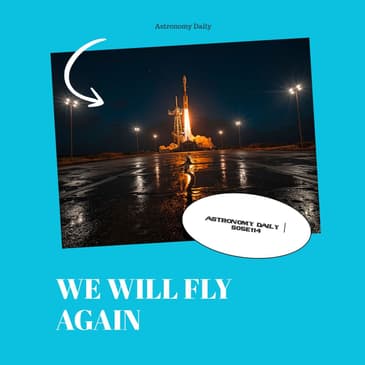
00:00:00 --> 00:00:02 Anna: Last week, a rocket exploded on its launch
00:00:02 --> 00:00:05 pad in Cape Canaveral. The fireball could be
00:00:05 --> 00:00:08 seen from miles. This week, the CEO
00:00:08 --> 00:00:10 of Blue Origin looked at the wreckage and
00:00:10 --> 00:00:13 said, five, we will fly again
00:00:13 --> 00:00:16 this year. That story, plus magnetic
00:00:16 --> 00:00:19 fields discovered on distant worlds. A, uh,
00:00:19 --> 00:00:21 space telescope moments from launch, and
00:00:21 --> 00:00:24 the definitive answer to one of astronomy's
00:00:24 --> 00:00:26 oldest questions. This is
00:00:26 --> 00:00:28 Astronomy Daily.
00:00:28 --> 00:00:31 Avery: Hello and welcome to Astronomy Daily, your
00:00:31 --> 00:00:33 daily guide to the universe and everything in
00:00:33 --> 00:00:34 it. I'm Avery.
00:00:34 --> 00:00:37 Anna: And I'm Anna. It is Wednesday the 4th of
00:00:37 --> 00:00:40 June, 2026, and we have an
00:00:40 --> 00:00:41 exceptional episode lined up.
00:00:41 --> 00:00:44 Avery: Today we do six stories
00:00:44 --> 00:00:46 ranging from a dramatic comeback story in the
00:00:46 --> 00:00:48 world of commercial spaceflight to a
00:00:48 --> 00:00:51 scientific first that reshapes what we know
00:00:51 --> 00:00:53 about planets beyond our solar system.
00:00:54 --> 00:00:55 If you've been listening this week, you'll
00:00:55 --> 00:00:58 know Blue Origin had a very bad Thursday.
00:00:58 --> 00:01:00 We'll have a full update on what comes next,
00:01:00 --> 00:01:01 but let's get into it.
00:01:02 --> 00:01:04 Anna: Last Thursday night at Cape Canaveral, Blue
00:01:04 --> 00:01:07 Origin's New Glenn rocket exploded on its
00:01:07 --> 00:01:10 launch pad during a routine pre launch hot
00:01:10 --> 00:01:13 fire test. The fireball engulfed Launch
00:01:13 --> 00:01:15 Complex 36. Debris was found up
00:01:15 --> 00:01:18 to half a mile away. It was the biggest and
00:01:18 --> 00:01:20 most public failure in the company's history,
00:01:21 --> 00:01:24 and many observers feared the road back could
00:01:24 --> 00:01:24 take years.
00:01:25 --> 00:01:28 Avery: But as of this week, Blue Origin CEO
00:01:28 --> 00:01:30 Dave Limp is pushing back hard on that
00:01:30 --> 00:01:33 narrative. He's saying the damage is far less
00:01:33 --> 00:01:34 catastrophic than it looked.
00:01:35 --> 00:01:38 Anna: Limp posted a, uh, detailed update on X in
00:01:38 --> 00:01:40 which he said that now that teams have gained
00:01:40 --> 00:01:43 full access to the pad, there's actually some
00:01:43 --> 00:01:44 good news. The propellant storage
00:01:44 --> 00:01:47 infrastructure, the oxygen tanks, the liquid
00:01:47 --> 00:01:50 hydrogen storage, and the cryogenic methane
00:01:50 --> 00:01:52 tanks all came through the blast in good
00:01:52 --> 00:01:55 shape. He called that extremely fortunate
00:01:55 --> 00:01:58 because those are very long lead items to
00:01:58 --> 00:01:58 replace.
00:01:59 --> 00:02:01 Avery: The water tower also survived. The main
00:02:01 --> 00:02:04 support gantry is damaged, but crucially,
00:02:04 --> 00:02:07 Limp says it can be repaired in place. It
00:02:07 --> 00:02:09 doesn't need to be torn down and rebuilt from
00:02:09 --> 00:02:09 scratch.
00:02:10 --> 00:02:12 Anna: Perhaps most importantly, there are spare
00:02:12 --> 00:02:15 assets. The previously flown New Glenn
00:02:15 --> 00:02:18 Booster, nicknamed Never Tell Me the Odds,
00:02:18 --> 00:02:20 along with three upper stages stored in a
00:02:20 --> 00:02:23 neighboring integration facility, all appear
00:02:23 --> 00:02:24 undamaged.
00:02:24 --> 00:02:26 Avery: As for the cause of the explosion, there's
00:02:26 --> 00:02:29 still no official word. The test was not
00:02:29 --> 00:02:31 within the scope of FAA license activities,
00:02:31 --> 00:02:33 so the FAA won't be leading the
00:02:33 --> 00:02:36 investigation. Blue Origin is conducting its
00:02:36 --> 00:02:37 own assessment.
00:02:37 --> 00:02:39 Anna: Limp also used the moment to announce a
00:02:39 --> 00:02:42 strategic pivot the company had already been
00:02:42 --> 00:02:44 working on, eliminating the need for a
00:02:44 --> 00:02:47 transporter erector, the massive structure
00:02:47 --> 00:02:50 used to move and stand the rocket upright. He
00:02:50 --> 00:02:53 said Blue Origin will now skip straight to an
00:02:53 --> 00:02:55 alternative vertical launch concept, which
00:02:55 --> 00:02:57 means they don't need to build a replacement
00:02:57 --> 00:02:59 for the one destroyed during the explosion.
00:03:00 --> 00:03:02 Avery: And he closed his statement with Blue
00:03:02 --> 00:03:04 Origin's motto, gradatum ferociter,
00:03:05 --> 00:03:06 which means step by step,
00:03:07 --> 00:03:10 ferociously, and the declaration we
00:03:10 --> 00:03:12 will fly again before the end of this year.
00:03:12 --> 00:03:15 Anna: That's an aggressive timeline by any measure,
00:03:15 --> 00:03:17 but it's the kind of defiant pledge
00:03:17 --> 00:03:20 investors, customers and the broader space
00:03:20 --> 00:03:23 industry needed to hear. Patrick Space Force
00:03:23 --> 00:03:25 Base has cleared Blue Origin to begin its
00:03:25 --> 00:03:28 full damage assessment of Launch Complex 36,
00:03:28 --> 00:03:31 though the formal rebuilding process is now
00:03:31 --> 00:03:31 underway.
00:03:32 --> 00:03:34 Avery: We will of course, keep tracking this story
00:03:34 --> 00:03:35 as it develops.
00:03:35 --> 00:03:38 Anna: Now let's move from the dramatic to the
00:03:38 --> 00:03:41 extraordinary. Scientists have just published
00:03:41 --> 00:03:43 what they're calling the first direct
00:03:43 --> 00:03:45 evidence that planets beyond our solar system
00:03:46 --> 00:03:48 possess magnetic fields. And they found it
00:03:48 --> 00:03:50 by studying the wind.
00:03:50 --> 00:03:53 Avery: This is a remarkable piece of science. A team
00:03:53 --> 00:03:55 of astronomers used two of the world's most
00:03:55 --> 00:03:58 powerful ground based telescopes, the ESO's
00:03:58 --> 00:04:01 Very Large Telescope in Chile and the Gemini
00:04:01 --> 00:04:03 North Telescope in Hawaii, to measure wind
00:04:03 --> 00:04:05 speeds on seven so called hot Jupiter
00:04:05 --> 00:04:06 exoplanets.
00:04:07 --> 00:04:10 Anna: Hot Jupiters are gas giants roughly the
00:04:10 --> 00:04:13 size of Jupiter but orbiting extremely
00:04:13 --> 00:04:15 close to their host stars, far closer than
00:04:15 --> 00:04:18 Mercury is to our sun because they're
00:04:18 --> 00:04:21 tidally locked, always showing the same face
00:04:21 --> 00:04:24 to their star. One side is perpetually
00:04:24 --> 00:04:26 scorching hot and the other is freezing
00:04:26 --> 00:04:29 cold. That temperature difference creates
00:04:29 --> 00:04:32 powerful winds that howl from the day side to
00:04:32 --> 00:04:33 the night side.
00:04:33 --> 00:04:36 Avery: The researchers measured those wind speeds
00:04:36 --> 00:04:38 and found something totally counterintuitive.
00:04:39 --> 00:04:41 On the hotter planets, the winds were
00:04:41 --> 00:04:43 actually slower, and that is the opposite of
00:04:43 --> 00:04:45 what standard physics would predict.
00:04:45 --> 00:04:48 Anna: If you have more thermal energy, you'd expect
00:04:48 --> 00:04:51 stronger winds. But these planets are pumping
00:04:51 --> 00:04:54 the brakes. And the best explanation, the one
00:04:54 --> 00:04:57 that actually fits the data, is magnetic
00:04:57 --> 00:04:57 fields.
00:04:58 --> 00:05:00 Avery: A magnetic field can interact with the
00:05:00 --> 00:05:02 electrically charged gas in a planet's upper
00:05:02 --> 00:05:05 atmosphere and slow those winds down. The
00:05:05 --> 00:05:07 stronger the magnetic field, the greater the
00:05:07 --> 00:05:10 braking effect. The team inferred magnetic
00:05:10 --> 00:05:13 field strengths ranging up to four times that
00:05:13 --> 00:05:16 of Saturn and up to about half the strength
00:05:16 --> 00:05:17 of Jupiter's field.
00:05:17 --> 00:05:19 Anna: The wind speeds themselves were
00:05:19 --> 00:05:22 extraordinary. They ranged from around
00:05:22 --> 00:05:25 7 km per hour up to more
00:05:25 --> 00:05:27 than 25 km per hour.
00:05:28 --> 00:05:30 For context, the fastest winds measured on
00:05:30 --> 00:05:33 Jupiter reach about 1
00:05:33 --> 00:05:36 kilometers per hour. These are winds on a
00:05:36 --> 00:05:38 scale we simply don't see in our own solar
00:05:38 --> 00:05:38 system.
00:05:39 --> 00:05:41 Avery: The results were published in the journal
00:05:41 --> 00:05:44 nature astronomy on June 2, and the
00:05:44 --> 00:05:46 implications go well beyond just knowing that
00:05:46 --> 00:05:49 Other planets have magnetic fields. Magnetic
00:05:49 --> 00:05:51 fields are thought to play a critical role in
00:05:51 --> 00:05:53 protecting planetary atmospheres from being
00:05:53 --> 00:05:56 stripped away by stellar radiation, which is
00:05:56 --> 00:05:58 one of the key factors in whether a planet
00:05:58 --> 00:06:01 could over billions of years, be potentially
00:06:01 --> 00:06:02 remain habitable.
00:06:03 --> 00:06:05 Anna: As the lead researcher put it, this is a key
00:06:05 --> 00:06:08 step toward ultimately understanding which
00:06:08 --> 00:06:11 planets can stay alive, keep their water,
00:06:11 --> 00:06:14 and perhaps even one day host life
00:06:14 --> 00:06:15 as we know it.
00:06:15 --> 00:06:17 Avery: A genuinely landmark result.
00:06:18 --> 00:06:21 Anna: Our next story takes us to NASA's Goddard
00:06:21 --> 00:06:23 Space Flight center in Greenbelt, Maryland,
00:06:23 --> 00:06:25 where engineers have completed what they
00:06:25 --> 00:06:28 describe as the last look humanity
00:06:28 --> 00:06:31 will ever take on a critical piece of
00:06:31 --> 00:06:33 hardware before it becomes the eyes of
00:06:33 --> 00:06:35 humanity on the universe.
00:06:35 --> 00:06:38 Avery: We're talking about the Nancy Grace Roman
00:06:38 --> 00:06:41 Space Telescope and specifically its primary
00:06:41 --> 00:06:43 mirror, a 2.4 meter
00:06:45 --> 00:06:47 reflector that will be the heart of the
00:06:47 --> 00:06:49 instrument once it launches into space.
00:06:49 --> 00:06:51 Anna: On May 20th and 21st,
00:06:52 --> 00:06:54 engineers performed a meticulous final
00:06:54 --> 00:06:57 inspection. They tilted the entire
00:06:57 --> 00:07:00 observatory onto its side, deployed the
00:07:00 --> 00:07:02 protective hood that will be stowed during
00:07:02 --> 00:07:05 launch, and used a high resolution camera
00:07:05 --> 00:07:08 with a powerful zoom lens to do a thorough
00:07:08 --> 00:07:10 multipurpose check, looking for any particles
00:07:10 --> 00:07:13 that may have settled on the mirror surface
00:07:13 --> 00:07:15 during testing and confirming that the
00:07:15 --> 00:07:16 optical alignment hadn't
00:07:16 --> 00:07:19 Avery: shifted it pass with flying colors.
00:07:20 --> 00:07:22 No specs, no misalignment. The
00:07:22 --> 00:07:24 mirror's silver coating, which is just
00:07:24 --> 00:07:27 400nm thick, hundreds
00:07:27 --> 00:07:29 of times thinner than a human hair, is
00:07:29 --> 00:07:30 perfect.
00:07:31 --> 00:07:34 Anna: The Roman telescope manager at Goddard, J.
00:07:34 --> 00:07:36 Scott Smith, marked the moment beautifully.
00:07:37 --> 00:07:39 He said the Roman engineering team laid
00:07:39 --> 00:07:42 eyes on the telescope for the final time
00:07:42 --> 00:07:45 before it in turn becomes the eyes of
00:07:45 --> 00:07:47 humanity, revealing the wonders of the
00:07:47 --> 00:07:50 cosmos. That's a sentence worth sitting with.
00:07:51 --> 00:07:53 Avery: With this milestone complete, Roman will now
00:07:53 --> 00:07:56 be shipped to Kennedy Space center in Florida
00:07:56 --> 00:07:57 in preparation for its planned launch,
00:07:58 --> 00:08:00 currently scheduled for as early as, ah,
00:08:00 --> 00:08:01 September 2026.
00:08:02 --> 00:08:04 Anna: Once in space, Roman will travel to the sun,
00:08:04 --> 00:08:07 earth, Lagrange point 2, known as
00:08:07 --> 00:08:10 L2, the same orbital neighborhood where the
00:08:10 --> 00:08:13 James Webb Space Telescope operates. It will
00:08:13 --> 00:08:15 join the most exclusive telescope real estate
00:08:15 --> 00:08:16 in the solar system.
00:08:17 --> 00:08:19 Avery: And Roman's scientific ambitions are
00:08:19 --> 00:08:22 extraordinary. It will have a field of view
00:08:22 --> 00:08:24 at least 100 times larger than the Hubble
00:08:24 --> 00:08:27 Space Telescope, potentially measuring light
00:08:27 --> 00:08:29 from a billion galaxies over its lifetime.
00:08:30 --> 00:08:32 It will also be capable of directly imaging
00:08:32 --> 00:08:35 exoplanets by blocking out starlight
00:08:35 --> 00:08:37 and conducting a comprehensive statistical
00:08:37 --> 00:08:40 census of planetary systems across our
00:08:40 --> 00:08:40 galaxy.
00:08:41 --> 00:08:43 Anna: We are getting very close to launch.
00:08:43 --> 00:08:45 September can't come soon enough.
00:08:45 --> 00:08:47 Avery: We'll be right back after this short break
00:08:47 --> 00:08:48 for a word from our sponsors.
00:08:48 --> 00:08:51 Anna: Stay with us and we're back three more
00:08:51 --> 00:08:54 stories to go and they are all fascinating.
00:08:54 --> 00:08:57 Avery: Space Force Has Made a Very large Investment
00:08:57 --> 00:09:00 in SpaceX On May 29, the US
00:09:00 --> 00:09:02 Space Force announced it had awarded Elon
00:09:02 --> 00:09:05 Musk's company a $4.16
00:09:05 --> 00:09:08 billion contract for a program called the
00:09:08 --> 00:09:10 Space Based Airborne Moving Target
00:09:10 --> 00:09:12 Indicator, or SBAMTI M.
00:09:13 --> 00:09:15 Anna: In plain language, the goal is to build a
00:09:15 --> 00:09:17 constellation of satellites that can track
00:09:17 --> 00:09:20 and target airborne threats from orbit,
00:09:20 --> 00:09:22 things like aircraft, cruise missiles and
00:09:22 --> 00:09:25 other fast moving threats anywhere on Earth
00:09:25 --> 00:09:26 at any time.
00:09:26 --> 00:09:28 Avery: The satellites are designed to fill a gap
00:09:28 --> 00:09:30 that currently exists in military
00:09:30 --> 00:09:32 surveillance. Traditionally, the US
00:09:32 --> 00:09:35 Military uses aircraft, particularly AWOKS
00:09:35 --> 00:09:38 planes, to track airborne targets. But
00:09:38 --> 00:09:40 satellites can reach areas where it's too
00:09:40 --> 00:09:42 dangerous to fly and they can maintain
00:09:42 --> 00:09:45 persistent coverage that aircraft simply
00:09:45 --> 00:09:45 can't match.
00:09:46 --> 00:09:47 Anna: The contract is part of the Trump
00:09:47 --> 00:09:50 administration's broader Golden Dome Missile
00:09:50 --> 00:09:52 Defense Initiative, which aims to build a
00:09:52 --> 00:09:54 layered national defense system including
00:09:54 --> 00:09:57 ground based interceptors, enhanced radar
00:09:57 --> 00:10:00 networks, and now this space based tracking
00:10:00 --> 00:10:00 layer.
00:10:00 --> 00:10:03 Avery: SpaceX isn't the only company involved. Space
00:10:03 --> 00:10:05 Force confirmed there are nine companies in
00:10:05 --> 00:10:08 the SBA MTI vendor pool, though the
00:10:08 --> 00:10:10 identities of the other eight have not been
00:10:10 --> 00:10:12 made public for national security reasons.
00:10:13 --> 00:10:15 More contracts are expected to be issued over
00:10:15 --> 00:10:16 the coming year.
00:10:16 --> 00:10:18 Anna: The goal is to have an initial operational
00:10:18 --> 00:10:21 constellation of these satellites in place by
00:10:21 --> 00:10:24 2028. This contract was also
00:10:24 --> 00:10:26 accompanied by a separate $2.29
00:10:26 --> 00:10:29 billion Space Force award to SpaceX
00:10:29 --> 00:10:32 earlier in the week for a Space Data Network
00:10:32 --> 00:10:35 backbone, a secure high speed military
00:10:35 --> 00:10:36 communication system.
00:10:36 --> 00:10:39 Avery: In total, SpaceX received over six and a half
00:10:39 --> 00:10:42 billion dollars in Space Force contracts in a
00:10:42 --> 00:10:44 single week. For a company that is also
00:10:44 --> 00:10:46 preparing for what could be the largest IPO
00:10:46 --> 00:10:49 in stock market history, it's been quite a
00:10:49 --> 00:10:50 week in Hawthorne, California.
00:10:51 --> 00:10:53 Anna: Now an update about a visitor that has
00:10:53 --> 00:10:55 already left, but whose influence is still
00:10:55 --> 00:10:58 being felt across the astronomy community.
00:10:58 --> 00:11:00 Avery: 3i ATLAS, the third
00:11:00 --> 00:11:03 interstellar object ever confirmed to pass
00:11:03 --> 00:11:06 through our solar system. Discovered on July
00:11:06 --> 00:11:09 1, 2025 by the Atlas Telescope Network in
00:11:09 --> 00:11:11 Chile, it is now heading back out into the
00:11:11 --> 00:11:13 deep Galaxy, never to return.
00:11:13 --> 00:11:16 Anna: But the scientific conversation it sparked is
00:11:16 --> 00:11:19 very much alive. A new analysis published
00:11:19 --> 00:11:21 this week explores the way that 3i
00:11:21 --> 00:11:24 atlas has prompted astronomers to
00:11:24 --> 00:11:26 fundamentally update what they understand
00:11:26 --> 00:11:29 not just about foreign solar systems, but
00:11:29 --> 00:11:29 about our own.
00:11:30 --> 00:11:32 Avery: Let's do a quick recap for listeners who may
00:11:32 --> 00:11:35 have joined us since the main 3i Atlas
00:11:35 --> 00:11:38 coverage last year. This was an extraordinary
00:11:38 --> 00:11:40 object. It was only the third interstellar
00:11:40 --> 00:11:43 visitor ever confirmed after 1i
00:11:43 --> 00:11:46 Oumuamua, um, in 2017 and
00:11:46 --> 00:11:48 2i Borisov in 2019.
00:11:49 --> 00:11:51 But unlike those, 2 3i Atlas
00:11:51 --> 00:11:54 was clearly an active comet, releasing dust
00:11:54 --> 00:11:57 and gas with multiple tails and a nucleus
00:11:57 --> 00:11:59 estimated at somewhere between a few hundred
00:11:59 --> 00:12:02 meters and several kilometers across.
00:12:02 --> 00:12:05 Anna: It passed closest to the sun in late October
00:12:05 --> 00:12:08 2025, then flew by Mars, then
00:12:08 --> 00:12:10 Jupiter, in March 2026, and is now
00:12:10 --> 00:12:13 departing. But even as it fades, the data it
00:12:13 --> 00:12:15 generated continues to be analyzed.
00:12:16 --> 00:12:18 Avery: One of the most striking findings came from a
00:12:18 --> 00:12:20 University of Michigan study that examined
00:12:20 --> 00:12:23 the water ice in 3i atlas
00:12:23 --> 00:12:26 and found it contained an extraordinarily
00:12:26 --> 00:12:28 high concentration of deuterium heavy
00:12:28 --> 00:12:31 isotope of hydrogen that is far less common
00:12:31 --> 00:12:33 in comets from our own solar system.
00:12:33 --> 00:12:36 Anna: That suggests three I ATLAS
00:12:36 --> 00:12:38 formed in an environment that was
00:12:38 --> 00:12:40 dramatically colder and more isolated than
00:12:40 --> 00:12:43 the conditions that shaped our solar system's
00:12:43 --> 00:12:46 comets. Researchers have since traced its
00:12:46 --> 00:12:49 likely origin to a cold, dark corner of the
00:12:49 --> 00:12:51 Milky Way that had not yet fully assembled
00:12:51 --> 00:12:54 into a planetary system when this object
00:12:54 --> 00:12:57 formed, potentially making it up to 11
00:12:57 --> 00:13:00 billion years old, more than twice the age of
00:13:00 --> 00:13:00 our Sun.
00:13:01 --> 00:13:03 Avery: What does all of this teach us? Quite a lot,
00:13:03 --> 00:13:05 as it turns out. It tells us that the
00:13:05 --> 00:13:07 chemical signatures of comets vary
00:13:07 --> 00:13:10 dramatically across the galaxy, meaning the
00:13:10 --> 00:13:12 building blocks of planetary systems,
00:13:12 --> 00:13:15 including the water and organics that may
00:13:15 --> 00:13:17 seed life differ significantly from one
00:13:17 --> 00:13:19 stellar neighborhood to another.
00:13:19 --> 00:13:22 Anna: It also demonstrates how much we can learn
00:13:22 --> 00:13:24 from fleeting cosmic visitors, and if we have
00:13:24 --> 00:13:27 the tools to observe them quickly. The
00:13:27 --> 00:13:30 Veracruz Rubin Observatory in Chile, which
00:13:30 --> 00:13:32 released its first images in June, is
00:13:32 --> 00:13:35 expected to dramatically increase the rate at
00:13:35 --> 00:13:37 which we detect future interstellar objects,
00:13:37 --> 00:13:40 which could let astronomers determine whether
00:13:40 --> 00:13:42 three I Atlas unusual
00:13:42 --> 00:13:45 properties are rare or commonplace.
00:13:45 --> 00:13:47 Avery: A visitor that has left the building but
00:13:47 --> 00:13:50 whose lessons will be with us for years to
00:13:50 --> 00:13:50 come.
00:13:50 --> 00:13:53 Anna: Our final story today answers a question that
00:13:53 --> 00:13:55 astrophysicists have been wrestling with for
00:13:56 --> 00:13:59 at what exact mass does a neutron star
00:13:59 --> 00:14:00 collapse into a black hole?
00:14:01 --> 00:14:03 Avery: This is one of those wonderfully fundamental
00:14:03 --> 00:14:05 questions in physics. We know that when a
00:14:05 --> 00:14:08 massive star dies, it can leave behind either
00:14:08 --> 00:14:11 a neutron star or a black hole, depending on
00:14:11 --> 00:14:13 how massive the original star was. But the
00:14:13 --> 00:14:16 precise boundary between those two fates has
00:14:16 --> 00:14:19 never been defeated definitively pinned down
00:14:19 --> 00:14:20 until now.
00:14:20 --> 00:14:23 Anna: Researchers at the Hun Ren Wigner Research
00:14:23 --> 00:14:25 center for Physics in Hungary have published
00:14:25 --> 00:14:28 what they describe as a definitive answer.
00:14:28 --> 00:14:31 The boundary falls between 2.2 and
00:14:31 --> 00:14:32 2.3 solar masses.
00:14:33 --> 00:14:36 Avery: To unpack that a neutron star is one of
00:14:36 --> 00:14:38 the most extreme objects in the universe,
00:14:38 --> 00:14:41 imagine taking the mass of two suns and
00:14:41 --> 00:14:44 compressing it into a sphere about the size
00:14:44 --> 00:14:47 of a city. A teaspoon of its material would
00:14:47 --> 00:14:49 weigh billions of tons. These are
00:14:49 --> 00:14:52 objects so dense that the neutrons themselves
00:14:52 --> 00:14:55 are packed together like one giant atomic
00:14:55 --> 00:14:55 nucleus.
00:14:56 --> 00:14:58 Anna: But there's a limit to how much mass a
00:14:58 --> 00:15:01 neutron star can hold before gravity wins
00:15:01 --> 00:15:03 and the whole thing collapses inward to form
00:15:03 --> 00:15:06 a black hole. That limit, the Tolman,
00:15:06 --> 00:15:09 Oppenheimer, Volkov limit, has previously
00:15:09 --> 00:15:11 been estimated to be somewhere between two
00:15:11 --> 00:15:14 and three solar masses. Depending on the
00:15:14 --> 00:15:16 assumptions used, this new
00:15:16 --> 00:15:18 Avery: work narrows that window considerably,
00:15:18 --> 00:15:21 placing the critical threshold between 2.2
00:15:21 --> 00:15:23 and 2.3 solar masses.
00:15:24 --> 00:15:27 Beyond that, a neutron star simply cannot
00:15:27 --> 00:15:29 support itself against gravity, and the black
00:15:29 --> 00:15:30 hole is born.
00:15:30 --> 00:15:32 Anna: Why does this matter? Because it gives
00:15:32 --> 00:15:35 astronomers a clearer tool to classify
00:15:35 --> 00:15:38 compact objects they observe. When we detect
00:15:38 --> 00:15:40 something via, uh, gravitational waves or X
00:15:40 --> 00:15:43 ray observations, knowing the precise mass
00:15:43 --> 00:15:45 boundary between neutron stars and black
00:15:45 --> 00:15:48 holes helps us identify what we're actually
00:15:48 --> 00:15:49 looking at.
00:15:49 --> 00:15:51 Avery: It also feeds into our understanding of what
00:15:51 --> 00:15:54 happens in neutron star m mergers, the
00:15:54 --> 00:15:56 cataclysmic collisions that produce
00:15:56 --> 00:15:58 gravitational wave signals, and some of the
00:15:58 --> 00:16:00 most energetic explosions in the universe.
00:16:01 --> 00:16:03 Anna: A beautifully precise answer to one of the
00:16:03 --> 00:16:06 universe's most extreme questions.
00:16:06 --> 00:16:09 Avery: Before we go, a quick look at the June sky
00:16:09 --> 00:16:11 for our listeners in Australia, New Zealand,
00:16:11 --> 00:16:13 and across the Southern hemisphere.
00:16:13 --> 00:16:15 Anna: June is a wonderful month for southern
00:16:15 --> 00:16:17 observers. We're heading toward the winter
00:16:17 --> 00:16:20 solstice on June 21, which means longer
00:16:20 --> 00:16:23 nights, prime time for stargazing.
00:16:23 --> 00:16:26 Jupiter and Venus are currently visible in
00:16:26 --> 00:16:29 the western sky after sunset, and on June
00:16:29 --> 00:16:31 9, they'll appear at their closest to each
00:16:31 --> 00:16:34 other, a spectacular conjunction worth
00:16:34 --> 00:16:35 getting outside for.
00:16:35 --> 00:16:38 Avery: The Milky Way core is also rising in the
00:16:38 --> 00:16:40 evening sky from the Southern hemisphere
00:16:40 --> 00:16:42 right now, beautifully positioned for
00:16:42 --> 00:16:44 photography and naked eye observation in dark
00:16:44 --> 00:16:47 sky locations away from city lights.
00:16:47 --> 00:16:50 Anna: That is all from us for today. Six stories,
00:16:50 --> 00:16:52 and every one of them a reminder that the
00:16:52 --> 00:16:54 universe is never standing still.
00:16:55 --> 00:16:58 Avery: From blue origin's defiant pledge to rise
00:16:58 --> 00:17:00 from the ashes to magnetic fields discovered
00:17:00 --> 00:17:03 on distant worlds, it has been a remarkable
00:17:03 --> 00:17:04 day to cover space.
00:17:05 --> 00:17:07 Anna: If you enjoyed today's episode, please
00:17:07 --> 00:17:10 subscribe, leave us a review, and tell a
00:17:10 --> 00:17:13 fellow space lover about the show. Find us on
00:17:13 --> 00:17:15 Instagram, Facebook, and x@, uh,
00:17:15 --> 00:17:17 astrodaily pod
00:17:17 --> 00:17:18 and@astronomydaily.IO.
00:17:19 --> 00:17:20 Avery: i'm Avery.
00:17:20 --> 00:17:22 Anna: And, uh, I'm Anna. We'll see you tomorrow.
00:17:22 --> 00:17:24 And until then, keep looking up.
00:17:37 --> 00:17:48 Avery: Sam.