
Become a supporter of this podcast: https://www.spreaker.com/podcast/astronomy-daily-latest-space-news--5648921/support.
Sponsor Details:
Ensure your online privacy by using NordVPN. To get our special listener deal and save a lot of money, visit www.astronomydaily.io/nordvpn. You'll be glad you did!
Get the best secure and private email on the planet. Stop your Government, google and who knows who else spying on every email you write. Do what we did and use ProtonMail. They beleive in privacy and there are no ads in their business model...yet they still provide a free forever service. Check them out and get out special deal at www.astronomydaily.io/protonmail
Become a supporter of Astronomy Daily by joining our Supporters Club. Commercial free episodes daily are only a click way... Click Here
This episode includes AI-generated content.
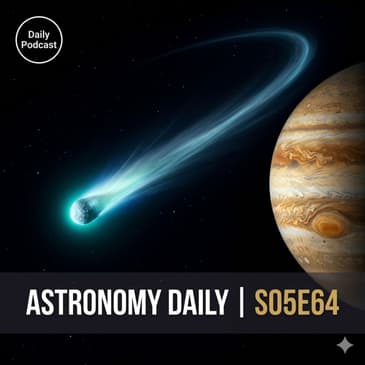
Hello, and welcome to Astronomy Daily. I'm Anna and I'm Avery. You're listening to Season five, episode sixty four, and what a Monday we have for you we do. Right now as we record this, an interstellar comet is making its final farewell pass through our solar system. It is swinging past Jupiter today and it's never coming back. That story alone would be enough, but we've also got a brand new mineral potentially discovered on Mars, a pre don sky show you can catch this week, ghost particles that carry memories of stars that died before Earth was born, and two genuinely mind bending stories about the nature of life itself. So let's get into it, starting with our cosmic farewell right then. If you've been following the story of three I Atls since it arrived in our solar system last July, today is a significant day. The comment is making its close this approach to Jupiter right now, and after that it begins its long one way journey back out into interstellar space. It will never return. Just to recap for anyone catching up, Three I Atlas is only the third known object ever confirmed to have come from outside our Solar System, after Omuamua in twenty seventeen and Borisov in twenty nineteen. This is our third interstellar visitor, and like the others, it's been an absolute gift to science. What makes today particularly satisfying is that astronomers have had months to study this thing up close, and the picture that's emerged is remarkable. In the last few weeks alone, the it's a Comma Large millimeter Array ALMA published finding showing that three i atls is packed with methanol, not just a bit of it, far more than almost any other comment we've ever seen from our own Solar System. Researchers described the methanol to hydrogen cyanide ratios as being up to about one hundred and twenty in places, which puts it completely off the charts compared to Solar System comets. And that matters because the methanol appears to be coming from two sources, directly from the comet's core and also from tiny ice grains drifting through the coma around it. That tells us something really interesting about how this object was built. One of the lead researchers describe observing three i atls as and I love this phrase. Taking a fingerprint from another solar system, because that's literally what it is. The chemistry locked in this comment reflects the conditions in the planetary system where it was born billions of years ago, around some star we may never identify. There's also the intrigue of Auvi Lobe's recent summary. He listed twenty two anomalies observed in three iatls during its passage. Some of those are almost certainly explained by unusual but natural chemistry. But the point is that every comet born in our solar system is at least somewhat familiar. This one keeps surprising us. And now it's leaving. If you want to try to catch it one last time, it's currently in the constellation Gemini. A small telescope will do it. Though it's fading southern hemisphere, observers still have a reasonable view. Safe travels. Three I als. You were a good guest. Now let's bring it a bit closer to home, literally your own backyard. If you're willing to get up early. This week, and I know it's a Monday, so maybe set that alarm a little earlier than usual, because this is worth it. Tonight and tomorrow morning. Mercury and Mars are gathering close to the crescent Moon in the pre dawn sky. On March sixteenth, that's tonight. The spacing between the moon and the two planets is roughly the width of a clenched tiff held at arm's length, and the arrangement of the three objects creates a sort of sad face shape which is charming and slightly melancholy for reasons I can't quite articulate. By tomorrow, March seventeenth, the thin crescent moon will first pass Mercury and then move close to Mars, which tightens the grouping. All three objects rise shortly before sunrise, though, so the sky is already brightening when they appear. You do need to be quick. And here's the thing. Southern hemisphere observers genuinely have the better view here for our listeners in Australia, New Zealand, South Africa, South America. The group sits a bit higher above the horizon, which makes a real difference. In those conditions. Look east before sunrise, give yourself at least twenty minutes before the sun comes up. Mercury is the tricky one. It never strays far from the horizon because it orbits so close to the sun, though binoculars can really help, and. We're in a geomagnetically active period of the year right now. The equinox is this Friday, March twentieth, and the weeks around the March and September equinoxes are statistically the most active for auroras, so if you're in the higher latitudes, it's worth checking aurora forecasts this week too. Pre dawn planetary grouping possible auroras equinox on Friday. It's actually a really rich week for skywatching even without the comment. All right, let's head to Mars and a story that on the surface sounds almost mundanely technical, but is actually quite exciting when you dig into it. Scientists studying Mars may have uncovered a brand new mineral hidden in the planet's ancient sulfate deposits. And the reason this is interesting isn't just because new minerals are cool, though they are. It's because of what it might tell us about Mars's geological and chemical history. The way this was found is a nice example of how planetary science works these days. The team combined laboratory experiments with orbital data, so they were essentially testing chemical reactions in the lab that might have occurred on ancient Mars, and then looking for matching signatures from orbit, and they found something that doesn't quite match anything already in the catalog. Soul fit minerals on Mars are enormously important scientifically because they tend to form in the presence of water. Mars went through periods of significant liquid water activity billions of years ago, and sulfates are one of the chemical fingerprints left behind. So if there's a previously uncataloged mineral hiding in those deposits, it's potentially a new clue to Mars's wet past, the conditions under which water was present, for how long and what temperatures. That feeds directly into the big question of whether Mars was ever habitable. This is still early stage science. A potential new mineral needs to be confirmed through further analysis and ideally through surface samples, which is one of the reasons the sample return missions being planned are so important. You can only go so far with orbital spectroscopy. At some point you need the rock in your hand. Or at least in a laboratory on Earth. But either way, another reason to keep looking at Mars. The planet still has things to teach us. Now this next story. I genuinely love this one because it involves particles that have been traveling through space for longer than Earth has existed, passing through absolutely everything in their path, and a telescope buried deep underground in Japan that might be able to catch them for the first time. We're talking about neutrinos, specifically what scientists call the diffuse supernova neutrino background. The idea is this, every time a massive star explodes in a supernova, the vast majority of the energy we're talking over ninety nine percent isn't in the light. It's in a flood of neutrinos that shoot outward at nearly the speed of light. And neutrinos are extraordinary particles. They have almost no mass, they carry no electric charge, and they interact with almost nothing. Billions of them are passing through your body right now, this very second, and you don't feel a thing. Some of them have been traveling for more than ten billion in years. So the idea is that all those supernovae across all of cosmic history have rough behind a kind of faint background glow of neutrinos, a cumulative whisper of every star that ever exploded, and Japan's Supercomyo Gunda detector, which has just received a major upgrade, may be able to detect that background glow for the first time in twenty twenty six. The upgrade is significant. Super Commoconde is buried under a mountain about a kilometer of rock overhead to filter out cosmic ray interference. It's essentially a tank containing fifty thousand tons of ultrapure water lined with photo multiplier tubes that flash when a neutrino very occasionally interacts with the water. The upgrade has made it roughly twice as sensitive. What makes this detection so remarkable if it happens, is that these neutrinos would include particles produced by stars that died before Earth even formed. Would be detecting the ghost signals of stars that died ten billion years ago, the universe's oldest obituaries. If you like the researcher quoted in the original article put it beautifully, this would mean seeing particles produced before the Earth itself existed. For a particle astrophysicist, they said, it would probably be one of the most exciting scientific achievements of their lifetime. We're not there yet. This is a might happen in twenty twenty six story, not a confirmed detection, but the fact that we're even within reach of this extraordinary. Okay, we need to talk about how we look for life on other worlds, because there's a paper published today, literally today that I think is going to become quite important. The standard approach to finding life on exoplanets is essentially to look at their atmospheres for the same gases we associate with life on Earth oxygen, methane, ozone, the logic being that the are hard to explain without biology. But there's always been a problem lurking in that approach. The problem is that we wrote that shopping list. By studying Earth, we are essentially looking for life that looks like us, and increasingly researchers have been finding false positive scenarios purely chemical processes that can mimic those biosignature gases without any life being involved. So Sarah Walker, professor of astrobiology at Arizona State University, and her colleagues have been developing a different framework entirely. It's called assembly theory, and instead of asking what molecules are present in this atmosphere, it asks how hard were those molecules to make. Every molecule can be given an assembly index, a minimum number of construction steps required to build it from the most basic chemical building blocks. Simple molecules like water or carbon dioxide are easy to assassemble by random chemistry, but truly complex molecules, the kind requiring many sequential, specific steps, essentially don't arise by accident. When you find the planetary atmosphere rich in molecules with very high assembly indices, and where the chemistry shows signs of deep interconnection, molecules sharing and reusing chemical fragments, exploring the full range of possible bonds, something beyond ordinary physics has been at work, and that's something the theory argues is almost certainly life. What's really powerful about this is that it makes no assumptions about what kind of life, no specific biochemistry, no specific metabolism, no DNA required. It would detect life that is genuinely alien in its chemistry, life not as we know it. When they compared Earth's atmosphere to Venus, Mars, and various exoplanet types, Earth stood out clearly as having the most complex molecular chemistry by this measure, even though Earth and Venus have similar chemical raw materials available to them, Earth's atmosphere shows far greater molecular diversity. That's the signature of a biosphere actively exploring chemical possibility space. And here's the practical part. This framework is being designed specifically for the Habitable World's Observatory, NASA's next flagship telescope. Assembly values can be calculated from infrared spectroscopy, which is exactly what space telescopes use to read distant atmospheres. Rather than a binary a live or dead result, you'd get a continuous complexity score, a spectrum from purely chemical to richly biological. The universe has had nearly fourteen billion years to experiment with chemistry. Assuming it only arrived at one solution for life, our solution does seem, when you think about it, a little over confident. Agreed, this one has legs. Watch and finally, let's end today with something that genuinely ships where you look when you're searching for life in the universe. In our standard mental model of a habitable world, you need a star, you need sunlight. Without a star, there's no energy, no warmth, no liquid water, no life. That's the assumption we've been working. With a new study from Ludwig Maximilian University of Munich and the max Plank Institute for Extraterrestrial Physics is quietly dismantling that assumption. Their research focuses on free floating planets, worlds that were ejected from their home Solar systems early in the chaos of planetary formation and have been drifting through the galaxy ever since, starless and alone. The question they asked is could moons orbiting those free floating planets maintain liquid water? And the answer is yes for a surprisingly long time. Two things make it possible. First, tidal heating. When a moon orbits a planet on an elliptical orbit, which is likely after the chaos ejection event, the planet's gravity compresses and releases the moon's interior as it passes close and then swings away. That friction generates heat. We see this in our own solar system. Io, Jupiter's innermost large moon is the most volcanically active body we know of. Because of tidal heating, Europa likely has a subsurface ocean for the same reason. The second piece is atmosphere. Earlier models looked at carbon dioxide as the insulating layer, but at the temperatures around a free floating planet, carbon dioxide freezes and drops out of the atmosphere the insulation collapses, so the team turned to hydrogen instead. Hydrogen has an unusual property under pressure, molecules temporarily link together and can absorb infrared radiation the kind that otherwise would carry heat away from the surface. It's called collision induced absorption. And crucially, hydrogen doesn't freeze, the atmosphere stays intact. The modeling found at a hundred bars of surface pressure, a moon could maintain habitable liquid water conditions for up to four point three billion years. That's not a coincidence. That's roughly the age of complex life on Earth. So in principle, there are moons drifting through the dark between the stars right now that could be hosting biology that started when ours did. The lead author put it simply and beautifully, the cradle of life does not necessarily require a sun. That is a sentence that I think will age very well. And that is Astronomy Daily for Monday, the sixteenth of March twenty twenty six. Interstellar farewells, new minerals on Mars, ghost particles, life without a star honestly, not a bad way to start the week. If you're heading outside before sunrise tomorrow, let us know what you see. Tag us. We are at Astro daily pod everywhere and if you're. Enjoying the show, please do leave us a review, share an episode with someone, or just tell a friend. It genuinely makes a difference. Until tomorrow, keep looking up. We are skies everyone. Sunny Day Star is the toll. Star is. The story is