
Follow & Connect 🌐 astronomydaily.io 📱 @AstroDailyPod 🎙️ Available on all major podcast platforms 📺 YouTube — optimised for mobile viewing Astronomy Daily is part of the Bitesz.com Podcast Network.
Become a supporter of this podcast: https://www.spreaker.com/podcast/astronomy-daily-latest-space-news--5648921/support.
Sponsor Details:
Ensure your online privacy by using NordVPN. To get our special listener deal and save a lot of money, visit www.astronomydaily.io/nordvpn. You'll be glad you did!
Get the best secure and private email on the planet. Stop your Government, google and who knows who else spying on every email you write. Do what we did and use ProtonMail. They beleive in privacy and there are no ads in their business model...yet they still provide a free forever service. Check them out and get out special deal at www.astronomydaily.io/protonmail
Become a supporter of Astronomy Daily by joining our Supporters Club. Commercial free episodes daily are only a click way... Click Here
This episode includes AI-generated content.
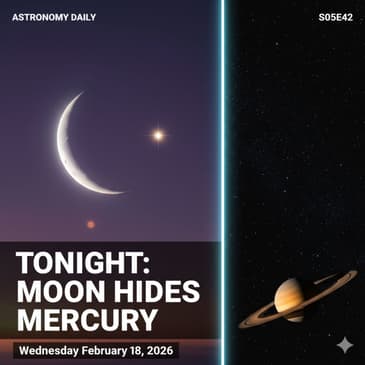
Hello, and welcome to Astronomy Daily. I'm Anna and I'm Avery. You're listening to Season five, episode forty two for Wednesday, the eighteenth of February twenty twenty six, And what a day to be a spaceman. Absolutely tonight right now, in fact, the Moon is sliding so close to mercury that it's actually hiding it from view for skywatchers in parts of the southern United States. A genuine celestial magic trick happening as you listen. And that's just one of six stories we're bringing you today. We've got NASA's Artemis two on the verge of a crucial fueling test, a European rocket making a big move in the satellite broadband race, a genuinely new twist in the ongoing saga of our interstellar Visitor, and two stories that I promise will make you rethink some things you thought you knew about the Solar System. Big show, let's get into it, so Anna. Let's start with the biggest space story of the week, and honestly the one that could define the Artemis two. Yes, for anyone who needs a quick refresh, Artemis two is NASA's first crude mission around the Moon since Apollo seventeen in nineteen seventy two. Four astronauts Reed Wiseman, Victor Glover, Christina Cock, and Canada's Jeremy Hansen are preparing to fly a ten day loop around the Moon and back. No lunar landing, but a crucial proving flight before we put boots on the surface. And they are so close. The rocket is sitting on Path thirty nine B at Kennedy Space Center right now. But before NASA will commit to a launch date, they need to successfully do what's called a wet dress rehearsal, a full practice countdown where they actually load the rocket with fuel and take it right to the edge of launch, then drain it all out again. They did that once already on February third, and it didn't go smoothly. A liquid hydrogen leak cropped up, the exact same kind of problem that plagued Artemis one one three years ago. The countdown was terminated at T minus five minutes and fifteen seconds, close but not close enough. Which pushed the February launch window off the table entirely. NASA administrator Jared Isaacman was fairly philosophical about it. He said This is exactly why you do a rehearsal to find these issues before you're flying with crew. But the clock is ticking. Since then, engineers have replaced two seals and a clogged filter in the hydrogen fueling system. They ran a partial confidence test on February twelfth to check the repairs, and now tomorrow, February nineteenth, they begin tanking day for the second full wet dress rehearsal. This is the one that counts. If the test goes cleanly, no oud of limits, hydrogen concentrations countdown proceeds all the way to the terminal phase, NASA will analyze the data and set a launch date. The current earliest possibility is March six. It's worth noting just how historic mission is beyond the Moon return angle, Victor Glover will become the first person of color to travel beyond low Earth orbit. Christina Cock will be the first woman, Jeremy Hansen will be the first non American. Every single person on that crew is making history in their own right. So tomorrow is genuinely a day to watch. We'll be keeping a close eye on how the tanking goes, and we'll have updates as they come through. All right. Let's bring it back to Earth, or rather to the sky above Earth, because tonight is one of those rare evenings where if you happen to be in the right place and you look up at the right moment, you'll see something genuinely extraordinary. Two things actually, First, the moon and mercury. Tonight, February eighteenth, a slender, one and a half day old crescent moon is passing extremely close to Mercury in the western sky just after sunset, and I mean extremely close. For observers along a narrow band of southern US states. We're talking Arizona and New Mexico, Texas, Louisiana, Mississippi, and Georgia, the moon will actually pass directly in front of Mercury and block it from view entirely. That's called an occultation. Mercury literally disappears behind the moon's dark limb and reappears on the other side. For everyone else across North America and beyond, it won't be a full occultation, but you'll still see a dramatically close pairing. East Coast observers will see Mercury sitting just north of the moon as twilight falls. By the time darkness reaches the west coast, the Moon will have shifted to within about one degree of the planet. Venus hangs brilliantly below them as a helpful reference point. Now the window is tight. Mercury sets not long after the sun, so you want to get outside as soon as the sky darkens. Look low in the west southwest if you can spot Venus, and you'll have no trouble doing that. It's blazingly bright. Mercury will be nearby. The moon makes it easy tonight. And if that warn enough, Jupiter watchers have a tree two tonight. Ganymede, Jupiter's largest moon and the biggest moon in the entire Solar System, is transitting across Jupiter's face. East coast observers can see it underway as soon as it gets dark. It takes just over three hours to cross the disk, and then Ganymede's shadow follows it across, creating that striking black dot effect on Jupiter's cloud tops. So tonight really is a two for one skywatching event. Mercury and the Moon in the west at dusk, Jupiter and Ganymede in the southeast through the night. If you have binoculars or a small telescope. Even better, get outside, staying with today's news, and this one happened literally today. Europe's Arion six rocket has successfully launched thirty two satellites into orbit for Amazon's Project Kuiper. For those not familiar with Kuyper, Amazon has been quietly building a large constellation of broadband Internet satellites designed to take on space exist. This is a big commercial play. Darlink currently leads the market with thousands of operational satellites, but Amazon has the resources and ambition to make this a genuine competition. What's notable about today's launch is that it used the most powerful configuration of Airon six, flying with four strap on boosters rather than two. It was essentially a statement of capability from the European side of the commercial launch industry. This rocket can handle serious payloads. There's also a bigger picture here. Arion six has had somewhat of a turbulent road. It came in behind schedule and face some early technical hurdles, but launches like this, winning commercial contracts for a high profile constellation like hyper are exactly what Europe needs to keep its launch industry competitive in an era dominated by SpaceX and an increasingly capable Chinese launch sector. The broadband satellite race is one of the defining infrastructure stories of this decade. I'd argue Starlink has already changed what connectivity looks like in remote areas and conflict zones, hyper Amazon's one Web investments, the Chinese Go Wong constellation. They all point to a future where low Earth orbit becomes genuinely critical economic territory. Today's launch is one tile in that much larger mosaic thirty two satellites closer to that future. Now an update on our Interstellar Visitor, and I do mean update. There is genuinely new information here happening right now. I know we've given three i at Lists quite a run over recent episodes, but this one earns its place today. Completely for new listeners. Three i at Lists is only the third interstellar object ever confirmed to pass through our Solar System. It arrived from outside our stellar neighborhood, swung around the Sun last October, and is now heading back out into the galaxy forever. We will never see this object again. Here's what's happening right now. Issa's Juice spacecraft. That's the Jupiter icy Moons Explore currently en route to Jupiter pass with an observational range of three I atlas back in November last year. Due to the challenging thermal conditions during Juice's transit through the Inner Solar System, the data collected couldn't be downlinked straight away. That data is now being transmitted to Earth. The window is February eighteenth to the twentieth today. If successful, these would be the closest ever observations of an interstellar object by a spacecraft. Now, Juice didn't do a dedicated flyby, its trajectory is locked in for Jupiter, but even opportunistic observations from its suite of cameras, spectrometers, and particle detectors could give us a perspective on three I at lists that no Earth based telescope can provide. And the data would complement an extraordinary recent run of discoveries. Hubble has directly imaged the nucleus for the first time. JWST detected methane in its atmosphere, a molecule never before seen in an interstellar object, and the object is still spinning faster than it was before its solar encounter, a legacy of all that outgassing as it's swung close to the Sun. Three I atlass is now about three and a half astronomical units from the Sun in the constellation Gemini. It's fading, but still reachable with a decent amateur telescope, and it has one more big act to play, a close pass by Jupiter in March, which may trigger fresh outbursts as Jupiter's tidal forces stress the nucleus. An extraordinary object, and the fact that we have a spacecraft data downlink happening as we record today makes it entirely current. What report would Juce found as soon as the science teams release their analysis. Right deep time now. I genuinely love this next story because it takes something you thought you understood Saturn's rings and reframes the entire origin of the system. New research by mattia Chuk at the SETI Intitude, about to be published in the Planetary Science Journal, proposes a dramatic two stage catastrophe that reshaped the entire Saturturnian system roughly four hundred million years ago, and I mean reshaped everything. Titan, the rings, Iapetus, Hyperion, all of it connected to one ancient collision. Let's set the scene. Saturn has puzzled planetary scientists for a long time. Its axial tilt is an unusually steep twenty six point seven degrees. You don't expect gas giants to form that way. Titan is migrating away from Saturn at a surprisingly rapid rate. The moon Iapetus sits at an oddly inclined orbit, and the rings are far younger than the planet itself, only a few hundred million years old. Geologically speaking, one thing after another that didn't quite add up. Juke and colleagues ran simulations and found the scenario that explains it all at once. The key player is a moon they're calling Proto Hyperion. Saturn used to have this additional mid sized satellite orbiting in the Outer System. When saturn Spin orbit resonance with the other planets in the Solar System broke down, Proto Hyperion was destabilized, it drifted inward, and it collided with a Proto Titan. The merger of those two moons roughly four hundred million years ago set off a chain reaction. Some of the collision debris accreted around what would become today's Titan, explaining why Titan's surface looks surprisingly young despite the moon itself, being ancient, Titan absorbed new material and essentially reset its surface. Other debris from the collision perturbed the inner moon system. Titan's resonant gravitational interaction with Protodone and Proto Rhea caused further instabilities, more collisions, more debris. Most of that material eventually reaccreted into the inner moons we see today mimis Enceladus. Test this Dione Rhea, but a fraction of it stayed dispersed. That fraction became Saturn's. Rings and Hyperion, the small, oddly shaped, walnut like moon that looks like it survived a very bad day. According to the model, it actually did survive a very bad day. It formed from the debris of that Proto Hyperion and Prototitan collision and was captured into resonance with Titan. The researchers note that in most of their simulations, Hyperion was lost entirely. Its survival in a relatively small number of runs suggests the real system was genuinely close to being quite different. What I find compelling about this is how elegantly one event connects everything. The tilt of the whole planet, the age of the rings, the orbits of Iapetus and Hyperion. Titan's migration rate one ancient merger explains it all. Now, the researchers are careful to say this is a hypothesis, not a confirmed history. Simulations can be suggestive without being definitive. But NASA's Dragonfly mission is heading to Titan. It launches in twenty twenty eight and arrives in twenty thirty four. One of the things Dragonfly will investigate is the age and history of Titan's surface. If the surface shows evidence of that ancient resetting, that would be a powerful confirmation. Four hundred million years of cosmic history hiding in a walnut shaped moon. I love the stuff. And finally a story that will make you rethink just how long it takes to get to Mars, or at least how long it might take one day. Russia State Nuclear Corporation rose Adam, through its Troyice Institute near Moscow, has been developing a nuclear powered magna plasma engine, and they're making a bold claim that this technology could get a crude spacecraft to Mars in thirty days. To put that in context, a can ventional chemical rocket takes roughly eight months to reach Mars thirty days would be a transformation, not just an improvement. It would fundamentally change the feasibility of human Mars missions. Less radiation exposure for the crew, less time, and microgravity, a completely different logistical calculus for resupply and emergency scenarios. The engine works by accelerating hydrogen using electromagnetic fields rather than combustion, to a velocity of one hundred kilometers per second. That's roughly twenty two times faster than the exhaust velocity of a conventional chemical rocket. The working body is plasma charged particles, and it's driven by an onboard nuclear reactor that provides the sustained electrical power the accelerator needs. Importantly, this isn't a launch engine. You'd still use conventional chemical rockets to get off Earth surface and into orbit. The plasma system switches on once you're in se for the interplanetary cruise, smooth continuous acceleration followed by a long deceleration burn. The prototype is currently running ground trials inside a fourteen meters vacuum chamber designed to replicate deep space conditions. The researchers say the engine has demonstrated sufficient longevity over twenty four hundred hours for a Mars transportation operation. A flight ready prototype is targeted for twenty thirty. Now, and this is important. There are real caveats here. No peer reviewed data has been published yet. The thrust is very low, around six newtons. Integrating a nuclear reactor into a crude spacecraft is an enormous engineering challenge in itself, with regulatory, thermal and radiation shielding hurdles that remain largely unsolved publicly. Fare points, but the broader context is genuinely interesting. NASA is investing in its own plasma propulsion programs. The Vasi mer engine from ad Astra Rocket Company in Texas targets a Mars trip of forty five to sixty days. China has plasma thrust or research under way. Two. There's a real multi nation push to solve the propulsion problem for deep space travel. Chemical rockets got us to the Moon. Getting to Mars regularly, safely and at human timescales requires something different. This is where that search is heading, wherever it ultimately leads. Thirty days to Mars, even as an aspiration. That's a sentence worth sitting with. And that's our six stories for Season five, Episode forty two. What a lineup from a rocket on a launch pad in Florida to a crescent moon swallowing Mercury to the debris of a four hundred million year old collision still orbiting Saturn, and. An interstellar comment sending us its last data from the edge of the Solar System while Russia dreams of getting to Mars in a month. Base never has a quiet week. If tonight's sky events caught your attention, there is still time to get outside Mercury and the Moon in the west, Jupiter and Ganymede in the southeast. You have your orders and keep. An eye on Artemis. Tomorrow's fueling test is one of those days where the news could come fast. We'll be on it. Thank you so much for spending part of your Wednesday with us. We'll be back tomorrow for more from the universe. Until then, clear sky is everyone, Sunny day Star is, Star is