
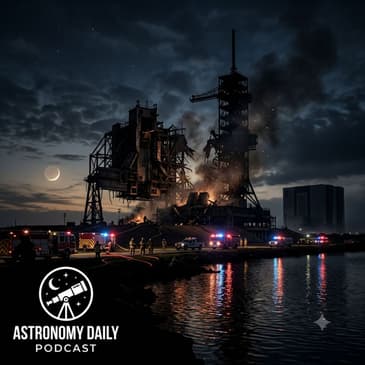
Become a supporter of this podcast: https://www.spreaker.com/podcast/astronomy-daily-latest-space-news--5648921/support.
Sponsor Details:
Ensure your online privacy by using NordVPN. To get our special listener deal and save a lot of money, visit www.astronomydaily.io/nordvpn. You'll be glad you did!
Get the best secure and private email on the planet. Stop your Government, google and who knows who else spying on every email you write. Do what we did and use ProtonMail. They beleive in privacy and there are no ads in their business model...yet they still provide a free forever service. Check them out and get out special deal at www.astronomydaily.io/protonmail
Become a supporter of Astronomy Daily by joining our Supporters Club. Commercial free episodes daily are only a click way... Click Here
This episode includes AI-generated content.
00:00:00 --> 00:00:02 Anna: Hello and welcome to Astronomy Daily,
00:00:02 --> 00:00:05 your daily guide to the cosmos. I'm
00:00:05 --> 00:00:05 Anna.
00:00:05 --> 00:00:08 Avery: And I'm um, avery. It's Tuesday the 2nd of
00:00:08 --> 00:00:11 June, 2026 and this is season 5
00:00:11 --> 00:00:12 episode 113.
00:00:13 --> 00:00:15 Anna: What a week it's been in space already.
00:00:16 --> 00:00:18 Blue Origin is picking up the pieces. After a
00:00:18 --> 00:00:21 spectacular rocket explosion and the ripple
00:00:21 --> 00:00:24 effects for NASA's moon plans are uh, growing
00:00:24 --> 00:00:24 by the hour.
00:00:25 --> 00:00:28 Avery: China quietly launched a brand new rocket
00:00:28 --> 00:00:30 overnight and barely told anyone about it.
00:00:30 --> 00:00:33 Anna: Starship is grounded again and this time
00:00:33 --> 00:00:35 there's an IPO in the balance.
00:00:35 --> 00:00:38 Avery: And NASA's Roman Space Telescope is getting
00:00:38 --> 00:00:40 ready to change everything we know about
00:00:40 --> 00:00:42 exoplanets. We're talking a hundred
00:00:42 --> 00:00:44 thousand new worlds.
00:00:44 --> 00:00:47 Anna: Plus, did you know Earth was once a planet
00:00:47 --> 00:00:50 wide ocean of lava for 500
00:00:50 --> 00:00:53 million years? New research is rewriting
00:00:53 --> 00:00:54 the story of our early home.
00:00:55 --> 00:00:57 Avery: And the Hubble Space Telescope has captured a
00:00:57 --> 00:00:59 stunning new look at a galaxy on a cosmic
00:00:59 --> 00:01:02 collision course. One that won't end for
00:01:02 --> 00:01:03 hundreds of millions of years.
00:01:04 --> 00:01:06 Anna: All that and more right here on Astronomy
00:01:06 --> 00:01:08 Daily. Let's get into it.
00:01:08 --> 00:01:10 Avery: Why don't you kick things off Anna with
00:01:10 --> 00:01:11 today's big news update.
00:01:12 --> 00:01:14 Anna: Okay. When Blue Origin's new Glenn
00:01:14 --> 00:01:17 rocket exploded on 28 May, the
00:01:17 --> 00:01:20 world was watching. But five days on the
00:01:20 --> 00:01:22 full scale of the damage, not just to the
00:01:22 --> 00:01:25 pad, but to America's lunar ambitions is
00:01:25 --> 00:01:27 becoming painfully clear.
00:01:27 --> 00:01:29 Avery: Let's recap what happened for anyone who
00:01:29 --> 00:01:32 missed it. The new Glenn was undergoing a
00:01:32 --> 00:01:34 static fire test. A uh, routine pre launch
00:01:34 --> 00:01:37 engine ignition at Launch Complex
00:01:37 --> 00:01:39 36 ahead of a planned June 4 launch.
00:01:40 --> 00:01:42 Instead, all seven first stage engines
00:01:42 --> 00:01:45 ignited. Something clearly went wrong and the
00:01:45 --> 00:01:48 322 foot rocket was engulfed in a
00:01:48 --> 00:01:51 massive fireball. The explosion could be seen
00:01:51 --> 00:01:52 and felt for miles.
00:01:53 --> 00:01:55 Anna: Blue Origin CEO Dave Limp has
00:01:55 --> 00:01:58 confirmed the company has begun clearing the
00:01:58 --> 00:02:01 pad. But here's the critical problem. Launch
00:02:01 --> 00:02:03 Complex 36 is Blue Origin's only
00:02:03 --> 00:02:06 orbital launch facility. They have no backup.
00:02:07 --> 00:02:09 And rebuilding a destroyed launch complex
00:02:09 --> 00:02:11 isn't a matter of weeks.
00:02:11 --> 00:02:13 Avery: And the mission that was sitting on that pad
00:02:13 --> 00:02:16 wasn't just about Internet satellites. Blue
00:02:16 --> 00:02:18 Origin was preparing to deploy Amazon's LEO
00:02:18 --> 00:02:21 broadband constellation. But the new Glenn is
00:02:21 --> 00:02:24 also the rocket that NASA is counting on to
00:02:24 --> 00:02:26 carry its Blue Moon landers to the lunar
00:02:26 --> 00:02:26 surface.
00:02:27 --> 00:02:29 Anna: That's right. Just two days before the
00:02:29 --> 00:02:32 explosion, NASA had signed a new agreement
00:02:32 --> 00:02:34 with Blue Origin to launch a pair of New
00:02:34 --> 00:02:37 Glenns carrying rovers to the moon. Rovers
00:02:37 --> 00:02:39 that would be waiting for Artemis Cruise, the
00:02:39 --> 00:02:42 Blue Moon Mark 1 Lander scheduled to deliver
00:02:42 --> 00:02:45 the first hardware for NASA's Moon Base 1
00:02:45 --> 00:02:47 mission this coming northern autumn will now
00:02:47 --> 00:02:49 faces an uncertain delay.
00:02:50 --> 00:02:52 Avery: And when the lander slips, the crew capable
00:02:52 --> 00:02:55 blue moon mark two timeline slips with it.
00:02:55 --> 00:02:58 One expert put it bluntly. NASA's moon based
00:02:58 --> 00:03:00 plans are at this point quote, an
00:03:00 --> 00:03:03 aspiration rather than being realistically
00:03:03 --> 00:03:04 achievable in the next few years.
00:03:05 --> 00:03:08 Anna: It's worth noting that SpaceX and United
00:03:08 --> 00:03:10 launch alliance both successfully launched
00:03:10 --> 00:03:13 rockets from elsewhere at the cape less than
00:03:13 --> 00:03:15 24 hours after the new Glenn explosion.
00:03:16 --> 00:03:18 A pointed reminder of the advantage of having
00:03:18 --> 00:03:20 multiple launch pads.
00:03:20 --> 00:03:22 Avery: A, uh, tough lesson and a sobering moment for
00:03:22 --> 00:03:25 the whole Artemis program. We'll be watching
00:03:25 --> 00:03:26 this one very closely.
00:03:26 --> 00:03:29 Anna: On to our next story. And were the Chinese
00:03:29 --> 00:03:31 being sneaky or just getting on with
00:03:31 --> 00:03:31 business?
00:03:32 --> 00:03:34 Avery: Well, while the world was focused on the Blue
00:03:34 --> 00:03:37 origin explosion, China was quietly making
00:03:37 --> 00:03:40 its own significant space history without so
00:03:40 --> 00:03:42 much as a press release in advance.
00:03:42 --> 00:03:45 Anna: On June 1, at 4:40am Eastern
00:03:45 --> 00:03:48 Time, China's new Long March 12B
00:03:48 --> 00:03:51 rocket lifted off from the Zhuquan Satellite
00:03:51 --> 00:03:53 launch center in the Gobi Desert. Its very
00:03:53 --> 00:03:56 first flight with no advance warning
00:03:56 --> 00:03:57 whatsoever.
00:03:57 --> 00:03:59 Avery: No announcement, no countdown, just
00:04:00 --> 00:04:03 gone. China's 35th orbital launch attempt
00:04:03 --> 00:04:05 of 2026 and arguably one of the most
00:04:05 --> 00:04:06 technically significant.
00:04:07 --> 00:04:10 Anna: The Long March 12B is China's answer
00:04:10 --> 00:04:13 to SpaceX's Falcon 9. It's a two
00:04:13 --> 00:04:15 stage kerosene and liquid oxygen rocket,
00:04:15 --> 00:04:18 72 meters tall with a 20 ton payload
00:04:18 --> 00:04:21 capacity to low Earth orbit. And crucially,
00:04:21 --> 00:04:23 it's designed from the ground up to be
00:04:23 --> 00:04:26 reusable. No recovery was attempted on this
00:04:26 --> 00:04:28 maiden flight, but one is planned.
00:04:28 --> 00:04:31 Avery: What makes it especially interesting is the
00:04:31 --> 00:04:33 technology on board the rocket features what
00:04:33 --> 00:04:35 engineers are calling dual brains.
00:04:36 --> 00:04:38 Independent flight computers on both stages
00:04:38 --> 00:04:40 that can process data and make real time
00:04:40 --> 00:04:43 flight decisions autonomously. Think of it as
00:04:43 --> 00:04:45 redundant artificial intelligence for the
00:04:45 --> 00:04:46 rocket itself.
00:04:47 --> 00:04:49 Anna: The debut mission successfully deployed
00:04:49 --> 00:04:52 another batch of satellites for the Qian Fan
00:04:52 --> 00:04:54 Constellation, also known as Thousand
00:04:54 --> 00:04:57 Sails, China's answer to Starlink. If
00:04:57 --> 00:04:59 this launch followed the typical batch size,
00:04:59 --> 00:05:01 the Qianfan Constellation now has
00:05:01 --> 00:05:04 approximately 180 satellites in
00:05:04 --> 00:05:05 orbit.
00:05:05 --> 00:05:08 Avery: And it was developed in just 21 months.
00:05:08 --> 00:05:11 21 months from concept to first successful
00:05:11 --> 00:05:14 flight of a new heavy lift rocket. That's a
00:05:14 --> 00:05:16 remarkable pace by any standard.
00:05:16 --> 00:05:19 Anna: And in other Chinese space news, and it's
00:05:19 --> 00:05:21 been a busy week. The three member Shenzhou
00:05:21 --> 00:05:24 Uh, 21 crew returned safely to Earth on
00:05:24 --> 00:05:27 29 May 2026, wrapping
00:05:27 --> 00:05:29 up a record 210 day mission
00:05:29 --> 00:05:32 aboard the Tiangong Space Station. Commander
00:05:32 --> 00:05:35 Cheng Liu, Wu Fei and Cheng Hongzhang are all
00:05:35 --> 00:05:38 in good health. It was a mission that had
00:05:38 --> 00:05:40 some added drama. A suspected space debris
00:05:40 --> 00:05:42 strike had damaged the window of their
00:05:42 --> 00:05:45 original return capsule, requiring China to
00:05:45 --> 00:05:48 launch an emergency replacement spacecraft to
00:05:48 --> 00:05:49 bring them home.
00:05:49 --> 00:05:51 Avery: China's space program is accelerating on
00:05:51 --> 00:05:54 every front simultaneously. The pace is
00:05:54 --> 00:05:55 extraordinary.
00:05:56 --> 00:05:58 Anna: Next up, you could say it's been a rough few
00:05:58 --> 00:06:01 days for commercial spaceflight and Starship
00:06:01 --> 00:06:04 hasn't escaped the turbulence. The FAA has
00:06:04 --> 00:06:06 formally grounded SpaceX's Starship version
00:06:07 --> 00:06:09 3 rocket following what it's designated a uh,
00:06:09 --> 00:06:12 Mishap during Flight 12 on 22
00:06:12 --> 00:06:13 May.
00:06:13 --> 00:06:15 Avery: Let's remind listeners what happened on
00:06:15 --> 00:06:17 Flight 12. It was the debut of the Version 3
00:06:17 --> 00:06:20 configuration, a significant upgrade with new
00:06:20 --> 00:06:22 Raptor 3 engines featuring a simplified
00:06:22 --> 00:06:25 design and increased thrust. The launch
00:06:25 --> 00:06:27 itself looked spectacular. The booster
00:06:27 --> 00:06:29 separated cleanly and delivered the upper
00:06:29 --> 00:06:31 stage to its intended trajectory.
00:06:31 --> 00:06:34 Anna: But then things went wrong during the boost
00:06:34 --> 00:06:37 back burn. When the super heavy booster fires
00:06:37 --> 00:06:39 its engines to arc back toward the recovery
00:06:39 --> 00:06:41 zone, it couldn't light all the planned
00:06:41 --> 00:06:44 engines. A partial burn ended early. The
00:06:44 --> 00:06:47 booster then attempted a landing burn, failed
00:06:47 --> 00:06:49 to ignite and hard splashed into the Gulf of
00:06:49 --> 00:06:52 Mexico or Gulf of America, depending on where
00:06:52 --> 00:06:55 you live. Meanwhile, one of the three vacuum
00:06:55 --> 00:06:58 Raptor vacuum engines on the upper stage also
00:06:58 --> 00:07:01 failed, though SpaceX was still able to steer
00:07:01 --> 00:07:03 it to the intended splashdown in the Indian
00:07:03 --> 00:07:03 Ocean.
00:07:04 --> 00:07:07 Avery: The FAA has now determined that constitutes a
00:07:07 --> 00:07:09 mishap under federal launch licensing rules
00:07:09 --> 00:07:11 and SpaceX must complete a, uh, full
00:07:11 --> 00:07:14 investigation led by SpaceX but overseen
00:07:14 --> 00:07:17 by the FAA. Before Starship can fly again.
00:07:18 --> 00:07:21 The FAA must approve the final report and
00:07:21 --> 00:07:24 any corrective actions. This is the seventh
00:07:24 --> 00:07:26 time Starship has been grounded in three
00:07:26 --> 00:07:26 years.
00:07:27 --> 00:07:29 Anna: Industry observers are currently pointing to
00:07:29 --> 00:07:32 a July to August 2026 window for
00:07:32 --> 00:07:35 Flight 13 May. SpaceX may also choose
00:07:35 --> 00:07:37 to skip the booster, catch on that flight and
00:07:37 --> 00:07:40 repeat the Gulf splashdown profile while the
00:07:40 --> 00:07:41 Raptor 3 issues are understood.
00:07:42 --> 00:07:45 Avery: Now here's where this gets particularly
00:07:45 --> 00:07:47 interesting. SpaceX filed its public
00:07:47 --> 00:07:50 IPO prospectus with the SEC on
00:07:50 --> 00:07:53 May 20, just two days before Flight
00:07:53 --> 00:07:55 12. The company is targeting a uh,
00:07:55 --> 00:07:57 NASDAQ listing under the ticker
00:07:57 --> 00:08:00 SPCX, with shares
00:08:00 --> 00:08:02 potentially trading as early as June 12.
00:08:02 --> 00:08:05 And its entire growth story is built
00:08:05 --> 00:08:06 around starship.
00:08:07 --> 00:08:10 Anna: In the S1 filing, SpaceX stated, and
00:08:10 --> 00:08:12 we're paraphrasing here, that its growth
00:08:12 --> 00:08:14 strategy depends on increasing launch cadence
00:08:14 --> 00:08:17 and payload capacity, which in turn depends
00:08:17 --> 00:08:20 on the successful development of Starship at
00:08:20 --> 00:08:23 scale. A grounding right before the IPO
00:08:23 --> 00:08:25 roadshow is not ideal.
00:08:25 --> 00:08:28 Avery: High stakes all around. We'll keep following
00:08:28 --> 00:08:30 both the investigation and the IPO timeline.
00:08:31 --> 00:08:33 Anna: Okay, let's take a breath from all the rocket
00:08:33 --> 00:08:36 drama and look ahead to something genuinely
00:08:36 --> 00:08:39 thrilling. NASA's Nancy Grace Roman Space
00:08:39 --> 00:08:41 Telescope is heading to Kennedy Space center
00:08:41 --> 00:08:43 this month with a launch target of early
00:08:43 --> 00:08:46 September 2026. And what it's going to do
00:08:46 --> 00:08:49 is nothing short of staggering.
00:08:49 --> 00:08:51 Avery: To put it in perspective, since the dawn of
00:08:51 --> 00:08:54 the exoplanet era, we have confirmed around
00:08:54 --> 00:08:57 6 planets beyond our solar system.
00:08:57 --> 00:09:00 That's across decades of work from Kepler,
00:09:00 --> 00:09:02 Tess, Hubble and every ground based
00:09:02 --> 00:09:05 observatory on Earth. Roman is expected
00:09:05 --> 00:09:08 to find approximately 100
00:09:08 --> 00:09:09 more in just five years.
00:09:10 --> 00:09:13 Anna: 100 15 times
00:09:13 --> 00:09:15 everything we've ever found in half a decade.
00:09:16 --> 00:09:16 How?
00:09:17 --> 00:09:19 Avery: It comes down to Roman's extraordinary
00:09:19 --> 00:09:22 combination of Hubble class resolution and a
00:09:22 --> 00:09:25 field of view at least 100 times larger.
00:09:25 --> 00:09:27 Where Hubble would photograph a postage stamp
00:09:27 --> 00:09:30 of sky, Roman photographs a full
00:09:30 --> 00:09:32 page spread with the same sharpness. It
00:09:32 --> 00:09:35 can survey the sky up to a thousand times
00:09:35 --> 00:09:36 faster than Hubble.
00:09:36 --> 00:09:38 Anna: And critically, Roman will be looking in
00:09:38 --> 00:09:41 places we've barely explored. Its galactic
00:09:41 --> 00:09:44 bulge Survey will observe approximately 100
00:09:44 --> 00:09:47 million stars in the dense, understudied
00:09:47 --> 00:09:49 heart of the milk Milwaukee regions where
00:09:49 --> 00:09:51 most planet hunting missions have never
00:09:51 --> 00:09:54 ventured. It will find planets using both the
00:09:54 --> 00:09:56 transit method and gravitational
00:09:56 --> 00:09:58 microlensing, which can detect planets that
00:09:58 --> 00:10:00 don't even transit their stars.
00:10:00 --> 00:10:03 Avery: Roman is also expected to find a significant
00:10:03 --> 00:10:06 population of rogue planets, worlds
00:10:06 --> 00:10:08 drifting through the galaxy without a star to
00:10:08 --> 00:10:11 orbit. We currently know of only a handful.
00:10:11 --> 00:10:13 Roman could reveal thousands.
00:10:14 --> 00:10:16 Anna: And then there's the coronagraph instrument,
00:10:16 --> 00:10:18 a ah, technology demonstrator that will
00:10:18 --> 00:10:21 directly image a handful of large planets
00:10:21 --> 00:10:23 around nearby stars. Testing techniques
00:10:23 --> 00:10:26 intended for a future mission to photograph
00:10:26 --> 00:10:28 Earth like worlds around sun, like stars.
00:10:29 --> 00:10:32 Roman is also hunting dark energy and dark
00:10:32 --> 00:10:32 matter.
00:10:32 --> 00:10:35 Avery: NASA administrator Jared Isaacman described
00:10:35 --> 00:10:37 the accelerated development as a true success
00:10:37 --> 00:10:40 story. The telescope is now targeting a
00:10:40 --> 00:10:43 September launch ahead of its May 2027
00:10:43 --> 00:10:45 commitment. It's heading to Kennedy Space
00:10:45 --> 00:10:46 center this very month.
00:10:47 --> 00:10:50 Anna: Roman is going to be extraordinary. Our
00:10:50 --> 00:10:52 audience is going to be hearing a lot about
00:10:52 --> 00:10:52 this one.
00:10:53 --> 00:10:55 Avery: Now, um, here's a question to ponder. Picture
00:10:55 --> 00:10:58 the very young Earth. Four and a half billion
00:10:58 --> 00:11:01 years ago, the Moon has just formed from the
00:11:01 --> 00:11:03 debris of a catastrophic collision. The
00:11:03 --> 00:11:06 surface is an ocean of molten rock. As far as
00:11:06 --> 00:11:09 you can see. The atmosphere is a thick,
00:11:09 --> 00:11:12 toxic steam. How long did that last?
00:11:12 --> 00:11:15 Anna: OSU scientists had assumed not very long,
00:11:15 --> 00:11:18 geologically speaking, A few tens of millions
00:11:18 --> 00:11:20 of years, perhaps before the planet cooled
00:11:20 --> 00:11:23 and solidified. But according to A striking
00:11:23 --> 00:11:25 new preprint from the researchers at the
00:11:25 --> 00:11:27 Kaptain Astronomical Institute in the
00:11:27 --> 00:11:30 Netherlands. The answer might be up to half a
00:11:30 --> 00:11:30 billion years.
00:11:31 --> 00:11:34 Avery: Half a billion years. To put that in
00:11:34 --> 00:11:36 perspective, that's longer than the entire
00:11:36 --> 00:11:38 history of complex animal life on Earth.
00:11:39 --> 00:11:42 The planet was essentially a global lava
00:11:42 --> 00:11:43 ocean for that entire time.
00:11:44 --> 00:11:47 Anna: So what kept it molten for so long? The
00:11:47 --> 00:11:49 researchers point to two key factors working
00:11:49 --> 00:11:52 together. First, the Moon. At that early
00:11:52 --> 00:11:55 stage, the newly formed Moon was orbiting the
00:11:55 --> 00:11:58 Earth much closer than it does today. That
00:11:58 --> 00:12:01 proximity created enormous tidal forces.
00:12:01 --> 00:12:03 Imagine the Moon's gravity kneading the
00:12:03 --> 00:12:06 interior of the planet like dough. That tidal
00:12:06 --> 00:12:08 heating alone would have kept the mantle
00:12:08 --> 00:12:09 churning and molten.
00:12:10 --> 00:12:12 Avery: And the second factor, the atmosphere.
00:12:12 --> 00:12:14 Anna: In the early Earth, the thick steam
00:12:14 --> 00:12:17 atmosphere acted like a thermal blanket,
00:12:17 --> 00:12:20 trapping heat and dramatically slowing the
00:12:20 --> 00:12:22 rate at which the planet could radiate energy
00:12:22 --> 00:12:25 into space and cool down. Without that
00:12:25 --> 00:12:28 atmospheric insolation, the magma ocean would
00:12:28 --> 00:12:29 have solidified much faster.
00:12:29 --> 00:12:31 Avery: But here's the part that makes this more than
00:12:31 --> 00:12:34 just a story about ancient geology. The
00:12:34 --> 00:12:37 research also found that these prolonged hot,
00:12:37 --> 00:12:39 chemical rich conditions would have been
00:12:39 --> 00:12:42 ideal for producing hydrogen cyanide,
00:12:42 --> 00:12:44 a molecule that sounds poisonous, but is
00:12:44 --> 00:12:46 actually considered one of the key building
00:12:46 --> 00:12:49 blocks of life's precursor chemicals.
00:12:49 --> 00:12:51 Rna, amino, um, acids.
00:12:51 --> 00:12:54 Anna: So the very conditions that kept Earth molten
00:12:54 --> 00:12:56 may also have set the stage for life to
00:12:56 --> 00:12:59 eventually emerge. A 500 million
00:12:59 --> 00:13:02 year lava world as a cradle for biology.
00:13:02 --> 00:13:04 It's a remarkable reframing.
00:13:04 --> 00:13:06 Avery: The paper is currently available as a pre
00:13:06 --> 00:13:09 print on Arxiv with full peer review to
00:13:09 --> 00:13:11 follow. We'll be watching for the published
00:13:11 --> 00:13:11 results.
00:13:11 --> 00:13:14 Anna: And we close today with something beautiful.
00:13:14 --> 00:13:17 A brand new image from the NASA and ESA
00:13:17 --> 00:13:20 Hubble Space Telescope that was released this
00:13:20 --> 00:13:21 week as Hubble's picture of the Month.
00:13:22 --> 00:13:24 Avery: It shows the spiral galaxy Messier
00:13:24 --> 00:13:27 88 M8, about 63 million
00:13:27 --> 00:13:30 light years away in the constellation Coma
00:13:30 --> 00:13:32 Berenices. It's a gorgeous object.
00:13:32 --> 00:13:35 Tight, symmetrical spiral arms outlined by
00:13:35 --> 00:13:37 sparkling pink and blue star clusters
00:13:38 --> 00:13:41 draped in knotted clouds of dust with a
00:13:41 --> 00:13:42 warm glowing heart.
00:13:42 --> 00:13:44 Anna: But what makes this image scientifically
00:13:44 --> 00:13:47 fascinating is the story behind what we're
00:13:47 --> 00:13:50 seeing. M M88 is a member of the Virgo
00:13:50 --> 00:13:52 Cluster, a collection of more than a thousand
00:13:53 --> 00:13:55 galaxies bound together by gravity. And M
00:13:55 --> 00:13:58 M88 is currently about 2 million light
00:13:58 --> 00:14:01 years from the cluster's center on a long
00:14:01 --> 00:14:03 inward journey that will unfold over hundreds
00:14:03 --> 00:14:04 of millions of years.
00:14:04 --> 00:14:06 Avery: And that, uh, journey is already leaving
00:14:06 --> 00:14:09 marks. Researchers have found that M M88
00:14:09 --> 00:14:12 has significantly less cold gas in its outer
00:14:12 --> 00:14:14 regions than you'd expect for a galaxy of its
00:14:14 --> 00:14:17 size. Cold gas is the raw fuel for star
00:14:17 --> 00:14:20 formation, and it's being stripped away by a
00:14:20 --> 00:14:22 process called ram pressure stripping, where
00:14:22 --> 00:14:24 the gravitational influence of the cluster
00:14:24 --> 00:14:27 environment essentially blows material off
00:14:27 --> 00:14:30 the galaxy like wind stripping lead from a
00:14:30 --> 00:14:30 tree.
00:14:30 --> 00:14:33 Anna: You can actually see the effect in the image.
00:14:33 --> 00:14:36 The leading edge of the galaxy's gas disk
00:14:36 --> 00:14:39 appears compressed and piled up like snow
00:14:39 --> 00:14:41 in front of a plow. The galaxy is being
00:14:41 --> 00:14:43 reshaped in real time by its environment,
00:14:44 --> 00:14:45 and in roughly
00:14:45 --> 00:14:48 Avery: 200 to 300 million years, M88
00:14:48 --> 00:14:49 will reach its closest encounter with
00:14:49 --> 00:14:52 neighboring giant Messier 87,
00:14:52 --> 00:14:55 the galaxy whose supermassive black hole gave
00:14:55 --> 00:14:58 us humanity's first ever photograph of a
00:14:58 --> 00:15:00 black hole back in 2019. Their
00:15:00 --> 00:15:03 gravitational interaction will reshape both
00:15:03 --> 00:15:04 galaxies
00:15:04 --> 00:15:07 Anna: profoundly, a cosmic drama unfolding
00:15:07 --> 00:15:09 across timescales almost too vast to
00:15:09 --> 00:15:12 comprehend. And Hubble is letting us watch it
00:15:12 --> 00:15:15 in a single, breathtaking image that is
00:15:15 --> 00:15:17 Avery: Astronomy Daily for Tuesday, 2nd
00:15:17 --> 00:15:20 June 2026. What a show
00:15:20 --> 00:15:22 today. From exploding rockets to a hundred
00:15:23 --> 00:15:25 thousand new worlds, from Earth's ancient
00:15:25 --> 00:15:28 fire to, uh, a galaxy's long journey through
00:15:28 --> 00:15:28 the cosmos.
00:15:29 --> 00:15:31 Anna: If you enjoyed today's episode, please follow
00:15:31 --> 00:15:33 us wherever you get your podcasts and share
00:15:33 --> 00:15:36 us with a fellow space fan. We'd love to grow
00:15:36 --> 00:15:36 our community.
00:15:37 --> 00:15:40 Avery: Find us at astronomydaily IO and follow
00:15:40 --> 00:15:42 us on X, Instagram, TikTok,
00:15:43 --> 00:15:45 Facebook, YouTubeMusic, and Tumblr, all
00:15:45 --> 00:15:46 @astrodaily.
00:15:46 --> 00:15:49 Anna: Pod for Avery I'm Anna
00:15:49 --> 00:15:50 Clear skies
00:15:50 --> 00:15:52 Avery: everyone, and stay curious.
00:15:58 --> 00:15:59 Anna: Love.
00:16:03 --> 00:16:05 Story soul.