
Become a supporter of this podcast: https://www.spreaker.com/podcast/astronomy-daily-latest-space-news--5648921/support.
Sponsor Details:
Ensure your online privacy by using NordVPN. To get our special listener deal and save a lot of money, visit www.astronomydaily.io/nordvpn. You'll be glad you did!
Get the best secure and private email on the planet. Stop your Government, google and who knows who else spying on every email you write. Do what we did and use ProtonMail. They beleive in privacy and there are no ads in their business model...yet they still provide a free forever service. Check them out and get out special deal at www.astronomydaily.io/protonmail
Become a supporter of Astronomy Daily by joining our Supporters Club. Commercial free episodes daily are only a click way... Click Here
This episode includes AI-generated content.
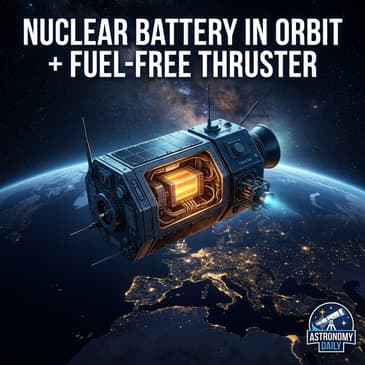
00:00:00 --> 00:00:02 Anna: From nuclear powered satellites to a, uh,
00:00:02 --> 00:00:05 thruster that never runs out of fuel. This is
00:00:05 --> 00:00:06 Astronomy Daily.
00:00:06 --> 00:00:07 Avery: I'm Avery.
00:00:07 --> 00:00:10 Anna: And I'm anna. It's Wednesday, July 8,
00:00:10 --> 00:00:13 2026, and this is season five, episode
00:00:13 --> 00:00:14 135.
00:00:14 --> 00:00:17 Avery: Big show today, Anna. We've got a genuine
00:00:17 --> 00:00:20 technology first, a Kiwi engineering trick
00:00:20 --> 00:00:22 that sounds almost too clever to be true. A
00:00:22 --> 00:00:25 plot twist five years in the making, and for
00:00:25 --> 00:00:28 once, a story that isn't about our Southern
00:00:28 --> 00:00:29 Hemisphere listeners.
00:00:29 --> 00:00:31 Anna: That's right. Today we're tipping our hat to
00:00:31 --> 00:00:33 the northern half of our audience, who make
00:00:33 --> 00:00:35 up the bulk of our listeners, but don't
00:00:35 --> 00:00:38 always get a sky story written just for them.
00:00:38 --> 00:00:41 Avery: Plus, a serious look at planetary defense.
00:00:41 --> 00:00:43 And we close things out with an astronaut
00:00:43 --> 00:00:46 who's already planning his next chapter just
00:00:46 --> 00:00:47 weeks after circling the moon.
00:00:47 --> 00:00:49 Anna: Let's get into it, and let's start with a,
00:00:49 --> 00:00:51 uh, genuine first.
00:00:51 --> 00:00:54 On July 7, SpaceX's Transporter
00:00:54 --> 00:00:56 17 rideshare mission lifted off from
00:00:56 --> 00:00:59 Vandenberg Space force base, carrying 81
00:00:59 --> 00:01:02 payloads. And tucked along them was something
00:01:02 --> 00:01:04 that's never flown before on a commercial
00:01:04 --> 00:01:04 mission.
00:01:05 --> 00:01:08 Avery: This is the Bore cubesat, built by a Florida
00:01:08 --> 00:01:10 company called City Labs. And what makes it
00:01:10 --> 00:01:12 special is what's powering one of its
00:01:12 --> 00:01:14 payloads. A tiny nuclear battery.
00:01:15 --> 00:01:17 Anna: Now, before anyone pictures a miniature
00:01:17 --> 00:01:19 reactor. This is something much gentler.
00:01:20 --> 00:01:22 It's called a beta voltaic device. City
00:01:22 --> 00:01:25 Labs calls the technology nanotritium.
00:01:26 --> 00:01:28 It takes the beta particles thrown off as
00:01:28 --> 00:01:31 tritium decays and converts them directly
00:01:31 --> 00:01:33 into electricity through a semiconductor.
00:01:33 --> 00:01:36 Avery: The power output is tiny. We're talking micro
00:01:36 --> 00:01:39 to milliwatts. Not enough to run your kettle.
00:01:39 --> 00:01:41 But here's the trick. It's continuous day or
00:01:41 --> 00:01:44 night, in sunlight or in shadow. It just
00:01:44 --> 00:01:45 keeps producing power.
00:01:45 --> 00:01:48 Anna: And tritium has a half life of 12.3
00:01:48 --> 00:01:51 years. So this thing stays effective for 20
00:01:51 --> 00:01:54 years before it quietly decays into harmless
00:01:54 --> 00:01:55 helium 3.
00:01:55 --> 00:01:57 Avery: The FAA had to sign off on this one, too.
00:01:57 --> 00:02:00 They concluded that public radiation exposure
00:02:00 --> 00:02:03 from the mission would stay under 1 millirem
00:02:03 --> 00:02:05 using conservative assumptions. So this has
00:02:05 --> 00:02:07 been vetted from a safety standpoint, not
00:02:07 --> 00:02:09 just an Engineering 1.
00:02:09 --> 00:02:12 Anna: Citilab CEO Peter Kabawi called it a
00:02:12 --> 00:02:14 historic step for commercial nuclear power in
00:02:14 --> 00:02:17 space and said it enables, quote,
00:02:17 --> 00:02:19 persistent always on payload operations
00:02:20 --> 00:02:22 that are not constrained by sunlight or
00:02:22 --> 00:02:22 battery life.
00:02:23 --> 00:02:25 Avery: Worth being? Clear. This isn't like the
00:02:25 --> 00:02:28 plutonium rtgs powering Voyager or
00:02:28 --> 00:02:30 New Horizons or the Mars rovers, which
00:02:30 --> 00:02:33 generate power from heat. This is much
00:02:33 --> 00:02:35 smaller, much lower power. And it's still
00:02:35 --> 00:02:38 relying on solar panels for its main Systems.
00:02:38 --> 00:02:40 This is a proof of concept, but
00:02:40 --> 00:02:42 Anna: it's a proof of concept with a very specific
00:02:42 --> 00:02:45 use case in mind. Permanently shadowed
00:02:45 --> 00:02:47 craters on the moon, for instance, where the
00:02:47 --> 00:02:50 sun genuinely never reaches. NASA's
00:02:50 --> 00:02:53 floated tritium beta voltaics as a way to run
00:02:53 --> 00:02:56 small autonomous sensors in exactly those
00:02:56 --> 00:02:56 conditions.
00:02:56 --> 00:02:59 Avery: Solar panels have run space missions for
00:02:59 --> 00:03:02 seven decades. This is the first real
00:03:02 --> 00:03:04 commercial attempt at an answer to the
00:03:04 --> 00:03:07 question, what happens when the sun doesn't
00:03:07 --> 00:03:08 reach you at all?
00:03:08 --> 00:03:11 Anna: It's a small battery, but if it scales, it
00:03:11 --> 00:03:13 opens some very dark corners of the solar
00:03:13 --> 00:03:13 system.
00:03:14 --> 00:03:16 Avery: Sticking with clever engineering, this next
00:03:16 --> 00:03:18 one comes from a lot closer to home for you,
00:03:18 --> 00:03:19 Anna.
00:03:19 --> 00:03:21 Anna: It does. This is a New Zealand story. A
00:03:21 --> 00:03:24 company called Zeno Astronautics, a spinoff
00:03:24 --> 00:03:26 from the University of Auckland, has just
00:03:26 --> 00:03:29 completed the first orbital test of something
00:03:29 --> 00:03:31 called the Super Torquer.
00:03:31 --> 00:03:33 Avery: And the pitch here is genuinely wild. It's a
00:03:33 --> 00:03:36 thruster that never runs out of fuel because
00:03:36 --> 00:03:38 it doesn't use any fuel at all.
00:03:38 --> 00:03:41 Anna: Here's how it works. The Super Torquer uses
00:03:41 --> 00:03:43 superconducting magnets powered by the
00:03:43 --> 00:03:46 satellite's solar panels. And those magnets
00:03:46 --> 00:03:48 push against Earth's own magnetic field.
00:03:49 --> 00:03:51 That interaction generates torque enough to
00:03:51 --> 00:03:54 turn and orient the satellite with zero
00:03:54 --> 00:03:55 propellant consumed.
00:03:55 --> 00:03:57 Avery: Superconducting magnets have been on people's
00:03:57 --> 00:04:00 wish list for this kind of job for years. But
00:04:00 --> 00:04:02 the hardware was always too big and too
00:04:02 --> 00:04:04 complicated to fit on a small satellite.
00:04:04 --> 00:04:06 Miniaturization has finally caught up with
00:04:06 --> 00:04:07 the
00:04:07 --> 00:04:09 Anna: idea to be precise about what this replaces.
00:04:10 --> 00:04:13 It's primarily for attitude control, so
00:04:13 --> 00:04:15 turning and orientation rather than big
00:04:15 --> 00:04:18 or get changing maneuvers. It's, uh, a much
00:04:18 --> 00:04:20 cleaner alternative to the cold gas thrusters
00:04:20 --> 00:04:22 satellites currently use just to point
00:04:22 --> 00:04:23 themselves the right way.
00:04:24 --> 00:04:26 Avery: But if you never need propellant for that
00:04:26 --> 00:04:28 job, a, uh, satellite's operational lifetime
00:04:28 --> 00:04:30 stops being limited by how much gas it
00:04:30 --> 00:04:31 launched with.
00:04:32 --> 00:04:34 Anna: Dano's own messaging captures the
00:04:34 --> 00:04:37 ambition nicely. They say they're trying to,
00:04:37 --> 00:04:39 quote, remove all reliance on
00:04:39 --> 00:04:42 Earth's resources so that we can build a
00:04:42 --> 00:04:45 sustainable industry in space. No
00:04:45 --> 00:04:47 tanks, no valves, nothing to run dry.
00:04:47 --> 00:04:50 Just magnets, sunlight and the planet's own
00:04:50 --> 00:04:53 magnetic field doing the work. A very
00:04:53 --> 00:04:56 kiwi way to solve a very old space
00:04:56 --> 00:04:56 problem.
00:04:57 --> 00:04:59 Now to an ongoing story that just took a
00:04:59 --> 00:05:02 genuine twist. Longtime listeners will
00:05:02 --> 00:05:04 remember we've been tracking China's Tianwen
00:05:04 --> 00:05:07 2 mission on its approach to the near Earth
00:05:07 --> 00:05:09 asteroid Kamaua Lewa.
00:05:09 --> 00:05:12 Avery: Well, on July 6th, after a 400 day,
00:05:12 --> 00:05:14 roughly 1 billion kilometer journey,
00:05:14 --> 00:05:17 Tianwen 2 arrived, settling in at a
00:05:17 --> 00:05:20 station keeping distance of about 20 km from
00:05:20 --> 00:05:23 the surface. China's space agency released
00:05:23 --> 00:05:25 the first close up image the same day.
00:05:25 --> 00:05:28 Anna: For context on what Kamalalewa actually is,
00:05:28 --> 00:05:31 it's one of only seven known quasi
00:05:31 --> 00:05:34 satellites of Earth. It orbits the sun, but
00:05:34 --> 00:05:37 it stays locked in a stable dance alongside
00:05:37 --> 00:05:40 our planet and has done so for roughly a
00:05:40 --> 00:05:43 hundred years, with about 300 more to
00:05:43 --> 00:05:43 go.
00:05:43 --> 00:05:46 Avery: The image shows a small asymmetrical rock
00:05:46 --> 00:05:48 somewhere in the range of 20 to 30 meters
00:05:48 --> 00:05:51 across. Tiny as these things go.
00:05:51 --> 00:05:54 Anna: Now, here's where it gets interesting. Since
00:05:54 --> 00:05:57 2021, the leading theory has been that Kamau
00:05:57 --> 00:06:00 Lewa is, uh, a genuine chip off our own moon,
00:06:00 --> 00:06:03 blasted off the lunar far side by the impact
00:06:03 --> 00:06:05 that created the Giordano Bruno crater
00:06:06 --> 00:06:08 somewhere between 1 and 10 million years ago.
00:06:09 --> 00:06:11 That was based on its reflectance spectrum,
00:06:11 --> 00:06:13 looking a lot like space weathered lunar
00:06:13 --> 00:06:14 soil.
00:06:14 --> 00:06:16 Avery: But just five days before Tianwen 2
00:06:16 --> 00:06:19 arrived, a JWST preprint
00:06:19 --> 00:06:22 modeled Kamawa Lea's albedo. How
00:06:22 --> 00:06:24 reflective it is. At 0.59,
00:06:25 --> 00:06:27 the moon's albedo is only about
00:06:27 --> 00:06:30 0.12. That's a huge
00:06:30 --> 00:06:32 mismatch and it's simply not compatible with
00:06:32 --> 00:06:33 a lunar origin.
00:06:33 --> 00:06:36 Anna: Astronomer Mikhail Grandvik of the University
00:06:36 --> 00:06:38 of Helsinki says the new TN12
00:06:38 --> 00:06:41 image basically confirms the albedo
00:06:41 --> 00:06:44 result from the JWST data,
00:06:44 --> 00:06:47 pointing instead toward Kamaualewa being a
00:06:47 --> 00:06:49 rare type of silicate asteroid
00:06:49 --> 00:06:51 entirely unrelated to our Moon.
00:06:51 --> 00:06:54 Avery: For five years, the story was it's a piece of
00:06:54 --> 00:06:56 the moon. That story might not survive
00:06:56 --> 00:06:57 contact with
00:06:57 --> 00:07:00 Anna: the evidence, which is exactly why Tianwen
00:07:00 --> 00:07:02 2 is there. Over the next year, it'll study
00:07:02 --> 00:07:05 kamauu Lewa with 11 science instruments
00:07:05 --> 00:07:07 before attempting to collect somewhere
00:07:07 --> 00:07:10 between 20 and 100 milligrams of surface
00:07:10 --> 00:07:13 material using whichever of three sampling
00:07:13 --> 00:07:16 techniques suits the asteroid surface best.
00:07:16 --> 00:07:19 Avery: Sample return is planned via an earth flyby
00:07:19 --> 00:07:22 around April 2027. And only then
00:07:22 --> 00:07:24 will we really know for certain what this
00:07:24 --> 00:07:25 little rock is made of.
00:07:25 --> 00:07:27 Anna: The only way to settle it for good is to
00:07:27 --> 00:07:29 bring a piece of it home.
00:07:29 --> 00:07:32 Now staying with asteroids, but shifting from
00:07:32 --> 00:07:35 origins to defense, because a new study
00:07:35 --> 00:07:37 out this week tackles a question that sounds
00:07:37 --> 00:07:39 like it's straight out of a disaster movie.
00:07:40 --> 00:07:42 Avery: How exactly do you nuke an asteroid if it
00:07:42 --> 00:07:45 ever comes to that? A peer reviewed paper
00:07:45 --> 00:07:46 published July 7 in the journal
00:07:47 --> 00:07:50 Science and Technology models two different
00:07:50 --> 00:07:52 approaches to nuclear asteroid deflection.
00:07:53 --> 00:07:55 Anna: Model one is what you'd probably
00:07:55 --> 00:07:58 an impact detonation. You hit the
00:07:58 --> 00:08:00 surface, create a shallow crater and
00:08:00 --> 00:08:02 detonate a nuclear Device there.
00:08:03 --> 00:08:05 Avery: Mode 2 is more elaborate. A, uh, pre
00:08:05 --> 00:08:08 excavation Detonation, A penetrator
00:08:08 --> 00:08:11 device digs a deeper crater first and
00:08:11 --> 00:08:14 then the warhead goes off inside that
00:08:14 --> 00:08:16 crater, achieving what the researchers call
00:08:16 --> 00:08:18 deep detonation within the asteroid's
00:08:18 --> 00:08:19 interior.
00:08:19 --> 00:08:21 Anna: The researchers modeled the energy of the
00:08:21 --> 00:08:24 launch vehicle, the impactor's velocity and
00:08:24 --> 00:08:26 the resulting change in the asteroid's own
00:08:26 --> 00:08:29 velocity for both approaches, and then tested
00:08:29 --> 00:08:31 them against a virtual database of threat
00:08:31 --> 00:08:34 asteroids, assuming warning times anywhere
00:08:34 --> 00:08:35 from one year to 20 years.
00:08:36 --> 00:08:38 Avery: The headline finding if you've got enough
00:08:38 --> 00:08:41 lead time, the deeper pre excavation
00:08:41 --> 00:08:43 approach is markedly more efficient at
00:08:43 --> 00:08:46 actually deflecting the asteroid. But if
00:08:46 --> 00:08:48 warning time is short, a simple surface
00:08:48 --> 00:08:50 impact detonation may be the only option
00:08:50 --> 00:08:52 you've got time to pull off.
00:08:52 --> 00:08:54 Anna: Worth saying. Clearly there's no known
00:08:54 --> 00:08:56 asteroid threatening Earth right now.
00:08:56 --> 00:08:59 Apophis, uh, once flagged as a risk for its
00:08:59 --> 00:09:02 2029 and 2068 close approaches,
00:09:02 --> 00:09:04 has been ruled out as a hazard for the
00:09:04 --> 00:09:05 foreseeable future.
00:09:05 --> 00:09:08 Avery: But it's not purely theoretical either. Back
00:09:08 --> 00:09:11 in 2024, a lab experiment published in
00:09:11 --> 00:09:14 Nature Physics showed that X rays from a
00:09:14 --> 00:09:16 nuclear blast could genuinely vaporize
00:09:16 --> 00:09:19 and push an asteroid's surface. And the
00:09:19 --> 00:09:21 researchers behind that suggested the
00:09:21 --> 00:09:23 technique could scale up to asteroids as
00:09:23 --> 00:09:25 large as around 4km across.
00:09:26 --> 00:09:28 Anna: And it's worth remembering the Chelyabinsk
00:09:28 --> 00:09:31 meteor back in 2013. A, uh, comparatively
00:09:31 --> 00:09:34 small object and it still caused real
00:09:34 --> 00:09:37 property damage and over a thousand injuries.
00:09:37 --> 00:09:40 Even modest sized asteroids are worth taking
00:09:40 --> 00:09:40 seriously.
00:09:40 --> 00:09:43 Avery: Hollywood's favorite plan, nuke it might
00:09:43 --> 00:09:46 genuinely be a good idea. It's just that.
00:09:46 --> 00:09:49 Exactly how you nuke it turns out to matter
00:09:49 --> 00:09:50 enormously.
00:09:50 --> 00:09:52 Anna: Not quite the Bruce Willis version, but
00:09:52 --> 00:09:55 planetary defense science is getting a lot
00:09:55 --> 00:09:57 more precise. And that's exactly what you'd
00:09:57 --> 00:09:59 want if we ever had to use it for real.
00:09:59 --> 00:10:01 Alright, time for something a little
00:10:01 --> 00:10:04 different. Avery, I believe this one's got
00:10:04 --> 00:10:05 your name on it.
00:10:05 --> 00:10:07 Avery: It does? Does. Southern hemisphere listeners
00:10:07 --> 00:10:09 feel free to sit this one out for once
00:10:09 --> 00:10:12 because this Aurora alert is entirely for
00:10:12 --> 00:10:12 our friends
00:10:12 --> 00:10:15 Anna: up north Base weather forecasters are
00:10:15 --> 00:10:18 watching. Two things line up for July 9th.
00:10:18 --> 00:10:21 First, a fast coronal mass ejection that
00:10:21 --> 00:10:23 launched from the sun on July 5th with a
00:10:23 --> 00:10:26 modeled arrival time around 6 UTC on
00:10:26 --> 00:10:26 the night.
00:10:27 --> 00:10:29 Avery: A second, a coronal hole, a patch
00:10:29 --> 00:10:32 of open magnetic field letting fast solar
00:10:32 --> 00:10:35 wind escape, is rotating into an Earth
00:10:35 --> 00:10:38 facing position and its high speed stream is
00:10:38 --> 00:10:40 expected to arrive around the same time.
00:10:40 --> 00:10:43 Anna: Put those two together and forecasters say we
00:10:43 --> 00:10:45 could see G1 class geomagnetic storm
00:10:45 --> 00:10:48 conditions. Minor on the storm scale, but
00:10:48 --> 00:10:50 enough to bring the aurora down to some
00:10:50 --> 00:10:52 surprisingly accessible latitudes.
00:10:53 --> 00:10:55 Avery: The zones to watch Seattle,
00:10:55 --> 00:10:58 Edinburgh and the northern tier of the United
00:10:58 --> 00:10:59 States and Canada.
00:11:00 --> 00:11:02 Anna: For context, this comes right after last
00:11:02 --> 00:11:05 week's monster sunspot regions rotated away
00:11:05 --> 00:11:08 to the sun's far side and they didn't go
00:11:08 --> 00:11:11 quietly, putting on a real show of flares and
00:11:11 --> 00:11:12 prominences on their way out.
00:11:12 --> 00:11:15 Avery: Solar activity's dropped back to low levels
00:11:15 --> 00:11:18 since then, mostly common C class flares
00:11:18 --> 00:11:19 with active region
00:11:19 --> 00:11:22 AR4482. Now the main
00:11:22 --> 00:11:24 feature we're watching on the Earth facing
00:11:24 --> 00:11:24 side.
00:11:24 --> 00:11:27 Anna: So if you're anywhere near Seattle, Edinburgh
00:11:27 --> 00:11:30 or the northern reaches of the US and Canada,
00:11:30 --> 00:11:32 July 9 might be where worth stepping outside
00:11:32 --> 00:11:34 at night and looking up.
00:11:34 --> 00:11:36 Avery: We don't say that to you nearly often enough.
00:11:37 --> 00:11:38 Consider this one a, uh, thank you
00:11:38 --> 00:11:40 Anna: note and we'll close today with a story about
00:11:40 --> 00:11:43 what comes after the mission of a lifetime.
00:11:43 --> 00:11:46 Avery: Jeremy Hansen, the Canadian Space Agency
00:11:46 --> 00:11:49 astronaut who became the first Canadian ever
00:11:49 --> 00:11:51 to fly around the moon back in April
00:11:51 --> 00:11:54 aboard Artemis 2, announced on July
00:11:54 --> 00:11:57 6 that he's stepping back from full time
00:11:57 --> 00:11:58 astronaut duty.
00:11:58 --> 00:12:00 Anna: Hansen flew as mission specialist alongside
00:12:00 --> 00:12:03 NASA astronauts Rosa Reid Wiseman, Victor
00:12:03 --> 00:12:06 Glover and Christina Koch on the first crewed
00:12:06 --> 00:12:08 moon mission in over 50 years.
00:12:08 --> 00:12:10 Avery: The transition takes effect this September
00:12:10 --> 00:12:13 after 32 years of military service and 17
00:12:13 --> 00:12:16 years as a CSA astronaut. He'll continue on
00:12:16 --> 00:12:18 as a reservist with the Royal Canadian Air
00:12:18 --> 00:12:21 Force and says he remains fully committed to
00:12:21 --> 00:12:23 Canada's space program, just in a different
00:12:23 --> 00:12:24 capacity.
00:12:24 --> 00:12:26 Anna: It's a nice detail that his Artemis 2 mission
00:12:26 --> 00:12:29 patch incorporated elements of Anishinaabe
00:12:29 --> 00:12:31 culture, reflecting a vision quest he
00:12:31 --> 00:12:33 undertook at A.H. turtle Lodge in Sag King
00:12:33 --> 00:12:35 First Nation during his training.
00:12:35 --> 00:12:37 Avery: In the months since the mission, he's taken
00:12:37 --> 00:12:39 on something of a public diplomacy role too.
00:12:39 --> 00:12:41 Appearances at the White House before
00:12:41 --> 00:12:43 Congressional committees and at, uh, both
00:12:43 --> 00:12:45 Canada Day and Independence Day celebrations
00:12:46 --> 00:12:48 championing the six decades long partnership
00:12:48 --> 00:12:50 between the US and Canada in space.
00:12:50 --> 00:12:53 Anna: His departure leaves the CSA with three
00:12:53 --> 00:12:55 active astronauts in its core, but as Hansen
00:12:55 --> 00:12:57 tells it, this really isn't a departure at
00:12:57 --> 00:12:58 all.
00:12:58 --> 00:13:00 Avery: Weeks after becoming the first Canadian to
00:13:00 --> 00:13:02 circle the moon and he's already planning his
00:13:02 --> 00:13:03 next chapter.
00:13:03 --> 00:13:05 Anna: A good reminder that flying to the moon isn't
00:13:05 --> 00:13:08 the end of an astronaut's story. Often it's
00:13:08 --> 00:13:10 just the most famous chapter in it.
00:13:10 --> 00:13:12 Avery: That's it for today's show. A nuclear
00:13:12 --> 00:13:15 battery, a fuel free thruster, a plot twist
00:13:15 --> 00:13:18 5 million kilometers from home, some serious
00:13:18 --> 00:13:20 planetary defense, an aurora shout out for
00:13:20 --> 00:13:23 the north, and an astronaut already planning
00:13:23 --> 00:13:23 what's next.
00:13:23 --> 00:13:25 Anna: Thanks for spending part of your day with us.
00:13:25 --> 00:13:28 Find full show notes, sources and links at
00:13:28 --> 00:13:30 astronomydaily IO and follow us at
00:13:30 --> 00:13:33 astrodaily Pod for updates between episodes.
00:13:33 --> 00:13:35 Avery: We'll be back tomorrow with more of the
00:13:35 --> 00:13:36 universe's news.
00:13:36 --> 00:13:38 Anna: Until then, Clear Skies
00:13:40 --> 00:13:40 MHM.
00:13:49 --> 00:13:50 Avery: Is the
00:13:50 --> 00:14:01 tongue.