
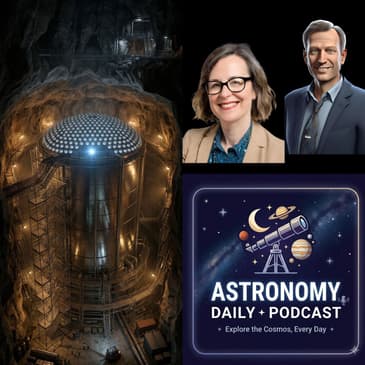
Become a supporter of this podcast: https://www.spreaker.com/podcast/astronomy-daily-latest-space-news--5648921/support.
Sponsor Details:
Ensure your online privacy by using NordVPN. To get our special listener deal and save a lot of money, visit www.astronomydaily.io/nordvpn. You'll be glad you did!
Get the best secure and private email on the planet. Stop your Government, google and who knows who else spying on every email you write. Do what we did and use ProtonMail. They beleive in privacy and there are no ads in their business model...yet they still provide a free forever service. Check them out and get out special deal at www.astronomydaily.io/protonmail
Become a supporter of Astronomy Daily by joining our Supporters Club. Commercial free episodes daily are only a click way... Click Here
This episode includes AI-generated content.
00:00:00 --> 00:00:03 Anna: Welcome back to Astronomy daily. It's Friday,
00:00:03 --> 00:00:06 September 4th, 2026. I'm
00:00:06 --> 00:00:09 Anna and this is series five, episode
00:00:09 --> 00:00:10 185.
00:00:11 --> 00:00:13 Avery: And I'm Avery. Anna.
00:00:13 --> 00:00:15 I want to start today with a number.
00:00:16 --> 00:00:17 2.6.
00:00:17 --> 00:00:20 Anna: 2.6 Sigma, which is not a
00:00:20 --> 00:00:21 discovery.
00:00:21 --> 00:00:23 Avery: M. You said that very fast.
00:00:24 --> 00:00:26 Anna: I said it fast because it's the most
00:00:26 --> 00:00:29 important sentence in the storey. But here's
00:00:29 --> 00:00:32 the rest of it. A dark matter detector a mile
00:00:32 --> 00:00:34 underground in South Dakota recorded a single
00:00:34 --> 00:00:37 flash of light in exactly the place a dark
00:00:37 --> 00:00:40 matter particle was supposed to show up. And
00:00:40 --> 00:00:42 the collaboration spent months trying to make
00:00:42 --> 00:00:45 that flash go away and could not do it.
00:00:46 --> 00:00:46 Avery: One event.
00:00:47 --> 00:00:49 Anna: One event. That's our lead.
00:00:50 --> 00:00:52 Including why we can't explain it. And
00:00:52 --> 00:00:55 we found dark matter are very different
00:00:55 --> 00:00:56 sentences.
00:00:57 --> 00:00:59 Avery: Then India has put its first imaging
00:00:59 --> 00:01:02 satellite into geostationary orbit. A,
00:01:02 --> 00:01:05 uh, real first and a capability nobody
00:01:05 --> 00:01:06 else in the region has.
00:01:07 --> 00:01:09 Anna: The first private mission to Venus has been
00:01:09 --> 00:01:12 grounded. Not by Venus, but by a
00:01:12 --> 00:01:14 rocket that hasn't flown yet.
00:01:14 --> 00:01:17 Avery: And a lovely piece of physics out of
00:01:17 --> 00:01:19 Syracuse. Why a star that keeps getting
00:01:19 --> 00:01:22 torn apart by a black hole puts on a fainter
00:01:22 --> 00:01:23 show every time.
00:01:24 --> 00:01:27 Anna: Plus the sky this weekend, both hemispheres
00:01:27 --> 00:01:29 and a new sunspot worth knowing about.
00:01:30 --> 00:01:31 Avery: Let's get into it.
00:01:32 --> 00:01:34 Start me at the beginning. Who announced what
00:01:35 --> 00:01:35 and where?
00:01:36 --> 00:01:39 Anna: The LZ collaboration, Lux Zeppelin,
00:01:39 --> 00:01:42 presented a result this week at TEV Particle
00:01:42 --> 00:01:45 Astrophysics 2026 in Chiba, Japan, which
00:01:45 --> 00:01:47 wraps up today. Brown University released it
00:01:47 --> 00:01:50 on Tuesday. The U.S. department of Energy has
00:01:50 --> 00:01:52 published its own account. And. And the paper
00:01:52 --> 00:01:54 has gone to Physical Review Letters.
00:01:55 --> 00:01:58 Avery: And LZ is the big Xenon one.
00:01:58 --> 00:02:01 Anna: LZ is the big Xenon one. 10
00:02:01 --> 00:02:04 tonnes of ultra pure liquid xenon in a tank
00:02:04 --> 00:02:06 at the Sanford Underground Research facility
00:02:06 --> 00:02:08 in Lead, South Dakota. That's the old home
00:02:08 --> 00:02:11 state gold mine. And the detector sits about
00:02:11 --> 00:02:14 a mile down, roughly 1480
00:02:14 --> 00:02:15 metres of rock overhead.
00:02:16 --> 00:02:17 Avery: Why underground?
00:02:18 --> 00:02:20 Anna: Because the enemy isn't darkness. It's noise.
00:02:21 --> 00:02:23 At the surface, you're rained on constantly
00:02:23 --> 00:02:26 by cosmic rays. A mile of rock filters
00:02:26 --> 00:02:28 nearly all of that out. Then they wrap the
00:02:28 --> 00:02:31 xenon in a water tank and a veto detector for
00:02:31 --> 00:02:33 stray neutrons and build it all from
00:02:33 --> 00:02:35 materials screened for radioactivity to
00:02:35 --> 00:02:38 absurd levels. The art of this field
00:02:38 --> 00:02:41 is subtraction. You spend 20 years
00:02:41 --> 00:02:43 removing every signal you can explain, then
00:02:43 --> 00:02:44 look at what's left.
00:02:45 --> 00:02:47 Avery: And what are they hoping is left?
00:02:47 --> 00:02:50 Anna: A, uh, wimp, weakly interacting massive
00:02:50 --> 00:02:53 particle. The leading dark matter candidate
00:02:53 --> 00:02:56 for about 40 years. A heavy particle left
00:02:56 --> 00:02:58 over from the early universe. That has mass,
00:02:58 --> 00:03:01 so it pulls on galaxies gravitationally, but
00:03:01 --> 00:03:03 ignores light and ignores ordinary matter.
00:03:03 --> 00:03:04 Almost all of the time.
00:03:05 --> 00:03:08 Avery: Almost all of the time being the operative
00:03:08 --> 00:03:08 phrase.
00:03:08 --> 00:03:11 Anna: That's the whole bet. If a WIMP occasionally
00:03:11 --> 00:03:14 bumps into an atomic nucleus, a big enough
00:03:14 --> 00:03:17 tub of xenon sitting quietly for long enough
00:03:17 --> 00:03:20 should eventually record one. The nucleus
00:03:20 --> 00:03:23 recoils and you get two flashes. A
00:03:23 --> 00:03:25 prompt one, then a second, from electrons
00:03:25 --> 00:03:28 drifting up through the liquid. Together they
00:03:28 --> 00:03:30 tell you where in the tank it happened and
00:03:30 --> 00:03:33 whether you hit a nucleus or just knocked an
00:03:33 --> 00:03:33 electron loose.
00:03:34 --> 00:03:36 Avery: Okay, tell me about the event.
00:03:37 --> 00:03:40 Anna: It's in data taken between March 2023
00:03:40 --> 00:03:42 and April 2024.
00:03:43 --> 00:03:45 220 live days. That
00:03:45 --> 00:03:48 dataset has been analysed before. LZ
00:03:48 --> 00:03:50 published world leading limits from it.
00:03:51 --> 00:03:53 What's new is that a team went back and
00:03:53 --> 00:03:55 searched a much wider range of possible
00:03:55 --> 00:03:58 interactions than the standard analysis
00:03:58 --> 00:04:00 covers, including higher energies.
00:04:00 --> 00:04:03 And one event turned up, uh, a nuclear
00:04:03 --> 00:04:05 recoil in a region where the expected
00:04:05 --> 00:04:07 background is very close to zero.
00:04:08 --> 00:04:10 Avery: Higher energy. Is that where you'd expect
00:04:10 --> 00:04:11 dark matter?
00:04:12 --> 00:04:15 Anna: No. And that's the first genuinely odd
00:04:15 --> 00:04:17 thing. The simplest WIMP models put your
00:04:17 --> 00:04:20 first signal at low energies. This is up the
00:04:20 --> 00:04:22 other end. Taken at face value, it points to
00:04:22 --> 00:04:25 a particle of at least 200 giga electron
00:04:25 --> 00:04:28 volts, more than 200 times the mass of a
00:04:28 --> 00:04:31 proton, interacting in a way the simplest
00:04:31 --> 00:04:32 models don't predict.
00:04:33 --> 00:04:35 Avery: So it's not the WIMP anyone ordered.
00:04:35 --> 00:04:38 Anna: It is not the WIMP anyone ordered.
00:04:38 --> 00:04:40 Which cuts both ways. And we'll come back to
00:04:40 --> 00:04:40 that.
00:04:41 --> 00:04:43 Avery: Give me the statistics. Honestly.
00:04:43 --> 00:04:46 Anna: 2.6- Sigma globally, 3.4-
00:04:46 --> 00:04:49 Sigma locally. And the difference between
00:04:49 --> 00:04:51 those two numbers is the most useful thing I
00:04:51 --> 00:04:52 can teach anyone today.
00:04:53 --> 00:04:54 Avery: Go on.
00:04:54 --> 00:04:57 Anna: LocalSignificants asks at this
00:04:57 --> 00:04:59 exact energy for this exact mass,
00:05:00 --> 00:05:02 how surprising is this event? Fairly
00:05:02 --> 00:05:05 surprising. Global significance asks the
00:05:05 --> 00:05:08 fairer question. I searched a whole range of
00:05:08 --> 00:05:11 masses and energies. So how surprising is it
00:05:11 --> 00:05:13 that somewhere in that range I found one odd
00:05:13 --> 00:05:16 thing? Account for the haystack and the
00:05:16 --> 00:05:19 surprise drops. That's the look elsewhere
00:05:19 --> 00:05:21 effect. Honest experiments quote both
00:05:22 --> 00:05:23 and LZ did
00:05:23 --> 00:05:26 Avery: M and 2.6 Sigma means what? In
00:05:26 --> 00:05:27 plain terms?
00:05:28 --> 00:05:30 Anna: Roughly a half a percent chance known
00:05:30 --> 00:05:32 backgrounds produced it. Which sounds
00:05:32 --> 00:05:34 compelling until you remember the bar.
00:05:35 --> 00:05:37 Particle physics calls something a discovery
00:05:37 --> 00:05:40 at five sigma, about one in three and
00:05:40 --> 00:05:43 a half million. 2.6 is nowhere near
00:05:43 --> 00:05:45 it. And physicists have watched three sigma
00:05:45 --> 00:05:47 results evaporate for decades.
00:05:48 --> 00:05:50 Avery: Did they try to kill it for months?
00:05:51 --> 00:05:54 Anna: Cosmic rays, neutrons from the rock,
00:05:54 --> 00:05:56 radioactivity in the detector materials,
00:05:57 --> 00:05:59 instrumental artefacts all modelled.
00:06:00 --> 00:06:02 Aaron Manalaise at Berkeley Lab, who chairs
00:06:02 --> 00:06:05 LZ's institutional board, said it's the first
00:06:05 --> 00:06:08 example in any experiment he's worked on of
00:06:08 --> 00:06:10 an outlier that appears valid in every way.
00:06:11 --> 00:06:12 That's a striking thing for an
00:06:12 --> 00:06:14 experimentalist to say out loud.
00:06:14 --> 00:06:16 Avery: What does the spokesperson say?
00:06:16 --> 00:06:18 Anna: Rick Gates, skull at Brown, is the
00:06:18 --> 00:06:20 spokesperson and he's been about as
00:06:20 --> 00:06:23 disciplined as you can be. His. His line
00:06:23 --> 00:06:25 with only one event. We don't want to get
00:06:25 --> 00:06:28 ahead of ourselves. We are not claiming to
00:06:28 --> 00:06:30 have seen dark matter and separately
00:06:30 --> 00:06:33 we're very intrigued to see this event in the
00:06:33 --> 00:06:35 data in the region where we expect dark
00:06:35 --> 00:06:37 matter to show up and the competing
00:06:37 --> 00:06:39 backgrounds are very low.
00:06:40 --> 00:06:41 Avery: Both things at once.
00:06:41 --> 00:06:43 Anna: Both things at once. And that's the correct
00:06:43 --> 00:06:46 posture. Sam Erickson at Bristol led the
00:06:46 --> 00:06:48 analysis and made the point that matters.
00:06:49 --> 00:06:51 Dark matter events are expected to be so rare
00:06:51 --> 00:06:53 that only a handful could mark the first
00:06:53 --> 00:06:56 detection. You can't dismiss one event for
00:06:56 --> 00:06:59 being single, but you can't build a discovery
00:06:59 --> 00:06:59 on it either.
00:07:00 --> 00:07:02 Avery: Is there a UK end um, to this?
00:07:02 --> 00:07:05 Anna: A significant one. Imperial College
00:07:05 --> 00:07:07 London did much of the work characterising
00:07:07 --> 00:07:10 the event and Henrique Araujo there put
00:07:10 --> 00:07:13 it beautifully. We need to analyse more data
00:07:13 --> 00:07:15 to be sure, but. But these are certainly
00:07:15 --> 00:07:16 interesting times.
00:07:16 --> 00:07:19 Avery: Now you promised the caveat about it not
00:07:19 --> 00:07:21 being the expected wimp.
00:07:21 --> 00:07:24 Anna: Two ways to read an unexpected signal.
00:07:24 --> 00:07:27 The generous one. Nature isn't obliged to
00:07:27 --> 00:07:30 be simple and 40 years of not finding dark
00:07:30 --> 00:07:32 matter may be exactly because we searched the
00:07:32 --> 00:07:35 tidiest places first. The unkind one,
00:07:36 --> 00:07:38 when a result lands where no model predicted,
00:07:38 --> 00:07:41 an unmodeled background is a very live
00:07:41 --> 00:07:44 explanation. The reason you haven't modelled
00:07:44 --> 00:07:45 it is that you didn't know it was there.
00:07:46 --> 00:07:48 Avery: Has this field been burned before?
00:07:49 --> 00:07:51 Anna: Repeatedly. DAMA in Italy has claimed an
00:07:51 --> 00:07:54 annual dark matter signal for over 20 years
00:07:54 --> 00:07:56 that nobody else can reproduce.
00:07:56 --> 00:07:59 Xenon1T reported an excess in 2020
00:07:59 --> 00:08:02 that caused enormous excitement and was most
00:08:02 --> 00:08:05 likely tritium contamination. A hydrogen
00:08:05 --> 00:08:07 isotope at a level almost too small to
00:08:07 --> 00:08:09 measure. That's the standard to hear this
00:08:09 --> 00:08:12 week against. To LZ's credit, they've
00:08:12 --> 00:08:14 published this as an anomaly, not a
00:08:14 --> 00:08:15 discovery.
00:08:15 --> 00:08:17 Avery: So what settles it?
00:08:17 --> 00:08:20 Anna: More xenon and more time. LZ has
00:08:20 --> 00:08:22 already banked substantially more data than
00:08:22 --> 00:08:25 went into this analysis and is running toward
00:08:25 --> 00:08:27 a thousand live days. If it's real,
00:08:27 --> 00:08:30 the rate is set by physics and more events
00:08:30 --> 00:08:33 follow. The significance climbs. If it's
00:08:33 --> 00:08:35 a fluke, it decays as exposure grows
00:08:35 --> 00:08:38 and A proposed successor, XLZD,
00:08:38 --> 00:08:41 would hold 10 times the xenon. This
00:08:41 --> 00:08:43 resolves itself in data, not argument.
00:08:44 --> 00:08:47 Avery: Southern hemisphere angle. Because dark
00:08:47 --> 00:08:49 matter feels like a Northern Hemisphere
00:08:49 --> 00:08:49 sport.
00:08:50 --> 00:08:52 Anna: It has been. And that's changing for a
00:08:52 --> 00:08:54 genuinely clever reason. There's now an
00:08:54 --> 00:08:57 underground lab in Australia, supl.
00:08:57 --> 00:09:00 The Stawell Underground Physics Laboratory, a
00:09:00 --> 00:09:02 kilometre down. A working gold mine in
00:09:02 --> 00:09:05 western Victoria. It's the first underground
00:09:05 --> 00:09:07 physics lab in the Southern hemisphere, built
00:09:07 --> 00:09:09 by the University of Melbourne with the ARC
00:09:09 --> 00:09:11 Centre of Excellence for Dark Matter Particle
00:09:11 --> 00:09:14 Physics and Ansto. And its first
00:09:14 --> 00:09:17 experiment, Sabre south, moves in late
00:09:17 --> 00:09:17 this year.
00:09:18 --> 00:09:20 Avery: And why does the hemisphere matter for dark
00:09:20 --> 00:09:21 matter of all things?
00:09:22 --> 00:09:25 Anna: Because of dama. Its claim is
00:09:25 --> 00:09:27 that the signal rises and falls once a year
00:09:28 --> 00:09:31 as Earth's motion around the sun adds to and
00:09:31 --> 00:09:33 subtracts from the solar system's motion
00:09:33 --> 00:09:36 through the galaxy's dark matter halo. The
00:09:36 --> 00:09:39 trouble is that plenty of ordinary things
00:09:39 --> 00:09:41 cycle annually too. Temperature,
00:09:41 --> 00:09:44 radon, cosmic ray rates. And
00:09:44 --> 00:09:47 in Italy they all peak in summer alongside
00:09:47 --> 00:09:48 the claimed signal.
00:09:48 --> 00:09:51 Avery: And in Victoria, the seasons are flipped.
00:09:51 --> 00:09:53 Anna: The seasons are flipped and the dark matter
00:09:53 --> 00:09:56 signal isn't. Run a near identical
00:09:56 --> 00:09:58 detector in the Southern hemisphere and a
00:09:58 --> 00:10:01 real galactic signal peaks in the same
00:10:01 --> 00:10:03 calendar month it does in Italy, while a
00:10:03 --> 00:10:05 seasonal artefact peaks six months out.
00:10:06 --> 00:10:08 Elegant piece of experiment design. And the
00:10:08 --> 00:10:10 only place on Earth you can do it is the one
00:10:10 --> 00:10:12 we happen to broadcast from.
00:10:13 --> 00:10:15 Avery: So what should people take away from today?
00:10:15 --> 00:10:18 Anna: Three things. LZ has found something it
00:10:18 --> 00:10:21 cannot explain in the right place and
00:10:21 --> 00:10:24 said so honestly. One event is one event and
00:10:24 --> 00:10:26 2.6 Sigma is a long way from a discovery.
00:10:27 --> 00:10:29 And the answer is already being collected.
00:10:29 --> 00:10:32 The detector is running right now. The honest
00:10:32 --> 00:10:34 headline is dark matter hunters find
00:10:34 --> 00:10:36 something they can't explain and refuse to
00:10:36 --> 00:10:39 overclaim it a good day for science, even if
00:10:39 --> 00:10:40 it isn't the day.
00:10:41 --> 00:10:43 Avery: On to our second storey today and this one
00:10:43 --> 00:10:45 is a genuine national first.
00:10:46 --> 00:10:49 Overnight, our time, 2:55 in the
00:10:49 --> 00:10:51 morning, Indian Standard Time on the 4th,
00:10:52 --> 00:10:54 which was 5:25 yesterday evening,
00:10:54 --> 00:10:57 US Eastern ISRO
00:10:57 --> 00:10:59 launched EOS05 on a
00:10:59 --> 00:11:02 GSLV Mark 2 out of Srihari
00:11:02 --> 00:11:03 Kota.
00:11:03 --> 00:11:06 Anna: And it's the orbit that's the storey, not the
00:11:06 --> 00:11:06 rocket.
00:11:07 --> 00:11:10 Avery: Exactly. EOS05
00:11:10 --> 00:11:12 is India's first dedicated imaging
00:11:12 --> 00:11:15 satellite headed for geosynchronous orbit.
00:11:16 --> 00:11:18 Everything India has flown for Earth
00:11:18 --> 00:11:20 observation until now has been in low
00:11:20 --> 00:11:23 orbit a few hundred kilometres up.
00:11:23 --> 00:11:25 Anna: Spell out the difference for people, a,
00:11:25 --> 00:11:28 Avery: uh, low orbit imaging satellite is a
00:11:28 --> 00:11:30 sprinter. It races around the planet in
00:11:30 --> 00:11:33 90 minutes and gives you a superb,
00:11:33 --> 00:11:36 very high resolution snapshot of a strip of
00:11:36 --> 00:11:39 ground and then it's gone. And you wait.
00:11:40 --> 00:11:42 Depending on the orbit, you might get another
00:11:42 --> 00:11:44 look in a day or, or several days.
00:11:45 --> 00:11:47 Anna: Whereas geostationary is a stair.
00:11:48 --> 00:11:49 Avery: Geostationary is a stair
00:11:50 --> 00:11:53 36 kilometres up, matching
00:11:53 --> 00:11:56 Earth's rotation. So from the ground, the
00:11:56 --> 00:11:58 satellite appears to hang motionless over the
00:11:58 --> 00:12:01 same piece of the planet permanently. You
00:12:01 --> 00:12:03 don't get a revisit time because you never
00:12:03 --> 00:12:04 leave.
00:12:04 --> 00:12:06 Anna: And that changes what you can use it for
00:12:06 --> 00:12:07 completely.
00:12:08 --> 00:12:11 Avery: Isro's framing is persistent
00:12:11 --> 00:12:13 coverage of the subcontinent and the
00:12:13 --> 00:12:15 applications are obvious once you say it that
00:12:15 --> 00:12:18 way. A, uh, cyclone forming in the Bay of
00:12:18 --> 00:12:20 Bengal. You watch it develop
00:12:20 --> 00:12:23 continuously instead of getting one frame a
00:12:23 --> 00:12:26 day. A flood, you see the water
00:12:26 --> 00:12:29 advance, a fire front, a landslide,
00:12:29 --> 00:12:31 a border. It's a dual use satellite,
00:12:32 --> 00:12:34 civil and military, and India hasn't been
00:12:34 --> 00:12:35 shy about that.
00:12:36 --> 00:12:38 Anna: There's a trade off though, surely there
00:12:38 --> 00:12:40 Avery: is, and it's worth being honest about it.
00:12:41 --> 00:12:43 You are imagining from a hundred times
00:12:43 --> 00:12:45 further away than a low orbit satellite,
00:12:46 --> 00:12:48 so the resolution is inevitably coarser.
00:12:49 --> 00:12:51 You are not reading number plates from
00:12:51 --> 00:12:53 geostationary orbit. What you're
00:12:53 --> 00:12:56 buying is time, not detail. And
00:12:56 --> 00:12:59 for disaster response, time is usually the
00:12:59 --> 00:13:00 thing you're short of.
00:13:01 --> 00:13:03 Anna: How did the launch go clean?
00:13:04 --> 00:13:05 Avery: The Spacecraft is about
00:13:05 --> 00:13:07 2
00:13:07 --> 00:13:10 kilogrammes, and ISRO chairman V
00:13:10 --> 00:13:13 Narayanan said it was successfully and
00:13:13 --> 00:13:15 precisely injected into its planned orbit.
00:13:16 --> 00:13:19 From here, EOS05 works
00:13:19 --> 00:13:21 its way up to its final station over the
00:13:21 --> 00:13:21 coming days.
00:13:22 --> 00:13:24 Anna: And the GSLV has had a mixed history.
00:13:25 --> 00:13:28 Avery: It has, which is part of why this matters to
00:13:28 --> 00:13:31 ISRO. The GSLV
00:13:31 --> 00:13:33 MK2 has now flown 12 times for
00:13:33 --> 00:13:36 10 successes. That's a vehicle that has
00:13:36 --> 00:13:39 visibly matured and it's the one carrying
00:13:39 --> 00:13:41 India's heavier missions to high orbit.
00:13:42 --> 00:13:43 Anna: Small country club.
00:13:43 --> 00:13:45 Avery: This very small,
00:13:45 --> 00:13:48 dedicated, high resolution imaging from
00:13:48 --> 00:13:50 geostationary orbit is a capability
00:13:51 --> 00:13:54 only a handful of nations have ever fielded.
00:13:54 --> 00:13:57 India has just joined that list and it did
00:13:57 --> 00:13:59 it with its own rocket from its own
00:13:59 --> 00:13:59 spaceport.
00:14:00 --> 00:14:03 Anna: Third storey, and it's a frustrating one. The
00:14:03 --> 00:14:05 first privately funded mission to another
00:14:06 --> 00:14:08 planet is still on the ground and it's going
00:14:08 --> 00:14:10 to stay there for a while yet.
00:14:10 --> 00:14:13 Avery: This is the Venus Life Finder.
00:14:13 --> 00:14:16 Anna: That's it. It's an MIT led mission
00:14:16 --> 00:14:19 driven by Sarah Seager, flying in partnership
00:14:19 --> 00:14:21 with Rocket Lab, and it is beautifully,
00:14:21 --> 00:14:24 almost aggressively simple. A small
00:14:24 --> 00:14:27 probe, one instrument, a few minutes of
00:14:27 --> 00:14:28 useful life.
00:14:29 --> 00:14:30 Avery: One instrument. That's it.
00:14:31 --> 00:14:33 Anna: One instrument. It's called an
00:14:33 --> 00:14:36 autofluorescence nifalometer, which is a
00:14:36 --> 00:14:38 mouthful for a fairly elegant idea. You
00:14:38 --> 00:14:40 fire an ultraviolet laser into the cloud
00:14:40 --> 00:14:43 droplets. As you fall through them, certain
00:14:43 --> 00:14:45 organic molecules absorb ultraviolet light
00:14:45 --> 00:14:47 and re emit it at a different wavelength.
00:14:48 --> 00:14:50 They fluoresce. So the instrument is looking
00:14:50 --> 00:14:53 for a glow that ordinary sulfuric acid
00:14:53 --> 00:14:54 chemistry shouldn't produce.
00:14:55 --> 00:14:57 Avery: And why the clouds, specifically?
00:14:58 --> 00:15:00 Anna: Because the surface of Venus is out of the
00:15:00 --> 00:15:02 question. 460 odd
00:15:02 --> 00:15:05 degrees, 90 atmospheres, but
00:15:05 --> 00:15:08 between about 45 and 60 kilometres up,
00:15:08 --> 00:15:10 the temperature and pressure are, uh, close
00:15:10 --> 00:15:12 to conditions at sea level on Earth.
00:15:13 --> 00:15:16 Extremely acidic, but not thermodynamically
00:15:16 --> 00:15:18 hopeless. That's the only plausible
00:15:18 --> 00:15:21 habitable niche on the planet. And it's what
00:15:21 --> 00:15:23 the 2020 phosphine claim put back on the
00:15:23 --> 00:15:26 table. A result that is still genuinely
00:15:26 --> 00:15:28 disputed and which this mission is designed
00:15:28 --> 00:15:30 to go and settle rather than argue about.
00:15:31 --> 00:15:33 Avery: So why isn't it flying?
00:15:34 --> 00:15:36 Anna: Neutron. The mission moved onto Rocket
00:15:36 --> 00:15:39 Lab's new medium lift rocket and Neutron
00:15:39 --> 00:15:42 hasn't flown yet. It was originally talked
00:15:42 --> 00:15:44 about for 2024, slipped to
00:15:44 --> 00:15:46 2026 and it's still in qualification.
00:15:47 --> 00:15:49 The launch date on Rocket Lab's own website
00:15:49 --> 00:15:51 now simply says to be confirmed.
00:15:52 --> 00:15:54 Avery: How is Seeger taking it?
00:15:54 --> 00:15:57 Anna: With more grace than I would. Her
00:15:57 --> 00:16:00 line was, we are awaiting neutron
00:16:00 --> 00:16:02 readiness. And she went on to say she
00:16:02 --> 00:16:04 continues to have high hopes for the mission
00:16:04 --> 00:16:07 and for its role in demonstrating what
00:16:07 --> 00:16:08 private enterprise can do in space
00:16:08 --> 00:16:09 exploration.
00:16:10 --> 00:16:12 Avery: There's an irony in there somewhere.
00:16:13 --> 00:16:15 Anna: There's a real one. The whole pitch of this
00:16:15 --> 00:16:17 mission was speed. That a small,
00:16:17 --> 00:16:20 focused, privately funded probe could go
00:16:20 --> 00:16:23 and answer one sharp question years before an
00:16:23 --> 00:16:26 agency flight could be approved, built and
00:16:26 --> 00:16:28 launched. And it's now waiting on launch
00:16:28 --> 00:16:31 capacity, which is the one part of the
00:16:31 --> 00:16:32 problem private industry was supposed to have
00:16:32 --> 00:16:33 solved.
00:16:33 --> 00:16:36 Avery: Meanwhile, Venus is getting crowded.
00:16:36 --> 00:16:39 Anna: It is. NASA's DaVinci and
00:16:39 --> 00:16:42 Veritas and Europe's Envision are all in
00:16:42 --> 00:16:43 the pipeline. For around the end of this
00:16:43 --> 00:16:46 decade, the Venus Life Finder was meant to be
00:16:46 --> 00:16:49 the scrappy one that got there first. And
00:16:49 --> 00:16:51 that lead is quietly evaporating on a launch
00:16:51 --> 00:16:52 pad in Virginia.
00:16:53 --> 00:16:55 Avery: Last news storey and it's pure
00:16:55 --> 00:16:58 astrophysics, published in the
00:16:58 --> 00:17:01 Astrophysical Journal on Tuesday, led by
00:17:01 --> 00:17:03 Ananya Bandopadhyay, a doctoral
00:17:03 --> 00:17:06 student at Syracuse University with Benjamin
00:17:06 --> 00:17:09 Amend and Eric Coughlin, plus collaborators
00:17:09 --> 00:17:12 at Leeds MIT and the Space
00:17:12 --> 00:17:14 Telescope Science Institute.
00:17:14 --> 00:17:17 Anna: And the puzzle is about stars that survive
00:17:17 --> 00:17:18 being eaten.
00:17:19 --> 00:17:22 Avery: Partly eaten. When a star wanders too
00:17:22 --> 00:17:24 close to a supermassive black hole and is
00:17:24 --> 00:17:27 ripped apart entirely, that's a tidal
00:17:27 --> 00:17:30 disruption event. One enormous flare
00:17:30 --> 00:17:32 and it's over. But there's a smaller
00:17:32 --> 00:17:35 class where the star is only partly stripped
00:17:35 --> 00:17:38 on each pass, survives and comes back
00:17:38 --> 00:17:38 around.
00:17:39 --> 00:17:42 Anna: So it flares over and over, over
00:17:42 --> 00:17:45 Avery: and over on a schedule. The
00:17:45 --> 00:17:48 Famous one is Assassin 14 Ko,
00:17:48 --> 00:17:51 which flares roughly every 114
00:17:51 --> 00:17:53 days and has done so for years.
00:17:54 --> 00:17:56 There are now something like seven or eight
00:17:56 --> 00:17:57 of these known.
00:17:58 --> 00:17:58 Anna: And what's the problem?
00:17:59 --> 00:18:02 Avery: The flares get dimmer each time. Which
00:18:02 --> 00:18:05 sounds intuitive. Less star left to strip.
00:18:05 --> 00:18:07 Except the simulations kept saying the
00:18:07 --> 00:18:10 opposite. Strip material from a star and
00:18:10 --> 00:18:13 it puffs up. And a puffier star is
00:18:13 --> 00:18:15 easier to strip next time round.
00:18:16 --> 00:18:18 Models kept producing flares that got
00:18:18 --> 00:18:21 brighter and the sky kept producing flares
00:18:21 --> 00:18:22 that got fainter.
00:18:22 --> 00:18:24 Anna: So what's the missing ingredient?
00:18:24 --> 00:18:27 Avery: Spin. This team ran
00:18:27 --> 00:18:29 hydrodynamic simulations of a high mass
00:18:29 --> 00:18:32 main sequence star being repeatedly
00:18:32 --> 00:18:34 disrupted by a black hole of about a million
00:18:34 --> 00:18:37 solar masses. And the key move was
00:18:37 --> 00:18:40 giving the star a fast rotation before the
00:18:40 --> 00:18:42 first encounter, spinning in the same
00:18:42 --> 00:18:44 direction as its orbit.
00:18:44 --> 00:18:46 Anna: Why does that change the outcome?
00:18:46 --> 00:18:48 Avery: Because ordinarily, the encounter itself
00:18:48 --> 00:18:51 spins the star up. And that spin up is
00:18:51 --> 00:18:53 part of what makes the next pass more
00:18:53 --> 00:18:56 violent. If the star arrives already
00:18:56 --> 00:18:59 rotating at a decent fraction of its breakup
00:18:59 --> 00:19:01 speed, there's very little extra spin to give
00:19:01 --> 00:19:04 it. The debris then falls back to the black
00:19:04 --> 00:19:07 hole, spread over a longer stretch of time
00:19:07 --> 00:19:10 instead of arriving in one lump. And the same
00:19:10 --> 00:19:13 material dribbling in over longer makes a
00:19:13 --> 00:19:15 fainter, more drawn out flare.
00:19:16 --> 00:19:18 Anna: Spread the fuel out and the fire is lower.
00:19:18 --> 00:19:21 Avery: That's it exactly. And with tens of
00:19:21 --> 00:19:23 percent of breakup rotation prograde,
00:19:24 --> 00:19:27 the simulations reproduce the dimming that's
00:19:27 --> 00:19:28 actually observed.
00:19:28 --> 00:19:30 Anna: Does it tell us anything about how the star
00:19:30 --> 00:19:31 got there in the first place?
00:19:32 --> 00:19:35 Avery: It does. And that's the bonus. A
00:19:35 --> 00:19:38 fast spinning star on a tight orbit around a
00:19:38 --> 00:19:40 supermassive black hole fits the Hill's
00:19:40 --> 00:19:43 mechanism. A, uh, binary pair strays too
00:19:43 --> 00:19:46 close. The black hole keeps one star
00:19:46 --> 00:19:49 and flings the other away at enormous speed.
00:19:50 --> 00:19:52 The captured one lands exactly where you need
00:19:52 --> 00:19:55 it. So the spin isn't an arbitrary
00:19:55 --> 00:19:58 knob. It's a fingerprint of how these systems
00:19:58 --> 00:19:58 get built.
00:19:59 --> 00:20:02 Anna: Right, let's get you outside. And the Moon is
00:20:02 --> 00:20:03 doing us a favour this weekend.
00:20:04 --> 00:20:05 Avery: Last quarter today.
00:20:06 --> 00:20:08 Anna: Last quarter today. September 4th. Which
00:20:08 --> 00:20:10 means it doesn't rise until around midnight.
00:20:10 --> 00:20:13 So. So the entire evening is dark. If you
00:20:13 --> 00:20:15 have been waiting for a night to actually
00:20:15 --> 00:20:17 look at something faint, this is the weekend.
00:20:18 --> 00:20:19 Avery: Southern hemisphere first.
00:20:20 --> 00:20:22 Anna: Southern hemisphere first because we get the
00:20:22 --> 00:20:25 best of it from Sydney. The sun sets about 20
00:20:25 --> 00:20:27 to 6 now, and once it's properly Dark. The
00:20:27 --> 00:20:29 centre of the Milky Way is high overhead.
00:20:30 --> 00:20:32 Sagittarius and Scorpius almost directly
00:20:32 --> 00:20:35 above you. From mid southern latitudes, the
00:20:35 --> 00:20:38 galactic core passes near the zenith, so
00:20:38 --> 00:20:39 you're looking through the least possible
00:20:39 --> 00:20:42 atmosphere. Northern listeners get the same
00:20:42 --> 00:20:44 object low and murky above the southern
00:20:44 --> 00:20:47 horizon. It's the one thing we can be smug
00:20:47 --> 00:20:50 about. And September is the last good month
00:20:50 --> 00:20:51 before it sinks westward.
00:20:51 --> 00:20:53 Avery: What do you actually look at?
00:20:53 --> 00:20:56 Anna: Find the teapot of Sagittarius with the naked
00:20:56 --> 00:20:59 eye and let your eye drift up out of the
00:20:59 --> 00:21:01 spout. That steam is the galactic
00:21:01 --> 00:21:04 centre. Binoculars turn it into star clouds
00:21:04 --> 00:21:07 and dark lanes. And the Lagoon Nebula is
00:21:07 --> 00:21:09 sitting right there, along with a dozen
00:21:09 --> 00:21:10 globular clusters.
00:21:11 --> 00:21:12 Avery: Planets.
00:21:12 --> 00:21:15 Anna: Venus in the west after sunset. Brilliant,
00:21:15 --> 00:21:18 unmistakable. Low and building toward
00:21:18 --> 00:21:20 greatest Brilliancy on the 18th.
00:21:20 --> 00:21:23 Saturn is up most of the night in Aquarius,
00:21:23 --> 00:21:25 climbing toward opposition on October 4th.
00:21:25 --> 00:21:28 And from here it passes far higher overhead
00:21:28 --> 00:21:30 than it does for northern observers.
00:21:30 --> 00:21:31 Avery: Pre dawn.
00:21:32 --> 00:21:35 Anna: Jupiter is the predawn showpiece, well up in
00:21:35 --> 00:21:37 the east before sunrise. And on Sunday
00:21:37 --> 00:21:40 morning the 6th, Mars sits just a few
00:21:40 --> 00:21:43 degrees below a thin, waning crescent Moon.
00:21:43 --> 00:21:45 That's a lovely one for a phone camera if
00:21:45 --> 00:21:46 you're up early.
00:21:47 --> 00:21:49 Avery: Now North America, because there's a proper
00:21:49 --> 00:21:50 event coming.
00:21:50 --> 00:21:53 Anna: On Tuesday the 8th, the moon occults
00:21:53 --> 00:21:56 Jupiter. The planet passes behind the
00:21:56 --> 00:21:58 lunar disc. The footprint favours
00:21:58 --> 00:22:01 northeastern Asia, where it happens in the
00:22:01 --> 00:22:04 dawn sky, and eastern North America
00:22:04 --> 00:22:06 where it happens after sunrise in broad
00:22:06 --> 00:22:08 daylight. Daylight,
00:22:09 --> 00:22:11 daylight. Which brings us to the standing
00:22:11 --> 00:22:13 reminder. And it applies directly here.
00:22:14 --> 00:22:16 If you are observing anywhere near the sun,
00:22:16 --> 00:22:19 hunting for Jupiter in a bright sky or
00:22:19 --> 00:22:21 looking at the sunspot. I'm about to mention
00:22:21 --> 00:22:24 any filter you use for direct solar viewing
00:22:25 --> 00:22:26 must be certified to the ISO
00:22:26 --> 00:22:29 123122 standard.
00:22:30 --> 00:22:32 Not sunglasses, not welding glass of unknown
00:22:32 --> 00:22:35 grade, not smoked glass, not a phone screen.
00:22:35 --> 00:22:36 ISO
00:22:36 --> 00:22:39
00:22:39 --> 00:22:41 and cheque. The certification is real.
00:22:41 --> 00:22:44 Sweeping binoculars or a telescope across a
00:22:44 --> 00:22:46 daylight sky is exactly the situation where
00:22:46 --> 00:22:49 people injure themselves permanently and it
00:22:49 --> 00:22:50 takes a fraction of a second.
00:22:51 --> 00:22:53 Avery: And the day after there's one for us.
00:22:53 --> 00:22:56 Anna: M the ninth, the Moon occults
00:22:56 --> 00:22:59 Regulus, the brightest star in Leo. And
00:22:59 --> 00:23:01 that footprint runs across the South Pacific.
00:23:01 --> 00:23:04 New Caledonia, best placed. Not Australia,
00:23:04 --> 00:23:07 unfortunately. But if you're in that track, a
00:23:07 --> 00:23:09 first magnitude star vanishing off the edge
00:23:09 --> 00:23:11 of the Moon is one of the sharpest things
00:23:11 --> 00:23:14 you'll ever see. Instantaneous.
00:23:14 --> 00:23:17 Avery: You mentioned a Sunspot, a new one,
00:23:17 --> 00:23:20 Anna: Active Region 4524, which
00:23:20 --> 00:23:23 rotated into view over the northeastern limb
00:23:23 --> 00:23:25 this week and has been busy. It fired an M
00:23:25 --> 00:23:28 M3 flare peaking at 19:20 Universal
00:23:28 --> 00:23:31 Time on Wednesday the 2nd, plus a stack of
00:23:31 --> 00:23:34 smaller ones. The coronal mass ejection from
00:23:34 --> 00:23:37 that flare isn't aimed at us, but a filament
00:23:37 --> 00:23:39 eruption the same day threw out material that
00:23:39 --> 00:23:41 may deliver a glancing blow around Monday the
00:23:41 --> 00:23:43 7th. Aurora chances
00:23:44 --> 00:23:47 modest and honest quiet conditions through
00:23:47 --> 00:23:49 the weekend, so nothing to promise tonight or
00:23:49 --> 00:23:52 Saturday. Monday is the one to watch. And if
00:23:52 --> 00:23:54 anything comes of it, the people with a shot
00:23:54 --> 00:23:56 are Tasmania and southern New Zealand down
00:23:56 --> 00:23:58 here and the northern tier of the us, Canada
00:23:58 --> 00:24:01 and Scotland up there. Watch the space
00:24:01 --> 00:24:03 weather feeds rather than the headlines.
00:24:03 --> 00:24:05 Avery: And one for northern observers with
00:24:05 --> 00:24:06 binoculars.
00:24:07 --> 00:24:09 Anna: The Double Cluster in Perseus. Two open
00:24:09 --> 00:24:12 clusters side by side in the same binocular
00:24:12 --> 00:24:15 field. Naked eye. It's a smudge in
00:24:15 --> 00:24:17 binoculars. It's one of the best sights in
00:24:17 --> 00:24:20 the sky and a moonless evening is exactly
00:24:20 --> 00:24:21 when to try it.
00:24:21 --> 00:24:24 Avery: And that's episode 185.
00:24:24 --> 00:24:27 A dark matter detector a mile underground
00:24:27 --> 00:24:30 has recorded one flash of light it cannot
00:24:30 --> 00:24:33 explain and has been admirably careful
00:24:33 --> 00:24:35 about what that does and and doesn't mean.
00:24:36 --> 00:24:38 Anna: India has put its first imaging satellite on
00:24:38 --> 00:24:41 station over the subcontinent. The first
00:24:41 --> 00:24:43 private mission to Venus is stuck waiting on
00:24:43 --> 00:24:46 a rocket that hasn't flown. And a star that
00:24:46 --> 00:24:48 keeps surviving a black hole shines a little
00:24:48 --> 00:24:51 fainter each time because of how fast it was
00:24:51 --> 00:24:51 already spinning.
00:24:52 --> 00:24:55 Avery: Full show notes, links to every primary
00:24:55 --> 00:24:57 source and the whole back catalogue are, uh,
00:24:57 --> 00:24:59 @astronomydaily.IO.
00:25:00 --> 00:25:02 Anna: you can find us on X Instagram and
00:25:02 --> 00:25:04 TikTok Strodaily pod.
00:25:05 --> 00:25:07 And if you've got a question or a correction,
00:25:07 --> 00:25:10 we genuinely want it. There's a contact form
00:25:10 --> 00:25:10 on the website.
00:25:12 --> 00:25:14 Avery: And if today's episode was useful, the single
00:25:14 --> 00:25:17 most helpful thing you can do is send it to
00:25:17 --> 00:25:18 one person who'd enjoy it.
00:25:19 --> 00:25:21 Anna: It's the weekend. Get outside and look up
00:25:21 --> 00:25:22 while the Moon's out of the way.
00:25:23 --> 00:25:24 Until tomorrow. Clear skies.
00:25:24 --> 00:25:25 Avery: Clear skies.
00:25:26 --> 00:25:27 Anna: Astronomy Day
00:25:29 --> 00:25:30 storeys
00:25:32 --> 00:25:32 the.
00:25:37 --> 00:25:37 Storey.