
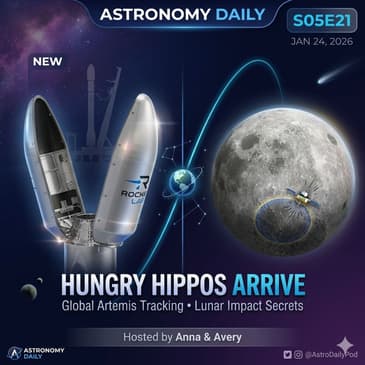
EPISODE HIGHLIGHTS:
🚀 Rocket Lab's Neutron program reaches major milestone as innovative "Hungry Hippo" reusable fairings arrive at Wallops Island after month-long sea journey from New Zealand, though first-stage tank ruptures during qualification testing at Maryland facility
🌕 NASA selects 34 volunteers from 14 countries to track Artemis II mission around the Moon, expanding from 10 participants during Artemis I and representing government agencies, commercial companies, universities, and amateur radio enthusiasts
🌑 China's Chang'e 6 lunar samples reveal unusual potassium isotope ratios in South Pole-Aitken Basin rocks, providing evidence that the giant impact 4.2 billion years ago fundamentally altered the Moon's chemistry and explains why the far side has so few maria
⭐ Space Beyond startup plans to send 1,000 people's ashes to orbit for just $249 using CubeSat technology on SpaceX rideshare mission in October 2027, founded by former Blue Origin engineer Ryan Mitchell
🪐 Astronomers detect potential exomoon around HD 206893 B that may be 40% the mass of Jupiter, so massive it could force redefinition of what constitutes a moon versus binary companion system
☄️ New research reveals 11th-century English monk Eilmer of Malmesbury recognized Halley's Comet's periodicity centuries before Edmond Halley, calling into question the comet's namesake
LINKS & RESOURCES:
• Rocket Lab Neutron development: https://www.nasaspaceflight.com/2026/01/hungry-hippos-test-tanks-neutron/
• NASA Artemis II tracking participants: https://www.nasa.gov/technology/space-comms/nasa-selects-participants-to-track-artemis-ii-mission/
• Chang'e 6 lunar impact study: https://www.space.com/astronomy/moon/a-colossal-asteroid-may-have-warped-the-moon-from-the-inside-out
• Space Beyond memorial service: https://techcrunch.com/2026/01/23/this-startup-will-send-1000-peoples-ashes-to-space-affordably-in-2027/
• Massive exomoon discovery: https://dailygalaxy.com/2026/01/alien-moon-massive-redefine-what-a-moon-is/
• Halley's Comet historical research: https://phys.org/news/2026-01-halley-comet-wrongly-11th-century.html
FOLLOW ASTRONOMY DAILY:
🌐 Website: astronomydaily.io
🐦 X/Twitter: @AstroDailyPod
📘 Facebook: @AstroDailyPod
📷 Instagram: @AstroDailyPod
🎵 TikTok: @AstroDailyPod
📺 YouTube: @AstroDailyPod
📱 Tumblr: @AstroDailyPod
Become a supporter of this podcast: https://www.spreaker.com/podcast/astronomy-daily-latest-space-news--5648921/support.
Sponsor Details:
Ensure your online privacy by using NordVPN. To get our special listener deal and save a lot of money, visit www.astronomydaily.io/nordvpn. You'll be glad you did!
Get the best secure and private email on the planet. Stop your Government, google and who knows who else spying on every email you write. Do what we did and use ProtonMail. They beleive in privacy and there are no ads in their business model...yet they still provide a free forever service. Check them out and get out special deal at www.astronomydaily.io/protonmail
Become a supporter of Astronomy Daily by joining our Supporters Club. Commercial free episodes daily are only a click way... Click Here
This episode includes AI-generated content.
00:00:00 --> 00:00:03 Anna: Welcome to Astronomy Daily, your source
00:00:03 --> 00:00:06 for the latest space and astronomy news.
00:00:06 --> 00:00:07 I'm Anna.
00:00:07 --> 00:00:09 Anna: And I'm Avery. Thanks for joining us on, um,
00:00:09 --> 00:00:12 this Saturday, January 24,
00:00:12 --> 00:00:14 2026. We've got some
00:00:14 --> 00:00:16 fantastic stories lined up for you today.
00:00:17 --> 00:00:20 Anna: We certainly do. From rocket development
00:00:20 --> 00:00:22 milestones to prehistoric lunar
00:00:22 --> 00:00:25 discoveries, today's episode is packed
00:00:25 --> 00:00:27 with celestial intrigue.
00:00:28 --> 00:00:30 Anna: Let's dive right in with our top story.
00:00:30 --> 00:00:33 Rocket Lab's ambitious neutron rocket has
00:00:33 --> 00:00:36 hit a significant milestone, even though it
00:00:36 --> 00:00:39 came with a bit of a bump in the road. Anna,
00:00:39 --> 00:00:41 what's ah, the latest from Wallops Island.
00:00:41 --> 00:00:44 Anna: Well, Avery, it's a story of both triumph
00:00:44 --> 00:00:47 and setback. The good news first.
00:00:47 --> 00:00:50 Rocket Lab's innovative Hungry Hippo
00:00:50 --> 00:00:52 fairings have successfully arrived at Wallops
00:00:52 --> 00:00:55 Island, Virginia after a month long sea
00:00:55 --> 00:00:57 journey from New Zealand aboard, uh, the
00:00:57 --> 00:01:00 vessel Northstar Integrity. These aren't
00:01:00 --> 00:01:03 your typical payload fairings. They're part
00:01:03 --> 00:01:06 of Neutron's groundbreaking reusable
00:01:06 --> 00:01:06 system.
00:01:07 --> 00:01:09 Anna: Right. And, um, what makes these Hungry
00:01:09 --> 00:01:10 hippos so special?
00:01:11 --> 00:01:14 Anna: Great question. Unlike traditional fairings
00:01:14 --> 00:01:16 that are jettisoned and lost during flight,
00:01:16 --> 00:01:19 these clamshell like structures actually
00:01:19 --> 00:01:22 stay attached to the first stage as
00:01:22 --> 00:01:25 it returns home. They open to release the
00:01:25 --> 00:01:28 second stage and payload, then close back up
00:01:28 --> 00:01:30 for the ride home. It's a clever design that
00:01:30 --> 00:01:33 should help drive down launch costs through
00:01:33 --> 00:01:34 rapid reuse.
00:01:34 --> 00:01:37 Anna: That's fascinating engineering. But you
00:01:37 --> 00:01:38 mentioned a setback.
00:01:38 --> 00:01:41 Anna: Unfortunately, yes. While the Fairings
00:01:41 --> 00:01:43 were making their journey, Rocket Lab
00:01:44 --> 00:01:46 experienced a, uh, tank rupture during
00:01:46 --> 00:01:48 qualification trials at their Middle River,
00:01:48 --> 00:01:51 Maryland facility. A first stage
00:01:51 --> 00:01:54 carbon composite tank failed during
00:01:54 --> 00:01:56 hydrostatic pressure testing. That's where
00:01:56 --> 00:01:59 they fill the structure with water and
00:01:59 --> 00:02:01 gradually increase pressure to verify it
00:02:01 --> 00:02:03 can handle operational loads.
00:02:04 --> 00:02:06 Anna: Ouch. How, uh, significant is that?
00:02:06 --> 00:02:09 Anna: Well, Rocket Lab was quick to emphasize that
00:02:09 --> 00:02:11 testing failures like this, while
00:02:11 --> 00:02:14 disappointing, are actually part of the
00:02:14 --> 00:02:16 rigorous development process for high
00:02:16 --> 00:02:19 performance rockets. They deliberately stress
00:02:19 --> 00:02:22 hardware to its limits and beyond to ensure
00:02:22 --> 00:02:25 reliability. The tank was found
00:02:25 --> 00:02:28 collapsed into a pile of debris. But the
00:02:28 --> 00:02:30 company maintains this is exactly why they
00:02:30 --> 00:02:33 test. To find these issues on the ground
00:02:33 --> 00:02:35 rather than during flight.
00:02:35 --> 00:02:38 Anna: Silver lining thinking. And, um, the program
00:02:38 --> 00:02:38 moves forward.
00:02:39 --> 00:02:42 Anna: Absolutely. With the Hungry Hippo fairings
00:02:42 --> 00:02:45 now at Wallops, engineers can proceed with
00:02:45 --> 00:02:48 integration, testing, fit checks, electrical
00:02:48 --> 00:02:51 interfaces, and eventually static fire
00:02:51 --> 00:02:53 preparations. The launch mount is already
00:02:53 --> 00:02:56 in place with the test stand ready for
00:02:56 --> 00:02:59 major testing with the rocket's second stage.
00:02:59 --> 00:03:01 Anna: Exciting times for commercial spaceflight.
00:03:02 --> 00:03:04 Now, speaking of major missions, NASA has
00:03:04 --> 00:03:07 some news about tracking the upcoming Artemis
00:03:07 --> 00:03:08 2 mission, right?
00:03:08 --> 00:03:11 Anna: They do indeed. NASA has selected
00:03:11 --> 00:03:14 34 global volunteers from 14
00:03:14 --> 00:03:17 different countries. To track the Orion
00:03:17 --> 00:03:19 spacecraft during its journey around the
00:03:19 --> 00:03:22 moon. This is a significant expansion from
00:03:22 --> 00:03:25 the Artemis 1 mission, which had only 10
00:03:25 --> 00:03:25 volunteers.
00:03:26 --> 00:03:28 Anna: So what exactly will these volunteers be
00:03:28 --> 00:03:28 doing?
00:03:29 --> 00:03:31 Anna: They'll be using their own equipment.
00:03:31 --> 00:03:33 Everything from established commercial
00:03:33 --> 00:03:36 service providers to university research
00:03:36 --> 00:03:39 facilities to individual amateur
00:03:39 --> 00:03:42 radio enthusiasts to passively track radio
00:03:42 --> 00:03:45 radio waves transmitted by Orion during its
00:03:45 --> 00:03:47 approximately 10 day mission. We're talking
00:03:47 --> 00:03:50 about 47 ground assets spanning the
00:03:50 --> 00:03:51 globe.
00:03:51 --> 00:03:53 Anna: That's impressive international cooperation.
00:03:54 --> 00:03:55 Who made the cut?
00:03:55 --> 00:03:57 Anna: The list is quite diverse. Government
00:03:58 --> 00:04:00 agencies like the Canadian Space Agency
00:04:00 --> 00:04:03 and Germany's DLR are participating.
00:04:03 --> 00:04:06 Commercial companies include GUN Hilly Earth
00:04:06 --> 00:04:09 Station in the uk, Kongsberg Satellite
00:04:09 --> 00:04:12 Services in Norway, and Intuitive Machines
00:04:12 --> 00:04:15 in Houston. Universities like UC
00:04:15 --> 00:04:18 Berkeley, the University of Pittsburgh, and
00:04:18 --> 00:04:20 even Morehead State University in Kentucky
00:04:20 --> 00:04:21 are involved.
00:04:22 --> 00:04:24 Anna: What about amateur radio operators?
00:04:24 --> 00:04:27 Anna: Oh, yes, they're well represented. We've got
00:04:27 --> 00:04:30 individuals like Chris Swire from South
00:04:30 --> 00:04:33 Dakota and Dan Slater from California.
00:04:33 --> 00:04:36 Amateur radio organizations from Argentina,
00:04:36 --> 00:04:39 Germany, the Netherlands and France are also
00:04:39 --> 00:04:41 particip. It's truly a, uh, global
00:04:41 --> 00:04:42 effort.
00:04:42 --> 00:04:45 Anna: And this data they collect, what's NASA doing
00:04:45 --> 00:04:46 with it?
00:04:46 --> 00:04:48 Anna: The volunteers will submit their tracking
00:04:48 --> 00:04:51 data to NASA for analysis. This helps the
00:04:51 --> 00:04:53 agency assess the broader aerospace
00:04:53 --> 00:04:56 community's tracking capabilities and
00:04:56 --> 00:04:58 identify ways to augment future moon and
00:04:58 --> 00:05:01 Mars mission support. Kevin Coggins,
00:05:01 --> 00:05:04 NASA's Deputy Associate Administrator for
00:05:04 --> 00:05:07 space communications and navigation, called
00:05:07 --> 00:05:09 it a real step toward scan's
00:05:09 --> 00:05:11 commercial first vision.
00:05:11 --> 00:05:13 Anna: Building that public private ecosystem for
00:05:13 --> 00:05:15 deep space exploration.
00:05:15 --> 00:05:16 Anna: Exactly.
00:05:17 --> 00:05:19 Now let's shift gears to some groundbreaking
00:05:20 --> 00:05:22 lunar research. Scientists
00:05:22 --> 00:05:25 analyzing samples from China's Chang' E6
00:05:25 --> 00:05:27 mission have made a discovery that helps
00:05:27 --> 00:05:30 explain one of the moon's most puzzling
00:05:30 --> 00:05:31 features.
00:05:31 --> 00:05:34 Anna: The asymmetry between the near and far sides.
00:05:34 --> 00:05:37 Anna: Precisely. You know how the near side of the
00:05:37 --> 00:05:39 moon has all those dark maria, those
00:05:39 --> 00:05:42 vast volcanic plains that formed the man in
00:05:42 --> 00:05:45 the Mo pattern we're all familiar with? The
00:05:45 --> 00:05:46 far side has barely any.
00:05:47 --> 00:05:49 Anna: I've always found that fascinating. What did
00:05:49 --> 00:05:50 they discover?
00:05:50 --> 00:05:53 Anna: Tonga6 brought back samples from the south
00:05:53 --> 00:05:55 pole Aitken Basin, which is one of the
00:05:55 --> 00:05:58 largest impact features in the entire solar
00:05:58 --> 00:06:01 system. About 1600 miles wide
00:06:01 --> 00:06:03 and between 4.2 and
00:06:03 --> 00:06:06 4.3 billion years old. Much
00:06:06 --> 00:06:08 older than the lunar maria, which are around
00:06:08 --> 00:06:10 3.6 billion years old.
00:06:11 --> 00:06:13 Anna: And what did these ancient samples reveal?
00:06:13 --> 00:06:16 Anna: The research team led by Heng Si Tian
00:06:16 --> 00:06:19 from the Chinese Academy of Sciences found
00:06:19 --> 00:06:21 something unusual in the basaltic rock
00:06:21 --> 00:06:24 samples. An abnormal ratio of
00:06:24 --> 00:06:27 potassium isotopes. Specifically, they
00:06:27 --> 00:06:29 found more of the heavier potassium 41
00:06:30 --> 00:06:33 relative to potassium 39 compared to
00:06:33 --> 00:06:34 samples from the near side.
00:06:34 --> 00:06:35 Anna: What Would cause that.
00:06:36 --> 00:06:38 Anna: After exploring several possibilities.
00:06:39 --> 00:06:41 Cosmic ray irradiation, magma
00:06:41 --> 00:06:44 processes, meteoritic contamination. They
00:06:44 --> 00:06:47 concluded that this isotopic signature is a
00:06:47 --> 00:06:50 relic of the giant impact that formed the
00:06:50 --> 00:06:52 south pole Aitken basin itself.
00:06:53 --> 00:06:55 Anna: So the impact actually changed the moon's
00:06:55 --> 00:06:56 chemistry?
00:06:56 --> 00:06:59 Anna: Not just changed it, it fundamentally
00:06:59 --> 00:07:02 altered it. The impact was so violent
00:07:02 --> 00:07:04 that it heated the moon's crust and mantle
00:07:04 --> 00:07:07 intensely, Causing many volatile elements,
00:07:07 --> 00:07:10 including potassium, to evaporate and escape
00:07:10 --> 00:07:13 into the lighter. Potassium 39.
00:07:13 --> 00:07:16 Isocope evaporated more easily than the
00:07:16 --> 00:07:19 heavier one, Leaving behind this unusual
00:07:19 --> 00:07:19 ratio.
00:07:20 --> 00:07:22 Anna: That's incredible detective work. And this
00:07:22 --> 00:07:24 explains the lack of Maria on the far side.
00:07:25 --> 00:07:28 Anna: Exactly. The reduction in volatiles would
00:07:28 --> 00:07:30 have suppressed magma formation, Limiting
00:07:30 --> 00:07:33 volcanism on the far side. It shows how
00:07:33 --> 00:07:35 deeply that ancient impact affected the
00:07:35 --> 00:07:38 moon's interior and why isotopic
00:07:38 --> 00:07:40 analysis can provide windows into the
00:07:40 --> 00:07:43 conditions of such catastrophic events.
00:07:43 --> 00:07:45 This research was published in the
00:07:45 --> 00:07:47 Proceedings of the National Academy of
00:07:47 --> 00:07:47 Sciences.
00:07:48 --> 00:07:49 Anna: Fascinating stuff.
00:07:49 --> 00:07:51 Now, here's something a bit more down to
00:07:51 --> 00:07:54 earth, Even if it's going to space. Anna, um,
00:07:54 --> 00:07:55 tell us about this startup that's making
00:07:55 --> 00:07:57 space memorials affordable.
00:07:57 --> 00:08:00 Anna: This is a really interesting story, Avery.
00:08:00 --> 00:08:03 A startup called Space beyond, founded by
00:08:03 --> 00:08:06 Ryan Mitchell, is planning to send up to
00:08:06 --> 00:08:08 1 people's ashes to space in
00:08:08 --> 00:08:11 October 2027 for as little as
00:08:11 --> 00:08:14 $249. Dramatically
00:08:14 --> 00:08:16 cheaper than traditional space memorial
00:08:16 --> 00:08:19 services that typically cost thousands of
00:08:19 --> 00:08:19 dollars.
00:08:19 --> 00:08:22 Anna: That's quite a price difference. How are they
00:08:22 --> 00:08:22 pulling this off?
00:08:23 --> 00:08:25 Anna: It's all about smart use of existing
00:08:25 --> 00:08:28 infrastructure. They're using a cubesat, one
00:08:28 --> 00:08:31 of those miniature cube shaped satellites
00:08:31 --> 00:08:33 that will launch as a rideshare payload on a
00:08:33 --> 00:08:36 SpaceX Falcon 9 rocket. The rideshare
00:08:36 --> 00:08:38 model has really democratized access to
00:08:38 --> 00:08:39 space.
00:08:39 --> 00:08:42 Anna: And Ryan Mitchell, he's got some serious
00:08:42 --> 00:08:43 space credentials, right?
00:08:43 --> 00:08:46 Anna: Absolutely. He worked on NASA's space
00:08:46 --> 00:08:49 shuttle program and spent nearly a decade at
00:08:49 --> 00:08:51 blue origin. The idea actually came to him
00:08:51 --> 00:08:53 while attending a, uh, family member's ash
00:08:53 --> 00:08:56 spreading ceremony. He thought, how could I
00:08:56 --> 00:08:59 do this better? And thus Space beyond was
00:08:59 --> 00:08:59 born.
00:09:00 --> 00:09:02 Anna: But there must be some limitations with such
00:09:02 --> 00:09:03 an affordable service.
00:09:04 --> 00:09:07 Anna: There are. Customers can only send about one
00:09:07 --> 00:09:10 gram of ashes. A practical limit due to
00:09:10 --> 00:09:12 weight considerations and the need to fit
00:09:12 --> 00:09:15 many customers remains in the cubesat. The
00:09:15 --> 00:09:17 satellite will only orbit for about five
00:09:17 --> 00:09:19 years before burning up in Earth's
00:09:19 --> 00:09:21 atmosphere. So it's not forever.
00:09:22 --> 00:09:25 Anna: Though that fiery ending has a certain poetic
00:09:25 --> 00:09:26 quality to it.
00:09:26 --> 00:09:28 Anna: Mitchell certainly thinks so. Plus, the
00:09:28 --> 00:09:31 CubeSat will be in a Sun synchronous orbit at
00:09:31 --> 00:09:34 about 550km altitude,
00:09:34 --> 00:09:37 meaning it'll fly over the entire globe. With
00:09:37 --> 00:09:40 modern spacecraft tracking services, families
00:09:40 --> 00:09:42 should be able to locate it and know when
00:09:42 --> 00:09:43 it's passing overhead.
00:09:43 --> 00:09:46 Anna: That's actually really touching. And, um,
00:09:46 --> 00:09:48 importantly, they're not spreading the ashes
00:09:48 --> 00:09:49 in space, right?
00:09:49 --> 00:09:52 Anna: Correct. Mitchell called that an almost
00:09:52 --> 00:09:54 nightmare scenario because the particles
00:09:54 --> 00:09:56 could create a debris cloud that could
00:09:56 --> 00:09:59 endanger other spacecraft. Since customers
00:09:59 --> 00:10:01 only send about a gram, they can do what they
00:10:01 --> 00:10:02 wish with.
00:10:02 --> 00:10:04 Anna: The rest of the thoughtful approach to a
00:10:04 --> 00:10:05 sensitive service.
00:10:06 --> 00:10:08 Now, let's talk about something that might
00:10:08 --> 00:10:11 literally redefine astronomy. Anna,
00:10:11 --> 00:10:14 tell us about this massive potential exomoon.
00:10:14 --> 00:10:16 Anna: This one's mind bending, Avery.
00:10:16 --> 00:10:19 Astronomers using the gravity instrument on
00:10:19 --> 00:10:22 the Very Large Telescope in Chile have
00:10:22 --> 00:10:24 detected what might be an exomoon orbiting
00:10:24 --> 00:10:26 the gas giant HD
00:10:26 --> 00:10:28 206893B,
00:10:29 --> 00:10:32 located 133 light years from Earth.
00:10:32 --> 00:10:35 But here's the kicker. This moon is so
00:10:35 --> 00:10:37 massive that it might force us to rethink the
00:10:37 --> 00:10:39 word moon even means.
00:10:40 --> 00:10:41 Anna: How massive are we talking?
00:10:42 --> 00:10:44 Anna: Get this. They estimate it could be as much
00:10:44 --> 00:10:47 as 40% the mass of Jupiter, or
00:10:47 --> 00:10:50 about nine times the mass of Neptune. To put
00:10:50 --> 00:10:53 that in perspective, it's thousands of times
00:10:53 --> 00:10:55 heavier than any moon in our solar system.
00:10:56 --> 00:10:58 Ganymede, Jupiter's largest moon and the
00:10:58 --> 00:11:01 biggest in our solar system, is thousands of
00:11:01 --> 00:11:03 times less massive than Neptune.
00:11:03 --> 00:11:06 Anna: Wow. So how did they even detect something
00:11:06 --> 00:11:06 like this?
00:11:06 --> 00:11:09 Anna: Through a technique called astrometry, which
00:11:09 --> 00:11:12 precisely tracks the position of celestial
00:11:12 --> 00:11:14 bodies over time. The team led by
00:11:14 --> 00:11:16 Quentin Crawl from the University of
00:11:16 --> 00:11:19 Cambridge observed a measurable wobble in
00:11:19 --> 00:11:20 HD20000
00:11:21 --> 00:11:24 6893B's motion, uh, a back and
00:11:24 --> 00:11:26 forth movement with a period of about nine
00:11:26 --> 00:11:26 months.
00:11:27 --> 00:11:29 Anna: And, um, that wobble is the Moon's
00:11:29 --> 00:11:30 gravitational tug.
00:11:30 --> 00:11:33 Anna: Exactly. Prall explained that the wobble has
00:11:33 --> 00:11:36 a size comparable to the Earth Moon distance,
00:11:36 --> 00:11:38 which is the exact signature you'd expect
00:11:38 --> 00:11:41 from an unseen companion. The potential
00:11:41 --> 00:11:44 Moon's orbit is also tilted by roughly 60
00:11:44 --> 00:11:47 degrees, suggesting a turbulent history of
00:11:47 --> 00:11:48 gravitational interactions.
00:11:49 --> 00:11:51 Anna: So at, uh, what point does something stop
00:11:51 --> 00:11:54 being a moon and become a binary companion?
00:11:54 --> 00:11:57 Anna: That's the million dollar question. Krall
00:11:57 --> 00:11:59 noted that at these masses, the distinction
00:11:59 --> 00:12:01 between a massive moon and a low mass
00:12:01 --> 00:12:04 companion becomes blurred. There's currently
00:12:04 --> 00:12:07 no official definition of an exomoon,
00:12:07 --> 00:12:10 so astronomers generally refer to any object
00:12:10 --> 00:12:12 orbiting a planet as a Moon.
00:12:12 --> 00:12:15 Anna: This could force a redefinition, potentially.
00:12:15 --> 00:12:17 Anna: Crawl suggested that as observational
00:12:17 --> 00:12:20 techniques improve, our definitions and
00:12:20 --> 00:12:23 understanding of what constitutes a moon will
00:12:23 --> 00:12:26 almost certainly evolve. He also pointed out
00:12:26 --> 00:12:28 that we're likely only seeing the tip of the
00:12:28 --> 00:12:31 iceberg just as the first exoplanets
00:12:31 --> 00:12:33 discovered were massive ones close to their
00:12:33 --> 00:12:35 stars because they were easiest to detect.
00:12:35 --> 00:12:38 The first exomoons we identify will be the
00:12:38 --> 00:12:40 most massive and extreme examples.
00:12:41 --> 00:12:44 Anna: Finding exomoons is challenging, I
00:12:44 --> 00:12:44 imagine.
00:12:45 --> 00:12:47 Anna: Extremely. The signals they produce are
00:12:47 --> 00:12:50 minute, often lost in the noise of their
00:12:50 --> 00:12:53 parent planet's data. The transit method
00:12:53 --> 00:12:56 that's revolutionized exoplanet discovery
00:12:56 --> 00:12:58 is less effective for moons because they
00:12:58 --> 00:13:01 produce light dips too faint to distinguish.
00:13:01 --> 00:13:04 But astrometry offers a new path
00:13:04 --> 00:13:07 forward, especially for detecting companions
00:13:07 --> 00:13:10 in far orbits where large stable
00:13:10 --> 00:13:12 moons are more likely to exist.
00:13:12 --> 00:13:15 Anna: This research was published in Astronomy and
00:13:15 --> 00:13:16 Astrophysics.
00:13:16 --> 00:13:19 Anna: It's been accepted for publication there, and
00:13:19 --> 00:13:21 it's currently available as a pre peer
00:13:21 --> 00:13:23 reviewed paper on arXiv. If confirmed,
00:13:24 --> 00:13:26 this would not only expand our catalog of
00:13:26 --> 00:13:29 celestial bodies, but force astronomers to
00:13:29 --> 00:13:32 rethink one of the oldest definitions in
00:13:32 --> 00:13:33 planetary science.
00:13:33 --> 00:13:34 Anna: Incredible.
00:13:34 --> 00:13:37 And finally, Anna, uh, we have a story that
00:13:37 --> 00:13:40 might rewrite history, or at least rename
00:13:40 --> 00:13:41 a famous comet.
00:13:41 --> 00:13:44 Anna: That's right. New research suggests that
00:13:44 --> 00:13:46 Halley's Comet might be wrongly maimed.
00:13:47 --> 00:13:49 Turns out an 11th century English monk
00:13:49 --> 00:13:52 named Elmer of Malmesbury understood
00:13:52 --> 00:13:55 the comet's periodic nature centuries before
00:13:55 --> 00:13:57 the British astronomer Edmund Halley.
00:13:58 --> 00:14:00 Anna: Wait, so Halley wasn't the first to figure
00:14:00 --> 00:14:01 this out?
00:14:01 --> 00:14:04 Anna: According to research by Professor Simon
00:14:04 --> 00:14:06 Portage Zwart and colleagues published in the
00:14:06 --> 00:14:09 book Doristat. And everything after,
00:14:09 --> 00:14:12 Gilmer witnessed Halley's comet twice in
00:14:12 --> 00:14:14 989 CE and again in
00:14:14 --> 00:14:17 1066 CE and realized it was
00:14:17 --> 00:14:19 the same comet returning.
00:14:20 --> 00:14:21 Anna: How do we know this?
00:14:21 --> 00:14:24 Anna: The events are described by the 12th century
00:14:24 --> 00:14:27 chronicler William of Malmesbury. But this
00:14:27 --> 00:14:29 connection had gone unnoticed by scholars
00:14:29 --> 00:14:32 until now. The 1066 appearance
00:14:32 --> 00:14:35 is actually depicted on the famous Bayeux
00:14:35 --> 00:14:37 Tapestry, which illustrates the events of
00:14:37 --> 00:14:40 that year, including the Norman Conquest of
00:14:40 --> 00:14:40 England.
00:14:41 --> 00:14:44 Anna: So Ilmer must have been quite elderly to see
00:14:44 --> 00:14:44 it twice.
00:14:44 --> 00:14:47 Anna: Exactly. Given that the Comet appears
00:14:47 --> 00:14:50 roughly 76 years, he would have been
00:14:50 --> 00:14:53 advanced in age when he witnessed it for the
00:14:53 --> 00:14:56 second time. And here's a fascinating detail.
00:14:56 --> 00:14:59 As was customary at the time, when he saw it
00:14:59 --> 00:15:02 in 1066, the king was warned
00:15:02 --> 00:15:05 of impending disaster. The
00:15:05 --> 00:15:07 comet appeared during the brief reign of King
00:15:07 --> 00:15:10 Harold Godwinson, who died at the Battle of
00:15:10 --> 00:15:11 Hastings that October.
00:15:12 --> 00:15:14 Anna: Medieval people really did see comets as
00:15:14 --> 00:15:15 omens, didn't they?
00:15:16 --> 00:15:18 Anna: They did indeed. The research shows that
00:15:18 --> 00:15:21 comet appearances around this time were
00:15:21 --> 00:15:23 consistently associated with the deaths of
00:15:23 --> 00:15:26 kings, war or famine in the British Isles.
00:15:26 --> 00:15:28 The researchers even found what might be
00:15:28 --> 00:15:31 historical fake news. Uh, a comet
00:15:31 --> 00:15:33 supposedly seen before the death of
00:15:33 --> 00:15:35 Archbishop Seidrich of Canterbury in
00:15:35 --> 00:15:38 995, which wasn't actually recorded
00:15:38 --> 00:15:41 in the chronicles. Possibly an exaggeration
00:15:41 --> 00:15:42 to frighten people.
00:15:42 --> 00:15:44 Anna: So what are the researchers calling for?
00:15:45 --> 00:15:47 Anna: They're arguing that Halley's Comet should be
00:15:47 --> 00:15:49 given a, uh, different name since it had been
00:15:49 --> 00:15:51 observed twice and its periodicity
00:15:51 --> 00:15:54 understood centuries before Halley's work.
00:15:54 --> 00:15:56 Portuguese Wort mentioned that while the
00:15:56 --> 00:15:59 research was fun to do, it was challenging
00:15:59 --> 00:16:01 working in such an interdisciplinary project
00:16:02 --> 00:16:04 alongside a historian. Nevertheless, they
00:16:04 --> 00:16:06 plan to carry out further research into
00:16:06 --> 00:16:09 periodic comet it's amazing how.
00:16:09 --> 00:16:11 Anna: Interdisciplinary research can uncover these
00:16:11 --> 00:16:13 historical oversights.
00:16:13 --> 00:16:16 Anna: It really is. And it shows that scientific
00:16:16 --> 00:16:18 discovery isn't always about new
00:16:18 --> 00:16:21 observations. Sometimes it's about looking at
00:16:21 --> 00:16:23 old records with fresh eyes.
00:16:24 --> 00:16:26 Anna: Well, that's all the time we have for today's
00:16:26 --> 00:16:28 episode. What a journey we've been on. From
00:16:28 --> 00:16:31 rocket fairings to ancient lunar impacts,
00:16:31 --> 00:16:33 affordable space memorials to massive
00:16:33 --> 00:16:34 exomoons and.
00:16:34 --> 00:16:37 Anna: Historical comet discoveries, it never
00:16:37 --> 00:16:40 ceases to amaze me how much is happening in
00:16:40 --> 00:16:43 space and astronomy every single day. From
00:16:43 --> 00:16:45 cutting edge engineering to billion year old
00:16:45 --> 00:16:48 mysteries, there's always something new to
00:16:48 --> 00:16:48 learn.
00:16:48 --> 00:16:50 Anna: Thanks so much for tuning in to Astronomy
00:16:50 --> 00:16:52 Daily. Be sure to visit our website at
00:16:52 --> 00:16:55 astronomydaily IO for detailed shown
00:16:56 --> 00:16:57 notes, transcripts and links to all the
00:16:57 --> 00:16:59 stories we discussed today.
00:16:59 --> 00:17:01 Anna: And don't forget to follow us on social
00:17:01 --> 00:17:04 media. We're astrodaily, pod on
00:17:04 --> 00:17:06 X, Facebook, Instagram, TikTok,
00:17:06 --> 00:17:08 YouTubeMusic, and Tumblr.
00:17:08 --> 00:17:11 Anna: Until next time, keep looking up and keep
00:17:11 --> 00:17:13 exploring the wonders of our universe.
00:17:14 --> 00:17:15 Anna: Clear skies everyone.
00:17:22 --> 00:17:22 Love.