
---
**Episode Summary:**
Join Steve Dunkley and his trusty AI sidekick Hallie for a stormy edition of Astronomy Daily. As the summer thunder rumbles, our hosts navigate through a cosmic tempest of space news on this 19th February 2024 episode. From the cutting-edge IM1 mission to the moon to the latest on asteroid defense and the dark universe exploration by Euclid, there's no shortage of stellar stories to electrify your day. Plus, Steve shares his thoughts on why he's not quite ready to sign up for a simulated Mars mission, even as NASA seeks volunteers for an out-of-this-world experience.
---
**Featured Topics:**
1. **IM1 Mission to the Moon:** Steve and Hallie discuss the recent launch of Intuitive Machines' first robotic lunar lander and its journey to the moon's surface, highlighting the mission's significance for NASA's Artemis programme.
2. **Asteroid Defense:** An overview of the National Academies' recommendations for planetary defense, featuring NASA's Goldstone solar system radar and the next-generation radar system's potential to protect Earth.
3. **Euclid's Dark Universe Survey:** Insights into the Euclid spacecraft's six-year mission to map the dark universe, its groundbreaking technology, and the tantalizing mysteries it may unravel about dark matter and dark energy.
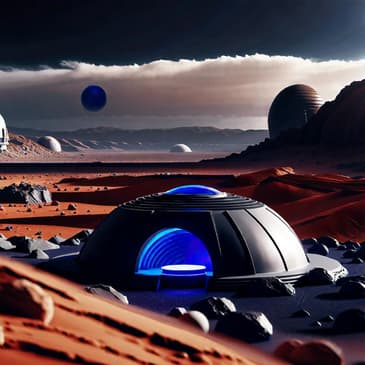
4. **Simulated Mars Mission:** A call for adventure as NASA seeks applicants for its CHAPEA analogue missions, offering a glimpse into the preparation for human exploration of the Red Planet.
---
**Notable Quotes:**
- "Australia is a weird place... lightning and thunder in the middle of summer. But in space, it's always clear skies, right Hallie?" - Steve Dunkley
- "Rocks in the sky, end of civilization as we know it – asteroids sure know how to keep things interesting." - Hallie
- "I'm a dedicated groundhog... You'd have a hard time getting me in a tall elevator these days, let alone a Mars habitat simulation." - Steve Dunkley
---
**Additional Information:**
Don't forget to subscribe to the Astronomy Daily newsletter for daily updates on all things cosmic. Visit bitesz.com or spacenuts.io to stay informed and explore the vast universe of Astronomy Daily episodes and the parent podcast, Space Nuts, with Andrew Dunkley and Professor Fred Watson.
---
**Next Episode Preview:**
Tune in next week for another episode packed with celestial happenings and interstellar insights. Steve and Hallie will be back to guide you through the latest developments in space exploration and the ever-expanding knowledge of our universe.
---
**Closing Remarks:**
As we close today's episode with an eye on the tumultuous weather, we're reminded of the calm yet dynamic expanse of space that awaits our exploration. Thank you for joining us on this journey through the cosmos. Until next time, keep your feet on the ground and your eyes on the stars.
---
**Host Sign-off:** Steve Dunkley: "Stay safe, unplug when necessary, and always keep looking up!" Hallie: "Farewell, until our paths cross again in the vastness of space.
Become a supporter of this podcast: https://www.spreaker.com/podcast/astronomy-daily-latest-space-news--5648921/support.
Sponsor Details:
Ensure your online privacy by using NordVPN. To get our special listener deal and save a lot of money, visit www.astronomydaily.io/nordvpn. You'll be glad you did!
Get the best secure and private email on the planet. Stop your Government, google and who knows who else spying on every email you write. Do what we did and use ProtonMail. They beleive in privacy and there are no ads in their business model...yet they still provide a free forever service. Check them out and get out special deal at www.astronomydaily.io/protonmail
Become a supporter of Astronomy Daily by joining our Supporters Club. Commercial free episodes daily are only a click way... Click Here
[00:00:00] Hello and welcome to the Astronomy Daily studios for another afternoon. It's the 19th of February 2024
[00:00:16] That's right Steve Dunkley here with Astronomy Daily for another day and joining me in the studio as always is our fabulous
[00:00:23] Dictracee of space science Hallie. Hi there Hallie. Hi Steve
[00:00:27] What's going on with the weather at your place? It's pouring today. I thought it was supposed to be hot
[00:00:32] Well, you're right about that. We just can't tell at the moment Hallie. This is what we call a summer storm
[00:00:37] It's not exactly cold and it is the middle of summer
[00:00:40] But it's dark and gray out there and lightning and thunder. That's crazy. Oh, yeah, it is a bit
[00:00:47] Australia is a weird place. Oh well no argument from me Hallie
[00:00:50] I was driving across town to get here this morning
[00:00:54] In here in Newcastle and the sky was flickering with lightning spikes all over the place from a huge black
[00:00:59] Weatherfront just off the coast and it was quite the experience. Well, I'm glad you're back at the studio safe and sound
[00:01:06] Well, I'm just hoping we don't lose power Hallie. You might have to get out and push
[00:01:10] Oh, no, that won't be pretty. Anyway, Hallie, what's in the mix today? Okay
[00:01:15] You're talking about the I am one mission to the moon, which is super interesting
[00:01:20] Well that it is I've got a great story about asteroids because I know you love talking about asteroids
[00:01:26] Well, Hallie they are interesting and you know some of them could be
[00:01:30] Potentially threatening to us, you know asteroids this asteroids that rocks in the sky end of civilization as we know it
[00:01:37] Hey, wait a minute. Steve. I liked you better when you talked about your guitar collection
[00:01:41] Oh, well, that is a pretty good collection
[00:01:43] Just kidding and we see that Euclid has begun its six year study of the dark universe
[00:01:49] Oh, now that really does sound like the intro to a new science fiction series boldly going where
[00:01:54] No probe has gone before yeah into the dark universe only it has some terrific equipment to discover new things
[00:02:01] I know you'll like the optics Steve. Oh, well, what I do know is the wild wide field
[00:02:06] Imaging system with a 70 minute exposure spoiler alert. Oh gosh, sorry. Okay back to you
[00:02:12] And I got just the thing for your next holiday Steve. Oh, I can hardly wait. Don't sound so excited
[00:02:17] I will know in you Hallie. I'll be chained to a nerf herder in the spice mines of Kessel for a week just for fun
[00:02:23] Spoilsport how about I start the news briefs then yeah, okay, then that sounds great back to you
[00:02:36] How can humans protect the earth from devastating asteroid and comet impacts?
[00:02:42] According to the national academies and their 2023 to 2032 planetary science and astrobiology decadal survey
[00:02:49] Ground-based astronomical radar systems will have a unique role to play in planetary defense
[00:02:56] There is currently only one system in the world concentrating on these efforts
[00:03:00] NASA's goldstone solar system radar, which is part of the deep space network
[00:03:05] However, a new instrument concept from the national radio astronomy observatory
[00:03:09] Which is referred to as the next generation radar system will use the national science foundations green bank
[00:03:16] And other current and future facilities to expand on these capabilities
[00:03:20] Tony Beasley and r. A. O.'s director believes that there are many applications for the future of radar
[00:03:26] From substantially advancing knowledge of the solar system to informing future robotic and crude spaceflight as well as
[00:03:32] Characterizing hazardous objects that stray too close to earth
[00:03:36] Most recently the green bank telescope helped confirm the success of nasa's dart mission
[00:03:41] The first test to see if humans could successfully alter the trajectory of an asteroid
[00:03:47] The green bank telescope is the world's largest fully steerable radio telescope
[00:03:52] The maneuverability of its 100 meter dish enables it to observe 85 percent of the celestial sphere
[00:03:58] Allowing it to quickly track objects across its field of view
[00:04:02] New radar transmitter designs like next generation radar on the green bank telescope
[00:04:07] Have the potential to significantly increase the output power and waveform bandwidth allowing for even higher resolution imaging
[00:04:15] It will also produce a scalable and more robust system by using telescope arrays to increase the collecting area
[00:04:22] So how does ground-based astronomical radar expand our understanding of the universe?
[00:04:28] By allowing us to study our nearby solar system and everything in it in unprecedented detail
[00:04:34] Radar can reveal the surface and ancient geology of planets and their moons letting us trace their evolution
[00:04:41] It can also determine the location size and speed of potentially hazardous near earth objects like comets or asteroids
[00:04:49] On july 1st 2023 the euclid spacecraft launched with a clear mission to map the dark and distant universe
[00:04:57] To achieve that goal over the next six years euclid will make 40 000 observations of the sky beyond the milky way
[00:05:05] From this data astronomers will be able to map the positions of billions of galaxies allowing astronomers to observe the effects of dark matter
[00:05:14] There have been several galactic sky surveys before but euclid's mission will take them to the next level
[00:05:21] Euclid is equipped with a wide field imaging system
[00:05:24] With each 70 minute exposure of the dark sky it will capture the image and spectra of more than 50 000 galaxies
[00:05:32] When it is complete the euclid survey will be the most detailed survey of galactic positions and distances
[00:05:39] The mission will also make several deep sky observations where it focuses on the most distant and dim galaxies
[00:05:46] One of the mysteries euclid could answer is the nature of dark energy
[00:05:51] The standard model of cosmology describes dark energy as a property of space and time
[00:05:57] A cosmological constant that drives cosmic expansion
[00:06:01] But some theories of dark energy argue that it's an energy field within space and time and that cosmic expansion isn't constant
[00:06:09] Euclid will study whether cosmic expansion varies allowing astronomers to constrain or rule out certain models
[00:06:16] The mission will also look at how dark matter distorts galaxies
[00:06:20] Allowing us to learn more about the properties of dark matter and how it interacts with regular matter
[00:06:26] The euclid mission officially began its survey on valentine's day and will complete about 15 percent of its survey this year
[00:06:33] An initial deep sky data set will be released in spring 2025 and data from the first year of the general survey will be released in summer
[00:06:41] 2026 and steve you said you needed a holiday
[00:06:46] This might be for you
[00:06:48] NASA is seeking applicants to participate in its next simulated one-year Mars surface mission to help inform the agency's plans for human exploration of the red planet
[00:06:59] The second of three planned ground based missions called chapia crew health and performance exploration analog is scheduled to kick off in spring 2025
[00:07:08] Each chapia mission involves a four-person volunteer crew living and working inside a 1700 square foot
[00:07:14] 3d printed habitat base
[00:07:17] The next mission is to explore the red planet and the planet
[00:07:22] And then the next mission is to explore the red planet
[00:07:25] The second of three planned ground based missions called chapia crew health and performance exploration analog is scheduled to kick off in spring 2025
[00:07:34] The NASA space center is a 1700 square foot 3d printed habitat based at nasa's johnson space center in houston
[00:07:41] The habitat called the mars doon alpha simulates the challenges of a mission on mars including resource limitations
[00:07:49] equipment failures communication delays and other environmental stressors
[00:07:53] Crew tasks include simulated spacewalks robotic operations habitat maintenance exercise and crop growth
[00:08:01] NASA is looking for healthy motivated u.s citizens or permanent residents who are non smokers
[00:08:07] 30 to 55 years old and proficient in english for effective communication between crewmates and mission control
[00:08:14] Applicants should have a strong desire for unique rewarding adventures and an interest in contributing to nasa's work to prepare for the first human journey to mars
[00:08:24] As nasa works to establish a long-term presence for scientific discovery and exploration on the moon through the Artemis campaign
[00:08:31] Chapia missions provide important scientific data to validate systems and develop solutions for future missions to the red planet
[00:08:39] With the first chapia crew more than halfway through their yearlong mission
[00:08:42] NASA is using research gained through the simulated missions to help inform crew health and performance support during mars expeditions
[00:08:50] The deadline for applicants is tuesday april second
[00:08:55] And that's all the news briefs for today steve over to you
[00:08:58] Oh, thank you for that haly interesting stuff as always and i don't think i'll be signing up for any mars missions simulated or otherwise
[00:09:05] Anytime soon. You know, I made dedicated groundhog
[00:09:08] I think we all know that by now
[00:09:10] Fair to say you'd have a hard time getting me in a tall elevator these days true enough
[00:09:16] So while we're enjoying the knowledge that stunning and amazing professionals are training themselves into finely honed space found creatures of the void
[00:09:23] You might like to join me in visiting the astronomy daily websites to sign up for the astronomy daily newsletter
[00:09:30] Just visit bites
[00:09:32] dot com that's
[00:09:34] b-i-t-e-s z dot com or
[00:09:36] Spacenuts.io and drop your email address into the slot provided to receive the famous
[00:09:40] astronomy daily newsletter
[00:09:42] In your email every day. It's full of all these news about space space science and astronomy from all around the globe
[00:09:49] Stay informed and up to date every day and while you're there check out the archives of astronomy daily's back editions
[00:09:56] And also our parent podcast Spacenuts featuring andrew dunkley. Yes my big brother and astronomer at large professor fred
[00:10:03] Watson of the australia observatory
[00:10:05] I believe we are in great company and you can be too so sign up today and we'll see you in the astronomy daily newsletter every day
[00:10:30] Now if you're like me and you've been watching the skies you'll know that on february 15 intuitive machines
[00:10:36] first robotic lunar lander mission to the moon's surface
[00:10:40] Launched aboard the space x falcon 9 rocket from nasa's kennedy space center intuitive machines successfully
[00:10:48] Transmitted its first i am one mission images to earth on february 16
[00:10:54] 2024 that was only the other day the images were captured shortly after separation from space x's second stage
[00:11:01] intuitive machines first journey to the moon under nasa's
[00:11:04] clps
[00:11:05] initiative the clps
[00:11:07] Is the commercial lunar payload services system which puts agency science instruments on private robotic moon landers like odysseus
[00:11:16] These instruments are designed to collect data that will aid nasa's artemis program
[00:11:22] Which aims to establish a crew base near the
[00:11:26] lunar south pole by the end of the 2020s
[00:11:30] The mission is carrying nasa scientific research and technology demonstrations
[00:11:35] To help us better understand the challenging environment of the lunar south pole region and improve landing precision
[00:11:41] And safety ahead of future artemis astronaut missions to the moon
[00:11:45] Odysseus is carrying six nasa experiments and technology
[00:11:50] demonstrations along with six private payloads on its current i am one mission
[00:11:56] i am one wasn't the first cpa
[00:11:58] clps effort to get off the ground that distinction goes to the debut flight of peregrine a moon lander built by
[00:12:05] Pittsburgh as a company astrobotic which launched last month atop a united launch alliance
[00:12:12] Centaur rocket that launch went well
[00:12:14] But the peregrine suffered a fuel leak shortly after separating from the rocket's upper stage and the lander couldn't reach the moon
[00:12:21] So its handlers steered the uh it into a controlled destruction in earth's atmosphere on january 18
[00:12:28] Things have been going better for odysseus
[00:12:31] The lander is healthy and communicating with mission control as it heads toward the moon for a planned february 22
[00:12:39] touchdown attempt intuitive machines has said this
[00:12:42] Odysseus's various systems are performing normally
[00:12:46] Including its engine which just aced a crucial check out in deep space
[00:12:52] intuitive machines flight controllers
[00:12:55] successfully fired up the first liquid methane and liquid oxygen engine in space completing the i am one mission engine
[00:13:03] commissioning this engine firing included a full thrust main stage engine burn and throttle down profile necessary to land on the moon
[00:13:11] The company said in an x post on friday
[00:13:14] Success on the upcoming landing try would be historic no private spacecraft has ever touched down softly on the moon
[00:13:22] odysseus's liquid methane
[00:13:25] um liquid oxygen combination by the way is also employed by space x's raptor engines which uh power the company's giant new starship rocket
[00:13:34] Starship which space x is developing to get people to the moon and to mars
[00:13:39] And to mars is being prepped for its third test flight just by the way which could take place in the next few weeks
[00:13:49] Exciting happenings now if you go over to space nuts podcast group on facebook you'll notice i put a
[00:13:56] video up there the last couple of days of
[00:14:01] Odysseus
[00:14:04] Separating from the
[00:14:06] Falcon 9 it was a great video and it goes on for a bit of while you get to see the
[00:14:10] control room and a lot of chatter of course which is always good to listen in on
[00:14:16] So have a look at that on the space nuts podcast group facebook page
[00:14:23] And just like that another episode of astronomy daily splashes down. Thank you so much for staying with us
[00:14:28] I know i'm cutting it short a little bit today
[00:14:32] And that's because i've got one eye on the weather. There is a massive front moving in from the southeast and a new castle
[00:14:38] That means unplug everything. So i'm about to do that
[00:14:43] So, uh, thank you again for staying with us. There will be more in store for us next week
[00:14:48] Right hallie. So don't forget to tune in
[00:14:51] And if they do forget to tune in hallie, there's always the astronomy daily and space nuts back edition library available anytime
[00:14:58] That's right on those websites bites.com and
[00:15:02] Spacenuts.io you can still hear us on spotify. Hey hallie, you could run this on your own, couldn't you? You never know
[00:15:10] See you all next time
[00:15:15] With your host Steve dunkley