
Ascend to the dizzying heights of the Atacama Desert where the University of Tokyo Atacama Observatory (TAO) now claims the title of the world's highest astronomical observatory. With its unparalleled view of the heavens, TAO is set to unveil the secrets of planetary formation and the evolution of galaxies, all from its lofty perch of 5,640 meters above sea level. The journey of TAO is a narrative of endurance, international unity, and respect for both human culture and scientific advancement.
Next, we delve into the ambitious SMILE mission, a testament to the power of international collaboration between the European Space Agency and the Chinese Academy of Sciences. This mission is set to unravel the mysteries of solar winds and their impact on Earth's magnetosphere, promising to deepen our understanding of space weather and its effects on our planet and beyond.
Step back in time with us as we explore the National Museum of the US Air Force's latest exhibit, Mercury Atlas 9, a replica that stands as a monument to America's early spaceflight endeavors. Relive the pioneering spirit of astronaut Gordon Cooper's solo orbital mission and the legacy of an era that propelled humanity into the cosmos.
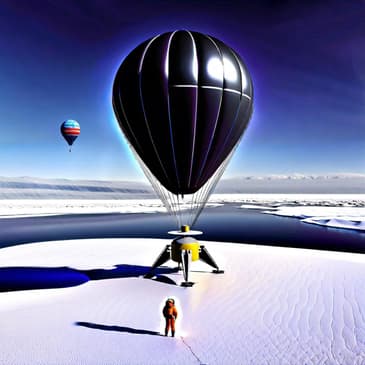
Lift your gaze as NASA's long-duration scientific balloons prepare to ascend from Sweden's Esrange Space Center, embarking on a mission to capture the intricacies of cosmic rays, solar phenomena, and the enigmatic black holes. These balloons, akin to floating observatories, promise to bring home a wealth of knowledge from the edge of space.
Join us in celebrating the bright minds at the 2024 FIRST Robotics World Championships, where NASA's presence underscored their commitment to inspire the next generation of space explorers. Witness the synergy of youthful innovation and NASA's pioneering technologies, fostering a future where the stars are within our reach.
Finally, we report on the bustling activity aboard the International Space Station, where scientific experiments and international cooperation converge in a microgravity dance of discovery. From producing perfect optical fibers to 3D printing heart tissues, the ISS continues to be a beacon of human achievement and a symbol of our shared journey among the stars.
This episode of Astronomy Daily - The Podcast is a voyage through the latest astronomical developments and the stories they tell. Join us as we traverse the universe, one discovery at a time.
---
**Featured Topics:**
1. **TAO - World's Highest Observatory:** A new pinnacle in astronomical observation.
2. **SMILE Mission:** ESA and China's collaborative venture into solar wind mysteries.
3. **Mercury Atlas 9 Exhibit:** Celebrating the golden age of spaceflight.
4. **NASA's Scientific Balloons:** High-altitude expeditions for cutting-edge research.
5. **FIRST Robotics World Championships:** NASA's role in fostering future innovators.
6. **ISS Update:** A hub of scientific progress and international unity.
---
**Additional Information:**
For more cosmic content, visit astronomydaily.io, and join us on X @AstroDailypod) for the latest updates and stellar discussions. Until next time, this is Anna, reminding you to keep your eyes on the skies and your sense of wonder alive. Clear skies and cosmic dreams to all our fellow stargazers!
This episode is brought to you by NordPass, the password manager that secures your celestial data. To grab our special offer and find out more, visit www.bitesz.com/nordpass
Become a supporter of this podcast: https://www.spreaker.com/podcast/astronomy-daily-the-podcast--5648921/support
#space #astronomy #news #podcast #TAO #SMILEmission #MercuryAtlas9 #NASABalloons #RoboticsChampionships #ISS #NordPass #AstroDailyPod
Sponsor Details:
Ensure your online privacy by using NordVPN. To get our special listener deal and save a lot of money, visit www.astronomydaily.io/nordvpn. You'll be glad you did!
Get the best secure and private email on the planet. Stop your Government, google and who knows who else spying on every email you write. Do what we did and use ProtonMail. They beleive in privacy and there are no ads in their business model...yet they still provide a free forever service. Check them out and get out special deal at www.astronomydaily.io/protonmail
Become a supporter of Astronomy Daily by joining our Supporters Club. Commercial free episodes daily are only a click way... Click Here
Welcome listeners to Astronomy Daily, the podcast your daily guide to the Cosmos. Today, we're embarking on a celestial adventure, exploring a realm that stretches far beyond our earthly confines. From the unveiling of a groundbreaking observatory to innovative scientific missions that push the boundaries of our understanding, There's much to uncover, so join us as we navigate through some fascinating astronomical developments and insights from across the globe. Prepare to be amazed, because the universe has stories to tell, and we're here to bring them right to your ears. Let's begin our journey through the stars the forecast. Perched precariously at the zenith of scientific endeavor and altitude, we find the groundbreaking TAO or the University of Tokyo, at a Comma observatory, now marking its place as the world world's highest astronomical observatory. With its eyepiece piercing the skies from Chile's ethereal Atacama Desert, Tao's ambition reaches as far into the cosmos as its home reaches toward the heavens. Standing at a monumental five thousand six hundred forty meters above sea level, Astronomers now have access to a clarity of vision unmatched by any other ground based telescope, offering a fresh perspective on how planets form, how galaxies evolve, and even the mystery surrounding the dawn of the universe itself. The location is no mere feet of geographic novelty. The arid, rarefied air and the significantly reduced atmospheric moisture at this altitude provide an exceptional environment for infrared astronomy, an essential tool to observe stellar nurseries where new worlds are birthed. The journey to this point has been nothing short of an odyssey, involving twenty six painstaking years of planning and challenges that transcend mere engineering. The Tao project in bodies a true synthesis of international collaboration, engaging with indigenous communities, local and national governments, and health and safety to ensure that the ambitious venture respects both human livelihood and scientific pursuit. It is here where Professor Takashimiyada envisions unearthing the hidden narratives of countless galaxies, utilizing cutting edge instruments like the simultaneous color wide field infrared multi object spectrograph or SWIMS to streamline our understanding of these cosmic constructs. The clarity provided by tao's privileged vantage point allows us to observe the universe's ballet more closely, refining our grasp on the life cycle of stars and the intricate dance of the galaxies they inhabit. With the operational commencement of the Tao, a portal has been opened for the seasoned academic and the bright eyed student astronomer alike, for the diligent researchers developing bespoke instruments specific to their increes. Tao is not merely a tool, but a canvas on which the mysteries of the universe might finally be etched into the ledger of human comprehension. Looking forward, it is the silent promise of Tao that excites the yet to be discovered phenomena and the theories waiting to be berthed from its observations. As young astronomers peer through this eye of the world high above the desolate stretches of the Atacama, humanity's comprehension of the cosmos will be forever sharpened on the altitude of endeavor and the edges of a dream made reality. In a historic cooperative venture, the European Space Agency has joined forces with the Chinese Academy of Sciences for a mission audaciously named SMILE, an acronym for Solar Wind Magnetosphere Ionosphere Link Explorer, aimed at unraveling the complex dynamics of solar winds. SMILE stands as a feather in the cap of European space endeavors with eyes set on the late twenty twenty five horizon. A Vega Sea rocket from Europe's spaceport in French Guiana has been carefully selected for this mission, showcasing Europe's burgeoning capabilities in space access. The choice of the vagacy, known for its adaptability and precision, underscores the critical nature of the SMILE mission's objectives. This mission is poised to significantly advance our understanding of the interactions between solar wind and Earth's magnetosphere, with a particular focus on the impact these interactions have on our terrestrial environment. It's a mission fundamental to deepening our knowledge of space weather and how it affects not only our planet's natural systems, but also our technologies, communication networks, and even astronauts safety. Smile will embark on its journey into a highly elliptical orbit perfect for continuous observation and monitoring of solar wind phenomena. By harnessing novel imaging technologies that span the spectrum from X ray to ultraviolet, the mission promises to deliver tantalizing new views of the magnetosphere and the breathtaking auroras. What sets SMILE apart is not only its ambitious scientific goals, but also its nature. As the first comprehensive space science collaboration between ESA and China, it marks a new chapter in global space exploration, where international cooperation paves the way for groundbreaking scientific achievement. The Smile mission thus encapsulates a blend of international partnership, technological prowess, and a thirst for knowledge that is the hallmark of human exploration. As we look to the skies, preparations gain momentum, and the promise of a deeper understanding of our solar system awaits stepping back in time to the era when the Space Race captured the world's imagination. The National Museum of the US Air Force proudly unveils its latest exhibit, Mercury Atlas nine, a towering symbol of America's venture into the unknown beyond our atmosphere. This replica of the famed rocket now stands erect amidst the giants of aerospace history. Visitors are invited to gaze upon the intricate craft that once carried astronaut Gordon Cooper into orbit, encapsulating the tension, ambition, and hope of early spaceflight. On May fifteenth, nineteen sixty three, atop the original Mercury Atlas nine, Gordon Cooper orbited our planet twenty two times, etching his name into the annals of history as the last NASA astronaut to complete a solo orbital mission. His spacecraft, dubbed Faith seven, was an emblem of human perseverance and technological innovation, transcending Earth's gravitational pull and delivering dreams into the cosmos. The exhibit captures the essence of that momentous journey, preserving the spirit of an era that furthered our reach into the stars. Now resting among a collection that charts the evolution of missiles and rockets, Mercury Atlas nine serves as a gateway to past glories and a source of inspiration for future endeavors. The museum's new addition not only commemorates the brave soul who piloted them through the silence of space, but also fosters an enduring fascination with the great beyond, beckoning visitors to reflect on our collective journey through the vastness of space and time Astronomy Daily podcast. As scientists continuously strive to understand the ever expanding mysteries of our universe, sometimes the journey of discovery doesn't require a spacecraft, but rather a return to one of the earliest methods of high altitude exploration. In an upcoming and exciting venture, NASA turns to the skies above Sweden to launch a series of long duration scientific balloons from the Swedish Space Corporations as Range Space Center, located in the Serene Expanses north of the Arctic Circle. These balloons are not your standard party fair picture. This towering, stadium sized structures soaring to the edge of space with missions that will take our research capabilities to new heights. Mid May marks the start of NASA's twenty twenty four Sweden Long Duration's Scientific Balloon campaign. Leveraging the near constant sunlight of the polar summer for uninterrupted observation. These zero pressure giants will carry a suite of scientific payloads, dedicating many days, even months to gather valuable data as they gracefully traverse the stratosphere from Sweden to Canada. But what kind of scientific cargo warrants such an extraordinary expedition. One of the primary missions is HELIX, the High Energy Light Isotope Experiment. Beyond its catchy name, HELIX poses a powerful magnet to scrutinize the flux of cosmic ray isotopes, information crucial to understanding the life cycles of the very particles that travel through our galaxy. Then there is BOOMS, the balloon Observation of microburst Scales, with its visionary X ray eyes set to reveal the transient bursts of energetic electrons above the polar atmosphere. The Sunrise three Solar Observatory takes ambitions sky high with high resolution tools to aim the magnetic fields, temperatures, and motions within our Sun's vibrant corona. And let us not forget excel Caliber Eager, with its telescopic lens poised to unravel the X ray emissions from the enigmatic black holes and neutron stars scattered across our cosmos. These missions are but a snapshot of the campaign's potential, with several smaller piggyback missions adding to the trove of science, from studying the structures of organic dust to the potential for printed organs. The goals are as diverse as they are profound. Each balloon's flight not only sheds light on the mysteries of the universe, but also serves as an aerial platform that challenges our ingenuity and thrives on collaboration. As we await the ascent of these behemoths of science, we are reminded of the power of partnership and the enduring human quest for knowledge. From the great expanse of Swedish skies, these balloons are ready to capture snapshots of Nature's grand tapestry, allowing us to unravel, thread by thread, the very fabric of the universe. At the twenty twenty four First Robotics World Championships, NASA was present in full force, a true testament to their commitment to pave the path for future innovation. Their presence went beyond mere participation. They stood there as emblems of a pioneering spirit that fuels the drive for new technologies. Here amongst the whir of motors and gleam of metal, NASA's displayed technologies are not just for show, but are manifestations of their mission to inspire. They brought to the four advancements that could shape the future of space exploration, robotics, and beyond. The Championships were a gathering of brilliant young minds from around the globe, each bringing their own unique approach to problem solving and engineering. It's here that NASA sees the reflection of their own values, a relentless pursuit of knowledge and an unwavering desire to explore the unknown. By engaging with the enthusiastic competitors at the Championships, NASA is nurturing a new GENI generation of creators, thinkers, and explorers. These are the individuals who will one day lead us to new frontiers, possibly even those beyond the skies that currently limit us. As the competitions roared with excitement and collaboration, NASA's exhibitions stood as a beacon of what's possible when we dare to combine curiosity with science. This is not just a competition, It is a celebration of human ingenuity, a reminder that the journey of discovery is an ongoing saga, and everyone, especially the youth, is invited to be a part of it. The International Space Station, our home in the Heavens, has been a hive of activity during the month of April, a buzz with science and the comings and goings of astronauts and cargo ships. April was marked by significant movement on the ISS, with the departure of the Soyuz MS twenty four, trimming the station's population from ten residents to seven. This marked the beginning of Expedition seventy one, seeing astronauts and cosmonauts from around the globe continue humanities enduring presence in orbit. A diverse assortment of scientific endeavors has kept the crew busy. Experiments ranged from producing perfect optical fibers, potentially revolutionizing communications on Earth, to the biofabrication facilities three D printing of heart tissues, a step that hints at a future where organs could be printed on demand. Human physiology and microgravity remained a central study point. This month. The astronauts contributed to the Cipher project, which investigates human health in space, from eye function to blood pressure, aiming to prepare us for even more extended stays off our planet. The eyes of the crew, both literally and through the lens of optical equipment, have turned to the stars. The crew performed detailed eye scans exploring spaceflight associated neuroocular syndrome, also known as SANDS. This holds implications for maintaining astronaut health on lengthy missions to Mars or Ether other celestial bodies. And let's not forget the extra vehicular activities. Grand spacewalks saw Russian cosmonauts venture outside the station to conduct vital maintenance and deployment tasks. This kind of work is essential in keeping the ISS functioning as the modern marvel. It is a testimony to international cooperation and human ingenuity in the face of outer space's vast unknowns. In the spirit of such cooperation, we saw the first fully collaborative space science venture between ESA and China, Smile etch closer to its spaceborne voyage. Furthermore, the anticipation grew for the upcoming Crew eight mission adjustments, which will welcome Boeing's CST one hundred Starliner spacecraft and exciting development in commercial spaceflight. The Cosmos doesn't just inspire awe, it challenges us to learn, adapt and overcome. And as our astronauts gaze upon Earth from the heavens, they remind us of our shared humanity and the path toward a future amid the stars. That dear listeners is the latest from the International Space Station, our beacon of scientific progression and a testament to what we can achieve together in space. Thank you for joining us on today's cosmic journey. It's been a pleasure sharing the latest awe inspiring developments in astronomy and space exploration with you. For more space news and to relive past episodes, be sure to visit our website at Astronomy Daily dot io, and don't forget You can keep up with all the celestial happenings and get your daily dose of the Cosmos by following us for updates on x at astro Daily Pod. Until next time, this is Anna signing off, reminding you to keep looking up and stay curious about the wonders of the universe. Sunday Star, the Boy still is control