
Become a supporter of this podcast: https://www.spreaker.com/podcast/astronomy-daily-latest-space-news--5648921/support.
Sponsor Details:
Ensure your online privacy by using NordVPN. To get our special listener deal and save a lot of money, visit www.astronomydaily.io/nordvpn. You'll be glad you did!
Get the best secure and private email on the planet. Stop your Government, google and who knows who else spying on every email you write. Do what we did and use ProtonMail. They beleive in privacy and there are no ads in their business model...yet they still provide a free forever service. Check them out and get out special deal at www.astronomydaily.io/protonmail
Become a supporter of Astronomy Daily by joining our Supporters Club. Commercial free episodes daily are only a click way... Click Here
This episode includes AI-generated content.
00:00:00 --> 00:00:02 Anna: Today, right now, as you're listening,
00:00:02 --> 00:00:05 SpaceX may already have launched something
00:00:05 --> 00:00:08 the world barely knows exists, a brand
00:00:08 --> 00:00:10 new spacecraft, a secret disk shaped
00:00:10 --> 00:00:13 capsule called Starfall. It blasted off
00:00:13 --> 00:00:16 this morning from Cape Canaveral and it could
00:00:16 --> 00:00:19 change how things are made in space. Today on
00:00:19 --> 00:00:21 Astronomy Daily. That story plus the next
00:00:21 --> 00:00:24 great space telescope just touched down in
00:00:24 --> 00:00:27 Florida and the most mysterious glow in the
00:00:27 --> 00:00:30 galaxy just got a whole lot more mysterious.
00:00:30 --> 00:00:31 Stay with us.
00:00:31 --> 00:00:34 Hello and welcome to Astronomy Daily. I'm
00:00:34 --> 00:00:34 Anna.
00:00:34 --> 00:00:37 Avery: And I'm Avery. It is Tuesday 23rd
00:00:37 --> 00:00:40 June, 2026, and the universe has been
00:00:40 --> 00:00:40 busy.
00:00:41 --> 00:00:44 Anna: We have six big stories for you today. A same
00:00:44 --> 00:00:47 day launch, a telescope milestone, two
00:00:47 --> 00:00:49 JWST blockbusters, a, uh,
00:00:49 --> 00:00:52 ticking clock, space rescue and China's
00:00:52 --> 00:00:54 asteroid mission. Approaching the moment of
00:00:54 --> 00:00:54 truth.
00:00:55 --> 00:00:56 Avery: Let's get into it.
00:00:56 --> 00:00:59 Anna: Here's something a bit unusual to kick things
00:00:59 --> 00:01:01 off. We're covering a story that is happening
00:01:01 --> 00:01:04 right now, this morning. As this episode goes
00:01:04 --> 00:01:07 out, SpaceX launched,
00:01:07 --> 00:01:09 Avery: or is about to launch, a spacecraft that the
00:01:09 --> 00:01:11 company has said almost nothing about
00:01:11 --> 00:01:12 publicly.
00:01:12 --> 00:01:15 Anna: It's called Starfall. And everything we know
00:01:15 --> 00:01:18 about it comes not from SpaceX press releases
00:01:18 --> 00:01:21 or Elon tweets, but from filings with the
00:01:21 --> 00:01:23 U.S. federal Aviation Administration and
00:01:23 --> 00:01:25 Federal Communications Commission.
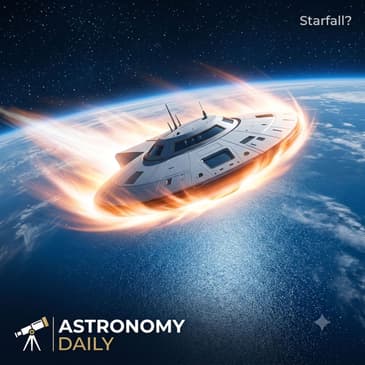
00:01:26 --> 00:01:28 Avery: So what is it? Starfall is a re entry
00:01:28 --> 00:01:31 capsule, a vehicle designed to carry cargo
00:01:31 --> 00:01:34 into orbit and bring it safely back to Earth.
00:01:34 --> 00:01:36 But it's not another dragon. It's a flat
00:01:36 --> 00:01:39 disk, about 3.1 meters across and
00:01:39 --> 00:01:42 only 75 centimeters tall. Think of a
00:01:42 --> 00:01:44 large flying saucer rather than a pointy
00:01:44 --> 00:01:45 rocket cone.
00:01:46 --> 00:01:48 Anna: The launch window opened at, uh, 6:43 this
00:01:48 --> 00:01:50 morning, Eastern Time. That's
00:01:50 --> 00:01:53 8:43pm here on the east coast of
00:01:53 --> 00:01:56 Australia. It's flying on a Falcon 9 from
00:01:56 --> 00:01:58 Cape Canaveral Space Force Station, the
00:01:58 --> 00:02:01 booster supporting the mission on its 29th
00:02:01 --> 00:02:01 flight.
00:02:02 --> 00:02:04 Avery: Now, why does this matter? The target market
00:02:04 --> 00:02:07 is space manufacturing. The idea is that
00:02:07 --> 00:02:10 microgravity, true weightlessness, lets
00:02:10 --> 00:02:13 you make things you can't make on Earth. Pure
00:02:13 --> 00:02:15 pharmaceutical crystals, advanced materials,
00:02:15 --> 00:02:18 bio printed tissues. But to make any of that
00:02:18 --> 00:02:20 commercially viable, you need a cheap,
00:02:20 --> 00:02:23 reliable way to bring your product home.
00:02:23 --> 00:02:26 Anna: Until now, a small California company called
00:02:26 --> 00:02:28 Varda Space Industries has been pioneering
00:02:28 --> 00:02:31 that market. They've flown six capsule
00:02:31 --> 00:02:33 missions. But their capsules are small,
00:02:33 --> 00:02:35 carrying dozens of kilograms at most.
00:02:36 --> 00:02:38 Starfall is rated for up to
00:02:38 --> 00:02:41 1000kg. That's roughly 30
00:02:41 --> 00:02:42 times more return capacity,
00:02:43 --> 00:02:45 Avery: which creates an interesting situation
00:02:45 --> 00:02:47 because Varda has been launching all of its
00:02:47 --> 00:02:50 missions on SpaceX rockets. SpaceX
00:02:50 --> 00:02:52 is now entering the market.
00:02:52 --> 00:02:54 Anna: It's been powering after reentry
00:02:54 --> 00:02:57 starfall splashes down in the Pacific Ocean
00:02:57 --> 00:02:59 off the US West coast, about
00:02:59 --> 00:03:02 1km offshore. It's
00:03:02 --> 00:03:04 designed to be mass produced for starship
00:03:04 --> 00:03:06 flights in the future. Though Today's demo
00:03:06 --> 00:03:09 uses Falcon 9, SpaceX
00:03:09 --> 00:03:11 Avery: has been approved for two re entry
00:03:11 --> 00:03:14 demonstrations. This is the first. We'll be
00:03:14 --> 00:03:16 watching closely for news of a successful
00:03:16 --> 00:03:16 recovery.
00:03:17 --> 00:03:19 Anna: A genuinely exciting morning to be a space
00:03:19 --> 00:03:20 nerd.
00:03:20 --> 00:03:23 Now, from a launch happening today to a
00:03:23 --> 00:03:25 launch that's just a couple of months away,
00:03:25 --> 00:03:27 NASA's next great space telescope
00:03:27 --> 00:03:30 Avery: has arrived in Florida, the Nancy Grace
00:03:30 --> 00:03:33 Roman Space Telescope. Roman for short,
00:03:33 --> 00:03:35 arrived at the Kennedy Space center on Sunday
00:03:35 --> 00:03:38 21 June, riding NASA's
00:03:38 --> 00:03:40 Pegasus barge down from Baltimore after being
00:03:40 --> 00:03:43 loaded up at Goddard Space Flight center in
00:03:43 --> 00:03:43 Maryland.
00:03:44 --> 00:03:46 Anna: The telescope was tucked inside a special
00:03:46 --> 00:03:49 transport container that NASA has nicknamed I
00:03:49 --> 00:03:52 love this, the Chariot, keeping with the
00:03:52 --> 00:03:54 Roman theme because the telescope is named
00:03:54 --> 00:03:57 after Nancy Grace Roman, NASA's very
00:03:57 --> 00:04:00 first chief of astronomy, not after the
00:04:00 --> 00:04:03 Empire. Roman is often called the
00:04:03 --> 00:04:05 mother of Hubble. She was the driving force
00:04:05 --> 00:04:08 behind getting Hubble built in the first
00:04:08 --> 00:04:10 place. It's a fitting tribute.
00:04:10 --> 00:04:13 Avery: Now roman is at KSC's Payload Hazardous
00:04:13 --> 00:04:14 Servicing Facility for final launch
00:04:14 --> 00:04:17 preparations. The team will check all six
00:04:17 --> 00:04:19 solar panels, inspect insulation and thermal
00:04:19 --> 00:04:22 blankets, and load around 290 gallons
00:04:22 --> 00:04:24 of hydrazine fuel.
00:04:24 --> 00:04:26 Anna: And here's the headline number NASA is
00:04:26 --> 00:04:29 targeting launch no earlier than Sunday 30th
00:04:29 --> 00:04:32 August on a SpaceX Falcon Heavy.
00:04:32 --> 00:04:35 And that timeline puts Roman a full eight
00:04:35 --> 00:04:37 months ahead of its original schedule.
00:04:37 --> 00:04:40 Avery: Eight months ahead. That's remarkable for a
00:04:40 --> 00:04:41 flagship space telescope.
00:04:42 --> 00:04:45 Anna: So what will Roman actually do? Its main
00:04:45 --> 00:04:48 Instrument is a 300 megapixel infrared
00:04:48 --> 00:04:51 camera with a field of view 100 times
00:04:51 --> 00:04:53 wider than Hubble's. It will survey billions
00:04:53 --> 00:04:56 of galaxies, discover hundreds of thousands
00:04:56 --> 00:04:59 of exoplanets, probe dark energy and
00:04:59 --> 00:05:02 dark matter, and do all of this at speeds and
00:05:02 --> 00:05:04 scales that simply weren't possible before.
00:05:05 --> 00:05:07 Avery: It also carries a coronagraph, a starlight
00:05:07 --> 00:05:10 blocking instrument that will directly image
00:05:10 --> 00:05:13 planets around nearby stars, a key step
00:05:13 --> 00:05:14 in the long hunt for Earth.
00:05:14 --> 00:05:17 Anna: Like worlds after launch, Roman will travel
00:05:17 --> 00:05:20 to the second Sun, Earth, Lagrange Point L2,
00:05:20 --> 00:05:23 about 1.5 million kilometers from
00:05:23 --> 00:05:25 Earth, the same neighborhood where the James
00:05:25 --> 00:05:28 Webb Space Telescope is parked right now.
00:05:28 --> 00:05:31 Avery: Webb looking deep and narrow, Roman
00:05:31 --> 00:05:33 looking wide and fast. They're going to
00:05:33 --> 00:05:35 complement each other beautifully.
00:05:35 --> 00:05:37 Anna: And speaking of the James Webb Space
00:05:37 --> 00:05:39 Telescope, let's talk about what it's been
00:05:39 --> 00:05:41 showing us lately, because JWST
00:05:41 --> 00:05:44 keeps finding things that shouldn't be there.
00:05:44 --> 00:05:46 Avery: This week, a series of three new papers
00:05:46 --> 00:05:48 published in the Astrophysical Journal
00:05:48 --> 00:05:51 Letters reveal something extraordinary about
00:05:51 --> 00:05:52 a galaxy cluster called
00:05:52 --> 00:05:55 XLSSC122.
00:05:55 --> 00:05:58 Anna: Now, XLSSC122 was
00:05:58 --> 00:06:01 first spotted way back in 2014 during an X
00:06:01 --> 00:06:03 ray survey. It's about 10.4
00:06:04 --> 00:06:06 billion light years away, meaning we're
00:06:06 --> 00:06:08 seeing it as it existed when the universe was
00:06:08 --> 00:06:11 only around 3.3 billion years old.
00:06:11 --> 00:06:14 That era is called cosmic noon, the peak
00:06:14 --> 00:06:17 of star formation when galaxies were building
00:06:17 --> 00:06:19 themselves at a furious rate.
00:06:19 --> 00:06:22 Avery: It looks far too grown up for its age. It's
00:06:22 --> 00:06:24 large, it's organized, it has a dense,
00:06:24 --> 00:06:27 concentrated core. A According to standard
00:06:27 --> 00:06:30 cosmological models, galaxy clusters that far
00:06:30 --> 00:06:32 back should still be loose, scattered. Still
00:06:32 --> 00:06:35 assembling, this one looks like it's had
00:06:35 --> 00:06:37 millions of years more to develop than it
00:06:37 --> 00:06:37 should have.
00:06:37 --> 00:06:40 Anna: But JWST has now revealed something
00:06:40 --> 00:06:43 even more surprising. When astronomers
00:06:43 --> 00:06:45 pointed the telescope at this cluster, they
00:06:45 --> 00:06:48 discovered it's acting as a gravitational
00:06:48 --> 00:06:51 lens. Its immense mass is bending and
00:06:51 --> 00:06:53 warping the light of even more distant
00:06:53 --> 00:06:55 galaxies behind it, creating beautiful
00:06:55 --> 00:06:58 blue gray arcs around the cluster's center.
00:06:58 --> 00:07:01 Avery: And that makes XLSSC122 the
00:07:01 --> 00:07:04 most distant galaxy cluster ever confirmed to
00:07:04 --> 00:07:07 act as a strong gravitational lens. Some of
00:07:07 --> 00:07:09 that bent light set out on its journey more
00:07:09 --> 00:07:11 than 12 billion years ago.
00:07:11 --> 00:07:13 Anna: The lensing effect is dominated not by the
00:07:13 --> 00:07:16 cluster's stars and gas, but by dark matter.
00:07:17 --> 00:07:19 By studying the arcs, the team at Caltech's
00:07:19 --> 00:07:22 IPAC can map the dark matter distribution
00:07:22 --> 00:07:25 with remarkable precision. And what they
00:07:25 --> 00:07:27 found is a core that's far more concentrated
00:07:27 --> 00:07:28 than their models.
00:07:28 --> 00:07:30 Avery: Predictable the third paper in the series
00:07:30 --> 00:07:33 found something called intracluster light, a
00:07:33 --> 00:07:35 faint glow from stars that have been stripped
00:07:35 --> 00:07:38 loose from their galaxies and now drift free
00:07:38 --> 00:07:39 through the cluster.
00:07:39 --> 00:07:42 XLSSC122 is the
00:07:42 --> 00:07:44 earliest known cluster where this glow has
00:07:44 --> 00:07:45 been detected.
00:07:45 --> 00:07:47 Anna: These results were announced at the
00:07:47 --> 00:07:49 248th meeting of the American
00:07:49 --> 00:07:52 Astronomical Society. Lead author Kyle
00:07:52 --> 00:07:55 Finner from IPAC summed it up before
00:07:55 --> 00:07:58 JWST we couldn't do this level of
00:07:58 --> 00:08:00 science in the early distant universe.
00:08:00 --> 00:08:02 Avery: It's another reminder that the early universe
00:08:02 --> 00:08:05 was far more structured and stranger than our
00:08:05 --> 00:08:05 models expected.
00:08:06 --> 00:08:08 Next up, we're staying in the realm of dark
00:08:08 --> 00:08:10 matter because a new study published in
00:08:10 --> 00:08:13 Physical Review Letters has just reignited
00:08:13 --> 00:08:16 one of astrophysics most stubborn debates.
00:08:16 --> 00:08:19 Anna: At the heart of our Milky Way, there's a
00:08:19 --> 00:08:22 mysterious spherical glow of high energy
00:08:22 --> 00:08:25 gamma rays. It extends for thousands of light
00:08:25 --> 00:08:27 years out from the galactic center. NASA's
00:08:27 --> 00:08:30 Fermi telescope first spotted it in the late
00:08:30 --> 00:08:33 2000s, and astronomers have been arguing
00:08:33 --> 00:08:34 about it ever since.
00:08:34 --> 00:08:37 Avery: It's called the galactic center excess, and
00:08:37 --> 00:08:40 there are two main explanations. One, a, uh,
00:08:40 --> 00:08:43 huge population of millisecond pulsars,
00:08:43 --> 00:08:46 rapidly spinning neutron stars that beam
00:08:46 --> 00:08:49 gamma rays outward. Two, dark
00:08:49 --> 00:08:51 matter particles annihilating each other.
00:08:52 --> 00:08:54 When two dark matter particles collide and
00:08:54 --> 00:08:56 destroy each other, they can release energy,
00:08:56 --> 00:08:58 including gamma rays.
00:08:58 --> 00:09:00 Anna: The pulsar explanation had been gaining
00:09:00 --> 00:09:03 ground in recent years. Some earlier
00:09:03 --> 00:09:06 analyses suggested a relatively modest
00:09:06 --> 00:09:08 population of a few hundred pulsars could
00:09:08 --> 00:09:10 explain the signal.
00:09:10 --> 00:09:13 Avery: But this new research, led by Florian List at
00:09:13 --> 00:09:16 the University of Vienna and Nick Rod at the
00:09:16 --> 00:09:18 Lawrence Berkeley National Laboratory, has
00:09:18 --> 00:09:21 changed the picture. They trained a machine
00:09:21 --> 00:09:23 learning model on more than 1 million
00:09:23 --> 00:09:26 simulated gamma ray observations. And the
00:09:26 --> 00:09:29 result? For pulsars to account for the
00:09:29 --> 00:09:32 signal, you would need more than 35
00:09:32 --> 00:09:34 of them concentrated near the galactic
00:09:34 --> 00:09:35 center.
00:09:35 --> 00:09:38 Anna: 35. That's an
00:09:38 --> 00:09:40 implausibly high number. And crucially,
00:09:40 --> 00:09:43 those pulsars would need to be so
00:09:43 --> 00:09:45 individually faint that they'd be nearly
00:09:45 --> 00:09:47 indistinguishable from the emission you'd
00:09:47 --> 00:09:49 expect from annihilating dark matter.
00:09:50 --> 00:09:53 Avery: As Nick Rod put it, our new analysis shows
00:09:53 --> 00:09:55 that the sources would have to be so faint
00:09:55 --> 00:09:58 that they would be almost indistinguishable
00:09:58 --> 00:10:00 from the emission expected from annihilating
00:10:00 --> 00:10:01 dark matter.
00:10:01 --> 00:10:04 Anna: The study doesn't prove dark matter is the
00:10:04 --> 00:10:07 cause, far from it. But it means the dark
00:10:07 --> 00:10:09 matter explanation cannot be ruled out.
00:10:09 --> 00:10:12 And the pulsar hypothesis is on much
00:10:12 --> 00:10:14 shakier ground than many thought.
00:10:14 --> 00:10:16 Avery: Upcoming observatories, including the
00:10:16 --> 00:10:19 Cherenkov Telescope Array and the Southern
00:10:19 --> 00:10:22 Wide Field Gamma Ray Observatory, should
00:10:22 --> 00:10:24 eventually give us the resolution to separate
00:10:24 --> 00:10:27 these two signals. That observatory,
00:10:27 --> 00:10:29 incidentally, is being built in Chile. Well
00:10:29 --> 00:10:32 placed for Southern Hemisphere skywatchers.
00:10:32 --> 00:10:35 Anna: Something to watch closely. The heart of our
00:10:35 --> 00:10:37 own galaxy may be telling us something
00:10:37 --> 00:10:40 profound about the invisible stuff that makes
00:10:40 --> 00:10:43 up most of the universe now. A, uh,
00:10:43 --> 00:10:46 ticking clock. NASA's SIFT observatory
00:10:46 --> 00:10:49 rescue mission is four days from launch, and
00:10:49 --> 00:10:51 the people behind it are honest about what
00:10:51 --> 00:10:52 they've pulled off.
00:10:52 --> 00:10:55 Avery: Sean Domogal Goldman, NASA's astrophysics
00:10:55 --> 00:10:58 division director, said at a briefing press
00:10:58 --> 00:11:00 last week. And I quote, frankly,
00:11:00 --> 00:11:03 I have to be honest, no one thought it was
00:11:03 --> 00:11:04 going to be possible.
00:11:04 --> 00:11:07 Anna: The story so far. The Neil Gerald
00:11:07 --> 00:11:09 Swift Observatory has been watching the sky
00:11:09 --> 00:11:12 for gamma ray bursts since 2004.
00:11:12 --> 00:11:15 Over 2 detected across more than
00:11:15 --> 00:11:18 two decades. But it's been slowly
00:11:18 --> 00:11:20 losing altitude. Increased solar
00:11:20 --> 00:11:23 activity has puffed up Earth's upper
00:11:23 --> 00:11:25 atmosphere, creating drag that's been pulling
00:11:25 --> 00:11:27 Swift down faster than expected.
00:11:28 --> 00:11:30 Avery: Without intervention, Swift faces a
00:11:30 --> 00:11:33 90% chance of uncontrolled re entry
00:11:33 --> 00:11:36 by the end of this year. So NASA awarded
00:11:36 --> 00:11:39 a contract to an Arizona company called
00:11:39 --> 00:11:41 Catalyst Space Technologies last September
00:11:42 --> 00:11:45 to build and launch a rescue spacecraft in
00:11:45 --> 00:11:47 under nine months. Nine months from
00:11:47 --> 00:11:50 scratch. To build something that has never
00:11:50 --> 00:11:51 been attempted before.
00:11:51 --> 00:11:54 Anna: That spacecraft is called Link,
00:11:54 --> 00:11:56 lightweight in space, navigation and
00:11:56 --> 00:11:59 kinematics. It's a boxy vehicle about the
00:11:59 --> 00:12:02 size of a fridge, carrying three robotic arms
00:12:02 --> 00:12:05 fitted with lidar sensors, three hall
00:12:05 --> 00:12:07 thrusters and 16 reaction control
00:12:07 --> 00:12:08 thrusters.
00:12:09 --> 00:12:11 Avery: Link is now encapsulated inside a, uh,
00:12:11 --> 00:12:14 Northrop Grumman Pegasus XL rocket, which
00:12:14 --> 00:12:17 itself will be making history as the last
00:12:17 --> 00:12:19 ever Pegasus XL flight. The
00:12:19 --> 00:12:21 rocket is carried under the belly of a
00:12:21 --> 00:12:24 modified aircraft called Stargazer, the only
00:12:24 --> 00:12:27 remaining airworthy Lockheed Martin L1011
00:12:27 --> 00:12:28 TriStar in the world.
00:12:29 --> 00:12:32 Anna: Launch is set for Saturday 27th
00:12:32 --> 00:12:35 June from Kwajalen Atoll in the Marshall
00:12:35 --> 00:12:37 Islands. The air launch method is required
00:12:37 --> 00:12:40 because Swift's orbit, inclined
00:12:40 --> 00:12:43 20.6 degrees to the equator, can't be
00:12:43 --> 00:12:45 efficiently reached from a ground based
00:12:45 --> 00:12:45 launch site.
00:12:46 --> 00:12:49 Avery: Once Link reaches Swift, it faces a delicate
00:12:49 --> 00:12:52 capture operation. Swift was never designed
00:12:52 --> 00:12:54 to be serviced. It has no docking port, no
00:12:54 --> 00:12:57 handholds. Link will have to grab it
00:12:57 --> 00:12:59 anyway. And after more than 20 years in
00:12:59 --> 00:13:02 space, Swift's insulation blankets may be as
00:13:02 --> 00:13:03 brittle as glass.
00:13:04 --> 00:13:07 Anna: If all goes well, Link will gradually raise
00:13:07 --> 00:13:09 Swift's orbit back to its original 600
00:13:10 --> 00:13:12 kilometer altitude, adding years to the
00:13:12 --> 00:13:15 telescope's life and proving that commercial
00:13:15 --> 00:13:17 satellite servicing can work at scale.
00:13:18 --> 00:13:20 Avery: We will absolutely be back with updates as
00:13:20 --> 00:13:23 this one unfolds. Saturday, June 27th.
00:13:23 --> 00:13:24 Mark it in your calendars.
00:13:25 --> 00:13:27 And finally today, China's Tianwen 2
00:13:27 --> 00:13:30 mission, an asteroid sample return mission
00:13:30 --> 00:13:32 that is now in its most critical phase yet.
00:13:33 --> 00:13:36 Anna: Taiwan 2 launched in May 2025,
00:13:36 --> 00:13:39 and on June 7 this month it
00:13:39 --> 00:13:41 performed its main insertion burn to enter
00:13:41 --> 00:13:44 orbit around a T near Earth
00:13:44 --> 00:13:46 asteroid called Kamo oaloa.
00:13:46 --> 00:13:48 Formally designated
00:13:48 --> 00:13:50 469219 Kamo
00:13:50 --> 00:13:53 Oeloa, Kamola' Olua is
00:13:53 --> 00:13:54 extraordinary.
00:13:54 --> 00:13:57 Avery: It's a quasi satellite of Earth. Not a moon
00:13:57 --> 00:13:59 in the traditional sense, but a space rock
00:13:59 --> 00:14:02 that orbits the sun on a path so similar to
00:14:02 --> 00:14:05 ours that it dances around us, perpetually
00:14:05 --> 00:14:08 staying between 38 and 100 times
00:14:08 --> 00:14:10 the distance of the moon. It's been Earth's
00:14:10 --> 00:14:12 companion for more than a century and will
00:14:12 --> 00:14:14 remain so for the foreseeable future.
00:14:15 --> 00:14:17 Anna: The asteroid is tiny, somewhere between
00:14:18 --> 00:14:20 40 and 100 meters across,
00:14:20 --> 00:14:23 smaller than a football pitch. It spins
00:14:23 --> 00:14:26 once every 28 minutes, which presents
00:14:26 --> 00:14:28 real challenges for the sampling operation.
00:14:29 --> 00:14:31 Avery: Since the June 7th orbit insertion, amateur
00:14:31 --> 00:14:34 radio operators using a 20 meter dish in
00:14:34 --> 00:14:37 Germany and the 25 meter Dwingelo telescope
00:14:37 --> 00:14:39 in the Netherlands have been tracking the
00:14:39 --> 00:14:41 spacecraft's fine adjustment burns. The
00:14:41 --> 00:14:43 Because China has published no official
00:14:43 --> 00:14:46 mission updates or ephemerities, everything
00:14:46 --> 00:14:48 we know about the mission's progress has come
00:14:48 --> 00:14:49 from independent observers.
00:14:50 --> 00:14:52 Anna: The mission timeline has sample collection
00:14:52 --> 00:14:55 beginning on July 4. Taiwan, too,
00:14:55 --> 00:14:58 has three sampling methods available Touch
00:14:58 --> 00:15:01 and go, hover and anchor and attach
00:15:01 --> 00:15:03 to cope with whatever surface conditions it
00:15:03 --> 00:15:04 finds at arrival.
00:15:05 --> 00:15:08 Avery: There's also a fascinating scientific debate
00:15:08 --> 00:15:10 simmering beneath all of this. Kamoa
00:15:10 --> 00:15:13 Olawa's reddish color resembles lunar rock,
00:15:13 --> 00:15:15 leading some scientists to propose it's a
00:15:15 --> 00:15:18 fragment blasted off the moon by an ancient
00:15:18 --> 00:15:20 impact. But a new study in Nature
00:15:20 --> 00:15:23 Communications suggests it may instead have
00:15:23 --> 00:15:25 originated in the Flora family of the main
00:15:25 --> 00:15:26 asteroid belt.
00:15:26 --> 00:15:29 Anna: The samples, expected to return to earth in
00:15:29 --> 00:15:32 late 2027, should settle that debate
00:15:32 --> 00:15:34 definitively. If the isotopes match
00:15:34 --> 00:15:37 lunar rock, the lunar fragment theory wins.
00:15:38 --> 00:15:40 If not, we're looking at a space weathered
00:15:40 --> 00:15:42 asteroid from the inner belt that just
00:15:42 --> 00:15:44 happens to look lunar.
00:15:44 --> 00:15:47 Avery: After delivering the samples, Tianwen 2
00:15:47 --> 00:15:50 doesn't stop. It uses Earth's gravity to
00:15:50 --> 00:15:52 slingshot toward a main belt comet called
00:15:52 --> 00:15:55 311P Pan Stars, with
00:15:55 --> 00:15:58 rendezvous expected in January 2035,
00:15:58 --> 00:16:01 a ten year mission of remarkable ambition.
00:16:02 --> 00:16:04 Anna: We will be watching the July 4th sample
00:16:04 --> 00:16:07 collection attempt very closely indeed
00:16:07 --> 00:16:09 before we go tonight.
00:16:09 --> 00:16:11 Tuesday 23rd the moon sits
00:16:11 --> 00:16:14 beautifully close to Spica, the brightest
00:16:14 --> 00:16:17 star in Virgo. They're separated by less than
00:16:17 --> 00:16:20 2 degrees, so easy to find with the naked eye
00:16:20 --> 00:16:22 after sunset, Spica, uh, shines as a
00:16:22 --> 00:16:25 brilliant bluish white point right beside the
00:16:25 --> 00:16:26 moon's glow.
00:16:26 --> 00:16:29 Avery: Looking ahead. On June 25, Mercury
00:16:29 --> 00:16:31 will appear close to Jupiter, low in the
00:16:31 --> 00:16:34 western sky after sunset. Venus will be
00:16:34 --> 00:16:36 shining nearby to complete a nice little
00:16:36 --> 00:16:39 planetary trio. You'll want a clear horizon
00:16:39 --> 00:16:41 to the west to catch Mercury, but Jupiter
00:16:41 --> 00:16:42 will be unmissable.
00:16:43 --> 00:16:45 Anna: And for our Southern Hemisphere listeners,
00:16:45 --> 00:16:47 you're well placed for the Milky Way core
00:16:47 --> 00:16:50 right now. Midwinter means dark early
00:16:50 --> 00:16:53 evenings, and the galactic center rises
00:16:53 --> 00:16:55 nicely in the north after sunset. Get away
00:16:55 --> 00:16:58 from city lights if you can. It's a beautiful
00:16:58 --> 00:16:59 time of year for it.
00:17:00 --> 00:17:03 Avery: The Strawberry Moon June's full moon rises
00:17:03 --> 00:17:05 on June 29th. That's coming up fast,
00:17:05 --> 00:17:08 shining in Sagittarius near the Teapot
00:17:08 --> 00:17:11 asterism for parts of southern Australia and
00:17:11 --> 00:17:13 New Zealand. Keep an eye out. There may be a
00:17:13 --> 00:17:16 lunar occultation of antares visible on June
00:17:16 --> 00:17:16 27th.
00:17:17 --> 00:17:19 Anna: That's Astronomy Daily for Tuesday
00:17:19 --> 00:17:22 23rd June 2026.
00:17:23 --> 00:17:26 What a morning. Starfall in the air,
00:17:26 --> 00:17:28 Roman in Florida and the
00:17:28 --> 00:17:31 universe full of mysteries that keep
00:17:31 --> 00:17:32 getting deeper.
00:17:32 --> 00:17:33 Avery: We'll be back tomorrow with the latest from
00:17:33 --> 00:17:36 the Cosmos. Find us at astronomydaily IO
00:17:36 --> 00:17:38 and subscribe so you never miss an episode.
00:17:38 --> 00:17:41 Anna: On behalf of Avery and the whole Astronomy
00:17:41 --> 00:17:43 Daily team, keep looking up. Clear skies,
00:17:43 --> 00:17:44 everyone.
00:17:44 --> 00:17:46 Avery: Fall is a re entry capsule, a vehicle
00:17:46 --> 00:17:49 designed to carry cargo into orbit and bring
00:17:49 --> 00:17:52 it safely back to Earth. But it's not another
00:17:52 --> 00:17:54 Dragon. It's a flat disk, about
00:17:54 --> 00:17:57 3.1 meters across and only 75
00:17:57 --> 00:17:59 centimeters tall. Think of a large flying
00:17:59 --> 00:18:02 saucer rather than a pointy rocket cone.
00:18:02 --> 00:18:05 Anna: The launch window opened at 6:43 this
00:18:05 --> 00:18:07 morning, Eastern Time. That's
00:18:07 --> 00:18:10 8:43pm here on the east coast of Australia.
00:18:10 --> 00:18:13 It's flying on a Falcon 9 from Cape Canaveral
00:18:13 --> 00:18:15 Space Force Station, the booster supporting
00:18:15 --> 00:18:18 the mission on its 29th flight.
00:18:18 --> 00:18:21 Avery: Now, why does this matter? The target market
00:18:21 --> 00:18:24 is space manufacturing. The idea is that
00:18:24 --> 00:18:27 microgravity, true weightlessness, lets
00:18:27 --> 00:18:29 you make things you can't make on Earth. Pure
00:18:29 --> 00:18:32 pharmaceutical crystals, advanced materials,
00:18:32 --> 00:18:35 bio printed tissues. But to make any of that
00:18:35 --> 00:18:37 commercially viable, you need a cheap,
00:18:37 --> 00:18:39 reliable way to bring your product home.
00:18:39 --> 00:18:42 Anna: M Until now, a small California
00:18:42 --> 00:18:44 company called Varda Space Industries has
00:18:44 --> 00:18:47 been pioneering that market. They've flown
00:18:47 --> 00:18:49 six capsule missions, but their capsules are
00:18:49 --> 00:18:52 small, carrying dozens of kilograms at most.
00:18:53 --> 00:18:54 Starfall is rated for up to
00:18:54 --> 00:18:57 1000kg. That's roughly 30
00:18:57 --> 00:18:59 times more return capacity,
00:18:59 --> 00:19:01 Avery: which creates an interesting situation
00:19:02 --> 00:19:04 because Varda has been launching all of its
00:19:04 --> 00:19:07 missions on SpaceX rockets. SpaceX
00:19:07 --> 00:19:09 is now entering the market it's been
00:19:09 --> 00:19:09 powering.
00:19:10 --> 00:19:13 Anna: After re entry, Starfall splashes down in the
00:19:13 --> 00:19:16 Pacific ocean off the US West coast, about
00:19:16 --> 00:19:19 1300 kilometers offshore. It's designed
00:19:19 --> 00:19:21 to be mass produced for starship flights in
00:19:21 --> 00:19:24 the future. Though today's Demo uses Falcon
00:19:24 --> 00:19:25 9, SpaceX
00:19:25 --> 00:19:27 Avery: has been approved for two re entry
00:19:27 --> 00:19:30 demonstrations. This is the first. We'll be
00:19:30 --> 00:19:32 watching closely for news of a successful
00:19:32 --> 00:19:33 recovery.
00:19:33 --> 00:19:36 Anna: A, uh, genuinely exciting morning to be a
00:19:36 --> 00:19:37 space nerd.
00:19:37 --> 00:19:40 Now, from a launch happening today to a
00:19:40 --> 00:19:41 launch that's just a couple of months away,
00:19:42 --> 00:19:45 NASA's next great space telescope has arrived
00:19:45 --> 00:19:46 in Florida.
00:19:46 --> 00:19:49 Avery: The Nancy Grace Roman Space Telescope, Roman
00:19:49 --> 00:19:51 for short, arrived at the Kennedy Space
00:19:51 --> 00:19:54 center on Sunday, 21 June, riding
00:19:54 --> 00:19:56 NASA's Pegasus barge down from Baltimore
00:19:56 --> 00:19:59 after being loaded up at Goddard Space Flight
00:19:59 --> 00:20:00 center in Maryland.
00:20:00 --> 00:20:03 Anna: The telescope was tucked inside a special
00:20:03 --> 00:20:06 transport container that NASA has nicknamed I
00:20:06 --> 00:20:08 love this, the Chariot, keeping with the
00:20:08 --> 00:20:11 Roman theme, because the telescope is named
00:20:11 --> 00:20:14 after Nancy Grace Roman, NASA's very
00:20:14 --> 00:20:16 first chief of astronomy, not after the
00:20:16 --> 00:20:17 Empire.
00:20:17 --> 00:20:20 Avery: Roman is often called the mother of Hubble.
00:20:20 --> 00:20:23 She was a driving force behind getting Hubble
00:20:23 --> 00:20:25 built in the first place. It's a fitting
00:20:25 --> 00:20:27 tribute. Now roman is at KSC's Payload
00:20:27 --> 00:20:30 Hazardous Servicing Facility for final launch
00:20:30 --> 00:20:32 preparations. The team will check all six
00:20:32 --> 00:20:35 solar panels, inspect insulation and thermal
00:20:35 --> 00:20:38 blankets, and load around 290 gallons
00:20:38 --> 00:20:39 of hydrazine fuel.
00:20:39 --> 00:20:42 Anna: And here's the headline number. NASA is
00:20:42 --> 00:20:45 targeting launch no earlier than Sunday 30th
00:20:45 --> 00:20:47 August on a SpaceX Falcon Heavy.
00:20:48 --> 00:20:50 And that timeline puts Roman a full eight
00:20:50 --> 00:20:52 months ahead of its original schedule.
00:20:53 --> 00:20:55 Avery: Eight months ahead. That's remarkable for a
00:20:55 --> 00:20:57 flagship space telescope.
00:20:57 --> 00:21:00 Anna: So what will Roman actually do? Its main
00:21:00 --> 00:21:03 Instrument is a 300 megapixel infrared
00:21:03 --> 00:21:05 camera with a field of view 100
00:21:06 --> 00:21:08 times wider than Hubble's. It will survey
00:21:08 --> 00:21:11 billions of galaxies, discover hundreds of
00:21:11 --> 00:21:14 thousands of exoplanets, probe dark energy
00:21:14 --> 00:21:17 and dark matter, and do all of this at
00:21:17 --> 00:21:19 speeds and scales that simply weren't
00:21:19 --> 00:21:20 possible before.
00:21:20 --> 00:21:23 Avery: It also carries a coronagraph, a starlight
00:21:23 --> 00:21:25 blocking instrument that will directly image
00:21:25 --> 00:21:28 planets around nearby stars, a key step
00:21:28 --> 00:21:30 in the long hunt for Earth. Like worlds.
00:21:31 --> 00:21:33 Anna: After launch, Roman will travel to the second
00:21:33 --> 00:21:35 Sun, Earth Lagrange Point L2,
00:21:36 --> 00:21:38 about 1.5 million kilometers from
00:21:38 --> 00:21:41 Earth, the same neighborhood where the James
00:21:41 --> 00:21:43 Webb Space Telescope is parked right now.
00:21:43 --> 00:21:46 Avery: Webb looking deep and narrow, Roman
00:21:46 --> 00:21:48 looking wide and fast. They're going to
00:21:48 --> 00:21:50 complement each other beautifully.
00:21:50 --> 00:21:52 Anna: And speaking of the James Webb Space
00:21:52 --> 00:21:54 Telescope, let's talk about what it's been
00:21:54 --> 00:21:56 showing us lately, because JWST
00:21:57 --> 00:21:59 keeps finding things that shouldn't be there.
00:21:59 --> 00:22:02 Avery: This week, a series of three new papers
00:22:02 --> 00:22:04 published in the Astrophysical Journal
00:22:04 --> 00:22:06 Letters reveal something extraordinary about
00:22:06 --> 00:22:08 a galaxy cluster called
00:22:08 --> 00:22:10 XLSSC122.
00:22:10 --> 00:22:13 Anna: Now, XLSSC122
00:22:13 --> 00:22:16 was first spotted way back in 2014 during
00:22:16 --> 00:22:19 an X ray survey. It's about 10.4
00:22:19 --> 00:22:22 billion light years away, meaning we're
00:22:22 --> 00:22:24 seeing it as it existed when the universe was
00:22:24 --> 00:22:26 only around 3.3 billion years old.
00:22:27 --> 00:22:30 That era is called cosmic noon, the peak
00:22:30 --> 00:22:32 of star formation, when galaxies were
00:22:32 --> 00:22:34 building themselves at a furious rate.
00:22:34 --> 00:22:37 Avery: It looks far too grown up for its age. It's
00:22:37 --> 00:22:40 large, it's organized, it has a dense,
00:22:40 --> 00:22:42 concentrated core. According to standard
00:22:42 --> 00:22:45 cosmological models, galaxy clusters that far
00:22:45 --> 00:22:48 back should still be loose, scattered. Still
00:22:48 --> 00:22:50 assembling. This one looks like it's had
00:22:50 --> 00:22:52 millions of years more to develop than it
00:22:52 --> 00:22:53 should have.
00:22:53 --> 00:22:56 Anna: But JWST has now revealed something
00:22:56 --> 00:22:58 even more surprising. When astronomers
00:22:58 --> 00:23:01 pointed the telescope at this cluster, they
00:23:01 --> 00:23:03 discovered it's acting as a gravitational
00:23:03 --> 00:23:06 lens. Its immense mass is bending and
00:23:06 --> 00:23:08 warping the light of even more distant
00:23:08 --> 00:23:11 galaxies behind it, creating beautiful
00:23:11 --> 00:23:13 blue gray arcs around the cluster's center.
00:23:13 --> 00:23:16 Avery: And that makes XLSSC122
00:23:16 --> 00:23:19 the most distant galaxy cluster ever
00:23:19 --> 00:23:21 confirmed to act as a strong gravitational
00:23:21 --> 00:23:24 lens. Some of that bent light set out on its
00:23:24 --> 00:23:26 journey more than 12 billion years ago.
00:23:26 --> 00:23:29 Anna: The lensing effect is dominated not by the
00:23:29 --> 00:23:32 cluster's stars and gas, but by dark matter.
00:23:32 --> 00:23:35 By studying the arcs, the team at Caltech's
00:23:35 --> 00:23:37 iPac can map the dark matter distribution
00:23:37 --> 00:23:40 with remarkable precision. And what they
00:23:40 --> 00:23:43 found is a core that's far more concentrated
00:23:43 --> 00:23:44 than their models predict.
00:23:44 --> 00:23:46 Avery: The third paper in the series found something
00:23:46 --> 00:23:49 called intracluster light, a faint glow
00:23:49 --> 00:23:51 from stars that have been stripped loose from
00:23:51 --> 00:23:54 their galaxies and now drift free through the
00:23:54 --> 00:23:57 cluster. XLSSC122
00:23:57 --> 00:23:59 is the earliest known cluster where this glow
00:23:59 --> 00:24:00 has been detected.
00:24:00 --> 00:24:03 Anna: These results were announced at the 248th
00:24:03 --> 00:24:06 meeting of the American Astronomical Society.
00:24:06 --> 00:24:09 Read author Kyle Finner from IPAC summed it
00:24:09 --> 00:24:12 up before jwst we
00:24:12 --> 00:24:14 couldn't do this level of science in the
00:24:14 --> 00:24:15 early distant universe.
00:24:15 --> 00:24:18 Avery: It's another reminder that the early universe
00:24:18 --> 00:24:20 was far more structured and stranger than our
00:24:20 --> 00:24:21 models expected.
00:24:21 --> 00:24:24 Next up, we're staying in the realm of dark
00:24:24 --> 00:24:26 matter because a new study published in
00:24:26 --> 00:24:29 Physical Review Letters has just reignited
00:24:29 --> 00:24:31 one of astrophysics most stubborn debates.
00:24:32 --> 00:24:34 Anna: At the heart of our Milky Way, there's a
00:24:34 --> 00:24:37 mysterious spherical glow of high energy
00:24:37 --> 00:24:40 gamma rays. It extends for thousands of light
00:24:40 --> 00:24:43 years out from the galactic center. NASA's
00:24:43 --> 00:24:45 Fermi telescope first spotted it in the late
00:24:45 --> 00:24:48 2000s, and astronomers have been arguing
00:24:48 --> 00:24:49 about it ever since.
00:24:50 --> 00:24:53 Avery: It's called the Galactic Center Excess, and
00:24:53 --> 00:24:55 there are two main one a
00:24:55 --> 00:24:58 huge population of millisecond pulsars,
00:24:59 --> 00:25:01 rapidly spinning neutron stars that beam
00:25:01 --> 00:25:04 gamma rays outward. Two dark
00:25:04 --> 00:25:07 matter particles annihilating each other.
00:25:07 --> 00:25:09 When two dark matter particles collide and
00:25:09 --> 00:25:11 destroy each other, they can release energy,
00:25:12 --> 00:25:13 including gamma rays.
00:25:14 --> 00:25:16 Anna: The pulsar explanation had been gaining
00:25:16 --> 00:25:18 ground in recent years. Some earlier
00:25:18 --> 00:25:21 analyses suggested a relatively modest
00:25:21 --> 00:25:24 population of a few hundred pulsars could
00:25:24 --> 00:25:25 explain the signal.
00:25:25 --> 00:25:28 Avery: But this new research, led by Florian List at
00:25:28 --> 00:25:31 the University of Vienna and Nick Rod at the
00:25:31 --> 00:25:34 Lawrence Berkeley National Laboratory, has
00:25:34 --> 00:25:36 changed the picture. They trained a machine
00:25:36 --> 00:25:39 learning model on more than 1 million
00:25:39 --> 00:25:42 simulated gamma ray observations. And the
00:25:42 --> 00:25:44 result? For pulsars to account for the
00:25:44 --> 00:25:47 signal, you would need more than 35
00:25:47 --> 00:25:50 of them concentrated near the galactic
00:25:50 --> 00:25:50 center.
00:25:51 --> 00:25:53 Anna: 35. That's an
00:25:53 --> 00:25:56 implausibly high number. And crucially, those
00:25:56 --> 00:25:59 pulsars would need to be so individually
00:25:59 --> 00:26:02 faint that they'd be nearly indistinguishable
00:26:02 --> 00:26:03 from the emission you'd expect from
00:26:03 --> 00:26:05 annihilating dark matter.
00:26:05 --> 00:26:08 Avery: As Nick Rod put it, our new analysis
00:26:08 --> 00:26:10 shows that the sources would have to be so
00:26:10 --> 00:26:12 faint that they would be almost
00:26:12 --> 00:26:14 indistinguishable from the emission expected
00:26:15 --> 00:26:16 from annihilating dark matter.
00:26:17 --> 00:26:19 Anna: The study doesn't prove dark matter is the
00:26:19 --> 00:26:22 cause, far from it. But it means the dark
00:26:22 --> 00:26:25 matter explanation cannot be ruled out.
00:26:25 --> 00:26:27 And the pulsar hypothesis is on much
00:26:27 --> 00:26:29 shakier ground than many thought.
00:26:30 --> 00:26:32 Avery: Upcoming observatories, including the
00:26:32 --> 00:26:34 Cherenkov Telescope Array and the Southern
00:26:34 --> 00:26:37 Widefield Gamma Ray Observatory, should
00:26:37 --> 00:26:40 eventually give us the resolution to separate
00:26:40 --> 00:26:42 these two signals. That observatory,
00:26:42 --> 00:26:45 incidentally, is being built in Chile. Well
00:26:45 --> 00:26:47 placed for Southern Hemisphere skywatchers.
00:26:48 --> 00:26:50 Anna: Something to watch closely. The heart of our
00:26:50 --> 00:26:53 own galaxy may be telling us something
00:26:53 --> 00:26:56 profound about the invisible stuff that makes
00:26:56 --> 00:26:58 up most of the universe now a, ah,
00:26:58 --> 00:27:01 ticking clock. NASA's SIFT observatory
00:27:01 --> 00:27:04 rescue mission is four days from launch and
00:27:04 --> 00:27:06 the people behind it are honest about what
00:27:06 --> 00:27:07 they've pulled off.
00:27:08 --> 00:27:11 Avery: John Domogal Goldman, NASA's astrophysics
00:27:11 --> 00:27:13 division director, said at a briefing press
00:27:13 --> 00:27:16 last week, and I quote, frankly I
00:27:16 --> 00:27:18 have to be honest, no one thought it was
00:27:18 --> 00:27:19 going to be possible.
00:27:20 --> 00:27:22 Anna: The story so far the Neil Gerald's
00:27:22 --> 00:27:25 Swift Observatory has been watching the sky
00:27:25 --> 00:27:27 for gamma ray bursts since 2004.
00:27:28 --> 00:27:31 Over 2 detected across more than
00:27:31 --> 00:27:33 two decades. But it's been slowly
00:27:33 --> 00:27:36 losing altitude. Increased solar
00:27:36 --> 00:27:38 activity has puffed up Earth's upper
00:27:38 --> 00:27:41 atmosphere, creating drag that's been pulling
00:27:41 --> 00:27:43 Swift down faster, uh, than expected.
00:27:43 --> 00:27:46 Avery: Without intervention, Swift faces a uh,
00:27:46 --> 00:27:49 90% chance of uncontrolled re entry
00:27:49 --> 00:27:52 by the end of this year. So NASA awarded
00:27:52 --> 00:27:54 a contract to an Arizona company called
00:27:54 --> 00:27:57 Catalyst Space Technologies last September
00:27:57 --> 00:28:00 to build and launch a rescue spacecraft in
00:28:00 --> 00:28:03 under nine months. Nine months from
00:28:03 --> 00:28:05 scratch to build something that has never
00:28:05 --> 00:28:06 been attempted before.
00:28:07 --> 00:28:09 Anna: That spacecraft is called Link.
00:28:09 --> 00:28:12 Lightweight in space navigation and
00:28:12 --> 00:28:15 kinematics. It's a boxy vehicle about the
00:28:15 --> 00:28:17 size of a fridge, carrying three robotic
00:28:17 --> 00:28:20 arms fitted with lidar sensors, three hall
00:28:20 --> 00:28:23 thrusters and 16 reaction control
00:28:23 --> 00:28:24 thrusters.
00:28:24 --> 00:28:27 Avery: Link is now encapsulated inside a Northrop
00:28:27 --> 00:28:30 Grumman Pegasus XL rocket, which itself
00:28:30 --> 00:28:32 will be making history as the last ever
00:28:32 --> 00:28:35 Pegasus XL flight. The rocket is
00:28:35 --> 00:28:37 carried under the belly of a modified
00:28:37 --> 00:28:40 aircraft called Stargazer, the only remaining
00:28:40 --> 00:28:43 airworthy Lockheed Martin L1011
00:28:43 --> 00:28:43 Tristar
00:28:43 --> 00:28:46 Anna: in the world launch is set for Saturday
00:28:46 --> 00:28:49 27 June from Kwajalen
00:28:49 --> 00:28:52 Atoll in the Marshall Islands. The air launch
00:28:52 --> 00:28:54 method is required because Swift's orbit,
00:28:54 --> 00:28:57 inclined 20.6 degrees to the equator,
00:28:58 --> 00:29:00 can't be efficiently reached from a ground
00:29:00 --> 00:29:01 based launch site.
00:29:01 --> 00:29:04 Avery: Once Lync reaches Swift, it faces a
00:29:04 --> 00:29:07 delicate capture operation. Swift was never
00:29:07 --> 00:29:09 designed to be serviced. Um, it has no
00:29:09 --> 00:29:11 docking port, no handholds. Link will
00:29:11 --> 00:29:14 have to grab it anyway. And after more than
00:29:14 --> 00:29:16 20 years in space, Swift's insulation
00:29:16 --> 00:29:19 blankets may be as brittle as glass.
00:29:19 --> 00:29:22 Anna: If all goes well, Link will gradually raise
00:29:22 --> 00:29:25 Swift's orbit back to its original 600
00:29:25 --> 00:29:28 kilometer altitude, adding years to the
00:29:28 --> 00:29:30 telescope's life and proving that commercial
00:29:30 --> 00:29:33 satellite servicing can work at scale.
00:29:33 --> 00:29:36 Avery: We will absolutely be back with updates as
00:29:36 --> 00:29:38 this one unfolds. Saturday June 27th.
00:29:38 --> 00:29:40 Mark it in your calendars.
00:29:40 --> 00:29:43 And finally today, China's Tianwen 2
00:29:43 --> 00:29:45 mission, an asteroid sample return mission
00:29:45 --> 00:29:48 that is now in its most critical phase yet.
00:29:48 --> 00:29:51 Anna: Taiwan 2 launched in May 2025,
00:29:51 --> 00:29:54 and on June 7 this month it
00:29:54 --> 00:29:56 performed its main insertion burn to enter
00:29:56 --> 00:29:59 orbit around a tiny near Earth asteroid
00:30:00 --> 00:30:02 called Kamo oeloa. Formally
00:30:02 --> 00:30:05 designated 469219,
00:30:05 --> 00:30:08 Kamo Oloa Kaumo'
00:30:08 --> 00:30:09 Oloa is extraordinary.
00:30:09 --> 00:30:12 Avery: It's a quasi satellite of Earth, not a moon
00:30:12 --> 00:30:15 in the traditional sense, but a space rock
00:30:15 --> 00:30:18 that orbits the sun on a path so similar to
00:30:18 --> 00:30:20 ours that it dances around us, perpetually
00:30:21 --> 00:30:24 staying between 38 and 100 times the
00:30:24 --> 00:30:26 distance of the Moon. It's been Earth's
00:30:26 --> 00:30:28 companion for more than a century and will
00:30:28 --> 00:30:29 remain so for the foreseeable future.
00:30:30 --> 00:30:33 Anna: The asteroid is tiny, somewhere between
00:30:33 --> 00:30:35 40 and 100 meters across,
00:30:36 --> 00:30:38 smaller than a football pitch, it spins
00:30:38 --> 00:30:41 once every 28 minutes, which presents
00:30:41 --> 00:30:43 real challenges for the sampling operation.
00:30:44 --> 00:30:47 Avery: Since the June 7th orbit insertion, amateur
00:30:47 --> 00:30:49 radio operators using a 20 meter dish in
00:30:49 --> 00:30:52 Germany and the 25 meter Dwingolo telescope
00:30:52 --> 00:30:54 in the Netherlands have been tracking the
00:30:54 --> 00:30:57 spacecraft's fine adjustment burns. Because
00:30:57 --> 00:30:59 China has published no official mission
00:30:59 --> 00:31:01 updates or ephemerities, everything we know
00:31:01 --> 00:31:03 about the mission's progress has come from
00:31:03 --> 00:31:05 independent observers.
00:31:05 --> 00:31:08 Anna: The mission timeline has sample collection
00:31:08 --> 00:31:11 beginning on July 4th. Taiwan
00:31:11 --> 00:31:13 2 has three sampling methods.
00:31:13 --> 00:31:16 Touch and go, hover and anchor and
00:31:16 --> 00:31:18 attach to cope with whatever surface
00:31:18 --> 00:31:20 conditions it finds at arrival.
00:31:21 --> 00:31:23 Avery: There's also a fascinating scientific debate
00:31:23 --> 00:31:25 simmering beneath all of this. Kamoa
00:31:25 --> 00:31:28 Olawa's reddish color resembles lunar rock,
00:31:28 --> 00:31:30 leading some scientists to propose it's a
00:31:30 --> 00:31:33 fragment blasted off the moon by an ancient
00:31:33 --> 00:31:35 impact. But a new study in Nature
00:31:35 --> 00:31:38 communications suggests it may instead have
00:31:38 --> 00:31:40 originated in the Flora family of the main
00:31:40 --> 00:31:41 asteroid belt.
00:31:42 --> 00:31:45 Anna: The samples expected to return to earth in
00:31:45 --> 00:31:47 late 2027 should settle that debate
00:31:47 --> 00:31:50 definitively. If the isotopes match
00:31:50 --> 00:31:53 lunar rock, the lunar fragment theory wins.
00:31:53 --> 00:31:55 If not, we're looking at a space weathered
00:31:55 --> 00:31:58 asteroid from the inner belt that just
00:31:58 --> 00:31:59 happens to look lunar.
00:32:00 --> 00:32:02 Avery: After delivering the samples, Tianwen 2
00:32:02 --> 00:32:05 doesn't stop. It uses Earth's gravity to
00:32:05 --> 00:32:08 slingshot toward a main belt comet called
00:32:08 --> 00:32:11 311P, with
00:32:11 --> 00:32:13 rendezvous expected in January 2035,
00:32:14 --> 00:32:16 a 10 year mission of remarkable ambition.
00:32:17 --> 00:32:20 Anna: We will be watching the July 4th sample
00:32:20 --> 00:32:22 collection attempt very closely indeed.
00:32:22 --> 00:32:25 Before we go tonight, Tuesday
00:32:25 --> 00:32:28 23rd, the moon sits beautifully close to
00:32:28 --> 00:32:30 Spica, the brightest star in Virgo.
00:32:30 --> 00:32:33 They're separated by less than 2 degrees,
00:32:33 --> 00:32:35 so easy to find with the naked eye after
00:32:35 --> 00:32:38 sunset. Spica, uh, shines as a brilliant
00:32:38 --> 00:32:41 bluish white point right beside the moon's
00:32:41 --> 00:32:42 glow, looking m ahead.
00:32:43 --> 00:32:45 Avery: On June 25, Mercury will appear close
00:32:45 --> 00:32:48 to Jupiter, low in the western sky after
00:32:48 --> 00:32:50 sunset. Venus will be shining nearby to
00:32:50 --> 00:32:53 complete a nice little planetary trio. You'll
00:32:53 --> 00:32:55 want a clear horizon to the west to catch
00:32:55 --> 00:32:58 Mercury, but Jupiter will be unmissable.
00:32:58 --> 00:33:00 Anna: And for our Southern Hemisphere listeners,
00:33:00 --> 00:33:03 you're well placed for the Milky Way core
00:33:03 --> 00:33:06 right now. Midwinter means dark early
00:33:06 --> 00:33:08 evenings, and the galactic center rises
00:33:08 --> 00:33:11 nicely in the north after sunset. Get away
00:33:11 --> 00:33:14 from city lights if you can. It's a beautiful
00:33:14 --> 00:33:15 time of year for it.
00:33:15 --> 00:33:18 Avery: The Strawberry Moon June's full moon rises
00:33:18 --> 00:33:21 on June 29th. That's coming up fast,
00:33:21 --> 00:33:23 shining in Sagittarius near the teapot
00:33:23 --> 00:33:26 asterism for parts of southern Australia and
00:33:26 --> 00:33:28 New Zealand. Keep an eye out. There may be a
00:33:28 --> 00:33:31 lunar occultation of antares visible on June
00:33:31 --> 00:33:32 27th.
00:33:32 --> 00:33:35 Anna: That's Astronomy Daily for Tuesday,
00:33:35 --> 00:33:38 23rd June 2026.
00:33:38 --> 00:33:41 What a morning star fall in the air,
00:33:41 --> 00:33:44 Roman in Florida and the universe
00:33:44 --> 00:33:47 full of mysteries that keep getting
00:33:47 --> 00:33:47 deeper.