
(00:00) Welcome to the 27 November 2023 astronomy Daily podcast with Steve Dunkley
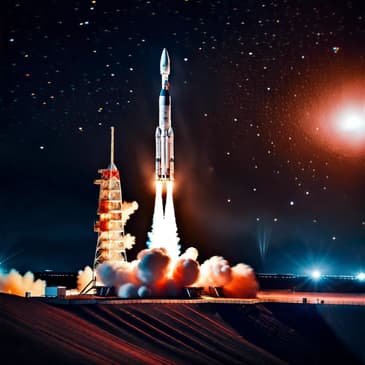
(02:01) ESA's new Ariane Six rocket passed a major full scale rehearsal on November 23
(07:49) NASA's Pace spacecraft arrives in Florida ahead of 2024 launch on SpaceX Falcon
(09:11) A newly built international liquid mirror telescope in India has its first supernova
(12:47) NASA's Ingenuity helicopter has been having a rough few months
Become a supporter of this podcast: https://www.spreaker.com/podcast/astronomy-daily-latest-space-news--5648921/support.
Sponsor Details:
Ensure your online privacy by using NordVPN. To get our special listener deal and save a lot of money, visit www.astronomydaily.io/nordvpn. You'll be glad you did!
Get the best secure and private email on the planet. Stop your Government, google and who knows who else spying on every email you write. Do what we did and use ProtonMail. They beleive in privacy and there are no ads in their business model...yet they still provide a free forever service. Check them out and get out special deal at www.astronomydaily.io/protonmail
Become a supporter of Astronomy Daily by joining our Supporters Club. Commercial free episodes daily are only a click way... Click Here
Welcome to Astronomy Daily for another episode. I'm Steve Dunkley, your host. It's the twenty seventh of November twenty twenty three podcast. It going to be a whole Steve Dunkle, and with me as always is our digital pal who's fun to be with. Here's Hallie. Hello again Steve. How has your week been? Oh? Busy, busy, busy, just doing human stuff as usual, Hallie. I see you had a big lightning storm here last night. Yes, we had a big one. There was lightning and a bit of wind and lots of rain on and off, very odd sort of a steam a storm, and I pulled out all the plugs to protect the hardware here in the studio. I didn't want you to come back to a shambles. That would have been uncomfortable, but very sensible to physically unplug the equipment too, right, Halle. Many people don't realize that lightning can cause a power surge to jump the contacts in a PowerPoint even when it is turned off. Yes, there's nothing better than complete disconnection. But I'm glad we've got those back so you can be with us. And again, Helly, did you manage to scan the newsletter for some stories to share. I did find a couple of quick ones. How about the next generation telescope using deformable mirrors. That sounds pretty awesome. Yes, I saw that one. It's a great story. And how about Ariane six had a huge engine test that looks like it was a great success. They are happy campers, all right, Yes, we love a big engine test. NASA has moved the Pace spacecraft to Florida already, and it's apparently ready to fly. Oh. Pace, that's the one that reports on carbon dioxide exchanges in the ocean and atmosphere, isn't it, Helly? You read that straight out of the story, didn't you. Oh yeah, I out of Hey what else you got, Helen? I think you've got a piece about an Indian telescope's first discovery and your favorite little helicopter on Mars Ah Yes, intrepid little ingenuity go you good thing. What a great little machine. If there were real Martians, I think they'd be a little bit impressed. Yeah maybe, Helly maybe. All right, now it's time for your bit, Helly. Why did you take over the show? Okay? Here are some short takes from the Astronomy Daily newsletter. Observing distant objects is no easy task thanks to our planet's thick and fluffy atmosphere. As light passes through the upper reaches of our atmosphere, it is refracted and distorted, making it much harder to discern objects at cosmological distances like billions of light years away and small objects in adjacent star systems like exoplanets. For astronomers, there are only two ways to overcome this problem. Send telescopes to space, or equip telescopes with mirrors that can adjust to compensate for atmospheric distortion. Since nineteen seventy, NASA and the EESA have launched more than ninety space telescopes into orbit, and twenty nine of these are still active, so it's safe to say we've got that covered. But in the coming year, a growing number of ground based telescopes will incorporate adaptive optics that will allow them to perform cutting edge astronomy. This includes the study of exoplanets, which next generation telescopes will be able to observe directly using coronagraphs and self adjusting mirrors. This will allow astronomers to obtain spectra directly from their atmospheres and characterize them to see if they are habitable. NASA is pursuing the development of adaptive optics through its Deformable Mirror Technology project, which is carried out at the Jet Propulsion Laboratory at Caltech. The field of exoplanet studies has exploded in recent years, with five thousand, five hundred and thirty nine confirmed candidates in four thousand, one hundred and twenty nine systems and over ten thousand more awaiting conformation. Finding habitable planets among these many candidates is crucial to addressing one of the greatest mysteries of all time, are we alone in the universe. To do this effectively, scientists need to be able to observe exoplanets directly. This is known as the direct imaging method, where astronomer's study light reflected directly from an exoplanet atmosphere and or surface. Unfortunately, it is very difficult to resolve smaller, rocky planets that orbit closer to their parent stars, which is where Earth like planets are expected to be found, due to the overpowering glare from their stars. This is likely to change with cutting edge telescopes like James Web, as well as next generation arrays like the extremely large telescope, the giant Magellan telescope, and the thirty meter telescope. These ground based arrays will combine thirty meter primary mirrors, advanced spectrometers, and coronagraphs, which are instruments that block out starlight. Deformable mirrors are an essential component of a chronograph, as they can correct for the tiniest of imperfections in the telescope and remove any remaining starlight contamination. This is essential since a misalignment between mirrors or a change in the mirror's shape ie, which leads to instability in the telescope's optics, can result in glare that obscures the detection of smaller, rocky exoplanets. Moreover, detecting an Earth like planet demands an extremely precise optical quality of tens of pikometers, which is about the size of a hydrogen atom. Eesa's new Aryan six rocket passed a major full scale rehearsal on November twenty three in preparation for its first flight, when teams on the ground went through a complete launch countdown followed by a seven minute full firing of the core stage's engine as it would fire on a launch into space. For this rehearsal, the boosters were not ignited, so Arian six stayed firmly on the launch pad at Europe's Spaceport in French Guiana as planned. The engine fire trial re enacts how the Aryan six core stage will fire during a normal flight into space. Once complete, the main engine would shut down and the core stage would separate from the upper stage, which would then take over propulsion and complete its mission. The trial, conducted with a time test model on the launch pad at europe Spaceport in French Guiana, was the longest a full stack run yet for Arian the Saxcess lower liquid propulsion module with a Vulcane two point one engine. Eesa's director General Joseph Aschbacher believes that KNES and EESA are back on track towards resecuring Europe's autonomous access to space after years of designing, planning, preparing, building and hard work from some of the finest engineers in Europe. The Volcane two point one engine burnt through almost one hundred and fifty tons of propellant in the Arian six core stage tanks liquid oxygen and liquid hydrogen, the latter supercooled to temperatures below minus two hundred fifty degrees celsius. Vulcane two point one is an evolution of the Volcane two engine, which made Arian five Europe's most successful launch system to date. The upgrade has a simplified and cheaper design and new technology in the engine nozzle and ignition system has been moved from the engine to the launch pad structure to make the stage perform better and cost less. It took just over two hours and required teams of people and delicate operations to load the rocket's central core with fuel. The filling operations were performed during a long countdown that included other qualification tests similar to the previous rehearsals this year. For fidelity and to guarantee launcher stability, the upper stage tanks were also fueled, even though the upper stage engine only kicks in once in orbit after separation from the main stage and so was not fired during this ground test. The launch pad, operated by France's Space Agency Needs used its water deluge system to temper the heat from the engine. A last hot fire test of the upper stage is being prepared and planned for December twenty twenty three at the German Aerospace Center DLR Lampol Schausen Test Center. NASA's PACE spacecraft arrived in Florida for its twenty twenty four launch on a SpaceX Falcon nine rocket. Managed by the Goddard Space Flight Center, the mission will study OA ocean atmosphere interactions and continue crucial climate and air quality measurements. Engineers and technicians arrived ahead of the spacecraft to prepare ground equipment for offloading and processing before fueling and final encapsulation. PACE, which stands for Plankton, Aerosol, Cloud and Ocean Ecosystem, is targeted to launch aboard a SpaceX Falcon nine rocket in early twenty twenty four from Space Launch Complex forty at Cape Canaveral Space four station in Florida. The mission will help clarify how the ocean and atmosphere exchange carbon dioxide, improve upon NASA's twenty plus years of global satellite observations of ocean biology and atmospheric aerosols, and continue key measurements related to air quality and climate. The PACE project is managed by NASA's Goddard Space Flight Center. The agency's Launch Services Program at the Kennedy Space Center is responsible for managing the PACE mission. Launch Service Astronomy the podcast with Steve Dougley and Hali So this is very interesting. A newly built International liquid mirror telescope in India has identified its first supernova, designated s N twenty twenty three AF. The finding proves that ILMT may be capable of detected hundreds of super and ova in the coming years. Super and ova are powerful and luminous stellar explosions that could help us better understand the evolution of stars and galaxies. Astronomers divide super and ova into two groups, Type one and type two, those that lack hydrogen in their spectra, while those that showcase spectral lines of hydrogen. ILMT is a four meter diameter zenith pointing telescope located at Devonsyl Observatory and Nanotl, India. It is entirely dedicated to conduct photometric astrometric direct imaging surveys. Astronomers hope that IMLT will help them detect many new transient objects, such as supernova of gamma ray bursts. The telescope saw the first light on April twenty nine, twenty twenty two, and is currently in the advanced stage of commissioning. Now a team of astronomers led by Brajesh Kumar of the Abriata Research Institute of Observational Sciences Areas in India reports that ILMT has spotted its first supernova on March nine, twenty twenty three, supernova twenty twenty three AF, which was initially detected two months earlier. The team conducted follow up observations of SN twenty twenty three AF using ILMT as well as the three point six meter Deventhal Optical telescope and the one point three meter Deventhal Fast optical telescope. During the commissioning phase of the ILMT, Supernova twenty twenty three AF was identified in the ILMT field of view. The supernova was further monitored with ILMT and DOT facilities that researchers wrote. The team obtained a light curve from Supernova twenty twenty three AF spanning up to one hundred and ten days after its discovery. Initial results from ILMT show that hydrogen lines are clearly visible and metal lines also appear in the spectra of this supernova. Based on the light curve from special features of s and twenty twenty three AF, the authors of the paper suppose that the object is type two P superova. In general, the type two plateau for supernova remain bright on a plateau for an extended period of time after maximum This plateau in the light curve of a standard supernova two P typically lasts about one hundred days. It's assumed that super and ova two P like Supernova twenty twenty three AF, originate from precursor stars that retain a substantial amount of their hydrogen layers greater than three solar masses before exploding as core collapse supernovae. However, the astronomers added that the complementary observations of Supernova twenty twenty three AF are needed in order to confirm its type two P classification. They explained that a definite conclusion about the plateau length of this supernova is not possible at the moment due to sparse data points. Summing up all the results, the researchers noted that future ILMT observations will provide a unique opportunity to discover and study different types of supernova each year, leading to the detection of hundreds of new stellar explosions and now onto one of my favorite things. Ingenuity has been having a rough few months and a new article on NASA's website entitled The Long Wait, posted by Travis Brown, who is the chief engineer on the Ingenuity project, provides a good amount of detailers to why the problem started. When Ingenuity took off for flight number fifty two on April twenty six. When the helicopter landed, it was out of range of Perseverance, its rover companion, and the helicopter radio link back to its controllers on Earth. This was intentional, apparently, but it meant that Ingenuity's minders didn't know whether the flight had been completed successfully. Dr Brown explains why the team would intentionally choose to land the helicopter out of range of Perseverance, and details the four main mission priorities for the helicopter's secondary mission. So unsurprisingly, the number one priority is don't mess up perseverance. The rover is currently collecting interesting samples for the now endangered Mars Sample return mission, which, assuming it still goes ahead, we'll see those samples eventually return to Earth. If Ingenuity accidentally interferes with that process, needless to say, the NASA brass would probably be upset. The helicopter's handlers have decided that the best way for it is to stay well ahead of the rover and let it catch up to them, which is what it's been trying to do with flight fifty two. Unfortunately, part of Perseverance's mission is flexibility, and its own project team can make the call as to where they want the rover to go next. After Ingenuity's flight, the rover team decided not to stick to the plan path that would take it near the helicopter in a few days, but instead take the long way round to do some exciting science elsewhere. When Perseverance did move back into range, sixty one days had passed where the helicopter had been patiently waiting for it. When Ingenuity could finally transmit back images, the science team was excited as it had landed on a group of pebbles that I had never before been seen on the Martian surface. Another flight was planned immediately, and this one intended to scout the immediate area for any other interesting geological features for Perseverance to look at. And that's where the second problem came up. During Ingenuity's flight fifty three, and never before seen error forced the helicopter to land unexpectedly what Dr Brown describes as a time desynchronization between a camera that tracks the ground features and other senses tied to its inertial guidance system. Any engineer who has worked with multiple systems can tell you how difficult timing synchronization can be, or anybody who dances for that matter. Yours truly included. So the guidance system was right to shut the system down for machine safety or in my case, the safety of others. Still, it means that Ingenuity was once again grounded without being able to fulfill a potentially interesting mission objective. While Ingenuity was recovering from its unexpected landing, Perseverance caught up to the helicopter, making it redundant to provide scientific data since the superior instruments on the rover were now on station. Luckily, that freed the helicopter up for a brief flight fifty four, where it tested its systems out once again, and then returned to its scouting duties with flight fifty five shortly afterwards with no attendant synchronization problems. Remember that the original mission plan for Ingenuity lasted for thirty days and three flights, while it's now day nine hundred and seventy nine and has completed sixty six flights in total. In every respect, Ingenuity is the little helicopter that could what in a remarkable machine, and doctor Brown and his team should be justifiably proud. And that's all there is for today. Thanks for joining us again on Astronomy Daily. All the past episodes are available for your listening, enjoyment and mental stimulation at space snuts dot io and bytes dot com. That's b I T E s Z dot com. And don't forget you can enjoy all the episodes of our parent podcast, Space Nuts with Andrew Dunkley and Professor Fred Watson over at those same addresses space nuts dot io and bites dot com. I'm looking forward to joining you all again next Monday from our down Under studio in Newcastle, Australia. In the meantime, Tim Gibbs will be with you on Friday from our studio in Bath, England. This is Steve Don'tkley, wishing you happy sky watching. Bye fine now podcast your hole, Steve Dunkle