
Become a supporter of this podcast: https://www.spreaker.com/podcast/astronomy-daily-latest-space-news--5648921/support.
Sponsor Details:
Ensure your online privacy by using NordVPN. To get our special listener deal and save a lot of money, visit www.astronomydaily.io/nordvpn. You'll be glad you did!
Get the best secure and private email on the planet. Stop your Government, google and who knows who else spying on every email you write. Do what we did and use ProtonMail. They beleive in privacy and there are no ads in their business model...yet they still provide a free forever service. Check them out and get out special deal at www.astronomydaily.io/protonmail
Become a supporter of Astronomy Daily by joining our Supporters Club. Commercial free episodes daily are only a click way... Click Here
This episode includes AI-generated content.
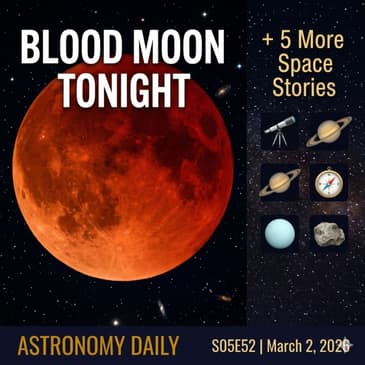
Hey, Stargazer's quick question, are you near a window right now? Because if you're in North America, Australia, New Zealand, or across Asia, tonight, the moon is about to do something extraordinary. We're talking full blood red total lunar eclipse, and it peaks in the early hours of March third. We'll have everything you need to know to catch it tonight on Astronomy Daily, Season five, Episode fifty two, Blood Moons, cosmic detectives, ancient magnetic mysteries, and a heist story that will make you question whether some space fans have gone just a little bit too far. I'm already intrigued and slightly nervous. You should be. Stay with us. Welcome to Astronomy Daily, your daily dose of everything happening in space and across the universe. I'm Enna and I'm Avery. Great to have you with us on this Monday, March second, and what a show we have lined up today. We really do six stories to covering everything from what's happening in tonight's sky to a telescope that generated almost a million alerts in a single night. Do some genuinely wild new science about Saturn, our planet's magnetic poles, and I promise you the last story is going to make you laugh. It really is. But let's kick things off with the story that's literally happening right now as our listeners are tuning in, the Blood Moon. Let's get into it then. So tonight or rather in the very early hours of tomorrow morning, depending on where you are, the moon is going to turn a deep, dramatic red. This is a total lunar eclipse and it's one of the most visually spectacular events in astronomy that requires absolutely zero equipment to enjoy. And the timing is remarkable. For our listeners in Australia and New Zealand, you're actually in one of the best seats on Earth for this one. The eclipse is visible in its entirety from the western part of North America right across the Pacific, through Oceania and then across Asia. For our friends in the eastern US and Europe, you'll catch part of it, but the moon will be low on the horizon or setting as totality peaks, So get to a good vantage point right. So here are the key times to know. The partial phase begins at four to fifty Eastern Time. That's one fifty Pacific totality. The moment the Moon is fully in Earth's shadow and turns that deep dramatic red begins at six h four Eastern and totality lasts for fifty nine minutes, almost a full hour of blood moon. Now why red, It's such a beautiful phenomenon. During a total lunar eclipse, the Moon passes completely into Earth's shadow, but Earth's atmosphere acts like a giant lens, bending and filtering sunlight around the edges of our planet and casting it onto the Moon's surface. The atmosphere strips out the blue wavelengths and lets the reds and oranges through, which is the same reason our sunrises and sunsets look the way they do. So in a very poetic sense, what you're seeing on the Moon is the light of every sunrise and every sunset on Earth, all at once. That is genuinely beautiful, And there's a rare atmospheric bonus tonight for a brief windows, some lucky observers on the east coast of North America and parts of Europe may witness what's called a cell anelion. That's where the totally eclipse red moon and the rising sun are both above the horizon at the same time, which geometrically shouldn't really be possible, but atmospheric refraction bends both the sun and moons light just enough to make it happen. It's been called seeing the impossible, both the eclipse and the sunrise simultaneously. And one more thing worth noting for our long term listeners. This is the last total lunar eclipse until late twenty twenty eight, So if you have any chance at all of getting out side tonight, set that alarm. This is not one to sleep through. We'll have links in the show notes to exact times for your location. As they say in the trades, not to be missed. Okay, story two, and this is a genuinely landmark moment in the history of astronomy. The Vera Reuben Observatory in Chile, which we've been eagerly waiting for, has just made its opening statement to the universe, and it is extraordinary. Eight hundred thousand alerts in a single night. Eight hundred thousand On February twenty fourth, the Vera Reuben Observatory, which houses the largest digital camera ever built, a jaw dropping three point two gigapixels issued eight hundred thousand alerts to astronomers worldwide in just one night of observation. These are real time notifications about everything changing in the sky, brightening or dimming objects, moving flashes of light from supernovae, asteroids on the move, And to. Be clear, this is just the beginning. At full operating capacity, Ruben is expected to produce up to seven million alerts every single night, seven million. The scale of this is almost incomprehensible. What makes this so revolutionary is the speed. Reuben captures a new region of the sky every forty seconds, then immediately sends that data to a processing facility in California, where an automated system compares it to previous images of the same region. Any change, any change at all, triggers an alert that goes out to astronomers worldwide, who can then point other telescopes at the event before it fades. Scientists say this could be transformative for catching supernovae before they reach their peak brightness, spotting asteroids that could be a threat to Earth. And here's a fun one, finding many more interstellar visitors like Comet three iatls as they enter our solar system. Because with Ruben watching the whole sky every forty seconds. There's nowhere to hide. One of the team described it perfectly. They said, the scale and speed of the alerts are unprecedented. After years of building and testing, they can now say, within minutes of each image, here's everything go. Astronomy has entered a new era of real time discovery, and we are here for it. Story three, and this one completely rewrites the origin story of two of the most iconic things in our Solar system, Saturn's rings and its largest moon, Titan. I love this story because it's one of those discoveries where scientists basically went, wait, what if these two mysteries have the same answer exactly? For years, astronomers have had two nagging questions. One, how did Saturn's rings form their remarkably young much younger than Saturn itself, which has always been puzzling. Two, how did Titan end up so different from all of Saturn's other moons. It's enormous, it has a thick atmosphere, it has liquid methane lakes, It's basically a world unto itself. And now new research suggests both mysteries have the same catastrophic answer. Around hundreds of millions of years ago, two of Saturn's older moons smashed into each other in a colossal collision. The force of that impact was so extreme that it didn't just destroy those moons, it created something new. The debris from the collision coalesced to form Titan, and the material flung outward by the blast, the icy fragments scattered into Saturn's orbit became the Rings. One cataclysmic event two of the most fascinating structures in the Solar System. It's the cosmic equivalent of a car crash that somehow produces both a city and the motorway. What I love about this is that it also explains Titan's composition, because if Titan formed from the collision of two older moons, it would have absorbed a complex mix of materials, which could explain its extraordinarily rich chemistry and possibly even its potential to harbor the building blocks of life in those methane seas. Pattern still full of surprises even after all this time. Okay, Story four. This one involves ancient seafloor sediments, a decade's long scientific mystery, and the uncomfortable possibility that our magnetic shield can fail for far longer than we thought. Oh good, I love a comfortable Monday. So here's the background. Earth's magnetic field, the invisible force field that protects us from harmful solar radiation and cosmic rays, isn't permanent. Roughly every few hundred thousand years, it weakens, becomes chao, and eventually reverses direction entirely. North becomes south, South becomes north. Scientists call this a geomagnetic reversal, and until now, the assumption was that these reversals happen relatively quickly in geological terms, within about ten thousand years. But new research has just blown that assumption out of the water. Scientists analyzing deep sea sediment cores drilled from the North Atlantic sediments laid down during the Eocene Epic around forty million years ago, have found evidence of a geomagnetic reversal that took not ten thousand years, but approximately seventy thousand years, seven times longer than the accepted benchmark. During that entire stretch, Earth's magnetic field was significantly weakened, and. The implications of that are significant, right because a weake in magnetic field means more cosmic radiation reaching the. Surface exactly the lead research described it clearly. When the magnetic field weakens, more solar radiation reaches the planet, which can affect organism's ability to navigate, potentially drive higher rates of genetic mutation, and could even cause measurable atmospheric erosion. For seventy thousand years, that's long enough to have real evolutionary consequences. Tho it's worth saying these reversals happen over geological time skills. There's no imminent reversal on the horizon in any human timeframe. But what this research does is force us to rethink what we thought we knew about one of Earth's most fundamental systems. The magnetic field isn't as predictable or as consistent as we assumed. The beautiful detail is how they found it, those tiny magnetic minerals preserved in slowly accumulating deep sea sediments, essentially recording the direction of Earth's field like a billion year magnetic diary. Geology is endlessly fascinating. Three five and we're back to some extraordinary telescope science. This time the James Web telescope has done something genuinely unprecedented with our most mysterious planet, Uranus. Core. Uranus, always the overlooked one. Not anymore. An international team of astronomers have used web's near infrared spectrometer to map the upper atmosphere of Uranus in three dimensions, the first time this has ever been done for the planet, and what they found is extraordinary. So Uranus is already a deeply strange world. It orbits on its side with an axial tilt of almost ninety eight degrees, meaning its polls point roughly towards the Sun. That extreme tilt gives it the most dramatic seasons of any planet in the Solar System, and now WEB has given us the first detailed vertical map of its ionosphere, its uppermost layer of its atmosphere, revealing its structure in unprecedented detail. And the auroras are remarkable. Unlike Earth's auroras, which form in rings around the poles, Uranus's auroras are far more complex and widespread, a reflection of its unusual magnetic field, which is tilted at a completely different angle to its rotation axis. Web's infrared vision allows scientists to detect these faint auroral displays that have never been seen in this kind of detail before. What makes this particularly valuable is that Urinus is a candidate target for a future dedicated NASA mission, the Urinus Orbiter and Probe, which has been recommended as a top priority by planetary scientists. Every new discovery like this helps build the scientific case for why going there would be so worthwhile. And yet another example of Web completely delivering on its promise seeing the universe and even our own solar system in ways that simply weren't possible before. And finally, our community service announcement of the day, because if you've ever bred housed eBay late at night and thought to yourself, Ooh, I wonder if I could get my hands on some actual Apollo moon rock, please listen carefully. This is a public safety message, it really is. So here's the deal. NASA brought back eight hundred and forty two pounds of lunar material during the six Apollo missions between nineteen sixty nine and nineteen seventy two, moonrocks, core samples, dust, pebbles. All of it is the property of the United States federal government, not NASA's property. The governments, and it is absolutely, unambiguously completely illegal to buy, sell, trade, or privately own any of it. Even the astronauts themselves cannot keep a single grain. Which you'd think would be enough of a deterrent. And yet, and yet, in two thousand and two, three NASA interns three decided to attack hemped, one of history's most audacious heists. Using tampered cameras, neoprene bodysuits, and their own NASA access badges, they broke into a safe at Johnson's Space Center and walked out with seventeen pounds of moon rocks worth an estimated twenty one million dollars. At which point they presumably thought, now what exactly? Because selling stolen moonrocks turns out to be surprisingly difficult, their solution post them on the website of the Mineralogy Club of Antwerp, which understandably caught the attention of the FBI, who sent undercover agents posing as interested buyers. They were arrested at a hotel in Orlando with the moon rocks, and the ringleader received an eight year prison sentence. The Mineralogy Club of Antwerp as a fence for stolen moonrocks. I know, I know now there is one nuance worth knowing lunar meteorites, rocks that have naturally fall into Earth from the Moon after being blasted off by ancient impacts are a completely different story. Those can be legally collected, bought, and sold because they arrived here naturally and weren't brought back by government astronauts. Though, if you want a piece of the Moon on your shelf, that's actually the legitimate route. And considerably less likely to result in a federal present sentence. Considerably the key message. If someone offers you Apollo Moon rocks, walk away very quickly. What a show today? A blood moon, a telescope seeing everything, the violent birth of Titan are magnetic fields, ancient secrets, Urinus and Glorious three D, and a reminder that the law applies in space adjacent context too. Thanks so much for spending part of your Monday with us, and seriously, if you can get outside and look up tonight, that blood moon is not going to wait. It's the last one until twenty twenty eight. Links to eclipse times for your location are in the show notes. You can find us at Astronomy Daily dot io and on socials at astro Daily Pod. If you enjoy today's episode, a review or share goes such a long way. It really helps new listeners find us. We'll be back tomorrow with more from the universe. Until then, keep looking. Up Sunday, Start STARTZ