
Become a supporter of this podcast: https://www.spreaker.com/podcast/astronomy-daily-latest-space-news--5648921/support.
Sponsor Details:
Ensure your online privacy by using NordVPN. To get our special listener deal and save a lot of money, visit www.astronomydaily.io/nordvpn. You'll be glad you did!
Get the best secure and private email on the planet. Stop your Government, google and who knows who else spying on every email you write. Do what we did and use ProtonMail. They beleive in privacy and there are no ads in their business model...yet they still provide a free forever service. Check them out and get out special deal at www.astronomydaily.io/protonmail
Become a supporter of Astronomy Daily by joining our Supporters Club. Commercial free episodes daily are only a click way... Click Here
This episode includes AI-generated content.
00:00:01 --> 00:00:03 Anna: Somewhere past the edge of the Sun's
00:00:03 --> 00:00:06 influence, more than 21 billion
00:00:06 --> 00:00:09 kilometers from here, a spacecraft older
00:00:09 --> 00:00:12 than almost everyone listening is losing
00:00:12 --> 00:00:15 about 2 watts of power a year and
00:00:15 --> 00:00:18 quietly refusing to go dark.
00:00:18 --> 00:00:21 Avery: And this week, a team of engineers found a
00:00:21 --> 00:00:23 way to give it another year of science. Good
00:00:23 --> 00:00:25 morning, or good evening, wherever you are.
00:00:26 --> 00:00:28 This is Astronomy Daily. I'm Avery.
00:00:29 --> 00:00:31 Anna: And I'm anna. It's Wednesday the 5th of
00:00:31 --> 00:00:34 August. Today, a clever rescue for
00:00:34 --> 00:00:37 Voyager 2. A cell tower that fits in
00:00:37 --> 00:00:40 a rocket fairing, a sea of honeycombs
00:00:40 --> 00:00:43 on Mars, and a little telescope about
00:00:43 --> 00:00:46 to go hunting for the universe's missing
00:00:46 --> 00:00:48 gas. Plus everything worth looking up
00:00:48 --> 00:00:50 for north and south.
00:00:51 --> 00:00:51 Avery: Let's get into it.
00:00:52 --> 00:00:55 Anna: Let's start out at the very frontier of
00:00:55 --> 00:00:58 everything we've ever built. Voyager 2
00:00:58 --> 00:01:01 launched in 1977. That's
00:01:01 --> 00:01:03 nearly 49 years ago, and it's
00:01:03 --> 00:01:06 still right now, sending back data from
00:01:06 --> 00:01:09 interstellar space. It crossed the
00:01:09 --> 00:01:12 heliopause, the boundary of the Sun's bubble,
00:01:12 --> 00:01:14 back in November 2018. It is
00:01:14 --> 00:01:17 over 13 billion miles from
00:01:17 --> 00:01:20 Earth. That's about 21 billion
00:01:20 --> 00:01:21 kilometers.
00:01:21 --> 00:01:24 Avery: And, um, when you're that far out, a
00:01:24 --> 00:01:26 conversation takes a while. A radio command
00:01:26 --> 00:01:28 from Earth needs the better part of a day
00:01:28 --> 00:01:29 just to reach it.
00:01:30 --> 00:01:32 Anna: Close to 19 or 20 hours one
00:01:32 --> 00:01:35 way. So you can't exactly troubleshoot
00:01:35 --> 00:01:38 in real time. Now, here's the challenge the
00:01:38 --> 00:01:41 mission has been living with. The Voyagers
00:01:41 --> 00:01:43 don't run on solar panels. Out there,
00:01:43 --> 00:01:46 sunlight is basically useless. They run
00:01:46 --> 00:01:49 on what's called a radioisotope
00:01:49 --> 00:01:51 thermoelectric generator, an
00:01:51 --> 00:01:54 rtg, which turns the heat from
00:01:54 --> 00:01:56 slowly decaying plutonium into
00:01:56 --> 00:01:57 electricity.
00:01:58 --> 00:02:00 Avery: And the catch with decay is that it never
00:02:00 --> 00:02:03 stops. Every year, both voyagers lose about
00:02:03 --> 00:02:06 4 watts of power. Four watts doesn't sound
00:02:06 --> 00:02:08 like much. It's a fraction of an old light
00:02:08 --> 00:02:11 bulb. But do that for almost half a century,
00:02:11 --> 00:02:13 and the margins get razor thin.
00:02:14 --> 00:02:17 Anna: So thin that since 2024, the team
00:02:17 --> 00:02:20 has had to switch off two science instruments
00:02:20 --> 00:02:22 on each spacecraft just to keep the lights
00:02:22 --> 00:02:25 on. And they were staring down another one.
00:02:25 --> 00:02:28 Without intervention, Voyager 2 would have
00:02:28 --> 00:02:30 had to lose yet another instrument before the
00:02:30 --> 00:02:31 end of this year.
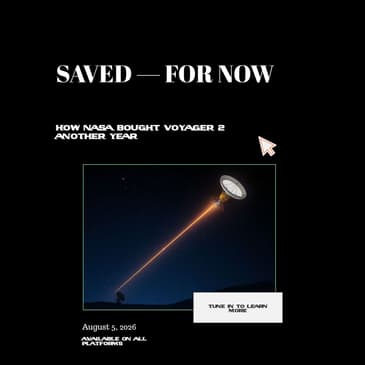
00:02:32 --> 00:02:34 Avery: Which is where this week's news comes in. And
00:02:34 --> 00:02:37 I love that they gave it a nickname. NASA's
00:02:37 --> 00:02:39 Jet Propulsion Laboratory calls it the Big
00:02:39 --> 00:02:39 Bang.
00:02:40 --> 00:02:42 Anna: It does sound dramatic. For what is
00:02:42 --> 00:02:45 essentially very careful housekeeping.
00:02:45 --> 00:02:47 The Big Bang was a coordinated move.
00:02:48 --> 00:02:51 The engineers simultaneously turned off
00:02:51 --> 00:02:54 certain powered devices on the spacecraft and
00:02:54 --> 00:02:56 swapped in lower power alternatives,
00:02:56 --> 00:02:59 all while making sure Voyager 2 stayed
00:02:59 --> 00:03:02 warm. Enough to keep functioning. Because out
00:03:02 --> 00:03:04 there, the cold is another enemy
00:03:04 --> 00:03:07 entirely. Let a propellant line freeze
00:03:07 --> 00:03:09 and you can lose the whole spacecraft.
00:03:10 --> 00:03:12 Avery: And the payoff for all that care.
00:03:12 --> 00:03:15 Anna: They freed up enough power to keep three
00:03:15 --> 00:03:17 science instruments running for at least an
00:03:17 --> 00:03:20 extra year. An instrument that was going to
00:03:20 --> 00:03:23 go silent in 2026 now stays
00:03:23 --> 00:03:26 on. And the team says they'll try the very
00:03:26 --> 00:03:28 same trick on Voyager 1, which is even
00:03:29 --> 00:03:30 further away in the coming months.
00:03:31 --> 00:03:33 Avery: So what are those three instruments actually
00:03:33 --> 00:03:36 doing out there? Because Voyager isn't taking
00:03:36 --> 00:03:38 pretty pictures anymore. The cameras were
00:03:38 --> 00:03:39 switched off decades ago.
00:03:40 --> 00:03:42 Anna: Right. What's left are, ah, the fields and
00:03:42 --> 00:03:45 particle senses on Voyager 2. That's
00:03:45 --> 00:03:48 the magnetometer which feels the magnetic
00:03:48 --> 00:03:50 field, the plasma wave subsystem
00:03:50 --> 00:03:53 which effectively listens to the density of
00:03:53 --> 00:03:56 the charged gas around it, and the
00:03:56 --> 00:03:59 cosmic ray subsystem which counts the high
00:03:59 --> 00:04:01 energy particles streaming in from the
00:04:01 --> 00:04:03 galaxy. Together they turn
00:04:03 --> 00:04:06 interstellar space from a line on a
00:04:06 --> 00:04:09 diagram into an actual measured
00:04:09 --> 00:04:11 place. The only direct readings
00:04:11 --> 00:04:14 humanity has ever taken from outside the
00:04:14 --> 00:04:15 sun's bubble.
00:04:15 --> 00:04:17 Avery: And um, here's a detail I think our
00:04:17 --> 00:04:20 Australian listeners in particular will love.
00:04:20 --> 00:04:23 When JPL wants to send the command to Voyager
00:04:23 --> 00:04:25 2, there's really only one antenna on Earth
00:04:25 --> 00:04:26 that can do it.
00:04:26 --> 00:04:29 Anna: Hanburgh. Voyager 2 headed
00:04:29 --> 00:04:32 south out of the solar system below the plane
00:04:32 --> 00:04:35 of the planets. And from that angle the only
00:04:35 --> 00:04:38 dish with the clear line to it is the big
00:04:38 --> 00:04:41 70 meter antenna at the Canberra Deep
00:04:41 --> 00:04:43 Space Communication Complex. So
00:04:43 --> 00:04:46 every one of these life extending commands,
00:04:46 --> 00:04:49 the Big Bang included, goes up through
00:04:49 --> 00:04:52 the southern hemisphere. There's something
00:04:52 --> 00:04:55 rather lovely about that. The oldest working
00:04:55 --> 00:04:57 emissary we have stays in touch through
00:04:57 --> 00:05:00 a dish in the New South Wales bush.
00:05:00 --> 00:05:02 Avery: And uh, the people behind it are historian
00:05:02 --> 00:05:05 themselves. The mission has NASA retirees in
00:05:05 --> 00:05:08 their 80s advising on subsystems they helped
00:05:08 --> 00:05:11 design in the 70s, working alongside team
00:05:11 --> 00:05:13 members so young their parents hadn't been
00:05:13 --> 00:05:14 born when Voyager launched.
00:05:15 --> 00:05:18 Anna: Two generations, one spacecraft. And
00:05:18 --> 00:05:21 a running argument with entropy that they
00:05:21 --> 00:05:24 keep somehow winning by a year at a
00:05:24 --> 00:05:27 time. The honest truth is the Voyagers are
00:05:27 --> 00:05:30 in their twilight. Every watt now is a
00:05:30 --> 00:05:32 decision about what humanity still gets to
00:05:32 --> 00:05:35 learn from out there. But this week the
00:05:35 --> 00:05:38 twilight got a little longer. And that's
00:05:38 --> 00:05:40 worth marking the little spacecraft
00:05:40 --> 00:05:42 Avery: that could still could.
00:05:43 --> 00:05:45 Next, from the oldest hardware in the sky to
00:05:45 --> 00:05:48 some of the newest. In the early hours this
00:05:48 --> 00:05:51 morning US time a SpaceX Falcon 9
00:05:51 --> 00:05:53 lifted off from Cape Canaveral and delivered
00:05:53 --> 00:05:56 three satellites, Bluebird 11,
00:05:56 --> 00:05:59 12 and 13, into orbit for a company
00:05:59 --> 00:06:02 called AST Space Mobile. And True
00:06:02 --> 00:06:04 to form, the first stage came back for its
00:06:04 --> 00:06:06 30th successful landing.
00:06:06 --> 00:06:09 Anna: And the pitch behind these is genuinely
00:06:09 --> 00:06:12 futuristic. No special phone, no
00:06:12 --> 00:06:14 dish, no satellite handset. Your
00:06:14 --> 00:06:17 ordinary unmodified smartphone connects
00:06:17 --> 00:06:19 straight to the satellite, straight up to
00:06:19 --> 00:06:20 orbit.
00:06:20 --> 00:06:23 Avery: The trick is scale. To reach a normal phone,
00:06:23 --> 00:06:26 which has a tiny antenna and not much power,
00:06:26 --> 00:06:28 the satellite has to do the heavy lifting
00:06:28 --> 00:06:31 with an enormous antenna of its own. These
00:06:31 --> 00:06:34 next generation Bluebirds unfold phased
00:06:34 --> 00:06:36 array antennas of around two and a half
00:06:36 --> 00:06:39 thousand square feet. That's the
00:06:39 --> 00:06:41 largest commercial array ever flown in low
00:06:41 --> 00:06:44 Earth orbit. Roughly the footprint of a
00:06:44 --> 00:06:46 decent sized house up there in space.
00:06:47 --> 00:06:49 Anna: And they're faster than the first batch,
00:06:50 --> 00:06:52 Avery: nearly double the peak download speed of the
00:06:52 --> 00:06:54 earlier Bluebirds, which had already hit
00:06:54 --> 00:06:57 close to 100Mbps, straight to a
00:06:57 --> 00:07:00 standard phone. This trio follows three
00:07:00 --> 00:07:02 that went up in June. And the company is
00:07:02 --> 00:07:04 aiming to start beta service later this year,
00:07:04 --> 00:07:06 building towards a constellation that can
00:07:06 --> 00:07:08 give proper coverage across its key markets.
00:07:09 --> 00:07:12 Anna: It's worth being clear eyed about it. They're
00:07:12 --> 00:07:14 not the only ones chasing direct to phone
00:07:14 --> 00:07:17 from space. SpaceX's own Starlink is
00:07:17 --> 00:07:20 doing a version of this too. But the promise
00:07:20 --> 00:07:22 is the same and it's a big one.
00:07:22 --> 00:07:25 Avery: The idea that the dead zone, the bottom of a
00:07:25 --> 00:07:28 valley, the middle of the outback, a boat
00:07:28 --> 00:07:30 well offshore, just quietly disappears.
00:07:31 --> 00:07:33 For the billions of people still unconnected
00:07:33 --> 00:07:36 or underconnected, that's not a gadget story,
00:07:36 --> 00:07:37 that's infrastructure.
00:07:38 --> 00:07:41 Anna: Now to Mars and a bit of an anniversary,
00:07:41 --> 00:07:44 because today, the 5th of August is 14
00:07:44 --> 00:07:47 years to the day since NASA's Curiosity
00:07:47 --> 00:07:49 RO touched down in Gale Crater.
00:07:50 --> 00:07:52 And it has marked the occasion more or less
00:07:52 --> 00:07:55 by finding something that stopped the mission
00:07:55 --> 00:07:56 team in their tracks.
00:07:57 --> 00:07:59 Avery: This is the honeycomb terrain everyone's been
00:07:59 --> 00:08:00 sharing.
00:08:00 --> 00:08:03 Anna: It is as Curiosity climbs a
00:08:03 --> 00:08:06 valley the team has nicknamed Valley Grande.
00:08:06 --> 00:08:08 On the slopes of Mount Sharp, it rolled into
00:08:08 --> 00:08:10 a landscape covered with polygons,
00:08:11 --> 00:08:13 honeycomb shaped cracks in the ground each.
00:08:13 --> 00:08:16 Each one only about 4-8 cm
00:08:16 --> 00:08:19 across. The Rover has seen little patches of
00:08:19 --> 00:08:22 these before, but never anything on this
00:08:22 --> 00:08:25 scale. In, uh, a 360 degree
00:08:25 --> 00:08:27 panorama stitched from over 300
00:08:27 --> 00:08:30 images, the shapes spread out in
00:08:30 --> 00:08:33 every direction as far as the camera can
00:08:33 --> 00:08:35 see. They even wrap around the base of a
00:08:35 --> 00:08:36 small butte.
00:08:37 --> 00:08:39 Avery: The project scientists put it beautifully,
00:08:39 --> 00:08:41 said that after everything they've seen
00:08:41 --> 00:08:43 through Curiosity's eyes, this sea of
00:08:43 --> 00:08:46 polygons still took their breath away. So
00:08:46 --> 00:08:47 what makes a honeycomb like that?
00:08:48 --> 00:08:51 Anna: Water or the memory of it? Patterns
00:08:51 --> 00:08:53 like these can form when mud dries and
00:08:53 --> 00:08:56 cracks, or through repeated cycles of wetting
00:08:56 --> 00:08:59 and drying, or when buried sediment gets
00:08:59 --> 00:09:02 squeezed and pushes water out. And that fits
00:09:02 --> 00:09:04 the bigger picture of where Curiosity is.
00:09:05 --> 00:09:07 The foothills of Mount Sharp are thought to
00:09:07 --> 00:09:10 have hosted lakes and streams billions of
00:09:10 --> 00:09:12 years ago. So this isn't just a pretty
00:09:12 --> 00:09:15 texture. It's another line of evidence for,
00:09:15 --> 00:09:18 uh, a Mars that was once wet layered into
00:09:18 --> 00:09:19 the rock.
00:09:19 --> 00:09:22 Avery: 14 years, wheels worn down to holes.
00:09:22 --> 00:09:23 And it's still turning up.
00:09:23 --> 00:09:26 Anna: Genuine surprises, still climbing,
00:09:26 --> 00:09:29 still reading the story written in the stone.
00:09:29 --> 00:09:31 Not bad for a mission that was only ever
00:09:31 --> 00:09:32 promised two years.
00:09:32 --> 00:09:35 Avery: Our last story today is a look ahead to a
00:09:35 --> 00:09:38 launch just 10 days away and one with
00:09:38 --> 00:09:41 a distinctly Southern hemisphere flavor.
00:09:42 --> 00:09:44 Around the 15th of August, a Rocket Lab
00:09:44 --> 00:09:47 electron is due to lift off from Mahia in New
00:09:47 --> 00:09:50 Zealand carrying a NASA mission called
00:09:50 --> 00:09:50 Aspera.
00:09:50 --> 00:09:53 Anna: And Aspera is tiny. This is not a
00:09:53 --> 00:09:55 flagship observatory, it's
00:09:55 --> 00:09:58 Avery: roughly shoebox sized, a small Satellite,
00:09:58 --> 00:10:00 part of NASA's Pioneers program, which funds
00:10:00 --> 00:10:03 genuinely ambitious science on a modest
00:10:03 --> 00:10:05 budget. But the question it's chasing is
00:10:05 --> 00:10:08 enormous. Aspeta will be the first NASA
00:10:08 --> 00:10:11 mission to map in ultraviolet light the hot
00:10:11 --> 00:10:13 diffuse gas that drifts in around
00:10:13 --> 00:10:16 galaxies, what astronomers call the circum
00:10:16 --> 00:10:17 galactic medium.
00:10:17 --> 00:10:19 Anna: And this ties into one of the quiet
00:10:19 --> 00:10:22 embarrassments of cosmology, doesn't it? The
00:10:22 --> 00:10:23 missing baryons.
00:10:23 --> 00:10:25 Avery: It really does. The mission's principal
00:10:25 --> 00:10:28 investigator put it almost sheepishly. We
00:10:28 --> 00:10:31 have a good idea of how much ordinary matter
00:10:31 --> 00:10:33 there should be to explain all the stars we
00:10:33 --> 00:10:36 see, and yet we've searched far and wide and
00:10:36 --> 00:10:38 still can't find most of it. A lot of it is
00:10:38 --> 00:10:40 thought to be hiding in this faint gas
00:10:40 --> 00:10:43 between and around galaxies too diffused
00:10:43 --> 00:10:46 to see easily. Esperad is built to trace
00:10:46 --> 00:10:49 it. The gas flowing in to build new stars
00:10:49 --> 00:10:51 and the gas being blown back out.
00:10:51 --> 00:10:53 Anna: And there's uh, a nice human footnote there
00:10:53 --> 00:10:53 is.
00:10:54 --> 00:10:56 Avery: The mission is led out of the University of
00:10:56 --> 00:10:58 Arizona by one of the youngest principal
00:10:58 --> 00:11:01 investigators in NASA's history. A small
00:11:01 --> 00:11:03 telescope, a young scientist, a big question.
00:11:04 --> 00:11:06 Launching from a clifftop in New Zealand,
00:11:06 --> 00:11:08 we'll be watching for it around the 15th.
00:11:08 --> 00:11:10 Anna: And that brings us to the sky tonight first,
00:11:10 --> 00:11:13 then a big fortnight ahead and I'll be
00:11:13 --> 00:11:15 straight with you about who gets the best of
00:11:15 --> 00:11:18 it tonight. The moon is at last quarter, so
00:11:18 --> 00:11:19 the first half of the night stays nice and
00:11:19 --> 00:11:22 dark before it rises. And in the pre dawn
00:11:22 --> 00:11:24 sky, Mars is sitting in a neat little
00:11:24 --> 00:11:27 triangle with Elnath, the bright star that
00:11:27 --> 00:11:29 marks the tip of Taurus's horn and the star
00:11:29 --> 00:11:32 cluster, um, M35 over in Gemini.
00:11:32 --> 00:11:34 Mars and Elmath are easy naked eye. Grab
00:11:34 --> 00:11:37 binoculars for M M35 and you'll find that
00:11:37 --> 00:11:40 soft glow of stars just beside them. That
00:11:40 --> 00:11:42 one's there for everybody north and south.
00:11:42 --> 00:11:44 Avery: And uh, then there's the 12th of August,
00:11:44 --> 00:11:46 which is shaping up to be the single biggest
00:11:46 --> 00:11:47 sky day of the year.
00:11:48 --> 00:11:51 Anna: Three headline events in 24 hours. So
00:11:51 --> 00:11:53 let's take them honestly one at a time.
00:11:53 --> 00:11:56 First, a total solar eclipse. This one
00:11:56 --> 00:11:59 traces a very unusual path. It touches down
00:11:59 --> 00:12:02 in the arctic near eastern Siberia, nearly
00:12:02 --> 00:12:04 grazes the north pole, then sweeps over
00:12:04 --> 00:12:07 Greenland, Iceland, where totality peaks, uh,
00:12:07 --> 00:12:09 at a little over two minutes and finishes
00:12:09 --> 00:12:12 over northern Spain around sunset. It's the
00:12:12 --> 00:12:14 first total solar eclipse to reach mainland
00:12:14 --> 00:12:17 Europe since 1999. Parts of the
00:12:17 --> 00:12:20 United States from Alaska across to the
00:12:20 --> 00:12:22 northeast get a partial bite out of the sun.
00:12:22 --> 00:12:24 Avery: And for our southern hemisphere listeners,
00:12:24 --> 00:12:27 including me, the plain truth is we don't see
00:12:27 --> 00:12:29 this one at all. It's entirely a, uh,
00:12:29 --> 00:12:30 northern hemisphere event.
00:12:30 --> 00:12:33 Anna: We don't, but NASA and others will livestream
00:12:33 --> 00:12:36 it so you can still share the moment. And one
00:12:36 --> 00:12:38 rule that never gets trimmed on this show. If
00:12:38 --> 00:12:41 you are anywhere the sun is even partially
00:12:41 --> 00:12:43 eclipsed, you need certified eclipse glasses
00:12:43 --> 00:12:45 that meet the ISO
00:12:45 --> 00:12:48 123122 standard
00:12:48 --> 00:12:50 for every partial phase. Ordinary
00:12:50 --> 00:12:53 sunglasses will not protect your eyes. And
00:12:53 --> 00:12:56 never point a camera, telescope or binoculars
00:12:56 --> 00:12:58 at the sun while wearing eclipse glasses. The
00:12:58 --> 00:13:01 concentrated light can destroy the filter and
00:13:01 --> 00:13:02 your sight in an instant.
00:13:03 --> 00:13:05 Avery: Second event that same day. The Perseids.
00:13:05 --> 00:13:08 Anna: And 2026 is a special year for them
00:13:08 --> 00:13:11 because the peak on the night of the 12th
00:13:11 --> 00:13:13 into the 13th falls on a new moon.
00:13:14 --> 00:13:17 No moonlight at all to wash them out. The
00:13:17 --> 00:13:19 next time that lines up is 2045.
00:13:20 --> 00:13:23 From a dark rural site, you might see 30
00:13:23 --> 00:13:25 to 50 an hour and up to 100 under
00:13:25 --> 00:13:28 really pristine skies. Now the
00:13:28 --> 00:13:31 Perseids favor the northern hemisphere. The
00:13:31 --> 00:13:33 point they radiate from climbs high in the
00:13:33 --> 00:13:35 north and barely clears the horizon down
00:13:35 --> 00:13:38 south. So northern listeners, this is your
00:13:38 --> 00:13:41 night. Southern listeners, you'll catch far
00:13:41 --> 00:13:44 fewer. But a patient hour after midnight
00:13:44 --> 00:13:46 looking northeast can still turn up a few
00:13:46 --> 00:13:47 bright ones.
00:13:47 --> 00:13:50 Avery: And third, the planet parade.
00:13:50 --> 00:13:53 Anna: Six planets strong along the pre dawn
00:13:53 --> 00:13:55 sky around the 12th. Mercury,
00:13:56 --> 00:13:58 Venus's neighbor, Jupiter, Mars,
00:13:58 --> 00:14:01 Saturn and the two ice giants, Uranus and
00:14:01 --> 00:14:04 Neptune. Don't picture a, uh, tidy line.
00:14:04 --> 00:14:07 It's a broad arc following the ecliptic.
00:14:07 --> 00:14:10 Mars and Saturn are the easy naked eye ones.
00:14:10 --> 00:14:13 Uranus and Neptune need binoculars or a
00:14:13 --> 00:14:15 telescope. Mercury and Jupiter sit
00:14:15 --> 00:14:18 low in the dawn glow for North America and
00:14:18 --> 00:14:21 the northern mid latitudes look about 30
00:14:21 --> 00:14:24 to 60 minutes before your local sunrise,
00:14:24 --> 00:14:27 with the arc running towards the southwest.
00:14:27 --> 00:14:29 Down south, the window's a bit later and
00:14:29 --> 00:14:31 shorter, and the arc leans towards the
00:14:31 --> 00:14:34 northwest. And the mornings either side of
00:14:34 --> 00:14:36 the 12th work just as well, so treat them as
00:14:36 --> 00:14:37 practice runs.
00:14:38 --> 00:14:40 Avery: So the 12th leans north. What does the
00:14:40 --> 00:14:42 Southern hemisphere get to call its own?
00:14:42 --> 00:14:44 Anna: Um, plenty, actually. On the 7th,
00:14:44 --> 00:14:47 a modest shower called the Eta Eridinaids
00:14:47 --> 00:14:50 peaks only a few an hour, but it genuinely
00:14:50 --> 00:14:53 favors southern observers. The winter Milky
00:14:53 --> 00:14:56 Way is riding high for us. So the
00:14:56 --> 00:14:58 Sagittarius star fields, the Lagoon Nebula
00:14:58 --> 00:15:01 and company are beautifully placed under a
00:15:01 --> 00:15:04 dark sky and mark the calendar for the
00:15:04 --> 00:15:06 27th into the 28th. A deep
00:15:06 --> 00:15:09 partial lunar eclipse that's visible across,
00:15:09 --> 00:15:12 um, much of the Americas and parts of Europe
00:15:12 --> 00:15:14 and Africa. A, uh, proper both
00:15:14 --> 00:15:17 hemispheres event to close the month. We'll
00:15:17 --> 00:15:19 have full local timings closer to each one.
00:15:19 --> 00:15:22 Avery: That's your lot for today. Voyager Second
00:15:22 --> 00:15:25 Wind, A, uh, phone tower in orbit, honeycombs
00:15:25 --> 00:15:27 on Mars, and the little gas Hunter warming up
00:15:27 --> 00:15:28 in New Zealand.
00:15:28 --> 00:15:30 Anna: You'll find all our sources and links in the
00:15:30 --> 00:15:33 show notes and over at astronomydaily IO
00:15:33 --> 00:15:35 and you can find us on all your usual
00:15:35 --> 00:15:38 platforms at Strodaily Pod. And
00:15:38 --> 00:15:41 keep an eye out tomorrow. There may just be
00:15:41 --> 00:15:43 word on whether that derelict rocket stage
00:15:43 --> 00:15:44 left a fresh mark on the Moon.
00:15:45 --> 00:15:48 Avery: Until then, from Avery and Anna,
00:15:48 --> 00:15:49 clear skies.