
Become a supporter of this podcast: https://www.spreaker.com/podcast/astronomy-daily-latest-space-news--5648921/support.
Sponsor Details:
Ensure your online privacy by using NordVPN. To get our special listener deal and save a lot of money, visit www.astronomydaily.io/nordvpn. You'll be glad you did!
Get the best secure and private email on the planet. Stop your Government, google and who knows who else spying on every email you write. Do what we did and use ProtonMail. They beleive in privacy and there are no ads in their business model...yet they still provide a free forever service. Check them out and get out special deal at www.astronomydaily.io/protonmail
Become a supporter of Astronomy Daily by joining our Supporters Club. Commercial free episodes daily are only a click way... Click Here
This episode includes AI-generated content.
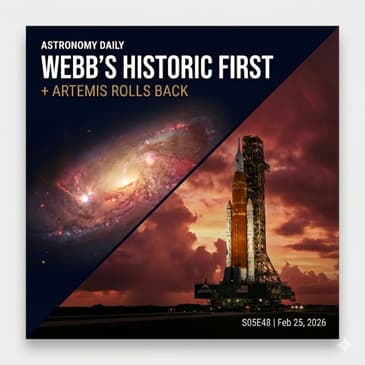
Hello, and welcome to Astronomy Daily. I'm Anna and I'm Avery. It's Wednesday, February twenty fifth, twenty twenty six, and you are listening to Season five, episode forty eight. Big Show. Today, NASA's Moon rocket is on the move again, James Webb has achieved a genuine first in a history of astronomy, and we're going to talk about a world out there that is becoming increasingly difficult to explain without considering the word life. Plus, the sun is taking a quiet day for the first time in years. There's some grippy new detail from China's incredible space emergency last year, and we close with something that might just make you want to send a letter. All that coming right up, let's get into it. We start with an update on a story we've been following closely all week and today there's a genuinely new angle that caught a lot of people off guard. Right so Artemis two. As of this morning, the enormous Space Launch System rocket and the Orion spacecraft have physically begun their four mile journey from launch Pad thirty nine B back to the vehicle assembly building at Kennedy Space Center. That rollback started around nine am Eastern Time and could take up to twelve hours. The reason, as we've covered, is a helium flow interruption in the rocket's upper stage. Helium is critical it pressurizes the propellant tanks. Without that working perfectly, you cannot fly. March is now completely off the table. The next realistic opportunity opens on April first. But here's what's new today, and it's a bit of a talking point. Last night, the four Artemis two crew members Reed Wiseman, Victor Glover, Christina Cock, and Canadian astronaut Jeremy Hansen. They were sitting in the gallery at the US Capitol for President Trump State of the Union. They were guests of House Speaker Mike Johnson. And the speech ran for nearly two hours. The President praised the space force extensively. He called, in quote, his baby, but he made no mention of the four astronauts sitting right there in the room, and no mention of the Artemis program at all. Which was noticed. These are the first people who will travel beyond low Earth orbit since the Apollo era, and they were in the chamber. Some in the space community found the omission quite striking. The crew have now been released from their pre launch quarantine. Since there's no imminent launch, NASA has said the whole the media briefing in the coming days to lay out the path forward. For now. April first is the earliest the mission could fly, pending successful repairs, a likely second wet dress rehearsal, and the clean flight readiness review. We will absolutely keep you updated as this develops. The mission itself is still on, It's just going to take a bit longer. This story has still got a long way to go, methinks. Now this next story is a genuine landmark in astronomy, something researchers have been waiting years for. It has to do with supernovae, those spectacular explosions that mark the deaths of massive stars. Astronomers have long wanted to look back at archival images after a supernova occurs and find the star that caused it, the so called progenitor star. But for many of the most massive stars, they just weren't there. They seem to be missing. Well now we know why, and it's thanks to James Webb. On June twenty ninth last year, an automated sky survey detected a new supernova in a galaxy called NNGC one six three seven, about forty million light years away. The explosion was designated twenty twenty five PHT, and a team at Northwestern University immediately did something color. Instead of pointing their telescopes at the new supernova, they went to the archives to image's Web had already taken of that same galaxy. And there it was a single red supergiant star sitting exactly where the suit supernova now shines. This is the first published detection of a supernova progenitor by the James Web telescope. Ever, and here's the key thing. Hubble couldn't see it. The star was completely invisible in Hubble images. It was surrounded by so much dust that shorter wavelengths of light were blocked entirely. Only Webb's infrared instruments could pierce that veil. Lead author Charlie Kilpatrick from Northwestern described it as quote the reddest, most dusty, red supergiant we've seen explode as a supernova. And there was another surprise the dust composition. They expected silicate rich dust, the kind astronomers usually find. Instead, it was carbon rich. The team thinks that carbon may have been dredged up from deep inside the star in its final moments before death. This has direct implications for what's called the mystery of the Missing Red Supergiants. Theory predicts these massive stars should be easy to spot before they explode. They should be bright and luminous, but historically they've often not shown up in pre supernova images at all. Now we have a compelling answer. They're there, They're just hidden in dust. The findings are published in the Astrophysical Journal Letters. The team is now looking for similar dusty red supergiants that might be the next to explode, and Web's successor missions, including the upcoming Nancy Grace Romans telescope, should help that search enormously. A beautiful piece of detective work. From stellar deafs to potential life, because our next story is one that keeps getting more interesting every time new data comes in. The exoplanet K two eighteen B. If you've been following exoplanet science over the last couple of years, you'll know this name. K two eighteen B is located one hundred and twenty four light years away in the constellation Leo, sitting squarely in the habitable zone of its red dwarf host star and James Webb has been staring at it. What WEB found was an atmosphere rich in both carbon dioxide and methane. That chemical combination is significant. It points strongly towards what astronomers call a Hycian world. The idea is a planet with a warm, liquid water ocean beneath a thick, hydrogen rich atmosphere. And the intrigue doesn't stop there. Earlier analyzes of K two eighteen b's atmosphere had also hinted at possible traces of dimethyl sulfide, a molecule that on Earth is produced almost exclusively by marine life. Now that hasn't been confirmed, and scientists are appropriately cautious. There are non biological explanations being explored, but the. Ongoing analysis of WEB data is continuing to add layers to the story. The carbon dioxide and methane combination is precisely what you'd expect if there were a liquid ocean beneath that atmosphere. The current focus is whether those chemical signatures could have a biological origin, and that's one of the most consequential questions in all of science. K two eighteen B is one of the most watched targets in astrobiology right now, and with web continuing to accumulate data, we should expect more updates in the months ahead. Ivery If it turns out there is life on K two eighteen B. Then everything changes. That's all I'll say. Okay, something a little different now, a story about our own Sun behaving unusually quietly. On February twenty second, the Sun's Earth facing disc went completely spotless for the first time in one thousand, three hundred and fifty five days. That ends a streak stretching all the way back to June eighth of twenty twenty two. For nearly four years, you could look at the Sun on any given day and find at least one active sunspot region, not anymore for a few days at least. Sun Spots are regions of intense magnetic activity on the solar surface, and they're the source of solar flares and the coronal mass ejections that can send charged particles hurtling toward Earth. We are in solar cycle twenty five, which peaked in October twenty twenty four, with a sunspot count significantly higher than scientists initially predicted. Here's a fun wrinkle. While Earth was looking at a blink sun. NASA's Perseverance rover on Mars had a different view from the Martian service. Perseverance could see sunspot groups blazing away on the far side of the Sun, invisible to us here on Earth, but clearly visible from Mars's position in the Solar system. The spotless period appears to have lasted about two to three days before a new active region began emerging around February twenty fourth. So the Sun isn't shutting down, it's just having a quiet moment. Solar activity isn't expected to reach its next minimum until around twenty thirty, but this little pause is a signal that Solar Cycle twenty five is beginning. It it's long, slow wind down from that October twenty twenty four peak. For listeners who love Aurora hunting, The good news is there's still plenty of solar activity ahead, but the best years of this cycle are behind us. Now now to a story that we've touched on the four but which has taken on fascinating new depth this week, with the shen Zu twenty astronauts speaking out in remarkable detail about last year's in orbit emergency. China's first ever human spaceflight crisis. Just to recap the situation, China's shen Zu twenty crew commander Chen Dong, along with Chen shang Rui and Wing Ye, launched in April twenty twenty five for what was supposed to be a standard six month mission to the Tiangong Space Station. During pre return checks, on the day before they were supposed to come home, Commander Chen went to inspect the return capsule and. He spotted something on the viewport window, something triangular. His first thought, and he shared this in a new interview with Chinese state broadcaster CCTV, was that a small leaf had somehow stuck to the outside of the glass. And then, as he told it, he quickly realized that couldn't happen because they were in space. What he was actually seeing was a crack, a triangular scar roughly two centimeters long in the outer layer of the three layer viewport window, most likely caused by a debris strike. The crew used a pen shaped microscope to confirm the damage, took photos immediately, and transmitted everything to the ground. The decision that followed was extraordinary. The crew could not safely return in their own spacecraft. Instead, they transferred to the Shenzo twenty one, vehicle that had just arrived days earlier carrying their relief crew. An uncrewed shen Zoo twenty two was then emergency launched carrying a porthole repair device. The whole response from finding the crack to the crew's safe return to Earth took just over twenty days, and. The damage sends you twenty capsule. It was eventually brought back to Earth uncrewed on January nineteenth of this year, after spending two hundred and seventy days in orbit, ninety days longer than planned. It survived reentry, which itself was a significant engineering achievement. Commander Chen Dong summed it up beautifully. The unexpected window cracks ultimately became a precious testament to the concerted efforts and shared commitment for safety between our two crews and all ground based space personnel. A genuinely remarkable chapter in human spacelight. The space debrie problem is real, and this story illustrates exactly why it matters. And finally, something a little lighter to close the show, avery, have you ever wanted to send a letter that was also technically a window to the Cosmos? I feel like that's a rhetorical question, but yes, obviously, well. The US Postal Service has you covered. Yesterday, February twenty fourth, the USPS officially issued two brand new Priority Mail stamps, both featuring images from the James web Space Telescope. The first is the Priority Mail Stamp, priced at eleven dollars and ninety five cents, and it features the crab Nebula, the spectacular remnants of a star that exploded in the constellation Taurus about six thousand, five hundred light years away. Web captured it in the infrared, revealing structural details that have never been seen before. The second is the Priority Mail Express stamp at thirty three dollars and twenty five cents. And this one is a real showpiece. It's a composite image called Galaxy Pair two interacting spiral galaxies ICE twenty one sixty three and NNGC twenty two oh seven, located about eighty million light years away. The image combines Web and Hubble data across in for read visible and ultraviolet wavelengths. It is genuinely stunning. Kansas City, Missouri, was the official city of issue, though there was no public ceremony. And here's a lovely detail. For collectors, you have until June twenty fourth to send your stamps in for a first day of issue postmark. The Postal Service will even apply the postmark for free up to fifty envelopes. And this is actually the fourth consecutive year the USPS has used web imagery on priority mail stamps. In twenty twenty two it was a Forever stamp featuring a rendering of the telescope itself. In twenty twenty four and twenty twenty five, the Pillars of Creation featured, now the crab, nebula and a galaxy pair. Web is becoming something of an annual tradition at the post Office, which, when you. Think about it, is rather wonderful. A space telescope that costs ten billion dollars and took thirty years to build is now sitting in people's junk drawers, next to the scissors and the tape. That is the most poetic thing you have ever said on this podcast. I have my moments, and that is Astronomy Daily for Wednesday, February twenty fifth, twenty twenty six. What a show, rollbacks, Red super Giants, Possible Ocean worlds, A quiet Sun Space debris emergencies and commemorative postage. If you enjoyed today's episode, please do leave us a review. Wherever you listen it makes a genuine difference, and you can find us at Astronomy Daily dot io and on social media at astro Daily Pod. For Avery, I'm anna stay curious, keep looking up, and we'll see you tomorrow. Clear Skies, everyone, Sunday Stars Starz. The story is to tell