
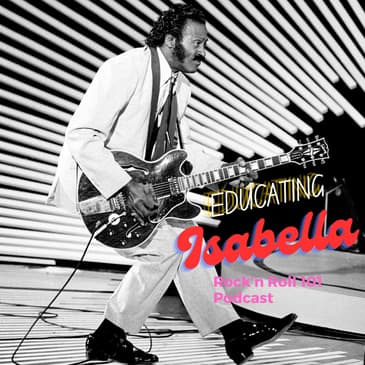
The Rise of Chuck Berry
Controversies and Challenges
The Comeback: Hits and Innovations
Legacy and Influence on Future Artists
Homework: Explore Chuck Berry's Music
Next Episode Preview: The New Romantics of the 80s
For more visit our website at https://bitesz.com/podcast/educating-isabella-rock-n-roll-101
Become a supporter of this podcast: https://www.spreaker.com/podcast/educating-isabella-rock-n-roll-101--6522543/support.
For more music history and commentary, visit our website at https://bitesz.com
This episode includes AI-generated content.
00:00:00 --> 00:00:02 Michael: Welcome back to Educating Isabella Rock and
00:00:02 --> 00:00:05 Roll 101, the podcast where we introduce
00:00:05 --> 00:00:08 you to the music and artists who got us to
00:00:08 --> 00:00:11 where we are today. I'm Michael. And today
00:00:11 --> 00:00:14 we continue our deep dive into one of
00:00:14 --> 00:00:17 rock's true architects, Chuck Berry.
00:00:17 --> 00:00:19 If you haven't listened to part one yet, I'd
00:00:19 --> 00:00:21 suggest going back and listening before
00:00:21 --> 00:00:23 tackling this episode in the name of having a
00:00:23 --> 00:00:26 complete picture of this complex man, the
00:00:26 --> 00:00:29 man who Jerry Lee Lewis own mother once
00:00:29 --> 00:00:32 announced to her son, well, you and Elvis are
00:00:32 --> 00:00:33 pretty good, but you're no Chuck Berry.
00:00:47 --> 00:00:50 In part one, we trace the birth of rock and
00:00:50 --> 00:00:53 roll from the first spark of Maybelline to
00:00:53 --> 00:00:55 the stardom of Johnny B. Goode and the
00:00:55 --> 00:00:57 explosion that echoed across the Atlantic.
00:00:59 --> 00:01:01 Now, in part two, we explore the other side
00:01:01 --> 00:01:03 of the story. The struggles, the
00:01:03 --> 00:01:06 controversies and the stubborn brilliance of
00:01:06 --> 00:01:08 a man who lived his life by his own rules.
00:01:09 --> 00:01:11 This is Chuck Berry, the price of greatness.
00:01:12 --> 00:01:15 By the late 1950s, Berry was one of the
00:01:15 --> 00:01:18 biggest stars in America. He was a black
00:01:18 --> 00:01:20 man commanding stages across a racially
00:01:20 --> 00:01:23 divided country, selling records to teenagers
00:01:23 --> 00:01:26 of every color. That alone made
00:01:26 --> 00:01:29 him a revolutionary figure, but it also made
00:01:29 --> 00:01:31 him a target. In 1959,
00:01:31 --> 00:01:34 his world crashed. Barry was arrested and
00:01:34 --> 00:01:37 later convicted under the man act, accused of
00:01:37 --> 00:01:39 transporting a minor across state lines.
00:01:40 --> 00:01:43 He served almost two years in prison. The
00:01:43 --> 00:01:45 details remain disputed even today, but one
00:01:45 --> 00:01:48 thing is when he emerged, the landscape of
00:01:48 --> 00:01:51 popular music had shifted. And so had he.
00:01:51 --> 00:01:54 He was bitter and more difficult, if that was
00:01:54 --> 00:01:56 possible, to work with. Elvis had been
00:01:56 --> 00:01:59 drafted and returned. New stars were rising.
00:02:00 --> 00:02:02 Yet the young bands in Britain and America
00:02:02 --> 00:02:05 who idolized him the Beatles, the Rolling
00:02:05 --> 00:02:07 Stones, the Beach Boys were now spreading his
00:02:07 --> 00:02:10 sound across the globe. Just take a listen to
00:02:10 --> 00:02:13 the Beach Boys. Surfin usa A, uh, barely
00:02:13 --> 00:02:16 disguised remake of Sweet Little Sixteen.
00:02:17 --> 00:02:19 His name might have been tarnished, but his
00:02:19 --> 00:02:21 music had already seeded the future.
00:02:22 --> 00:02:25 When Berry walked free in 1963,
00:02:25 --> 00:02:27 many thought his career was over.
00:02:28 --> 00:02:31 Instead, he came roaring back. Returning to
00:02:31 --> 00:02:33 Chess Records, he wrote songs with the wit,
00:02:33 --> 00:02:36 humor and edge that had always defined him.
00:02:37 --> 00:02:39 No particular place to Go, with its sly
00:02:39 --> 00:02:41 teenage innuendo, climbed the charts.
00:02:42 --> 00:02:45 You never can tell. That Wedding Day Waltz
00:02:45 --> 00:02:47 proved he hadn't lost his gift for
00:02:47 --> 00:02:49 observation and groove. And Nadine
00:02:50 --> 00:02:52 showed he could still craft a story that
00:02:52 --> 00:02:55 jumped out of the speakers. But Barry
00:02:55 --> 00:02:57 was changed. The boyish grin had hardened.
00:02:57 --> 00:03:00 The trust was gone. He insisted on getting
00:03:00 --> 00:03:03 paid in cash before every show. He often
00:03:03 --> 00:03:06 arrived alone, renting local musicians rather
00:03:06 --> 00:03:08 than touring with a permanent band.
00:03:09 --> 00:03:11 Promoters complained fellow Performers called
00:03:11 --> 00:03:14 him difficult, but Berry had seen too
00:03:14 --> 00:03:16 much of the industry's dark side, and he
00:03:16 --> 00:03:19 refused to be cheated again. Those
00:03:19 --> 00:03:22 who played with him tell stories of awe and
00:03:22 --> 00:03:25 frustration in equal measure. He'd
00:03:25 --> 00:03:27 walk on stage without rehearsing, call out a
00:03:27 --> 00:03:29 key and expect the band to keep up.
00:03:30 --> 00:03:33 When they did, it was electric. When they
00:03:33 --> 00:03:35 didn't, it could be chaos. And yet,
00:03:35 --> 00:03:38 the moment he hit that first riff, that
00:03:38 --> 00:03:40 unmistakable opening to Johnny B. Goode, the
00:03:40 --> 00:03:43 crowd erupted every time. Whatever his
00:03:43 --> 00:03:45 moods, his artistry never deserted him.
00:03:46 --> 00:03:49 Then came 1972, and the surprise
00:03:49 --> 00:03:52 hit that no one saw coming, My Ding A Ling.
00:03:52 --> 00:03:55 A novelty sing along recorded live in London,
00:03:55 --> 00:03:58 it reached number one on the US charts and
00:03:58 --> 00:04:00 several other countries around the globe.
00:04:00 --> 00:04:03 Barry's only chart topper. Critics
00:04:03 --> 00:04:06 hated it, fans were puzzled. But Barry didn't
00:04:06 --> 00:04:09 care. He'd outlasted them all. It was
00:04:09 --> 00:04:11 proof that even his mischief could move
00:04:11 --> 00:04:14 millions. Still, beneath the
00:04:14 --> 00:04:16 humor and swagger, the years were taking
00:04:16 --> 00:04:19 their toll. Lawsuits, tax
00:04:19 --> 00:04:21 troubles and more arrests shadowed him
00:04:21 --> 00:04:23 through the 1970s and 80s.
00:04:24 --> 00:04:26 He could be charming one moment and cutting
00:04:26 --> 00:04:29 the next. But for every scandal or
00:04:29 --> 00:04:31 clash, there was another generation of
00:04:31 --> 00:04:34 musicians citing him as the reason they'd
00:04:34 --> 00:04:37 picked up a guitar. By the mid-1980s,
00:04:37 --> 00:04:40 Berry had become both a legend and an enigma.
00:04:40 --> 00:04:42 A man respected, feared, and endlessly
00:04:42 --> 00:04:44 imitated. In
00:04:44 --> 00:04:47 1986, the year the Rock and Roll hall of Fame
00:04:47 --> 00:04:49 opened its doors for the first time, Chuck
00:04:49 --> 00:04:52 Berry was among the inaugural inductees.
00:04:53 --> 00:04:56 They called him the Poet Laureate of Rock and
00:04:56 --> 00:04:59 Roll. A year later, Keith Richards,
00:04:59 --> 00:05:01 the ultimate disciple, helped organize a
00:05:01 --> 00:05:04 tribute concert for Barry's 60th birthday.
00:05:05 --> 00:05:07 It was Keith's job to put an all star band
00:05:07 --> 00:05:09 together to back and support Chuck. And he
00:05:09 --> 00:05:12 nailed it. Though more than a few of the big
00:05:12 --> 00:05:15 stars probably found Chuck demanding,
00:05:15 --> 00:05:17 shall we say? It became the documentary
00:05:17 --> 00:05:20 Hail, Hail Rock and Roll. Keith
00:05:20 --> 00:05:23 Richards described working with Chuck Berry
00:05:23 --> 00:05:25 during the filming as being challenging yet
00:05:25 --> 00:05:28 instructive, noting Berry gave him more
00:05:28 --> 00:05:30 headaches than Mick Jagger. It
00:05:30 --> 00:05:32 was during the filming of this movie that
00:05:32 --> 00:05:35 Barry famously gave Keith Richards a black
00:05:35 --> 00:05:37 eye for the crime of touching his guitar.
00:05:38 --> 00:05:40 No one touches my guitar. Whack.
00:05:41 --> 00:05:44 Fortunately, Keith took the incident in good
00:05:44 --> 00:05:46 spirits, telling Chuck he would have probably
00:05:46 --> 00:05:49 done the same thing if he'd caught someone
00:05:49 --> 00:05:51 touching his guitar. Watching that
00:05:51 --> 00:05:54 film, you see both sides of him. The pride,
00:05:54 --> 00:05:56 the ego, the humor and the genius.
00:05:57 --> 00:05:59 Richards once joked that playing with Chuck
00:05:59 --> 00:06:02 was like trying to keep up with a hurricane.
00:06:03 --> 00:06:05 Yet amid the tension, there was deep
00:06:05 --> 00:06:08 affection. Berry had earned his place in
00:06:08 --> 00:06:10 history not because he was perfect, but
00:06:10 --> 00:06:13 because he was irreplaceable. In
00:06:13 --> 00:06:15 his final decades, Berry kept performing.
00:06:16 --> 00:06:19 He played small clubs, often in his hometown
00:06:19 --> 00:06:22 of St. Louis, still demanding cash, still
00:06:22 --> 00:06:24 duck walking across the stage, sometimes
00:06:24 --> 00:06:27 brilliantly, sometimes barely holding it
00:06:27 --> 00:06:29 together. When he turned 90 in 2016,
00:06:29 --> 00:06:32 he announced one last album, simply titled
00:06:32 --> 00:06:35 Chuck, his first new studio record in
00:06:35 --> 00:06:38 nearly 40 years. He didn't live to
00:06:38 --> 00:06:40 see its release. Chuck berry died in
00:06:40 --> 00:06:43 March 2017, and at the age of 90.
00:06:44 --> 00:06:46 Tributes poured in from every corner of the
00:06:46 --> 00:06:49 music world. Mick Jagger wrote, he lit
00:06:49 --> 00:06:52 up our teenage years and blew life into our
00:06:52 --> 00:06:55 dreams. Bruce Springsteen called him
00:06:55 --> 00:06:57 the greatest pure rock and roll writer and
00:06:57 --> 00:06:59 performer who ever lived.
00:07:00 --> 00:07:02 And even modern artists like Ed Sheeran and
00:07:02 --> 00:07:05 Hozier spoke of his influence on the songs
00:07:05 --> 00:07:06 they grew up loving.
00:07:07 --> 00:07:10 Chuck Berry was complicated. He could be
00:07:10 --> 00:07:13 proud, stubborn, sometimes abrasive. But
00:07:13 --> 00:07:15 he was also a pioneer, a poet of everyday
00:07:15 --> 00:07:18 life, a visionary guitarist, and the man who
00:07:18 --> 00:07:21 gave rock and roll its attitude. Every
00:07:21 --> 00:07:23 riff that makes you want to move, every lyric
00:07:23 --> 00:07:26 that celebrates youth, freedom and
00:07:26 --> 00:07:28 rebellion, they all trace back to him.
00:07:29 --> 00:07:31 His music crossed racial boundaries,
00:07:31 --> 00:07:34 inspired social change, and created the
00:07:34 --> 00:07:36 blueprint that still drives popular music
00:07:36 --> 00:07:39 today. So, Isabella, here's your homework.
00:07:40 --> 00:07:42 Start by listening to Nadine, no Particular
00:07:42 --> 00:07:44 Place to Go and My Ding a Ling.
00:07:45 --> 00:07:48 Then move forward and hear how his DNA runs
00:07:48 --> 00:07:50 through. The Rolling Stones, Brown Sugar,
00:07:50 --> 00:07:52 Bruce Springsteen's she's the One, and even
00:07:52 --> 00:07:55 Hozier's Movement. You'll
00:07:55 --> 00:07:57 find them all and plenty more on our
00:07:57 --> 00:08:00 Educating Isabella playlists available on
00:08:00 --> 00:08:02 Spotify, YouTubeMusic Music and Deezer.
00:08:03 --> 00:08:06 Next time on Educating Isabella, we'll move
00:08:06 --> 00:08:08 from the roots of rock to one of the great
00:08:08 --> 00:08:11 bands of the 80s. We'll be taking a look
00:08:11 --> 00:08:13 at the band that defined the term New
00:08:13 --> 00:08:16 Romantics. Until then, keep
00:08:16 --> 00:08:18 listening, keep learning, keep dancing, and
00:08:18 --> 00:08:21 remember, uh, genius is rarely simple.
00:08:21 --> 00:08:23 And the story of rock and roll was never
00:08:23 --> 00:08:26 meant to be tidy. It was meant to be
00:08:26 --> 00:08:29 loud, alive and unforgettable, just like
00:08:29 --> 00:08:31 Chuck Berry. Rock on.