
Become a supporter of this podcast: https://www.spreaker.com/podcast/educating-isabella-rock-n-roll-101--6522543/support.
For more music history and commentary, visit our website at https://bitesz.com
This episode includes AI-generated content.
00:00:00 --> 00:00:03 Michael: Welcome back to Educating Isabella Rock and
00:00:03 --> 00:00:06 Roll 101. I'm Michael, and sitting
00:00:06 --> 00:00:08 across from me, as always, is my favorite
00:00:08 --> 00:00:10 student, Isabella.
00:00:10 --> 00:00:13 Michael: Hey, great to be back. Although, Michael, I
00:00:13 --> 00:00:16 have to say, after The Dave Clark 5 episode,
00:00:16 --> 00:00:18 I've been thinking a lot about this whole
00:00:18 --> 00:00:21 British Invasion thing. Like how did so
00:00:21 --> 00:00:23 many British bands all suddenly become
00:00:23 --> 00:00:25 massive in America at the same time?
00:00:25 --> 00:00:28 Educating is a fella. Here the tales
00:00:28 --> 00:00:31 unfold Is the rocks.
00:00:39 --> 00:00:42 Michael: That's such a great question. And honestly,
00:00:42 --> 00:00:44 it's the perfect starting point for today's
00:00:44 --> 00:00:47 episode because today's band is probably the
00:00:47 --> 00:00:49 most extreme m example of exactly that
00:00:49 --> 00:00:50 phenomenon.
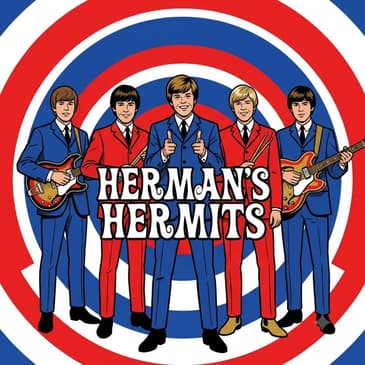
00:00:50 --> 00:00:53 Today we're talking about Herman's Hermits.
00:00:53 --> 00:00:56 Michael: Herman's Hermits. Okay, I'll be honest.
00:00:56 --> 00:00:58 I've heard the name, but I know basically
00:00:58 --> 00:01:00 nothing about them. Were they actually called
00:01:00 --> 00:01:01 Herman?
00:01:02 --> 00:01:05 Michael: That is one of my favorite stories in all of
00:01:05 --> 00:01:08 British pop history. No, the lead
00:01:08 --> 00:01:10 singer's real name was Peter Noone. But
00:01:10 --> 00:01:13 here's how they got the name. A Manchester
00:01:13 --> 00:01:15 pub landlord looked at Peter and said he
00:01:15 --> 00:01:18 reminded him of Sherman, a cartoon character
00:01:18 --> 00:01:20 from an animated show called Rocky and
00:01:20 --> 00:01:21 Wolvenkle.
00:01:21 --> 00:01:23 Michael: Wait, so they named themselves after a
00:01:23 --> 00:01:24 cartoon?
00:01:25 --> 00:01:27 Michael: Sort of. Sherman became Herman,
00:01:28 --> 00:01:30 Herman found his Hermits. And that's how one
00:01:30 --> 00:01:32 of the most successful British bands in
00:01:32 --> 00:01:35 American history got their name from an
00:01:35 --> 00:01:37 animated dog on American television.
00:01:37 --> 00:01:40 Michael: That is absolutely ridiculous. And I love
00:01:40 --> 00:01:40 it.
00:01:41 --> 00:01:43 Michael: So let me set the scene. It's Manchester,
00:01:43 --> 00:01:46 England, 1963. The Beatles are
00:01:46 --> 00:01:49 already becoming huge. Every group of lads
00:01:49 --> 00:01:51 with a guitar thinks they can make it. And
00:01:51 --> 00:01:54 among them is a group originally called the
00:01:54 --> 00:01:56 Heartbeats. Very young guys. Teenagers
00:01:56 --> 00:01:57 mostly.
00:01:57 --> 00:01:58 Michael: How young are we talking?
00:01:59 --> 00:02:01 Michael: Well, when Peter Noon joined as a lead
00:02:01 --> 00:02:03 singer, he was 15 years old.
00:02:04 --> 00:02:07 Michael: Fifteen? That's. I mean, that's like being
00:02:07 --> 00:02:08 in secondary school.
00:02:08 --> 00:02:11 Michael: Exactly. And it gets better. He
00:02:11 --> 00:02:14 wasn't just a school kid with a guitar. At,
00:02:14 --> 00:02:16 ah, 15, he was already a professional
00:02:16 --> 00:02:19 actor. He'd been on Coronation street, the
00:02:19 --> 00:02:21 biggest soap opera in British television,
00:02:21 --> 00:02:23 playing the son of one of the main
00:02:23 --> 00:02:23 characters.
00:02:24 --> 00:02:27 Michael: So he was basically already famous before the
00:02:27 --> 00:02:27 band.
00:02:27 --> 00:02:30 Michael: In a minor way, yes. He had stage
00:02:30 --> 00:02:33 presence. He knew how to perform. He was
00:02:33 --> 00:02:35 comfortable in front of cameras. The other
00:02:35 --> 00:02:38 lads in the band, Carl Green on bass, Barry
00:02:38 --> 00:02:41 Whitwam on drums, Keith Hopwood on rhythm
00:02:41 --> 00:02:44 guitar, Derek Leckenby on lead guitar. They
00:02:44 --> 00:02:46 were older teenagers, but very ordinary
00:02:46 --> 00:02:49 Manchester kids. Carl was training as an
00:02:49 --> 00:02:51 engraver. Barry was working as a barber.
00:02:52 --> 00:02:54 They weren't exactly glamorous on paper.
00:02:55 --> 00:02:57 Michael: Love that. A barber and an engraver.
00:02:58 --> 00:02:59 Very glamorous.
00:03:00 --> 00:03:03 Michael: Manchester Glamour at its finest. But when
00:03:03 --> 00:03:05 this group came together, something clicked
00:03:05 --> 00:03:07 and then they were spotted by a manager named
00:03:07 --> 00:03:10 Harvey Lisberg who was convinced they had
00:03:10 --> 00:03:12 something special. Now here's where it gets
00:03:12 --> 00:03:15 really interesting. Isabella Lisberg was so
00:03:15 --> 00:03:17 convinced about the band that he actually
00:03:17 --> 00:03:19 bought a plane ticket for a famous London
00:03:19 --> 00:03:22 record producer named, hmm, Mickey Most and
00:03:22 --> 00:03:25 sent it to him, essentially saying, just come
00:03:25 --> 00:03:26 and see these kids play.
00:03:26 --> 00:03:27 Michael: Did Most go?
00:03:27 --> 00:03:30 Michael: He went all the way to Bolton, a town near
00:03:30 --> 00:03:32 Manchester, and he was immediately sold on
00:03:32 --> 00:03:35 Peter Noone. He reportedly said Noone
00:03:35 --> 00:03:38 reminded him of John F. Kennedy. That fresh
00:03:38 --> 00:03:40 faced, wholesome, immediately likable
00:03:40 --> 00:03:41 quality.
00:03:41 --> 00:03:43 Michael: That's a big comparison.
00:03:43 --> 00:03:45 Michael: It was, but it captures something real.
00:03:46 --> 00:03:48 Peter Noon had this quality of being likable
00:03:48 --> 00:03:51 the instant you saw him. He was non
00:03:51 --> 00:03:53 threatening, charming, genuinely warm.
00:03:54 --> 00:03:56 So Mickey Mo signed them and took them into
00:03:56 --> 00:03:59 the studio and they just started recording.
00:03:59 --> 00:04:02 Well, and this is the controversial part of
00:04:02 --> 00:04:04 the story, on many of the early records, the
00:04:04 --> 00:04:06 actual band members didn't play the
00:04:06 --> 00:04:08 instruments. Mickey Mose brought in
00:04:08 --> 00:04:11 professional session musicians from London
00:04:11 --> 00:04:11 instead.
00:04:11 --> 00:04:14 Michael: What, so the band wasn't actually on
00:04:14 --> 00:04:15 their own records?
00:04:16 --> 00:04:18 Michael: Not always, particularly in the early
00:04:18 --> 00:04:21 days. And here's the thing that makes this
00:04:21 --> 00:04:24 extraordinary. Some of those session
00:04:24 --> 00:04:26 musicians later became incredibly famous
00:04:26 --> 00:04:29 themselves. Among them was a young
00:04:29 --> 00:04:31 guitarist named Jimmy Page.
00:04:31 --> 00:04:34 Michael: Jimmy Page? As in Jimmy Page of Led
00:04:34 --> 00:04:34 Zeppelin?
00:04:35 --> 00:04:38 Michael: The very same. And also a bass player
00:04:38 --> 00:04:40 and arranger named John Paul Jones.
00:04:41 --> 00:04:43 Michael: That's. Wait, both of them,
00:04:43 --> 00:04:45 two of the four members of Led Zeppelin were
00:04:45 --> 00:04:48 playing on Herman's Hermits records before
00:04:48 --> 00:04:50 Zeppelin even existed.
00:04:50 --> 00:04:53 Michael: Yes, they were top session musicians for
00:04:53 --> 00:04:55 hire in London and they worked on some of the
00:04:55 --> 00:04:58 biggest pop records of the era. Herman's
00:04:58 --> 00:05:00 Hermits was just one of many artists they
00:05:00 --> 00:05:01 worked with.
00:05:01 --> 00:05:04 Michael: That is one of the most random facts I've
00:05:04 --> 00:05:05 ever heard. I love it.
00:05:05 --> 00:05:08 Michael: Their debut single was I'm Into Something
00:05:08 --> 00:05:11 Good, a song written by the legendary Gerry
00:05:11 --> 00:05:13 Goffin and Carole King duo. It had already
00:05:14 --> 00:05:16 been a minor hit in America for a singer
00:05:16 --> 00:05:18 called Earl Jean, but in Herman's
00:05:18 --> 00:05:20 Hermit's version it became something
00:05:21 --> 00:05:21 irresistible.
00:05:22 --> 00:05:23 Michael: What made it different?
00:05:23 --> 00:05:26 Michael: Peter Noon's vocal, mainly that high
00:05:26 --> 00:05:29 pitched, exuberant, almost goofy
00:05:29 --> 00:05:31 quality that just radiated good, humorous.
00:05:32 --> 00:05:34 He couldn't hear it without smiling. It went
00:05:34 --> 00:05:37 straight to number one in the UK in September
00:05:37 --> 00:05:39 1964 and by December
00:05:39 --> 00:05:41 it had reached number 13 in
00:05:41 --> 00:05:44 Michael: America though they broke through on Britain
00:05:44 --> 00:05:45 first and then America caught up.
00:05:46 --> 00:05:48 Michael: Exactly. And then in
00:05:48 --> 00:05:50 1965 everything
00:05:50 --> 00:05:53 exploded. They toured America for the first
00:05:53 --> 00:05:55 time. MGM Records released a
00:05:55 --> 00:05:58 compilation album called Introducing Herman's
00:05:58 --> 00:06:01 Hermits. And on that album was a song
00:06:01 --> 00:06:04 that had never been released as a single, a
00:06:04 --> 00:06:06 song called Mrs. Brown youn've Got a Lovely
00:06:06 --> 00:06:07 Daughter.
00:06:07 --> 00:06:10 Michael: That's a very specific title, isn't
00:06:10 --> 00:06:10 it?
00:06:10 --> 00:06:13 Michael: It was based on a British TV play and the
00:06:13 --> 00:06:16 group had recorded it almost as a joke. It
00:06:16 --> 00:06:19 had a banjo guitar sound. Peter Noon
00:06:19 --> 00:06:21 sang it in his thick Manchester accent,
00:06:22 --> 00:06:24 very much in the style of old British music
00:06:24 --> 00:06:27 hall entertainment in England.
00:06:27 --> 00:06:29 Releasing this as a single would have been
00:06:29 --> 00:06:31 commercial suicide. It sounded like something
00:06:31 --> 00:06:33 your grandparents would enjoy.
00:06:33 --> 00:06:35 Michael: So why did they put it on the album?
00:06:35 --> 00:06:38 Michael: Partly as a novelty, partly as filler,
00:06:38 --> 00:06:41 but then an American disc jockey heard it
00:06:41 --> 00:06:44 and he went absolutely mad for it.
00:06:44 --> 00:06:47 He convinced MGM to release it as a single
00:06:47 --> 00:06:49 and America lost its mind.
00:06:50 --> 00:06:52 Michael: People liked the old fashioned sound.
00:06:52 --> 00:06:55 Michael: They loved it. It went to number one and
00:06:55 --> 00:06:57 stayed there for three weeks. The very thing
00:06:57 --> 00:06:59 that would have embarrassed the band in
00:06:59 --> 00:07:02 England being too quaint, too old
00:07:02 --> 00:07:04 fashioned, too music hall was
00:07:04 --> 00:07:06 exactly what American audiences found
00:07:06 --> 00:07:09 charming and exotic. The thick
00:07:09 --> 00:07:11 Manchester accent that might have seemed
00:07:11 --> 00:07:14 unappealing at home sounded wonderfully,
00:07:14 --> 00:07:16 authentically British in America.
00:07:16 --> 00:07:18 Michael: So they basically accidentally discovered
00:07:18 --> 00:07:20 what American audiences wanted to.
00:07:21 --> 00:07:24 Michael: Precisely. And then they doubled down on it
00:07:24 --> 00:07:26 because their next American number one was
00:07:26 --> 00:07:29 even more old fashioned. It was called
00:07:29 --> 00:07:31 I'm Henry viii, I Am M
00:07:31 --> 00:07:34 Isabella. This song was not written in
00:07:34 --> 00:07:37 1964, it was written in
00:07:37 --> 00:07:38 1911.
00:07:38 --> 00:07:41 Michael: 1911, as in over
00:07:41 --> 00:07:43 50 years before they recorded it.
00:07:43 --> 00:07:46 Michael: Over 50 years. It was a cockney
00:07:46 --> 00:07:49 music hall song, the kind of thing people
00:07:49 --> 00:07:51 sang in pubs and variety theaters in the days
00:07:51 --> 00:07:54 before radio. An absolutely
00:07:54 --> 00:07:56 ancient piece of British working class
00:07:56 --> 00:07:59 entertainment. And Herman's Hermits took it
00:07:59 --> 00:08:01 to number one in America in
00:08:01 --> 00:08:02 1965.
00:08:02 --> 00:08:04 Michael: That's kind of incredible.
00:08:04 --> 00:08:07 Michael: It really is. Peter Noon sang it with this
00:08:07 --> 00:08:10 wonderful, almost theatrical cheekiness.
00:08:10 --> 00:08:12 He leaned into it. He performed it with
00:08:12 --> 00:08:15 enormous energy and fun. And American
00:08:15 --> 00:08:18 teenagers, who had no connection to British
00:08:18 --> 00:08:20 music hall, who had no idea this was the kind
00:08:20 --> 00:08:22 of thing their great grandparents would have
00:08:22 --> 00:08:24 sung, just thought it was brilliant.
00:08:25 --> 00:08:27 Michael: What was happening in America at this time?
00:08:27 --> 00:08:29 Like, why were they so open to all this
00:08:29 --> 00:08:30 British stuff?
00:08:30 --> 00:08:33 Michael: Great question. A few things. The
00:08:33 --> 00:08:36 Beatles had opened the Door in 1964.
00:08:36 --> 00:08:38 Once British bands had proven they could
00:08:38 --> 00:08:40 conquer America, the whole industry was
00:08:40 --> 00:08:43 looking for the next British act. American
00:08:43 --> 00:08:46 teenagers were genuinely fascinated by
00:08:46 --> 00:08:48 Britain. British accents, British
00:08:48 --> 00:08:51 fashion, British culture, it all seemed
00:08:51 --> 00:08:53 exotic and exciting.
00:08:53 --> 00:08:56 Michael: So it worked in their favor that they were so
00:08:56 --> 00:08:57 obviously British.
00:08:57 --> 00:09:00 Michael: Absolutely. And Herman's Hermits were smart,
00:09:00 --> 00:09:02 or at least Mickey Mose was smart about
00:09:02 --> 00:09:05 leaning into that they didn't try to sound
00:09:05 --> 00:09:07 American. They sounded completely
00:09:07 --> 00:09:10 authentically, sometimes comically
00:09:10 --> 00:09:13 British. And Americans loved them for it.
00:09:13 --> 00:09:16 Here's a statistic that still staggers me.
00:09:16 --> 00:09:19 Between March and August of 1965,
00:09:19 --> 00:09:21 Herman's Hermits had five singles
00:09:21 --> 00:09:24 simultaneously in the American top 10.
00:09:24 --> 00:09:27 24 consecutive weeks in the top 10.
00:09:27 --> 00:09:30 And for that whole year, Billboard magazine
00:09:30 --> 00:09:32 ranked them the number one singles act in the
00:09:32 --> 00:09:32 country.
00:09:33 --> 00:09:34 Michael: More than the Beatles.
00:09:34 --> 00:09:37 Michael: The Beatles were number two. Harmon's
00:09:37 --> 00:09:39 Hermits were number one.
00:09:40 --> 00:09:42 Michael: I genuinely cannot get my head around that.
00:09:42 --> 00:09:45 Michael: So why did they connect so deeply with
00:09:45 --> 00:09:46 American audiences, do you think?
00:09:47 --> 00:09:49 Michael: Well, from what you said, Peter Noon seems
00:09:49 --> 00:09:52 like he was just incredibly likable, like
00:09:52 --> 00:09:52 naturally.
00:09:53 --> 00:09:56 Michael: That's exactly right. And there's a context
00:09:56 --> 00:09:58 to that. The rolling stones in
00:09:58 --> 00:10:01 1965 were dangerous. They were
00:10:01 --> 00:10:03 rebellious, parents were suspicious of them.
00:10:04 --> 00:10:06 The Beatles were witty and lovable, but also
00:10:06 --> 00:10:09 clearly on their own artistic journey.
00:10:09 --> 00:10:12 Herman's Hermits were safe in the best
00:10:12 --> 00:10:14 possible way. You could love them without
00:10:14 --> 00:10:16 your parents disapproving. They were
00:10:16 --> 00:10:19 cheerful, friendly and absolutely non
00:10:19 --> 00:10:19 threatening.
00:10:20 --> 00:10:22 Michael: It sounds like they were kind of the boy band
00:10:22 --> 00:10:23 of their era.
00:10:23 --> 00:10:26 Michael: That's a really astute comparison. The
00:10:26 --> 00:10:28 template of the boy band. The good looking
00:10:28 --> 00:10:31 frontman, the clean image, the accessible
00:10:31 --> 00:10:33 pop. Ehrman's Hermits were running that
00:10:33 --> 00:10:36 playbook in 1965. They appeared on
00:10:36 --> 00:10:39 all the big American TV shows at Sullivan,
00:10:39 --> 00:10:42 Dean Martin, Jackie Gleason, and they even
00:10:42 --> 00:10:44 appeared in films in hold on in
00:10:44 --> 00:10:47 1966 and Mrs. Brown, you've got a
00:10:47 --> 00:10:48 Lovely Daughter that same year.
00:10:49 --> 00:10:52 Michael: So they were proper pop stars, movie stars,
00:10:52 --> 00:10:53 even at their peak.
00:10:53 --> 00:10:56 Michael: Absolutely. And there's something else worth
00:10:56 --> 00:10:58 noting. There was an unusual amount of social
00:10:58 --> 00:11:01 tension in America in 1965. The
00:11:01 --> 00:11:03 Civil Rights movement beginning to escalate,
00:11:04 --> 00:11:06 the Vietnam War beginning to escalate.
00:11:06 --> 00:11:09 Political assassinations still fresh in
00:11:09 --> 00:11:11 people's memories. In that environment,
00:11:11 --> 00:11:14 music that was simply joyful, that asked
00:11:14 --> 00:11:16 nothing of you, that just made you want to
00:11:16 --> 00:11:18 dance and smile, had enormous appeal.
00:11:19 --> 00:11:21 Michael: Happy music when the world feels heavy.
00:11:21 --> 00:11:24 Michael: Exactly, Isabella, you've put it perfectly.
00:11:24 --> 00:11:27 By 1967, things were shifting.
00:11:27 --> 00:11:30 The music world was changing very rapidly.
00:11:30 --> 00:11:32 The Beatles released Sgt.
00:11:32 --> 00:11:34 Pepper, Rock became more serious and
00:11:34 --> 00:11:37 psychedelic and Herman's Hermits found it
00:11:37 --> 00:11:38 harder to fit in.
00:11:38 --> 00:11:40 Michael: Is that when they fell apart?
00:11:40 --> 00:11:43 Michael: Not immediately. Interestingly, just
00:11:43 --> 00:11:45 as they were fading in America, they enjoyed
00:11:45 --> 00:11:48 a renewed run of hits in Britain. Songs like
00:11:48 --> 00:11:51 no Milk Today, which had a brilliant bass
00:11:51 --> 00:11:53 arrangement by John Paul Jones, by the way,
00:11:53 --> 00:11:56 There's A Kind of Hush, My Sentimental
00:11:56 --> 00:11:59 Friend. Britain finally warmed to them. Just
00:11:59 --> 00:12:00 as America was moving on.
00:12:01 --> 00:12:02 Michael: That's kind of bittersweet.
00:12:02 --> 00:12:05 Michael: It really is. Peter noon left in
00:12:05 --> 00:12:08 1971. He had a solo career, including
00:12:08 --> 00:12:10 a hit called oh, you Pretty Thing.
00:12:10 --> 00:12:11 Michael: Who wrote that?
00:12:12 --> 00:12:13 Michael: David Bowie.
00:12:13 --> 00:12:14 Michael: What?
00:12:14 --> 00:12:17 Michael: David Bowie wrote a hit for Peter Noon
00:12:18 --> 00:12:20 in 1971, before Bowie was really a
00:12:20 --> 00:12:23 major star himself. It was actually one of
00:12:23 --> 00:12:25 Bowie's first writing credits to become a
00:12:25 --> 00:12:27 chart hit for another artist.
00:12:27 --> 00:12:29 Michael: This whole episode is just one
00:12:29 --> 00:12:32 incredible fact after another. Led
00:12:32 --> 00:12:34 Zeppelin playing on their records, David
00:12:34 --> 00:12:36 Bowie writing their soloits.
00:12:36 --> 00:12:38 Michael: That's what I love about this era of music.
00:12:39 --> 00:12:41 Everyone knew everyone, everyone was working
00:12:41 --> 00:12:44 with everyone. It was a very small,
00:12:44 --> 00:12:47 very interconnected world. In total,
00:12:47 --> 00:12:50 Herman's Hermit sold over 60 million
00:12:50 --> 00:12:52 records, 14 gold singles and
00:12:52 --> 00:12:55 seven gold albums in America alone.
00:12:56 --> 00:12:58 And drummer Barry Whitwam still tours with
00:12:58 --> 00:13:01 the Herman's Hermit's name today. He's the
00:13:01 --> 00:13:03 only original member still carrying the flag.
00:13:04 --> 00:13:05 Michael: And Peter Noon?
00:13:05 --> 00:13:08 Michael: Peter Noon also still tours separately
00:13:08 --> 00:13:10 as Herman's Hermit, starring Peter Noon.
00:13:11 --> 00:13:13 There's some legal complexity around who has
00:13:13 --> 00:13:16 the right to use the name. Music and business
00:13:16 --> 00:13:18 don't always end happily.
00:13:18 --> 00:13:19 Michael: That's a bit sad.
00:13:20 --> 00:13:23 Michael: It is. But the music endures and that's what
00:13:23 --> 00:13:23 matters.
00:13:24 --> 00:13:26 So, Isabella, verdict on Herman's Hermits.
00:13:26 --> 00:13:29 We've heard their story. What do you make of
00:13:29 --> 00:13:29 them?
00:13:29 --> 00:13:32 Michael: Honestly? I came in not knowing much and now
00:13:32 --> 00:13:35 I find them genuinely fascinating. Like they
00:13:35 --> 00:13:37 weren't trying to be the most deepest or the
00:13:37 --> 00:13:39 most revolutionary band. They just wanted to
00:13:39 --> 00:13:41 make people happy. And they did that
00:13:41 --> 00:13:42 spectacularly.
00:13:43 --> 00:13:45 Michael: That's a very fair verdict. And I'd add they
00:13:45 --> 00:13:48 deserve far more credit than they typically
00:13:48 --> 00:13:50 get in the history books. 60 million
00:13:50 --> 00:13:53 records, number one in America in
00:13:53 --> 00:13:55 1965. Session musicians who went
00:13:55 --> 00:13:58 on to be in Led Zeppelin. A frontman whose
00:13:58 --> 00:14:01 solo hit was written by David Bowie.
00:14:01 --> 00:14:03 That's not a footnote in music history.
00:14:03 --> 00:14:04 That's a chapter.
00:14:05 --> 00:14:07 Michael: A very fun chapter.
00:14:07 --> 00:14:09 Michael: The most fun chapters usually are.
00:14:10 --> 00:14:12 Now, for everyone listening, we've put
00:14:12 --> 00:14:14 together a playlist of essential Herman's
00:14:14 --> 00:14:16 Hermits tracks so you can hear everything we
00:14:16 --> 00:14:18 talked about today. You'll find it on
00:14:18 --> 00:14:21 Spotify, Apple Music and Deezer. The links
00:14:21 --> 00:14:23 are in the show notes or just search for our
00:14:23 --> 00:14:25 playlists in the relevant directories.
00:14:25 --> 00:14:28 Michael: Start with I'm into something good. Honestly,
00:14:28 --> 00:14:30 it just makes you smile from the first note.
00:14:30 --> 00:14:33 Michael: Exactly right. And then Mrs. Brown
00:14:33 --> 00:14:36 and I'm Henry VIII. I am, uh. Just to
00:14:36 --> 00:14:38 understand why America went so completely
00:14:38 --> 00:14:39 wild for them.
00:14:40 --> 00:14:42 Michael: And no milk today. Michael told me that one
00:14:42 --> 00:14:45 has a John Paul Jones arrangement and it's
00:14:45 --> 00:14:46 actually quite beautiful.
00:14:46 --> 00:14:49 Michael: It really is. Okay, that's our show.
00:14:49 --> 00:14:52 Thank you so much for listening to Educating
00:14:52 --> 00:14:54 Isabella Rock and Roll 101.
00:14:54 --> 00:14:57 Michael: I'm Michael M. And I'm Isabella. Keep
00:14:57 --> 00:14:58 listening, keep learning.
00:14:58 --> 00:15:00 Michael: Next time, we'll be introducing you to the
00:15:00 --> 00:15:03 incomparable Dusty Springfield. In the
00:15:03 --> 00:15:04 meantime, keep rocking.