
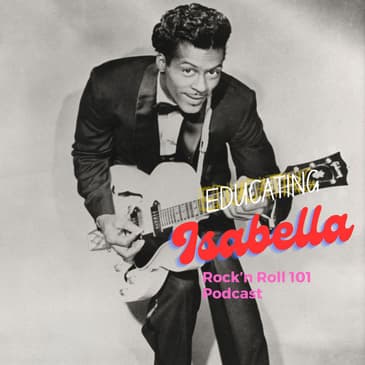
Introduction to Chuck Berry
The Birth of Rock and Roll
Berry's Signature Style and Showmanship
Key Hits: "Maybelline," "Roll Over Beethoven," "Johnny B. Goode"
The Legacy of Chuck Berry
Homework: Explore Chuck Berry's Music
Twist Scene from Pulp Fiction featuring You Never Can Tell
Johnny B. Goode scene from Back to the Future
Next Episode Preview: From Fame to Fallout
For more visit our website at https://bitesz.com/podcast/educating-isabella-rock-n-roll-101
Become a supporter of this podcast: https://www.spreaker.com/podcast/educating-isabella-rock-n-roll-101--6522543/support.
For more music history and commentary, visit our website at https://bitesz.com
This episode includes AI-generated content.
Welcome back to educating Isabella rock and roll one oh one. I'm Michael, a rock and roll tragic and today, Isabella, I want to introduce you to a man who is there right at the very beginning. We're going right back to where it all began. Before the Beatles, before the Rolling Stones, before Elvis became a household name, there was one man who helped shape what we now call rock and roll. Here's a rock spring and rigards hold from ribs to the ricks and revels, coside and soul of it all. His name was Chuck Berry. And if rock music has a family tree, he's one of the roots. This is music your grandfather grew up on, Isabella. Imagine America in the late nineteen forties, if you can, music was segregated. Rhythm and blues was largely played by and four black audiences, while country and pop dominated white radio. Then along comes a to all slick, guitar slinging storyteller from Saint Louis, Missouri, with a grin that said he knew something the rest of the world didn't yet. Chuck Barry has always been very cagey about his birth date, except to say it was October eighteenth. The year was believed to be between nineteen twenty six and nineteen thirty two. From an early age, he soaked up everything gospel, country, blues, swing, even hillbilly tunes. He once said that when you mixed all that together and played it with rhythm, you got rock and roll. He started playing guitar in his teens and performing around Saint Louis, developing not just a sound but a style. Barry understood showmanship. He'd leap across the stage, grin, and make the crowd feel like every song was written just for them. And then there was that duckwalk, his signature move where he'd bend low and shuffle across the stage while never missing a note. As for how it started, even Chuck gave different stories. Sometimes he said he first did it as a kid to make his mother laugh, other times that it was a happy accident trying to hide a crease in his trousers during a show. However, it began that duck walk became one of the most iconic moves in rock history, copied by generations of performers, from Angus Young of A C. D C. To Bruce Springsteen. By the early nineteen fifties, Chuck was playing with a trio that leaned into R and B and country fusion, but everything changed in nineteen fifty five when he made a trip to Chicago and met Muddy Waters, the king of the electric blues. Eager to get a foot in the door, Chuck Berry played with the Muddy Waters Band at one of their club gigs in the city early in nineteen fifty five. Muddy Waters liked his style and suggested that he get in touch with Leonard Chess, the head of Chess Records, for whom all the major Chicago blues artists recorded. Leonard Chess told him to come back with some of his material, and when he returned with six tracks, including Maybelene, a reworking of a country tune called Ida Red but with a driving beat, guitar riffs that cut like lightning, and lyrics about cars, love and teenage freedom, and wee wee hours taped on his seventy nine dollars mono recorder. He was signed up immediately. The Chess brothers heard it and knew instantly this was new, this was crossover. They recorded it, released it, and within weeks Maybelene was racing up both the R and B and pop charts a rare thing. In nineteen fifty five, it sold over a million copies. Barry E quipped one time that the only maybeleine he knew in his entire life was a cow, and with that rock and roll was officially born. What followed was a run of songs that essentially wrote the rock and roll dictionary. Rollover Beethoven a declaration of generational change. Out with the old, In with the electric guitar, rock and roll music, a rallying cry for a new cultural identity. Sweet Little Sixteen a snapshot of teenage life and innocence. And of course Johnny B. Good, a partly autobiographical anthem about a country boy with a guitar who could play just like ringing a bell. It's hard to overstate it Isabella without Chuck Berry. There's no Beatles, no Stones, no Beach Boys, no Springsteen. John Lennon once said, if you tried to give rock and roll another name, you might call it chuck Berry. By the early nineteen sixties, his sound had traveled across the ocean, straight into the hearts of British teenagers who were listening late at night to forbidden American Records, The Beatles covered roll Over Beethoven, the Rolling Stones recorded come On as their debut single, and hundreds of young musicians picked up guitars and learned Chucks Riff's note for note. Barry's mix of clever wordplay, irresistible rhythm, and guitar driven energy became the blueprint for rock's next generation, but fame came with complications. Barry was a sharp businessman, sometimes stubborn, and often clashed with promoters and labels over money and control. Some even called him ruthless. Its thought this drive came from having been ripped off for so many years by dodgy club owners on his way up, and his mother telling him don't let the same dog bite you twice, a motto he carried with him for life. In the late nineteen fifties, his career hit turbulence when he faced legal troubles over an involvement with an underage girl that landed him in prison for a time, an event that would shadow him for years. When he came out in the early nineteen sixties, the musical landscape had changed, but his influence had only grown stronger. He returned to Chess Records and recorded songs like No Particular Place to Go and You Never Can Tell, proving that he could still deliver hits with that unmistakable Chuck Berry wit and swagger. When speaking of You Never Can Tell. That song found a second life in the nineteen nineties thanks to Quentin Tarantino's movie Pulp Fiction. Remember the now legendary dance scene with John Travolta and Uma Thurman. Their twist to Chuck's tune made it iconic all over again, introducing his music to an entirely new generation. If you're not familiar with the scene, I'll include a link in the show notes. After all, everyone should look this cool on the dance floor, all right. Back to our story, now, Isabella. Let's fast forward three decades earlier to another unforgettable pop culture moment. It's nineteen eighty five and back to the future hits movie screens. Marty McFly, the teenage time traveler, grabs a guitar at a nineteen fifties dance and plays Johnny B. Good. The crowd stares stunned. In the background, a character named Marvin Barry phones his cousin, shouting, Chuck, Chuck, it's your cousin. Marvin. You know that new sound you're looking for, Well, well listen to this. It's one of cinema's greatest tributes, a moment that reminded the world that Chuck Berry didn't just influence rock and roll, he invented its language. So Isabella, your homework this time is to explore Chuck Berry's world. Start with May Belene, roll over Beethoven, Johnny b Good, no particular place to go, and you never can tell. Then listen to how his fingerprints show up everywhere, from the Beatles back in the USSR to Bruce Springsteen's Born to Run, to the guitar hooks in Taylor Swift's style, and Don't Forget. You can find all these songs and more on our Educating Isabella playlists, now available on Spotify, YouTube Music, and Deezer. Next time, on Educating Isabella, we continue the Chuck Berry story from fame to fallout and the complex legacy of a man who changed music forever. Until then, keep listening, keep learning, and remembering every rift, every beat, and every shout of Oh Johnny Go. Started with one man in his guitar rock on