
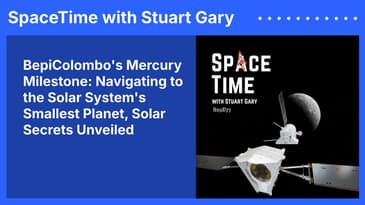
SpaceTime Series 29 Episode 77 BepiColombo mission finally reaches Mercury space After eight years of powered flight towards the planet Mercury, mission managers have finally turned off the BepiColombo spacecraft’s propulsion engines in preparation for planetary orbit insertion. Is our Sun changing A new study claims the Sun has been mysteriously changing over the last forty years. Strange new type of x-ray flare detected in deep space Astronomers have detected a mysterious never before seen new type of X-ray flare in the skies of the Southern Hemisphere. The Science Report A special report on the latest bombshell developments in the case of the COVID 19 pandemic. Our Guests This Week: Uk Space Agency Programme Manager Rosemary Young Principle Investigator MIXS Instrument Emma Bunce Leicester University Planetary Geoscientist David Rothery The open University And our regular guests: Alex Zaharov-Reutt from techadvice.life And Senior science writer and Sky and Telescope magazine contributor Jonathan Nally 🌏 Get Our Exclusive NordVPN deal here ➼ www.bitesz.com/nordvpn (http://www.bitesz.com/nordvpn) . The discounts and bonuses are incredible! And it’s risk-free with Nord’s 30-day money-back guarantee! ✌ If you’d like to support the podcast and gain access to bonus content by becoming a SpaceTime crew member, you can do just that through The Big Bang editions on Patreon, Spotify and Apple Podcasts. Details on the Support page on our website https://www.bitesz.com/show/spacetime/support/ (https://www.bitesz.com/show/spacetime/support/) For more SpaceTime and show links: https://linktr.ee/biteszHQ (https://linktr.ee/biteszHQ) If you love this podcast, please get someone else to listen to. Thank you…
Episode link: https://play.headliner.app/episode/34030661?utm_source=youtube
[00:00:00] This is Space News Today series 29 episode 77, for broadcast on the 29th of June 2026. Coming up on Space Time, the BepiColombo mission finally reaches Mercury space. Is our sun changing? Is growing evidence suggesting that it might be? And a strange new type of X-ray flare detected in deep space. All that and more coming up on Space Time.
[00:00:26] Welcome to Space Time with Stuart Gary. After eight years of powered flight towards the planet Mercury, mission managers have finally
[00:00:51] turned off the BepiColombos spacecraft's propulsion engines in preparation for planetary orbit insertion. Engine cutoff marks the end of the joint European Space Agency, Japan Aerospace Exploration Agency probe's long cruise phase and the beginning of its arrival at Mercury. Since its launch way back in October 2018, the BepiColombos spacecraft has been propelled by four electric propulsion thrusters located on its Mercury Transfer Module.
[00:01:20] The thrusters use electricity generated by the spacecraft's solar arrays from sunlight to ionize Xeon gas and then shoot it at the rear of the engines, providing a continuous glowing blue thrust. The mission's complicated flight path included a gravity assist maneuver swing around the Earth and two past Venus, as well as six loops around Mercury to slow down enough to be captured by the rock nearest the Sun's gravity.
[00:01:46] As BepiColombo draws closer to Mercury, this ion propulsion system, which is effective for long-range flight, no longer offers the braking force needed to slow the spacecraft down and enter orbit around the planet. It leaves BepiColombo on a ballistic trajectory towards Mercury, reaching a point suitable for the first chemical propulsion maneuver aimed at orbital insertion in late November. BepiColombo is the first mission to study Mercury using three spacecraft at the same time.
[00:02:15] There's the Mercury Transfer Module, which is equipped with the ion propulsion system used to propel the mission during its cruise phase. Mind you, things didn't always go smoothly. A thruster glitz saw the mission slow down by 11 months, with arrival at Mercury now slated for November 21st. Then there's the European Space Agency's Mercury Planetary Orbiter. It'll circle close to the planet, providing scientists with a precise map of Mercury's surface,
[00:02:43] detailing its composition, how it formed, how it's changed over time, and what temperature it is. The Mercury Planetary Orbiter will also fly over Mercury's poles, allowing the spacecraft to peer deep into permanently shadowed craters in order to see if there's any water there. Then there's the Japanese Exploration Agency's Mercury Magnetospheric Orbiter. It'll take a larger elliptical orbit around the planet, studying the interaction between the planet's magnetic field and the solar wind.
[00:03:11] It'll also observe plasma and energetic particles in the magnetosphere, providing an analysis of electric fields, plasma waves and radio waves. It'll measure the abundance, distribution and dynamics of sodium in Mercury's exosphere, and investigate the distribution of interplanetary dust in Mercury's orbit. BepiColombo is humanity's third mission to the planet Mercury, and it follows in the path of two NASA missions, the 1973 Mariner 10 flight and the 2004 Messenger mission.
[00:03:42] BipiColombo is the first mission to the planet Earth's planet Earth's planet Earth's planet Earth. It's a very important mission to the moon. That means spacecraft need to avoid being trapped by the massive gravity of Earth's nearest star, which makes navigation and ongoing operations complicated. And once a spacecraft reaches Mercury, temperatures are fierce, even hundreds of kilometres above the planet's surface. It's also hard to observe with telescopes, because the sun's powerful glare can damage sensitive optics.
[00:04:07] The spacecraft carries multiple instruments, including one from the UK Space Agency. Firstly, it's a very difficult thing to do, and it's something that we know very little about. There's been very few spacecraft that have visited Mercury in the past. So just finding out about how the planet is made and how it interacts with our sun will tell us a lot about the formation of our solar system and our place in the solar system as well.
[00:04:33] The UK has invested £6.8 million in this mission, and this has mostly gone to the University of Leicester to build the MIX instrument. The MIX instrument is going to be dedicated to studying the planet itself. So we're going to be looking at the surface of Mercury and what that tells us about the formation of Mercury and its history, how its surface has evolved over time.
[00:04:59] The other aspect of the MIX science is that we're going to be able to look at how Mercury interacts with its surrounding magnetic environment. We're going to be able to see how the sun interacts with Mercury directly using our instrument. As a volcanologist, one thing that intrigues me about Mercury is the causes and the nature of the volcanic explosions.
[00:05:21] There's impact craters everywhere, but some of them have holes in their floors which have been blasted out by volcanic explosions. And some of these volcanic explosions are not that ancient. Most of Mercury's surface is two or three billion years old, but the explosive volcanic activity has continued into at least the last billion years. So there's something going on there. BepiColombo has got two spacecraft, the European one and the Japanese one.
[00:05:51] We'll measure what's going on in the magnetic field in two different places at the same time. That's never been done anywhere except for the Earth. We're going to learn so much from BepiColombo. And in that report, we heard from UK Space Agency Programme Manager Rosemary Young, the Principal Investigator for the MIX instrument, Emma Bruce from Leicester University, and Planetary Scientist David Rothbury from the Open University. This is Space News Today. Still to come, is our sun changing?
[00:06:19] There's growing evidence suggesting that it might be. And discovery of a strange new type of X-ray flare detected in deep space. All that and more still to come on Space Time. A new study claims the sun has been mysteriously changing over the last 40 years.
[00:06:45] Listening to tiny sound waves inside the star has led scientists to discover that it may be entering a new different mode of behaviour. The findings, reported in the monthly notices of the Royal Astronomical Society, are of special significance for space weather events, and astronomers now need to explore what this all means. The sun's activity rises and falls in 11-year cycles. In the process, producing increasing and decreasing amounts of solar flares and coronal mass ejections,
[00:07:14] spewing highly charged particles that give rise to geomagnetic storms and aurorae. This activity and its cyclic variation has its origins in the sun's interior, in processes that regenerate and reorganise the sun's magnetic field. Every solar minimum, the last was in 2019 and the next will be in 2030, the sun's magnetic field flips polarity, North Pole becomes South and South Pole North.
[00:07:39] Understanding what drives this cycle is therefore crucial for making predictions about space weather and how it affects the Earth. Space weather events can damage or destroy satellites, disrupt communications and navigation systems, black out power grids on the Earth and increase radiation dosage for astronauts in space and people on high-flying aircraft. Traditional measures of solar activity track these emissions and other surface phenomena like sunspots, but they don't look deep under the solar surface.
[00:08:09] However, by listening to tiny sound waves inside the sun, a technique known as helioseismology, it's possible to do just that. By tracking changes in the otherwise hidden solar interior, the study's authors found a different picture emerged of the sun's activity over the past few solar cycles. Using almost 40 years of helioseismic data collected by six telescopes around the world in the Birmingham Solar Oscillations Network or BISON, the authors uncovered a gradual change in structure
[00:08:38] just beneath the sun's visible surface. That change has spanned multiple cycles, with the current solar cycle 25 showing especially strong signatures of these changes. The authors discovered that solar magnetic activity is being squeezed into an increasingly shallow layer just below the visible surface, signposting long-term changes to the sun's active behavior. The study's lead author Bill Chaplin from the University of Birmingham says the sun has its
[00:09:05] own active biorhythm, creating rising and falling magnetic activity that shapes space weather. However, traditional surface measurements don't capture the full story that the sun may be entering a different mode of behavior unfolding over decades. Chaplin and colleagues uncovered evidence of systematic changes in the sun's activity cycle. Crucially, magnetic activity is becoming more tightly confined near the surface with each cycle.
[00:09:32] The authors analyzed p-mode oscillations, formed by global sound waves inside the sun, whose frequencies shift in response to solar magnetic activity. They allowed them to determine how the sun's internal structure changed across solar cycles 23 to 25 between 1987 and 2025. They grouped the oscillations into low, medium and high frequency bands to probe different depths beneath the solar surface. They then compared these frequency shifts with traditional measures of solar activity.
[00:10:01] And they found evidence of changing behavior. The link between oscillation frequencies and traditional activity measures has shifted significantly since cycle 23, indicating long-term evolution in the sun's internal processes. They also found surface confinement of structural changes. The combined behavior of low, mid and high frequency modes showed that the solar cycle-driven structural changes are becoming increasingly confined to just the shallow layers within a thousand kilometers of the sun's surface.
[00:10:31] And by reinterpreting the strength of the latest solar cycle, cycle 25 appears to be weaker in traditional surface indicators, but comparably strong when seen in high frequency heliososmic data. The thing is, this trend can't be simply explained by weaker magnetic fields. Instead, it indicates a structural reorganization of how the sun's magnetic activity is stored beneath the surface. Ongoing collection and analysis of Bison's solar data over what remains of cycle 25,
[00:11:01] and for the upcoming cycle 26, will be crucial in determining whether the changes discovered in the sun's activity are putting to a sustained systematic change in solar magnetic behavior. And we then need to work out how that's going to affect the Earth. This is space-time. Still to come, a strange new type of X-ray flare detected in deep space, and later in the science report, special coverage of the latest bombshell developments in the case of the COVID-19 pandemic.
[00:11:30] All that and more still to come on Space Time. Astronomers have detected a mysterious, never-before-seen new type of X-ray flare in the skies of the Southern Hemisphere.
[00:11:56] The discovery, reported in the Journal of the Monthly Notices of the Royal Astronomical Society, was made by the Wide-Field X-ray Telescope aboard the Einstein probe spacecraft. No previous X-ray source had ever been detected at the location of the flare, which is now being catalogued as EP240305A. Its light curve comprised two brief powerful X-ray flares, one right after the other, and the two separated by about 200 seconds of quiet.
[00:12:24] Additional observations were carried out using further X-ray observatories, as well as infrared, optical and radio telescopes, confirming that this new discovery doesn't fit any known class of cosmic explosion. The authors found that the X-rays faded rapidly over the following days, while radio observations faded much more slowly over weeks, revealing evidence of an evolving jet. A faint fading near-infrared source was also detected at the same location.
[00:12:52] But interestingly, there was no detection of anything at optical wavelengths. To try and determine what's going on, the authors compared their observations to other known events. These included a jetted tidal disruption event caused by a star being shredded by a black hole, or an X-ray binary outburst from a neutron star or black hole feeding on a stellar companion, which then suddenly flares up. But both of these were ruled out because they'd take weeks or months to fade, whereas EP-240305A faded in just days.
[00:13:22] A thermonuclear burst on a neutron star's surface was also ruled out because the measured temperature was simply too low, and its radio signal lasted far too long. A giant magnetar flare wouldn't work either, because they fared in less than a second. And a stellar flare was also ruled out because the radio signal lasted far too long compared with typical stellar flares.
[00:13:45] Now interestingly, this mysterious blast's properties did line up with several features of gamma ray bursts, GRBs. The double flash pattern resembles a known feature seen in some gamma ray bursts known as double bursts. And both the X-ray luminosity and radio pattern emissions match that expected from a gamma ray burst. The problem here is, there was no actual gamma rays detected from the event. The authors think the lack or weakness of gamma ray emissions from this event could have been caused by
[00:14:14] the jet pointing slightly off axis as seen from Earth. Or the jet simply could have failed to fully break through its surrounding material. Or the jet may have been loaded with extra material, dampening its gamma ray output. Needless to say, the search is now on for more such objects, and a close eye will be kept on the location of this one. This is Space News Today. And time now for the Science Report.
[00:14:42] Today, a special report looking at the latest bombshell developments in the ongoing saga of the COVID-19 pandemic. The United States Office of the Director of National Intelligence has released new documents claiming that former National Institute of Health Director and Chief Presidential Medical Advisor Anthony Fauci was involved in manipulating intelligence assessments in order to cover up that China's Institute of Virology was the real source of the COVID-19 pandemic.
[00:15:10] The outgoing director, Tulsi Gabbard, has accused Fauci of politicising leadership within the intelligence community in order to suppress information regarding the origins of COVID-19 and American funding of gain-of-function research on bat coronaviruses prior to the outbreak of the pandemic. Gabbard's also accused Fauci of lying under oath to Congress in 2024 by denying that he had knowledge of or participated in discussions with intelligence officials about the research. So, what are we dealing with here?
[00:15:41] Well, COVID-19 is 96.4% identical to the RATG13 bat virus. The problem is, no confirmed direct animal to human sources for COVID-19 have ever been identified. The first confirmed cases of COVID originated in three lab assistants working at the Wuhan Institute of Virology in September or early October of 2019, in what suspected of being an accidental lab leak during an experiment.
[00:16:10] Coincidentally, on September the 12th, 2019, the Wuhan Institute of Virology suddenly decided to erase all computer data on its research into coronaviruses and destroy all existing samples. Now, this is unprecedented. It's never been done in any laboratory, and it goes against everything science stands for. At the same time, the lab ordered new air filtration equipment for its facilities, and it purchased PCR equipment to test for SARS-CoV-2.
[00:16:38] By late October 2019, people in the surrounding Wuhan district began raising the alarm about a deadly new flu-like virus rapidly spreading through the city. At the same time, truckloads of extra body bags were seen being delivered to local hospitals and morgues in the area. And while all this was going on, Chinese embassy employees around the world began visiting local medical supplies and pharmacies in the countries therein, including Australia,
[00:17:04] purchasing as many face masks, personal protective equipment, antiviral medications, and PCR tests for SARS-CoV-2 as they could, literally hoarding global stocks. As concerns spread, numerous doctors, scientists, medical staff, and journalists in China investigating or speaking out about the growing outbreak were suddenly being arrested, and many simply disappeared forever, never to be heard from again.
[00:17:30] Meanwhile, the World Health Organization repeatedly denied there was any sort of global China flu pandemic developing. At least that was until the death toll began to climb into the tens of thousands around the world, leaving the WHO with no choice but to finally admit there was a problem. Now, it's worth noting at this point that the Director General of the World Health Organization, Tedros Adyom Ghebreyesh, was appointed to his position at the World Health Organization with the strong support and backing of Beijing.
[00:17:58] China has repeatedly blocked or interfered with attempts to conduct independent investigations into the source of the outbreak, instead insisting there was nothing to worry about or when they couldn't say that anymore, claiming it emerged from outside China, possibly from Europe, but more likely through American troops. As the pandemic continued to spread, documents began appearing which confirmed reports that the Wuhan Institute of Virology was indeed ground zero.
[00:18:24] The laboratory had participated in gain-of-function research to genetically engineer coronaviruses. The Washington Post reported that U.S. State Department inspections of the Wuhan lab in 2018 had already sent two official warnings back to America that they had found insufficient safety precautions at the facility. As the pandemic grew, the U.S. Department of Energy, which is responsible for America's nuclear arsenal and is expert in weapons of mass destruction, undertook its own investigation into the origins of the virus,
[00:18:54] finding COVID-19 did likely arise from a laboratory leak at the Wuhan Institute of Virology. The findings, first reported by the Wall Street Journal, were based on an updated classified national intelligence report provided to the White House and key members of Congress. Now, the then-FBI director, Christopher Wray, had previously said that the agency had already assessed that a leak from the Wuhan lab was the cause of the COVID-19 pandemic.
[00:19:20] US officials said that while the Department of Energy and the FBI both claimed the source was an unintended lab leak, they arrived at the conclusions through different independent sources. It's worth noting at this stage a previous August 2021 report by the Office of the Director of National Intelligence had already stated that the SARS-CoV-2 virus, which caused COVID-19, most likely originated through gain-of-function experiments at China's Wuhan Institute of Virology sometime before September 2019.
[00:19:49] The United States House Oversight and Accountability Committee's COVID-19 panel later concluded that a lab-related incident involving gain-of-function research at the Wuhan Institute of Virology was the most likely origin of the COVID-19 pandemic. Its highly detailed 520-page report found the weight of evidence increasingly supports the lab leak hypothesis. It followed two years of intense investigations
[00:20:14] and ridiculed suggestions that the virus emerged in nature and then jumped from animals to people. The House report also found that Wuhan is the home of China's former SARS research lab, which has a long history of conducting gain-of-function research under inadequate biosafety levels. It confirmed that researchers at the Wuhan Institute of Virology were infected with COVID-19 during the fall of 2019, months before it was discovered in a local wet market in December of that year.
[00:20:42] This report also slammed the New York non-profit EcoHealth Alliance for using American taxpayer dollars to facilitate gain-of-function research at the Wuhan lab, and the Biden administration for deliberately spreading COVID-19 misinformation by wrongly claiming that the lab leak was just a conspiracy theory. Now, EcoHealth Alliance President Peter Daszak would later be one of the so-called international experts selected by the World Health Organization to travel to China in January 2021
[00:21:10] to investigate the origins of the COVID-19 pandemic. The 14-member team spent weeks reviewing data, interviewing government-approved Chinese researchers, and visiting specially prepared sites, including the Wuhan Institute of Virology and the Hunan Seafood Market. They concluded that a zoonotic spillover through an intermediary host animal was the most likely pathway, and that a laboratory origin was extremely unlikely. The problem is that findings have been widely criticized,
[00:21:38] as Daszak's inclusion on the panel was a clear and deliberate conflict of interest. So instead of ending debate, it sparked significant scrutiny and pushback from the scientific community. Even the media was forced to take a second look. Later, congressional investigations and federal audits revealed EcoHealth had failed to properly report or oversee its risky gain-of-function experiments conducted at Wuhan with their Chinese partners. And it's not just the Americans who expressed concern.
[00:22:05] In 2020, Germany's foreign intelligence service, the BDN, provided its own intelligence to then-German Chancellor Angela Merkel, indicating that the coronavirus behind the COVID-19 pandemic was accidentally released from China's Wuhan Institute of Virology. Now, according to a joint report by the Zeit and Zudeutsche Zeitung, Germany's spy agency had indicated that the Institute had conducted gain-of-function experiments in which viruses were modified to become more transmissible to humans for research purposes.
[00:22:34] These assessments were based on an intelligence operation codenamed Zarema, as well as through publicly available data. Leaked official documents also show that the former head of the UK's foreign intelligence agency, MI6, told then-British Prime Minister Boris Johnson in early 2020 that the COVID-19 virus escaped from the Wuhan lab. Meanwhile, a central intelligence agency assessment prepared during the Biden administration admitted COVID-19 was more likely to have originated from a laboratory leak at Wuhan,
[00:23:04] but the agency went to pains to stress its assessment had only a low level of confidence. That CIA assessment was based on analysis of existing intelligence related to the virus' characteristics, its initial spread, and the working conditions in the virology lab, leading to the conclusion that a laboratory origin was more likely than a natural origin based on the available information. However, it's also known that the CIA supported the Wuhan SAS research through black ops funding
[00:23:31] in order to keep a close eye on China's biological weapons program, how advanced it was, and in which direction it was heading. This included some US$53 million given to EcoHealth Alliance through USAID. In March 2020, we reported the original Nature Medicine Journal story, The Proximal Origin of SARS-CoV-2, on the Space Time Science Report, which looked at the origins of the COVID-19 virus.
[00:23:56] The Nature study concluded the virus resulted from natural evolution rather than laboratory manipulation. That study found the spike protein's receptor-binding domain and the virus's overall molecular structure strongly suggested natural selection, contradicting theories of an engineered laboratory construct. The authors proposed two scenarios that could plausibly explain the origins of SARS-CoV-2. Either natural selection in an animal host before a xenotic transfer,
[00:24:24] or natural selection in a human host following xenotic transfer. But since its original publication, the Nature article has been strongly criticised. Virologists, biological researchers and experts in genetic engineering argue the conclusion was premature and lacked definitive empirical evidence at the time, as the natural xenotic spillover pathway remained unproven. Then there were uncovered emails and freedom of information release communications, which revealed that while drafting the Nature paper,
[00:24:53] the authors privately expressed significant concerns that the virus's genome did have features potentially indicative of laboratory engineering, such as deferring cleavage sites. Critics argue they failed to disclose these key misgivings in their final published text. Many observers and scientists accused the authors of using their Nature article to prematurely steer the public, the media and policymaker attention away from legitimate investigations into research-related origins,
[00:25:21] potentially to protect the scientific community from political scrutiny or to prevent any restriction of research funding. Importantly, while the Nature authors claim the virus's unique fur and cleavage site was the result of natural selection, critics and virologists have argued that this specific feature is highly uncharacteristic of naturally occurring SARS-related coronaviruses and remains a structural element highly compatible with laboratory manipulation. And finally, there's the issue of the missing intermediate hosts.
[00:25:51] Despite the paper's advocacy for natural selection, either in animals before or in humans after transfer, years and years of extensive sampling have still not identified a direct animal reservoir or intermediate host. Gabbard's documents allege that US money funneled through the EcoHealth Alliance to the Wuhan Institute of Virology sparked a pandemic, accusing Fauci of deliberately manipulating intelligence assessments and lying to Congress to cover up the financing.
[00:26:17] The declassified information also outlined the US government's support for more than 120 biological laboratories operating across 30 foreign countries. Gabbard's accused Fauci of orchestrating a deliberate attempt to cover up the truth, during which she claimed that he pushed lies, disinformation and censorship. Gabbard stated that her office received testimony from whistleblowers within the intelligence community who've reportedly faced threats and retaliation for challenging the narrative put forth by Fauci.
[00:26:46] The release has prompted fresh questions about congressional testimony, whistleblower claims and the scope of former President Joe Biden's pre-emptive auto-pen pardon for Fauci. You see, historically, presidential pardons involve specific charges, specific conduct or identifiable offences. Now, that didn't happen in Fauci's case. The World Health Organization says over 7.1 million people have now been killed by the COVID-19 coronavirus
[00:27:14] since it was first detected among those workers at China's Wuhan Institute of Virology way back in September 2019. The Lancet Medical Journal estimates the true global death toll is likely to be more than 18 million, with well over three quarters of a billion confirmed cases globally. Even if you hadn't had COVID, you probably know someone who has. This is Space News Today.
[00:27:38] And that's the show for now. Space Time is available every Monday, Wednesday and Friday through Bytes.com, SoundCloud, YouTube, your favorite podcast download provider, and from SpaceTimeWithStewartGary.com.
[00:28:07] Space Time's also broadcast through the National Science Foundation on Science Zone Radio, and on both iHeartRadio and TuneIn Radio. And you can help to support our show by visiting the Space Time store for a range of promotional merchandising goodies. Or by becoming a Space Time patron, which gives you access to triple-episode commercial-free versions of the show, as well as lots of bonus audio content which doesn't go to air, access to our exclusive Facebook group, and other rewards.
[00:28:35] Just go to SpaceTimeWithStewartGary.com for full details. You've been listening to Space Time with Stuart Gary. This has been another quality podcast production from Bytes.com.