
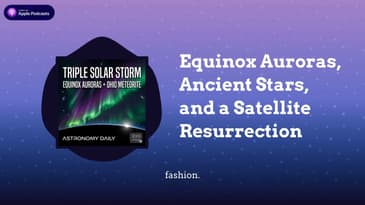
It's the first day of astronomical spring — and the universe is celebrating in style. On today's Astronomy Daily, Anna and Avery cover a triple CME solar storm with aurora potential reaching as far south as Illinois, explain why the vernal equinox amplifies aurora activity, report on the ongoing meteorite hunt following Tuesday's spectacular Ohio fireball, reveal an extraordinary 14-billion-year-old star that carries the chemical fingerprints of the universe's very first stars, bring a happy update on Europe's Proba-3 solar science satellite which has ended a month of silence, and explain how X-ray CT scans of returned asteroid samples finally cracked one of Bennu's longest-standing mysteries. Stories in This Episode 1. Triple CME Strike + Equinox Aurora Alert Three coronal mass ejections (CMEs) are currently en route to Earth, with the first arriving today. Forecasters predict G2 (moderate) to G3 (strong) geomagnetic storm conditions, potentially bringing auroras as far south as Illinois. The timing coincides with the vernal equinox — historically one of the best aurora windows of the year due to the Russell-McPherron effect. 2. The Vernal Equinox — Today! The 2026 March equinox arrived today at 14:46 UTC, marking the astronomical start of spring in the Northern Hemisphere (and autumn in the Southern). Tonight, a thin crescent Moon appears alongside Venus in the west-southwest sky. 3. Ohio Fireball — Meteorite Hunt Underway On St. Patrick's Day (March 17), a seven-ton asteroid exploded over northeast Ohio with the force of 250 tons of TNT. NASA confirmed meteorites landed near Medina County, and hunters from across the US have already found fragments in the Sharon Center area. 4. Ancient 'Cosmic Fossil' Star PicII-503 Astronomers have discovered PicII-503, a second-generation star in the Pictor II dwarf galaxy with only 1/40,000th of the Sun's iron — the lowest ever measured outside the Milky Way. Its extraordinary carbon-to-iron ratio links it to mysterious carbon-enhanced metal-poor stars scattered across our galaxy's halo, solving a long-standing stellar mystery. Published in Nature Astronomy by Anirudh Chiti (Stanford) et al. 5. Proba-3 Phones Home — 'A Great Relief!' ESA confirmed on March 19 that its Proba-3 Coronagraph satellite — silent since mid-February after an anomaly caused it to lose attitude control — has reestablished contact via the Villafranca ground station. The spacecraft is in safe mode, solar-powered, and undergoing health checks before science operations can resume. 6. NASA Cracks Bennu's Boulder Mystery X-ray CT scans of returned OSIRIS-REx samples reveal Bennu's boulders are riddled with internal crack networks — the missing piece explaining the asteroid's puzzling low thermal inertia. Published in Nature Communications. The findings will improve asteroid characterisation from Earth-based telescopes globally. Source Links Triple CME / Aurora Alert — Space.com: https://www.space.com/stargazing/auroras/aurora-alert-powerful-geomagnetic-storm-could-spark-northern-lights-as-far-south-as-illinois-on-march-19 (https://www.space.com/stargazing/auroras/aurora-alert-powerful-geomagnetic-storm-could-spark-northern-lights-as-far-south-as-illinois-on-march-19) Triple CME / Sun News — EarthSky: https://earthsky.org/sun/sun-news-activity-solar-flare-cme-aurora-updates/ (https://earthsky.org/sun/sun-news-activity-solar-flare-cme-aurora-updates/) NOAA Space Weather Prediction Centre: https://www.spaceweather.gov (https://earthsky.org/astronomy-essentials/everything-you-need-to-know-vernal-or-spring-equinox/ (https://earthsky.org/astronomy-essentials/everything-you-need-to-know-vernal-or-spring-equinox/) Ohio Fireball — EarthSky: https://earthsky.org/earth/sonic-boom-from-a-meteor-cleveland-ohio-and-pennsylvania-mar-17-2026/ (https://earthsky.org/earth/sonic-boom-from-a-meteor-cleveland-ohio-and-pennsylvania-mar-17-2026/) Ohio Meteorite Hunt — Cleveland19: https://www.cleveland19.com/2026/03/19/meteorite-hunters-states-away-find-fragments-northeast-ohio/ (https://www.cleveland19.com/2026/03/19/meteorite-hunters-states-away-find-fragments-northeast-ohio/) PicII-503 Discovery — NOIRLab: https://noirlab.edu/public/news/noirlab2607/ (https://noirlab.edu/public/news/noirlab2607/) PicII-503 — Nature Astronomy (DOI): https://doi.org/10.1038/s41550-026-02802-z (https://doi.org/10.1038/s41550-026-02802-z) Proba-3 Phones Home — Space.com: https://www.space.com/space-exploration/missions/a-great-relief-europes-proba-3-solar-eclipse-satellite-phones-home-after-a-month-of-silence (https://www.space.com/space-exploration/missions/a-great-relief-europes-proba-3-solar-eclipse-satellite-phones-home-after-a-month-of-silence) Proba-3 ESA Statement: https://www.esa.int/Enabling_Support/Space_Engineering_Technology/Proba-3_s_Coronagraph_is_alive (https://www.esa.int/Enabling_Support/Space_Engineering_Technology/Proba-3_s_Coronagraph_is_alive) Bennu...
00:00:00 --> 00:00:02 Happy first day of spring, everyone. At
00:00:02 --> 00:00:04 least if you're in the northern
00:00:04 --> 00:00:06 hemisphere. I'm Anna.
00:00:06 --> 00:00:08 >> And I'm Avery. And what a day for the
00:00:08 --> 00:00:11 cosmos to celebrate with us. Because
00:00:11 --> 00:00:13 right now, as we're recording, the sun
00:00:13 --> 00:00:15 has fired three enormous blasts of
00:00:16 --> 00:00:19 charged particles straight at Earth. A 7
00:00:19 --> 00:00:21 ton space rock just lit up the skies
00:00:21 --> 00:00:24 over Ohio. A satellite that went silent
00:00:24 --> 00:00:26 for a full month has finally phoned
00:00:26 --> 00:00:29 home. And astronomers have found a star
00:00:29 --> 00:00:31 so old it carries the direct
00:00:31 --> 00:00:33 fingerprints of the very first stars
00:00:33 --> 00:00:35 that ever existed.
00:00:35 --> 00:00:37 >> Plus, we're going to explain exactly why
00:00:38 --> 00:00:40 the equinox and those solar storms are
00:00:40 --> 00:00:42 connected. It's one of the most
00:00:42 --> 00:00:44 fascinating quirks of Earth's orbit
00:00:44 --> 00:00:46 around the sun. And today is literally
00:00:46 --> 00:00:48 the best day of the year to talk about
00:00:48 --> 00:00:49 it.
00:00:49 --> 00:00:51 >> This is Astronomy Daily, season 5,
00:00:52 --> 00:00:54 episode 68. Let's get into it. Okay,
00:00:54 --> 00:00:56 Avery, before we even get into the
00:00:56 --> 00:00:59 equinox itself, we have to talk about
00:00:59 --> 00:01:01 what the sun has been doing this week
00:01:01 --> 00:01:03 because it has been busy.
00:01:03 --> 00:01:06 >> Extremely busy. So, here's a situation.
00:01:06 --> 00:01:09 As of today, Friday the 20th of March.
00:01:09 --> 00:01:11 Earth is being targeted by not one, not
00:01:11 --> 00:01:14 two, but three separate coronal mass
00:01:14 --> 00:01:17 ejections, CMEs, all fired off within
00:01:17 --> 00:01:20 the last few days. So, for anyone who
00:01:20 --> 00:01:22 needs a quick refresher, a CME is
00:01:22 --> 00:01:25 essentially a massive eruption of plasma
00:01:25 --> 00:01:27 and magnetic field from the sun. When
00:01:27 --> 00:01:29 these hit Earth's magnetic fields, they
00:01:29 --> 00:01:32 compress it, cause geomagnetic storms,
00:01:32 --> 00:01:34 and most visibly for us down here, they
00:01:34 --> 00:01:36 trigger auroras.
00:01:36 --> 00:01:38 >> The first of the three CMEs was expected
00:01:38 --> 00:01:41 to arrive today. Forecasters at Noah's
00:01:41 --> 00:01:43 Space Weather Prediction Center have
00:01:43 --> 00:01:45 issued a geomagnetic storm watch with
00:01:46 --> 00:01:48 conditions potentially reaching G2.
00:01:48 --> 00:01:51 That's moderate with a chance of G3 or
00:01:51 --> 00:01:55 strong. And that second level, G3, is
00:01:55 --> 00:01:56 where things get really interesting
00:01:56 --> 00:01:59 >> because G3 conditions could push aurora
00:02:00 --> 00:02:02 visibility well into mid latitudes as
00:02:02 --> 00:02:05 far south as Illinois, Oregon,
00:02:05 --> 00:02:07 potentially even lower under the right
00:02:07 --> 00:02:09 conditions. So, if you're in the
00:02:09 --> 00:02:11 northern US, northern Europe, Canada,
00:02:12 --> 00:02:14 tonight is a night to keep an eye on the
00:02:14 --> 00:02:14 sky.
00:02:14 --> 00:02:17 >> And there's more to come. A second CME
00:02:17 --> 00:02:19 is expected to deliver a glancing blow.
00:02:19 --> 00:02:22 And the third, triggered by an M2.75
00:02:22 --> 00:02:27 flare from sunspot region AR4392
00:02:27 --> 00:02:30 is expected to arrive around March 21st.
00:02:30 --> 00:02:32 So, this isn't a one-day event. The
00:02:32 --> 00:02:34 space weather picture remains active
00:02:34 --> 00:02:35 through the weekend.
00:02:35 --> 00:02:37 >> We should also mention we're currently
00:02:37 --> 00:02:40 near solar maximum, the peak of the
00:02:40 --> 00:02:42 sun's 11-year cycle, which is part of
00:02:42 --> 00:02:44 why we're seeing this kind of activity.
00:02:44 --> 00:02:47 Peak activity is expected to continue
00:02:47 --> 00:02:50 through the second half of 2026. So get
00:02:50 --> 00:02:51 used to these kinds of alerts.
00:02:51 --> 00:02:53 >> Worth bookmarking Noah's space weather
00:02:54 --> 00:02:56 prediction center, spaceweather.gov,
00:02:56 --> 00:02:59 for live aurora forecasts. And on our
00:02:59 --> 00:03:01 website at astronomydaily.io,
00:03:01 --> 00:03:03 we'll link to some recommended aurora
00:03:03 --> 00:03:04 apps for your phone.
00:03:04 --> 00:03:07 >> Okay, so let's talk about the actual
00:03:07 --> 00:03:09 astronomical event that is happening
00:03:09 --> 00:03:13 today, the vernal equinox. The 2026
00:03:14 --> 00:03:17 March equinox falls at 14:46
00:03:17 --> 00:03:20 UTC this afternoon.
00:03:20 --> 00:03:22 >> At that moment, the sun crosses the
00:03:22 --> 00:03:25 celestial equator, the imaginary line in
00:03:25 --> 00:03:28 the sky directly above Earth's equator,
00:03:28 --> 00:03:30 moving from south to north. And at that
00:03:30 --> 00:03:33 precise moment, every point on Earth
00:03:33 --> 00:03:35 receives roughly equal amounts of
00:03:35 --> 00:03:36 daylight and darkness.
00:03:36 --> 00:03:39 >> The word equinox comes from the Latin
00:03:39 --> 00:03:41 for equal night.
00:03:41 --> 00:03:43 It's the astronomical beginning of
00:03:43 --> 00:03:45 spring in the northern hemisphere and
00:03:45 --> 00:03:47 autumn in the southern. So if you're
00:03:47 --> 00:03:50 listening from Australia or New Zealand,
00:03:50 --> 00:03:51 happy autumn to you.
00:03:51 --> 00:03:53 >> And here's the thing that connects this
00:03:53 --> 00:03:56 equinox directly to the aurora story we
00:03:56 --> 00:03:58 just told. There's a phenomenon called
00:03:58 --> 00:04:00 the Russell McFaran effect named after
00:04:00 --> 00:04:02 the two scientists who identified it.
00:04:02 --> 00:04:05 And it specifically amplifies aurora
00:04:05 --> 00:04:07 activity around the equinoxes.
00:04:07 --> 00:04:10 >> Right? Basically around the equinoxes,
00:04:10 --> 00:04:12 Earth's magnetic field orientation is
00:04:12 --> 00:04:14 particularly favorable for coupling with
00:04:14 --> 00:04:16 the solar wind. The geometry of our
00:04:16 --> 00:04:19 planet's tilt relative to the sun means
00:04:19 --> 00:04:22 incoming charged particles from CMEs
00:04:22 --> 00:04:23 interact more efficiently with our
00:04:24 --> 00:04:26 magnetosphere. So what this means in
00:04:26 --> 00:04:28 practice is the equinoxes are
00:04:28 --> 00:04:30 historically the best times of year to
00:04:30 --> 00:04:33 see auroras even when the sun isn't
00:04:33 --> 00:04:35 being especially active. When you
00:04:35 --> 00:04:37 combine a natural peak in aurora
00:04:37 --> 00:04:39 probability with three incoming CMEs on
00:04:39 --> 00:04:43 the same day, well, today is genuinely a
00:04:43 --> 00:04:46 special aurora opportunity. And there's
00:04:46 --> 00:04:48 a lovely bonus for sky watchers this
00:04:48 --> 00:04:51 evening. After sunset today, look to the
00:04:51 --> 00:04:53 west southwest and you'll be able to
00:04:53 --> 00:04:57 spot a thin 5% lit waxing crescent moon
00:04:57 --> 00:05:00 glowing just above Venus. Spring
00:05:00 --> 00:05:02 evenings don't get much more beautiful
00:05:02 --> 00:05:05 than that. Equinox, auroras, crescent
00:05:05 --> 00:05:08 moon, Venus. Anna, I feel like the
00:05:08 --> 00:05:11 universe planned this episode.
00:05:11 --> 00:05:13 >> I am starting to think so, too. Check
00:05:13 --> 00:05:15 astronomyaily.io
00:05:15 --> 00:05:18 for skywatching links for tonight.
00:05:18 --> 00:05:20 >> Okay, shifting from things you need to
00:05:20 --> 00:05:22 look up for to something that came down
00:05:22 --> 00:05:25 from above rather dramatically on
00:05:25 --> 00:05:27 Tuesday, St. Patrick's Day. Thousands of
00:05:28 --> 00:05:29 people across the American Midwest
00:05:30 --> 00:05:32 experienced quite the green tinged
00:05:32 --> 00:05:34 morning. And not just from the holiday.
00:05:34 --> 00:05:38 >> At around 8:57 in the morning, a 7 ton
00:05:38 --> 00:05:41 asteroid roughly 6 feet in diameter
00:05:41 --> 00:05:44 entered the atmosphere above Lake Erie
00:05:44 --> 00:05:47 near Lraine, Ohio, and moved southeast
00:05:47 --> 00:05:51 at around 40 mph before fragmenting
00:05:51 --> 00:05:55 about 30 m above Valley City. The
00:05:55 --> 00:05:57 explosion had the energy equivalent of
00:05:57 --> 00:06:01 250 tons of TNT, and it produced
00:06:01 --> 00:06:03 multiple sonic booms that were heard and
00:06:03 --> 00:06:06 felt across northeast Ohio, and into
00:06:06 --> 00:06:09 Pennsylvania, New York, and beyond. Some
00:06:09 --> 00:06:12 reports came in as far as Ontario and
00:06:12 --> 00:06:13 Canada.
00:06:13 --> 00:06:15 >> People were flooding 911 lines thinking
00:06:15 --> 00:06:18 it was an earthquake or an explosion, or
00:06:18 --> 00:06:20 actually, there was quite a creative
00:06:20 --> 00:06:23 range of theories on social media. But
00:06:23 --> 00:06:25 NASA's Meteoroid Environments Office
00:06:25 --> 00:06:28 confirmed the meteor quickly and tracked
00:06:28 --> 00:06:30 its trajectory precisely.
00:06:30 --> 00:06:32 >> And here's the exciting follow-up that's
00:06:32 --> 00:06:34 still unfolding. NASA confirmed
00:06:34 --> 00:06:37 meteorites, actual fragments that
00:06:37 --> 00:06:39 survived the journey to the ground,
00:06:39 --> 00:06:41 landed in the vicinity of Medina County,
00:06:41 --> 00:06:43 Ohio. And the meteorite hunting
00:06:43 --> 00:06:46 community has mobilized in a spectacular
00:06:46 --> 00:06:48 fashion. Within days, hunters from
00:06:48 --> 00:06:50 Connecticut, South Carolina, and
00:06:50 --> 00:06:53 multiple other states were converging on
00:06:53 --> 00:06:55 a small town called Sharon Center. At
00:06:55 --> 00:06:58 least one hunter found a 12.2 g
00:06:58 --> 00:07:01 fragment. Another found pieces in a
00:07:01 --> 00:07:03 parking lot, and the hunt is still very
00:07:04 --> 00:07:07 much on. Daytime fireballs this bright
00:07:07 --> 00:07:09 are genuinely rare. An amateur
00:07:09 --> 00:07:11 astronomer in the area said something
00:07:11 --> 00:07:13 along the lines of, "To see a fireball
00:07:13 --> 00:07:15 in the daytime, it has to be
00:07:15 --> 00:07:17 extraordinarily bright." And the fact
00:07:17 --> 00:07:19 that it created multiple sonic booms
00:07:19 --> 00:07:21 over a populated area is something that
00:07:21 --> 00:07:24 happens perhaps once in a lifetime. If
00:07:24 --> 00:07:26 you're in the Medina County area and you
00:07:26 --> 00:07:29 spot a dark rock with a shiny exterior
00:07:29 --> 00:07:32 or a gray interior that looks slightly
00:07:32 --> 00:07:34 out of place, it might be worth a closer
00:07:34 --> 00:07:37 look. NASA's guidance is to photograph
00:07:37 --> 00:07:39 it without disturbing it and contact a
00:07:40 --> 00:07:43 local university geology department and
00:07:43 --> 00:07:45 absolutely do not pick it up without
00:07:45 --> 00:07:48 checking the rules. Meteorites have real
00:07:48 --> 00:07:49 scientific value.
00:07:49 --> 00:07:51 >> Happy hunting, Ohio.
00:07:51 --> 00:07:53 >> All right. From things falling to Earth
00:07:53 --> 00:07:57 to a star so old it predates almost
00:07:57 --> 00:07:59 everything we can see in the modern
00:07:59 --> 00:08:01 universe. This week in the journal
00:08:01 --> 00:08:04 Nature Astronomy, a team led by Anna
00:08:04 --> 00:08:07 Rude Chitty of Stanford University
00:08:07 --> 00:08:09 published a discovery that is being
00:08:09 --> 00:08:11 called, and I love this phrase, cosmic
00:08:11 --> 00:08:13 archaeology.
00:08:13 --> 00:08:15 >> So, let's set the scene. In the very
00:08:15 --> 00:08:18 early universe, the first stars were
00:08:18 --> 00:08:20 enormous and formed from just three
00:08:20 --> 00:08:23 elements: hydrogen, helium, and a tiny
00:08:23 --> 00:08:25 bit of lithium. That was it. Those were
00:08:25 --> 00:08:28 the only elements that existed. No
00:08:28 --> 00:08:31 carbon, no iron, no oxygen, none of the
00:08:31 --> 00:08:33 building blocks of chemistry as we know
00:08:33 --> 00:08:33 it.
00:08:33 --> 00:08:37 >> These first stars, called population 3
00:08:37 --> 00:08:40 stars, burned fast and hot. And when
00:08:40 --> 00:08:42 they exploded as supernova, they
00:08:42 --> 00:08:44 scattered the first heavy elements into
00:08:44 --> 00:08:47 the surrounding gas clouds. The next
00:08:47 --> 00:08:49 generation of stars, population 2,
00:08:49 --> 00:08:52 formed from that enriched material.
00:08:52 --> 00:08:54 >> And that's what makes this week's
00:08:54 --> 00:08:57 discovery so extraordinary. Astronomers
00:08:57 --> 00:09:01 have found a star called PIC 2-503
00:09:01 --> 00:09:04 sitting in a tiny ancient dwarf galaxy
00:09:04 --> 00:09:09 called Pictor 2, located about 150
00:09:09 --> 00:09:11 light years from Earth. And this star
00:09:11 --> 00:09:15 contains virtually no iron, less than
00:09:15 --> 00:09:18 140th of the iron in our sun.
00:09:18 --> 00:09:20 >> To put that in perspective, our sun is a
00:09:20 --> 00:09:24 third generation star. Picked 25503 is
00:09:24 --> 00:09:27 second generation. It formed from the
00:09:27 --> 00:09:29 direct debris of the universe's very
00:09:29 --> 00:09:32 first stars. It is quite literally
00:09:32 --> 00:09:34 carrying the chemical fingerprints of
00:09:34 --> 00:09:37 stars that no longer exist anywhere in
00:09:37 --> 00:09:40 the observable universe. The star also
00:09:40 --> 00:09:42 has an extraordinary overabundance of
00:09:42 --> 00:09:46 carbon, about 1 times more carbon
00:09:46 --> 00:09:49 relative to iron than our sun. And this
00:09:49 --> 00:09:51 is the key to unlocking a mystery that
00:09:51 --> 00:09:54 astronomers have puzzled over for years.
00:09:54 --> 00:09:56 There's a whole class of stars in the
00:09:56 --> 00:09:58 outer halo of our Milky Way called
00:09:58 --> 00:10:01 carbon-enhanced metal pore stars that
00:10:01 --> 00:10:04 show this same bizarre signature. High
00:10:04 --> 00:10:07 carbon, almost no iron. Scientists knew
00:10:07 --> 00:10:09 they were ancient, but they couldn't
00:10:09 --> 00:10:11 explain where they originally formed.
00:10:12 --> 00:10:13 Because our galaxy has been
00:10:13 --> 00:10:15 cannibalizing smaller galaxies for
00:10:15 --> 00:10:18 billions of years, scattering stars far
00:10:18 --> 00:10:19 from their birthplaces.
00:10:19 --> 00:10:23 >> Picked 25503 is the missing link. It
00:10:23 --> 00:10:25 shows that these mysterious halo stars
00:10:26 --> 00:10:28 were born in tiny primitive dwarf
00:10:28 --> 00:10:31 galaxies like picture 2. Galaxies that
00:10:31 --> 00:10:33 formed early in cosmic history and
00:10:33 --> 00:10:35 haven't changed much since. The
00:10:35 --> 00:10:37 discovery was made possible by the magic
00:10:37 --> 00:10:40 survey. That stands for DAM mapping the
00:10:40 --> 00:10:44 ancient galaxy in CHK. A 54night
00:10:44 --> 00:10:46 observing program using the dark energy
00:10:46 --> 00:10:49 camera in Chile combined with a followup
00:10:49 --> 00:10:51 from the very large telescopes and the
00:10:51 --> 00:10:53 Mellan telescopes.
00:10:53 --> 00:10:55 >> The lead researcher described it as
00:10:55 --> 00:10:56 being at the edge of what we thought
00:10:56 --> 00:10:58 possible. And I think that phrase
00:10:58 --> 00:11:01 captures it perfectly because this star
00:11:01 --> 00:11:04 isn't just old. It's a direct record of
00:11:04 --> 00:11:05 chemical processes that happened when
00:11:05 --> 00:11:07 the universe was less than a billion
00:11:07 --> 00:11:10 years old. It's a time capsule.
00:11:10 --> 00:11:12 >> The paper is in Nature Astronomy this
00:11:12 --> 00:11:14 week. We'll link to the Nor lab press
00:11:14 --> 00:11:16 release on the website. They have some
00:11:16 --> 00:11:19 spectacular images of Pictor 2.
00:11:19 --> 00:11:21 >> Now, this one is a followup to a story
00:11:21 --> 00:11:23 we covered a few weeks ago, and it is
00:11:24 --> 00:11:26 very much a good news update. You'll
00:11:26 --> 00:11:29 remember that Europe's proba 3 mission,
00:11:29 --> 00:11:32 issa's ingenious two satellite formation
00:11:32 --> 00:11:35 flying solar science mission ran into
00:11:35 --> 00:11:38 serious trouble in midFebruary when the
00:11:38 --> 00:11:40 coronagraph spacecraft went completely
00:11:40 --> 00:11:42 silent. For those who need the
00:11:42 --> 00:11:45 refresher, proba 3 consists of two small
00:11:45 --> 00:11:48 satellites flying in exquisitly precise
00:11:48 --> 00:11:51 formation about 150 m apart with
00:11:52 --> 00:11:55 positioning accuracy of 1 mm. The
00:11:55 --> 00:11:57 oultter spacecraft blocks out the bright
00:11:57 --> 00:12:00 disc of the sun, while the coronagraph
00:12:00 --> 00:12:02 photographs the sun's outer atmosphere,
00:12:02 --> 00:12:05 the corona. It's basically a spacecraft
00:12:05 --> 00:12:08 that manufactures artificial solar
00:12:08 --> 00:12:11 eclipses on demand in orbit. The science
00:12:11 --> 00:12:14 potential is enormous because the corona
00:12:14 --> 00:12:16 is normally invisible from Earth except
00:12:16 --> 00:12:19 during the few minutes of a total solar
00:12:19 --> 00:12:22 eclipse. But in midFebruary, an anomaly
00:12:22 --> 00:12:24 on the coronagraph triggered a cascade
00:12:24 --> 00:12:27 of failures. It lost its attitude, its
00:12:27 --> 00:12:29 orientation in space, and failed to
00:12:30 --> 00:12:33 enter safe mode as expected. ESA spent
00:12:33 --> 00:12:35 weeks attempting to regain contact,
00:12:35 --> 00:12:37 working through ground stations around
00:12:37 --> 00:12:40 the world. And the great news confirmed
00:12:40 --> 00:12:43 on March 19th, issa's ground station in
00:12:43 --> 00:12:46 Vafrana, Spain, received a data packet
00:12:46 --> 00:12:48 from the coronagraph. The satellite is
00:12:48 --> 00:12:51 alive. It's in safe mode. Its solar
00:12:51 --> 00:12:53 panel is facing the sun, powering the
00:12:53 --> 00:12:55 electronics and charging the battery.
00:12:55 --> 00:12:58 >> Proba 3 mission manager Damian Galano
00:12:58 --> 00:13:00 said, and this is a direct quote from
00:13:00 --> 00:13:03 the ESA statement. Hearing back from the
00:13:03 --> 00:13:05 coronagraph is amazing news and a great
00:13:05 --> 00:13:06 relief.
00:13:06 --> 00:13:08 >> Now, we should be clear, the mission
00:13:08 --> 00:13:11 team isn't popping champagne just yet.
00:13:11 --> 00:13:13 The satellite has spent a month floating
00:13:13 --> 00:13:17 in space, exposed to the deep cold of
00:13:17 --> 00:13:19 orbital night, and its systems need time
00:13:19 --> 00:13:22 to warm up before any major actions are
00:13:22 --> 00:13:24 taken. Health checks are underway to
00:13:24 --> 00:13:27 assess whether any damage occurred.
00:13:27 --> 00:13:29 >> But the spacecraft is stable. The
00:13:29 --> 00:13:31 hardware is powered, and if those health
00:13:31 --> 00:13:33 checks come back clean, Proba 3 could
00:13:33 --> 00:13:35 resume its artificial eclipse science
00:13:36 --> 00:13:37 program. We'll be following this one
00:13:37 --> 00:13:38 closely.
00:13:38 --> 00:13:41 >> What a relief is right. We'll link to
00:13:41 --> 00:13:42 the full ESA update at
00:13:42 --> 00:13:45 astronomydaily.io.
00:13:45 --> 00:13:47 >> And finally, a story that is both a
00:13:47 --> 00:13:49 scientific mystery solved and a lovely
00:13:49 --> 00:13:51 reminder for why sample return missions
00:13:51 --> 00:13:54 matter so much. You'll remember NASA's
00:13:54 --> 00:13:56 Osiris Rex spacecraft collected samples
00:13:56 --> 00:13:59 from asteroid Bennon back in 2020, and
00:13:59 --> 00:14:02 those samples arrived on Earth in 2023.
00:14:02 --> 00:14:04 Well, this week, scientists published
00:14:04 --> 00:14:06 results in Nature Communications that
00:14:06 --> 00:14:08 finally solve one of Bennu's most
00:14:08 --> 00:14:11 puzzling features. So, here's the
00:14:11 --> 00:14:14 mystery. Back in 2007, NASA's Spitzer
00:14:14 --> 00:14:16 Space Telescope measured what's called
00:14:16 --> 00:14:19 low thermal inertia on Bennu, meaning
00:14:19 --> 00:14:22 the asteroid surface heats up and cools
00:14:22 --> 00:14:24 down rapidly as it rotates. on Earth.
00:14:24 --> 00:14:27 That's what sand does, which led
00:14:27 --> 00:14:29 astronomers to expect Bennu's surface
00:14:29 --> 00:14:31 would be sandy and smooth, a bit like a
00:14:31 --> 00:14:32 beach.
00:14:32 --> 00:14:35 >> And then Osiris Rex arrived in 2018 and
00:14:35 --> 00:14:38 found the opposite. The surface was
00:14:38 --> 00:14:40 covered in enormous boulders, rough,
00:14:40 --> 00:14:43 rocky, definitely not sandy. And these
00:14:43 --> 00:14:45 boulders should behave like blocks of
00:14:45 --> 00:14:47 concrete thermally, holding heat for
00:14:47 --> 00:14:49 hours after the sun goes down. But they
00:14:50 --> 00:14:52 weren't. They were losing heat rapidly,
00:14:52 --> 00:14:54 just like the original observation
00:14:54 --> 00:14:55 suggested.
00:14:55 --> 00:14:57 >> Scientists scratched their heads for
00:14:57 --> 00:15:00 years. The boulders were porous. That
00:15:00 --> 00:15:02 explained some of the heat loss, but not
00:15:02 --> 00:15:04 all of it. The numbers still didn't add
00:15:04 --> 00:15:05 up.
00:15:05 --> 00:15:07 >> And then they put the actual return
00:15:07 --> 00:15:09 samples into an X-ray CT scanner. And
00:15:10 --> 00:15:11 that's when everything clicked into
00:15:11 --> 00:15:13 place. The boulders aren't just porous.
00:15:13 --> 00:15:15 They're riddled with an extensive
00:15:15 --> 00:15:18 internal network of fine cracks, like a
00:15:18 --> 00:15:20 shattered windshield that's still in one
00:15:20 --> 00:15:22 piece. The cracks dramatically alter how
00:15:22 --> 00:15:24 heat moves through the rock. When
00:15:24 --> 00:15:27 scientists ran computer simulations
00:15:27 --> 00:15:29 scaling those cracked boulder properties
00:15:29 --> 00:15:31 up to the full size of Bennu's actual
00:15:31 --> 00:15:34 surface, the numbers matched perfectly,
00:15:34 --> 00:15:36 right down to what the spacecraft had
00:15:36 --> 00:15:37 measured from orbit.
00:15:37 --> 00:15:39 >> The lead researcher, Andrew Ryan, from
00:15:39 --> 00:15:42 the University of Arizona put it simply.
00:15:42 --> 00:15:43 It turns out they're really cracked,
00:15:44 --> 00:15:45 too. And that was the missing piece of
00:15:46 --> 00:15:48 the puzzle. The full citation is in the
00:15:48 --> 00:15:49 show notes.
00:15:49 --> 00:15:51 >> And the implications go way beyond
00:15:51 --> 00:15:53 Bennu. This work means scientists can
00:15:54 --> 00:15:55 now use the thermal properties of an
00:15:55 --> 00:15:58 asteroid measured from a telescope on
00:15:58 --> 00:16:00 Earth to make much more accurate
00:16:00 --> 00:16:02 inferences about its internal structure.
00:16:02 --> 00:16:04 You no longer need to go there and pick
00:16:04 --> 00:16:06 it up to understand it,
00:16:06 --> 00:16:08 >> which matters enormously for planetary
00:16:08 --> 00:16:10 defense. The more accurately we can
00:16:10 --> 00:16:12 model asteroid composition and structure
00:16:12 --> 00:16:14 from a distance, the better we can
00:16:14 --> 00:16:16 predict trajectories, deflection
00:16:16 --> 00:16:18 responses, and potential impact hazards.
00:16:18 --> 00:16:22 Osiris Rex keeps on delivering. What an
00:16:22 --> 00:16:24 episode to celebrate the first day of
00:16:24 --> 00:16:26 spring in the northern hemisphere and
00:16:26 --> 00:16:28 autumn in the southern hemisphere. We
00:16:28 --> 00:16:31 had solar storms, an aurora opportunity,
00:16:31 --> 00:16:33 a meteorite hunt in Ohio, one of the
00:16:33 --> 00:16:36 oldest stars ever discovered, a
00:16:36 --> 00:16:38 satellite that came back from the dead,
00:16:38 --> 00:16:41 and an asteroid mystery finally cracked.
00:16:41 --> 00:16:43 Not bad for a Friday.
00:16:43 --> 00:16:45 >> If you're in aurora territory tonight,
00:16:45 --> 00:16:47 get outside, find a dark spot, look
00:16:47 --> 00:16:49 north. The sky may reward you.
00:16:49 --> 00:16:52 >> You can find show notes, source links,
00:16:52 --> 00:16:53 and skywatching guides at
00:16:53 --> 00:16:55 astronomyaily.io.
00:16:55 --> 00:16:58 Follow us on X, Instagram, Tik Tok,
00:16:58 --> 00:17:01 YouTube, and Tumblr, all at Astro Daily
00:17:01 --> 00:17:02 Pod.
00:17:02 --> 00:17:04 >> If you're enjoying the show, please
00:17:04 --> 00:17:05 leave us a review wherever you get your
00:17:05 --> 00:17:07 podcasts. It genuinely helps new
00:17:07 --> 00:17:09 listeners find us.
00:17:09 --> 00:17:11 >> Until next time, keep looking up. I'm
00:17:11 --> 00:17:12 Anna
00:17:12 --> 00:17:26 >> and I'm Avery. Happy Equinox, everyone.
00:17:26 --> 00:17:29 Stories told.