
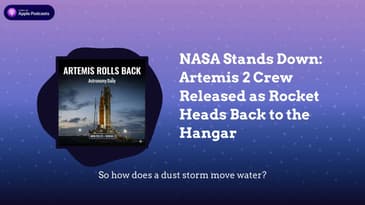
🚀 Astronomy Daily — Season 5 | Monday, February 23, 2026 NASA rolls back the Artemis 2 moon rocket, Europa's ocean gets a life-friendly upgrade, SpaceX breaks its own booster reuse record, Rocket Lab launches a hypersonic mission TODAY, Mars dust storms reveal how the Red Planet lost its water, and SIX planets are visible in tonight's sky. IN THIS EPISODE: 🌕 Artemis 2 rollback — the crew is released from quarantine and the moon launch is pushed to April 🌊 Europa's hidden ocean may be receiving nutrients from the surface — big news for the search for life 🛸 SpaceX flies two Falcon 9s in one day and sets a new booster reuse record 🔥 Rocket Lab's HASTE hypersonic test rocket launches TODAY from Wallops, Virginia 🌪️ A Mars dust storm was moving water at unexpectedly high rates — new clues to the Red Planet's past 🌟 Six-planet parade peaks this week + the crescent Moon passes through the Pleiades tonight FOLLOW ASTRONOMY DAILY: 🌐 astronomydaily.io 📱 @AstroDailyPod on all platforms 🎙️ Part of the Bitesz.com Podcast Network
Become a supporter of this podcast: https://www.spreaker.com/podcast/astronomy-daily-space-news-updates--5648921/support (https://www.spreaker.com/podcast/astronomy-daily-space-news-updates--5648921/support?utm_source=rss&utm_medium=rss&utm_campaign=rss) .
Sponsor Details:
Ensure your online privacy by using NordVPN . To get our special listener deal and save a lot of money, visit You'll be glad you did!
Become a supporter of Astronomy Daily by joining our Supporters Club. Commercial free episodes daily are only a click way... Click Here (https://www.spreaker.com/podcast/astronomy-daily-space-news-updates--5648921/support)
This episode includes AI-generated content.
Episode link: https://play.headliner.app/episode/31814186?utm_source=youtube
00:00:00 --> 00:00:03 Welcome to Astronomy Daily, your daily
00:00:03 --> 00:00:05 guide to what's happening in the cosmos.
00:00:05 --> 00:00:06 I'm Anna.
00:00:06 --> 00:00:08 >> And I'm Avery. It is Monday, February
00:00:08 --> 00:00:12 23rd, 2026, and we have got a jam-packed
00:00:12 --> 00:00:13 show for you today.
00:00:13 --> 00:00:15 >> We really do. We're kicking off with
00:00:15 --> 00:00:19 some big Aremis news. And I mean big.
00:00:19 --> 00:00:21 The moon rocket is on the move again,
00:00:21 --> 00:00:23 but not in the direction anyone was
00:00:23 --> 00:00:26 hoping for. We also have a fascinating
00:00:26 --> 00:00:28 story about Jupiter's moon Europa, a
00:00:28 --> 00:00:31 record-breaking SpaceX milestone, a
00:00:31 --> 00:00:33 launch happening literally today, some
00:00:33 --> 00:00:36 surprising new science from Mars, and
00:00:36 --> 00:00:38 the spectacular sky watching event you
00:00:38 --> 00:00:40 won't want to miss tonight.
00:00:40 --> 00:00:42 >> All that coming right up. Let's get into
00:00:42 --> 00:00:42 it.
00:00:42 --> 00:00:44 >> We start today with the story that has
00:00:44 --> 00:00:47 dominated space news over the weekend.
00:00:47 --> 00:00:49 NASA's Aremis 2 moon rocket, the one
00:00:49 --> 00:00:51 that was sitting on the launchpad at
00:00:51 --> 00:00:53 Kennedy Space Center, ready to send four
00:00:53 --> 00:00:55 astronauts around the moon, has been
00:00:55 --> 00:00:57 ordered back to the garage.
00:00:57 --> 00:01:00 >> That's right. Engineers discovered a
00:01:00 --> 00:01:02 problem with helium flow to the rocket's
00:01:02 --> 00:01:04 upper stage, specifically the interim
00:01:04 --> 00:01:07 cryogenic propulsion stage. And the
00:01:07 --> 00:01:09 issue simply can't be fixed out on the
00:01:09 --> 00:01:12 pad. The rocket needs to roll back into
00:01:12 --> 00:01:14 the vehicle assembly building, which is
00:01:14 --> 00:01:16 about a four-mile journey, and that's
00:01:16 --> 00:01:19 expected to happen as early as tomorrow,
00:01:19 --> 00:01:21 February 24th, weather permitting.
00:01:22 --> 00:01:23 >> So, what does this mean for the mission
00:01:23 --> 00:01:25 timeline? Last week, we were talking
00:01:25 --> 00:01:27 about March 6th, as the launch date.
00:01:28 --> 00:01:30 >> March 6th is now officially off the
00:01:30 --> 00:01:32 table. The good news, if there is good
00:01:32 --> 00:01:35 news here, is that NASA says the quick
00:01:35 --> 00:01:37 decision to begin roll back preparations
00:01:37 --> 00:01:40 potentially preserves an April launch
00:01:40 --> 00:01:42 window. But that's dependent on what
00:01:42 --> 00:01:44 they find when they get the rocket back
00:01:44 --> 00:01:46 inside and how quickly the repair work
00:01:46 --> 00:01:47 goes.
00:01:47 --> 00:01:50 >> And what about the crew? Reed Wisman,
00:01:50 --> 00:01:53 Victor Glover, Christina Ko, and Jeremy
00:01:53 --> 00:01:55 Hansen. They had actually entered
00:01:55 --> 00:01:57 pre-flight quarantine at around 5 in the
00:01:57 --> 00:01:59 afternoon on Friday. They were days away
00:01:59 --> 00:02:01 from heading to Kennedy Space Center.
00:02:01 --> 00:02:03 >> Yes, they were released from quarantine
00:02:03 --> 00:02:05 on the evening of Saturday, February
00:02:05 --> 00:02:08 21st, and they're all back in Houston
00:02:08 --> 00:02:10 now. NASA confirmed they'll re-enter
00:02:10 --> 00:02:13 quarantine approximately 2 weeks before
00:02:13 --> 00:02:15 the next targeted launch date whenever
00:02:15 --> 00:02:17 that's confirmed. NASA has also said
00:02:17 --> 00:02:19 they'll hold a media event in the coming
00:02:19 --> 00:02:22 days to give a fuller update on the roll
00:02:22 --> 00:02:25 back and revised plans. It's frustrating
00:02:25 --> 00:02:27 news for everyone following the Aremis
00:02:27 --> 00:02:29 program, but the right call. You don't
00:02:29 --> 00:02:31 want helium flow issues on a rocket
00:02:31 --> 00:02:33 that's about to send four people around
00:02:33 --> 00:02:34 the moon.
00:02:34 --> 00:02:36 >> Absolutely not. We'll keep you updated
00:02:36 --> 00:02:38 as this develops. April, it seems, is
00:02:38 --> 00:02:40 the new target.
00:02:40 --> 00:02:42 >> From mission delays to genuinely
00:02:42 --> 00:02:45 exciting science, new research published
00:02:45 --> 00:02:47 today is giving a major boost to the
00:02:47 --> 00:02:49 idea that Jupiter's moon Europa could be
00:02:49 --> 00:02:52 a habitable world. Scientists have found
00:02:52 --> 00:02:55 evidence that salty, nutrient-rich ice
00:02:55 --> 00:02:57 on Europa's surface can actually sink
00:02:57 --> 00:02:59 down through the moon's ice shell to
00:02:59 --> 00:03:01 reach the subsurface ocean below.
00:03:02 --> 00:03:03 >> And that's a big deal because one of the
00:03:03 --> 00:03:05 long-standing questions about Europa's
00:03:06 --> 00:03:08 habitability has been whether the ocean
00:03:08 --> 00:03:11 is a closed isolated system cut off from
00:03:11 --> 00:03:14 any energy or chemistry or whether it
00:03:14 --> 00:03:15 gets fed with fresh material from
00:03:15 --> 00:03:18 outside. This suggests it's the latter.
00:03:18 --> 00:03:20 >> Walk us through how it works. Europa's
00:03:20 --> 00:03:23 surface is bombarded by radiation from
00:03:23 --> 00:03:25 Jupiter, which creates oxidants,
00:03:25 --> 00:03:28 essentially oxygen containing compounds
00:03:28 --> 00:03:31 in the ice. The new research shows that
00:03:31 --> 00:03:33 over time, this irradiated surface ice
00:03:33 --> 00:03:36 can become dense enough and heavy enough
00:03:36 --> 00:03:38 that it literally breaks free and sinks
00:03:38 --> 00:03:40 downward through the icy shell,
00:03:40 --> 00:03:43 transporting those oxidants, salts, and
00:03:43 --> 00:03:45 potentially life friendly nutrients all
00:03:46 --> 00:03:47 the way down to the ocean,
00:03:47 --> 00:03:49 >> which is essentially the same kind of
00:03:49 --> 00:03:51 chemical delivery system that helps
00:03:51 --> 00:03:53 sustain life in some of Earth's deep
00:03:53 --> 00:03:55 ocean environments.
00:03:55 --> 00:03:58 >> Exactly that comparison. It's not proof
00:03:58 --> 00:04:01 of life. Let's be clear about that. But
00:04:01 --> 00:04:03 it removes one of the major objections
00:04:03 --> 00:04:06 to Europa as a candidate for life. The
00:04:06 --> 00:04:09 ocean isn't just a dark static body of
00:04:09 --> 00:04:12 water. It may be actively receiving
00:04:12 --> 00:04:14 fresh chemistry from above. And of
00:04:14 --> 00:04:17 course, NASA's Europa Clipper spacecraft
00:04:17 --> 00:04:19 is currently on its way to Jupiter due
00:04:19 --> 00:04:22 to arrive in 2030. Findings like this
00:04:22 --> 00:04:24 are going to shape exactly what the
00:04:24 --> 00:04:25 science team is looking for when he gets
00:04:25 --> 00:04:28 there. Great timing on that research.
00:04:28 --> 00:04:30 Europa remains one of the most
00:04:30 --> 00:04:33 tantalizing places in the entire solar
00:04:33 --> 00:04:34 system.
00:04:34 --> 00:04:37 >> Staying in the realm of big milestones,
00:04:37 --> 00:04:39 SpaceX had quite a Saturday. The company
00:04:40 --> 00:04:42 launched not one but two Falcon 9
00:04:42 --> 00:04:44 rockets in a single day. One from
00:04:44 --> 00:04:47 California and one from Florida, both
00:04:47 --> 00:04:49 carrying batches of Starling satellites.
00:04:49 --> 00:04:51 But the really headline grabbing moment
00:04:51 --> 00:04:54 was the second launch. The Falcon 9
00:04:54 --> 00:04:56 booster that flew from Cape Canaveral
00:04:56 --> 00:04:59 set a new reuse record for the company.
00:04:59 --> 00:05:01 This is a rocket that has flown more
00:05:01 --> 00:05:04 times than any other Falcon 9 booster in
00:05:04 --> 00:05:05 history.
00:05:05 --> 00:05:06 >> It's remarkable when you stop to think
00:05:06 --> 00:05:08 about it. In the early days of space
00:05:08 --> 00:05:10 flight, rockets were essentially
00:05:10 --> 00:05:12 disposable. You launched them once and
00:05:12 --> 00:05:14 they burned up or crashed into the
00:05:14 --> 00:05:17 ocean. SpaceX has fundamentally changed
00:05:17 --> 00:05:20 that equation. And every time they set a
00:05:20 --> 00:05:22 new record like this, it drives down the
00:05:22 --> 00:05:24 cost of access to space a little bit
00:05:24 --> 00:05:27 more. The economics of the Starlink
00:05:27 --> 00:05:29 constellation and by extension a lot of
00:05:30 --> 00:05:32 SpaceX's broader ambitions depend on
00:05:32 --> 00:05:35 being able to fly the same hardware over
00:05:35 --> 00:05:37 and over again reliably.
00:05:37 --> 00:05:39 >> Any word on how many times this
00:05:39 --> 00:05:41 particular booster has flown?
00:05:41 --> 00:05:43 >> The specific flight count is still being
00:05:43 --> 00:05:45 confirmed, but it's enough to break the
00:05:45 --> 00:05:46 previous record, and that's the
00:05:46 --> 00:05:49 significant part. We'll have the exact
00:05:49 --> 00:05:51 number in our show notes. It's another
00:05:51 --> 00:05:54 quiet but important step forward for
00:05:54 --> 00:05:55 reusable space flight.
00:05:55 --> 00:05:57 >> And speaking of launches, one is
00:05:57 --> 00:06:00 happening today, right now in fact, or
00:06:00 --> 00:06:02 very soon after this episode drops.
00:06:02 --> 00:06:04 Rocket Lab is launching its haste rocket
00:06:04 --> 00:06:06 from Wallop's flight facility in
00:06:06 --> 00:06:09 Virginia at 300 p.m. Eastern time this
00:06:09 --> 00:06:11 afternoon. AET stands for hypersonic
00:06:12 --> 00:06:15 accelerator suborbital test electron and
00:06:15 --> 00:06:17 it's exactly what it sounds like a
00:06:17 --> 00:06:19 modified version of rocket lab's
00:06:19 --> 00:06:21 electron rocket adapted to carry
00:06:21 --> 00:06:24 hypersonic test payloads to suborbital
00:06:24 --> 00:06:27 trajectories at very high speeds. This
00:06:27 --> 00:06:29 mission is for the defense innovation
00:06:29 --> 00:06:31 unit. That's a US government agency
00:06:31 --> 00:06:33 focused on accelerating the adoption of
00:06:33 --> 00:06:35 commercial technology for national
00:06:35 --> 00:06:38 security. So this is firmly in the dual
00:06:38 --> 00:06:40 use space. commercial rocket technology
00:06:40 --> 00:06:42 meeting defense research.
00:06:42 --> 00:06:44 >> Hypersonic vehicles, anything traveling
00:06:44 --> 00:06:47 at Mach 5 or above, are one of the
00:06:47 --> 00:06:49 hottest areas in both defense and
00:06:49 --> 00:06:51 commercial aerospace right now. Being
00:06:51 --> 00:06:53 able to test technologies at those
00:06:53 --> 00:06:56 speeds in a relatively affordable,
00:06:56 --> 00:06:59 responsive way is exactly what Haste is
00:06:59 --> 00:07:00 designed to offer.
00:07:00 --> 00:07:02 >> And it's a good reminder that Rocket Lab
00:07:02 --> 00:07:04 is not just the cute little satellite
00:07:04 --> 00:07:06 launcher it started out as. They're
00:07:06 --> 00:07:07 expanding into quite different mission
00:07:07 --> 00:07:08 profiles now.
00:07:08 --> 00:07:10 >> Very much so. We'll be watching the
00:07:10 --> 00:07:12 launch this afternoon. If you want to
00:07:12 --> 00:07:14 follow along, check our social channels
00:07:14 --> 00:07:15 for updates.
00:07:15 --> 00:07:18 >> Now to Mars and to a story that has real
00:07:18 --> 00:07:20 implications for how we understand the
00:07:20 --> 00:07:23 long-term faith of the red planet. New
00:07:23 --> 00:07:25 research published this week has found
00:07:25 --> 00:07:27 that an intense regional dust storm on
00:07:27 --> 00:07:30 Mars transported unusually high amounts
00:07:30 --> 00:07:31 of water vapor through the planet's
00:07:31 --> 00:07:34 atmosphere. Water on Mars is always a
00:07:34 --> 00:07:37 fascinating topic because we know Mars
00:07:37 --> 00:07:40 once had liquid water, rivers, lakes,
00:07:40 --> 00:07:42 possibly even oceans. And the big
00:07:42 --> 00:07:45 question is where did it all go? The
00:07:45 --> 00:07:47 leading answer is that Mars lost its
00:07:47 --> 00:07:50 water over billions of years, partly to
00:07:50 --> 00:07:53 space. And dust storms appear to be a
00:07:53 --> 00:07:55 key mechanism in that process.
00:07:55 --> 00:07:58 >> So, how does a dust storm move water?
00:07:58 --> 00:08:00 >> Great question. When a dust storm kicks
00:08:00 --> 00:08:03 up on Mars, it heats the atmosphere and
00:08:03 --> 00:08:06 lifts dust particles high into the sky.
00:08:06 --> 00:08:08 Water ice and water vapor get caught up
00:08:08 --> 00:08:11 in this turbulence and lofted to much
00:08:11 --> 00:08:13 higher altitudes than they'd normally
00:08:13 --> 00:08:15 reach. Up high, the water is more
00:08:15 --> 00:08:18 exposed to ultraviolet radiation from
00:08:18 --> 00:08:20 the sun, which breaks the water
00:08:20 --> 00:08:23 molecules apart. The hydrogen escapes to
00:08:23 --> 00:08:25 space and the water is permanently lost
00:08:25 --> 00:08:28 from the planet. So every major dust
00:08:28 --> 00:08:31 storm is essentially Mars losing a
00:08:31 --> 00:08:33 little more of its water budget
00:08:33 --> 00:08:36 >> over geological time scales. Yes. What
00:08:36 --> 00:08:39 makes this study significant is the
00:08:39 --> 00:08:41 quantity involved. The researchers found
00:08:41 --> 00:08:43 the storm was transporting water at
00:08:43 --> 00:08:45 rates much higher than previous models
00:08:45 --> 00:08:48 had predicted. It suggests we may have
00:08:48 --> 00:08:50 been underestimating the role that
00:08:50 --> 00:08:52 regional dust storms play in Mars'
00:08:52 --> 00:08:55 ongoing water loss as distinct from the
00:08:55 --> 00:08:58 planetwide global storms.
00:08:58 --> 00:09:00 >> And this matters a lot for our thinking
00:09:00 --> 00:09:02 about early Mars when it was warmer and
00:09:02 --> 00:09:05 wetter. Understanding how water was lost
00:09:05 --> 00:09:07 helps us understand how long Mars might
00:09:07 --> 00:09:08 have been habitable.
00:09:08 --> 00:09:11 >> Exactly. Every new piece of data about
00:09:11 --> 00:09:14 Mars' water history gets us closer to
00:09:14 --> 00:09:15 understanding whether it had the
00:09:15 --> 00:09:18 conditions for life and for how long.
00:09:18 --> 00:09:20 Really compelling research.
00:09:20 --> 00:09:22 >> And we finished today with something you
00:09:22 --> 00:09:25 can literally go outside and enjoy
00:09:25 --> 00:09:28 tonight. Anna, tell us about the skies.
00:09:28 --> 00:09:31 >> Oh, where to begin? So, we are right in
00:09:31 --> 00:09:33 the peak of an extended six planet
00:09:33 --> 00:09:35 parade that's been running through late
00:09:35 --> 00:09:38 February. Tonight after sunset, if you
00:09:38 --> 00:09:40 look toward the western sky, you'll be
00:09:40 --> 00:09:43 able to spot Venus low on the horizon,
00:09:43 --> 00:09:45 bright and unmistakable. Not far from
00:09:45 --> 00:09:48 it, Mercury and Saturn are also visible,
00:09:48 --> 00:09:51 forming a close trio in the west.
00:09:51 --> 00:09:53 >> And for those with binoculars or a
00:09:53 --> 00:09:56 telescope, Neptune is lurking very close
00:09:56 --> 00:09:58 to Saturn as well. So, it's quite the
00:09:58 --> 00:10:01 western horizon spectacle. Then as you
00:10:01 --> 00:10:04 scan across to the east, Jupiter is high
00:10:04 --> 00:10:07 and dominant, hard to miss. And Uranus
00:10:07 --> 00:10:09 is up in the south near the Pletes star
00:10:09 --> 00:10:12 cluster. Again, needing binoculars, but
00:10:12 --> 00:10:13 very findable tonight.
00:10:13 --> 00:10:15 >> And the moon plays a special role
00:10:16 --> 00:10:17 tonight, doesn't it?
00:10:17 --> 00:10:20 >> It really does. The waxing crescent moon
00:10:20 --> 00:10:22 is passing right through the northern
00:10:22 --> 00:10:24 edge of the Pletes tonight. That's the
00:10:24 --> 00:10:26 beautiful little star cluster, also
00:10:26 --> 00:10:29 known as the seven sisters. Depending on
00:10:29 --> 00:10:31 your location, particularly if you're in
00:10:31 --> 00:10:34 the northern US or Canada, the moon may
00:10:34 --> 00:10:37 actually occult. That means pass in
00:10:37 --> 00:10:39 front of several of the Pletes stars,
00:10:39 --> 00:10:42 causing them to disappear and reappear
00:10:42 --> 00:10:44 one by one. That window runs from
00:10:44 --> 00:10:48 roughly 1000 p.m. to 12:15 a.m. Eastern
00:10:48 --> 00:10:48 time.
00:10:48 --> 00:10:51 >> That sounds absolutely magical. And even
00:10:51 --> 00:10:54 if you miss the occultation, the sight
00:10:54 --> 00:10:56 of the crescent moon nestled among those
00:10:56 --> 00:10:58 stars is just beautiful.
00:10:58 --> 00:11:01 >> It really is. Six planets and a moon in
00:11:01 --> 00:11:04 the pletes. February is delivering for
00:11:04 --> 00:11:06 sky watchers. Get outside tonight if you
00:11:06 --> 00:11:07 can.
00:11:07 --> 00:11:09 >> And that is your astronomy daily for
00:11:09 --> 00:11:13 Monday, February 23rd, 2026. What a
00:11:13 --> 00:11:16 show. Artemis setbacks, Europa ocean
00:11:16 --> 00:11:19 science, SpaceX records, a live launch,
00:11:19 --> 00:11:22 Mars water mystery, and six planets
00:11:22 --> 00:11:24 waiting for you outside.
00:11:24 --> 00:11:26 >> We'll have all of today's stories,
00:11:26 --> 00:11:28 links, and resources in the show notes
00:11:28 --> 00:11:31 and on the blog at astronomyaily.io.
00:11:31 --> 00:11:33 Don't forget to follow us at astrodaily
00:11:34 --> 00:11:36 pod across all your social platforms.
00:11:36 --> 00:11:38 >> If you enjoyed today's episode, please
00:11:38 --> 00:11:40 subscribe, leave us a review. It
00:11:40 --> 00:11:43 genuinely helps the show. and tell a
00:11:43 --> 00:11:45 fellow space fan about us.
00:11:45 --> 00:11:47 >> Until tomorrow, keep looking up.
00:11:47 --> 00:11:49 >> The universe is waiting. Clear skies,
00:11:49 --> 00:12:02 everyone, especially tonight.
00:12:02 --> 00:12:06 Stories told.