
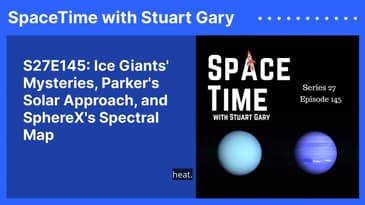
SpaceTime Series 27 Episode 145
* Unveiling the Mysteries of Uranus and Neptune
A new study reveals that Uranus and Neptune, the ice giants of our solar system, may have layered interiors composed of water, methane, and ammonia, similar to oil and water that do not mix. This discovery could explain their unique magnetic fields, previously a mystery to scientists. The research, led by Burkhard Miltzer from the University of California, Berkeley, suggests that these planets have a water-rich layer beneath their cloud tops, followed by a denser carbon-rich layer, challenging previous theories about their internal structure.
* Parker Solar Probe's Final Venus Flyby
NASA's Parker Solar Probe has completed its last Venus gravity assist, setting its course to come within 6.2 million kilometers of the Sun's surface. This maneuver, aside from aiding the primary mission, has provided new insights into Venus, as the probe's instruments captured unexpected data revealing the planet's surface glowing in the near-infrared spectrum. These findings offer fresh perspectives on Venusian surface conditions and composition.
* NASA's SphereX Mission: A Kaleidoscope of the Cosmos
Scheduled for launch next year, NASA's SphereX mission will create the most colorful map of the cosmos ever attempted. By observing the universe in 102 infrared colors, SphereX aims to uncover the mysteries of the universe's formation and evolution, including the origins of water on planets like Earth. This mission will provide a comprehensive 3D map of hundreds of millions of galaxies, offering unprecedented insights into cosmic history and the distribution of essential life ingredients across the Milky Way.
The Science Report
Russia has deployed a new nuclear-capable hypersonic missile, marking a significant escalation in its military capabilities. The Lancet's report on climate change impacts highlights that nearly half the world experienced extreme drought last year. Archaeologists have discovered what might be the oldest alphabetic writing in Syria, dating back to 2400 BCE. A new documentary explores the British royal family's interest in UFOs and the paranormal, revealing a long-standing fascination with these phenomena.
www.spacetimewithstuartgary.com (https://www.spacetimewithstuartgary.com)
www.bitesz.com (https://www.bitesz.com)
🌏 Get Our Exclusive NordVPN deal here ➼ www.bitesz.com/nordvpn (https://www.bitesz.com/nordvpn) . Enjoy incredible discounts and bonuses! Plus, it’s risk-free with Nord’s 30-day money-back guarantee! ✌
Check out our newest sponsor - Old Glory (https://www.bitesz.com/oldglory) - Iconic Music and Sports Merch and now with official NASA merch . Well worth a look....
Become a supporter of this Podcast for as little as $3 per month and access commercial-free episodes plus bonuses: https://www.spacetimewithstuartgary.com/abou (https://www.spacetimewithstuartgary.com/about) t
00:00 New study suggests Uranus and Neptune feature layers that don't mix
07:04 NASA's Parker Solar Probe completes its final Venus gravity assist flyby
11:14 NASA's SphereX mission will look at the universe in 102 colors
20:50 Modern astronomy is built upon spectroscopy. Spectra unveil the structures of black holes
22:42 Russia has commenced using a new nuclear capable hypersonic missile to attack Ukraine
25:35 Almost half of the world experienced extreme drought last year, according to Lancet study
University of California, Berkeley
[berkeley.edu](https://www.berkeley.edu)
Proceedings of the National Academy of Sciences
[pnas.org](https://www.pnas.org)
NASA's Parker Solar Probe
[nasa.gov/solarprobe](https://www.nasa.gov/solarprobe)
Johns Hopkins Applied Physics Laboratory
[jhuapl.edu](https://www.jhuapl.edu)
NASA's SphereX Mission
[nasa.gov/spherex](https://www.nasa.gov/spherex)
Magellan Spacecraft
[nasa.gov/magellan](https://www.nasa.gov/magellan)
NASA's Jet Propulsion Laboratory
[jpl.nasa.gov](https://www.jpl.nasa.gov)
The Lancet
[thelancet.com](https://www.thelancet.com)
Johns Hopkins University
[jhu.edu](https://www.jhu.edu)
Space Time with Stuart Gary Gary
[spacetimewithstuartgary.com](https://www.spacetimewithstuartgary.com)
Become a supporter of this podcast: https://www.spreaker.com/podcast/spacetime-with-stuart-gary--2458531/support (https://www.spreaker.com/podcast/spacetime-with-stuart-gary--2458531/support?utm_source=rss&utm_medium=rss&utm_campaign=rss) .
Episode link: https://play.headliner.app/episode/24391892?utm_source=youtube
00:00:00 --> 00:00:03 this is spacetime series 27 episode 145
00:00:03 --> 00:00:05 we broadcast on the 2nd of December
00:00:05 --> 00:00:09 2024 coming up on SpaceTime What Lies
00:00:09 --> 00:00:11 Beneath The Mysterious worlds of Uranus
00:00:11 --> 00:00:14 and Neptune the final Venus Fly by
00:00:14 --> 00:00:17 finesses Parker solar probe and the most
00:00:17 --> 00:00:19 colorful map of the cosmos ever
00:00:19 --> 00:00:23 attempted all that and more coming up on
00:00:23 --> 00:00:26 SpaceTime welcome to SpaceTime with
00:00:26 --> 00:00:28 Stuart Gary
00:00:28 --> 00:00:35 [Music]
00:00:43 --> 00:00:45 a new study suggest that the ice giants
00:00:45 --> 00:00:47 of our outer solar system Uranus and
00:00:47 --> 00:00:50 Neptune feature layers of water methane
00:00:50 --> 00:00:52 and ammonia which just like water and
00:00:52 --> 00:00:55 oil don't mix the findings could help
00:00:55 --> 00:00:57 explain the two outer planets unusual
00:00:57 --> 00:00:59 magnetic fields which have left
00:00:59 --> 00:01:02 scientists dumb founded until now see
00:01:02 --> 00:01:05 until now ideas like diamond rain and
00:01:05 --> 00:01:08 super iic water are the best explanation
00:01:08 --> 00:01:10 scientists have to try and explain What
00:01:10 --> 00:01:12 Lies Beneath the thick bluish hydrogen
00:01:12 --> 00:01:15 and helium atmospheres of Neptune and
00:01:15 --> 00:01:17 Uranus but now burkard milter from the
00:01:17 --> 00:01:20 University of California Berkeley has an
00:01:20 --> 00:01:22 alternative hypothesis namely that the
00:01:22 --> 00:01:24 Interiors of both these planets are
00:01:24 --> 00:01:26 layered and that the two layers just
00:01:26 --> 00:01:29 like oil and water don't mix now if
00:01:29 --> 00:01:31 correct the idea reported in the journal
00:01:31 --> 00:01:33 the proceedings of the National Academy
00:01:33 --> 00:01:35 of Sciences nearly explains the two
00:01:35 --> 00:01:37 planets unusual magnetic fields and
00:01:37 --> 00:01:39 implies that earlier theories about
00:01:39 --> 00:01:42 their interior might be wrong milter
00:01:42 --> 00:01:44 argues that a deep ocean of water lies
00:01:44 --> 00:01:47 just below the cloud layers and below
00:01:47 --> 00:01:49 that is a highly compressed fluid of
00:01:49 --> 00:01:51 carbon nitrogen and hydrogen and it's
00:01:51 --> 00:01:54 not just speculation computer
00:01:54 --> 00:01:55 simulations show that under the
00:01:55 --> 00:01:56 temperatures and pressures of these
00:01:56 --> 00:01:59 planets Interiors a combination of water
00:01:59 --> 00:02:01 methane and ammonia would naturally
00:02:01 --> 00:02:03 separate into two layers primarily
00:02:04 --> 00:02:05 because hydrogen would be squeezed out
00:02:05 --> 00:02:07 of the methane and ammonia that
00:02:07 --> 00:02:10 comprises much of the deep interior
00:02:10 --> 00:02:12 these emiss layers would explain why
00:02:12 --> 00:02:14 neither Uranus nor Neptune have magnetic
00:02:14 --> 00:02:17 fields like that seen on Earth that was
00:02:17 --> 00:02:19 one of the surprising discoveries about
00:02:19 --> 00:02:21 the ice giants made by the Voyager 2
00:02:21 --> 00:02:23 mission during the late 1980s as it was
00:02:23 --> 00:02:25 completing its grand tour of the outer
00:02:26 --> 00:02:28 solar system milter believes that this
00:02:28 --> 00:02:31 new work provides a good theory as to
00:02:31 --> 00:02:32 why Uranus and Neptune have really
00:02:32 --> 00:02:35 different magnetic fields compared to
00:02:35 --> 00:02:36 planets like the Earth Jupiter and
00:02:37 --> 00:02:39 Saturn he says if other star systems
00:02:39 --> 00:02:41 have similar composition to ours giant
00:02:41 --> 00:02:43 ice planets around those Stars could
00:02:43 --> 00:02:45 well also have similar interior
00:02:45 --> 00:02:48 structures planets about the size of
00:02:48 --> 00:02:50 Uranus in Neptune the so-called sub
00:02:50 --> 00:02:52 neptunian planets are among the most
00:02:52 --> 00:02:55 common exoplanets discovered so far as a
00:02:55 --> 00:02:57 planet cools from its surface downwards
00:02:57 --> 00:03:00 cold and dens material sinks or Blobs of
00:03:00 --> 00:03:03 hotter fluid rise like boiling water
00:03:03 --> 00:03:05 it's a process called convection now if
00:03:05 --> 00:03:07 the interior is electrically conducting
00:03:07 --> 00:03:09 a thick layer of convecting material
00:03:09 --> 00:03:12 will generate a dipole magnetic field
00:03:12 --> 00:03:14 similar to what we see in a bar magnet
00:03:14 --> 00:03:16 Earth's dipole field created by its
00:03:16 --> 00:03:18 liquid iron outer core produces a
00:03:18 --> 00:03:20 magnetic field that loops around the
00:03:20 --> 00:03:22 North and South poles and is the reason
00:03:22 --> 00:03:25 compasses Point towards the poles but
00:03:25 --> 00:03:27 Voyer 2 discovered that neither of the
00:03:27 --> 00:03:29 two ice giants has such a dipole field
00:03:30 --> 00:03:32 only disorganized magnetic fields and
00:03:32 --> 00:03:34 this implies there's no convective
00:03:34 --> 00:03:36 movement of material in a f layer in the
00:03:36 --> 00:03:39 planet's Interiors to explain these
00:03:39 --> 00:03:41 observations two separate research
00:03:41 --> 00:03:43 groups proposed more than 20 years ago
00:03:43 --> 00:03:45 that the planets must have layers that
00:03:45 --> 00:03:48 can't mix thus providing large scale
00:03:48 --> 00:03:51 convection and a global dipolar magnetic
00:03:51 --> 00:03:53 field however convection in one of these
00:03:53 --> 00:03:55 layers could produce a disorganized
00:03:55 --> 00:03:58 magnetic field the trouble is neither of
00:03:58 --> 00:03:59 these groups could explain exactly what
00:03:59 --> 00:04:02 these non-mixing layers were made of now
00:04:02 --> 00:04:04 10 years ago miltz tried to resolve this
00:04:04 --> 00:04:07 problem repeatedly using computer
00:04:07 --> 00:04:09 simulations in his simulations he used
00:04:09 --> 00:04:11 about 100 atoms with a proportion of
00:04:11 --> 00:04:13 carbon oxygen nitrogen and hydrogen
00:04:13 --> 00:04:15 reflecting the known composition of
00:04:15 --> 00:04:17 elements in the early solar system now
00:04:17 --> 00:04:19 at the temperatures and pressures
00:04:19 --> 00:04:21 predicted for the interior of planets
00:04:21 --> 00:04:23 like Uranus and Neptune that's some 3.4
00:04:23 --> 00:04:25 million times Earth's atmospheric
00:04:25 --> 00:04:28 pressure 4750 Kelvin he simply could not
00:04:28 --> 00:04:31 find a way for these separate layers to
00:04:31 --> 00:04:34 form however all that changed last year
00:04:34 --> 00:04:36 thanks to the development of machine
00:04:36 --> 00:04:39 learning milter was able to finally run
00:04:39 --> 00:04:41 a computer model which simulates the
00:04:41 --> 00:04:44 behavior of 540 atoms and to his
00:04:44 --> 00:04:46 surprise he found that the layers do
00:04:46 --> 00:04:48 naturally form as the atoms are heated
00:04:48 --> 00:04:51 and compressed it shows that the water
00:04:51 --> 00:04:53 had separated from the carbon and
00:04:53 --> 00:04:56 nitrogen now we know why these layers
00:04:56 --> 00:04:58 form one which is waterr and the other
00:04:59 --> 00:05:01 which is carbon rich and in the case of
00:05:01 --> 00:05:03 Uranus and Neptune it's the carbon Rich
00:05:03 --> 00:05:06 system which is below the heavy part
00:05:06 --> 00:05:08 stays at the bottom and the lighter part
00:05:08 --> 00:05:10 stays at the top and it cannot do any
00:05:10 --> 00:05:12 convecting and the amount of hydrogen
00:05:12 --> 00:05:14 squeezed out increases with pressure and
00:05:14 --> 00:05:17 depth forming a stably stratified carbon
00:05:17 --> 00:05:19 nitrogen hydrogen layer almost like a
00:05:19 --> 00:05:21 plastic polymer while the upper water
00:05:21 --> 00:05:23 Rich layer likely convex to produce The
00:05:23 --> 00:05:25 observed disorganized magnetic field the
00:05:26 --> 00:05:28 deeper stratified hydrogen carbon Rich
00:05:28 --> 00:05:30 layer can't do this
00:05:30 --> 00:05:32 when miltz modeled the gravity field
00:05:32 --> 00:05:34 produced by a layered Uranus and Neptune
00:05:34 --> 00:05:36 the gravity Fields match those measured
00:05:36 --> 00:05:39 by Voyager 2 nearly 40 years ago Mila
00:05:39 --> 00:05:42 predicts that below Uranus's 4 km
00:05:42 --> 00:05:45 thick atmosphere lies a waterr layer
00:05:45 --> 00:05:48 about 8 km thick and below that a
00:05:48 --> 00:05:51 hydrocarbon Rich layer also about 8
00:05:51 --> 00:05:54 km thick and its Rocky core would be
00:05:54 --> 00:05:57 about the size of the planet Mercury
00:05:57 --> 00:05:58 though Neptune is more massive than
00:05:58 --> 00:06:01 Uranus it's actually smaller in diameter
00:06:01 --> 00:06:02 with a thinner atmosphere but with
00:06:03 --> 00:06:04 similarly thick water rich and
00:06:04 --> 00:06:07 hydrocarbon Rich layers its Rocky core
00:06:07 --> 00:06:09 is also slightly larger than that of
00:06:09 --> 00:06:12 Uranus approximately the size of Mars
00:06:12 --> 00:06:13 the proposed NASA mission to Uranus
00:06:13 --> 00:06:15 could provide confirmation if the
00:06:15 --> 00:06:17 spacecraft has an unboard Doppler imager
00:06:17 --> 00:06:19 in order to measure the planet's
00:06:19 --> 00:06:21 vibrations you see a layered Planet
00:06:21 --> 00:06:23 would vibrate at different frequencies
00:06:23 --> 00:06:26 than a convecting planet mil's next
00:06:26 --> 00:06:27 project will be to use his computational
00:06:27 --> 00:06:29 model to calculate how the plan
00:06:30 --> 00:06:32 vibrations would differ needless to say
00:06:32 --> 00:06:35 we'll keep you informed this is
00:06:35 --> 00:06:38 spacetime still to come the final Venus
00:06:38 --> 00:06:41 flyby Vanessa's Parker solar probe and a
00:06:41 --> 00:06:43 new NASA mission to make the most
00:06:43 --> 00:06:45 colorful map of the cosmos ever
00:06:45 --> 00:06:47 attempted all that and more still to
00:06:47 --> 00:06:53 come on SpaceTime
00:06:53 --> 00:07:04 [Music]
00:07:04 --> 00:07:06 NASA's Parker solar probe has completed
00:07:07 --> 00:07:09 its final Venus gravity assist flyby
00:07:09 --> 00:07:13 maneuver passing within 376 km of the
00:07:13 --> 00:07:16 venian surface the flyby adjusted
00:07:16 --> 00:07:18 Parker's trajectory into a final orbital
00:07:18 --> 00:07:20 configuration which will ultimately
00:07:20 --> 00:07:21 bring the spacecraft to with an
00:07:21 --> 00:07:24 unprecedented 6.2 million kilm of the
00:07:24 --> 00:07:27 solar surface later this month it'll be
00:07:27 --> 00:07:30 the closest any man-made object has ever
00:07:30 --> 00:07:32 flown to the Sun and although the sun is
00:07:33 --> 00:07:35 the primary target of the Parker solar
00:07:35 --> 00:07:37 probe Mission its Venus flybys have
00:07:37 --> 00:07:40 become a boon for New Venetian science
00:07:40 --> 00:07:42 that's all thanks to a chance Discovery
00:07:42 --> 00:07:44 by Whisper the probe's wide filled
00:07:44 --> 00:07:47 imager the instrument looks out from
00:07:47 --> 00:07:49 Parker and away from the Sun to study
00:07:49 --> 00:07:51 fine details in the solar wind the
00:07:51 --> 00:07:53 constant stream of charged particles
00:07:53 --> 00:07:56 flowing out from the Sun but on July the
00:07:56 --> 00:07:58 11th 2020 during Parker's third Venus
00:07:58 --> 00:08:01 flyby scientists turned whisper towards
00:08:01 --> 00:08:03 Venus in the hope of tracking changes in
00:08:03 --> 00:08:05 the planet's thick cloud cover but the
00:08:05 --> 00:08:08 images revealed an amazing surprise a
00:08:08 --> 00:08:10 portion of the whisper data which
00:08:10 --> 00:08:12 captures visible and near infrared light
00:08:12 --> 00:08:13 seemed to see all the way through the
00:08:13 --> 00:08:17 thick clouds to the venian surface below
00:08:17 --> 00:08:19 scientist naram Eisenberg from the
00:08:19 --> 00:08:20 John's Hopkins Applied Physics
00:08:20 --> 00:08:22 laboratory in lurel Maryland says the
00:08:22 --> 00:08:24 whisper cameras looked through the
00:08:24 --> 00:08:26 clouds to the planet's surface and saw
00:08:26 --> 00:08:28 that it was actually glowing in the near
00:08:28 --> 00:08:31 infrared because it's so hot Venus is
00:08:31 --> 00:08:35 sizzling at approximately 465 de C and
00:08:35 --> 00:08:37 this was radiating through the clouds
00:08:37 --> 00:08:40 The Whisper images from the 2020 flyby
00:08:40 --> 00:08:42 as well as those from the next flyby in
00:08:42 --> 00:08:45 2021 revealed Venus's surface in a new
00:08:45 --> 00:08:47 light but they also raised some puzzling
00:08:47 --> 00:08:49 questions and so scientists used the
00:08:49 --> 00:08:52 November flyby to help answer them the
00:08:52 --> 00:08:55 Venus images corresponded well with data
00:08:55 --> 00:08:57 from the Millan spacecraft showing dark
00:08:57 --> 00:08:59 and light patterns that line up with
00:08:59 --> 00:09:01 surface regions which mellan captured
00:09:01 --> 00:09:03 when it mapped Venus's surface using
00:09:03 --> 00:09:06 radar between 1990 and
00:09:06 --> 00:09:08 1994 but some parts of the whisper
00:09:08 --> 00:09:10 images appeared a lot brighter than
00:09:10 --> 00:09:12 expected and that's hinting at extra
00:09:12 --> 00:09:15 information captured by the whisper data
00:09:15 --> 00:09:17 so that begs the question is whisper
00:09:17 --> 00:09:19 picking up on chemical differences on
00:09:19 --> 00:09:21 the surface where the ground is made up
00:09:21 --> 00:09:22 of different material or is it seeing
00:09:22 --> 00:09:25 variations in age where more recent lava
00:09:25 --> 00:09:28 flows added a Fresh coat to the venusian
00:09:28 --> 00:09:30 surface Eisenberg says that because it
00:09:30 --> 00:09:32 flies over a number of similar and
00:09:32 --> 00:09:33 different land forms than the previous
00:09:33 --> 00:09:36 Venice flybys the November flyby
00:09:36 --> 00:09:37 provided more context allowing
00:09:37 --> 00:09:39 scientists to better evaluate whether
00:09:39 --> 00:09:41 whisper can actually help distinguish
00:09:41 --> 00:09:43 physical or even chemical properties on
00:09:43 --> 00:09:46 the venian surface after the flyby
00:09:46 --> 00:09:48 Parker was on a course to swoop down
00:09:48 --> 00:09:50 close to the solar surface the final
00:09:50 --> 00:09:52 objective of this historic Mission first
00:09:53 --> 00:09:55 conceived more than 65 years ago
00:09:55 --> 00:09:58 Parker's data will be charting as yet
00:09:58 --> 00:09:59 Uncharted Territory
00:10:00 --> 00:10:02 in this hyper close regime Parker will
00:10:02 --> 00:10:03 quite literally cut through the plumes
00:10:03 --> 00:10:06 of plasma still connected to the sun
00:10:06 --> 00:10:08 it'll be close enough to pass inside
00:10:08 --> 00:10:10 solar eruptions sort of like a surfer
00:10:10 --> 00:10:13 diving under a crashing wave the closest
00:10:13 --> 00:10:15 approach to the sun perah helion will
00:10:15 --> 00:10:17 occur on December the 24th during which
00:10:17 --> 00:10:19 Mission Control will be out of contact
00:10:19 --> 00:10:21 with the spacecraft so we won't know
00:10:21 --> 00:10:24 what happened until December the 27th
00:10:24 --> 00:10:26 when Parker will send a turnone beacon
00:10:26 --> 00:10:28 hopefully that'll confirm its success
00:10:28 --> 00:10:31 and the space Craft's Health Parker will
00:10:31 --> 00:10:33 then remain in this orbit around the Sun
00:10:33 --> 00:10:35 for the rest of its Mission completing
00:10:35 --> 00:10:38 at least two more parelia at the same
00:10:38 --> 00:10:42 distance this is spacetime still to come
00:10:42 --> 00:10:43 making the most colorful map of the
00:10:43 --> 00:10:45 cosmos ever attempted and later in the
00:10:45 --> 00:10:47 science report Russia has commenced
00:10:47 --> 00:10:50 using a new nuclear capable Hypersonic
00:10:50 --> 00:10:53 missile in its attacks on Ukraine and
00:10:53 --> 00:10:55 we'll have all the details available on
00:10:55 --> 00:10:57 this new weapon all that and more still
00:10:57 --> 00:11:04 to come on SpaceTime
00:11:04 --> 00:11:14 [Music]
00:11:14 --> 00:11:16 time a new NASA Mission sled for launch
00:11:16 --> 00:11:18 next year will make the most colorful
00:11:18 --> 00:11:21 map of the cosmos ever attempted NASA's
00:11:21 --> 00:11:23 ferix Mission won't be the first Space
00:11:24 --> 00:11:25 Telescope to observe hundreds of
00:11:25 --> 00:11:27 millions of stars and galaxies when it's
00:11:27 --> 00:11:29 launched in April next year but will be
00:11:29 --> 00:11:33 the first to observe them in 102 colors
00:11:33 --> 00:11:34 although these colors aren't visible to
00:11:35 --> 00:11:36 the human eye because they're in the
00:11:36 --> 00:11:38 infrared range astronomers will be able
00:11:38 --> 00:11:39 to use them to learn more about the
00:11:39 --> 00:11:41 physical characteristics which govern
00:11:41 --> 00:11:43 the universe less than a second after
00:11:43 --> 00:11:47 its birth 13.8 billion years ago spheric
00:11:47 --> 00:11:49 will also allow scientists to learn more
00:11:49 --> 00:11:51 about the origins of water on planets
00:11:51 --> 00:11:53 like the Earth principal investigator
00:11:53 --> 00:11:55 Jamie Bach from NASA's jet proportion
00:11:55 --> 00:11:57 laboratory in pasadina California says
00:11:57 --> 00:11:59 it'll be the first mission to look at
00:11:59 --> 00:12:01 the the whole sky in so many colors and
00:12:01 --> 00:12:03 whenever astronomers look at the sky in
00:12:03 --> 00:12:05 a new way they can usually be counted on
00:12:05 --> 00:12:08 to make new discoveries short for
00:12:09 --> 00:12:10 spectrometer of the history of the
00:12:10 --> 00:12:13 universe Epoch of reionization and Isis
00:12:13 --> 00:12:16 Explorer spheric will collect infrared
00:12:16 --> 00:12:17 light which is wavelength slightly
00:12:17 --> 00:12:19 longer than what the human eye can
00:12:19 --> 00:12:21 detect the telescope will use a
00:12:21 --> 00:12:23 technique called spectroscopy to take
00:12:23 --> 00:12:25 the light from hundreds of millions of
00:12:25 --> 00:12:27 stars and galaxies and separate that
00:12:27 --> 00:12:29 light into individual colors in the same
00:12:29 --> 00:12:31 way a prism can transform sunlight into
00:12:31 --> 00:12:34 a rainbow the color breakdown can reveal
00:12:34 --> 00:12:36 various properties about an object
00:12:36 --> 00:12:38 including its chemical composition its
00:12:38 --> 00:12:41 distance from the earth even its heat
00:12:41 --> 00:12:43 you see what human eyes perceive as
00:12:43 --> 00:12:45 colors are actually distinct wavelengths
00:12:45 --> 00:12:48 of light the only difference between
00:12:48 --> 00:12:49 colors is the distance between the
00:12:49 --> 00:12:52 crests of the light wave now if the
00:12:52 --> 00:12:54 staro galaxy moving its light waves get
00:12:54 --> 00:12:57 stretched or compressed changing the
00:12:57 --> 00:12:59 colors they appear to emit if if it's
00:12:59 --> 00:13:01 moving away from The Observer those
00:13:01 --> 00:13:03 light waves are stretched and the colors
00:13:03 --> 00:13:05 appear slightly redder that's called red
00:13:05 --> 00:13:07 shifting if the objects moving towards
00:13:07 --> 00:13:10 the Observer those colors are compressed
00:13:10 --> 00:13:12 and appear slightly Bluer that's called
00:13:12 --> 00:13:14 Blue shifting it's actually the same
00:13:14 --> 00:13:16 Doppler effect you get in sound waves
00:13:16 --> 00:13:18 which is why the pitch of an ambulance
00:13:18 --> 00:13:20 siren seems to go up as it approaches
00:13:20 --> 00:13:22 you and lower as it moves away
00:13:22 --> 00:13:24 astronomers can measure the degree to
00:13:24 --> 00:13:26 which a light is red shifted or blue
00:13:26 --> 00:13:28 shifted and they can use that to infer
00:13:28 --> 00:13:31 the distance to the object spherix will
00:13:31 --> 00:13:33 apply this principle to map the exact
00:13:33 --> 00:13:34 position of hundreds of millions of
00:13:34 --> 00:13:38 galaxies in three dimensions by doing so
00:13:38 --> 00:13:39 scientists can study the physics of
00:13:40 --> 00:13:42 inflation that's the event which caused
00:13:42 --> 00:13:43 the universe to suddenly expand by a
00:13:44 --> 00:13:45 trillion trillion times in less than a
00:13:45 --> 00:13:48 second just after the big bang this
00:13:48 --> 00:13:50 rapid expansion Amplified small
00:13:50 --> 00:13:52 differences in the distribution of
00:13:52 --> 00:13:54 matter because these differences remain
00:13:54 --> 00:13:56 imprinted in the distribution of
00:13:56 --> 00:13:58 galaxies today measuring how galaxies
00:13:58 --> 00:14:00 are distributed Across the Universe can
00:14:00 --> 00:14:02 tell astronomers more about how
00:14:02 --> 00:14:04 inflation might have worked now spheric
00:14:04 --> 00:14:06 will also measure the collective glow
00:14:06 --> 00:14:09 created by all the galaxies near and far
00:14:09 --> 00:14:10 in other words the total amount of light
00:14:10 --> 00:14:13 emitted by galaxies over Cosmic history
00:14:14 --> 00:14:15 scientists have tried to estimate this
00:14:15 --> 00:14:17 Total light output by observing
00:14:17 --> 00:14:18 individual galaxies and then
00:14:18 --> 00:14:20 extrapolating that to trillions of
00:14:20 --> 00:14:23 galaxies Across the Universe trouble is
00:14:23 --> 00:14:25 these counts are leaving out some faint
00:14:25 --> 00:14:27 or hidden light sources such as galaxies
00:14:27 --> 00:14:29 that are too small or too distant for
00:14:29 --> 00:14:31 telescopes to easily detect and with
00:14:32 --> 00:14:34 spectroscopy spherics can also show
00:14:34 --> 00:14:35 astronomers how the total light output
00:14:35 --> 00:14:38 has changed over time for example it may
00:14:38 --> 00:14:40 reveal that the universe's earliest
00:14:40 --> 00:14:42 generation of stars and galaxies were
00:14:42 --> 00:14:44 producing more light than previously
00:14:44 --> 00:14:46 thought because they were more plentiful
00:14:46 --> 00:14:48 or bigger and brighter than current
00:14:48 --> 00:14:51 estimat suggest because light takes time
00:14:51 --> 00:14:53 to travel through space we see distant
00:14:53 --> 00:14:56 objects as they were in the past and as
00:14:56 --> 00:14:58 light travels the universe's expansion
00:14:58 --> 00:15:01 St stretches or red shifts them changing
00:15:01 --> 00:15:03 its wavelength and color scientists can
00:15:03 --> 00:15:05 therefore use spherics data to determine
00:15:05 --> 00:15:07 how far light is traveled and where in
00:15:07 --> 00:15:10 the universe's history it was released
00:15:10 --> 00:15:12 spheric will also measure the abundance
00:15:12 --> 00:15:15 of Frozen water carbon dioxide and other
00:15:15 --> 00:15:16 essential ingredients for Life as we
00:15:16 --> 00:15:19 know it along more than 9 million unique
00:15:19 --> 00:15:21 directions across the Milky Way galaxy
00:15:22 --> 00:15:23 and this information will help
00:15:23 --> 00:15:25 scientists better understand just how
00:15:25 --> 00:15:27 available these key molecules are in
00:15:27 --> 00:15:29 forming planets Research indicates
00:15:29 --> 00:15:31 there's a lot of water out there in
00:15:31 --> 00:15:33 space but most of the water in our
00:15:33 --> 00:15:36 galaxy is in the form of ice rather than
00:15:36 --> 00:15:38 gas Frozen to the surface of small dust
00:15:38 --> 00:15:41 grains in these dense clouds where stars
00:15:41 --> 00:15:44 form these icy dust grains can become
00:15:44 --> 00:15:46 part of newly forming planets with the
00:15:46 --> 00:15:48 potential to create oceans just like the
00:15:48 --> 00:15:51 ones we see here on Earth the mission's
00:15:51 --> 00:15:53 colorful new view of the universe will
00:15:53 --> 00:15:55 enable scientists to identify these
00:15:55 --> 00:15:57 materials because chemical elements and
00:15:57 --> 00:15:59 molecules leave a unique signature in
00:15:59 --> 00:16:02 the colors that they absorb and emit
00:16:02 --> 00:16:04 many space telescopes including NASA's
00:16:04 --> 00:16:05 Hubble and web can provide high
00:16:05 --> 00:16:08 resolution in-depth spectroscopy of
00:16:08 --> 00:16:09 individual objects even small sections
00:16:09 --> 00:16:12 of space other telescopes like NASA's
00:16:12 --> 00:16:15 now retired wise wide filled infrared
00:16:15 --> 00:16:16 survey Explorer telescope were designed
00:16:16 --> 00:16:19 to take images of the whole sky but what
00:16:19 --> 00:16:21 spherix does is combine all these
00:16:21 --> 00:16:23 abilities into a single spectroscope
00:16:23 --> 00:16:26 looking at the entire Sky by combining
00:16:26 --> 00:16:28 observations with telescopes that Target
00:16:28 --> 00:16:31 specific parts of the sky with sphero's
00:16:31 --> 00:16:33 big picture view cus will get a more
00:16:33 --> 00:16:35 complete and a more colorful perspective
00:16:35 --> 00:16:38 on the universe this report from Nessa
00:16:38 --> 00:16:41 TV astrophysics is much more than just
00:16:41 --> 00:16:43 capturing different wavelengths of light
00:16:43 --> 00:16:46 many objects or phenomenon are simply
00:16:46 --> 00:16:48 too far away to directly image a lot of
00:16:48 --> 00:16:51 data comes from pixel-sized point
00:16:51 --> 00:16:53 sources and those points provide
00:16:53 --> 00:16:56 astrophysicists with a powerful window
00:16:56 --> 00:16:59 into what makes up the universe even now
00:16:59 --> 00:17:01 most of what scientists learn about the
00:17:01 --> 00:17:03 cosmos comes from studying light
00:17:03 --> 00:17:06 astronomers can work out distances
00:17:06 --> 00:17:09 speeds sizes temperatures and the
00:17:09 --> 00:17:13 composition of elements because matter
00:17:13 --> 00:17:16 behaves in predictable and consistent
00:17:16 --> 00:17:19 ways they do this by literally prying
00:17:19 --> 00:17:23 these photons apart this is spectroscopy
00:17:23 --> 00:17:26 spectroscopy is a study of how matter
00:17:26 --> 00:17:29 interacts with light and all began with
00:17:29 --> 00:17:31 a prism light entering one side of the
00:17:31 --> 00:17:34 prism bends or refracts as it passes
00:17:34 --> 00:17:36 through the triangle shape and exits out
00:17:36 --> 00:17:38 the other side all of the wavelengths
00:17:38 --> 00:17:41 enter together but they exit as a
00:17:41 --> 00:17:44 rainbow likee spread of
00:17:44 --> 00:17:46 colors what's happening is that the
00:17:46 --> 00:17:48 shorter more energetic wavelengths like
00:17:49 --> 00:17:51 blue and violet bend a little more than
00:17:51 --> 00:17:54 the longer lower energy light like red
00:17:54 --> 00:17:57 and orange because they Bend at slightly
00:17:57 --> 00:17:59 different angles the wavelengths
00:17:59 --> 00:18:02 separate Fanning out into a band of
00:18:02 --> 00:18:05 colors NASA has a whole Fleet of
00:18:05 --> 00:18:07 telescopes that can split and study a
00:18:07 --> 00:18:08 wide range of light on the
00:18:08 --> 00:18:11 electromagnetic spectrum not just the
00:18:11 --> 00:18:14 light that our eyes can detect so Hubble
00:18:14 --> 00:18:16 can detect through the visible spectrum
00:18:16 --> 00:18:19 but also a bit into the infrared and the
00:18:19 --> 00:18:23 ultraviolet web is just infrared and can
00:18:23 --> 00:18:25 look at the light that is emitted from
00:18:25 --> 00:18:27 billions of years ago and of course the
00:18:27 --> 00:18:30 images from web are really spectacular
00:18:30 --> 00:18:32 this spectrum shows a light that
00:18:32 --> 00:18:34 penetrated the atmosphere of a planet
00:18:34 --> 00:18:37 called wasp 96b the light being measured
00:18:37 --> 00:18:39 comes from the planet's host star some
00:18:39 --> 00:18:42 of which skims through the atmosphere
00:18:42 --> 00:18:43 humans are a long way from directly
00:18:43 --> 00:18:46 Imaging exoplanets so telescopes like
00:18:46 --> 00:18:48 web will use spectroscopy to find those
00:18:48 --> 00:18:50 chemicals that could support life in
00:18:50 --> 00:18:52 their atmospheres which is why web's
00:18:52 --> 00:18:56 first Spectra is so amazing bumps and
00:18:56 --> 00:18:57 wiggles that indicate the presence of
00:18:57 --> 00:18:59 water vapor in the atmosphere of this
00:18:59 --> 00:19:02 exoplanet but it's one thing to identify
00:19:02 --> 00:19:05 single elements or simple molecules but
00:19:05 --> 00:19:07 deciphering whole foreign bodies took us
00:19:08 --> 00:19:10 a very long time to figure this out it
00:19:10 --> 00:19:12 really took us many many decades and it
00:19:12 --> 00:19:14 took us many many Fantastic new
00:19:14 --> 00:19:18 instruments if all of our astrophysical
00:19:18 --> 00:19:19 objects or anything that we're looking
00:19:19 --> 00:19:21 at were made up of one element this
00:19:21 --> 00:19:24 would just be so easy but we don't so we
00:19:24 --> 00:19:27 have to do experiments on Earth to prove
00:19:27 --> 00:19:29 what we're looking at looks like what we
00:19:29 --> 00:19:32 are thinking we're looking at so here is
00:19:32 --> 00:19:35 argon it glows as really pretty purple
00:19:35 --> 00:19:37 and then if we look at it with a
00:19:37 --> 00:19:40 spectroscope it shows us a very specific
00:19:40 --> 00:19:42 fingerprint to argon these are called
00:19:42 --> 00:19:45 spectral tubes they contain the gas of
00:19:45 --> 00:19:47 one element and the Box runs a voltage
00:19:47 --> 00:19:49 through the tube when I turn on the
00:19:49 --> 00:19:53 switch the charged gas turns to plasma
00:19:53 --> 00:19:55 and emits a color that is unique to that
00:19:55 --> 00:19:58 one element it also makes unique lines
00:19:58 --> 00:20:00 when you look through the spectroscope
00:20:00 --> 00:20:02 this same process happens in a star or a
00:20:03 --> 00:20:05 hot region of gas so we use tubes like
00:20:05 --> 00:20:08 this to verify what we see in space if
00:20:08 --> 00:20:10 you do a quick search for spectroscopy
00:20:10 --> 00:20:12 data there are numerous ways that the
00:20:12 --> 00:20:14 data can appear those variations are
00:20:14 --> 00:20:17 based on the source of the cosmic light
00:20:17 --> 00:20:19 there are three types of Spectra that we
00:20:19 --> 00:20:20 can use
00:20:20 --> 00:20:24 continuous emission and absorption light
00:20:24 --> 00:20:27 from a hot dense Source like the sun
00:20:27 --> 00:20:30 produces a continuous Spectrum when that
00:20:30 --> 00:20:33 light passes through cooler gases on its
00:20:33 --> 00:20:36 way to us the gases take away or absorb
00:20:36 --> 00:20:39 some of that energy dark lines appear
00:20:39 --> 00:20:42 where specific colors are missing and
00:20:42 --> 00:20:46 when thin gases glow themselves we see
00:20:46 --> 00:20:48 only their characteristic colors kind of
00:20:48 --> 00:20:52 like a cosmic barcode like all data
00:20:52 --> 00:20:55 there is an art to analyzing Spectra
00:20:55 --> 00:20:57 scientists use computers to calculate
00:20:57 --> 00:20:59 and tease out clear signals
00:20:59 --> 00:21:01 comparing them then to models that are
00:21:01 --> 00:21:04 already known many scientists in Globs
00:21:04 --> 00:21:06 on Earth they try to recreate the same
00:21:06 --> 00:21:08 conditions and and measure basically
00:21:08 --> 00:21:10 what these Fingerprints of those
00:21:10 --> 00:21:11 different transitions for different
00:21:11 --> 00:21:13 elements are okay so we're always
00:21:13 --> 00:21:16 comparing to sort of the fingerprint of
00:21:16 --> 00:21:18 what we have and then if it has deviated
00:21:18 --> 00:21:20 from that that is the new information
00:21:20 --> 00:21:22 from what we're looking at correct
00:21:22 --> 00:21:25 Spectra unveil the structures of black
00:21:25 --> 00:21:27 holes the swirling winds that surround
00:21:27 --> 00:21:29 them and the
00:21:29 --> 00:21:31 big jets of particles that come out of
00:21:31 --> 00:21:33 them so all of this is mostly a chistian
00:21:33 --> 00:21:35 disc at this level it's just different
00:21:35 --> 00:21:37 parts of it we can zoom in right and we
00:21:37 --> 00:21:40 see all of the absorption lines right
00:21:40 --> 00:21:42 all of these lines are also shifted a
00:21:42 --> 00:21:44 lot so they come from this wind so
00:21:44 --> 00:21:47 that's how we know that there is wind
00:21:47 --> 00:21:49 blowing around black holes the same
00:21:49 --> 00:21:51 principles apply no matter the
00:21:51 --> 00:21:53 wavelength of light but each wavelength
00:21:53 --> 00:21:55 of light tells us a little something
00:21:55 --> 00:21:58 different about each character we find
00:21:58 --> 00:22:00 in the Universe it's pretty wild how
00:22:00 --> 00:22:03 different the universe looks to our eyes
00:22:03 --> 00:22:06 and how it presents to our telescopes
00:22:06 --> 00:22:08 and that's precisely why we need to
00:22:08 --> 00:22:10 observe in different wavelengths of
00:22:10 --> 00:22:14 light modern astronomy is built upon
00:22:14 --> 00:22:16 spectroscopy so with every stream of
00:22:16 --> 00:22:19 light We Gather we further understand
00:22:19 --> 00:22:22 what the universe is made of all we need
00:22:22 --> 00:22:25 to do is pry openen its contents this
00:22:25 --> 00:22:28 SpaceTime
00:22:28 --> 00:22:42 [Music]
00:22:42 --> 00:22:43 and time now to take a brief look at
00:22:43 --> 00:22:45 some of the other stories making use in
00:22:45 --> 00:22:48 science this week with a science report
00:22:48 --> 00:22:50 Russia has commenced using a new nuclear
00:22:50 --> 00:22:53 capable Hypersonic missile to attack
00:22:53 --> 00:22:55 Ukraine this is a major escalation of
00:22:56 --> 00:22:58 moscow's invasion of Ukraine because it
00:22:58 --> 00:23:00 demonstr rates a new Unstoppable
00:23:00 --> 00:23:02 capability giving Vladimir Putin a
00:23:02 --> 00:23:04 significant strategic advantage over the
00:23:04 --> 00:23:07 West the new missile called oink or
00:23:07 --> 00:23:10 Hazel Tree in Russian flies at over Mac
00:23:10 --> 00:23:12 10 10 times the speed of sound that's
00:23:12 --> 00:23:15 more than 3 km/ second and it can
00:23:15 --> 00:23:17 maneuver mid-flight thereby making it
00:23:17 --> 00:23:19 harder to track and intercept using
00:23:19 --> 00:23:21 existing state-of-the-art a defense
00:23:21 --> 00:23:23 systems you see speed's important
00:23:24 --> 00:23:25 because the faster a missile can travel
00:23:25 --> 00:23:27 the quicker it gets to its Target and
00:23:27 --> 00:23:30 the less a defenses have to react
00:23:30 --> 00:23:33 ballistic missiles fly in an arching
00:23:33 --> 00:23:35 trajectory first going up into outer
00:23:35 --> 00:23:37 space and then back down to their
00:23:37 --> 00:23:40 targets but as it descends a Hypersonic
00:23:40 --> 00:23:42 missile gains so much extra speed and
00:23:42 --> 00:23:43 kinetic energy it can maneuver down
00:23:43 --> 00:23:46 towards its Target avoiding interception
00:23:46 --> 00:23:49 until now 80% of all Russian missiles
00:23:49 --> 00:23:52 fired into Ukraine were intercepted by
00:23:52 --> 00:23:54 Patriot batteries but these new
00:23:54 --> 00:23:56 Hypersonic ballistic missiles negate
00:23:56 --> 00:23:59 that advantage in in other words as of
00:23:59 --> 00:24:02 today there is no means of counteracting
00:24:02 --> 00:24:05 such a weapon now from what we can tell
00:24:05 --> 00:24:08 oen carries up to six mves modable
00:24:08 --> 00:24:10 independently targetable warheads and
00:24:10 --> 00:24:12 they can be either conventional or
00:24:12 --> 00:24:15 thermonuclear the missiles use against
00:24:15 --> 00:24:17 Ukraine showed numerous Warheads
00:24:17 --> 00:24:19 striking simultaneously in a spectacular
00:24:19 --> 00:24:21 show of force and of course it wasn't
00:24:21 --> 00:24:24 just to damage Ukrainian territory it
00:24:24 --> 00:24:26 was meant to show the West what Moscow
00:24:26 --> 00:24:29 is now capable of in other words the
00:24:29 --> 00:24:32 bear was saying don't mess with us now
00:24:32 --> 00:24:33 in this case they were conventional
00:24:33 --> 00:24:35 Warheads but they could just as easily
00:24:35 --> 00:24:38 have been nuclear Ukrainian media claims
00:24:38 --> 00:24:40 the missile was launched from the kusin
00:24:40 --> 00:24:43 rocket range that's around 900 km from
00:24:43 --> 00:24:46 its Target in Neo Vladimir Putin
00:24:46 --> 00:24:47 described the missile as being medium
00:24:47 --> 00:24:50 range but Russian military experts say
00:24:50 --> 00:24:52 it's actually intermediate range meaning
00:24:52 --> 00:24:55 a range of up to 5 km and just one
00:24:55 --> 00:24:57 level below that of an intercontinental
00:24:57 --> 00:24:58 ballistic missile
00:24:58 --> 00:25:00 that means the Oink could hit any point
00:25:00 --> 00:25:03 in Europe Eastern Asia or the western
00:25:03 --> 00:25:05 United States the US defense department
00:25:05 --> 00:25:07 are describing the orink as an
00:25:07 --> 00:25:09 experimental missile based on Russia's
00:25:09 --> 00:25:12 rs26 Rubik which itself is a modified
00:25:12 --> 00:25:15 tool ICBM now Moscow has announced that
00:25:15 --> 00:25:17 it's approved full production of the new
00:25:17 --> 00:25:19 missile and that implies only a few
00:25:19 --> 00:25:20 prototypes are available for use at the
00:25:20 --> 00:25:23 moment but as Russia tools up and begins
00:25:23 --> 00:25:26 production that will change and in the
00:25:26 --> 00:25:28 process it will also change the Global
00:25:28 --> 00:25:31 balance of power bringing us all a lot
00:25:31 --> 00:25:34 closer to a potential third world
00:25:34 --> 00:25:37 war turning to other news now and the
00:25:37 --> 00:25:39 lancet's annual stock take on how
00:25:39 --> 00:25:41 climate change is impacting Global
00:25:41 --> 00:25:43 Health has shown that almost half of the
00:25:43 --> 00:25:45 world experienced extreme drought last
00:25:45 --> 00:25:47 year the study found that Health threats
00:25:47 --> 00:25:50 posed by climate change continued to
00:25:50 --> 00:25:53 grow and it affected more people in 2023
00:25:53 --> 00:25:55 than at any previous time in history the
00:25:55 --> 00:25:58 author say 48% of all land areas around
00:25:58 --> 00:26:01 the world experienced extreme drought
00:26:01 --> 00:26:02 and people globally are now being
00:26:02 --> 00:26:05 exposed to an average of 50 more days of
00:26:05 --> 00:26:07 temperatures that threaten their health
00:26:07 --> 00:26:09 the report is the eighth of its kind and
00:26:09 --> 00:26:11 the researchers say the findings are the
00:26:11 --> 00:26:13 worst
00:26:13 --> 00:26:16 yet well last week it was the stunning
00:26:16 --> 00:26:17 discovery that the will was likely
00:26:17 --> 00:26:20 invented in what now is Israel now
00:26:20 --> 00:26:21 scientists of une Earth what could be
00:26:22 --> 00:26:24 evidence of the oldest alphabetic
00:26:24 --> 00:26:26 writing in human history in a tomb in
00:26:26 --> 00:26:28 neighboring Syria Arch ologist from the
00:26:28 --> 00:26:31 Johns Hopkins University discovered the
00:26:31 --> 00:26:33 writing edged under finger length clay
00:26:33 --> 00:26:36 cylinders dating back to around 2
00:26:36 --> 00:26:38 BCE that's some 500 years earlier than
00:26:38 --> 00:26:41 the previous known alphabetic scripts
00:26:41 --> 00:26:42 the new discovery upends what
00:26:42 --> 00:26:44 archaeologists know about where
00:26:44 --> 00:26:46 alphabets came from how they're shared
00:26:46 --> 00:26:48 across societies and what that could
00:26:48 --> 00:26:50 mean for early Urban
00:26:50 --> 00:26:53 civilizations the discovery was made at
00:26:53 --> 00:26:55 an archaeological dig site at T Mel Mara
00:26:55 --> 00:26:58 in Western Syria carbon 14 dating was
00:26:58 --> 00:27:00 used to determine the age of six human
00:27:00 --> 00:27:03 skeletons found in the early Bronze Age
00:27:03 --> 00:27:05 tomb the cylinders were among a range of
00:27:05 --> 00:27:07 objects buried with the occupants
00:27:07 --> 00:27:09 including gold and silver jewelry
00:27:09 --> 00:27:12 cookware a spearhead and intact Pottery
00:27:12 --> 00:27:15 vessels previously Scholars had thought
00:27:15 --> 00:27:17 the alphabet was invented in or around
00:27:17 --> 00:27:21 Egypt sometime after 1900
00:27:21 --> 00:27:24 BCE a new documentary about the RO
00:27:24 --> 00:27:26 family's secret passion for UFOs in the
00:27:26 --> 00:27:29 paranormals just been released the doco
00:27:29 --> 00:27:31 title king of UFOs speaks with Witnesses
00:27:31 --> 00:27:33 about the late Queen and Prince Philip's
00:27:33 --> 00:27:35 passionate interest in topics like crop
00:27:35 --> 00:27:38 circles and the renam UFO case from 1980
00:27:38 --> 00:27:40 often described as the British Roswell
00:27:40 --> 00:27:42 it suggests that a UFO landed in the
00:27:42 --> 00:27:44 forest at rendlesham over the Christmas
00:27:45 --> 00:27:48 weekend in 1980 not far from RAF praters
00:27:48 --> 00:27:50 which at the time was a US Air Force
00:27:50 --> 00:27:53 NATO base Airmen from the base who went
00:27:53 --> 00:27:55 to investigate reported seeing strange
00:27:55 --> 00:27:57 orbs and beams of light shining through
00:27:57 --> 00:27:58 the fire
00:27:58 --> 00:28:00 now apparently the most likely source of
00:28:00 --> 00:28:02 this light wasn't a flying sorcer but
00:28:02 --> 00:28:05 the nearby orness Lighthouse timendum
00:28:05 --> 00:28:07 from a strin skeptic says the Royals
00:28:07 --> 00:28:10 have a long long fascination with all
00:28:10 --> 00:28:12 things paranormal we've known for some
00:28:12 --> 00:28:13 time actually that Quince Philip had a
00:28:13 --> 00:28:15 bit of an interest in UFOs and that sort
00:28:15 --> 00:28:17 of thing but I didn't know actually that
00:28:17 --> 00:28:19 the late Queen also shared his view this
00:28:19 --> 00:28:21 the theory that comes up in a recent
00:28:21 --> 00:28:22 documentary which is looking at the
00:28:22 --> 00:28:25 Royal Family's interest in crop circles
00:28:25 --> 00:28:27 and UFOs and all that what apparently
00:28:27 --> 00:28:28 happens is that they had a of books they
00:28:28 --> 00:28:30 discussed things with different people
00:28:30 --> 00:28:32 they investigated all according to this
00:28:32 --> 00:28:33 documentary anyway particular event
00:28:33 --> 00:28:35 rollsroyce turned up at a crop circle on
00:28:35 --> 00:28:37 people in in the circle said oh great
00:28:37 --> 00:28:38 we're going to get Queens turning up but
00:28:38 --> 00:28:40 it wasn't it was just supposedly the
00:28:40 --> 00:28:42 royal family scientific adviser who was
00:28:42 --> 00:28:43 coming out to have a look think the
00:28:43 --> 00:28:45 queen necessarily made a royal visit to
00:28:45 --> 00:28:47 a crop circle one of the problems with
00:28:47 --> 00:28:50 this is that the fellow who made the
00:28:50 --> 00:28:52 documentary named Mark Christopher Lee
00:28:52 --> 00:28:53 if you got a name like Christopher Lee
00:28:53 --> 00:28:55 you've got to be the supernatural short
00:28:55 --> 00:28:57 I know I know he say that the royal
00:28:57 --> 00:28:59 family had to keep is mostly a secret
00:28:59 --> 00:29:01 because of possible ridicule but if such
00:29:01 --> 00:29:03 high standing balanced people took them
00:29:03 --> 00:29:05 seriously why can't we and I trying to
00:29:05 --> 00:29:06 figure out what necessarily make the
00:29:06 --> 00:29:08 Royal a high standing well High standing
00:29:08 --> 00:29:10 a but balanced people and are they
00:29:10 --> 00:29:12 necessarily more intelligent or more
00:29:12 --> 00:29:13 incisive than anyone else I would
00:29:13 --> 00:29:15 suggest not especially if the royal
00:29:15 --> 00:29:19 family has a strong ponon for Homeopathy
00:29:19 --> 00:29:21 uh which is a very dodgy well it's
00:29:21 --> 00:29:23 actually a false medicine it just does
00:29:23 --> 00:29:24 not work and it can't work and it's one
00:29:24 --> 00:29:26 of the areas that the Skeptics will be
00:29:26 --> 00:29:28 100% sure that nope ain't nothing there
00:29:28 --> 00:29:30 but anyway so these high standing
00:29:30 --> 00:29:31 balanced people are believers in a
00:29:31 --> 00:29:33 totally sudo medicine like Homeopathy
00:29:33 --> 00:29:35 and yet their belief is supposed to be
00:29:35 --> 00:29:37 endorsed by because of their standing in
00:29:37 --> 00:29:39 UFOs and it's like getting celebrity
00:29:39 --> 00:29:41 endorsements for your political beliefs
00:29:41 --> 00:29:42 isn't it you you know why would you
00:29:42 --> 00:29:44 believe anything a celebrity tells you
00:29:44 --> 00:29:45 they're an actor why would you believe
00:29:45 --> 00:29:47 celebrities for anything you a medical
00:29:47 --> 00:29:49 treatment a product a vacuum cleaner you
00:29:49 --> 00:29:51 name it why is they just because you
00:29:51 --> 00:29:52 know them and they look nice doesn't
00:29:52 --> 00:29:55 mean they actually understand the
00:29:55 --> 00:29:57 technology or the implications of of
00:29:57 --> 00:29:58 what they what they're endorsing I know
00:29:58 --> 00:30:00 it's the whole concept of celebrity
00:30:00 --> 00:30:02 endorsement whether it's a royal family
00:30:02 --> 00:30:04 or a film star it's pretty um pretty
00:30:04 --> 00:30:06 difficult actually to to support why not
00:30:06 --> 00:30:08 support someone with actual expertise
00:30:08 --> 00:30:10 like a scientist could have S all
00:30:10 --> 00:30:12 scientists that's a radical idea that's
00:30:12 --> 00:30:14 a totally radical idea yeah why are
00:30:14 --> 00:30:16 someone who's an expert why I get a film
00:30:16 --> 00:30:17 star who's been in an action movie
00:30:17 --> 00:30:22 that's Tim mum from Australian Skeptics
00:30:22 --> 00:30:35 [Music]
00:30:35 --> 00:30:38 and that's the show for now SpaceTime is
00:30:38 --> 00:30:40 available every Monday Wednesday and
00:30:40 --> 00:30:43 Friday through Apple podcasts iTunes
00:30:43 --> 00:30:46 Stitcher Google podcast pocketcasts
00:30:46 --> 00:30:50 Spotify acast Amazon music bites.com
00:30:50 --> 00:30:53 SoundCloud YouTube your favorite podcast
00:30:53 --> 00:30:55 download provider and from SpaceTime
00:30:55 --> 00:30:58 withth Stewart gary.com SpaceTime
00:30:58 --> 00:30:59 also broadcast through the National
00:30:59 --> 00:31:02 Science Foundation on science Z Radio
00:31:02 --> 00:31:04 and on both iHeart radio and TuneIn
00:31:04 --> 00:31:06 radio and you can help to support our
00:31:06 --> 00:31:09 show by visiting the SpaceTime store for
00:31:09 --> 00:31:11 a range of promotional merchandising
00:31:11 --> 00:31:13 goodies or by becoming A Spacetime
00:31:13 --> 00:31:15 Patron which gives you access to Triple
00:31:15 --> 00:31:17 episode commercial free versions of the
00:31:17 --> 00:31:19 show as well as lots of burnus audio
00:31:19 --> 00:31:21 content which doesn't go to AAR access
00:31:21 --> 00:31:23 to our exclusive Facebook group and
00:31:23 --> 00:31:26 other Awards just go to SpaceTime withth
00:31:26 --> 00:31:30 Stewart gary.com for full details you've
00:31:30 --> 00:31:32 been listening to SpaceTime with Stuart
00:31:32 --> 00:31:34 Gary this has been another quality
00:31:34 --> 00:31:38 podcast production from bites.com