
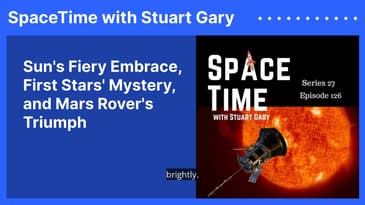
SpaceTime Series 27 Episode 126
* NASA's Parker Solar Probe Completes 21st Philip of the Sun
NASA's Parker Solar Probe has achieved its 21st close encounter with the Sun, matching its previous distance and speed records. The spacecraft swooped to within 7.26 million kilometers of the solar surface at a record speed of 635,300 km/h. This flyby sets up the probe for its final closest approaches, with its orbit shaped by a Venus gravity assist. The mission, launched in 2018, aims to study the Sun's corona and the solar wind, unraveling the mysteries of solar phenomena that impact the solar system.
* Webb Space Telescope Finds Potential Missing Link to First Stars
Astronomers using NASA's Webb Space Telescope have identified a galaxy with an unusual light signature that could be a missing link in galactic evolution. The galaxy, found approximately a billion years after the Big Bang, features gas outshining its stars, possibly due to massive, hot stars. This discovery offers insights into the transition from the universe's first stars to more familiar galaxies, providing a glimpse into the early cosmic environment.
* Perseverance Rover's Key Science Instrument Robert
NASA's Perseverance rover on Mars has regained the use of its critical Sherlock instrument after a six-month effort. The spectroscope, crucial for detecting organics and assessing habitability, had malfunctioned in January. The successful repair allows the rover to continue its mission of analyzing Martian rocks and soil for signs of past life and understanding the planet's geological history.
The Science Robert
A new study suggests that caffeine consumption may improve heart health by aiding vascular growth. Another study reveals increasing plant cover in Antarctica, linked to climate change. Research highlights how people often form opinions without sufficient information, contributing to conflicts. Lastly, a study confirms that astrologers perform no better than chance in predicting character or future events.
00:00:00 - This is spacetime series 27, episode 126, for broadcast on 18 October 2024
00:00:30 - NASA's Parker solar probe completes 21st close encounter with the sun
00:03:08 - The Parker solar probe is touching the sun for the first time
00:08:32 - Galaxy with unusual light signature attributed to gas outshining stars
00:12:00 - NASA scientists have successfully brought a key science instrument back online on Mars
00:14:51 - A new study has shown that consuming more caffeine may improve your heart health
00:17:01 - New study shows people are biased to assume they know enough about situations
www.spacetimewithstuartgary.com (https://www.spacetimewithstuartgary.com)
www.bitesz.com (https://www.bitesz.com)
🌏 Get Our Exclusive NordVPN deal here ➼ www.bitesz.com/nordvpn (https://www.bitesz.com/nordvpn) . Enjoy incredible discounts and bonuses! Plus, it’s risk-free with Nord’s 30-day money-back guarantee! ✌
Check out our newest sponsor - Old Glory (https://www.bitesz.com/oldglory) - Iconic Music and Sports Merch. Well worth a look....
Become a supporter of this Podcast and access commercial-free episodes plus bonuses: https://www.spreaker.com/podcast/spacetime-with-stuart-gary--2458531/support (https://www.spreaker.com/podcast/spacetime-with-stuart-gary--2458531/support) .
Episode link: https://play.headliner.app/episode/23554253?utm_source=youtube
00:00:00 --> 00:00:03 this is spacetime series 27 episode 126
00:00:04 --> 00:00:06 for broadcast on the 18th of October
00:00:06 --> 00:00:10 2024 coming up on SpaceTime NASA's
00:00:10 --> 00:00:12 Parker solar probe completes its 21st
00:00:12 --> 00:00:16 flyby of the Sun the web Space Telescope
00:00:16 --> 00:00:17 discovers a potential missing link to
00:00:18 --> 00:00:21 the universe's first stars and Mission
00:00:21 --> 00:00:22 managers have fixed a key science
00:00:22 --> 00:00:25 instrument aboard NASA's perseverance
00:00:25 --> 00:00:28 Rover all that and more coming up on
00:00:28 --> 00:00:30 SpaceTime
00:00:30 --> 00:00:34 welcome to SpaceTime with Stuart
00:00:34 --> 00:00:41 [Music]
00:00:48 --> 00:00:51 Gary NASA's Parker solar probe has
00:00:51 --> 00:00:53 completed its 21st close encounter with
00:00:53 --> 00:00:56 the Sun the flyby equaled its own
00:00:56 --> 00:00:58 previous distance record swooping to
00:00:58 --> 00:01:01 within 7.26 million kilm of the solar
00:01:01 --> 00:01:04 surface the close parhelion approach
00:01:04 --> 00:01:07 occurred at a record speed of
00:01:07 --> 00:01:08 635
00:01:09 --> 00:01:12 kmph again matching its previous record
00:01:12 --> 00:01:14 en counter speed after the flyby the
00:01:15 --> 00:01:16 spacecraft checked in with Mission
00:01:16 --> 00:01:18 managers at the Johns Hopkins Applied
00:01:18 --> 00:01:20 Physics laboratory in Lal Maryland using
00:01:21 --> 00:01:23 a beacon turn to indicate that it was in
00:01:23 --> 00:01:24 good health and all systems were
00:01:24 --> 00:01:27 operating nominally a close encounter
00:01:27 --> 00:01:29 set the probe up for another close flyby
00:01:29 --> 00:01:30 of Venus
00:01:30 --> 00:01:32 this close approach marked the last time
00:01:33 --> 00:01:34 that Parker will fly around the Sun at
00:01:34 --> 00:01:36 this distance and speed before it makes
00:01:36 --> 00:01:39 the first of three final closest
00:01:39 --> 00:01:42 approaches they'll begin on December the
00:01:42 --> 00:01:44 24th now at this point with its orbit
00:01:44 --> 00:01:46 being shaped by the mission's final
00:01:46 --> 00:01:49 Venus gravity assist on November the 6th
00:01:49 --> 00:01:50 the spacecraft will swoop down to just
00:01:50 --> 00:01:53 6.1 million kilm from the solar surface
00:01:53 --> 00:01:58 moving at over 692 th000 kmph that's the
00:01:58 --> 00:02:01 fastest any man-made object has ever
00:02:01 --> 00:02:03 traveled at launched aboard a Delta 4
00:02:03 --> 00:02:06 heavy from space launch complex 37 at
00:02:06 --> 00:02:07 the cape canaval space for space in
00:02:07 --> 00:02:10 Florida back in August 2018 the Parker
00:02:10 --> 00:02:12 solar probe is on a 7-year Mission
00:02:12 --> 00:02:15 studying the sun's outer atmosphere the
00:02:15 --> 00:02:17 corona the mission's undertaking 24
00:02:18 --> 00:02:20 highly eccentric orbits around the Sun
00:02:20 --> 00:02:23 flying deep into the corona it'll trace
00:02:23 --> 00:02:24 the flow of energy that heats up the
00:02:25 --> 00:02:27 Corona and accelerates the solar wind
00:02:27 --> 00:02:29 the constant stream of charged particles
00:02:29 --> 00:02:31 flying out from the Sun and bathing the
00:02:31 --> 00:02:34 entire solar system as well as detecting
00:02:34 --> 00:02:36 the sources of the solar wind it'll also
00:02:36 --> 00:02:38 determine the structure and dynamics of
00:02:38 --> 00:02:40 the sun's magnetic fields and it will
00:02:40 --> 00:02:42 work out the mechanisms which are
00:02:42 --> 00:02:44 accelerating and transporting energetic
00:02:44 --> 00:02:47 particles the 1.5 billion spacecraft
00:02:47 --> 00:02:49 carries four scientific instrument
00:02:49 --> 00:02:52 Suites designed to study magnetic fields
00:02:52 --> 00:02:54 plasma and energetic particles and
00:02:54 --> 00:02:57 capture images of the solar wind this
00:02:57 --> 00:03:01 report from NASA TV liftoff of the
00:03:01 --> 00:03:03 mighty Delta 4 heavy rocket in August
00:03:03 --> 00:03:06 2018 in Cape canaval Florida NASA
00:03:06 --> 00:03:08 launched Parker solar probe to touch the
00:03:08 --> 00:03:12 sun par of probe is touching the Sun and
00:03:12 --> 00:03:14 this is nor aafi the project scientist
00:03:14 --> 00:03:16 of the mission he has been waiting for
00:03:16 --> 00:03:18 this moment since the beginning of his
00:03:18 --> 00:03:20 career this is a dream camp trip one of
00:03:20 --> 00:03:22 the major goals for the par Sol per
00:03:22 --> 00:03:25 mission is to fly through the Sol Corona
00:03:25 --> 00:03:27 and we are doing that now so what does
00:03:27 --> 00:03:30 it mean to touch the sun to that we need
00:03:30 --> 00:03:33 to look at the sun structure unlike
00:03:33 --> 00:03:35 Earth the Sun doesn't have a solid
00:03:35 --> 00:03:38 surface it's a giant ball of hot plasma
00:03:38 --> 00:03:40 that's held together by its own
00:03:40 --> 00:03:42 gravity solar material flows out from
00:03:43 --> 00:03:45 the surface but around the sun it's
00:03:45 --> 00:03:48 bound by the Sun's gravity and magnetic
00:03:48 --> 00:03:50 field this material forms the sun's
00:03:50 --> 00:03:53 atmosphere the corona eventually some of
00:03:53 --> 00:03:55 this hot and fast solar material escapes
00:03:55 --> 00:03:58 the pole of the Sun and gushes out into
00:03:58 --> 00:04:00 space as solar wind
00:04:00 --> 00:04:01 the boundary that marks the edge of the
00:04:01 --> 00:04:04 sun's atmosphere is known as the alane
00:04:04 --> 00:04:07 critical surface we didn't know exactly
00:04:07 --> 00:04:09 where this boundary was but for the
00:04:09 --> 00:04:12 first time in history a spacecraft has
00:04:12 --> 00:04:14 crossed it Park a solar probe ventured
00:04:14 --> 00:04:17 into the corona touching solar material
00:04:17 --> 00:04:20 still bound to the Sun the wispy Corona
00:04:20 --> 00:04:23 is too faint to see most of the time but
00:04:23 --> 00:04:25 it's revealed during total solar
00:04:25 --> 00:04:28 eclipses for centuries we've been
00:04:28 --> 00:04:30 studying the sun's atmosphere during
00:04:30 --> 00:04:32 eclipses because it's important for
00:04:32 --> 00:04:34 understanding how a star influences life
00:04:34 --> 00:04:37 in the solar system but much about the
00:04:37 --> 00:04:40 corona remains a mystery two of the most
00:04:40 --> 00:04:42 challenging scientific mysteries in
00:04:42 --> 00:04:44 astrophysics occur in a region that we
00:04:44 --> 00:04:46 call solar Corona the first mystery is
00:04:46 --> 00:04:48 about the temperature the corona is
00:04:49 --> 00:04:50 about 300 times hotter than the
00:04:51 --> 00:04:53 Photosphere the visible surface of the
00:04:53 --> 00:04:55 Sun below secondly there's a constant
00:04:56 --> 00:04:58 stream of particles flowing from the Sun
00:04:58 --> 00:05:00 known as the solar wind it accelerates
00:05:00 --> 00:05:03 up to millions of miles hour out of the
00:05:03 --> 00:05:06 Corona and we don't know how solar wind
00:05:06 --> 00:05:08 can disrupt our satellites and
00:05:08 --> 00:05:10 Technology to better protect them we
00:05:10 --> 00:05:12 need to go where the solar wind starts
00:05:12 --> 00:05:15 in the corona so heading there has been
00:05:15 --> 00:05:18 a key goal of NASA for a while we first
00:05:18 --> 00:05:19 proposed the idea of sending a
00:05:19 --> 00:05:21 spacecraft to the sun in
00:05:21 --> 00:05:24 1958 we didn't have the technology to
00:05:24 --> 00:05:26 withstand the journey until the
00:05:26 --> 00:05:30 2000s since its launch in 2018 Parker
00:05:30 --> 00:05:33 has been heading towards our star then
00:05:33 --> 00:05:35 in April 2021 during Parker's eighth
00:05:35 --> 00:05:37 orbit around the Sun the spacecraft was
00:05:37 --> 00:05:40 around 20 solar radi or 8 million miles
00:05:40 --> 00:05:42 from the sun's surface when it crossed
00:05:43 --> 00:05:46 into the corona this is a huge milestone
00:05:46 --> 00:05:49 it took us over six decades to come to
00:05:49 --> 00:05:52 this point as Parker entered the corona
00:05:52 --> 00:05:54 its whisper instrument took images
00:05:54 --> 00:05:56 streams of plasma surrounded the
00:05:56 --> 00:05:58 spacecraft and Parker's other
00:05:58 --> 00:06:00 instruments detected that the magnetic
00:06:00 --> 00:06:01 conditions had
00:06:01 --> 00:06:04 changed outside the corona solar wind
00:06:04 --> 00:06:07 gushes out pushing solar material away
00:06:07 --> 00:06:09 at high speeds so that it can't return
00:06:09 --> 00:06:12 back to the sun's surface inside the
00:06:12 --> 00:06:15 corona the sun's magnetic field becomes
00:06:15 --> 00:06:18 much stronger solar material is slower
00:06:18 --> 00:06:20 and Tethered to the Sun instead of a
00:06:20 --> 00:06:23 smooth divide Parker found that the
00:06:23 --> 00:06:25 boundary between these two sides is
00:06:25 --> 00:06:28 wrinkly these bumpy ridges are created
00:06:28 --> 00:06:30 from huge flows of plasma traveling out
00:06:30 --> 00:06:33 of the corona scientists are not sure
00:06:33 --> 00:06:35 why this happens but as Parker gets
00:06:35 --> 00:06:38 closer we're finding more clues before
00:06:38 --> 00:06:40 entering the corona Parker had seen
00:06:40 --> 00:06:42 kinks in the solar wind where it would
00:06:42 --> 00:06:44 momentarily double back on itself
00:06:44 --> 00:06:46 scientists called these features in the
00:06:46 --> 00:06:49 solar wind switchbacks but no one knew
00:06:49 --> 00:06:53 how or where they formed in 2021 the
00:06:53 --> 00:06:55 spacecraft finally tracked switchbacks
00:06:55 --> 00:06:58 to one of their Origins as Parker got
00:06:58 --> 00:07:00 even closer to the Sun it detected
00:07:00 --> 00:07:01 bursts of
00:07:01 --> 00:07:03 switchbacks scientists Trace these
00:07:03 --> 00:07:05 bursts all the way to the visible
00:07:05 --> 00:07:06 surface of the
00:07:06 --> 00:07:09 Sun as heat rises beneath these
00:07:09 --> 00:07:11 convection cells churn and create
00:07:11 --> 00:07:14 funnels of magnetic energy above the
00:07:14 --> 00:07:17 surface scientist found that switchbacks
00:07:17 --> 00:07:20 form inside these funnels before Rising
00:07:20 --> 00:07:22 into the Corona and
00:07:22 --> 00:07:24 Beyond this is only one piece of the
00:07:24 --> 00:07:27 switchbacks puzzle though exactly how
00:07:27 --> 00:07:30 they form is still unknown
00:07:30 --> 00:07:32 over the next few years Parker will keep
00:07:32 --> 00:07:35 looking for Clues as it explores our sun
00:07:35 --> 00:07:38 the only star we can study up close the
00:07:38 --> 00:07:40 sun is also the only star known to
00:07:40 --> 00:07:42 support life so understanding it is
00:07:43 --> 00:07:45 critical as we search for life beyond
00:07:45 --> 00:07:47 our solar system that will link directly
00:07:47 --> 00:07:49 into the question are we alone in this
00:07:49 --> 00:07:52 universe and that is one of the biggest
00:07:52 --> 00:07:59 question for Humanity to to answer
00:07:59 --> 00:08:03 this is spacetime still to come NASA's
00:08:03 --> 00:08:05 web Space Telescope finds a potential
00:08:05 --> 00:08:07 missing link to the first stars in the
00:08:07 --> 00:08:09 universe and Mission managers have fixed
00:08:09 --> 00:08:11 a faulty science instrument aboard the
00:08:11 --> 00:08:14 Mars perseverance Rover all that and
00:08:14 --> 00:08:19 more still to come on SpaceTime
00:08:19 --> 00:08:32 [Music]
00:08:32 --> 00:08:34 astronomers looking deep into the early
00:08:34 --> 00:08:36 Universe with NASA's web Space Telescope
00:08:36 --> 00:08:38 have found something unprecedented a
00:08:38 --> 00:08:41 galaxy with an unusual light signature
00:08:41 --> 00:08:42 which they're attributing to gas
00:08:42 --> 00:08:45 outshining the Stars found approximately
00:08:45 --> 00:08:47 a billion years after the big bang the
00:08:47 --> 00:08:52 Galaxy GS NDG 9422 may be a missing link
00:08:52 --> 00:08:54 phase of Galactic Evolution between the
00:08:54 --> 00:08:56 universe's first stars and the familiar
00:08:56 --> 00:08:59 well established galaxies we see today
00:08:59 --> 00:09:01 the study's lead author Alex Cameron
00:09:01 --> 00:09:03 from Oxford University says his first
00:09:03 --> 00:09:04 thought in looking at the Galaxy
00:09:04 --> 00:09:07 Spectrum was that's weird so Cameron
00:09:07 --> 00:09:09 reached out to his colleague Harley Katz
00:09:09 --> 00:09:11 a theoretical physicist in order to
00:09:11 --> 00:09:14 determine the strange data working
00:09:14 --> 00:09:16 together they developed computer models
00:09:16 --> 00:09:18 showing that Cosmic gas clouds he by
00:09:18 --> 00:09:20 very hot massive stars to the extent
00:09:20 --> 00:09:22 where the gas would shine brighter than
00:09:22 --> 00:09:24 the Stars themselves was nearly a
00:09:24 --> 00:09:27 perfect match for the web observations
00:09:27 --> 00:09:29 study co-author cats also from Oxford
00:09:29 --> 00:09:30 says it looks like these starters must
00:09:30 --> 00:09:32 have been far hotter and more massive
00:09:32 --> 00:09:34 than what we see in our local Universe
00:09:34 --> 00:09:37 today and that makes sense because the
00:09:37 --> 00:09:38 early Universe was a very different
00:09:39 --> 00:09:41 environment in the local Universe
00:09:41 --> 00:09:42 typical hot massive stars have
00:09:42 --> 00:09:45 temperatures ranging from between 40
00:09:45 --> 00:09:48 and 50 de C now according to these
00:09:48 --> 00:09:50 new observations reported in the monthly
00:09:50 --> 00:09:52 notices of the Royal Astronomical
00:09:52 --> 00:09:56 Society Galaxy GSG 9422 has stars hotter
00:09:56 --> 00:10:00 than 880 de C the authors suspect
00:10:00 --> 00:10:01 that this galaxy must have been in the
00:10:01 --> 00:10:04 midst of a brief phase of intense star
00:10:04 --> 00:10:06 formation deep inside a cloud of dense
00:10:06 --> 00:10:08 gas and that's what's producing the
00:10:08 --> 00:10:11 large number of massive hot Stars the
00:10:11 --> 00:10:13 gas cloud is being hit with so many
00:10:13 --> 00:10:15 photons of light from these stars that
00:10:15 --> 00:10:17 it shining extremely brightly now in
00:10:18 --> 00:10:20 addition to its novelty value nebul gas
00:10:20 --> 00:10:22 out shining stars is intriguing because
00:10:22 --> 00:10:23 it's something predicted in the
00:10:23 --> 00:10:25 environments of the universe's very
00:10:25 --> 00:10:27 first generation of stars which
00:10:27 --> 00:10:29 astronomers refer to as population three
00:10:30 --> 00:10:33 stars now cat says this galaxy does not
00:10:33 --> 00:10:35 have population three stars that's
00:10:35 --> 00:10:37 because the web data shows it's got far
00:10:37 --> 00:10:40 too much chemical complexity however its
00:10:40 --> 00:10:41 stars are definitely different from what
00:10:41 --> 00:10:44 we're familiar with today and so the
00:10:44 --> 00:10:46 Exotic stars in this galaxy could be a
00:10:46 --> 00:10:48 guide for understanding how galaxies
00:10:48 --> 00:10:50 transition from primordial stars to the
00:10:50 --> 00:10:53 types of galaxies we know today now at
00:10:53 --> 00:10:55 this point this galaxy is just one
00:10:55 --> 00:10:57 example of this phase of Galactic
00:10:57 --> 00:10:59 development and so there are many
00:10:59 --> 00:11:00 questions which still need to be
00:11:00 --> 00:11:02 answered for example are these
00:11:02 --> 00:11:04 conditions common in galaxies from this
00:11:04 --> 00:11:06 time period or is this a rare occurrence
00:11:06 --> 00:11:08 and what more can galaxies like this
00:11:08 --> 00:11:10 tell us about this earlier phase of
00:11:10 --> 00:11:13 Galactic Evolution so Cameron cats and
00:11:13 --> 00:11:15 colleagues are now actively identifying
00:11:15 --> 00:11:17 more galaxies like this to try and add
00:11:17 --> 00:11:20 to this population in order to better
00:11:20 --> 00:11:21 understand what's happening in the
00:11:21 --> 00:11:23 universe within the first billion years
00:11:23 --> 00:11:25 after the big bang of
00:11:25 --> 00:11:29 creation this is spacetime still to come
00:11:29 --> 00:11:31 Mission managers have repaired a major
00:11:31 --> 00:11:33 science instrument that had broken down
00:11:33 --> 00:11:36 on the masss perseverance Rover and
00:11:36 --> 00:11:38 later in the science report a new study
00:11:38 --> 00:11:41 has confirmed that people simply don't
00:11:41 --> 00:11:43 know how much they really don't know all
00:11:43 --> 00:11:46 that and more still to come on SpaceTime
00:11:46 --> 00:11:53 [Music]
00:12:01 --> 00:12:03 well after more than 6 months of effort
00:12:03 --> 00:12:05 NASA Mission managers and technicians
00:12:05 --> 00:12:07 have finally been able to bring one of
00:12:07 --> 00:12:09 the mass perseverance Rob's most
00:12:09 --> 00:12:11 important scientific instruments back
00:12:11 --> 00:12:14 online Sherlock the scanning habitable
00:12:14 --> 00:12:16 environments with rayen and luminescence
00:12:16 --> 00:12:18 for Organics and chemicals stopped
00:12:18 --> 00:12:21 working back in January this key
00:12:21 --> 00:12:23 spectroscope uses fine scale Imaging and
00:12:23 --> 00:12:25 an UltraViolet laser to determine
00:12:25 --> 00:12:28 detailed minerology and to detect
00:12:28 --> 00:12:29 organic compounds
00:12:29 --> 00:12:32 Sherlock was so important because it
00:12:32 --> 00:12:33 would be used to help assess the
00:12:33 --> 00:12:35 habitability potential of rocks and soul
00:12:36 --> 00:12:38 samples and their aquous history and
00:12:38 --> 00:12:40 that means it would help scientists
00:12:40 --> 00:12:42 determine if there were potential buyer
00:12:42 --> 00:12:44 signatures preserved in Martian rocks
00:12:44 --> 00:12:46 and it would also provide organic and
00:12:46 --> 00:12:48 mineral analysis for Selective sample
00:12:48 --> 00:12:50 caching helping to select the rocks that
00:12:51 --> 00:12:53 would be brought back in a sample return
00:12:53 --> 00:12:55 Mission and it doesn't end there
00:12:55 --> 00:12:57 Sherlock was also designed to examine
00:12:57 --> 00:12:59 the availability of ke elements and
00:12:59 --> 00:13:01 energy sources for Life on Mars
00:13:01 --> 00:13:04 including carbon hydrogen nitrogen
00:13:04 --> 00:13:07 oxygen phosphorus and sulfur however all
00:13:07 --> 00:13:10 that came to a crashing halt back in
00:13:10 --> 00:13:12 January when one of the instrument's key
00:13:12 --> 00:13:14 Motors suddenly caused its dust cover
00:13:14 --> 00:13:17 and auto focus mechanism to become
00:13:17 --> 00:13:19 inoperative this was an important piece
00:13:19 --> 00:13:21 of scientific equipment aboard the
00:13:21 --> 00:13:24 car-sized robotic Rover and its sudden
00:13:24 --> 00:13:26 failure was a serious blow to the
00:13:26 --> 00:13:30 perseverance mission in jro Crater
00:13:30 --> 00:13:32 now fortunately AEM motion by the
00:13:32 --> 00:13:34 robotic arm 2 months after the initial
00:13:34 --> 00:13:35 issue occurred resulted in the dust
00:13:35 --> 00:13:38 cover moving nearly to the full open
00:13:38 --> 00:13:40 position and as a result of that mission
00:13:40 --> 00:13:42 managers began to look at new ways to
00:13:42 --> 00:13:43 try and focus the Optics and operate
00:13:43 --> 00:13:45 Sherlock with a dust cover left
00:13:45 --> 00:13:48 permanently in its open position now
00:13:48 --> 00:13:49 these efforts involved numerous trials
00:13:49 --> 00:13:51 and errors and multiple rounds of
00:13:51 --> 00:13:54 diagnostic examinations analysis and
00:13:54 --> 00:13:56 troubleshooting after a lot of hard work
00:13:56 --> 00:13:59 and persistence the team were able to
00:13:59 --> 00:14:01 successfully bring Sherlock back online
00:14:01 --> 00:14:03 with a successful observation of the
00:14:03 --> 00:14:06 rock Target were Hower Glades and since
00:14:06 --> 00:14:08 then Sherlock's Ry and capabilities
00:14:09 --> 00:14:11 whose Destiny was uncertain a month ago
00:14:11 --> 00:14:13 perform multiple calibrations scans and
00:14:13 --> 00:14:16 observations of another rock Shava Falls
00:14:16 --> 00:14:17 and scientists were thrilled to discover
00:14:18 --> 00:14:19 what is now the most compelling evidence
00:14:19 --> 00:14:22 for Organics in jro Crater see organic
00:14:22 --> 00:14:24 compounds are important because although
00:14:24 --> 00:14:26 they can be formed by non-biological
00:14:26 --> 00:14:28 processes they can also be formed
00:14:28 --> 00:14:30 through biological processes and the
00:14:30 --> 00:14:31 Organics that Sherlocks observed in
00:14:31 --> 00:14:34 Shava Falls would need to be studied in
00:14:34 --> 00:14:35 Laboratories back here on Earth for
00:14:35 --> 00:14:38 their Origins to be determined
00:14:38 --> 00:14:39 regardless of how they were formed the
00:14:39 --> 00:14:41 Shava fults Organics will tell
00:14:41 --> 00:14:43 scientists a great deal about the red
00:14:43 --> 00:14:45 planet's past and present carbon
00:14:45 --> 00:14:48 inventory a possible early carbon cycle
00:14:48 --> 00:14:50 and the precursor conditions for Life as
00:14:50 --> 00:14:55 We Know It This is spacetime
00:14:56 --> 00:15:03 [Music]
00:15:10 --> 00:15:11 and time now to take another look at
00:15:11 --> 00:15:12 some of the other stories making news in
00:15:13 --> 00:15:15 science this week with a science report
00:15:15 --> 00:15:17 a new study has shown that consuming
00:15:17 --> 00:15:19 more caffeine May improve your heart
00:15:19 --> 00:15:21 health a report in the journal
00:15:21 --> 00:15:23 Rheumatology has found that caffeine
00:15:23 --> 00:15:26 which is present in coffee tea and coco
00:15:26 --> 00:15:29 actively helps endothal progenitor cells
00:15:29 --> 00:15:30 there are a group of cells that help
00:15:30 --> 00:15:32 regenerate the Linings in blood vessels
00:15:32 --> 00:15:35 and are involved in vascular growth
00:15:35 --> 00:15:37 vascular disease damage a blood vessels
00:15:37 --> 00:15:39 and their resulting consequences such as
00:15:39 --> 00:15:41 heart attack and stroke are among the
00:15:41 --> 00:15:43 leading causes of death in the general
00:15:43 --> 00:15:45 population and in patients with
00:15:45 --> 00:15:47 inflammatory Rheumatic diseases such as
00:15:47 --> 00:15:49 lupus and rheumatoid arthritis these
00:15:49 --> 00:15:51 risks are even greater researchers
00:15:51 --> 00:15:54 investigated 31 Lupus patients without
00:15:54 --> 00:15:56 traditional cardiovascular risk factors
00:15:56 --> 00:15:59 using a 7-Day food questionnaire after a
00:15:59 --> 00:16:01 week the investigators took the patients
00:16:01 --> 00:16:02 blood in order to measure their blood
00:16:02 --> 00:16:05 vessel Health they found that patients
00:16:05 --> 00:16:07 who consumed coffee had far better
00:16:07 --> 00:16:09 vascular Health as measured through
00:16:09 --> 00:16:11 their endothal
00:16:11 --> 00:16:14 cells a new study has found that 35
00:16:14 --> 00:16:16 years of satellite observations have
00:16:16 --> 00:16:18 shown that plant cover is increasing
00:16:18 --> 00:16:20 along the northernmost part of
00:16:20 --> 00:16:23 Antarctica researchers found that areas
00:16:23 --> 00:16:25 of vegetation on the Antarctic Peninsula
00:16:25 --> 00:16:28 have increased from less than 0.9 Square
00:16:28 --> 00:16:31 km to almost 12 square km that's roughly
00:16:31 --> 00:16:34 14 fold increase between 1986 and
00:16:34 --> 00:16:36 2021 the finding is reported in the
00:16:36 --> 00:16:39 journal Nature geoscience showed that
00:16:39 --> 00:16:41 the rate of Greening was higher in 2016
00:16:41 --> 00:16:43 to 2021 which could be linked to lowest
00:16:43 --> 00:16:45 sea ice cover causing warmer wetter
00:16:45 --> 00:16:47 conditions the authors say their
00:16:47 --> 00:16:49 observations could be explained by the
00:16:49 --> 00:16:51 spread of existing Moss dominated
00:16:51 --> 00:16:53 vegetation but that mosses helped
00:16:53 --> 00:16:56 convert rocky surfaces into soil which
00:16:56 --> 00:16:57 could make it easier for other plants
00:16:57 --> 00:16:59 including invasive spe species to spread
00:16:59 --> 00:17:01 in the
00:17:01 --> 00:17:03 future well over the past year the
00:17:03 --> 00:17:05 Ward's been horrified by news reports
00:17:05 --> 00:17:07 full of protests by people concerned
00:17:07 --> 00:17:09 about the Middle East but who it turns
00:17:09 --> 00:17:11 out have absolutely no knowledge or
00:17:11 --> 00:17:13 facts about the history behind the
00:17:13 --> 00:17:16 events in many cases they don't even
00:17:16 --> 00:17:17 understand that they would be the first
00:17:17 --> 00:17:19 to be shot stoned or thrown off tall
00:17:19 --> 00:17:21 buildings were they to actually visit
00:17:21 --> 00:17:22 the groups they're often violently
00:17:22 --> 00:17:25 supporting A syndrome which is jokingly
00:17:25 --> 00:17:28 now known as chickens for KFC now a new
00:17:28 --> 00:17:31 study has explained what's going on it
00:17:31 --> 00:17:34 turns out people simply don't know that
00:17:34 --> 00:17:36 they don't know what they don't know a
00:17:36 --> 00:17:38 report in the journal plus one has shown
00:17:38 --> 00:17:40 that people are biased to assume that
00:17:40 --> 00:17:42 they're not missing crucial information
00:17:42 --> 00:17:44 when it comes to them forming an opinion
00:17:44 --> 00:17:46 about any given situation to reach their
00:17:46 --> 00:17:48 conclusions the authors recruited more
00:17:48 --> 00:17:50 than a thousand participants and
00:17:50 --> 00:17:51 presented them with a hypothetical
00:17:52 --> 00:17:53 scenario where they needed to recommend
00:17:54 --> 00:17:56 whether two schools should be merged or
00:17:56 --> 00:17:58 not some were given information about
00:17:58 --> 00:18:00 the the benefits of the merger others
00:18:00 --> 00:18:01 were given information about the
00:18:01 --> 00:18:03 benefits of not merging and some were
00:18:03 --> 00:18:06 given both the researchers say
00:18:06 --> 00:18:08 participants in all groups were equally
00:18:08 --> 00:18:09 likely to think that they had enough
00:18:09 --> 00:18:11 information to make a call and they were
00:18:11 --> 00:18:13 heavily influenced by the information
00:18:13 --> 00:18:15 they received when making their decision
00:18:15 --> 00:18:17 but none bothered to seek out more
00:18:17 --> 00:18:19 information in order to gain a more
00:18:19 --> 00:18:21 informed opinion the researchers say
00:18:21 --> 00:18:23 this assumption that people know enough
00:18:23 --> 00:18:25 to form an opinion may be the source of
00:18:25 --> 00:18:29 much of the conflict in our lives today
00:18:29 --> 00:18:32 a new study has again confirmed that
00:18:32 --> 00:18:33 when placed under strict scientific
00:18:33 --> 00:18:35 testing astrologers are no better than
00:18:35 --> 00:18:37 chance at determining someone's
00:18:37 --> 00:18:40 character their past or their future
00:18:40 --> 00:18:42 life the findings come despite clear
00:18:42 --> 00:18:45 evidence that astrology is very popular
00:18:45 --> 00:18:47 with both Gallup and ugv polls showing
00:18:47 --> 00:18:50 that some 25% of Americans believe that
00:18:50 --> 00:18:52 the position of stars and planets really
00:18:52 --> 00:18:55 can affect their lives and an additional
00:18:55 --> 00:18:57 20% being unsure of its legitimacy not
00:18:57 --> 00:19:00 willing to rule it out the latest study
00:19:00 --> 00:19:02 by clearth thinking. org wanted to see
00:19:02 --> 00:19:04 if astrologers could use astrological
00:19:04 --> 00:19:06 charts to understand a person's
00:19:06 --> 00:19:08 character in life Tim mum from
00:19:08 --> 00:19:11 Australian skeptic says 152 experienced
00:19:11 --> 00:19:14 astrologers took part in the study yet
00:19:14 --> 00:19:16 not a single astrologer got more than
00:19:16 --> 00:19:18 five out of 12 questions right making
00:19:18 --> 00:19:20 their performance indistinguishable from
00:19:20 --> 00:19:23 Pure random guessing there's recent
00:19:23 --> 00:19:24 study done of astrologers to see if they
00:19:24 --> 00:19:26 could actually match up birth
00:19:26 --> 00:19:29 information time day date CL that sort
00:19:29 --> 00:19:31 of information and character assessment
00:19:31 --> 00:19:33 as well and see if they can do a blind
00:19:33 --> 00:19:34 test so they're given a character
00:19:34 --> 00:19:36 assessment of someone and see if they
00:19:36 --> 00:19:37 can match it up with the birth
00:19:37 --> 00:19:38 astrological information this sort of
00:19:38 --> 00:19:41 thing is done every generation or so it
00:19:41 --> 00:19:43 comes up with the same result no they
00:19:43 --> 00:19:44 can't do it they're no better than
00:19:44 --> 00:19:46 chance that they're given five different
00:19:46 --> 00:19:48 character assessments or one character
00:19:48 --> 00:19:49 assessment of five different
00:19:49 --> 00:19:51 astrological charts or vice versa and
00:19:51 --> 00:19:52 they say pick it so you got one chance
00:19:52 --> 00:19:54 in five of getting it right just purely
00:19:54 --> 00:19:56 by chance and lo and behold what these
00:19:57 --> 00:19:58 astrologers and these are serious
00:19:58 --> 00:19:59 astrologers the ones who always say I'm
00:19:59 --> 00:20:01 going to get 10 out of 12 or something
00:20:01 --> 00:20:02 like that they get one out of five right
00:20:02 --> 00:20:04 or thereabout most of them would purely
00:20:04 --> 00:20:06 align with chance and so what they said
00:20:06 --> 00:20:08 they can do what they thought they were
00:20:08 --> 00:20:09 doing while they were doing it they were
00:20:09 --> 00:20:10 saying we're going really well this
00:20:10 --> 00:20:12 happens all the time but they turned out
00:20:12 --> 00:20:13 that they weren't and apparently there's
00:20:13 --> 00:20:15 about a whole lot of different types of
00:20:15 --> 00:20:16 astrology and they and this test was
00:20:17 --> 00:20:18 pretty decent test and they go to Great
00:20:18 --> 00:20:20 Lengths to explain how it was all these
00:20:20 --> 00:20:21 different types of astrology they all
00:20:21 --> 00:20:23 came out with the same result chance
00:20:23 --> 00:20:25 pure chance you can't do what you say
00:20:25 --> 00:20:26 you can do and this is what the Skeptics
00:20:26 --> 00:20:28 are all about testing people we've got
00:20:28 --> 00:20:30 100 $1 challenge show us what you
00:20:30 --> 00:20:31 can do if you can do it under strict
00:20:32 --> 00:20:33 scientific conditions you're going to
00:20:33 --> 00:20:35 get 100 Grand and people therefore come
00:20:35 --> 00:20:36 out and that and we've done a lot of
00:20:36 --> 00:20:38 tests with people and none of them have
00:20:38 --> 00:20:40 ever been able to show that they can do
00:20:40 --> 00:20:42 what they say they can do right it takes
00:20:42 --> 00:20:43 a pretty UND Discerning audience to
00:20:43 --> 00:20:45 think they're genuine and Skeptics are
00:20:45 --> 00:20:47 quite the opposite we're very Discerning
00:20:47 --> 00:20:49 if you like but Keen to find out we got
00:20:49 --> 00:20:51 100 real money Keen to find out
00:20:51 --> 00:20:52 let's do it we've tested astrologers
00:20:52 --> 00:20:55 we've tested water divers psychics Palm
00:20:55 --> 00:20:56 readers all sorts of different things
00:20:56 --> 00:20:58 all sorts of Technologies and things and
00:20:58 --> 00:21:00 none of them have actually been able to
00:21:00 --> 00:21:02 do what they say they can do and of
00:21:02 --> 00:21:03 course people see that say yeah okay and
00:21:03 --> 00:21:05 then they go away and they see the test
00:21:05 --> 00:21:06 was wrong even though the test was not
00:21:06 --> 00:21:08 wrong they've always got to find some
00:21:08 --> 00:21:10 sort of self justification always find a
00:21:10 --> 00:21:12 solution within hours normally perhaps
00:21:12 --> 00:21:15 even less that either we cheated or the
00:21:15 --> 00:21:17 the test was always agreed to beforehand
00:21:17 --> 00:21:18 and then they say the test was unfair
00:21:18 --> 00:21:20 the astrologers whether they gave
00:21:20 --> 00:21:21 reasons for it they probably would said
00:21:21 --> 00:21:23 it's just a bad day but no a lot of
00:21:23 --> 00:21:26 astrologers were tested 152 tested with
00:21:26 --> 00:21:28 these charts and they got no better than
00:21:28 --> 00:21:30 chance you and I could do just as well
00:21:30 --> 00:21:32 as they did that's Tim mum from
00:21:32 --> 00:21:35 Australian
00:21:35 --> 00:21:44 [Music]
00:21:48 --> 00:21:51 Skeptics and that's the show for now
00:21:51 --> 00:21:53 SpaceTime is available every Monday
00:21:53 --> 00:21:55 Wednesday and Friday through Apple
00:21:55 --> 00:21:58 podcasts iTunes Stitcher Google podcast
00:21:58 --> 00:22:02 pocketcasts Spotify acast Amazon music
00:22:02 --> 00:22:03 bites.com
00:22:03 --> 00:22:06 SoundCloud YouTube your favorite podcast
00:22:06 --> 00:22:08 download provider and from SpaceTime
00:22:09 --> 00:22:11 withth Stewart gary.com space time's
00:22:11 --> 00:22:13 also broadcast through the National
00:22:13 --> 00:22:15 Science Foundation on science Zone Radio
00:22:16 --> 00:22:18 and on both iHeart radio and TuneIn
00:22:18 --> 00:22:20 radio and you can help to support our
00:22:20 --> 00:22:22 show by visiting the SpaceTime store for
00:22:22 --> 00:22:24 a range of promotional merchandising
00:22:24 --> 00:22:27 goodies or by becoming a space-time
00:22:27 --> 00:22:29 Patron which gives you access to Triple
00:22:29 --> 00:22:31 episode commercial free versions of the
00:22:31 --> 00:22:33 show as well as lots of bonus audio
00:22:33 --> 00:22:35 content which doesn't go to a access to
00:22:35 --> 00:22:38 our exclusive Facebook group and other
00:22:38 --> 00:22:40 Awards just go to space timewith Stewart
00:22:40 --> 00:22:43 gary.com for full details and if you
00:22:43 --> 00:22:45 want more space time please check out
00:22:45 --> 00:22:47 our blog where you'll find all the stuff
00:22:47 --> 00:22:49 we couldn't fit in the show as well as
00:22:49 --> 00:22:51 heaps of images news stories loads of
00:22:51 --> 00:22:53 videos and things on the web I find
00:22:53 --> 00:22:55 interesting or amusing just go to
00:22:55 --> 00:22:59 SpaceTime with Stewart gary. tumblr.com
00:22:59 --> 00:23:01 that's all one word and that's Tumblr
00:23:01 --> 00:23:03 without the e you can also follow us
00:23:03 --> 00:23:06 through @ Stewart Gary on Twitter at
00:23:06 --> 00:23:08 SpaceTime with Stuart Gary on Instagram
00:23:08 --> 00:23:10 through our SpaceTime YouTube channel
00:23:11 --> 00:23:13 and on Facebook just go to
00:23:13 --> 00:23:15 facebook.com/ SpaceTime with Stewart
00:23:15 --> 00:23:18 Gary you've been listening to SpaceTime
00:23:18 --> 00:23:20 with Stewart Gary this has been another
00:23:21 --> 00:23:22 quality podcast production from
00:23:22 --> 00:23:25 bites.com