
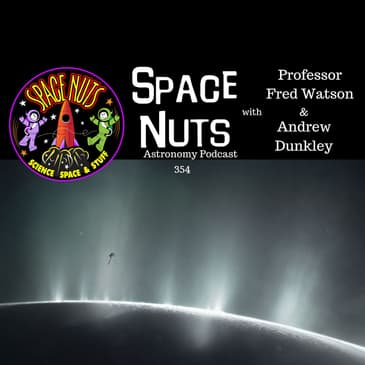
In this episode of Space Nuts, we take a look at the geysers on Enceladus. The James Webb Space Telescope has had another look at them after they've been previously seen elsewhere, and they've found out a bit more about them. And it's amazing. Also, a star that may not be a normal star. This one could be a dark matter star as a matter of fact. We get stuck into that. And we follow up on a couple of things that came up in the last program. And we will be looking at a white dwarf age issue, according to Rusty. And Jeff is asking about what the view would be like from inside a black hole, if we could possibly get inside one. Tunnel vision at the very least, I imagine. That's all coming up in this edition of Space Nuts. Astronomy, Science, Space, and Stuff. Space Nuts Episode 354 with Professor Fred Watson & Andrew Dunkley Download from your favorite podcast distributor or visit our website at www.spacenuts.io For more Space Nuts, visit our websites. Links: https://linktr.ee/biteszHQ New: Listen to Space Nuts on your favorite app with the Universal listen link: https://spacenutspodcast.com/listen
Take Andrew's advice and join us on LinkedIn via our HQ: https://www.linkedin.com/company/bitesz/
#space #astronomy #science #news #podcast #spacenuts
Become a supporter of this podcast: https://www.spreaker.com/podcast/space-nuts-astronomy-insights-cosmic-discoveries--2631155/support.
[00:00:00] Hello again, thanks for joining us. This is Space Nuts. I'm your host, Andrew Dunkley. It's always good to have your company and I hope you're well. Coming up on today's program we'll be looking at
[00:00:10] geysers on Enceladus. The James Webb Space Telescope has had another look at them after they've been previously seen elsewhere and they've found out a bit more about them and it's pretty
[00:00:21] amazing. Also a star that may not be a normal star, this one could be a dark matter star as a matter of fact. We'll get stuck into that. We'll follow up a couple of things that came up in the last program,
[00:00:36] just some questions that needed to be investigated further and we will be looking at a white dwarf age issue according to Rusty. We talked recently about Saturn's ring rain, David wants to bring
[00:00:51] that one up again as well as his lunch and Jeff is asking about what the view would be like from a black hole if we could possibly get inside one. Would be tunnel vision at the very least I imagine.
[00:01:04] That's all coming up on this edition of Space Nuts. And joining me once again is his good self Professor Fred Watson, astronomer at large. Hello Fred. Hello Andrew, how are you? I am quite well. Back to work this week, back to normal,
[00:01:37] back to business, back to everything that I had forgotten how to do after a month off. Yep, that's what happens isn't it? Does indeed. Come back and it's all still there. Yeah, yeah.
[00:01:52] Well maybe that's better than it all not being there at all. Indeed yes, it's good to have good people that can back us up, that always makes a big difference so you come back and you go well
[00:02:03] that's a relief, nothing's broken, nothing's missing, nothing's wrong. So it's always nice when you can rely on people and that's what we've got. Good to hear. And yeah, plenty of things to talk about so let's get stuck into it straight away. And this first story I find really
[00:02:22] exciting because there's a lot of attention being paid to Enceladus for all sorts of reasons, notwithstanding the potential for life, but these incredible geysers that have been recorded previously have been seen again, this time by the James Webb Space Telescope.
[00:02:39] Yeah, so this is really quite exciting news and it highlights once again the capabilities of the James Webb Telescope as a tool for science that sort of par excellence. The observations have been made of Saturn's moon Enceladus. Now we haven't yet seen those observations,
[00:03:02] so I haven't seen any images and that's probably partly because the research paper that's describing this work is still pending. So it hasn't yet appeared in the scientific press and I guess the people who are responsible for it are essentially keeping their powder dry to
[00:03:26] basically stop the media getting hold of it before they've actually published it. Yeah, that happens. Which does happen and you know that as a media person. I've never done it myself. Gosh, never break an embargo.
[00:03:47] Break an embargo, no. And I have to say I haven't either because I get all these things that are embargoed and I too don't break them just because it's the wrong thing to do. So yes,
[00:03:58] I think that's what's happening there. But this is scientists at the Goddard Space Flight Center who have presented these results actually at a conference in the Space Telescope Science Institute
[00:04:11] which is in Baltimore, a place I visited a long time ago. So going back to the matter in hand, Saturn's moon Enceladus, we've known since the flybys of the Cassini spacecraft in the early
[00:04:26] 2000s. I think it was as early as 2005 that the ice plumes being emitted from Enceladus' South Pole have been discovered then. In fact, what first hit the headlines, I don't know whether you remember
[00:04:43] this because I'm sure you and I talked about it, but there were these things near the South Pole of Enceladus which were markings that were described as tiger stripes because they do look a bit like
[00:04:54] tiger stripes. And then it was discovered that there were actually cracks through which what probably started off as water but as soon as it hit the vacuum of space became ice crystals and that's what were being observed by the Cassini spacecraft. And in fact,
[00:05:11] Cassini made several passes through those ice crystals so that using the equipment that it had on board, it could detect some of the chemicals that were in them, principally H2O, so water there,
[00:05:24] but also molecular hydrogen and I think some silicates as well were detected which tended to give you the insight that the water that was underneath the ice had been in contact with rock
[00:05:41] before it was spat out to form the ice crystals. And the molecular hydrogen was interpreted as being possibly symptomatic of the fact that there were these deep... Wait, it'll come to me in a minute. The black smokers, that's the expression I was looking for
[00:06:05] down on the floor of Enceladus' ocean, the sub-ice ocean that there were basically hydrothermal vents in the ocean floor. So that was all very exciting but of course with Cassini's mission coming to an
[00:06:19] end in 2017, all that stopped and so further research was not possible until now when the James Webb telescope has been directed at Enceladus and they've kind of hit payday because they've discovered an ice plume that is far bigger than any of the ones that were observed by Enceladus
[00:06:40] and that sort of makes you wonder why that might be. Is there one of the cracks, one of the tiger stripes has opened up a bit to allow more water through or is it something to do with the
[00:06:51] gravitational pull of Saturn? What's happening here? And so that's one of the things that is being studied at the moment. Apparently this ice plume extended quite a lot further than the diameter of Enceladus itself which is 500 kilometers. Yeah, that's one of the things they've
[00:07:08] discovered as a consequence of this observation is how big these geysers are. Yeah and I remember from that time an image of Enceladus which was taken when Enceladus was backlit. So the sun was
[00:07:29] behind Enceladus but you could see that the plumes of stuff that were coming off Enceladus were actually feeding into Saturn's E-ring. The E-ring is one of the diffuse rings outside the main ring
[00:07:45] system and that was great because that answered the puzzle of where the E-ring came from. It actually comes from ice crystals that are generated by Enceladus. So all that's sort of backstory but now we have these new observations and in principle we've got a new way of investigating
[00:08:05] these things because the James Webb is equipped with very sensitive infrared detectors, spectrometers and things of that sort. It's possible that we might get some new insights into what chemical elements and perhaps even molecules are contained within those ice plumes.
[00:08:24] Although I think the bottom line really in the end is going to be sending a spacecraft to Enceladus. Just going back to what we knew these jets contained, we've got quite a big list in addition
[00:08:45] to the ones that I mentioned earlier. Methane, carbon dioxide and ammonia. These are of course all organic molecules containing carbon. And Babel fish. Probably Babel fish as well, yes. If you need to translate from one language to another. Anyway, it might be even more exciting
[00:09:09] than Babel fish if anything like that could be possible because that methane could turn out to be from methanogenic organisms. We don't know that but all of this still highlights Enceladus as a fantastic target for further exploration. A couple of things come to mind there.
[00:09:31] A mission which is proposed called the Enceladus Orbilander and that name tells you what it's going to do. It will orbit the moon if this goes ahead for about six months and actually flying
[00:09:45] through those ice plumes and then land and look at the exact details of the surface. It probably would not try and penetrate the ice though. That's the province of one that you and I have spoken
[00:10:03] about before. Something called EEL which is a bit like an eel, something called a snake robot. EEL is an acronym for Exobiology Extant Life Surveyor or EELS actually. One of the brains,
[00:10:19] one of the principal boffins behind that is Linda Spilker who was with us a few years ago to give the Alison Levick lecture. Linda Spilker being the Cassini mission scientist. Very, very well
[00:10:36] equipped to propose new missions and I think EELS was one of the ones she was involved with. Yeah if that doesn't work of course the backup mission is the Black & Decker mission. Yes, that's right or if you really need it the JCB or the Caterpillar mission with
[00:10:56] the heavy lifting stuff. Or the Ryobi mission, any of those that can drill. Yeah, that's right. If you guys are going to go with Ryobi you only need one set of batteries. That's right.
[00:11:10] Yeah, I actually had a Ryobi leaf blower and the leaf blower died before the battery did. Oh, yes, interesting. It is, isn't it? Quite surprising. Ours is still very much alive but being tall after all the cardboard tube on the end to extend
[00:11:27] it down to blow away the leaves. Anyway, that's a different story. It is indeed. I must say whoever thought of Enceladus or Belanda, I mean, come on, couldn't they come up with something better than that?
[00:11:41] I think in the end it would have a nicer name. But yeah, like you, I'm finding this really exciting that the Webb telescope now can turn its very substantial capabilities onto a moon like Enceladus. Certainly nowhere near the same resolution as we had from the Cassini mission,
[00:12:01] but lots to find out nevertheless. Yes, and there's so much attention being paid to Enceladus and its similar cousin of Jupiter, which is, I'm stretching to remember the name of it. Hang on, hang on. Beginning with T? Yes. T-I? No. No. Texas Instruments. No, T-I is Titan.
[00:12:26] I wasn't thinking of that. I was thinking of the other ice. Well, Titan's definitely an ice moon, but it's another notion. I mean, the other ice moons that we really know a lot about are Europa, Ganymede, Callisto, yes, around Jupiter. All prime candidates for potential life. Yeah, exactly.
[00:12:48] What kind of life we don't know, but if we can get up there and find it and study it and see what it's made up of and whether or not it's the same stuff as us, that would be really interesting.
[00:13:01] Exactly, because if we found life there, living organisms there, it would suggest that wherever you've got the raw materials for life and the right environment, you're going to guess it. And it would change the answer to the Drake equation. That's correct. It would. It would indeed.
[00:13:19] We're all hoping for that. The Drake equation, though, well, it certainly puts one further input into the Drake equation. It doesn't give you the answer because that's all about intelligent life. It would be astonishing, though, if we found vertebrates or something with some kind of intelligence.
[00:13:39] I keep saying it. I keep saying it. Krill. Krill. That's right. Hyper intellectual krill. Hype is. I'm sure they're out there somewhere. All right. If you want to follow up this story, as Fred said, they haven't released the data yet,
[00:13:56] but I'm sure it will come to a website near you in the not too distant future. This week's episode of Space Nuts is brought to you by Curiosity Stream, which is a great place to find and watch documentaries covering all sorts of topics,
[00:14:14] science, history, technology, nature, travel, and so much more. I personally love watching science and astronomy documentaries, but I also have a very keen interest in conflict, particularly the First World War, and I logged in the other day just
[00:14:33] to test the service out and instantly found a fabulous World War One documentary series, which I am working my way through at the moment. And I must confess, it's just so great to be able to go to one place that covers
[00:14:50] all the topics I love. I think I'm really going to get a heck of a lot out of this. And you can too, because it's as easy as logging on as a Space Nuts listener and signing up for Curiosity Stream. All these documentaries in the same place.
[00:15:07] It's really easy. You can do it through your TV, through all those services, Roku, Xbox, smart TVs, as I said, Apple TV, Amazon Fire, and so many more. It's available globally, so it doesn't matter where you are. You can take advantage of Curiosity Stream
[00:15:26] and all those incredible topics, and they add new shows every week. Now as a Space Nuts listener, there is a special offer to you. If you sign up now through this special URL, you'll get 25% off. Curiositystream.com slash Space Nuts for unlimited access to the
[00:15:48] world's top docos and non-fiction series as a Space Nuts listener. And the promo code, by the way, is Space Nuts. So click on the link, curiositystream.com slash Space Nuts. Use the promo code Space Nuts for a saving of 25% right now with our sponsor, CuriosityStream.
[00:16:10] Okay, we checked all four systems and in with the go. Space Nuts. Now Fred, to another matter, that of dark matter, we get so many questions about this, so many questions about black holes. Anything that's got darkness involved is obviously of
[00:16:25] great interest in the astronomical world and to the layman too. But this is a really interesting story about a star system that they've known about for a while, but now a couple of astronomers
[00:16:38] or space scientists are saying, hang on a minute, this might not be what you think it is. This could be a dark matter star. Indeed, that's right. So let's do the backstory. This comes about from observations made by Gaia,
[00:16:59] which is an astrometric spacecraft. So Gaia is basically something that measures with incredible accuracy the positions of stars in the sky. In other words, their right ascension and declination, the equivalent of latitude and longitude on earth. And this Gaia system is so accurate
[00:17:23] that it basically allows us not just to measure the positions of stars, but to measure their positions changing over time. And so you can basically look for the motion of stars. For example, if a star is orbiting something else, you will see that motion from the measurements
[00:17:44] made by Gaia. And that's what's happened here in that a star, which is nearly the same mass as the sun, it is a sun-like star. So it's something like 93% of the mass of the sun, but also has similar
[00:18:01] chemical properties to the sun. So it's got similar, what we call metallicities, the amount of material other than hydrogen that's in its atmosphere. And you can determine that from the spectrum of the star. But the Gaia measurements revealed that it's actually orbiting something
[00:18:19] else, which is invisible. And you can look at the analysis of the orbit and you can work out that it's the thing that the star is orbiting is around 11 times the mass of the sun.
[00:18:34] And the star orbits that at something like the distance that Mars is from our sun. So it's an interesting scenario. And I guess the first thing that you would think of is that it's a black hole, because 11 solar masses is kind of in the regime that
[00:18:55] the black holes fit. It would be a quiescent black hole. And that's to say one that is not gobbling up gas and dust in its surroundings and causing that to form an accretion disc,
[00:19:10] which emits light and x-rays and things of that sort. So it's a black hole that would not be revealed by anything other than something going around it. But there is a problem with that.
[00:19:22] And it's because a sun-like star, which probably would be typically about the same age as our sun, four and a half billion years, would in order to have survived that long, would be unlikely to have been in the vicinity either of the black hole or of its predecessor.
[00:19:48] So the thinking is that this black hole would have come from a massive star that collapsed at the end of its life, formed a supernova, which in itself might get rid of the sun-like star,
[00:20:03] that then continued to exist as a black hole. And the problem is it seems that you need to really tinker around with the parameters to make this possibility work. And so the authors of this
[00:20:17] work have suggested that this is so unlikely that maybe there is a different explanation. And what they have suggested is that this is something called a boson star. Now bosons are the force carriers like photons. The electromagnetic force is carried by a boson
[00:20:41] called a photon. And there's something known as the Higgs boson, which we all know about. Other bosons include the strong and weak nuclear forces there, two other sorts. So a star that's
[00:20:54] made of these things is an exotic sort of star. But what they're suggesting is that this is a kind of boson that's not already known. In other words, it's not made of photons because that would be light. It's something else. And the best candidate for what they're hypothesizing
[00:21:17] is probably something called an axion, which is a candidate for dark matter. So they're suggesting that this is just a clump of dark matter particles, which are not switched on into a star because they
[00:21:30] don't do that. But it's massive enough that we've got this other star going around it. It's rather an interesting paper. I actually had a look at the... Let me see if I can find
[00:21:50] the paper again. Just here we are. It is... The paper is called... Come on, where are you? Here you are. We're going well today. That's why I know I am, yeah. We're doing it all on the fly.
[00:22:04] Sorry to our listeners and viewers. This is the reality of space nuts. The paper is called A Sun Like Star Orbiting a Boson Star. Okay. And let me just read it because it actually is written in
[00:22:19] plain English, which actually tells it like it is. The high precision astrometric mission Gaia recently reported the remarkable discovery of a sun-like star closely orbiting a dark object. While the plausible explanation for the central dark object is a black hole,
[00:22:36] the evolutionary mechanism leading to the formation of such a two-body system is highly challenging. That's kind of what I just said, but perhaps more succinctly. Here we challenge the scenario of a central black hole and show that the observed orbital dynamics can be explained
[00:22:52] under fairly general assumptions if the central dark object is a stable clump of bosonic particles of spin zero or spin one known as a boson star. Work that one out. We further explain how future astrometric measurements of similar systems will provide an exciting opportunity to probe the
[00:23:14] fundamental nature of compact objects and test compact alternatives to black holes. In other words, they're throwing the gauntlet out there. They're saying, well maybe all the objects that we think are black holes aren't. They're just piles of dark matter particles and not black
[00:23:30] holes at all. Yeah, I mean I believe that their research is yet to be peer-reviewed. Is that right? That's correct. Yeah, and they're throwing it open for further study. And I think they even say it's unlikely that this actually is a boson star and they're urging follow-up
[00:23:49] observations. So yeah, they're just basically saying look this is what we've found. This is what we think it could be but it could be something else and we really need to take a closer look at this. Exactly so. That's exactly right. So yeah, just something that needs
[00:24:11] further explanation. And the work was done by two researchers, Dr. Pombo and Dr. Soltust. And I'm not sure where they are but they have Greek names so that's a clue. They could be in Melbourne if that's
[00:24:29] the case. That's also true. Hang on, let's check. Well Melbourne is the biggest Greek city outside of Greece in the world. It is, that's correct. Yes, absolutely right. And I have enjoyed Greek food
[00:24:41] in Melbourne from a genuine family Greek restaurant. So it was genuine Greek food. It was damn nice too. Excellent. It's good to know because that's kind of sort of what you need
[00:24:56] to know when you go traveling. Yes. One thing that's popped into my head about this is we've talked in the past about how dark matter is probably not well named and dark energy has even
[00:25:11] got a worse name because it's not that. Are we walking down that path again by calling this a dark matter star? Because it's not a star. Yes, that's right. It's a clump. Yeah, so it's a
[00:25:24] dark matter. You could almost call it a dark matter nebula because nebulae are sort of clouds of gas. Very, yes, very interesting terminology there. Maybe it's the equivalent of a dark matter star. So what is it? It's a dark matter lump or something. A dark matter blob. Yeah,
[00:25:51] a dark matter blob, that could be it. These two researchers by the way are at the Czech Academy of Sciences, so I was wrong there. Oh yeah. Well, so was I. Not in Melbourne.
[00:26:04] Not in Melbourne, that's right. Okay, so this is a bit of a new idea and a new concept and it's certainly a bit of a curve ball in the scheme of things. So from your perspective as somebody who's been in the industry for so long,
[00:26:23] what happens now? They've thrown this one out there. Is someone going to take the bait and maybe come up with an alternative theory or what? Yes, very likely. I mean in this particular case,
[00:26:39] what you've got is a sample of one, something that doesn't look as though it's going to be a black hole but it's something else. I think what will happen is that people will
[00:26:51] maybe troll through the Gaia data with a bit more of a background in looking for this kind of object and dig up more of these normal stars orbiting dark spaces. It has happened before. You and I have
[00:27:06] in fact spoken about people finding black holes because of the orbits of the objects around them, but it's usually been fairly unequivocal that it's a black hole and it's not a kind of normal sun-like star that's orbiting around it. In fact, I think we talked about the dark,
[00:27:22] what was it? The black hole police, I think they were called. These people who tried to debunk the idea that all these things are black holes. So yes, there'll be more observations, hopefully more examples dug up and a lot of thinking by the theoretical astronomers who
[00:27:40] will try and make it all work in terms of what the realistic scenarios are. Yes, very interesting to watch and hopefully we'll have more on that in the not too distant
[00:27:50] future. If you want to find out more about it in the meantime, you'll easily find it on the web at the livescience.com website or space.com. This is Space Nuts with Andrew Dunkley and Professor Fred Watson. Space Nuts.
[00:28:10] Okay Fred, before we get stuck into questions for this week, some follow-up. Ross asked us last week about the brightest of all time in terms of an explosion and I was a bit off track with what
[00:28:23] I thought he was talking about, but you've got some more information on the boat. Yes, the boat. So we got confused as you would do with two acronyms with different meanings, the boat meaning the brightest of all time and the boat meaning the biggest of all time.
[00:28:44] What we talked about last week was the biggest of all time, whereas the brightest of all time turns out to be a gamma ray burst which was detected last year and has copious amounts of energy. It is
[00:28:57] the brightest of all time. I think it might have been Ross rather than Ross, I'm not sure. But Ross's question was he had heard that there may be insights into new physics coming from what
[00:29:12] needs to be explained there. That essentially is confirmed by my reading of the situation that the amount of energy that's involved, even if you allow for the fact that this gamma ray burst is formed by a burst of energy that's directed towards Earth and it is highly collimated,
[00:29:33] that means it's a very parallel beam of radiation that you're seeing. To form that, there is difficulty in accounting for that observation with what we know about physics as it stands. But you can bet your life that somebody will. The theoretical astronomers
[00:29:54] will get their brains around it and say, oh yeah, we should have expected this but we didn't. Well I think when it comes to astronomy always expect the unexpected. Indeed, that's exactly right. Especially when you're doing podcasts like this one because it's always something unexpected.
[00:30:15] Okay Ross, so watch this space again is what we're saying. Clyde was asking about dark matter black holes. Was he asking whether or not they could exist? He was, that's right. It's interesting considering we just talked about a dark matter bomb.
[00:30:33] Yes, that's right. So it's a nice segue from that which we completely failed to make but never mind. So that was my fault. Clyde asked whether you could have dark matter black holes and I sort
[00:30:45] of waffled about this to say yes, it's possibly true because the driving force behind a black hole is gravity and dark matter experiences gravity. But there are issues and it's all to
[00:31:01] do with the way that we know black holes are formed either by an exploding star of one sort or another or just a direct collapse of a cloud of gas. It turns out that in order to make the black
[00:31:16] hole, you have to have interactions between particles. In particular, you have to have things like friction, things like electromagnetic phenomena in order to make that collapse take place. The dark matter particles, whatever they are, do not have that. They don't have
[00:31:38] any other interaction. They only interact gravitationally. And so the thinking is that there would be no such thing as a dark matter black hole. Which surprised me too. Until someone proves there is one. Exactly. Somebody's sure to come along.
[00:31:58] Yes, all right. There you go, Clyde. Hopefully that gives you just a fraction more information but it's a bit of a work in progress. Let's go to our questions and I just want to say thanks
[00:32:12] to Rusty, one of our regulars from Donnybrook in Western Australia for sending me this Scorpio pic. He took a photo of the constellation Scorpio the other day and sent it through. It looks rather spectacular. Must have some great sky in Donnybrook. How's Rusty?
[00:32:30] They must have. The constellation is Scorpios. All right. Yes, Scorpio is what the astrologist took. Oh, of course. Sorry about that. Yes, I know how you feel about that. But this is not about
[00:32:42] Scorpios. This is about white dwarf stars. But he's taking it a bit further, Fred, and he's questioning astronomers all over the world with this one. Hi, Fred and Andrew. It's Rusty in Donnybrook and I have a curly one for you regarding
[00:32:58] white dwarfs. We've recently discovered a couple in the Milky Way that are 9 and 10 billion years old and they're not the oldest. They have found one in another galaxy 11 and a half billion years old. Its mass is around about 0.55 or 55% of the sun's mass.
[00:33:20] And the sun is expected to lose some mass and when it becomes a white dwarf in another 5 billion years, be 53% of its current mass. Now, the sun is a 10 billion year life in the main sequence
[00:33:40] before becoming a white dwarf. And these white dwarfs are around 10 billion years old. That means that the universe must be at least 20 billion years old. Would you care to explain why that wouldn't be the case? Rusty, stirring the pot, my friend.
[00:34:01] Stirring the pot, that's right. Well, the universe can't be 20 billion years old because everything we know about it says it's 13.8 billion years old and that's a very self-consistent picture. So there's something wrong with the interpretation there. And my guess is,
[00:34:21] and I don't really know enough about the evolution of normal stars of various masses. I should do, actually, because that's one of the fields that I've specialized in, but I will check up on this.
[00:34:37] But there must be quicker ways of producing a white dwarf than just doing what the sun will do to produce its white dwarf, which Rusty's right. It will be about half a solar mass thereabouts
[00:34:52] when it's finished blowing off its outer layers. So white dwarfs, I should have explained, the end product of normal stellar evolution, a star, when it runs out of hydrogen fuel, goes through various what we call old age phenomena, but eventually ends up with the
[00:35:12] former nucleus of the star or the core of the star becoming a white dwarf, which is electron degenerate. It's only the electrons that are stopping it from collapsing further into a neutron star or a black hole. And the interesting thing about white dwarfs is that
[00:35:28] we have an upper limit for their mass beyond which they explode. And that's why we know the brightness of type 1a supernovae, because they are exploding white dwarfs at a mass of 1.4 times the
[00:35:40] mass of the sun, which they attain by accreting other stuff. That's the higher mass end of white dwarfs. We're talking about the low mass end of white dwarfs. And Rusty, I will indeed follow up
[00:35:52] on your question to find out what the mechanisms are for forming these low mass white dwarfs and whether we can do it in maybe a couple of billion years rather than 10 billion years. I'll put an asterisk next to Rusty because that's another follow-up we've got to do.
[00:36:09] Well, we've got a good track record on follow-ups for the last week. Yes. For the last six years, I doubt. Two out of two. Well, two out of a hundred for the last six years. Two out of two for the last week.
[00:36:23] Indeed. Thank you, Rusty. So we'll get back to you on that one. Let's go to David now who's got another focus on Saturn. Saturn's been big news the last couple of weeks. G'day Fred, Andrew. David here from Queensland. Just a quick question, may have a quick answer
[00:36:41] listening to the podcast regarding Saturn and the ring rain falling to the planet. Fred obviously mentioned, as we know, the planet is the most oblate. Perhaps it is the deposition of material from the ring rain increasing the equator or is it just a factor
[00:37:02] of its gravitational spin? Thanks very much. Love the show. See you guys. See you, David. Thank you. All right. There's a theory. Yeah, it's a great suggestion, David. But I think to quote the time-honoured phrase, I think you'll find... It's so polite, isn't it?
[00:37:25] It's when people are being pedantic. I think you'll find, no, that wasn't written in 1741. It was 1745. Anyway, I think you'll find that the mass of the rings, even if you pile the whole
[00:37:44] of the ring system onto Saturn's equator, it won't make any difference to the oblateness of the planet because the amount of material in it is very, very small compared with the mass of the planet. So Saturn's oblateness, which is explained just by normal physics, the physics of rotating
[00:38:04] bodies, is due to Saturn's rapid rotation speed and probably things like its density as well. Because you can get things that rotate faster but don't go quite as oblate. So the oblateness is the swelling around the waist, the fact that the globe is slightly flattened.
[00:38:28] Actually, all the planets are oblate, the Earth included. If you look at the numbers, it might surprise people. Yeah, yeah. It's definitely tens of kilometres, isn't it? Yeah, it is. It's quite a bit.
[00:38:44] Quite a lot. So I think the answer is, it's a nice suggestion, but we think that is probably not enough to make any difference to the oblateness of Saturn. Okay. There you go, David. Simple. You did think it would be an easy answer, quick answer.
[00:39:02] So yeah, he got that right. The question is, did I? Yeah. Well, it's astronomy, so who knows? Who knows? And finally, we're going to hear from Jeff, who's got a what-if question for us. Hi, this is Jeff from Los Angeles. I have a question for you guys.
[00:39:28] If it was possible to go into a black hole and survive that, go beyond the event horizon, and I know it's not possible, but if it was possible and one were to look back on the universe, what would they see? Oh, that's a good question.
[00:39:50] Oh, he caught me off guard. He's finished. Yes, Jeff. Thank you. Sorry, Jeff. Sorry, Andrew. Yeah. Well, my thinking is nothing, but I don't know. Putting spaghettification aside or linguini-ization, as some people have decided it should be. Yeah.
[00:40:10] Let's just assume for a moment you remain intact, you go into the black hole and you want to look out. Well, nothing escapes a black hole, so I don't... Yeah, it's hard to answer the question. But stuff goes into a black hole.
[00:40:24] Yeah. So photons can go into a black hole. But I think you're right though. I think it's dark inside a black hole. Sorry, not inside a black hole, but within the event horizon.
[00:40:38] Because the fact that stuff is definitely crossing that boundary to be gobbled up by the black hole and photons must as well. What the viewpoint from within the black hole itself is, is something that I think is dark. And I think it's because basically, the photons themselves
[00:41:09] are swallowed up by the black hole because nothing can exceed the speed of light. I'm actually... My logic here is a little bit sus because I'm thinking in vague circles, but I might I might give some more sober thoughts to this. Another follow up.
[00:41:27] But yeah, I'll follow it up. But my guess is... We're going to do a whole show of follow ups in a few weeks. Yeah. Well, that's right. We could do that. I think inside the black hole is dark. Yeah. But I'll need to check the physics of that.
[00:41:41] Unless you take a torch or a flashlight if you're in America. No, no. You switch your flashlight on and all the photons immediately get sucked into the black hole. As well as your flashlight and you, by the way. Now, I said we weren't going there. You're remaining intact.
[00:41:59] Yes. But yes, you couldn't use a flashlight or a torch in a black hole because the light would... Gone. Yeah, not a very coherent answer, Geoff. I apologise for that. But watch this space because we're getting really good at following up.
[00:42:17] Yes. Yes. There's another two we've got to do for next week. That's good. Could be a whole new segment this week on follow up with Fred. All right. That exhausts this week's questions, but don't forget if you have questions for us,
[00:42:34] send them through via our website, spacenutspodcast.com or spacenuts.io. And just click on the AMA link at the top of the page and you can send us a text or audio
[00:42:45] question there or you can click on the link on the right hand side of the homepage. As long as you've got a device with a microphone, you are set and don't forget to tell us who you are and
[00:42:56] where you're from. And I will remind social media users, particularly those who use LinkedIn, which I called Linkerdin for many years before someone told me, what are you talking about? LinkedIn? I never put it together, Fred. Honestly, I looked at it over and over and I thought,
[00:43:13] what is this Linkerdin thing? True story. Ages before I finally got it right. LinkedIn. We're on LinkedIn these days. If you would like to follow us on LinkedIn, just do a search for bytes.com, that's our parent organization, bytes.com and we need 150 followers. And once we get 150
[00:43:38] followers on LinkedIn, we will be able to stream live, which we want to do. We're doing it on as many platforms as possible. So LinkedIn is one we want to add to our repertoire. So that's
[00:43:50] where we are at with our social media, as well as Facebook and Twitter and Instagram and some others. One others? One others. That's good, isn't it? One or two others. But yes, LinkedIn, if you're a LinkedIn user, check us out, bytes.com. Fred, we have-
[00:44:09] So go on, sorry. A suggestion for our follow up, the name of our follow up segment, Space Nuts, the questions they dare not answer. That could work. It could work, couldn't it? It could work. Very welcome.
[00:44:27] Sorry, Andrew, you were about to wrap up. That's okay. Fred, we've reached the end of the show. Thank you so much. It's a pleasure, always a pleasure, especially when things keep going as
[00:44:37] they have done for the last five minutes. Well, when you've got to reach a certain time frame, you do a radio trick. It's just called stretching out. The keeping going I was referring to was the technology, Andrew. You see, it's gone so well, you've forgotten. Oh, yes.
[00:44:57] Yes. I just didn't want to dare hex us with another dropout. I've probably done it already. Yeah, maybe so. All right. Thank you, Fred. We'll catch you next week. Sounds great. Fred Watson, astronomer at large, part of the team here at Space Nuts. And thanks
[00:45:14] to Hugh in the studio for reasons I cannot explain, but thanks anyway. And from me, Andrew Dunkley, always a pleasure. Thanks for joining us. We'll catch you on the very next episode. Bye-bye. Space Nuts. You've been listening to the Space Nuts podcast.
[00:45:30] Available at Apple Podcasts, Google Podcasts, Spotify, iHeartRadio or your favorite podcast player. You can also stream on demand at bytes.com. This has been another quality podcast production from bytes.com.