
00:01:30 Launch of Boeing Starliner scheduled for Friday has been scrubbed
00:04:47 Andrew Webb: There's a lot of interest in the moon right now
00:10:41 A valley in Norway has a mirror that doesn't see the sun
00:14:56 Andrew Dunkley: Hipie is the high precision polarimetric instrument
00:20:45 Polarising sunglasses can detect rainbows with incredibly high precision
00:25:40 Fred Geyer explores the use of satellites to predict crop yieldsSupport Space Nuts and join us on this interstellar voyage by visiting https://www.spreaker.com/podcast/space-nuts--2631155/support. Don't miss out on future episodes as we continue to decode the universe's grandest puzzles. Clear skies and bold questions await on Space Nuts, where we make the cosmos your backyard.
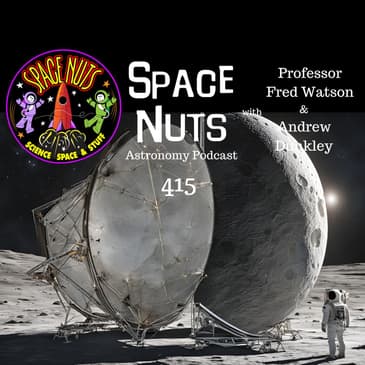
Hello again, thank you for joining us. This is Space Nuts, the podcast about astronomy and space science. My name, my name is I forget. My name is Andrew Dunkley, your host. It's good to have your company. Coming up on today's edition, We've got quite a few things to talk about. The the ups and downs, or certainly not ups of the Boeing star Liner. We'll have a quick chat about that. Lighting up the Moon with reflectors is on the agenda. And using satellites to predict crop yields. Yes, they looked down from space and go, oh that looks crop. And we're going to look at a special special anniversary with Professor Fred Watson. All coming up on this edition of Space Nuts fifteen in Channel ten nine ignition Space Nuts NI or three two Space Nuts as when I report it. Bill's good and here he is the man of the Millie second Professor Fred Wat's an astronomer A large Hello, Fred, I love Andrew. That was a pretty croppy introduction you did there. Yes, I have to agree with you. Most of my introductions are here. You been all well? Well, thank you all good? Still still it's got strong still a stronger at larging. Yes, no, fair enough all right, let's let's get started. I want to talk about the Boeing star Liner because they were I've been reading stories about it for the last week or so. They were so ramped up after years of delays, we were finally going to get it off the ground, and ah, it slipped on a banana. I don't know what happened, but it's it looks like another delay. It was, Yes, so the crew of two this was going to be the first crew mission of the star Liner, and it was going to wind up at the International Space Station and probably come back from there as well. And the launch was set for Friday our time. I think I'm right in saying that I can't remember. I get so many tag your word for it launch dates in my mind. You know, these days you can look forward to a launch pretty well every day. Anyway, it was recently. Maybe it wasn't Friday. I think that might have been Changese six at launched on Friday, which was also successful. The star Liner, however, I think they got to within two hours of liftoff. Might be exaggerating there, and there was a sort of vibrating valve I think on the rocket itself rather than the star Liner, which caused the launch not just to be paused, but to be scrubbed. That was the official term term scrub, and in fact you can find online you can find the dialogue between mission control and the two astronauts in the capsule where I've actually got it Houston beep beep thing something like that. I think that I mean Houston or it's equivalent. In twentieth first centuries, speak said we're scrubbing the launch, and you could tell, you know, just the it was Roger. Yeah, it wasn't Roger. It was Roger Roger, I think the laster. Yeah, that's I mean the you know, I think they'd be happy to scrub anything that was imparting a risk to the launch, So I think you'd be happy with that. But yes, the disappointment when you're all you're basically keyed up, because you know, within a matter of ours, if not less, you're you're going to be docking at the International Space Station. The last I heard was that it's scrubbed for at least ten days, and in fact, I've just saw some photos this morning of the the assembly basically the rocket booster with the star Liner on top being moved back to the kind of servicing bay that they've got there, something a bit like that, you know, vehicle assembly building that there is at Pad thirty nine. Anyway, so it's scrubbed for a while, so hopefully we will catch up with better news soon. It was pretty exciting. It will be you know, Bowing's first CREWD mission to space. Yes, well, I'm sure it will happen. But as we've said many times in the past, safety first, so they're just being ultra careful, and who can blame them for that? All right, let's move on to the Moon. To the Moon and back. This is a really interesting story because we're looking there's so much interest in the Moon. We've got a lot of missions either there or on their way there, and they're not too distant. Future human missions coming up soon. I know China is looking at putting a base there, whether it's on the surface or in orbit, a research base of some kind, and it's just going to get bigger and bigger. And the Moon's got a lot of attention because well, it's got resources there that people want. But when you get there and set up bases and have people there long term, there are challenges, and one of those is light that's a problem. It is, and yes, you know, you're absolutely right. The South Pole in particular, which is a very heavily created region of the Moon's surface, is attracting international attention because we have evidence from a number of spacecraft, actually notably an Indian one Chandra Yara think it was called, which the evidence supports the notion that there is water ice on the floor of these craters, because being at the south pole of the Moon, the creaters themselves never see the sun overhead or anything like overhead. It's always at an angle low down in the sky, and in most cases so low that it never rises above the walls of these creators, and so sorry the craters. And so the floor of the crater is basically yes, it's got ice on it, which may have been there for millions, perhaps billions of years, but that ice is basically unobtainable because there's no sunlight, so you can't melt it, nor can you use electrical power to decompose it into hydrogen and oxygen, which is what everybody is keen on doing. It gives you a free supply of oxygen to breathe and hydrogen plus oxygen to make rocket fuel. So that's why there's so much interest in the ice in these creators is a potential resource for future exploration of not just the Moon, but the Solar system generally. So there's the problem. Power especially is a problem because these never see the Sun. And that sort of thinking has led a group of scientists somewhat sextas A and M University, some at NASA Langley Research Center to think about how you deal with this, and they have basically done the obvious. They've said, well, why can't we reflect the light of the Sun down into the crater? So you focus it onto the solar panels and you've got a mirror near the near the rim of the crater. So that's the plan the research, which is still apparently in quite an early stage. What they've done, though, is to use fairly sophisticated modeling systems computer models to show what will be the best kind of surface and the best sorts of materials as well to use. And it's no surprise that a parabolic shape comes out as being the optimal. That's because paraboloid focus is light. That's what many telescope mirrors are made of. Paraboidal mirror that focuses the starlight onto it to make an image, which you then magnify it with an eyepiece. So what you do with your mirror is steer it so it's always basically pointing at the sun in such a way that it reflects the light down to your solar panels, and have it on a mountain that will track the Sun as it goes around the sky. Now, the other thing that I think is new about this is well two things here. One of the problems is you want to make your mirror as big as possible in order to collect as much sunlight as possible. But reflectors are not very easy to fold up into the cargo bay of a spacecraft, or at least you know its cargo pod in the nose of the spacecraft, and so you need something that will fold up. Now we've encountered this problem before Andrew In a well known thing called the James Web telescope, which was indeed folded up because it was made of sixteen, sorry eighteen hexagonal segments that could be folded away. What they think of for this, though, because the optical sing optical surfacing requirements to nowhere near astringent. What they're thinking about is using new materials, and in particular something which is called a self morphing material, which has actually been developed texas A and M. So what you do is you have what they call shape memory materials and change the shape in response to changes in temperature. And you'd certainly get a change in temperature when you go at the south pool of the Moon, because the temperature when the sun's not there drops to about minus one hundred and fifty. When the sun's there, it's about plus one hundred and fifty, And so I think there's a bit of give and take in those levels, but it's that sort of order. So shape morephing materials that will kind of basically pop into the right shape when the sun gets on them are a nice idea. And maybe this is a way to the future for the south pole of the Moon. Maybe are you ready for this one? Gat to me on reflection, that's a good idea. You should be on the radio. Oh God, no, thanks? How much? Lie? Are we talking about generating? Here? A mirrorsworth? I guess? And there is a comparison, Andrew, and I've forgotten the name of the place, but there is a valley in Norway, southern Norway. It's not that far from it's a valley that doesn't there's a town in the bottom of the valley that doesn't see the sun for I don't know, a couple of months around the winter solstice, which of course means kind of November, December, January, that sort of time. And so they have a mirror on a hilltop that does see the sun and basically beams a pool of light. I think it's a flat mirror other than a parabolic one, beams a pool of light down into the town square so that people can, you know, people who suffer from sad what's that season or something disorder in winter blues. Yeah, in winter blues, which is pretty serious in those Scandinavian countries. So people can get a taste of sunlight without having to get on the jet to go to Mayoka or somewhere like that. The other thing that comes to mind with this is, and this is a bit off the track, but you can't You've got to watch out for those focusing mirrors because it was a story it's probably three four years ago now, a new building in London which had a glass surfaces, a skyscraper glass surface that was curved and it was basically cars. Yeah, it was melting the insides of it. Yeah, come back to their car and all the plastics melted onto the floor of the car. Wow, this building's focused the sunlight onto it. So that's not what The other problem I heard with buildings like that is it causes bird problems. They don't realize it's actually a solid object because they can see a direct reflection of what's around and behind them, so they go straight into it. Thousands of birds get killed every year from these situations. That's right. That's unlikely to be an issue for the lunar as the Moon, yes, but it is certainly is on the Earth. Yeah, you mentioned how cold it gets down in those craters on the Moon. I stand to be corrected, but I do believe that at the bottom of some of those craters it's the coldest place in the Solar system as far as I'm aware. Yes, it's going to be. You're right, there are record breakers for the coldest place in the Solar system. And I think I've read the same thing as you have. The bottom of those creators, they never see the sun, and you know, thermal temperature losses, the thermal radiation that you get from those into the blackness of space probably do make them very cold. Indeed, hm hmm, yeah, I mean I could be wrong about that, and there are so many very cold places in the Solar systems down the bottom. Sorry, go ahead on, I was going to say, yes, we've got the delay probably here Andrew both talk over one another. I'm going to just continue. I think the coldest place in the Solar System is in a laboratory somewhere in the United States, where the artificially created temperatures just a few, you know, micro degrees above absolute zero. So, in fact, I think I've read either that or either that or it's their management style could be that too. Yeah, all right, so yeah, lighting up the Moon a very interesting concept and one that will probably come to fruition. Will shed more light on that down the track, haha, And you can find out more about it at fizz dot or this is space Nuts. Andrew Dunkley here with Professor Fred what's that and space nuts? Now? Fred, we mentioned an anniversary at the head of the program, ten years of Hippie. Yeah it isn't you know. It's for a start, it's such a brilliant acronym. But you're absolutely right Hippie has been going for ten years. Hippie is spelled not hi double p y, but h I double pi, and it's an acronym for the high precision polar emetric instrument, so high hip high precision pio polar emetric instrument. That acronym has actually been very useful in the last day or so because people are wishing it to Hippie birthday because it's ten years old. So Hippie bird, I'll tell you my reaction. I've got the shakes. Oh yeah, tell that one Hippi Hippi shore for goodness sake, not strictly, some people get that, the other will two of them. I got it two of the other ones somewhere. So it's well, you know, to tell the story. What was celebrated yesterday, and just for reference, yesterday our time was the eighth of May twenty twenty twenty four. On the eighth of May twenty fourteen, Hippie was first used on the Angle Australian Telescope. I was at that time this astronomery in charge of the Angle Australian Telescope, so I remember it all pretty well. But what I didn't realize at that time was just how powerful an instrument this was, and what an illustrious life it was going to have down the track as it has done for ten years. So that machine has been evolved. It's now, excuse me, Hippie two, which is the you know, it's the improved version. It's been used on the Anglo Australian Telescope, It's been used on the Germany North Telescope at Mana, KaiA, so one of the biggest telescopes in the world, the eight point two meter telescope, and a number of other telescopes as well, both in America and in Australia. So it's got a fabulous track record. It's it's brainchild again. Sorry, no, it's farther figure, if I can put it that way. It was a colleague and friend of mine by the name of Jeremy Bailey. He when he sent out a lovely notice yesterday advertising Hippie's tenth birthday, and it's not online, it's just something that we know between astronomers. He basically included a list of all the publications that Hippie has has resulted in, which come from eighty four hundred and eighteen Individual polarization Measurement that's pretty impressive. It do what does it do? It just sits in a corner and goes, oy man, this is so cool. Yeah, I think it'd be quite good if it did the Sorry, you put my train of thought in an entirely different direction. You're now reflecting on your youth. Well, I'm actually reflecting on them, on two people who we and I won't say where they were or how we met them, but two people that we basically named Cheech and chum because that's what Yes, that's right, Yes, so I remember. The clue is in the acronym a high precision polar imetary instrument, and polar imetry is about measuring polarized lights. You can do it in radio waves as well, but that's with radio telescopes. This is an optical polarimetry instrument. And you know, I'm sure Jeremy would cringe if he heard me saying this. Jeremy Bailey, the father figure, along with many of his colleagues at the University of New South Wales. I should mention that that's where it was developed here in Sydney. I'm sure they'd cringe at this analogue. But yes, polarizing sunglasses, we're all familiar with polarizing sunglasses and what they do. They take out the glare from a reflective surface. And that's because if light falls on a reflective surface, it becomes polarized. And what that means is that the vibrations of the Oh, here we go. These are my golf glasses, mister polarizing some other supered. Yes, that's good. Now for those of you listening to this who can't see, Andrew looks extremely glamorous with a pair of polarizing sunglasses glasses off. I wish you'd keep them on all the time, because yeah, it all fits with the hippie image. You have to say, I'm cool. But if you now, if you, if you kind of lift those off your head, Andrew keep looking through them, pull them forward so that you can turn them round through a right angle, if you see what I mean. Pull them forward and then twist them. No, not that way, the other axis. Yeah, that's it. So when you look through one of those, now you're actually doing the opposite in terms of polarized light. So what you do the other way, and you'll see light that scattered off a reflective surface. And if you then turn them back to the way they normally should be. That will disappear. That's amazing. Again, I never wear them sideways. No, you don't know, that's true. You don't wear them sideways. You look ridiculous if you did. Anyway, So what's happening there is that it's the vibe. The way light vibrate. The vibration, the electromagnetic vibration of a propagating light wave is kind of in all directions. But to put the polarizing sunglasses on, what you do is you just basically stream out most of those directions so that you've got these waves which are effectively representing a flat surface. I'm not really explaining it very well, but you're confining the vibrations into one plane. You can put it that way, and that's what a polarizing sunglass does. Now Hippie does that too, but in a much much more sophisticated way. And whereas you're you know, if you used your polarizing sunglasses to measure how much polarization there was in a beam of light, you might get it to one part in ten something like that, and accuracy of that kind. Hipnie can do that with an accuracy of one or two parts per million and so it is incredibly high precision, hence the name Hippie High Precision polarimetary Instrument. So it's got this unique ability and it hasn't been surpassed by anything else in the world to make these really superbly accurate measurements all in a box about the size of a loaf of bread, which means not only was it very cheap to make, it's also one of the smallest frontline instruments on the world in the world. In fact, Geremany Is Jeremy and his colleagues sent around a lovely photograph showing Hippie on the back end of the Gemini North telescope in Hawaii. The caption is a very small instrument on a very large telescope, and Hippie weighs fifteen kilograms, but in order to mount it on the back of the telescope they've got to add two tons of counterweight so it doesn't just spoil the balance of the telescope, because most astronomical instruments weigh several tons. So once it done, it's polarization is really useful for tracking magnetic fields in distant star systems distant galaxies because what happens is that magnetic fields tend to align the particles in clouds of dust. And we call it dust, but to anybody else it's smoke in space. And those clouds of dust actually are essentially magnetic. They will align along the field lines of a magnetic field, and the dust also polarizes the light that passes through them. And so what you've got is an instrument that can measure very accurately the magnetism a very great distances. You know, galaxies at the other side of the universe can be have the magnetic fields measured, not because you've got a bar magnet to hold up or anything, but because you've got a polarimitter. And so that's the kind of science that it does. But it can also and I love this. Jeremy once told me this, and I've been blown away by ever since. You know that you probably don't know, but again, you should check this with your polarizing sunglasses. If you're on the golf course with those sunglasses on, Andrew, you have a shower of rain and you see a rainbow, check the rainbow out through your sunglasses and do that same trick of bending the turning your sunglasses through ninety degrees and you'll see that the light from the rainbow is very very highly polarized. Okay, some polarizing angles, it disappears altogether. So rainbows are things that polarize light very efficiently. And Hippie is capable because of this, of detecting rainbows in the atmospheres of xts of planets. Work that one out. You can find rainbows on other worlds in orbit around other stars. What a brilliant thing to look for. I don't whether Jeremy's ever detected that. I think the last time I spoke to him we hadn't, But it's certainly one of the one of the possibilities for this kind of astronomy that you might be able to detect rainbows on other world wonderful, incredible, what a great instrument. Happy birthday to Hippie as ten years ten years old. In fact, we'll go Hippy Hippie hooray. Yes, I'm glad you said that, because yeah, I wish I hadn't. Did There were several emails back to Jeremy yesterday that said exactly that, Hippie. Certain my ideas, Yes they are still in you. All right to our final story today, Fred, and this one is the use of satellites to predict crop yields. Now, this sounds like it doesn't sound beyond the realms of possibility. I'm sure fifty years ago they would have said hogwash can't be done. Never happened, But it is. It is. It's basically a framework that has been put in place two essentially, and this is actually coming from the one of one of the press releases about this, this idea and arises in Cornell University in the United States. The idea is to produce this framework, and by that I mean a kind of you know, a system framework that would let you predict agricultural yields using minimal data. That's the trick here. You're using as little information as you can from a spacecraft to be able to predict the agricultural yield of what's on the ground. And the reason why that's important is that if you've got you know, if if you're a farmer in Australia, you're farmer in the United States, farmer in Europe, you would have resources that would let you do that. On the ground, you be able to go and check your crops and say, well, this is going to be a bumper harvest, or this is going to be not a croppy harvest. If I can quote you from the beginning, it's going to be rubbish. So, but if you imagine yourself in a developing nation with yields that might be highly dependent on weather conditions and virtually no technology to be able to use to work out whether your crop's going to fail or not, that is the whole idea of that. And so the basic premise of this whole work is that from space you can measure essentially the color of the crop. And by that I mean not just whether it's green or you know, green or yellow, but the subtleties of its spectrum. So you can look at the spectrum of a paddock or a field of crops from space and analyze that, analyze the colors in it. And what you can look for is something called chlorophyll fluorescence. Now we're all kind of familiar with chlorophylla. It's what gives grass and trees the green color, and basically it's the photo photosynthesis mechanism in crops. It's what actually allows you know, like to turn the chemicals in those crops into useful things that nourish it and also provide oxygen. So chlorophyll fluorescence means that if the sun is shining on it, then you get you get chlorophyll fluorescence being formed and it's a reddish color that's emitted by photosynthetic tissue, and you can measure that from space and you can do it pretty accurately. So it means that you're you know, you're not really getting an instant measurement of what the yield will be, but it does tell you about the health of that crop on the ground, how well it's doing, and what sort of you know, what sort of yield you're likely to get at the end of the day. And so yes, it's very much aimed at, first of all, as I said, developing nations, but also the fact that a lot of traditional cropping methods are starting to break down because of climate change, and so climate change again is very much an important part of this story. Yes, one of the crops that's under major thread is coffee because they need to grow coffee beans at high altitude and it's getting too warm, so it's only a certain height they can go and it could jeopardize future coffee crops. Satellite technologies anonymous with agriculture these days, and in my part of the world where we have big, big, huge farms that grow wheat and canola and sorghum and you name it. The harvesters are actually satellite controls. They're all geo controlled from space. You can you sit in the cabin and watch movies while it just does it all by itself. It's quite incredible, all satellite control. It is remarkable and that comes from it's probably now six years ago. I seem to remember. This was part of the twenty eighteen kind of kickoff when the Space Agency was formed. Geosciences Australia got grunts to do exactly what you've said, to use satellites to control planters, harvesters, all the other agricultural machines. But it's more than just giving the driver arrest. It's about high precision farming, so that you can go within a millimeter of the edge of your paddock where you know the ground falls away. You know, you can get so close to that you can have very very high efficiency in the yields of the land. And that was what they were talking about at that time, how it can improve the yield by high precision farming. I imagine it would also be that they'd be able to calculate the best combination of maneuvers to get the crop off with the lowest amount of fuel use things like that. It's quite amazing. But yeah, crop, I can see this being an incredible tool going forward for farming, being able to just take a peek at your crop and going Okay, I'm selling the farm or I'm going to buy another one. Yes, that's right, that's it, depending on the yields. Yeah, fantastic. That story, if you're interested, is on seed daily dot com and now we do have a lot of people in agricultural areas that do listen to us, as seed daily dot com is where you'll find that story. Fred. That brings us to the end. A reminder, if you'd like to listen, like to visit our website. You can do that at space nuts podcast dot com orspacenuts dot io. If you've been following us on YouTube, don't forget to subscribe below and please leave reviews. Reviews are very handy to spread the word and get more people on board with Space Nuts, so yes, please leave reviews on whatever platform you use. We'd really appreciate that. Fred. As always, it's been a great pleasure, and we will catch up with you again real soon. Probably could be minutes, never know, well it could be. That's a bit unlikely, but it could be all right, Thanks Fred, will see you soon. Sounds great. Thanks Andrew Fred wat's an astronomer at large part of the team here at Space Nuts. And Hugh in the studio who's been watching all sorts of crop on his television lately and I'm not really going to get into that too deeply scary stuff. And from me Andrew Ductley, thanks for your company. I will join you again as Wilfred on the next episode of Space Nuts. See you then, Bye bye, Spacenuts. You'll be listening to the Space Nuts podcast available at Apple Podcasts, Spotify, iHeartRadio, or your favorite podcast player. You can also stream on demand at bites dot com. This has been another quality podcast production from nights dot com.