
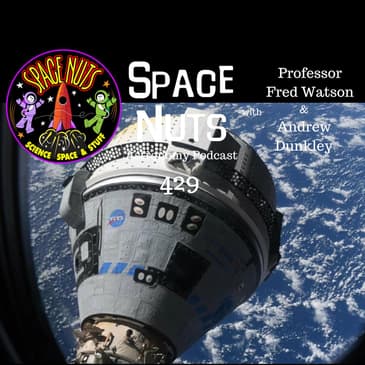
Episode Highlights:- Boeing Starliner Update: The Boeing Starliner faces new challenges, this time with its return to Earth. Fred and Andrew discuss the issues with the thrusters and the cautious approach by NASA and Boeing to ensure the astronauts' safe return.
- Titan's Coastal Erosion: Discover the latest findings on Titan, the only other body in our solar system with a liquid surface. The duo explores how coastal erosion on Titan might be driven by waves, similar to Earth, and what this means for our understanding of this intriguing moon.
- Moon Formation: Fred explains the latest research on where moons are most likely to form, with a focus on rocky planets. Learn about the theories behind moon formation and why our own moon might be a rarity.
- Dark Matter Influence: Dark matter is back in the news with new research questioning our understanding of its influence on galaxies. Fred discusses the latest findings and what they mean for the future of dark matter research.
Don't forget to send us your questions via our website for our Q&A episodes....available Mondays... spacenuts.io.
Support Space Nuts and join us on this interstellar journey by visiting our website support page. Your contributions help us continue our mission to explore the wonders of the universe.
Clear skies and boundless exploration await on Space Nuts, where we make the cosmos your backyard.
Check out our sponsor: www.nordvpn.com/spacenuts
Become a supporter of this podcast: https://www.spreaker.com/podcast/space-nuts--2631155/support
Visit our websites: www.spacenuts.io
www.bitesz.com
Hi there, this is Space Nuts. My name is Andrew Dunkley. Thank you for joining us for yet another episode. In this one, we are going to be looking at the latest with Boeing star Liner. They had trouble getting it off the ground. Now it looks like they're having trouble getting it on the ground. We'll be looking at coastal erosion, not on Earth, but on the only other body in our Solar system where we know there is a liquid surface and we don't know much about it. They've come up with an idea about this particular place named Titan and what might be happening around the coast where you don't want to live. We're also going to find out about we most likely to form a moon and dark matter and its influence is back in the news. That's all coming up on this edition of Space Nuts. Fifteen second guidance in Channel ten nine ignition sequence Space Nuts Sie three two one Street Nurse and I bought it real good and here to tell us all about moons and Titan and star liners and dark matter influences. Professor Fred what's an astronomer at large? Hi? Fred? Hi Andrew? How are you doing? I'm doing everything I came this day. Warm air condition died on Saturday afternoon, just as the temperature was dropping. So we've spent the weekend wrapped in blankets and seventy five layers of clothing. And I don't know, we've killed a few geese and taken their feathers. We are freezing and you've chosen the coolest weekend of the winter to do it. Yeah. Yeah's very pleasant. It's quite trull. We just went past the winter solstice, so yeah, the shortest day. And yeah, it's rather jilly here at the moment, but on well as you do. But I hope you get it fixed soon. Anyway, it's not very not very nice when you're out. Conditioning's gone blong. No, definitely not. You are yes, gone bung. Yeah, yeah, the air the air con has gone bun. That that's what's basically happened. Uh. And you you have a studio guest there who might make his presence felt sooner or later, named Jordy, so will yes, we will welcome him. Is he having a bit of listeners? So good? Yeah, it's a tough life for dogs. Let's get started, Fred, Let's do a Star Lineer update. I remember when it wasn't so long ago that we're trying to get it off the ground, and then they didn't, then they did, then they didn't, and they did, and finally it got up there too much fanfare, and now NEI they're a bit stuck. That's right, it's a It is an interesting story and one that I mean. I think what we're seeing is a very cautious approach by both Boeing and NASA to this because Boeing contracts to NASA with their star Liner space capsule, which is designed to be the second kind of space taxi after the Crew Dragon, the SpaceX Crew Dragon, which has been successfully flying up and down with astronauts for quite some time now. But there was so this is the first test flight, the first crewde test flight of the Boeing star Liner with two NASA crew members on board. It has flown twice before, I think, without crew and worked well, but there were issues before they left, before they left Earth, and the I think it was it was the beginning of June when they when they headed up there, the return was scheduled for I think fourteenth of June originally, then the twenty sixth of June, but now it's been postponed kind of indefinitely, although you can't postpone it completely indefinitely because you need to bring your astronauts back. And the reason is that there are issues with some of the thrusters, the maneuvering thrusters that the spacecraft has. It has, believe it or not, twenty eight of those, which is, you know, it's quite a number, which I guess you need to position the spacecraft to orient it so that it lines up exactly with the docking port on the International Space Station and things of that sort. But apparently five of the thrusters have got issues which are apparently helium leaks and the helium is something that pressurizes the thrusters. There's also an issue with a well valve which is not moving as quickly as it should do. And so what they've done is put a hold on returning these astronauts back to Earth in the star Liner and then try and you know, fix these problems before it does make its return to the planet. I think, yeah, I think there's a fairly full program of work for the astronauts up there while they're working the while they're living at the space station, so they're not going to be sitting twiddling their thumbs, and quite a lot of what they might be doing I suspect is to do it with Kenny, to do with getting back home. So that's the way the status quote the moment. Of course, it could change very quickly. By the time this podcast goes to air. It may have changed already, but we wait developments with interest. Yes, absolutely, in hope, Paul is well, I look, I know they're sitting there regretting that they didn't take their w D forty with them. That's I will have solved everything, I reckon. Well, it nobly does, that's right. Yeah, I think I've told you the story before about why it's called w D forty. You have, but I'll hear it again happily. Well, it was quite simply the fortieth variation of the formula, and it's the one they got right. But WD is something to do with water dispersal or something like that. Yeah, I'm going to look it up right now. Good on you. You're somebody who can do more than one thing at a time, which I can't. Yeah, it's water displacement fortieth formula. There, you are not too far off the mark. I do remember an issue that you know the water was highlighted in the name. Yeah, I don't know about helium dispersement. Yeah, that's I think they're wrong about HD ninety five. Now, Ali, maybe all right, fingers crossed for the bowing star line. And look, they've done very very well considering all the problems they've had before they got it off the ground for this crude mission. And I'm sure they'll solve it. They're probably just been super duper cautious. And yes, that's fair enough to moving on. Let's go to Titan, the only other place in the Solar System, or the universe for that matter, that we know of, that has a liquid surface. This is not a liquid surface that you want on Earth. We wouldn't be here if this existed on Earth in the capacity that it does on Titan, or we might be here in a different form, who knows, But we're talking petrochemicals. And one of the big mysteries of Titan is whether or not it's oceans work the same way as they do on Earth. And they've been looking into this. Indeed, then this is a question that goes back a long way. So remember the Cassini mission up to twenty seventeen, when it burned up in Saturn's atmosphere. An absolute treasure trove of information that came from it, including radar mapping of the surface of Titan, Saturn's biggest moon, second biggest moon in the Solar System, and that radar mapping showed very clearly that as suspected actually because people thought this was the case. There are season lakes on Titan which are of liquid natural gas. Basically, the temperature at the surface is roughly one hundred and seventy minus one hundred and seventy degrees celsius, and that's called enough for you know, these gases ethane and methane to be liquid, and so liquid natural gas on Titan fills these basins, which are mostly near the North Polar region, so the sat turns sorry Titans. North Polar region has its whole array of lakes and seas which show up dark on the radar reflections. They're actually you know that that's kind of how we know that they are very smooth because the radar just bounces off them. It doesn't scatter like a rough surface does. But the question has always been are there waves on those lakes and seas? And there's two schools of thought here. One is that they are very smooth, and in fact, I do remember being staggered to read once. This is quite some time ago, probably a decade ago, that the biggest wavefight on titaned seas was probably a millimeter and that seems, you know, not there's not much surfing with the millimeter high waves there, that's right, not unless sure iFly? Yeah, so so they they The other side of the coin, though, was that occasionally on Titan you get bright patches being reflected in the radar beams. And those bright patches are something that come and go. They don't stay, they're not permanent, they don't last very long. And so one suggestion for that was that these were wind driven waves. You've got storms, basically, that the waves on the surface of Titan. Another thought was possibly methane icebergs that you know, didn't we talk about that one that Bill We did. Yeah, And maybe the methane icebergs hang around for a while and then melt or disappear, and so that's why these bright things that appeared in the seas look look are temporary that they come and go. So a group from a number, well, there's a lot of NASA scientists in this scientists from MIT Massasachusetts Institute of Technology, and other institutions US Geological Surveys also involved with this work. What they've done is taken a different approach. They've looked at the shape of the coastline of these lakes and seas, because they've quite intricate coastlines. You know, if you look at photographs of them, it's pretty easy to find them. You can see river estuaries and headlands and all of that sort of thing, the kinds of things that we just think of as being natural coastal features. So they've looked at those in detail, and taking the Earth as a model, they've said, okay, on Earth, there's two main kinds of erosion of a coastline. One is what's called uniform erosion, and that occurs where the coastline is actually being dissolved away by whatever chemicals are in the water. And we see that in cast country, where you've got limestone with lakes forming in it, and basically the water in the lakes dissolves the limestone and so you get this what's called uniform erosion. And the other kind is wave driven erosion, and wave erosion depends on the wind direction, the wind speed that causes the waves. But the interesting feature is that these two different sorts of erosion, uniform erosion wave erosion, give quite different styles of coastline, if I can put it that way. They wear things down differently. And so the analysis of the Cassini images have essentially supported the idea that these coastal features are wave driven rather than uniform erosion. Interesting. Yeah, so it's a really neat way of trying to work out whether they're away. It's on the seas of Titan, and it looks as though that's confirmed as being a possibility. If there are waves, that means there must be something driving them. Would that have to be wind, wouldn't y? Yeah, that's right. And the next step in this research is to try, and you know, by again by careful analysis of these coastal features, try and work out what the wind direction is and what speed it is the prevailing winds on Titan. The surfers that listen to us are very excited to learn of Ye, but that minus one hundred and seventy degrees you'd need a heck of a wetsuit. Yeah, and you wouldn't want your air conditioning to break down either. No, no, definitely not. There is just one PostScript to that story, though, and that is that twenty twenty eight, we hope NASA will launch its Dragonfly mission, which is an autonomous rotocraft a drone basically, which will be in orbit around or it won't be in orbit. It'll be patrolling the landscape of Titan. Hopefully we'll land on a beach somewhere and actually have a look at these waves and tell us what the waves are like. So, yes, Dragonfly is something very much to look forward to. The next big mission to Titan. How long it's going to take to get there, But I think it's quite a while, So twenty twenty eight launch might be I don't know, it might be ten years before it gets there, but at least it's on its way. I'm going to find it. Okay, good because we need to put it in the diary for Space Nuts for when Dragonfly is deployed on Titan. It's July twenty twenty eight, six years to reach. Okay, not bad, so twenty thirty four, yeah, we'll still be going strong. But then that's away. Yeah, absolutely a problem at all. If you'd like to follow up on that story here about the waves on Titan. You can find fabulous right up at universe tooday dot com. This is space Nuts Andrew Dunkley here with Professor Fred. What's an Okay, we take a space nuts now, Fred, let's talk about moons and where to find them. And well, it looks like, I mean, we've got one, Mars has got a couple, Venus doesn't have any, does it. But they're starting to think that the formation of moons is more likely around rocky planets. What's the story here, Yeah, so let's just review what we know about the origin of our own moon. The current theory about the origin of the Moon is that a Mars sized planetism by the name of Fear. We've given it a name, even though it longer doesn't exist anymore. That's right. It collided with the Moon very early in the history of the Solar System. You know, the Solar System might have only been ten or one hundred million years old at that time, which is very very new. You forming planets. You've got these planetismals charging around all over the place, and this collision is thought to have occurred very early on, which excavated an enormous amount of material from the Earth. Basically, the amount of energy that was put in rendered the surface of Earth molten, so it became a lava world, and the debris basically formed a ring around the Earth, which eventually it created to become the moon that we are familiar with today. And so that is the basic picture. There's still a lot of, you know, places where the jury is still out on the angle velocity all of those things. The exact massive thear by the angle of velocity, I mean of the of the collision that created created the moon. So apparently, when you look at these studies, if you've got a high energy impact, what you wind up with, and this is the theoretical study, is a disc around the planet that's dominated by vapor, where whilst or a sort of gaseous material, if I put it that way, while a lower energy impact, you get a disc that's dominated by rock basically by dust, silicate silicate dust, and so which of those happens apparently will play a big influence on what you get at the end of it, you get a moon or whether you just get vapor that you know, gas is material that just disperses into space. And apparently, and this is This is a kind of technical term that I've not really been that familiar with, but it's something called a stream streaming and streaming instability, let's get it right, friend, the streaming instability, which is the the the deciding factor in what you're going to get. So, so the streaming instability comes depending on the velocity of the impact, the energy of the impact. And it turns out that the bottom line, as you've probably picked up from what I've been saying, is that that the the more the less high velocity, the lower energy perhaps you could say, are gentler in pact, that is more likely to result in the formation of a large moon, Whereas if you've got a high energy impact, you don't you don't get the moon. You just get a lot of vapor, a lot of gas that heads off into space. So it is, yeah, it's an interesting suggestion, and it sort of somehow, to some extent, it reinforces our view that perhaps many of the moons of the outer planets the gas giants, which are much smaller than the parent bodies, unlike our own moon, which is pretty substantial compared with the parent body. It's one eightieth of the mass of the Earth. It's why you know it talies with the suggestion that some of those larger planets have moons that were really caused by perhaps captured captured material or colliding comets, so colliding asteroids, things of that sort, rather than a collision process like the one that we we think formed our own moon. No, that's interesting because you look at Mars and the two moons of Mars seem to be more likely captured objects. That's correct. Yes, we don't really know too much about the origin Phobos and demos. They probably are captured captured objects rather than something caused by an impact like the one that caused our own mot I mean, it's sort of you know, it emphasizes the point really that maybe our own moon is quite a rarity because it's it's it's not uncommon for smaller bodies to have large moons. And the casing point is is Pluto, the dwarf planet Pluto with its moon care on which is I can't remember. It's significantly high. I think it's something like one sixth of the mass of Pluto. I might be exaggerating that. I'm just trying to remember from the New Horizons flyby, but it is quite big. Compared with compared with Pluto itself, it's one two hundred and fourteen kilometers across, which is about half, yeah, half the diameter of Pluto. Pluto's with more than two thousand kilometers. So yes, it's it's you know, there you've got two bodies which are similar in size, and they're almost a binary body. And we know there are binary asteroids. We see many binary asteroids as of asteroids. So when you get to the smaller end of the of the planetismal or planetoid spectrum, it seems that large moons are more common. But when you when you grow up into when you look at big, bigger planets, bigger objects in the in the Solar System, it looks as though smaller moons are the way it goes. So the suggestion of this particular piece of research is that perhaps small, rocky planets are better at making moons than large ones. It comes from a variety of scientists, mostly in the United States. That's fascinating. Well, I suppose now if they if they because they've been doing simulations to try and prove their theory, what they probably need to do now is take a look out there and see if I mean it's probably very difficult. Finding an exoplanet hard enough, but we're getting better and better at it. But finding moons around those planets, if this theory holds true, you probably have better target options. But as we've said before, seeing a rocky exoplanet is much more difficult than a gas giant, isn't it. That's right. I think there's one or two suspected moons. There's nothing that's been guaranteed an exo moon. And one of the things that comes to mind, and we might have talked about this a year or so ago, is with gravitational microlensing. This is where a star with it with planets, passes in front of another star in the background, and the gravitational field of the foreground star distorts the background star and magnifies it. It actually makes it much brighter, and you can detect planets that way, quite small ones, actually much much smaller than the other normal planetary detection methods. And I think there was a suspected exo moon found in one of the micro lensing experiments that was done a few years ago, if I remember rightly, except I think correct me if I'm wrong. But haven't they got to say it three times to prove it. Yeah, except you don't. With micro lensing, it's a one off. Yeah, absolutely right, because you see the story of the planet again, they're all invisible, so it just gets a microlensing event name rather than a planet name. No fair interesting, all right, If you want to look at that story. Space dot com is the website. We can check it out to our final story, Fred And this is a this is pretty big one actually, and not surprisingly dark matter is in the news again, but we're looking at the influence of dark matter and it's it's again questioning our understanding of the universe and why things are happening the way they are. That's right. So we've you know, we return to this theme so many times and so often, but it is interesting. It is a huge part of current astronomical research. What is the nature of dark matter? And some people question whether it really exists at all. And so this is some research that's come out of Case Western Reserve University in the US and goes back to one of the methods that was used in the early days of dark matter research to determine what was going on. Just to give you a bit of history, Andrew dark matter was first postulated actually back in nineteen thirty three by very interesting astronomer Swiss American astronomy by the name of Fritz Vicky and VICKI was observing galaxies in a cluster of galaxies called the Coma Cluster the northern constellation of Coma Brenises, and he worked out that if all he could see was all that was there, these galaxies should have gone their own separate ways millennia ago, because there wasn't enough mass that he could see that would hold the cluster together. And it was then nobody understood that, so it was just ignored basically as a curious fact of astronomy that we couldn't explain. And it wasn't until actually nineteen seventy that it was raised again by Australian astronomer Ken Freeman. I was in touch with Ken last week. He's still going strong. He got the Prime Minister Science price for this work. But back in nineteen seventy he said that the galaxies that he was measuring, he was looking at the rotation of galaxies. We're going too fast to stay together. They should fly apart, and that was then confirmed later in the seventies. Nineteen seventy eight by Via Rubin, a wonderful American astronomer. She made that she basically put together all these ideas to work out that the only way you could get galaxies holding together was if they were enveloped in a sort of spherical cloud or halo of dark matter. And that's been this sort of status quo ever since. But we now have this new research which this takes big bad that's right, takes the rotation idea, but looks at the way galaxies rotate millions of light years from their centers, in other words, the very outer regions of galaxies. They are basically sorry, I've just canceled a call there from something quite famous, interestingly said, I'll call you later. They've taken they've looked at large galaxies and looked at the way they rotate in their outer, outer most regions and discover that it's it looks as though they're still being controlled by dark matter. So the bottom line is that they're saying that the dark matter halos, either the dark matter haloes are much much bigger than we thought they were, that these galaxies are immersed in enormous halos of dark matter, much bigger than we thought they were before, or we've got it wrong, and you know that we're we're we're we're misleading ourselves by the fact that our understanding of gravity and acceleration are incomplete. And this goes back to Mordeheigh Milgram's theory of moond as it's called modified Neutonian dynamics, that says that very low accelerations Newtonian dynamics doesn't work the way Newton said it did. In other words, you know, you push something and it moves, but it doesn't quite work that way a very low accelerations. So that's the that's the issue. You know, it's it's once again, it's it's challenging dark matter dark matter. We the mainstream belief is that it is some form of massive subatomic posts that we have not yet discovered. In fact, the sub Atomic Particle Fraternity have worked very very hard to try and find whatever this is, but we've failed completely. So if it's not a particle, what is it? And this work kind of pushes back in the direction of our understanding of acceleration being roll. Yeah, I think it's w D thirty nine what it is? Yes, well, there you go. It could be could be it is. I'm hoping the day will come where we find out what dark matter is and the penny drops and we go, yeah, of course it's so simple. Yeah, yes, we're not there. No, we're not. And the reason why Mom doesn't have a big following is that it sort of lets you down in other ways. It might explain the rotation of galaxies, but it can't explain explain the behavior of galaxies in cluster in clusters, which is what old Fritz Vicki was discovering. There are a few other things that don't work well. In fact, you know, to do with the general structure of the universe, you tend to need dark matter to make the universe look like it does. So the dark matter has still got a lot a lot going for it, Andrew, Yeah, sure has. And of course, now that we've talked about it, I'm sure we'll get one or two questions and potential theories. A lot of our audience do put up theories, which we do like we do. Okay, if you want to read that story, it's at Space Daily dot com and you'll probably find it on many other pages as well. That brings us to the end of this episode. But don't forget to visit our website, Space Nuts podcast dot com or space nuts dot io and have a look around. Don't forget to become a member. If you're interested in becoming a member of Space Nuts, you can do that on our website. You can click on the supporter link and learn about becoming a patron. And we do thank our patrons very very kindly for supporting us financially. We don't ask for that, but the fact that you're willing to do so is very humbling. Indeed, and everything else you need to know about us is on our website as well, and don't forget about our social media platforms as well, including YouTube. And if you do listen or view on YouTube, hit the subscribe button if you haven't done so already. That's it, Fred, thank you so much. Great pleasure is always under it. Yeah, it's becoming quite regular, this isn't it. It's almost like we've been doing a fore years. Yes, yes, yeah, all right, thanks, there's more. Okay, thanks for it. We'll see you soon. Sounds great. Thanks Andrew. Fred Wat's an astronomer at large part of the team here at Space Nuts and Hugh back in the studio. He's trying to figure out how to use the Internet and from me Andrew Dunkley. Always good to have your company. Catch you on the very next episode of Space Nuts. By bye. You'll be listening to the Space Nuts podcast available at Apple Podcasts, Spotify, iHeartRadio, or your favorite podcast player. You can also stream on demand at fides dot com. This has been another quality podcast production from nights dot com.