
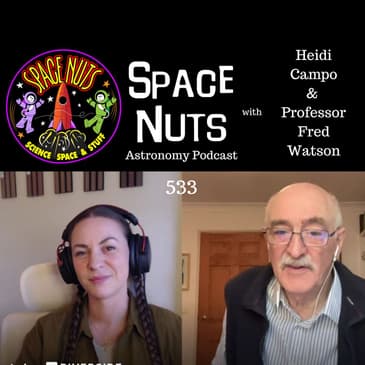
In this intriguing episode of Space Nuts, hosts Heidi Campo and Professor Fred Watson delve into the captivating world of cosmic enigmas. From the potential resolution of the 'missing matter' mystery to the groundbreaking findings linking Earth's magnetism and oxygen levels, this episode is packed with revelations that will spark your curiosity about the universe.
Episode Highlights:
- Fast Radio Bursts and Missing Matter: The episode kicks off with a discussion on fast radio bursts, their origins, and how they may help astronomers account for the elusive missing matter in the universe. Fred explains the significance of these brief bursts of radio waves and their role in revealing the intergalactic medium's composition.
- Understanding Neutron Stars: Heidi and Fred take a moment to clarify the difference between neutron stars and our sun, exploring the fascinating life cycle of stars and the unique characteristics of neutron stars that lead to phenomena like magnetars and fast radio bursts.
- Proba 3 Mission and Solar Eclipses: The conversation shifts to the European Space Agency's Proba 3 mission, which aims to study the sun's corona using two satellites. Fred shares how this innovative approach allows scientists to observe the sun's outer atmosphere in detail, akin to a solar eclipse, and the potential for citizen scientists to engage with this data.
- Link Between Magnetism and Oxygen: The episode concludes with a discussion on a recent study revealing a mysterious correlation between Earth's magnetic field strength and atmospheric oxygen levels over the past 500 million years. Fred emphasizes the implications of this finding for understanding life processes and the search for extraterrestrial life.
For more Space Nuts, including our continuously updating newsfeed and to listen to all our episodes, visit our website. Follow us on social media at SpaceNutsPod on Facebook, X, YouTube Music Music, Tumblr, Instagram, and TikTok. We love engaging with our community, so be sure to drop us a message or comment on your favorite platform.
If you’d like to help support Space Nuts and join our growing family of insiders for commercial-free episodes and more, visit spacenutspodcast.com/about
Stay curious, keep looking up, and join us next time for more stellar insights and cosmic wonders. Until then, clear skies and happy stargazing.
(00:00) Welcome to Space Nuts with Heidi Campo and Fred Watson
(01:20) Discussion on fast radio bursts and missing matter
(15:00) Clarifying neutron stars vs. our sun
(25:30) Insights into the Proba 3 mission and solar corona
(35:00) Exploring the link between Earth's magnetism and oxygen
For commercial-free versions of Space Nuts, join us on Patreon, Supercast, Apple Podcasts, or become a supporter here: https://www.spreaker.com/podcast/space-nuts-astronomy-insights-cosmic-discoveries--2631155/support
00:00:00 --> 00:00:02 Heidi Campo: Welcome back to another exciting episode of
00:00:02 --> 00:00:05 Space Nuns. I'm your host for this season,
00:00:06 --> 00:00:08 Heidi Campo. And joining us is Professor
00:00:08 --> 00:00:11 Fred. Watch it. Fred Watson,
00:00:11 --> 00:00:12 astronomer at large.
00:00:13 --> 00:00:16 Professor Fred Watson: Actually, that's quite a nice, uh. It's quite
00:00:16 --> 00:00:19 a nice epithet. It should be Fred watching,
00:00:19 --> 00:00:21 uh, because I watched the universe. Fred
00:00:21 --> 00:00:24 watching here loud and clear.
00:00:24 --> 00:00:27 Looking forward to speaking again, Heidi.
00:00:27 --> 00:00:30 Heidi Campo: We, uh. We, uh. We're off to a great start.
00:00:30 --> 00:00:32 No, that's. That is fun. We are. We are. We
00:00:32 --> 00:00:35 are all observers in this universe. And you
00:00:35 --> 00:00:37 are listening to space nuts.
00:00:37 --> 00:00:40 Generic: 15 seconds. Guidance is internal.
00:00:40 --> 00:00:43 10, 9. Uh, ignition
00:00:43 --> 00:00:43 sequence.
00:00:43 --> 00:00:45 Professor Fred Watson: Star space nuts.
00:00:45 --> 00:00:48 Generic: 5, 4, 3, 2. 1, 2, 3, 4,
00:00:48 --> 00:00:50 5, 5, 4, 3, 2, 1. Space
00:00:50 --> 00:00:53 nuts. Astronauts report it feels good.
00:00:54 --> 00:00:57 Heidi Campo: Um, today we have some very interesting
00:00:57 --> 00:00:59 articles. Uh, we're. We're kind of kicking
00:00:59 --> 00:01:01 things off. It's a. It's kind of a mystery
00:01:01 --> 00:01:03 episode. I feel like this is a very, very
00:01:03 --> 00:01:06 detective heavy episode. We've
00:01:06 --> 00:01:09 got mysteries being solved,
00:01:09 --> 00:01:12 we have mysteries unsolved, and we have clues
00:01:12 --> 00:01:14 to mysteries. So our first
00:01:14 --> 00:01:17 article this week is we are talking about a
00:01:17 --> 00:01:20 mystery that, uh, might be
00:01:20 --> 00:01:23 solved. So this is, uh. We're looking
00:01:23 --> 00:01:26 at what this is, is the home address
00:01:26 --> 00:01:28 for some missing matter.
00:01:29 --> 00:01:31 Professor Fred Watson: Yeah, that's right. Um, uh, it's a
00:01:31 --> 00:01:34 story that, um, I find really
00:01:34 --> 00:01:37 interesting because the
00:01:37 --> 00:01:39 groundwork for this work was laid down five
00:01:39 --> 00:01:41 years ago here in Australia,
00:01:42 --> 00:01:45 um, with, um, work that's
00:01:45 --> 00:01:47 been carried out on something you and I have
00:01:47 --> 00:01:49 spoken about before. Briefly.
00:01:50 --> 00:01:52 Uh. Briefly is the word, because we're
00:01:52 --> 00:01:54 talking here about fast radio bursts,
00:01:55 --> 00:01:58 uh, which are things that have only been
00:01:58 --> 00:02:00 known in the last. It's getting on for 20
00:02:00 --> 00:02:02 years now since the first observations were
00:02:02 --> 00:02:04 made. But, uh. But they're still
00:02:04 --> 00:02:07 relatively new in the
00:02:07 --> 00:02:10 armory that astronomers can bring to
00:02:10 --> 00:02:12 bear on the universe. And what they are
00:02:13 --> 00:02:16 is pretty well what the name says. They're
00:02:16 --> 00:02:19 bursts of radio radiation. These are detected
00:02:19 --> 00:02:21 with radio telescopes, not visible light
00:02:21 --> 00:02:23 telescopes. Uh, and they are.
00:02:24 --> 00:02:26 Fast, uh, is probably a misnomer. Uh,
00:02:26 --> 00:02:29 short would be a better word. Uh,
00:02:29 --> 00:02:32 but they, uh. Because they only last for
00:02:32 --> 00:02:34 typically a millionth of. Sorry, uh, a
00:02:34 --> 00:02:35 millisecond, a thousandth of a second,
00:02:35 --> 00:02:38 thereabouts, roughly. Often they've got
00:02:38 --> 00:02:40 structure in them as well, which is
00:02:40 --> 00:02:42 interesting when you look at the profile of
00:02:42 --> 00:02:44 the intensity of that millisecond
00:02:44 --> 00:02:47 burst spread out. If you can magnify the,
00:02:48 --> 00:02:50 uh, sort of time domain, you can see that
00:02:50 --> 00:02:52 there are features in that, uh, peaks and
00:02:52 --> 00:02:55 troughs, uh, squashed into that millisecond.
00:02:55 --> 00:02:58 So very, very fascinating
00:02:58 --> 00:03:01 objects. Their origin is still not
00:03:01 --> 00:03:04 certain. Um, I think the best
00:03:04 --> 00:03:07 guess of my colleagues who work on this kind
00:03:07 --> 00:03:10 of thing is that they are flares on
00:03:10 --> 00:03:12 magnetars. And magnetars are
00:03:12 --> 00:03:15 highly magnetized neutron stars.
00:03:15 --> 00:03:18 And these things apparently are able
00:03:18 --> 00:03:21 to have flares on their surface which can be
00:03:21 --> 00:03:23 very intense. These radio bursts are very,
00:03:23 --> 00:03:26 very bright in the radio spectrum.
00:03:27 --> 00:03:29 So that's one thing.
00:03:29 --> 00:03:30 Heidi Campo: Real quick, Fred. I'm sorry.
00:03:30 --> 00:03:31 Professor Fred Watson: No worries.
00:03:31 --> 00:03:33 Heidi Campo: I have noticed, um, based on the questions
00:03:33 --> 00:03:35 lately, that we are getting a lot of new
00:03:35 --> 00:03:38 listeners lately. Can you, um, maybe
00:03:38 --> 00:03:40 specify to some of our newer listeners the
00:03:40 --> 00:03:43 difference between a neutron star and
00:03:43 --> 00:03:44 perhaps our star?
00:03:45 --> 00:03:48 Professor Fred Watson: I can, um. Yeah, sorry. That's a really good
00:03:48 --> 00:03:50 question and a really good point to make. Um,
00:03:51 --> 00:03:53 so, um, neutron stars are, uh,
00:03:54 --> 00:03:56 stars that have reached the end of
00:03:56 --> 00:03:59 their life, their hydrogen fuel, which
00:03:59 --> 00:04:02 is what powers stars like our sun that's
00:04:02 --> 00:04:05 being powered by hydrogen fuel. As we speak.
00:04:06 --> 00:04:09 That fuel has run out on
00:04:09 --> 00:04:11 a neutron star. And
00:04:11 --> 00:04:14 the stars are really interesting because
00:04:14 --> 00:04:17 there's a constant battle going on between,
00:04:17 --> 00:04:20 uh, the radiation that is coming from
00:04:20 --> 00:04:22 these nuclear processes, which is pushing
00:04:22 --> 00:04:24 outwards, and gravity, which is pulling
00:04:24 --> 00:04:27 inwards and trying to compress, uh, a star
00:04:27 --> 00:04:29 like the sun. So it achieves a balance
00:04:29 --> 00:04:32 between, uh, radiation and gravitation.
00:04:32 --> 00:04:35 And so you can imagine what would happen if,
00:04:35 --> 00:04:38 at the end of a star's life, um, the
00:04:38 --> 00:04:41 radiation stops because the nuclear
00:04:41 --> 00:04:43 processes have actually changed. They don't
00:04:43 --> 00:04:45 stop, but they change. What's going to happen
00:04:45 --> 00:04:48 is gravitation wins and compresses, uh,
00:04:48 --> 00:04:50 the star down. And that, uh, sometimes
00:04:50 --> 00:04:53 happens explosively in the case of what we
00:04:53 --> 00:04:55 call a supernova, an exploding star. And so
00:04:55 --> 00:04:58 one possible remnant from such
00:04:58 --> 00:05:01 an event is a neutron star, uh,
00:05:01 --> 00:05:04 in which, uh, the thing
00:05:04 --> 00:05:07 has collapsed. And the only thing that's
00:05:07 --> 00:05:10 stopping that central core of
00:05:11 --> 00:05:14 the X star, the star that is now
00:05:14 --> 00:05:16 no longer a star. The only thing,
00:05:17 --> 00:05:19 um, that stops it collapsing completely to a
00:05:20 --> 00:05:22 black hole, uh, is the outward
00:05:22 --> 00:05:25 resistance of the neutrons within it.
00:05:25 --> 00:05:28 Um, and so those neutrons have an
00:05:28 --> 00:05:30 outward pressure, and that limits the
00:05:30 --> 00:05:33 collapse. Uh, so what you have is
00:05:33 --> 00:05:35 a star that used to be perhaps like our Sun.
00:05:35 --> 00:05:38 1.3. Probably more actually, in the case of a
00:05:38 --> 00:05:39 neutron star, because they're bigger than the
00:05:39 --> 00:05:41 sun anyway. 1.32
00:05:42 --> 00:05:44 million kilometers across. Suddenly, uh,
00:05:45 --> 00:05:47 it's collapsed to something, um, 10
00:05:47 --> 00:05:50 kilometers, 7 miles across,
00:05:50 --> 00:05:53 uh, but with incredibly high density.
00:05:54 --> 00:05:57 And all sorts of unusual phenomena take place
00:05:57 --> 00:05:58 in those stars. They are generally
00:05:58 --> 00:06:01 magnetized. Um, many of them
00:06:01 --> 00:06:04 squirt, um, beams of radiation out, um,
00:06:04 --> 00:06:06 and because they're rotating, those Beams
00:06:06 --> 00:06:08 have this sort of lighthouse effect that we
00:06:08 --> 00:06:11 see them flashing. Uh, but we believe
00:06:11 --> 00:06:14 as well some are so highly magnetized that
00:06:14 --> 00:06:16 they form a different species, though what
00:06:16 --> 00:06:18 are called magnetars. And apparently they
00:06:18 --> 00:06:21 have flares on them. Uh, and these flares are
00:06:21 --> 00:06:23 what we think gives rise to fast radio
00:06:23 --> 00:06:26 bursts. So that's
00:06:26 --> 00:06:28 where the science is. Uh,
00:06:28 --> 00:06:31 astronomers have been now observing these
00:06:31 --> 00:06:32 fast radio bursts for
00:06:34 --> 00:06:37 best part of a decade. Uh,
00:06:37 --> 00:06:39 and, uh, one or two of them repeat,
00:06:40 --> 00:06:42 which are a bit mysterious because it
00:06:42 --> 00:06:44 suggests that something's rotating because
00:06:44 --> 00:06:46 you get this repeating appearance of the
00:06:46 --> 00:06:49 burst. Uh, often though, they just come
00:06:49 --> 00:06:51 out of nowhere. Uh, and there are several
00:06:51 --> 00:06:53 radio telescopes in the world that are
00:06:53 --> 00:06:56 actively looking for these objects. One
00:06:56 --> 00:06:59 of them is down, uh, here in Australia,
00:07:00 --> 00:07:01 uh, the ascap, the Australian Square
00:07:01 --> 00:07:04 Kilometer Array Pathfinder. And that actually
00:07:04 --> 00:07:06 was one of the ones that contributed to the
00:07:06 --> 00:07:08 work that was carried out that I mentioned a
00:07:08 --> 00:07:10 minute ago, uh, about five years ago.
00:07:11 --> 00:07:14 Um, in looking at how
00:07:14 --> 00:07:16 what these fast radio bursts might tell us
00:07:17 --> 00:07:20 about not just magnetars, but about
00:07:20 --> 00:07:22 the space through which the bursts of
00:07:22 --> 00:07:25 radiation travel. Because we now know
00:07:25 --> 00:07:28 that most of these radio bursts take place in
00:07:28 --> 00:07:30 very distant galaxies. They're galaxies that
00:07:30 --> 00:07:32 are, ah, you know, where distances are
00:07:32 --> 00:07:34 measured in billions of light years. They're
00:07:34 --> 00:07:37 a long, long way off. And so the radio
00:07:37 --> 00:07:40 bursts have traveled through a lot of empty
00:07:40 --> 00:07:43 space. Apparently empty. Um,
00:07:43 --> 00:07:46 and so I'm getting near the story here.
00:07:46 --> 00:07:48 This is the introduction to the story. We're
00:07:48 --> 00:07:51 nearly there. Um, what we
00:07:51 --> 00:07:54 find with fast radio bursts is that the
00:07:54 --> 00:07:57 bursts are, ah, um, dispersed.
00:07:57 --> 00:08:00 That's the technical term, which is a little
00:08:00 --> 00:08:03 bit like the way a prism breaks up the light
00:08:03 --> 00:08:06 of the sun or a white light into a
00:08:06 --> 00:08:09 spectrum, spectrum of colors. The same
00:08:09 --> 00:08:12 sort of thing happens as radio waves travel
00:08:12 --> 00:08:14 through space. You've got this spike of
00:08:14 --> 00:08:17 radiation, but as it goes through space,
00:08:17 --> 00:08:20 this dispersion phenomenon takes place. And
00:08:20 --> 00:08:23 the result is, uh, that the different
00:08:23 --> 00:08:26 frequencies are spread out in time. So,
00:08:26 --> 00:08:28 um, if I remember rightly, I'm not a radio
00:08:28 --> 00:08:31 astronomer, the, um,
00:08:32 --> 00:08:34 short wave, the higher frequencies arrive
00:08:34 --> 00:08:37 before the lower frequencies. Is that right?
00:08:37 --> 00:08:40 I think that's right. Yes, it is. Um,
00:08:40 --> 00:08:43 and the high frequencies are high first. But
00:08:43 --> 00:08:45 this burst, um, in different frequencies,
00:08:45 --> 00:08:48 it's still a spike of radiation. But you're
00:08:48 --> 00:08:50 now looking at almost like you've dispersed
00:08:50 --> 00:08:51 it into a spectrum.
00:08:51 --> 00:08:53 You're looking at different frequencies.
00:08:54 --> 00:08:57 And so the lower frequencies arrive later.
00:08:57 --> 00:08:59 Now that tells you
00:09:00 --> 00:09:03 something about the space that the
00:09:03 --> 00:09:05 radio waves have been traveling through.
00:09:05 --> 00:09:06 Because there is what we call the
00:09:06 --> 00:09:09 intergalactic medium. Uh, and
00:09:09 --> 00:09:11 that is basically a very
00:09:11 --> 00:09:14 rarefied, um, gas, if
00:09:14 --> 00:09:16 you like. Although you're talking about one
00:09:16 --> 00:09:19 atom per cubic meter or thereabouts. It's
00:09:19 --> 00:09:22 that sort of rarefaction. Uh,
00:09:22 --> 00:09:23 but there's enough of it. Because you're
00:09:23 --> 00:09:25 coming through these great distances. There's
00:09:25 --> 00:09:28 enough of that gas to have the effect of
00:09:28 --> 00:09:31 dispersing this radiation. So the amount of
00:09:31 --> 00:09:33 dispersion tells you how much
00:09:33 --> 00:09:36 gas there is. That the radio waves have
00:09:36 --> 00:09:38 traveled through. And that was the
00:09:38 --> 00:09:41 breakthrough made about five years ago. By a
00:09:41 --> 00:09:44 team of Australian scientists. Led by
00:09:45 --> 00:09:47 a, um, fantastic young gentleman called
00:09:47 --> 00:09:50 J.P. marchant. I think it was Jean Pierre,
00:09:51 --> 00:09:54 um, uh. A wonderful radio
00:09:54 --> 00:09:56 astronomer in Western Australia. A young man,
00:09:57 --> 00:10:00 uh, two weeks after this breakthrough paper
00:10:00 --> 00:10:03 had been, uh, released, he died.
00:10:04 --> 00:10:06 Uh, an absolute tragedy, this huge
00:10:06 --> 00:10:09 breakthrough. Yeah. And uh, I think he had a
00:10:09 --> 00:10:11 heart attack, if I remember rightly.
00:10:11 --> 00:10:12 Heidi Campo: It, uh, was probably the paper.
00:10:13 --> 00:10:15 Professor Fred Watson: Whatever it was, um, it was.
00:10:16 --> 00:10:18 It absolutely rocked the Australian
00:10:18 --> 00:10:21 astronomical community. This new knowledge
00:10:21 --> 00:10:23 that had been created. And he was the lead
00:10:23 --> 00:10:25 author on the paper. Sadly, he died.
00:10:26 --> 00:10:29 Um, however, that work has now been
00:10:29 --> 00:10:30 carried on at other
00:10:31 --> 00:10:33 radio astronomy observatories.
00:10:33 --> 00:10:36 Which brings us to the story today. And
00:10:36 --> 00:10:39 this is a paper that has been released, um,
00:10:39 --> 00:10:41 by astronomers at the center for
00:10:41 --> 00:10:44 Astrophysics, uh, the Harvard
00:10:44 --> 00:10:47 Smithsonian center for Astrophysics, cfa. Uh,
00:10:47 --> 00:10:49 and what they've done is they've taken this
00:10:49 --> 00:10:51 work a step further. Because they've looked
00:10:51 --> 00:10:53 at many, many more fast radio bursts. As
00:10:53 --> 00:10:56 you'd expect, these things are coming, um,
00:10:56 --> 00:10:59 um, um, are being constantly observed.
00:10:59 --> 00:11:02 Um, and what they've done is they have
00:11:02 --> 00:11:05 looked again at, uh. The structure
00:11:06 --> 00:11:08 or the constituents of the
00:11:08 --> 00:11:10 intergalactic medium. The space between the
00:11:10 --> 00:11:13 galaxies. And exactly as the Maaschant,
00:11:14 --> 00:11:17 uh, uh, uh, work. Um, proposed
00:11:17 --> 00:11:20 five years ago. They're able to use this
00:11:21 --> 00:11:23 as a measure of just what the.
00:11:23 --> 00:11:26 What the contents of the intergalactic
00:11:26 --> 00:11:29 medium are. Ah, and they find that it
00:11:29 --> 00:11:32 is enough to account for what
00:11:32 --> 00:11:34 we call the missing matter. Now, this is not
00:11:34 --> 00:11:36 dark matter that we're talking about. This is
00:11:36 --> 00:11:38 normal matter. Um, protons,
00:11:38 --> 00:11:41 electrons. The normal stuff which we are
00:11:41 --> 00:11:43 familiar with. Which in fact, uh. Is only
00:11:44 --> 00:11:47 something like 20% of the amount of matter in
00:11:47 --> 00:11:49 the universe. The rest of it is the dark
00:11:49 --> 00:11:52 matter. That's something else. But even that
00:11:52 --> 00:11:54 normal matter that we know about. When we
00:11:54 --> 00:11:56 look at the calculations as to what should
00:11:56 --> 00:11:59 emerge from the Big Bang. The um, event in
00:11:59 --> 00:12:02 which the universe was formed, we can't find
00:12:02 --> 00:12:04 enough of it. That's why we call it the
00:12:04 --> 00:12:07 missing matter. But it now Turns out
00:12:07 --> 00:12:09 that this combined set of
00:12:09 --> 00:12:12 researchers looking at the intergalactic
00:12:12 --> 00:12:14 medium find that there is enough matter in
00:12:14 --> 00:12:17 the intergalactic medium to account for that
00:12:17 --> 00:12:20 missing matter. So this is a problem solved.
00:12:20 --> 00:12:23 As you said at the beginning. Yeah, the two
00:12:23 --> 00:12:25 things absolutely dovetail together. The
00:12:25 --> 00:12:27 predicted amount of matter in the universe is
00:12:27 --> 00:12:30 now exactly what we find when we include
00:12:30 --> 00:12:33 this intergalactic medium. So it's
00:12:33 --> 00:12:36 amazing research. It's, um, very fitting
00:12:36 --> 00:12:37 that it should be our lead story on this
00:12:37 --> 00:12:40 edition of Space Nuts, because, um, as I
00:12:40 --> 00:12:42 said, it's got an Australian content. The
00:12:42 --> 00:12:44 thrusters now moved to other observatories,
00:12:44 --> 00:12:47 but we have this global picture now, uh,
00:12:47 --> 00:12:50 of what dark matter can tell us. Sorry, what,
00:12:50 --> 00:12:53 uh, fast radio burst can tell us about. Not
00:12:53 --> 00:12:55 dark matter, but the missing matter of the
00:12:55 --> 00:12:55 universe.
00:12:56 --> 00:12:59 Heidi Campo: Oh, that's wonderful. Uh, this reminds me
00:12:59 --> 00:13:01 when I'm trying to do math unsuccessfully,
00:13:01 --> 00:13:03 and I'm trying to find why I can't get the
00:13:03 --> 00:13:05 right answer and I forgot to carry the one.
00:13:05 --> 00:13:08 It turns out it was there the whole time. The
00:13:08 --> 00:13:11 answer was right there. I just forgot to grab
00:13:11 --> 00:13:13 that one little piece to pull it in to get
00:13:13 --> 00:13:16 the correct answer. But they solved such a
00:13:16 --> 00:13:19 complex, uh, problem. And isn't
00:13:19 --> 00:13:21 that kind of funny sometimes the answers are
00:13:21 --> 00:13:22 right there in plain sight.
00:13:22 --> 00:13:24 Professor Fred Watson: Exactly. It's in plain sight.
00:13:25 --> 00:13:27 Heidi Campo: But it's like you said, one atom per.
00:13:28 --> 00:13:29 What did you say it was?
00:13:29 --> 00:13:32 Professor Fred Watson: 1 cubic meter? It's something like that. It's
00:13:32 --> 00:13:34 that kind of level. It's very. A few atoms
00:13:34 --> 00:13:37 per cubic meter, perhaps. Um, but yes,
00:13:37 --> 00:13:40 uh, it's in plain sight. But you need.
00:13:41 --> 00:13:43 The thing that's made this possible, this
00:13:43 --> 00:13:45 detection possible is the fact that these
00:13:45 --> 00:13:47 bursts of radiation are so short,
00:13:48 --> 00:13:50 they're milliseconds. And that means that as
00:13:50 --> 00:13:52 they're dispersed, uh, into different
00:13:52 --> 00:13:54 frequency bands as they pass through the,
00:13:55 --> 00:13:57 the, the universe, um, you still can, you can
00:13:57 --> 00:14:00 detect this dispersion of the frequency
00:14:00 --> 00:14:02 bands, whereas with a constant radio signal,
00:14:02 --> 00:14:04 you wouldn't, you wouldn't do that. Um, you
00:14:04 --> 00:14:07 know that you've just got us radiation
00:14:07 --> 00:14:09 coming all the time. There's nothing to tell
00:14:09 --> 00:14:12 you whether the, whether the, um,
00:14:12 --> 00:14:14 lower frequencies are slower than the faster
00:14:14 --> 00:14:16 frequencies. There's nothing to tell you
00:14:16 --> 00:14:18 that. Yeah.
00:14:19 --> 00:14:20 Wonderful detective work. Yeah.
00:14:21 --> 00:14:22 Heidi Campo: Oh, yeah, it's fantastic.
00:14:22 --> 00:14:25 So by these radio, uh, astronomers then.
00:14:26 --> 00:14:29 So they do radio astronomy. What is your
00:14:29 --> 00:14:31 specialty? And then if you're not. So I also,
00:14:31 --> 00:14:33 I also, I have to make a joke, you know, it's
00:14:33 --> 00:14:34 not Space nuts if there's not a few dad
00:14:34 --> 00:14:37 jokes. And I've Been. I have not been holding
00:14:37 --> 00:14:40 up my end of, um, filling Andrew's shoes. So
00:14:40 --> 00:14:42 you may not be a radio astronomer, but
00:14:42 --> 00:14:43 technically you are an astronomer on the
00:14:43 --> 00:14:44 radio.
00:14:45 --> 00:14:48 Professor Fred Watson: That's correct. Yeah. I like it. I
00:14:48 --> 00:14:50 like it. Yes. Your dad jokes will go far,
00:14:50 --> 00:14:53 Heidi. Um, uh, so
00:14:53 --> 00:14:56 my specialty, um, and
00:14:56 --> 00:14:59 really my work now is in sort of policy and
00:14:59 --> 00:15:01 things of that sort rather than observing.
00:15:02 --> 00:15:05 Uh, but yes, for 40 years I guess
00:15:05 --> 00:15:07 I was, um, in fact more than that, nearly 50
00:15:07 --> 00:15:09 years, I was an optical astronomer. And that
00:15:09 --> 00:15:12 means I use telescopes that look at visible
00:15:12 --> 00:15:15 light, um, so giant telescopes
00:15:15 --> 00:15:17 that have a very shiny mirror at the
00:15:17 --> 00:15:19 base of them. In fact, the one I used
00:15:19 --> 00:15:21 principally was the, um, 3.9 meter
00:15:22 --> 00:15:25 Anglo Australian Telescope, uh, which we
00:15:25 --> 00:15:27 celebrated the 50th birthday on last year.
00:15:27 --> 00:15:30 Heidi Campo: Oh, happy, happy birthday, telescope.
00:15:32 --> 00:15:34 Professor Fred Watson: 0G and I feel fine space
00:15:34 --> 00:15:35 nuts.
00:15:35 --> 00:15:38 Heidi Campo: So with the, uh, ESA's Probe 3
00:15:38 --> 00:15:40 mission, that telescope, would that count as
00:15:40 --> 00:15:42 a big mirror telescope?
00:15:42 --> 00:15:45 Professor Fred Watson: Yeah, um, it's a small mirror telescope.
00:15:46 --> 00:15:46 Heidi Campo: Okay.
00:15:46 --> 00:15:49 Professor Fred Watson: Um, but it is an optical telescope. That's
00:15:49 --> 00:15:51 right. So it's looking at visible light and
00:15:51 --> 00:15:53 lovely, uh, segment segue there to the next
00:15:53 --> 00:15:56 story, Heidi. Um, so this
00:15:56 --> 00:15:58 again, you know, needs a little bit of
00:15:58 --> 00:16:01 background to, uh, get over its
00:16:01 --> 00:16:03 significance. But this, I think is a
00:16:03 --> 00:16:05 fantastic story, uh, because,
00:16:06 --> 00:16:09 um, it kind of means, um, that
00:16:09 --> 00:16:11 you can make an eclipse of the sun anytime
00:16:11 --> 00:16:13 you like. Uh, as you know,
00:16:13 --> 00:16:15 eclipses, ah, are rare.
00:16:16 --> 00:16:19 Um, well, in any given place on the Earth,
00:16:19 --> 00:16:22 they're a rare phenomenon. Uh, that's to say
00:16:22 --> 00:16:24 when the moon exactly blots out the
00:16:24 --> 00:16:27 disk of the sun or blacks it out. Uh, that
00:16:27 --> 00:16:29 means the Moon's shadow on the Earth's, uh,
00:16:29 --> 00:16:32 surface passes over different
00:16:32 --> 00:16:35 places. Uh, we call it the path of
00:16:35 --> 00:16:37 totality because that's where you see a total
00:16:37 --> 00:16:40 eclipse. And that's only narrow. It's only 50
00:16:40 --> 00:16:43 to 100 kilometers wide, um, 30 to
00:16:43 --> 00:16:46 60 miles, I guess, something like that. So,
00:16:46 --> 00:16:47 uh, um,
00:16:48 --> 00:16:51 ah, it's a rare phenomenon at any one place.
00:16:51 --> 00:16:54 And that's why, uh, when eclipses come along,
00:16:54 --> 00:16:56 people chase all over the world. Uh,
00:16:56 --> 00:16:59 everybody here in Australia, or certainly the
00:16:59 --> 00:17:01 state I'm in, New South Wales, are, uh,
00:17:01 --> 00:17:04 looking forward to July 2028, when an
00:17:04 --> 00:17:07 eclipse, um, will be seen from this
00:17:07 --> 00:17:09 state. And in fact, the Moon's shadow will
00:17:09 --> 00:17:12 pass directly over Sydney. So Sydney's going
00:17:12 --> 00:17:14 to be the center of the world's astronomers
00:17:15 --> 00:17:17 for, um, a short time. In
00:17:17 --> 00:17:20 2028 it is already, of course, but, uh, in a
00:17:20 --> 00:17:22 different sort of way. Anyway. One of the
00:17:22 --> 00:17:25 reasons why scientists Asked
00:17:25 --> 00:17:28 so keen on watching eclipses is
00:17:28 --> 00:17:31 because when the moon's disk blots out the
00:17:31 --> 00:17:34 visible disk of the sun, what you see
00:17:34 --> 00:17:37 is the sun's outer atmosphere. It's corona.
00:17:37 --> 00:17:40 And, uh, this is a, it's a almost
00:17:40 --> 00:17:43 ethereal glow around the sun
00:17:43 --> 00:17:45 which has got structure in it that comes from
00:17:45 --> 00:17:48 the magnetic field of the sun, uh, that
00:17:48 --> 00:17:50 dictates what the corona looks like. There
00:17:50 --> 00:17:53 are many mysteries, uh, that we don't
00:17:53 --> 00:17:55 understand about the corona. One is why its
00:17:55 --> 00:17:58 temperature is so high. Uh, the
00:17:58 --> 00:18:00 sun's surface temperature, around
00:18:01 --> 00:18:04 5 degrees. This
00:18:04 --> 00:18:07 is degrees Celsius, the temperature of the
00:18:07 --> 00:18:09 corona, about 15 million degrees.
00:18:10 --> 00:18:13 Um, you're talking about this huge difference
00:18:13 --> 00:18:15 between the bit that we can
00:18:15 --> 00:18:18 see and the bit that is invisible
00:18:18 --> 00:18:21 except when you have an eclipse.
00:18:22 --> 00:18:24 That's because it's very faint compared with,
00:18:24 --> 00:18:27 you know, with the disk of the sun. Uh, and
00:18:27 --> 00:18:29 the mystery is, why is the corona so hot?
00:18:29 --> 00:18:31 So, uh, the corona. And it's thought to be.
00:18:32 --> 00:18:33 We actually think it's all about magnetic
00:18:33 --> 00:18:36 fields again. Anyway, the corona is an
00:18:36 --> 00:18:39 interesting area of study, but you
00:18:39 --> 00:18:41 can't see it unless you're in an eclipse.
00:18:42 --> 00:18:44 Now the problem, you might think, okay, well,
00:18:44 --> 00:18:46 why don't we make a telescope with a little
00:18:46 --> 00:18:49 disk that blots out the light of the sun so
00:18:49 --> 00:18:51 that you can see the corona around it. And
00:18:51 --> 00:18:53 there are such telescopes, they're called
00:18:53 --> 00:18:56 coronagraphs. That's the name,
00:18:56 --> 00:18:59 gives away what it's for. They only work
00:18:59 --> 00:19:02 where they really only work in a vacuum
00:19:02 --> 00:19:05 because the atmosphere tends to, um, scatter
00:19:05 --> 00:19:08 the light and blocks out the view of the
00:19:08 --> 00:19:11 corona. So one or two very high mountain
00:19:11 --> 00:19:13 sites have had coronagraphs used on them, and
00:19:13 --> 00:19:15 you can also use them in space. But
00:19:16 --> 00:19:18 they have their limitations.
00:19:18 --> 00:19:20 And this gets us to the story that you
00:19:20 --> 00:19:23 mentioned, Proba 3. This is actually two
00:19:23 --> 00:19:26 satellites which are operated by the European
00:19:26 --> 00:19:28 space agen. Um, and they are
00:19:29 --> 00:19:31 about, if I remember rightly, 150 meters
00:19:31 --> 00:19:34 apart. Uh, they are
00:19:34 --> 00:19:37 arranged so that one has
00:19:37 --> 00:19:40 a sort of disk, one has got a
00:19:40 --> 00:19:42 disk on it. Um, it's disk shaped, if I can
00:19:42 --> 00:19:45 put it that way. And if you line that up with
00:19:45 --> 00:19:48 the sun as seen from the other
00:19:48 --> 00:19:50 spacecraft, which has a telescope on it,
00:19:50 --> 00:19:52 probably with a shiny mirror in there
00:19:52 --> 00:19:55 somewhere, um, and that lets you
00:19:55 --> 00:19:57 blot out the sun's disk. And it gives you
00:19:58 --> 00:20:01 the best view that we have outside
00:20:01 --> 00:20:03 a solar eclipse of the solar
00:20:03 --> 00:20:06 corona. Uh, and the reason why this is in the
00:20:06 --> 00:20:08 news at the moment is because we're just
00:20:08 --> 00:20:11 starting to see the first images from this
00:20:11 --> 00:20:13 Prober 3 mission. It's a European Space
00:20:13 --> 00:20:16 Agency mission, uh, and we can see
00:20:16 --> 00:20:19 the uh, corona, uh, of the sun
00:20:19 --> 00:20:21 in great detail, just as we would
00:20:21 --> 00:20:24 if we were watching an eclipse from the uh,
00:20:24 --> 00:20:27 Earth. Uh, and so this is a step
00:20:27 --> 00:20:30 forward. It's a new technology. Uh, it is
00:20:30 --> 00:20:33 going to allow us to monitor the Sun's corona
00:20:33 --> 00:20:36 um, in real time, uh, and for
00:20:36 --> 00:20:38 a long period. I think they're proposing, uh,
00:20:38 --> 00:20:41 is it 1000 hours of observing
00:20:41 --> 00:20:44 of the Sun? Yes, it will create about
00:20:44 --> 00:20:46 1 hours of images over its two year
00:20:46 --> 00:20:49 mission and anyone will be able to download
00:20:49 --> 00:20:52 the data. So it's a uh, really
00:20:52 --> 00:20:54 interesting step forward by the European
00:20:54 --> 00:20:56 Space Agency and the scientists who are
00:20:56 --> 00:20:59 working uh, on this piece, um, of equipment
00:20:59 --> 00:21:01 to let us see the Sun's corona over the next
00:21:01 --> 00:21:02 two years in great detail.
00:21:04 --> 00:21:06 Heidi Campo: It's fantastic. I'm looking at the images
00:21:06 --> 00:21:09 right now and I've got to say, um,
00:21:09 --> 00:21:12 some of you may get this reference. It looks
00:21:12 --> 00:21:15 just like the um, late 90s, early
00:21:15 --> 00:21:17 2000s Windows media player
00:21:18 --> 00:21:19 visualizers.
00:21:19 --> 00:21:20 Professor Fred Watson: Yes.
00:21:20 --> 00:21:23 Heidi Campo: Doesn't it? It's got such a,
00:21:23 --> 00:21:25 interesting hue to it. I feel like I could be
00:21:25 --> 00:21:28 listening to like early 2000s techno music
00:21:28 --> 00:21:29 with these images.
00:21:30 --> 00:21:32 Professor Fred Watson: We can probably provide that somewhere
00:21:33 --> 00:21:34 some space techno.
00:21:34 --> 00:21:37 Heidi Campo: My other question, since this will be um,
00:21:37 --> 00:21:40 available to the public, would this be a good
00:21:40 --> 00:21:42 opportunity for any citizen scientists
00:21:43 --> 00:21:45 to tap into and are there any programs that
00:21:45 --> 00:21:47 you know of that people may want to be paying
00:21:47 --> 00:21:49 attention to if they are interested in
00:21:49 --> 00:21:51 getting involved in citizen science?
00:21:51 --> 00:21:54 Professor Fred Watson: Yeah, that's a great question. And um, you
00:21:54 --> 00:21:56 know there is a wonderful array of
00:21:56 --> 00:21:59 citizen science projects which are ah,
00:21:59 --> 00:22:01 related to astronomy, um,
00:22:03 --> 00:22:06 um, various ones. The zooniverse is the
00:22:06 --> 00:22:08 sort of, um, I guess you've probably heard of
00:22:08 --> 00:22:11 the zooniverse, which is a kind of cluster of
00:22:11 --> 00:22:14 citizen science projects, um,
00:22:14 --> 00:22:16 that um, brings to bear
00:22:18 --> 00:22:20 the resources of our citizen uh, science
00:22:20 --> 00:22:23 scientists, uh, to bear on astronomical
00:22:23 --> 00:22:26 data. And you can bet your life that there
00:22:26 --> 00:22:29 will be, I don't know, uh, particularly that
00:22:29 --> 00:22:31 this is the case, but you can bet your life
00:22:31 --> 00:22:33 that there will be people poring over these
00:22:33 --> 00:22:36 coronagraph Images from Probe 3 looking uh,
00:22:36 --> 00:22:39 to see what we might discover about the
00:22:39 --> 00:22:42 solar corona. Um, it is uh, I think it's
00:22:42 --> 00:22:45 a, uh, really, if I can put it this
00:22:45 --> 00:22:47 way, it's a project that is ripe for
00:22:47 --> 00:22:49 exploitation with citizen science.
00:22:50 --> 00:22:53 Heidi Campo: Yeah, and I'm such a, you guys have probably
00:22:53 --> 00:22:55 heard me talk about citizen science programs
00:22:55 --> 00:22:56 on here before because I'm such a big
00:22:56 --> 00:22:59 advocate for everybody getting involved
00:22:59 --> 00:23:02 Because I, uh, you know, don't save it for
00:23:02 --> 00:23:04 the brilliant people with the PhDs. We love
00:23:04 --> 00:23:07 you, Fred. You're wonderful. But if we can
00:23:07 --> 00:23:09 export some of this work to the whole pool of
00:23:09 --> 00:23:12 talent, and I've always learned this, the
00:23:12 --> 00:23:14 more I get involved in the space industry is
00:23:14 --> 00:23:17 don't let. Don't let you know, don't be the
00:23:17 --> 00:23:19 person to tell yourself, no, I can't do that.
00:23:19 --> 00:23:21 Let somebody else tell you. Just start
00:23:21 --> 00:23:24 pursuing it. If you're interested in it, get
00:23:24 --> 00:23:26 involved. There's so many opportunities and
00:23:26 --> 00:23:29 there's so much to learn. We still have
00:23:29 --> 00:23:32 more questions than we have answers. So there
00:23:32 --> 00:23:35 is absolutely. Here's a pun. Here's another
00:23:35 --> 00:23:37 pun. I'm. I got two for them today. There's
00:23:37 --> 00:23:40 space for you. There's space for you to get
00:23:40 --> 00:23:42 involved in space. We need your
00:23:42 --> 00:23:45 help. So citizen science program programs,
00:23:45 --> 00:23:48 um, are a fantastic way
00:23:48 --> 00:23:51 to get involved. And I think this is
00:23:51 --> 00:23:53 a little bit more of my bumpier segue. Unless
00:23:53 --> 00:23:54 you had something you wanted to say, Fred.
00:23:54 --> 00:23:57 Professor Fred Watson: No, no, I'm just a big fan of cities and
00:23:57 --> 00:23:59 science as well. I think it's fabulous what
00:23:59 --> 00:24:01 is achieved by that. Um, and I
00:24:01 --> 00:24:04 wholeheartedly agree with your comments
00:24:04 --> 00:24:06 there, Heidi, but, yeah, ah, I think you had
00:24:06 --> 00:24:07 a nice segue coming up there, which I
00:24:07 --> 00:24:09 probably ruined now.
00:24:09 --> 00:24:10 Heidi Campo: Oh, no, I think it was going to be a pretty
00:24:10 --> 00:24:13 bumpy one. So this is. Okay. Um, I will say
00:24:13 --> 00:24:16 I do know that actually, um, some.
00:24:16 --> 00:24:19 I remember because I got some, um,
00:24:19 --> 00:24:21 they called it the NASA TOPS program.
00:24:21 --> 00:24:24 TOPS Standard for something. Open science
00:24:24 --> 00:24:26 repository, something like that. But it's,
00:24:26 --> 00:24:29 um, it's just a casual certification
00:24:29 --> 00:24:31 that you can get online from. It's an
00:24:31 --> 00:24:33 official NASA thing that you can get and just
00:24:33 --> 00:24:35 put it on your LinkedIn. But they just talked
00:24:35 --> 00:24:37 about a lot of different citizen science
00:24:37 --> 00:24:40 programs. And I believe I remember reading,
00:24:40 --> 00:24:42 if I, If I read this correctly, a, um.
00:24:42 --> 00:24:45 Lot of breakthroughs have happened
00:24:45 --> 00:24:48 with hurricane technology and, um,
00:24:49 --> 00:24:51 early detection of hurricanes through citizen
00:24:51 --> 00:24:54 science. Because that was one of the first
00:24:55 --> 00:24:57 places that we tapped into citizen science.
00:24:58 --> 00:25:00 Don't quote me on the decades. I'm terrible
00:25:00 --> 00:25:01 at my history. But the first,
00:25:02 --> 00:25:05 um, cited use of citizen
00:25:05 --> 00:25:08 science was the former
00:25:08 --> 00:25:11 belief was that wind
00:25:11 --> 00:25:14 always moved one direction because if you're
00:25:14 --> 00:25:15 standing in the wind, it's coming at you one
00:25:15 --> 00:25:18 direction. And this guy was the I. And I. I
00:25:18 --> 00:25:20 wish I had his name. I'm so sorry. But he was
00:25:20 --> 00:25:23 like, hey, I think wind moves in different
00:25:23 --> 00:25:26 patterns. And so what he did is he,
00:25:26 --> 00:25:28 um, had a weather event and he had People
00:25:28 --> 00:25:31 posted all over the place and
00:25:31 --> 00:25:33 he's like, tell me which direction the wind
00:25:33 --> 00:25:36 was moving. And they reported back to him
00:25:36 --> 00:25:39 and he discovered that yes, the
00:25:39 --> 00:25:41 weather was not always. The wind was not
00:25:41 --> 00:25:43 always moving one direction. So that was uh.
00:25:43 --> 00:25:44 I don't know if you know more about that
00:25:44 --> 00:25:44 story.
00:25:44 --> 00:25:47 Professor Fred Watson: I don't know that but that exactly. It's uh,
00:25:47 --> 00:25:50 you know, it, that's. It's wonderful when
00:25:50 --> 00:25:53 people have an idea like that and managed to
00:25:53 --> 00:25:55 muster the resources that um, he clearly did
00:25:55 --> 00:25:58 and get the results. And citizen science is a
00:25:58 --> 00:25:59 lot like that.
00:26:01 --> 00:26:03 Okay, we checked all four systems and.
00:26:03 --> 00:26:05 Heidi Campo: Team with a go space navigation. Yeah.
00:26:06 --> 00:26:09 So here's my bumpy segue to the last
00:26:09 --> 00:26:11 article. Um, I guess we can say if we're
00:26:11 --> 00:26:13 keeping it with the detective, uh, metaphor
00:26:13 --> 00:26:16 for this episode is this is a clue. So we
00:26:16 --> 00:26:19 had the first story was we've
00:26:19 --> 00:26:22 solved something. The second one is we have
00:26:22 --> 00:26:24 um. Well I guess the second one was the clue.
00:26:24 --> 00:26:27 And this last one is there is a mystery. This
00:26:27 --> 00:26:30 is a open case yet to be solved, which
00:26:30 --> 00:26:33 is a mysterious link between
00:26:33 --> 00:26:35 Earth's magnetism and
00:26:35 --> 00:26:38 oxygen. So this is an open
00:26:38 --> 00:26:40 mystery. We don't know the answers.
00:26:40 --> 00:26:43 Professor Fred Watson: We don't uh, um. And it
00:26:43 --> 00:26:45 is um, really quite a significant
00:26:46 --> 00:26:48 result Heidi, that um,
00:26:49 --> 00:26:52 uh, has come from scientists. Actually
00:26:52 --> 00:26:54 One of them is at my alma mater, the
00:26:54 --> 00:26:55 University of St. Andrews in Scotland,
00:26:55 --> 00:26:58 Scotland's oldest university, founded in
00:26:58 --> 00:27:01 1413. I was there shortly afterwards, as I
00:27:01 --> 00:27:04 always tell people. Um, um. It's
00:27:04 --> 00:27:07 uh, the university uh, of um, of St.
00:27:07 --> 00:27:09 Andrews and also uh, scientists at the
00:27:09 --> 00:27:11 University of leed. So this is work in the
00:27:11 --> 00:27:13 uk. Um, the
00:27:14 --> 00:27:17 story is uh,
00:27:17 --> 00:27:20 basically uh, that we have
00:27:20 --> 00:27:22 this trend, uh, that is
00:27:22 --> 00:27:24 detectable um
00:27:25 --> 00:27:28 by techniques that
00:27:28 --> 00:27:31 are uh, quite um,
00:27:32 --> 00:27:34 remote from what we do in the world of
00:27:34 --> 00:27:37 astronomy. Uh, it's um,
00:27:37 --> 00:27:37 what was it?
00:27:39 --> 00:27:42 Biogeochemistry I think was one of them.
00:27:42 --> 00:27:44 So what scientists have looked at,
00:27:45 --> 00:27:48 uh, what you might call proxies,
00:27:48 --> 00:27:51 uh, um, things that tell you
00:27:51 --> 00:27:54 about something else. And uh, for
00:27:54 --> 00:27:57 example one of the examples is this, uh,
00:27:57 --> 00:28:00 if you look back through the geological
00:28:00 --> 00:28:02 record you can find evidence
00:28:03 --> 00:28:05 in the geological strata of
00:28:05 --> 00:28:08 periods where there were lots and lots of
00:28:08 --> 00:28:11 wildfires, um, what we call bushfires here in
00:28:11 --> 00:28:14 Australia, forest fires elsewhere.
00:28:14 --> 00:28:17 So you can find evidence of that. And
00:28:17 --> 00:28:20 the scientists are saying that is a proxy
00:28:20 --> 00:28:23 for the number of these wildfires, is a
00:28:23 --> 00:28:25 proxy for the amount of oxygen that was in
00:28:25 --> 00:28:28 the atmosphere at the time. Because
00:28:28 --> 00:28:31 uh, wildfires spread much more readily
00:28:31 --> 00:28:33 if you've got an oxygen rich atmosphere than
00:28:33 --> 00:28:35 they do if you've got less.
00:28:35 --> 00:28:36 Heidi Campo: Oh, interesting.
00:28:36 --> 00:28:39 Professor Fred Watson: Yeah. So it's that kind of work that's been
00:28:39 --> 00:28:42 done. Also, um,
00:28:42 --> 00:28:44 something that's a little bit more directly
00:28:44 --> 00:28:47 measurable, uh, is the history of
00:28:47 --> 00:28:49 the Earth's magnetic field. And that's one of
00:28:49 --> 00:28:51 the ways that we know that the Earth's
00:28:51 --> 00:28:54 magnetic poles reverse every, probably
00:28:54 --> 00:28:56 three or four times every million years,
00:28:56 --> 00:28:58 something like that. Uh, so the, the
00:28:58 --> 00:29:00 magnetic field of the Earth is something that
00:29:00 --> 00:29:03 we can get from the alignment of grains
00:29:03 --> 00:29:05 of crystals in rocks. Um,
00:29:05 --> 00:29:08 and that tells you, you know, how well these
00:29:08 --> 00:29:10 are aligned, tells you about the intensity of
00:29:10 --> 00:29:13 the magnetic field. Excuse me. So
00:29:14 --> 00:29:16 this group of scientists. Sorry, I've got,
00:29:17 --> 00:29:19 uh, an oxygen rich, uh, throat at the moment.
00:29:19 --> 00:29:22 It's wanting to come. So these groups of
00:29:22 --> 00:29:24 scientists have looked at something that
00:29:24 --> 00:29:27 nobody would have expected, uh, to
00:29:27 --> 00:29:30 correlate, but they find that
00:29:30 --> 00:29:32 there is a correlation between,
00:29:33 --> 00:29:35 and this is looking back over half a billion
00:29:35 --> 00:29:38 years. So they're looking back in time over
00:29:38 --> 00:29:41 500 million years. When you plot the strength
00:29:41 --> 00:29:43 of the Earth's, uh, magnetic field over that
00:29:43 --> 00:29:46 period and compare it with the
00:29:46 --> 00:29:49 amount of oxygen in the Earth's atmosphere
00:29:49 --> 00:29:52 over that period, the two graphs match
00:29:52 --> 00:29:55 very, very closely. Um, there's
00:29:55 --> 00:29:58 clearly a link, uh, between the
00:29:58 --> 00:30:00 amount of oxygen in the atmosphere, the
00:30:00 --> 00:30:02 intensity of the magnetic field.
00:30:03 --> 00:30:05 The mystery is,
00:30:06 --> 00:30:09 is that link telling you that
00:30:09 --> 00:30:12 more magnetism means more oxygen and,
00:30:12 --> 00:30:14 or more oxygen means more magnetism?
00:30:14 --> 00:30:16 Or is it telling you that there is something
00:30:16 --> 00:30:19 else going on that affects both the magnetic
00:30:19 --> 00:30:22 field and the oxygen as well, and
00:30:23 --> 00:30:25 affects them both in the same way? So some
00:30:25 --> 00:30:28 other process that we don't really understand
00:30:28 --> 00:30:31 yet. So a really big mystery, but
00:30:31 --> 00:30:34 the reason why I'm mentioning this on, um,
00:30:34 --> 00:30:36 space knots is that it feeds into
00:30:36 --> 00:30:39 our understanding of what might,
00:30:40 --> 00:30:42 uh, constitute places where life evolves
00:30:42 --> 00:30:44 elsewhere in the universe. Because we know,
00:30:45 --> 00:30:47 ah, most of the oxygen in the Earth's
00:30:47 --> 00:30:49 atmosphere actually comes from biological
00:30:49 --> 00:30:52 processes. It's what we call a biomarker.
00:30:52 --> 00:30:53 Somebody looking at the Earth from outside
00:30:54 --> 00:30:56 and seeing that much oxygen,
00:30:57 --> 00:31:00 uh, if they have life of the same
00:31:00 --> 00:31:01 kind that we have, they could say, yes,
00:31:01 --> 00:31:04 that's a biomarker that is marking, uh.
00:31:04 --> 00:31:06 Heidi Campo: Similar to K2 18B, right?
00:31:06 --> 00:31:09 Professor Fred Watson: Exactly. That's right. Although
00:31:09 --> 00:31:12 it was, uh, what was it? Dimethyl
00:31:12 --> 00:31:15 sulfide was the biomarker that was
00:31:15 --> 00:31:17 caused for the exoplanet
00:31:17 --> 00:31:20 K2.18b, which is still of great
00:31:20 --> 00:31:22 interest to astrobiologists. We don't really
00:31:22 --> 00:31:25 know first of all whether that, uh,
00:31:25 --> 00:31:28 um, finding of dimethyl sulfide is real.
00:31:28 --> 00:31:31 Or whether it's being confused with some
00:31:31 --> 00:31:34 other molecule. The signature in the spectrum
00:31:34 --> 00:31:36 that the James Webb telescope took, um, and
00:31:36 --> 00:31:38 we don't actually know whether that is
00:31:38 --> 00:31:41 genuinely a biomarker in
00:31:41 --> 00:31:43 an environment different from the Earth's. So
00:31:43 --> 00:31:46 lots of questions attached to that too. But
00:31:47 --> 00:31:49 this new finding, the link between magnetism
00:31:49 --> 00:31:52 and oxygen, whatever causes it,
00:31:52 --> 00:31:55 uh, may be something that will feed into
00:31:56 --> 00:31:58 the understanding of the way life processes
00:31:58 --> 00:32:01 work, uh, by astrobiologists and perhaps
00:32:01 --> 00:32:04 will tell us more about the kinds of places
00:32:04 --> 00:32:06 that we might look for extraterrestrial life,
00:32:07 --> 00:32:09 uh, when we get the next generation of giant
00:32:09 --> 00:32:12 telescopes with big shiny mirrors. Uh, and
00:32:12 --> 00:32:14 the biggest shiny mirror of all is going to
00:32:14 --> 00:32:16 be the European Extremely Large Telescope.
00:32:16 --> 00:32:19 Should come online in 2028. Its mirror is
00:32:19 --> 00:32:21 39 meters in diameter.
00:32:22 --> 00:32:24 It's huge. Anyway.
00:32:24 --> 00:32:27 Heidi Campo: Yeah, well, I mean, uh,
00:32:27 --> 00:32:29 this is, uh, important to consider. This is
00:32:29 --> 00:32:31 one of the first things they teach you
00:32:31 --> 00:32:33 anytime you go to any kind of, of STEM
00:32:33 --> 00:32:35 related program is okay.
00:32:35 --> 00:32:37 Correlation does not mean causation.
00:32:38 --> 00:32:38 Professor Fred Watson: Exactly.
00:32:38 --> 00:32:40 Heidi Campo: And you said this. I mean, it's like we don't
00:32:40 --> 00:32:43 know if it's this, this, or this. And,
00:32:43 --> 00:32:46 and it's. I mean, I'm looking at the trend
00:32:46 --> 00:32:47 lines right now. I mean, they are
00:32:49 --> 00:32:51 right there. It's so easy to jump to the
00:32:51 --> 00:32:54 conclusion and say, yeah, these are so
00:32:54 --> 00:32:56 highly correlated. But then we just have to
00:32:56 --> 00:32:59 remind ourselves why. And we don't know. This
00:32:59 --> 00:32:59 one's a mystery.
00:33:00 --> 00:33:03 Professor Fred Watson: It's a mystery. And, um, well, I'm sure
00:33:03 --> 00:33:05 it will be the focus of a lot of really
00:33:05 --> 00:33:07 interesting research over the next year or
00:33:07 --> 00:33:10 two. Maybe Heidi, you and I'll talk about
00:33:10 --> 00:33:13 whatever they find in a Space Nuts down the
00:33:13 --> 00:33:15 track sometime. Uh, but yeah, we should,
00:33:15 --> 00:33:17 um, keep an eye on this one because it's a
00:33:17 --> 00:33:18 very exciting result.
00:33:20 --> 00:33:22 Heidi Campo: Well, I think that that is a good segue to
00:33:22 --> 00:33:24 kick it back to you, our listeners. We've
00:33:24 --> 00:33:26 talked about a lot of fun things,
00:33:27 --> 00:33:29 questions, answers, solutions, and more
00:33:29 --> 00:33:32 questions and citizen science in there. Um,
00:33:32 --> 00:33:34 I think we should just take this time to
00:33:34 --> 00:33:36 encourage you guys to stay involved because
00:33:36 --> 00:33:39 you can be a part of these breakthroughs.
00:33:39 --> 00:33:42 And then instead of writing in just simple
00:33:42 --> 00:33:44 questions here on SpaceNets, you can also
00:33:44 --> 00:33:47 say, hey, as a citizen scientist myself, I
00:33:47 --> 00:33:49 have discovered this. What do you think about
00:33:49 --> 00:33:51 these findings? And I think that would be
00:33:51 --> 00:33:53 really neat to hear those kinds of statements
00:33:53 --> 00:33:53 from you guys.
00:33:55 --> 00:33:56 Professor Fred Watson: Absolutely. We could then tell the world.
00:33:56 --> 00:33:59 Remember where you heard it first here on
00:33:59 --> 00:33:59 Space Nuts.
00:34:00 --> 00:34:03 Heidi Campo: What a perfect, perfect ending. Um, Fred,
00:34:03 --> 00:34:05 this has been such a fun conversation.
00:34:05 --> 00:34:08 Professor Fred Watson: Thank you so much My pleasure always, Heidi.
00:34:08 --> 00:34:09 And, uh, I look forward to talking to you
00:34:09 --> 00:34:10 next time.
00:34:11 --> 00:34:13 Voice Over Guy: You've been listening to the Space Nuts
00:34:13 --> 00:34:16 podcast, available at
00:34:16 --> 00:34:19 Apple Podcasts, Spotify, I Heart
00:34:19 --> 00:34:22 Radio, or your favorite podcast player. You
00:34:22 --> 00:34:23 can also stream on
00:34:23 --> 00:34:26 demand at bitesz.com This has been another
00:34:26 --> 00:34:28 quality podcast production from
00:34:28 --> 00:34:29 bitesz. com.