
www.incogni.com/spacenuts
Cosmic Dust in a Jar, Volcanic Eruptions on Io, and the Quest for Intelligent Life
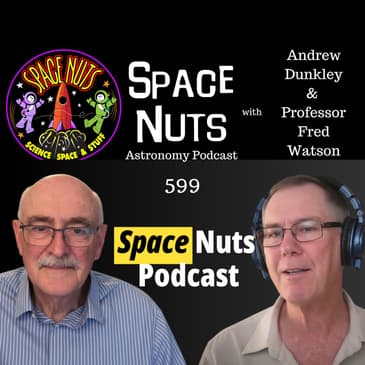
In this exciting episode of Space Nuts, hosts Andrew Dunkley and Professor Fred Watson delve into a series of captivating cosmic stories that will spark your imagination. From the groundbreaking creation of cosmic dust in a lab to the simultaneous volcanic eruptions on Jupiter's moon Io, this episode is a treasure trove of astronomical insights.
Episode Highlights:
- Cosmic Dust in a Jar: A Sydney PhD student has synthesized cosmic dust in a laboratory setting. Andrew and Fred discuss the implications of this breakthrough for our understanding of how complex organic molecules form in space, and whether this could reduce the need for future space missions to gather samples from asteroids.
- Simultaneous Volcanic Eruptions on Io: The hosts explore the extraordinary event of five volcanoes erupting at once on Io, revealing insights into the moon’s geological activity. They discuss the gravitational forces at play and how this discovery challenges previous theories about Io's solid interior.
- Follow the Coal to Find Intelligent Life: A new theory suggests that the presence of coal may be a key factor in the development of intelligent civilizations. Andrew and Fred unpack the idea that access to natural resources could influence technological advancement, raising questions about the rarity of intelligent life in the universe.
For more Space Nuts, including our continuously updating newsfeed and to listen to all our episodes, visit our website. Follow us on social media at SpaceNutsPod on Facebook, Instagram, and more. We love engaging with our community, so be sure to drop us a message or comment on your favorite platform.
If you’d like to help support Space Nuts and join our growing family of insiders for commercial-free episodes and more, visit spacenutspodcast.com/about.
Stay curious, keep looking up, and join us next time for more stellar insights and cosmic wonders. Until then, clear skies and happy stargazing.
Become a supporter of this podcast: https://www.spreaker.com/podcast/space-nuts-astronomy-insights-cosmic-discoveries--2631155/support.
Hi there, thanks for joining us. This is Space Nuts. My name is Andrew Dunkley and it's always good to have your company. I hope you're well. Coming up on this episode we will be discussing these things. A Sydney PhD student has created cosmic dust in a jar, probably not quite a jar, but pretty close to a jar. So how did they do it? And what does this mean? Does it mean we'll never have to go out the space again? Possibly? Anyway, that's a really good story, this one. Because I'm a bit of a volcano junkie. Simultaneous volcanic eruptions have been recorded on EO, one of Jupiter's moons, and it's a very rare event. In fact, I think it's the first time it's been recorded as far as I'm aware. So we'll look at that, and here. Is a line for the ages, find the coal, and we find the people. That's all coming up in this episode of Space Nuts back of the Channel ten nine ignition Space Nuts or three two Space Nurse, as I report it, mels good and here to unravel the revelment that is all of those stories is Professor Fred Wat's, an astronomer at large. Hello Fred, Andrew. I can easily ruvel them all up again. I can tell you make them even more revel than they were to start with. Yes, well, you know, we don't strive for excellence here. We never have. It's all about adequacytable. Sometimes we don't even make adiquousy. No, probably not no, But. Some quirky stories today, And I'm very excited about this first one because this, I mean, I joked about us not having to go back into space and you know, intercept asteroids and collect junk from them, because this kind of does it for us, and you don't have to leave the planet. The Sydney pH d student creating cosmic dust. This is quite extraordinary. It is. It's actually a great story, and it's nice that it's got you know, it's got a local flavor to it because of the Sydney University connection. I used to have an honorary professorship at Sydney University, but I think it's lapsed. I think they've got rid of me. So as never mind of them, still like dishonoring a chick, still happy to sing their praises. Sydney University is pretty good, particularly my dad went there. Yeah, that's good anyway, what's it all about. It's about a bit of a mystery because we now know. That, you know, a lot of the. Complex organic molecules that we often talk about as the building blocks of life, the amino acids and all of those sorts of things, we know that they are found in space. But what's not been clear is well, two things not clear. One is did they find their way to Earth? And maybe you know, when we find these chemicals, for example, in meteors and in comets, maybe yes, there have been collisions that have brought them to Earth. So that's a fairly logical step. But the big question has been how do they form in the depths of space enough quantities that they're quite commonplace? And we know they are because we can see a lot. Of these. Basically these chemicals. It deep in the dust and gas clouds that we often analyze, things like the nebulae which have got not just gas in them, blowing gas, but often clouds of dust as well. And dust is very well studied by astronomers using infrared and radio telescopes. In fact, one of my close friends who was one of my fellow students hundreds of years ago at Saint Andrews made his career in studying cosmic dust and the contents of that and looking at the way these chemicals come together or have been brought together. The question is how do they come together? And that's the question that's been asked by a team at Sydney University, including the PhD candidate who's I think she might be the lead author on this paper, Linda Losudo. She has essentially created this synthetic version of the cosmic dust that are infrared and radio astronomy colleagues measure in clouds of gas and dust. She's created it, synthesized it in the laboratory, probably as you said, in a jar, with other things as well. And the extraordinary thing is that what she's created seems to match what these carbonaceous dust particles tell us in space. In other words, you know, it seems like a very accurate synthesis. So what she did was took a set of gases quite simple nitrogen, carbon dioxide and acetylene which also contains hydrogen oxygen, these gases in a tube and then basically irradiated them with very intense electrical energy. They put ten thousand vaults into the tube, which was almost in a vacuum, so the pressures are very low, and you actually, if you do that, you get these glow discharge phenomena, You get colors appearing from the exciting X citation of the atoms. But what she also found was that on silicon basically sorry, not silicon, silicate silicate fingers within the within the tube, they found these tiny particles of dust forming, and when they analyze them, they've got exactly the same chemical signature as these dust clouds in space. And so what they're saying is that these basically these chemicals do form in the kind of high energy environment that you find around for example, a white dwarf star that's beaming out ultraviolet radiation, or in the aftermath of a super and ova, where you've got a sort of neutron star which is also got high energy processes because the you know, the supernova explosion itself creates shockway and things of that sort. So she's basically mimicking those conditions and finding that what she gets in the jar is what you get in space when you see those conditions. So it's a really nice piece of work, and congratulations to that. Yes, yes, indeed, and I mean I was probably being a bit silly suggesting that this is going to replace the need to go out and catch asteroids and have a scratch around on the surface. We still need to do that because they're not all identical. There's going to be things to learn from various missions in the future, which we've already seen come to fruition in a couple of cases. But I suppose what she's done is she's opened a door to learning how things happen way out in space where we can't even get and maybe coming up with ways of looking at these mysteries at a local level and kind of putting a bit more light on them. I suppose, Yeah, that's right, to study them better. And you know, I'm sure this is just the beginning of a series of experiments that will produce some really interesting results, might maybe even give us molecules that are actually closer to life molecules than they've already found. So I think I think it's a very promising avenue of research. It coincides with a story I read last week that had nothing to do with astronomy or space dust, but it was a science story about a bloke who went to a river and took a handful of mud, shoved it in a jar and then sealed it off from the rest of the world. And he just filled it with water and just put it to one side, and he left it, and he covered it up, and he didn't go back for a couple of months, I think it was. And when he came back, it had created its own balanced ecosystem, completely separate from the rest of the world. New life had come and gone, and a species had become dominant, some kind of slug. You know. It really does. Make you wonder how life hasn't been found anywhere else yet if that can be done with a blob of mud from a river in a sealed jar. I mean, if you opened it, it all dies because they've created their own world. But it was an amazing story. I was captivated by it that I didn't think it was possible. I thought, if you cut off the outside world, that would be the end of it. But no, they created their own eco system and their own environment and their own atmosphere, and yeah, it worked. I didn't think it was possible. Now kids are going to be going out filling jars with mud and seiling them up. This is what's a fascinating experiment. Yeah, if you wait a few million years, you john like you know, Evolver a dinosaur or something like that World. Cood miniature one. You never know. That's a fascinating story and this one is too, and you can read about it at fizz dot org. And I think the paper was published in the Lost It there you go. I saw it there a minute ago, but there was a paper publisher the Astrophysical Journal there you are, so look out for that one. This is Space Narts with Andrew Dunkley and Professor Fred what's an Let's take a break from the show to tell you about our sponsor in Cogny. You know, if you've been overwhelmed by a barrage of spam calls and emails and targeted ads robo calls, it's probably because they can find you online very very easily and just harvest your contact information. If you've ever felt like that, then the answer is in COGNI. What happens is data brokers collect and sell your details, leading to an endless array of spam and other potential risks. And if you want to get rid of that, in COGNI is the answer. It's your personal data removal assistant. It automatically sends removal requests to over two hundred and ten data brokers, ensuring your information is taken down. You can even watch the progress of it through an online dashboard with weekly updates. You can track the cleansing of your digital footprint. Plus there's a thirty day money back guarantee, so it's risk free. It's called in Cogni, Take control of your online presence. Visit in Cogni dot com slash space nuts. And here's the kicker, sixty percent off if you use the code word space nuts. That's in Cogni dot com slash space nuts sixty percent off if you use the code word space nuts. Enjoy a peaceful online existence without digital disturbance, open anguality. They're the landed space nuts. Now this next story is just as fascinating. I guess most people will have heard of the moon Eo, which orbits Jupiter. It's a very very interesting and somewhat foreboding place. It's just absolutely covered in volcanoes and they erupted quite a lot. But what's happened in this case is they have had five volcanoes erupt simultaneously, which has kind of got them wondering what's going on inside. Exactly. That's right. In fact, that's the story in the Nutsha. So yes, the innermost of the large moons of Jupiter, the ones that were discovered by Galileo Buck in sixteen ten. It's the nearest one to the planet, and that means it feels the strongest and most disruptive, if I can put it that way, gravitational pull from Jupiter. So it's constantly being squashed and squeezed by the gravitation of Jupiter, and that's what we think is the reason behind it's very active and dynamic volcanism. It is the most volcanically active body in the Solar System. It's not the one covered with the most volcanoes. That's actually Venus. But Venus may be maybe inactive. Now we don't actually know whether Venus's volcanoes are still active. You and I've talked about that before, but we definitely know that the ones on EO are because we've seen them on many occasions and the results that have brought this story to uh, you know, to the science media. I have come from our old friend Juno. The spacecraft, the orbiting spacecraft NASA spacecraft, which is in orbit around around Jupiter, and it's captured basically infrared images of the southern polar region of EO, and has realized that there are five volcanoes going off at the same time. It's so it is really quite an extraordinary thing, quite a coincidence. These these volcanoes, they are all in the southern south polar region of EO. He is about the same size as our moon. It's not a small world. So what they've what they've done is tried to work out what that means if you've got first of all, a very violent eruption, that was what drew their attention to this event, but the fact that nearby there were others in sync with the main volcano. So what I think is coming out of this is the suggestion of a porous or spongy interior for EO, rather than a solid body as was thought before. And that might mean that there's some sort of like almost like a liquid magma reservoir. There's actually big enough that it pokes through the cruster EO in a number of different places. And so you've got several volcanoes all erupting simultaneously what they call interconnected magma chambers, which would allow for these highly lava rich eruptions to take place simultaneously, and so it it sort of calls into question the old idea about the interior of EO, which was thought to be fairly solid. But if it's kind of porous and spongy, then that might explain why we're seeing these phenomena of such volcanic activity. Yeah, and it's not the same kind of activity as we see on Earth with our volcanic eruptions, you know, which is to go to Well, EO, it's being really squashed by the gravitational pool of Jupiter, isn't it. Is that what's mainly like you squeeze the sponge and all the stuff comes out, Is that what's happening. Well, yes, it's almost like that, that's right, you're right, as I said, it's the gravitational squashing and squeezing that that being so close to Jupiter provides what we call tidal forces, that in the tidal effect. So yes, and you know, it's as though all the volcanoes in the Mediterranean, for example, suddenly started. Erupting at once. Vesuvius and and you know the other ones that are in that region Stromboli. Yes, yeah, that's right, that's the news. Thinking of all of those if they all suddenly started spearing out stuff at once, that would suggest something going on as we've got apparently on EO. But is a very different world from the Earth is and you know, and part part of the reason for that is this external gravitational stress that comes from Jupiter. Yeah, it's a it's a very toxic world, isn't it. It's not. It's not a nice place. You wouldn't want to wander around them on it. Well, it's mostly sulfur sulfur deposits that have come from these volcanoes. Yeah, well, yeah, it's yeah, it actually is a that's a nice thought experiment. Just to imagine what it would be like wandering around on EO. I think it might be quite quite an interesting experience. Wouldn't smell very nice? No, neither would you probably if you know to over the volcanoes and the lava lakes. It's got lava lakes, big pools of lava that we know about too, So. Yes, an extraordinary world. Yeah, it's got over four hundred active volcanoes apparently. Yeah, that's right. That's amazing. Now you said it was about the same size as the Moon. Here's another thought experiment. If you would have swap the Moon and EO, if you could just somehow, you know, but one way or the other reason vice versa. What would happen to EO orbiting Earth and what would happen to the Moon orbiting Jupiter. I think the Moon would turn into EO and EO would turn into the Moon, because yeah, because they you know that. Yes, there might be compositional differences and things of that sort, but it really is the it's the environment that dictates why EO is so volcanically active, and the Moon of course in a much much more benign environment. It's, in fact the main we do see evidence of large scale volcanism on the Moon. That's where the Maria came from. The so called seas on the near side of the Moon, these dark, darker areas. They are the result of basalt flows of lava flows. But that is from a period a long long time ago, and the heat was probably driven more by impact by bombardment during the late Heavy bombardment when a lot of stuff was hitting the Moon and the Earth too. But Earth of course has plate tectonics, so the evidence of all that's gone. Whereas it's still around on the Moon. But since that period three and a half four billion years ago, things have been pretty quiet on the Moon. But if you put it where EO is, know, I'm sure it would turn into another EO. Yet, well, I wondered, And yeah, that is interesting because we're pretty glad it won't happen. But then again, if you did, if you did swap them, it would make Artemis to a really interesting mission. I certainly would. Yeah, you would imagine having to pick your way between the volcanoes before you learned your air sex starship. On the moon. Absolutely, And I also read that part of that gravitational tug of war that causes the volcanism on EO is also attributable to Europa and Ganny Mate. Apparently they have a part of the plan in it as well. So poor old EO is getting bounced around like a ping pong boar, which is messy as it turns out. Yeah, yeah, you won't want to play ping. Pong with it, though, No, no, definitely not. It would definitely pong. For certain I wish I could say I flied you that line, but I'm afraid I didn't. Yes, that's all it goes if you would like to read up on that story, It's on the Daily Galaxy website, and I'm sure you'll be able to find a paper about it somewhere. As well, because I forgot the look. I usually look these things up, and some people do like to read the papers, but I didn't do it in this case. And I'm doing what's called padding right now so that I can actually find where the paper's been published and then tell you, because you'll think I'm amazing, but no, I've got no idea. Yes I have. It's been published in Planet. That's an old radio trick. That is, where there's something you need to say and you have quite quite got your finger on the button, but you just the track away until you find it. It's that you patter away, but you're doing that then on autopilot, and you're never quite sure what's going to come out. Now, that's true, yeah, But where it is it is available the paper at JGR Planets. This is Space Nuts. Andrew Dunkley here with Professor Fred Watson. That's one of the better. We've had a couple of cardiac reff down here too. Be space Nuts. Now. Our final story, Fred, is a really good one. As well, and I love the way they've sort of spun this one. We've talked before about the search for extraterrestrial life and whether or not there are intelligent communication capable beings somewhere else in the universe. This new study or theory or whatever you want to call it that's been published in the International Journal of Astrobiology, by the way, is basically saying that if we can find the coal, we will find the people. They've got a really interesting theory and I think it probably does have some street cred. Yeah, that's right. The normal mantra we talk about is follow the water, but in this case it's followed the coal. And the difference is that following the water, we hope will lead you lead us to living organisms, whereas following the coal might lead you to eat. And it's all all this all. This article is saying, really, is that we as an intelligent species and with a fairly high degree of technology you and I are using right now that has only come about because of the coal reserves that we find on the planet and what that and the reason for that is that it, you know, the coal basically fuel the industrial revolution in North America. The UK, and Europe. That was in fact, the world I grew up in Andrew was still fueled by coal. It was a very coal dependent environment that I lived in. You've got to have coal in order to gain enough heat to be able to forge steel. Then your steel needs to be honed and treated in such a way that you can actually keep going and finding more fossil fuel, like oil, for example, with drill bits. So all of that stuff they say comes actually from the fact that there were coal deposits not too far from the surface of the planet just the time that we were we as a species were emerging and recognizing the possibilities of the industrial revolution. It wasn't called that then. And in fact, here's a quote, and I'm quoting here again from fizz dot org. Without access to coal, our own civilization would never have been able to harness deep deposits of oil and gas and in turn generating our feet and electricity to melt steel. This enabled the development of radio telescopes that today dot our own planet, which can send and receive messages across interstellar space. So what they're saying is they're linking our technological prowess to this sort of accident. Almost that we had these coal beds laid down seventy or so million years ago that are kind of just at the right time for us to or were at the right time for them to have turned into coal and for that coal to be available near the surface so that we as a species could actually mine it and basically make use of it. What the authors of this article say is that if humans or some things like humans had evolved earlier than we did, then. Cole might not have existed. It might not have you know, got from the basically the peat that formed call into the material that we can now mine. And so that suggests that once again there is you know, it's almost like good bits of good luck that lead to our evolution as an intelligent species. And what in turn that suggests is that once again other intelligence species out there who are technically technologically able may actually be very rare in there there at all. If if the circumstances that they're pointing to are required for an intelligent species to be able to communicate, which is one of the Drake equations, that's parameters, that that could mean that the number of intelligence species is probably even less than we would consider, or and that that's a bit sobering a bit, sad Ina. Well, that's right. You know, there's so many aspects of the Drake equation. Excuse me. The only the only you know, firm parts of the Drake equation that we know about is that stars do form planets. Planets are very common, which was not known excuse me when Frank Drake put that equation together. But yes, the number of civilizations that do go on to develop the technology to communicate, that is one of the one of the terms in the equation. And if you don't have coal, you might never get there. Yeah. Does that mean though, that there may be intelligent species roaming planets somewhere else in the universe, but because they haven't been able to do what we've done, because they don't have access to, say coal, they reach a point where they can't go any further. So they're wandering around in their jockeys, you know, knocking dinosaurs on the head or whatever they do. And that's as good as it gets that. Permanently in the permanently in the Stone Age, Yeah, I think that is. Yeah. Wow. Until a coal comet lands on the planet, the call for or a coke a coke asteroid bottle because all that. Yeah, wasn't there a movie about that once? I'd be surprised and African native got hit on the head by a coke bottle and decided to return it to the gods. That's a very funny film. Yes, but yes, find the coll and we might find the people. It does seem to have a bit of credibility that particular theory, and you can read all about it at fizz dot org. It's also been published in the International Journal of Astrobiology. It's a fascinating story. And yeah, it does suggest that there might be intelligent species out there that can't communicate ever because they don't have the tools, because they can't make them. So that does that is fascinating. Indeed, we're just about done, Fred, thank you very much. A nice quick one today. It was certainly nice and also quick. Yes, you're right, just louting the time. We'll chut again soon, I hope. What's your name again, Andrew? That's right, it's definitely not Fred, No, it's you were. Going to be James there for me, and quite was going on. The I know Fred's already taken, so I can't have that one, all right, we'll catch it next time. Thanks Fred, Yeah later, I get that one a lot. Professor Fred Wat's an astronomer at large joining us here on Space Nuts. Don't forget to visit us online. As well at our website Space nuts podcast dot com or space nuts dot Io, where you can send us questions or comments through the Ask Me Anything link at the top of the page. There's the daily newsfeed you can subscribe to. You can also go to our shop and have a bit of a browse around. There's lots of goodies in there, and if you want to find out how to support us, hit the Support our podcast button and learn more about that. It's not mandatory, it's voluntary, and we do say thank you to the patrons that sign up. We really do appreciate your support. Thanks to here in the studio who couldn't be with us today because he's gone looking for coal. He thinks it's going to help him have better communications with his wife. Oh and from me Andrew Dunkley, thanks for your company. We'll see you on the next episode of Space Nuts. Bye byepauts. You'll be listening to the Space Nuts podcast available at Apple Podcasts, Spotify, iHeartRadio, or your favorite podcast player. You can also stream on demand at bites dot com. This has been another quality podcast production from nights dot com.