
Space Nuts Episode 509: Neptune's Secrets, Lunar Dust Shields, and the Helix Nebula
In this exciting episode of Space Nuts, fill-in host Heidi Campo joins astronomer Fred Watson to explore some of the cosmos' most intriguing phenomena. From the latest discoveries about Neptune's atmosphere to innovative solutions for lunar dust challenges, and the mysteries of the Helix Nebula, listeners are in for a treat filled with cosmic insights and engaging discussions.
Episode Highlights:
- Neptune's Atmosphere: Heidi and Fred dive into the recent observations made by the James Webb Space Telescope, revealing the presence of auroras on Neptune and discussing its unique atmospheric conditions, including record-breaking winds and intriguing cloud formations.
- Lunar Dust Shield Innovations: The duo explores NASA's new Electrodynamic Dust Shield, designed to repel lunar regolith, and its potential applications for future lunar missions and even everyday life on Earth.
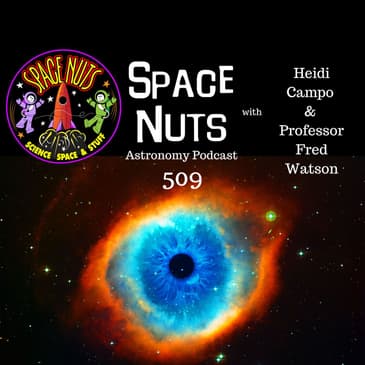
- Helix Nebula Mysteries: The episode wraps up with a discussion about the Helix Nebula, its stunning visuals, and the fascinating theory surrounding the remnants of a planet that was destroyed as its star transitioned into a white dwarf.
For more Space Nuts, including our continually updating newsfeed and to listen to all our episodes, visit our website. Follow us on social media at SpaceNutsPod on Facebook, X, YouTube Music Music, Tumblr, Instagram, and TikTok. We love engaging with our community, so be sure to drop us a message or comment on your favorite platform.
If you'd like to help support Space Nuts and join our growing family of insiders for commercial-free episodes and more, visit spacenutspodcast.com/about
Stay curious, keep looking up, and join us next time for more stellar insights and cosmic wonders. Until then, clear skies and happy stargazing.
(00:00) Welcome to Space Nuts with Heidi Campo and Fred Watson
(01:40) Discussion on Neptune's auroras and atmospheric conditions
(11:20) The innovative Electrodynamic Dust Shield for lunar missions
(22:15) Exploring the Helix Nebula and its planetary ghost
(30:00) Final thoughts and reflections on space exploration
Become a supporter of this podcast: https://www.spreaker.com/podcast/space-nuts-exploring-the-cosmos--2631155/support.
Welcome to Space Nuts. My name is Heidi Compo, and I'm here with Fred Watson, Astronomer at Large. And I bet many of you are wondering who is this lady, Why is she here? Where is Andrew? I can assure you he is just fine and probably having the time of his life. I am here filling in helping him out while he is on a little break. And I found say Space Nuts originally from just being a listener myself. I also have a podcast, reality Check the Science of Fiction, where I talk to subject matter experts about the plausibility of sci fi concepts. And I am a graduate student here in Space City, Houston, Texas, and I'm focusing on spaceflight, human optimization and performance, so I have a very interesting segue into the space world. I'm really interested in a lot of the I guess, the sci fi concepts that integrate into space science and all the new discoveries that Fred knows so much about. And I'm excited to be here as your fill in host for this episode. Fifteen second guide to the in Channal ten nine ignition Si Wench Space Nuts NI four three two one Space Nuts as when actually boughted Neil's good Fred, thanks for having me. You're very welcome. Heidi. Is a delight to welcome you to the Space Nuts team. It's very appropriate. I think that we should be beaming out from Houston, Texas. And what better person to fit into Andrew's empty shoes at the moment than yourself. It's lovely to have you, and I'm really looking forward to our our next few sessions when we can chat together behind Andrew's back. Now, this is going to be great. So we have some really interesting topics this week. I was looking over them. We're going to be talking about the Blue Ghost sojourn on Mars or sorry, on the Moon, and that looked really interesting in me. The other thing we're going to be talking about is some of the activity with the James Webb telescope about Neptune. So that's a planet we really don't talk as much about. Neptune is really kind of the ignored stepchild of the Solar System, so I'm excited to hear what. You have to say about that activity. And then the last thing we'll be talking today about today is the Helix Nebula and some really exciting new discoveries going on with that. So I think that I would be interested in just jumping right in with the Neptune story. Excellent, a good planet to start with, Heidi, And you're absolutely right. Neptune has only been visited by at once by a human built spacecraft. Maybe there were alien spacecraft that have visited it, but only one human built one, which was Voyager two. And so what we know about it really comes very much from the images that were taken when Voyager two flew by Neptune. That was in the eighties. But Neptune, of course is a world that has an active atmosphere. It's an ice giant, one of the two ice giants in the Outer Solar System, and that term refers to the fact that we believe there are solid ices as a kind of haze in the atmosphere of Neptune. So it's slightly different from the other two gas giants, Jupiter and Saturn, which they don't have those icy hazes because their temperature is just slightly warmer being nearer the Sun. So the really interesting thing was when the flyby with Voyager two took place, Neptune looked very boring. It had you know, it was just like a pale, blue green disc with not much happening, and I think that probably did it a disservice because we've you know, we thought of this planet is having rather uninteresting atmospherics, although subsequent measurements made from Earth actually demonstrated that it does have high winds in its atmosphere. And just a mention to. The system of moons of Neptune because some of those are particularly interesting as well. Triton is its largest moon. It may well be one of these ice worlds with a rocky core, an overlying ocean, a global ocean, and ice on top. That's not what we're talking about today. So what's the story. Why is Neptune in the news. Well, it's because, as you might expect, it has been a subject of observation by basically astronomy's new toy, still new after three years, I guess now, the James Webb Space Telescope with its marvelous infrared cameras and very very sensitive spectroscopic systems. So what has been detected by the WEB is something that we've known about, maybe hinted at by earlier observations over a long period of time, probably since the voyager flyby, that it has a rory or auroras if you want to be less picky about your Latin, northern and southern light like we have on Earth, like the other gas giants themselves have. But the problem is, you know, hints are fine, but what you really want is a kind of signature of these things in the spectrum, the sort of rainbow of colors that we see when we split the light up into those components, and that, as we've discussed many times on space Nuts, those spectra are crossed by a kind of almost like a you know, a supermarket barcode of information which we can read and detect what gases are involved with these with these spectral colors. So yes, the James Webb has thrown its might behind observations of Neptune, and sure enough we have found strong emission of the kind of telltale elements that indicate auroral activity. And remember a rorria caused by the solar particles, the subatomic particles that come from the song interacting with the atmosphere of planet. That's what caused the glow and that's why it has characteristic colors, because the glow itself comes from the elements in the atmosphere. So yes, ar on Neptune and very similar to the phenomenon on Earth, but different colors because it's different elements that are being excited. The green in a rory here on Earth comes from oxygen, which isn't there on Neptune. So the colors are coming from they're actually coming from hydrogen. Yeah, and it's absolutely beautiful. I'm looking at these images right now. It reminds me of one of those mood rings that were really popular in the nineties where it's starting to change color. It's really spectacular to see. And I'm seeing in this image. So you just described that the greenish color comes from hydrogen. I'm seeing also spots of white, because if you look at the images of Hubble, which it's pretty much just blew all the way across, and then the image of the web, there's some big white spots. Is that part of the aura? I suspect some of those are clouds, which are also now visible in the infrared. We see similar things in the atmosphere of Uranus, white spots, which are very extensive areas of cloud in the atmosphere. The atmospheric circulation, you know, on both those ice giants, Uranus and Neptune, is relatively slow in terms of the changes in the atmosphere, and that's partly because the temperature there is minus two hundred and fourteen degrees celsius at the surface, but that doesn't necessarily mean that you don't get high winds, and in fact, I think the winds on Neptune are the record breaking winds in the atmosphere of a planet in the Solar System. Up to two four hundred kilometers per hour, that's what's that. That's about eighteen eighteen hundred miles per hour. So it's very fast. I'm thinking of it in hurricane terms. It's super hurricane, that's right. And I think that there is also on Neptune. There is a something that's sort of related to the great red spots on Jupiter, a storm, a long lived storm, and maybe that's what's showing up as the some of the white spots, or at least one of the white spot. I'm just looking for them now. There is a big white spot in the middle of the JWST images, but. Is the Aurora. And you've just reminded me though looking at those pictures. One of the peculiarities of Neptune is that we think it's magnetic axis that the two magnetic poles are tilted well over to sort the middle latitudes, unlike here on Earth, where they don't exactly align. Magnetic north is not the same as geographic north, but the the magnetic poles more or less align with the rotation of the planet. And that's probably to do with the fact that we think these that the magnetism is generated by the circulation of the iron and nickel core, which is in two parts, and it sort of acts like a dynamo, and that generates a magnetic field. Neptune and probably the other gas giants have something similar. We really don't understand the origin of their magnetism. We don't know whether there's a solid core or not in the gas giants. We suspect there must be in order for them to have these strong magnetic fields. But on Neptune, the magnetic field is tilted over at quite a considerable angle to the rotation of the planet, which is why the aurori appear at mid latitudes on Neptune rather than near the poles as they do here on Earth. As I know well from my sojourn up in the Arctic two months ago. So there's something going on with Neptune's orbit, it's either wobbly or it changes or something like that. Would that have anything to do with this tilt? It is possible, you know, the two may be related. Usually the rotation of a planet and its orbits are fairly decoupled. And you've only to look at Uranus, which you know, as you know, is tilted over nine degrees. I think it's nine degrees below what you might call the horizontal the plane of its orbit, and Uranus has a reasonably well. Sort of well behaved orbit. Neptune's interesting because it's, in modern parlance, it represents the outermost planet of the Solar System, and it does affect the orbits of the many myriads of objects that we know lie beyond that, so called trans Neptunian objects, which include things in the Kaiper Belt and things called resonant objects like Pluto's. Pluto's are resonant objects because it resonates in its orbital period with Neptune and the and the scattered disc objects as they're called, way beyond that. So it could be that Neptune's orbit is interacting with those. Although a big planet like Neptune, it takes a lot to shift its orbit to perturb it. So I haven't seen those reports that you've mentioned, and everything you've just heard is complete waffle. But that's the way it works when you're talking about things you've not seen before, right, And I. Think there's just so much of that with space. It's the I was at a NASA tech talk last week and one of the they were talking about sands, which is an ocular syndrome that the astronauts experience. Yes, sorry, they have issues with their eyes. And now, for those of you listening, my little dogs biking for attention to the corner. We're just gonna ig norm it totally good time when we're done recording. But the the person enter he brought he was a flight surgeon, and he brought up so many funny headlines and articles it's NASA scientists say this and this. He's like, I cannot find these experts. Yes, if anybody knows these experts that this headline is claiming to talk about, please let me know, because this is all wrong. So I think there's a lot of that in the space industry. So that is a really interesting syndrome, isn't it, Because that's one of the potential long lived consequences of long term spaceflight that you've got these ocular effects. My sorry, we're way off topic here, Heidi, But that's all right. I've forgotten you. About Simba, like the lion king, his wagon, his tail. He's asked me. He's trying as hard as he can to be as cute as possible. He's doing a fine job. Yea computer. He thinks if he's cuter, I'll stop recording and go play with him. Yeah, I know the syndrome. So just what I've read is that it may be caused by the fact that, you know, the circulation in the body, the blood circulation in the body changes in microgravity, and that you might well have pressures in the cranium that might affect the eyes in a way that we don't have on Earth. Is that the thinking or am I just making there? You're absolutely spot on. Yeah. It has everything to do with fluid. So when the fluid changes in the body, we normally have gravity pulling that fluid away from the head, But when we're in space, the fluid tends to, you know, pull up towards our head and shift in places that we don't necessarily want it. So there that is a leading issue and causing that pressure, and then there were you know, there were so many other points and tangents with that, but we're learning so much more about it now. And one of the really interesting things with space medicine and human performance in space is when we're looking at the research, we'll have like an n of eight and for those of you non science people, and is your subject numbers, so you know, when we're looking at, you know, cancer research, that can be in the hundreds or thousands of data points that we're looking at. But when we're talking about astronaut health, it's just a handful of people. So there's really there's as much as we know about it is with the people that have been to space already. And that's one reason why I'm so excited about what some of these other companies are doing, like Blue Origin, Axiom Virgin that are getting more and more people into space so that we can learn more about space health, which does influence health on Earth. There's so much we've learned about space medicine that has helped improve life on Earth. Which is remarkable and great news. And one of the you know, the many, many, many benefits of space exploration. We've got another commercial flight about to launch. I think within the next few days. Is that right? From two mission? Oh, they're going all the time. I don't I can't even keep up with all of them. Sometimes that's what you should listen to this show for. So I have another deputune question, and I want to segue this in with the Humans and the People part. Are you familiar with the book? It's a book and a TV series called The Expanse. Are you familiar with it? No? And I apologize for that because there's so much going on out there that I simply don't have time to read or look at. And yeah, I rely on I certainly rely on Andrew keeping keeping me honest in regards to science fiction, and I'm sure the same is going to be true with you. But no, I don't know about that. Yes, So in the Expanse, they have they have populated the Solar System. There's people living on Earth, Mars, and there are also people living out in the Asstroid Belts. They call them Belters. And these people are multi generations born in space, so they have physiologically adapted to life in space. So they have become physically different from people born on Earth because of the gravities and the systems there. So I want to segue this back into talking about Neptune, because we have ice, we have wind, and from what I do know about greenhouse gases and thinking about the expanse, there has been some chatter about putting some industrial factories and whatnot on Mars eventually to help generate greenhouse gases to help increase atmosphere on Mars. Is this something because I always like to think about what we're looking at and seeing with these auroras in space and everything we're learning, and what does it mean for future generations? Could could Neptune potentially be. A big power generating planet with the winds if we could harvest these winds. Well, the lovely idea wind turbines on Neptune, Now that's really a really expansive idea, if I can use the joke there. It's so. The likelihood is that with with so many things that people talk about doing in space, it's actually easier not to to find alternative sources of whatever it is you're trying to generate. And the winds on Neptune colossal winds, as we've said, you know, up to maybe approaching two thousand miles per hour, How you would generate them, It's hard to know. What might be interesting though, is if you could use them, sorry, how you could use how you could use those winds to generate power? How to know? But if you could use those winds to facilitate exploration of the planet's atmosphere, And that's something I could well imagine, you know, people dropping balloons into the atmosphere of Neptune to watch the circulation, to do what we do here on Earth with our multiple capacity for measuring and predicting the weather. So whether or Neptune might be something that turns out to be quite interesting, I think a more in some ways, a more what's the word apposite? Maybe is the right word world to be interested in the Neptune system is moon Triton, because that could turn out to be, you know, one of the places like Europa and Enceladus that has the potential for perhaps living organisms beneath the surface. And that is very exciting, very exciting, And it really just comes down to the human ingenuity, the engineering and all the new breakthroughs that we're making. It seems like every single day there's more stuff that we're coming up with to get us out there. Okay, let's take a quick break from the show to give a shout out to our sponsor, Nord VPN. Now, if you're not familiar with VPN or virtual private networks, think of it like a shield that protects you from hackers and scammers trying to hijack your data. It keeps you hidden online, which is super handy anytime you're using public Wi Fi, and that could be at a airports, railway stations, hotels, cafes, shopping malls, basically anywhere that offers open, unencrypted Wi Fi. Getting hacked and having your. Personal information stolen or worse, sold on the dark web isn't fun, but it's avoidable with a VPN, and honestly, there's no better option out there than noored VPN. Right now, Space Nuts listeners get an exclusive deal four months extra for free when you sign up for two year year plan and that's a saving of seventy four percent, plus it comes with their thirty day money back guarantee. All you have to do is head over to NordVPN slash Space Nuts and click on get NordVPN. You'll see all the current deals and options, including their VPN service, malware protection, ad blocker, track a blocker. They're awesome, password manager, and even a data breage scanner. Seriously, have a look at it. NordVPN dot com slash space nuts. I've been using. Nord for over two years now, and I'll be renewing because it's hands down the best security for my needs and probably for yours too. Nord vpn dot com slash space nuts. All right, let's get back to the show. Space Nuts, which I think. Is kind of a good segue. Next, Storry. So now says created this new dust shield and it's going to help repel the lunar regolith, which is very important. The is very fine, it's very sticky. It can be kind of dangerous if this is getting in their analogs and their facilities and where they're living. So tell me more about this. This is quite the interesting story. That's that's Jordy. Let me just check what's happening. Because he does sound like a chicken. J I do like a chicken. It does, doesn't it. Yeah, it's just like a rooster. He doesn't know that. He thinks he sounds like a big Just calm down, Jody, it's all right. That there's there's a dog that he hates that he's only occasionally brings it near our. Property to take. Don't they know better? Yeah, all right, joby count out. Okay, So the lunar regularis back to the Moon, from the sublime to the ridiculous, or the other way around. Yes, you're right, absolutely right that the soil on the Moon is such an interesting thing. It's different from anything we have on Earth. And that's because it has been formed not by wind and water erosion like the soil on Earth has, but by bombardment by these subatomic particles, the wind of particles that constantly blows from the Sun, probably a few micrometeorites banging into. The surface as well. And so what we've got is a soil that is very very fine and very angular, so it's got sharp edges all the way around it. And exactly as you've said, that's why it gets into all the nooks and crannies, all the crevices that the basically the clothing of astronauts. There is one. Recorded case, and you probably know more about this than I do, Heidi, one of the Apollo missions, and I can't remember which one it was, but so much dust was brought into the lunar module by one of the astronauts that it pervaded the whole return trip back to Earth and gave that person the first case of Luna hey fever because he was sneezing all the time because of this dust. I can't remember who it was. I do remember hearing about this. I also can't remember who it was. But yeah, it can be quite the problem. It's just a sticky, fine mess. So NASA, in their wisdom, are looking at ways to mitigate the effects of that. And as part of the Blue Ghost mission, that was a spacecraft at commercial spacecraft landed on the Moon successfully I don't know a month ago, I guess it's not very long ago, which was part of NASA's program for I think it's called the Commercial Lunar Payloads program, in other words, getting the commercial world to actually do some of the legwork in preparing for the Artomus flights to the Moon later in the decade. And one of the experiments carried on board Blue Ghost was indeed about how you can reduce the effects of this lunar dust. It has a name, it is called the EDS, the electrodynamic dust shield, and basically it is a way of removing the contamination of dust and dirt from whatever surfaces you've got on the Moon. Probably it's more. Like spacecraft surfaces than clothing, although it might lend itself to that eventually. And it seems to have worked very very well. There is a pair of images which are pretty easy to find on the web. I'm looking actually at the NASA website itself for the press release which is entitled NASA's dust shield successfully repels lunar regularly on the Moon, and you can see her before and after with this device activatesd I suspect it works well. It's called an electro electrodynamic dust shield, but that electrodynamic usually means moving electrons, so there's a current flowing, but I suspect that the basic mechanism is electrostatic. It's a repulsion of the of the you know, the flightly charged soil particles that. Exist on the Moon. They are they are electrically charged, so if you can give them an opposite charge, they'll be repelled. And that looks as though it's what's happening, and it's been met with success, so perhaps it's a step forward in cleaning up our voyages to the Moon and not bringing back a whole lot of unwanted moon dust when you come back to Earth. Absolutely, And I'm just thinking again of the implications for Earth, because i think sometimes there's a little bit of like I said earlier, there's a little bit of a disconnect, you know, thinking space and how it's not related to Earth and it's so so related to everything we do here on Earth. I mean, GPS, NASA gave us, GPS, NASA gave us water purification, NASA gave us. Oh man, I'm totally mind blanking the big machine that you go into that scans you, if you go to the hospital, MRI machine, Yes, that should be the one that I know. But yeah, I mean, so much of this has come from space science, and I'm thinking of something that would make my life easier, even just on the simplest level. If the surfaces in my house, my tables and everything repelled dust. And I don't know if we are just that much closer to inventing dust repelling surfaces, and that just makes everybody's life that much easier, that much safer, because then you're not using cleaning agents and chemicals to clean your house. You just have a surface that just repels that dust automatic and that just that could even have really good implications in sterile environments like computer places where they're building computer or hospital settings. So this is actually very very exciting that they're doing this. And the article is quite short, it's just a blurb, but the implications of this, you know, we don't know how this is going to improve life down the road. Exactly. That's right. It's you know, the the sky the sky's limit, really, isn't it in terms of what we can do with the space technology technology perfected for space. I do worry, you know, if you if you press a button and all the dust leaps off all the surfaces in your house, you might need an extractor fan to take them away. So they don't wind up somewhere where you don't want them. Yes, to be the next the next segue, Okay, we take a space nets. Yes, speaking of the sky being the limit. Our last article that we're looking at there was a big Nebula explosion and there's a glow left over from it. The title is a Nebula's X ray glow may come from a destroyed giant planet, and that's quite dramatic. But we are excited about these images because it tells us about history. That's right, And in fact, everything in the universe tells you about history, which is great. You're always looking back in time. We're looking back in this case. I think it's about six hundred and seventy six hundred and. Fifty light years. It's a very very well known object called the helix nebula, and in fact first captured in full color by my colleague and friend David Merlin, who was the person who essentially developed a technique in the nineteen seventies and eighties to put true color into celestial images by taking three sets of photographic plates as we used in those days, through red, green, and blue filters, and he became very well known for that. He was totally fastidious and still is actually about getting the color balance right, so that what we saw in these images was what we would be able to see if our eyes were millions of times more sensitive. Now segue from that to the present time. When that lovely color image of the helix nebula, it became very very famous. That was what we see in visible light, but it's now been observed many other wavelengths of light as well, and ranging from infrared to X rays I fact put it that way around, or X rays to infrared, and it's the X ray radiation that is the most exciting, and it's the reason why we've got this story. So the helix nebula, just to give the backstory, is what we call a planetary nebula, and it's nothing to do with planets except in the way that we'll come to in a minute. It was called that by William Herschel, an astronomer back in the early nineteenth century, who saw these things which were clearly not planets because they were in the deep sky. They were moving with the stars rather than with planets, so they weren't in the Solar System, but they had a slightly planetary appearance. They looked circular, so he called them planetary nebulae. And what we discovered in the early twentieth century is that what we're seeing there is the outer layers of a star which has reached old age and is not massive enough. To explode like a supernova. An exploding star that detonates and blows itself to pieces, you need to be more than about three or four times the mass of the Sun to do that. In fact, ten times is probably a better bet. The star, like the Sun, gets to the end of its life and basically the instabilities that are caused by the fact that it's used at most of its hydrogen fuel. It causes the outer atmosphere to basically to be shed gently and that produces a cloud of gas, often spherical in forms. Sometimes they're eyeglass shaped. They've got all kinds of different shapes. But the helix nebula in the southern hemispheres sky is the classic example of a planetary nebula. A star at the end of its life, it shed its out alair as they're glowing. Because what's left of the star is a remnant called a white dwarf, which is an object the size of our planet, size of the Earth, but with the mass of a star, so it's very very dense. Now, white dwarfs are interesting creatures in their own rise, but the helix nebula has one that is even more interesting the normal because it radiates copiously in X rays and X rays. We have to get above the atmosphere to detect because the atmosphere fortunately absorbs X rays very very effectively. But there's been a number of space satellites, mostly satellites around the Earth, spacecraft that have been essentially used to survey the sky in X ray emission, and the helix nebula of course, has been one of the things that have been looked at with X rays with a whole series of different satellites through the you know, through the ages. It was. Actually first detected by back in the early nineteen eighties by NASA's Einstein Observatory, which is an X ray satellite, and there was another one called ROSAT. I guess it comes from the German word for X rays after. Professor who discovered them Rosat in the nineteen early nineteen nineties. Both of those spacecraft detected X rays from from the helix nebula, which weren't really understood now. Those have been followed up a couple of decades later. NASA's Chandra X ray Observatory in nineteen ninety nine and XMM Newton which is a European Space Agency spacecraft in two thousand and two have recorded these copious quantities of X rays coming from the helix nebula. What is it all about? Where do they come from? How do you get something that shouldn't be producing X rays but has you know, sort of thirty years, well twenty years anyway of strong X ray emission. And so the people who think deeply about these things, the theoretical astronomers, and some of these astronomers in this case, some are in the United States, but some are also in Mexico. They have deduced that what's happened is probably a Jupiter sized planet, maybe a bit more than Jupiter, was orbiting the star as it reached the end of its life, carried on orbiting the white dwarf. But because of the forces involved with the collapse of the star to a white dwarf at the end of its life, that the planet was shredded basically and formed a ring of disc sorry, a disc of material, not a ring of disc that doesn't make sense. A disc of material around the around the white dwarf which is accelerated to very very high velocities. The gravitational field of a white dwarf is a bit like a black hole, not quite as extreme, but very strong. And so this is the ghost of a planet exactly, Yes, the debris of a planet. Planetary ghost. I love the term it's but it's all it's you know, it's basically it's dismembered remains whizzing around this white dwarf at high orbital velocity, and that creates X rays because of the heating effects of this turbulence that is in the disc of material. And that's the theory at the moment, and it's the best one that we've got as to why the Helix nebula is so copiously emitting X rays. That it's got an unfortunate planet that didn't survive the collapse and is radiating. Violently in the X ray wavelength. So that rather story. Let me see if I understand this correctly. So I'm looking at this image and it's got kind of a red dot in the middle. For those listening, if you don't see the image, you guys can look up the Helix nebula. It's a very famous photo and you'll see what I'm describing. It almost looks like a kind of like an eye. So it's got this red like the terminator. It's got this red dot in the middle, and then it almost looks like an iris, and then it keeps expanding out. It actually does look exactly like an eye. Now that I look at it. But so the planet got sucked into the red which is the dwarf, and then bun apart like a centrifuge. And because it looks like it exploded from inside out, well what's happening is it's spinning apart, and that's why it's surrounding this red and it's spinning, and so the gravity is like the debris coming apart from the center rather than getting pulled into the center. Is that what I'm am, I understanding. That's correct. Yeah, that's right, Yes, that's right. So the X radiation is, you know, it's sort of pervading the whole of the nebula. You've got X rays coming from every part of it, or appearing to but they're being emitted by this object which is actually within. It's not visible. The disc itself is not visible, the disc of material that was this planet that's too near the white dwarf. The white dwarf itself is visible, in visible in optical image, visible light images, but not in the X ray image. So it's a match of inference along the lines that you've just described. So maybe you already explained this because this doesn't make sense to me. Why so if the gravity is strong enough to be keeping these bits and parts within its gravity. Why is it still spreading out. So that the the the gaseous envelope of the star itself is that was basically emitted over many millions, probably tens of millions, hundreds of millions of years before the star collapsed into a white dwarf. So that's far enough away that it's not feeling that intense gravity in the you know, the region. Near to the white dwarf itself. It's it's basically drifting off as because you know, the distances are measured in light years, they're not they're not measured in million of kilometers. They're very very large distances. So yes, it's a great question though, So it's all the stuff that is really within the immediate vicinity of the white dwarf that's feeling that acceleration and undergoing that intense orbital motion around the white dwarf. Is this your favorite nebula? It probably is. Actually that's a really good question too, because I've never sort of thought about that. There is a well known one in the northern sky which will be visible from Houston, called the ring nebula, But the Helix nebula, I think is a little bit more glamorous because it's got a. Bit more structure to it. It's got this it's called the helix nebula because it's it looks a bit like a sort of unwound spring. And you can see you're probably having a look at the ring nebula as we spear. Yeah, it's absolutely beautiful. That's just stunning. So I think maybe this will be a topic for a or another session, but I definitely want to understand more of the technology that you said your friend developes. And he was also Fred No. Actually is Fred's middle Dave's Frederick David Maeln. Yeah, so he just briefly. When the Anglo Australian Telescope, it's the largest visible light telescope on Australian soil, with a three point nine meter one hundred and fifty six inch mirror, and he and I both worked there. I was the astronomer in charge for twenty years in fact, but before that he in fact, when the telescope was brand new, he was taken on board on the stuff. He speaks a lot like me because it comes from the North of England, went to Australia and perfected this technique in those days imaging of astronomical objects was done with photographic plays, and I'm talking about nineteen seventy five. That's when he went to Australia and apart from a few experiments with color emulsions, normal color film, which really didn't work well for astronomical objects because color film is designed for a very short exposure. You know, you're in a camera, press the button, shutter opens and closes again in the fiftieth of a second, and you record the image. Astronomers spend hours exposing their photographic plays as we did in those days, and the whole you know, optical chemical process that makes color photography just didn't work, and so he designed this technique. It actually goes back a couple of hundred years to you know way people thought you can perhaps replicate with the red, green and blue, you can replicate a color image, and it's true you can, but it took David's skills and hard work to perfect that and the result was twofold. It made the telescope very famous because his images found their way on to the front covers of magazines and album covers and books. They were all over the world in. The nineteen eighties early nineteen eighties. It made the telescope famous and it made him very famous as well, and he still is interested in this. He's now retired. He doesn't really do any frontline photography anymore, but occasionally we end up involved in scientific discussions about all kinds of things, so he's still very active. Well, it's I mean, I think nebula's I think are probably one of the most beautiful, beautiful things in space, and these images are just breathtaking and to think of the it's almost impossible to comprehend the scale of a nebula because we just see him on our desktop as a beautiful picture, but to think of the size and the magnitude is quite amazing. And the contributions the field are really quite incredible. It's quite astonishing to think of the conspiracy theorists and how they think that these are just you know, computer generated and they're like, oh, the scientists are just painting the photos to make them look like how they want. And then you're telling us stories of how your friend and you put twenty years into just developing these technologies. Yep, yeah, that's right. Look, conspiracy theories another breed. We can talk endlessly about them, but yes, you know, the work that David did was really very rigorous to try and make sure that what we were seeing was what we would see if our eyes were more sensitive. The downside of that, Heidi, is that whenever David went anywhere to get a talk, and he did that all the time, especially in the digital era, as things moved on, he got very upset if the color balance on the projector was not to his liking. And indeed he started all his talks and I do now too, with a basically a color chart, you know, a color die, and if it wasn't to his liking, he would start tinkering with the projector to try and make it so, and once in a while he would refuse to give the talk because it would not show his pictures in the true colors that he'd work so hard to create. Talk about a perfectionist things like that, you really just makes the conspiracy theorists sound just that more that much more silly. They think they have something figured out because they watched a YouTube video. Yes, but. Not to end on a negative note of the conspiracy theorists, and we'll take it as we're ending on a positive talking about these beautiful, beautiful nebulas and these incredible contributions to the field, and I just want to, I don't know, inspire and encourage listeners to if you're a space enthusiast to keep considering all these possibilities, and if you are someone who works in the field, you never know what you know you're going to be producing twenty years from now, and what your work is going to do and contribute to humanity, and what kind of neuroticism you'll develop, if you'll never be able to look at a projector the same way, or if you're just going to become the person who is so obsessed with doing this one thing because you've put twenty thirty forty years into studying something so incredibly niche Fred, do you have anything else you want to add? Not to that story, just to say this has been a wonderful session. I think it's episode five hundred and nine that we've just done. Wow, it's been great talking to Heidi and I look forward to our next chat. Excellent. Again, thank you so much for having me and you have been listening to space Nuts. Thank space Nuts. You'll be listen to the Space Nuts podcast Hope available at Apple Podcasts, Spotify, iHeart Radio, or your favorite podcast player. You can also stream on demand at bides dot com. This has been another quality bond Cast productions from nights dot com