
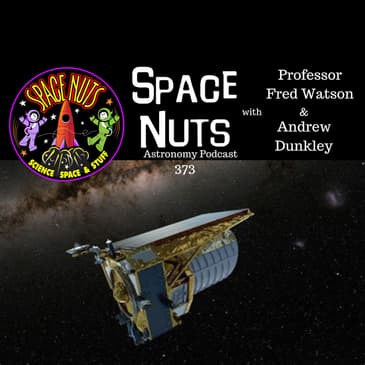
Do you want to gain a deeper understanding of the groundbreaking Euclid telescope mission? Are you looking for a solution that will allow you to explore the fascinating world of space exploration and astronomy? Look no further! In this article, I will be revealing the key insights and information about the Euclid telescope mission, providing you with the knowledge and perspective you need to unravel the mysteries of the universe. Embark on this cosmic journey with me and discover the secrets that the Euclid telescope holds, unlocking a whole new level of understanding and appreciation for the vast expanse of space. In this episode, you will be able to: · Discover the fascinating setbacks and challenges faced by the Euclid telescope mission and how they were resolved through innovative software solutions. · Gain a deeper understanding of the upcoming Psyche mission by NASA and its significance in unraveling the mysteries of planetary formation. · Explore the intriguing world of dark photons and muons, and how they shape the fate of time and space in the universe. · Dive into the captivating story of Fred's trip to the UK and the Channel Islands, unraveling the hidden gems and experiences that await. · understand how a fine guidance sensor affected the Euclid telescope mission and the innovative software patch that resolved the issue, shedding light on the complexities of space exploration. Euclid is a telescope on a mission to map the sky, and even a small hiccup won't stop us from exploring the vast unknown. - Andrew Dunkley Innovative Software Patch for Euclid Telescope The solution to the Euclid telescope's problems came through a valuable tool - an innovative software patch. This fix, reminiscent of updates on everyday devices such as smartphones, was used to rectify the issues and get the mission back on track. This showcases the intersection between modern technology and space exploration, enabling continued research and breakthroughs amid potential roadblocks. The resources mentioned in this episode are: · Visit the website to learn more about the Psyche mission and stay updated on its launch. · Check out the Euclid telescope's website for updates on the FGS issue and the software patch. · Explore the Bo's segment on maximum entropy to gain a deeper understanding of the concept. · Listen to John's discussion on the early universe for fascinating insights into its origins. · Discover Al's insights on dark energy and its role in shaping the universe. · Stay tuned for future episodes of Space Nuts for more exciting space news and discussions.
Become a supporter of this podcast: https://www.spreaker.com/podcast/space-nuts-astronomy-insights-cosmic-discoveries--2631155/support.
[00:00:00] Hello, thanks for joining us. This is Space Nuts. My name is Andrew Dunkley, your host. Great to be with you. Coming up, we're going to talk about Fred. Yes, we are. He's been away,
[00:00:10] but he's back. You mightn't have even noticed that he wasn't in, but it's true. We'll also be talking about the Psyche mission that's due to launch any minute now. And Fred's got a real
[00:00:22] personal connection with this one. And the Euclid Telescope seems to have run into some issues, but maybe they've solved them. It's the FGS, which is better than an LOS, apparently. Yes. Also, we will be hearing from Beau about maximum entropy, John about the early universe and Al
[00:00:41] about dark energy. That's all coming up on this edition of Space Nuts. And joining us to talk about all of that and so much more is Professor Fred Watson, astronomer at large. Hi there, Fred. Hello, Andrew. How are you? I'm good. You look well.
[00:01:13] I haven't seen you for a month. Most people are going, what is he talking about? Every week. But we had to do eight episodes in like three or four weeks to cover the fact that I was away
[00:01:24] and then you were away and now we're back. And now we're going to do two more because I'm away. It's just ridiculous. But probably no need to explain it because everyone's going,
[00:01:34] no, no, the episodes are there. You must have been home. So tell us about your trip. Where did you go? What did you do? Did you meet anyone famous aside from yourself? You meet someone famous
[00:01:44] every day in the mirror. I met somebody infinitely more famous, certainly than me, and probably even you as well. Definitely. So this was a kind of two-pronged absence. Three weeks of my absence were on one of Marnie's tours, which was of the UK beginning in the Channel
[00:02:05] Islands, which are nearer to France than they are to Britain, and then ending in the Shetland Islands, which are nearer to Norway than they are to Britain. Nearly actually, it's about the same distance. But yeah, wonderful stuff all the way. So we had a group of about 20 people,
[00:02:22] the Channel Islands, marvellous, lovely weather, also interesting history there because not only are there fortifications everywhere against the Napoleonic invaders in the early 19th century, but there's a lot of World War II stuff as well. Because as you probably know,
[00:02:39] the Channel Islands were actually occupied by Germany during World War II. I wasn't aware of the bit of Britain that was. Then we were up through Cornwall, took in a lot of really interesting history there, went to Land's End. That's where my family comes from.
[00:02:56] Is it? Dungleys. I should have known that. I'd have looked them up. We did look up the site of where Doc Martin is filmed for our Doc Martin fans on the show, sorry, on the trip. A bit of astronomy
[00:03:14] to the Goonhilly Earth Station, which is a satellite communication station, which has been there since 1962. I remember when it was built. That's somewhere I'd never visited before, so we saw that. Then into Wales, so amazing stuff, a Stone Age burial site as well as much
[00:03:36] more recent castles and things of that sort. We were in Bath at the William Herschel Museum, which is the place where the planet Uranus was discovered, stood on the spot in the garden in
[00:03:45] the rain. I loved Bath. What a lovely place. It is, isn't it? Yeah, it's a stunning city. It was in Bath that we were joined for the rest of the tour by our world famous guest,
[00:03:59] Dame Jocelyn Bell Burnell, the discoverer of pulsars back in 1967. When we got to Wales, actually Jocelyn gave us a lovely talk, a public talk, which drew people from all over Wales to come and hear her speaking as you would with somebody that famous. Jocelyn was a delight,
[00:04:17] accompanied us the rest of the way. We took in the Beatles Museum in Liverpool. We were at Jodrell Bank, the iconic radio telescope near Manchester, and then up to Shetland, which was kind of the focus of what we were doing because we were trying to make
[00:04:33] the connection between Bronze Age stuff, of which there is quite a lot in Shetland as well as Iron Age and other more recent historical artefacts. But there is also one of the UK's spaceports,
[00:04:47] the most northerly spaceport in Britain is at a place called Saxavore, right on the northern tip of Shetland. So we're up there looking at what's being done there. They actually have already have one launch pad completed and they've done test firings from that, but have not yet
[00:05:04] launched a space vehicle. But that is expected to happen before the end of this year. So watch out for the Saxavore on spaceport. We will probably talk about it again and it's a delight to have
[00:05:14] been there and explore what it's like. I imagine building a spaceport and particularly a launch pad is super duper technical. It wouldn't be like laying a driveway at a house. There'd be so
[00:05:26] much more that goes into it. There is, and there's an added dimension with this particular one because halfway through the construction of all this, they discovered a Bronze Age memorial burial site. So you had to get all the archaeologists flooded in. But the spaceport is actually privately run,
[00:05:47] a privately run venture and they are really enthusiastic about the fact that they've now got a Bronze Age burial site on their territory as well as a few space age things.
[00:05:59] In fact, they said there's a nice quote from the guy who is the CEO of the spaceport. He said, because there's a lot of Viking remains there as well. And he said, our mantra used to be
[00:06:11] from long ships to spaceships, but now it's from the Bronze Age to the space age. Oh, that's a good one too. They both work. Yeah, they do both work. I wonder how many times these sorts of projects, not just astronomy, but spaceports, but
[00:06:26] projects in general, they do a bit of digging and go, oh, hello. Don't tell anybody. I think that happens. I bet it happens. And it's something you have to be very careful about. We in the Department of Industry, of course,
[00:06:43] have responsibility for the Australian end of the Square Kilometre Array Observatory. And one of the things that was not done was exactly what you've just described, because the fact that there are probably sacred sites on that country. And some of my colleagues,
[00:07:01] along with the Wajiru people who own the area, they actually walked over the 65 kilometres of this site for the Square Kilometre Array, looking precisely for that, for any sacred sites, any particular sites of significance, which was incredible. One of my colleagues
[00:07:24] is a specialist on that, and it's amazing to talk to him and find out what lengths they went to, to get all this right. Most importantly though, Fred, on your trip, did you manage to run into
[00:07:34] Duncan from Weymouth? Do you know I didn't? As I mentioned, I think at the time when we'd last heard from Duncan, we were passing through his territory, but it turned out that there was no way
[00:07:49] of actually stopping. It was a long transfer from Southampton right down to Penzance, which is near Land's End, and there was no way of stopping anywhere except at motorway services. Oh, right.
[00:08:10] Maybe another day. I think Duncan will, I'll keep him posted though, because it's very nice to know we've got somebody who listens to us in Weymouth, he might not be doing any more. I'm sure he is.
[00:08:22] I'm sure he is. He's always got questions for us and I'm sure we'll hear from Duncan again. Now, Fred, we've got a couple of topics to discuss. I think we'll start with the Euclid
[00:08:32] telescope issue because it happened to Hubble, it happened to James Webb, and now it's happened to the Euclid telescope. This is the one that was set up by the European Space Agency, and it's got a very, very intense mission ahead of it. They've been doing the tests
[00:08:49] and they found a problem with the FGS, the Fine Guidance Sensor, which sounds very important. It is. You're right, it's what lets you point the telescope in the right direction. And so there was an issue. And the thing is that, Andrew, with a telescope like this,
[00:09:12] which is a survey telescope, it's basically mapping the sky. And we've done that with telescopes I've been involved with here in Australia. And what you're keen to do is not lose any time between observations. You're mapping one bit of the sky with your telescope,
[00:09:32] usually we used to use photography, that's gone now, but it's all electronic detection. But what you don't want to do is then spend half an hour looking for the next bit of sky that you're
[00:09:42] supposed to be observing and locking onto the stars that let you guide your instruments. And that was the issue with the FGS, that it wasn't working. And because Euclid needs to zap to a new
[00:09:58] field of view every, basically every hour and a quarter, they had to get this right. Using guide stars, by the way, that came from another ESA mission, the Gaia mission, which is a very accurate astrometry mission, one that lets you measure the positions of stars in the sky
[00:10:18] with incredible accuracy. It's fairly easy for our listeners and viewers to go on the web and find what the images were looking like when the fine guidance sensor was failing, because there's all
[00:10:36] these trails of star images which look like a complete random walk in the sky. The telescope's clearly looking for something and not finding it. So, it's just like somebody's drawn scribbly lines
[00:10:48] on a piece of paper. But that's now been cured. The issue, I'm not actually sure what it is. I think it was to do with something that we used to have trouble with on terrestrial telescopes,
[00:11:08] and that's cosmic rays. So, cosmic rays is something we know, subatomic particles that come down from the universe. If they hit one of these electronic sensors, they cause a flash or a little line. And we had terrible problems getting rid of those. Certainly with one of
[00:11:27] the instruments that I was involved with, it was a long drawn out problem. We were worried that we're going to have to put the whole thing in a lead casing to stop these cosmic rays coming through,
[00:11:38] because there was so much interference on the screen. And I think it's been the same problem with the fine guidance system of the Euclid instrument. And I think they have now led to, they've corrected that basically by a software update to the telescope's control system.
[00:12:01] I think they're calling it a software patch. That's right. Yeah. They must have got advice from iPhone 15 technicians. Have you got software patches on iPhone 15? I've had an iPhone 15 for a bit over a week, and I think I've had two software updates already.
[00:12:19] Have you really? Yes. And my wife got the 15, I got the 15 Pro, and hers has been overheating, which has been in the news. But that's a worry. I've patched that as well. That's good. Yeah. Well, yeah, software patches are things that you can apply that, I mean,
[00:12:36] in your case it might, or in your wife's case, it might well have been to do with the charging rate or the discharging rate that might need software control. It was something different for Euclid,
[00:12:47] but the good news is it's fixed. Yes. Yes, indeed. Now let's remind everybody what Euclid's mission is. It's got a big job. It's going to be scanning the night sky and changing its observations every
[00:13:01] 75 minutes as it scans the universe. It's out there in that Lagrange point where it will sit and spin and carry on like a pork chop. But it's got one of the most intriguing missions, I think,
[00:13:17] of the modern era. That's correct. So it's doing what we've been doing for a while from terrestrial observatories, but doing it in a big way. So it's measuring billions of galaxies. Essentially, there's two points to this. One is mapping the position of the galaxies. The other
[00:13:42] is looking at their shapes as well, because that tells you about gravitational lensing. So what you will end up with, we hope, after... I've forgotten when the... Remember, we did talk about this. I think it was 2027. We're going to get some results back from this
[00:14:00] mission because it's something that takes time to do. We'll get the most up-to-date or the best 3D map of the wider universe that we've ever had. But its real function is looking at the way
[00:14:17] the universe has been expanding over the last 10 billion years or so. And from that, teasing out information about those two big mysteries, dark matter and dark energy, both of which affect the way galaxies are distributed in the universe. So hopefully by the end of it,
[00:14:36] we'll have a much better clue about the way these two phenomena behave. Whether it tells us what they are or not, it's another matter. Indeed. Speaking of which, there was a story recently, a group of Australian scientists have put forward evidence that they say strongly supports
[00:14:55] dark photons. Yes, that's right. Dark photons. Yeah. I saw that story. What are they talking about there? You're absolutely right. It's Australian led. And what the story is about is to do with the suite of subatomic particles that we know exist. And in particular,
[00:15:18] there's been focus on the muon. And there is an issue with the magnetic field of the muon that is not understood. But if you postulate that the universe contains as part of its dark matter
[00:15:35] suite, whose nature we don't know, but if you postulate that some of that is dark photons, that means an equivalent to a photon, but an invisible one, one that belongs to the dark universe, if I can put it that way. If you postulate the existence of dark photons,
[00:15:52] the issue with the muon magnetic field disappears. And they say that this discovery suggests the existence of dark photons with actually a really high degree of confidence. I think they said it
[00:16:05] was a six sigma result, which is just a shorthand way of saying it's very likely. But they haven't yet found a dark photon. What they found is perhaps a mathematical proof that dark photons
[00:16:20] exist. Now, whether a mathematical proof is good enough for what we think of in the dark universe, that's a different matter. But I think this is work that will continue to go on. And yeah,
[00:16:32] dark photons are quite exciting. I think you and I have talked about them before, Andrew. We might have. I'm starting to think there's probably going to be a dark equivalent to everything. Everything. Yes, that's right. A dark thread. A dark everything.
[00:16:44] Yes, don't go near the dark Fred. Can't imagine. He's a large and angry Fred. I can't imagine it. You mentioned muons. I know what they are. Where we've moved, there's a cat across the road and it gets its muon. It sounds like someone strangling a chook.
[00:17:04] That poor thing. I'll record it one day. You got to hear it. I've never heard anything like it. Yeah. Yes. All right. And back to the Euclid mission we watched with interest, but it's good
[00:17:15] to know they've got the bugs out. This is Space Nuts, Andrew Dunkley with Professor Fred Watson. Okay. Let's just take a little break from the show to tell you about our sponsor, NordVPN.
[00:17:26] Now I've talked about NordVPN many times, a virtual private network. It is such a great asset to have in your arsenal to stop all that nasty stuff that happens on the internet. And we've all been victims
[00:17:39] of it. Spyware, spam. You may have been hacked. You may even have your details on the dark web. Censorship is an issue. Geoblocking, malware. Gosh, it's a nasty list, isn't it? But NordVPN
[00:17:57] can protect you from that. Now, how do you get onto NordVPN? You type in NordVPN.com and then hit slash Space Nuts, because as a Space Nuts listener, you get a special deal.
[00:18:11] So enter that and it will bring up an interface where you can learn more about NordVPN and the offer available to you. Now, the first thing you'll notice is there's an exclusive deal.
[00:18:24] If you buy NordVPN through us now, you get four extra months with a 30-day money back guarantee. And you can go down through the list and look at some of the information attached to your computer
[00:18:38] that Nord picks up just by interfacing with them. Now, if you want to click Get NordVPN, it shows you all the packages that are available and all the services. Now, I've mentioned some
[00:18:50] of the things that you've got to look out for online. Nord does that for you. Now, I use it. I use Nord every day. I particularly love their password system. All my passwords and usernames
[00:19:04] are stored in what's called the Cross-Platform Password Manager. It is encrypted. No one can hack it. It's attached to a master password system. And it really does sort of put everything in one place so you never have to remember anything except your master password. So it's
[00:19:26] brilliant. That's my favorite thing of all. But I use malware protection. I use the tracker and the ad blocker, of course, high-speed VPN. And I still don't know how they get higher speeds than my internet service provider actually provides, but it does happen. You can get one terabyte
[00:19:43] of cloud storage. It just depends what level of service you want to go. There's a standard, a plus service, and the complete package. Now, if you go with a monthly plan, it costs a little bit
[00:19:55] more. There's a one-year plan. Or if you go the two-year plan, it costs less per month over a longer period. But go and have a look at it for yourself. I honestly think it's the best in the
[00:20:05] business. And they are working very hard to make the internet a safer place for everybody. That's their mantra. So jump online, nordvpn.com slash space nuts and get the deal because it is really
[00:20:19] worthwhile. And you've got a 30-day money back guarantee if you're not happy. That's nordvpn.com slash space nuts. Now back to the show. Okay, we checked all four systems. Now, Fred, this is an exciting mission as well. And as we speak, maybe it's already happened for
[00:20:38] some people who are slow downloaders. You can go beyond dial up. There are things out there that are a bit quicker. But yes, the Psyche mission. This is a mission that NASA has put on to go out
[00:20:51] and visit this asteroid because it's different. It's metallic. And this is one you've got a connection with. You studied this before we knew exactly what it was. I did, yeah. Yeah. Back in the 70s, actually, when I was doing my master's degree at St. Andrews,
[00:21:09] my degree was about the orbits of asteroids. And Psyche was one of the asteroids whose orbit I studied. It was asteroid number 16. So we called it 16. And you saw the results to Fred's test and
[00:21:23] he went, it does orbit. Yes, that was it. That was the answer. It goes around the sun. I'm 100% for that. 100%. But what we've learned since, as you said, is that the asteroid Psyche is possibly, maybe even probably, but possibly the central core of a planet, a planetism,
[00:21:48] an object that was going to be a planet, but never made it. And the way planets eventually come into being is by accretion, things banging into each other. And that includes the stony material and the metallic material. But with the heat that's generated by those collisions as
[00:22:07] planets are forming, the metallic material, which is mostly iron, sinks to the center under its own gravity. It just pulls itself into a blob in the middle of one of these molten planetesimals.
[00:22:21] And we think what's happened is that quite early on in the history of the solar system, something has banged into this planetism and basically sheared off its outer stony mantle
[00:22:32] and left the metallic core. So you're quite right. We have a launch date in US time of the 12th of October. That's probably the 13th for us here in Australia. The spacecraft of the same name
[00:22:49] will be launched towards the asteroid Psyche. And it's a fairly long trip as well. It's not something that's going to happen next week, the arrival there. It will blast off, as I said,
[00:23:01] October 12th at the US Eastern Daylight Time. And then we'll have to go to, sorry, 3.5 billion kilometers. And it's actually got a gravity assist maneuver somewhere in there. I can't remember which planet it's going to get a jump from. It's probably Jupiter. I should check that,
[00:23:27] shouldn't I, before I start speaking. But there is a gravity assist maneuver, at least one involved. And eventually the spacecraft, the Psyche spacecraft will arrive at Psyche, the asteroid in 2029. Psyche is kind of on the far edge of the main belt. It's towards Jupiter rather than
[00:23:49] towards Mars. And then we'll see images of what this strange object looks like. So it is, it's very exciting, especially for somebody who studied the asteroid in his youth. So what exactly are
[00:24:01] they hoping to glean from this? I mean, we've just recently seen the return of some asteroid dust. Yes, that's right. Which was from a rocky icy asteroid. What are they hoping to find in regard to this one? Well, there are mysteries with Psyche. This is 16 Psyche, isn't it?
[00:24:26] Yes, 16, six asteroid number. Yeah. That's right. So asteroids after the first one was discovered series in 1801. It took a little while before people realized that that wasn't just a planet.
[00:24:42] It was one of a large number of objects, but very quickly these were all numbered in. And so they're numbered in chronological order. So I think 16 Psyche was discovered in the 18 somethings? 1856. 1852. 1852. I was close.
[00:24:59] Yeah. But the thing that's interesting about it is that when you look at, so you can actually investigate to some extent the material of its surface by looking at the spectrum of the object
[00:25:20] that tells you, especially in the infrared, it'll tell you about the chemistry on the surface of an asteroid. And there are differences between Psyche and what we see on other asteroids. So things like iron oxides, which are present in most of the inner solar system, and we've
[00:25:46] always to look at Mars to see iron oxide displayed in the very red nature. There's nothing like that on Psyche. And it's interesting because if you've got something that's mostly made of iron,
[00:26:00] and you put it in the presence of oxygen, which will be certainly in the nebula that the solar system formed from, you would expect to see these oxides, but apparently you don't. And so this is leading people to speculate that maybe Psyche might tell us things about
[00:26:20] formation and evolution of planets that at the moment that we're missing, there might be additional steps in it that we don't really know about. Or that there are two ways of making planets rather than just the one that we all talk about. So that will be what
[00:26:37] Psyche will do. I think as far as I remember, it will be in orbit around Psyche and we'll basically analyze it to death. Yes, its orbits are something like 700 kilometers and it will get closer and
[00:26:53] closer to the asteroid. And eventually, so it'd be able to pick up certain things like gamma rays from the surface, which will give you all kinds of interesting insights into what the surface
[00:27:11] is about. So yeah, I hope you and I last on Space Knots to 2029 so we could talk about all this. Yeah, they're not landing anything on it or trying to get us there?
[00:27:26] As I understand it, it is basically an orbital mission with no lander, but being orbited by something that's festooned with state of the art instrumentation. Gamma ray neutron spectrometer, whoa, this is high tech stuff. I think it's going to spend like half a year in orbit before it's
[00:27:51] completed its mission, something like that? Yes, yes, that's right. Yes, they've got what they call different orbital regimes named A and B. So the first, the A orbital regime is 56 day orbits and that's going to be looking for a magnetic field, which would be really interesting because
[00:28:10] if it has a magnetic field, it probably tells you that once it was part of something that was going to become a planet. And then the other orbital regimes are basically much longer.
[00:28:27] I'm sorry, I misled you there. The orbital regime lasts for 56 days. It's not an orbit period of 56 days. These will be much shorter than that. Yes, of course. Do we know how big 16 Psyche is?
[00:28:42] I suppose we do. Yeah, it's a matter of, what is it? 100 dish or 200 kilometers, 279 kilometers. There you are. Oh, it's a big one. Shaped like a potato. Yeah, it is. Well, for it to be the
[00:28:57] 16th asteroid discovered, it would have to be, and it is on the far side of the asteroid belt, so it has to be a big object to reflect enough light for telescopes in 1852 to actually detect it.
[00:29:08] Well, if it's made of metal, it'd be pretty shiny. It's hard to imagine what a metal asteroid would look like, isn't it? But my guess is it's not shiny at all. I think it'll be,
[00:29:21] it might look like, I don't know, maybe a freshly laid road tar surface or something like that. Hard to estimate. Well, I mean, you can look online and find artists' impressions of what
[00:29:36] Psyche might be like, but we really don't know. What happens to the spaceship when the mission's over? As far as I know, it will continue in orbit around Psyche. It'll just stay there, become part
[00:29:47] of the asteroid belt. Yes, that's right. I don't think there's a plan to collide with the object itself. They might change their mind. They might. They might change their mind, that's right. You know, astronomers, just like tradesmen, love crashing into things.
[00:30:04] Or smashing stuff up, as you know. Well, yeah, we, yeah, absolutely. Smashing up is part and parcel of what we do. Yes, absolutely true. By the way, the slingshot is around Mars. Yes. Yes. I think that makes sense because it's going that way. Yeah.
[00:30:22] Okay. Well, lots to learn, but not in a hurry because we won't see it arrive until August of 2029. So hold your breaths and we'll get back to you shortly. This is Space Nuts. Andrew Dunkley here with Professor Fred Watson.
[00:30:44] Okay, Fred, let's tackle a few questions. Got a whole bunch because we've sort of not been able to talk for a while and we've got squillions of them. And with Episode 375 not far away,
[00:30:55] we'll have plenty of ammunition for our Q&A program when we get to it. But let's just tackle a few audio questions. Our first one comes from Bo. Hello, Fred and Andrew. It's Bo here from Melbourne in Australia. I love your show.
[00:31:14] I've got a correction, a question and a dad joke for you. First of all, the correction. The name of the Chinese moon lander program is pronounced Chang'e, not Chang'e because that's the place in Singapore, but it's pronounced Chang'e like an E-R with the upward inflection.
[00:31:35] If you can please refer to that in the future episode, that'd be great. And of course, Chang'e is the moon goddess in Chinese mythology. On to my question, what happens to time and space when the universe reaches its maximum entropy? I would assume there'll be no gravity because
[00:31:55] there's no matter. Therefore, there'll be no light, no energy as such. But what happens to time and space itself? Does that evaporate or cease to exist? And if so, how do you actually know you've reached maximum entropy because there's no space as such? Anyway, that's just
[00:32:13] the thought. As for the dad joke, well, can't remember because it's not apparent. Thank you very much. Love your show. Bye. Thank you, Bo. And yeah, Chang'e, I will try and remember, but don't quote me on that because I'm terrible at remembering these things. But yes, thank you
[00:32:33] for the correction. Time and space and maximum entropy. So yes, talking about here. So maximum disorder. And Bo raises a really interesting point, which I've never really kind of thought about because as I guess he's implying, as the universe continues to expand and we think it's
[00:33:07] going to always be expanding because dark energy seems to force that expansion to increase its velocity so that we've got an accelerating universe. So the entropy is always going to be increasing. And so a time of maximum entropy would really
[00:33:27] correspond to a time when the universe had reached its final state. We don't really know what that is because there have been suggestions that there may be a big rip, so that space itself somehow gets full of imperfections and tears. That certainly would constitute an increase in entropy.
[00:33:53] So I think the endpoint of entropy is really the endpoint of the universe. And the universe doesn't seem to have an endpoint. It seems to be an infinitely expanding entity. Well, it'll eventually run out of hydrogen fuel. So star formation will stop and stars will burn out.
[00:34:12] They will usually turn into black holes or white dwarfs, which the black white dwarfs will eventually turn into black dwarfs, which are just in lumps. Black holes can evaporate eventually. So perhaps in many hundreds of billions or even trillions of years, we might find that the black
[00:34:34] holes have all evaporated. Meanwhile, entropy is continuing to increase. So we've got a situation where there might never be a maximum point of entropy. It's always going to be more entropic than it was the day before. So does that mean time and space will continue until they stop?
[00:34:58] Who knows? Because time began at the moment of the Big Bang. Yes, that's what relativity demonstrates. And if you've got an expansion that's going to go on infinitely, unless... If there is such a thing as a big rip, and some cosmologists do talk about that,
[00:35:20] then maybe that will rip time as well. So how do you... Time we know distorts because we see relativistic effects and we can measure those. We know that time can bend, but whether it can rip and therefore become the end of time, who knows?
[00:35:40] You have very profound questions, Poe. Yeah, they are. You'd have to have some kind of substance to have something rip though, wouldn't you? Well, but that's the issue that there isn't a substance. It's the fabric of space, whatever that is. We use that term glibly, that's right,
[00:36:00] because it isn't a fabric at all, but it does have structure because that is what actually bends for... With gravitational lensing, for example, it's the structure of space that's bending. Yeah, okay. I just heard that cat. Uh-huh. Actually, a puppy complaining that
[00:36:19] something's coming up the driveway. That'll do it. They're good alarm clocks and they're very, very good guard dogs sometimes. Did we cover everything? Yes. I'd really appreciate Bo's comment on Chang'e as well because I have not put that inflection at the end. Chang'e?
[00:36:37] Chang'e? Well, I've been way off the mark. Apparently, I went to Singapore, but that's fine. We just revert to simplicity when it comes to trying to decipher foreign languages. You should have heard my attempt at Spanish over the last week. They were total rubbish.
[00:36:58] It's funny how we struggle with other languages and the accents kind of mess it up too. Thank you, Bo. Lovely to hear from you. Next is John. Hi, this is John from Madison, Wisconsin.
[00:37:11] If all of the stuff early at the beginning of the universe was as close together and as dense as I imagine it to be, how did it not all just get trapped inside a big black hole?
[00:37:27] How did it get away from itself? Thanks. Yeah. Thank you, John. We get a lot of questions about the early universe and what happened and why. He poses an interesting one. Why didn't it all just
[00:37:44] conglomerate and stay where it was and get- Well, maybe it did get trapped in a black hole and were inside it. That's a theory. Some people have postulated the idea of an event horizon
[00:37:56] sort of at the edge of the universe. But I think the bottom line, John, though, is that you're absolutely right. The density and temperature in the early universe were unbelievably high. There was a kind of trigger point at three minutes that allowed
[00:38:17] the nuclei of atoms to form. So, it cooled down after three minutes enough to let that happen. But I think the bottom line is that the expansion of the universe, which was generated by whatever
[00:38:35] energy source actually caused the Big Bang itself, because we know it was a very energetic thing. Yeah, I've got an audience in there. Marty's not doing a very good job of keeping quiet,
[00:38:51] but that's because it's impossible to shut up. So, you've got so much energy that what I guess we're saying is that that overcomes the gravitational pull of the stuff that's in
[00:39:05] the universe. So, the universe is always going to be a balance between the energy of the Big Bang and the gravitational pull of what's within the universe. And that's why before the discovery of the accelerated expansion, that's why we thought the universe would likely collapse
[00:39:23] on itself because of the gravitational breaking effect of all the matter in it. That finally would overcome the energy that was imparted to the universe by the Big Bang itself, which is what stopped it forming into a Black Hole to start with.
[00:39:42] It's so hard to get your head around the time scales, but the Big Bang happened. Lots of things happen in very, very short spaces of time. You talk about formation of atoms after
[00:39:53] three minutes. Well, the thing that's the most rapid, the blink of an eye thing is the inflation, which started something like 10 to the minus 33 of a second after the Big Bang and lasted for
[00:40:06] about the same length of time. Meanwhile, the universe went from the size of a football to the size of a galaxy in that interval. Now, that itself must have had an energy source, the inflation, which we believe. And there's really good evidence for believing that that
[00:40:26] actually happened, that was a fundamental part of the aftermath of the Big Bang. If you can call 10 to the minus 33 of a second the aftermath. Well, do we know what fueled it? What fired it? No idea.
[00:40:41] The standard story is in the beginning there was nothing, then it exploded. Yeah, that's as much as we know. It's probably one of the biggest, if not the absolute biggest mystery
[00:40:55] of the universe. Were we all there at some stage or did we sort of, the bits and bobs that created? Yeah, we were all part of that. We were all in there. Yes, all the particles that eventually
[00:41:10] became you and me, except they were in a different form because there was, you know, the only nuclei were hydrogen and helium and a few trace elements of lithium and things like that. So we've existed in some form for 13 point whatever. Eight billion years, the particles
[00:41:29] that made us, that's right. That's why you feel old, Andrew. Yeah, that's why my leg hurts. Absolutely. So no, the matter didn't get trapped, John, because whatever exploded the universe was powerful enough to stop it from happening. In other words,
[00:41:48] it could overcome gravity. Yeah, well if you're talking about an expansion in the milliseconds over the size of a galaxy, that's massive power. Yeah, it is. Humongous power. And so we just call it inflation, which is... Yeah, kind of understates it really, doesn't it? Yeah.
[00:42:09] Don't talk about inflation in Australia at the moment. No, that's right. Hmm. Okay, thank you, John. Our final question comes from Big Al. Hello, this is Young Al from the Sunshine Coast. If you were to go into a black hole,
[00:42:25] time slows down according to where we are. Conversely, if we look at the distant universe, it becomes less dense the further away it is and time speeds up compared to us. They are accelerating. Doesn't this explain dark energy?
[00:42:43] Ah, okay. Well, so we try to explain dark energy. It's as good as any. No, it doesn't. No, apparently not. But I'm trying to be... Trying to help you there, Al. Yeah, and I'm trying to help you as well, Al. So the time dilation phenomenon,
[00:43:09] I don't think... Which is real. And there was a paper not two months ago, I think, where that time dilation was observed. I think you and I spoke about it, the gravitational time dilation in the early universe. I don't think the phenomena that you're talking about, Al,
[00:43:33] are big enough to account for the apparent acceleration of the expanding universe. I think time dilation phenomena are already taken into account when you calculate what the universe is doing. Okay. Sorry, Al. You don't sound convinced, Andrew.
[00:43:53] I'm just confused, as usual. I did see a story, I think it was even today, I happened across a story about a study that's suggesting that the majority of the universe is made of dark energy. It is. It is, 75% or something. Energy versus matter, though.
[00:44:16] Yeah. So that's when you talk about the mass energy content of the universe, because matter and energy are equivalent, equals MC squared. And so you lump them all together. So if you're only talking about matter, then we've got normal matter and dark matter,
[00:44:33] and dark matter outweighs normal matter by about five to one. If you're talking about everything, the whole mass energy budget or matter energy budget of the universe, then the dark energy is by far the biggest. Okay. Three-quarters of the universe. Wow. Yeah. There you go.
[00:44:53] All right. Thank you, Al. Great questions today. And they were very thought provoking, and we appreciate them. If you'd like to send us a question, we welcome them. We've got quite a few, but we do tend to run through them pretty rapidly. So please don't hesitate if something
[00:45:11] pops into your expansive brain and you need to know. Fred has all the answers. No response. No, I'm just writing down what I need to think about next. So if you go to our website, spacenutspodcast.com or spacenuts.io,
[00:45:31] you can send us a question through the AMA tab or the little thing on the right-hand side where if you've got a device with a microphone, you're all set. Just don't forget to tell us who you are
[00:45:41] and where you're from. We like to know. And you can send us your questions anytime you like, 24 hours, seven days a week. We will get to them around about the same time as the psyche probe arrives at its target. 2029 August.
[00:45:57] Yes. So stay tuned. That's just about it, Fred. Thank you very much. Oh, it's a pleasure. It's always a pleasure. Mostly. Good to talk to you, Andrew. And I look forward to speaking again next week.
[00:46:12] I'm going to blatant jet lag for that comment. Thank you, Fred. And we'll catch you on the next episode. And thanks to Hugh in the studio who was all fit and ready to go today and then press
[00:46:24] the wrong button, but he eventually caught up. And from me, Andrew Dunkley, thanks to your company. Catch you on the very next episode of Space Nuts. Bye bye.