
Become a supporter of this podcast: https://www.spreaker.com/podcast/spacetime-with-stuart-gary--2458531/support.
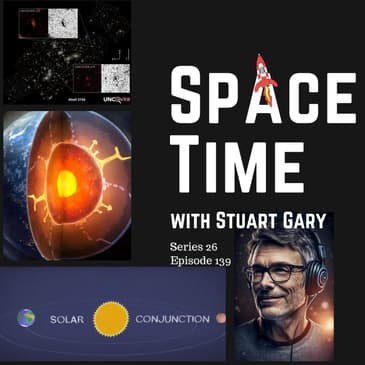
[00:00:00] This is Space Time, Series 26 Episode 139 for broadcast on the 20th of November 2023. Coming up on Space Time Discovery of some of the most distant and ancient galaxies ever seen. New evidence suggests that Earth's surface water dives deep all the way down to the planet's core.
[00:00:21] And NASA's Mars spacecraft goes silent. All that and more coming up on Space Time. Welcome to Space Time with Stuart Gary. Astronomers have discovered two of the most distant galaxies ever seen, dating back some 13.4 billion years to a time when the universe was just 330 million years old.
[00:01:01] These two ancient stellar cities reported in the Astrophysical Journal were found by NASA's Webb Space Telescope in a region known as Pandora's Cluster, Abell 2744. Following up on a deep field image of the area, scientists confirmed the distance to these ancient galaxies and inferred their properties using new
[00:01:21] spectroscopic data, information about light emitted across the electromagnetic spectrum. Unlike other galaxies confirmed at these sort of cosmic distances that usually appear in images as red dots, these new galaxies have distinct shapes, one looking more like a peanut, the other like a fluffy ball.
[00:01:38] The study's lead author, Bingji Wang from Penn State, says very little is known about the early universe and the only way to learn about this time in cosmic history and to test theories about early galaxy formation and growth is with very distant galaxies.
[00:01:54] Prior to this new discovery, astronomers only knew of three galaxies confirmed at around this extreme distance. Wang says studying these galaxies and their properties is revealing the diversity of galaxies in the early universe and how much there is to learn about them.
[00:02:11] Because the light from these galaxies has traveled so long to reach the Earth, it provides a window into the past, offering insights into how the earliest galaxies might have formed.
[00:02:21] While the authors estimate the light was emitted from these two galaxies when the universe was about 330 million years old and those photons have since traveled some 13.4 billion light-years to reach the Earth, they estimate that these two galaxies would currently be more like 33 billion light-years away from Earth
[00:02:38] due to the physical expansion of the universe over time. Wang describes these ancient relics as beacons, with light bursting through the very thin hydrogen gas that made up the early universe.
[00:02:51] It's only by their light that astronomers can begin to understand the exotic physics that govern the universe near the cosmic dawn. Fascinatingly, these two galaxies are considerably larger than the three previously located at the same distance
[00:03:05] and one of them is at least six times larger, around 2,000 light-years across. Now by comparison, our modern day Milky Way is approximately 100,000 light-years across, but it's had more than 12 billion years to grow. Wang points out the early universe was also far smaller, with features much closer together,
[00:03:24] so it's surprising that this early galaxy was as large as it is. It's still unclear if the differences in size between the two galaxies is more to do with how the stars formed as opposed to what
[00:03:35] happened with them after they formed, but the diversity in the galaxy properties is interesting. These two galaxies are expected to have been formed out of similar materials, but clearly they're showing early signs of being very different from each other, a fascinating observation.
[00:03:50] The two galaxies are among 60,000 sources of light in Pandora's Cluster, detected in one of Hubble's first deep field images taken during its first year of science operations. This region of space was selected in part because it's located behind several galaxy clusters and these act like a gravitational lens,
[00:04:09] bending and magnifying the light from further away background objects. The gravitational pull of the cluster's combined mass warps the space around it, focusing and magnifying any light that passes nearby and providing a magnified view behind the clusters.
[00:04:25] In a matter of months, the authors were able to narrow down those 60,000 light sources to 700 candidates for follow-up observations. And eight of those were identified as potentially at least being among the very first galaxies.
[00:04:40] Then Webb was again pointed at Pandora's Cluster, recording the candidate spectral signatures, a sort of chemical fingerprint detailing the amount of light given off at each wavelength.
[00:04:51] Other than hydrogen, helium and a smattering of lithium, the first elements in the universe were forged in the cores of early stars through a process called nuclear fusion. So it makes sense that these early galaxies didn't have many heavy elements in them.
[00:05:06] That's because they were some of the first stellar factories to make these heavy elements. And of course, they'd have to be young and star-forming to be the first galaxies.
[00:05:15] But combining all these properties is an important basic test of science's models, helping to confirm the whole paradigm of the Big Bang Theory. Amazingly, Webb's powerful infrared instruments should be able to detect galaxies even further away than these two.
[00:05:31] So the fact that the authors didn't observe anything beyond these two galaxies could mean that galaxies simply didn't exist before this time and so the authors aren't going to find anything further away.
[00:05:43] Or of course, it could simply mean they didn't get lucky enough to see anything more distant considering the very tiny window they had to look through in this region. This is Space Time.
[00:05:54] Still to come, a new study finds that Earth's surface water dives deep all the way down to the planet's core and NASA's Mars spacecraft have all gone silent. All that and more still to come on Space Time.
[00:06:09] Scientists have found that water from Earth's surface likely percolates all the way down to the core-mantle boundary, changing its structure. A few decades ago, seismologists imaging the deep planet identified what appeared to be a thin layer just a few hundred kilometers thick near the core-mantle boundary.
[00:06:43] The origin of this region, which has been labeled the E' layer, has remained a mystery since then, at least until now. New research reported in the journal Nature Geoscience indicates that over billions of years,
[00:06:57] surface water has been transported deep down into the Earth by descending or subducting tectonic plates. And upon reaching the core-mantle boundary, some 2,889 kilometers below the surface, the same water triggers a profound chemical interaction,
[00:07:14] altering the composition of the outermost region of the liquid metallic core and creating a distinct thin layer. Using high-pressure experiments, the authors demonstrated that subducted water chemically reacts with the core's materials. This reaction forms a hydrogen-rich layer. At the interface where subducting water meets the core,
[00:07:35] the reaction causes a chemical exchange to occur, resulting in the formation of a hydrogen-rich silicon-depleted film-like layer in the topmost outer core. This modified liquid metallic layer is predicted to be less dense, with reduced seismic velocities all in alignment with anomalous characteristics mapped by seismologists.
[00:07:54] The same water reaction is also producing dense silica crystals that rise and integrate with the base of the mantle. One of the study's authors, Dan Shim from Arizona State University,
[00:08:05] says that for years it had always been believed that any material exchange between the Earth's core and mantle was limited. But these new high-pressure experiments are revealing a very different story. When water reaches the core-mantle boundary, it reacts with silicon in the core, forming silica.
[00:08:23] This discovery, along with previous observations of diamonds forming from water reacting with carbon in iron liquid under extreme pressure, points to a far more dynamic core-mantle interaction, suggesting substantial material exchange. These new findings advance the science's understanding of the Earth's internal processes,
[00:08:42] suggesting a far more extensive global water cycle than previously recognized. And this altered film of the core also has profound implications for the geochemical cycles which connect the surface water cycle with a very deep metallic core. This is Space Time.
[00:09:00] Still to come, NASA's Mars spacecraft have all gone silent, and later in the science report, Planet Earth has just experienced its hottest year on record. All that and more still to come on Space Time. NASA's fleet of Martian spacecraft have all gone silent.
[00:09:33] Now it's nothing to panic about, the move is actually a regular operational necessity brought about by the loss of communications caused by the red planet's orbit taking it behind the Sun from Earth's perspective.
[00:09:44] The rovers and orbiters will continue collecting limited amounts of data during the two-week communications pause, but mission managers will hold off sending any new commands to the vehicles over this period. It's known as Mars-solar conjunction, a phenomenon that happens every two years.
[00:10:02] As the red planet's orbit takes it onto the opposite side of the Sun from where the Earth is, hot ionized plasma expelled by the Sun's corona has the potential to interrupt or corrupt radio signals sent from Earth to Mars,
[00:10:16] and that could result in commands being corrupted, affecting spacecraft operations. The easy solution is to simply not send any for two weeks. That's not to say the robotic explorers are on holiday.
[00:10:29] NASA's Perseverance and Curiosity rovers are continuing to monitor changes in surface conditions, weather and radiation as they stay parked. And although momentarily grounded, the Ingenuity helicopter will use its color cameras to study the movement of sand, which poses an ever-present challenge to Mars missions.
[00:10:48] NASA's Mars Reconnaissance Orbiter spacecraft and the Mars Odyssey orbiter will also continue imaging the surface, and NASA's MAVEN will continue collecting orbital data on interactions between the Martian atmosphere and the Sun. Usually, NASA will continue receiving health updates from the Mars fleet during conjunction.
[00:11:07] But there will be two days when the agency won't hear from the spacecraft because the red planet will be fully blocked by the disk of the Sun. Once the communications pause ends, the orbiters will relay all the pending science data back to Earth,
[00:11:21] and the spacecraft can begin receiving instructions again. Glenn Nagel from the CSIRO's NASA Deep Space Communications Center at Tidbinbilla near Canberra says mission teams at NASA's Jet Propulsion Laboratory in Pasadena, California have spent months preparing to-do lists for all the Mars spacecraft.
[00:11:39] Every 25 months or so, Mars and Earth's respective orbits around the Sun means that Mars ends up on the opposite side of the Sun from us. So it passes behind the Sun from Earth's point of view for a period of about two weeks.
[00:11:53] So yeah, for the next little while, Mars will not be visible to us here on Earth. So this is solar conjunction and during solar conjunction, communications with spacecraft both on the Martian surface and in orbit around Mars becomes difficult.
[00:12:06] Yeah, so the Sun is pumping out huge amounts of ionized gas, and for our radio signals coming from the spacecraft or us on Earth and the Deep Space Network sending commands off to the vehicles at Mars, there's a chance that that information can be distorted.
[00:12:20] And if you were transmitting certain commands off to a spacecraft and you lose some of the ones and zeros within that command, you could cause more problems. So if we go through a communication port, a communication moratorium, so that the spacecraft on Mars earlier than the conjunction starts,
[00:12:35] send a set of commands basically standby, we'll see you again in two weeks. And what happens over that gap? Everything just freezes or are there various operations spacecraft are assigned? Yeah, for the rovers on the surface of Mars like Curiosity and Perseverance
[00:12:50] and even the little helicopter Ingenuity, which is with Perseverance there on Mars, basically the mission team send a set of commands to say, okay, we just want you to do some simple science. Just stay where you are, no driving, no attempting to fly,
[00:13:02] just sit there and maybe just do some atmospheric studies, look at the radiation environment or in the case of the little helicopter, it's just going to take a series of pictures over the course of the next couple of weeks looking for sand moving across the surface of Mars.
[00:13:15] So I'll do some basic science, but no driving, no major activities, just sit tight, do some basic stuff, record that information, we'll hear from you soon. And the hope is that on the 29th everything's back to normal?
[00:13:27] Yeah, so we won't actually completely lose contact with the vehicles themselves. So because of the sun's enormous gravity, radio signals get bent around the sun because of its enormous mass. And so we'll still actually know that the spacecraft and rovers are still there
[00:13:43] and still operating, we'll get kind of a carrier tone, it will be, albeit weak, but we'll still be there. But once the Mars moves out from behind the sun and the Earth moves in its position, then yeah, we'll be back in contact with the spacecraft
[00:13:56] and we'll be back to business as normal. And this is not the first time that a Mars conjunction has happened. Back for the rover Curiosity, this will actually be its sixth time that it's been out of contact with Earth. Yeah, Curiosity has just celebrated what, 4,000 days on Mars?
[00:14:11] Yeah, amazing, 4,000 sols on the Martian planet, not bad. This is a vehicle that's been travelling around on Mars for over 11 and a half Earth years now. And the mission was originally only designed to last maybe two to four years.
[00:14:24] So it's quite an incredible vehicle and busy mountain climbing, of course, in the middle of Gale Crater on Mars. Yeah, its fourth mission extension already and still going strong. It's starting to show a bit of worse for wear now, but it's still there.
[00:14:36] Yeah, certainly the wheels have done a lot more evolutions, they've gone over very tough terrain as it continues across Gale Crater and up Mount Sharp in the middle of that crater. The payoff, even with those damage to the wheels, is the incredible vistas,
[00:14:50] the places that we're seeing now looking back across the crater, looking at these amazing mesas and layers, rock strata and different types of material during that climb. It's really giving us an incredible building-year history of Mars as we continue to traverse those layers.
[00:15:07] That's Glenn Nagle from the CSIRO's NASA Deep Space Communications Center at Tidbinbilla near Canberra. And this is Space Time. And time now to take a brief look at some of the other stories making news in science this week with the Science Report.
[00:15:38] Planet Earth has just experienced its hottest year on record. The findings, published by the Climate Central Report and Copernicus Climate Change Service Bulletin, shows that over the past 12 months, the average global surface temperature was 1.32 degrees Celsius above pre-industrial baseline levels. Scientists with a non-profit organization, Climate Central,
[00:16:02] found that a quarter of the planet's population experienced dangerous levels of extreme heat. Climate scientist Andrew Pershing, vice president for science at Climate Central, says it's the hottest temperature Earth has experienced in the past 125,000 years. He says most of this warming, about 1.28 degrees Celsius,
[00:16:22] is the direct product of human actions. Natural variations caused by processes such as the ongoing ocean-warming event El Niño contributed the rest. Scientists have created a monkey made from cells from two separate monkey embryos. The infant chimeric monkey was created by injecting a monkey embryo
[00:16:43] with stem cells from a genetically distinct donor embryo. A report in the journal Cell claims the resulting animal is the first live-born chimeric primate to have a high proportion of cells originating from donor stem cells. The monkey's creation paves the way for scientists
[00:16:59] to use chimeric primates in order to study human diseases. However, the monkey had to be euthanized when it was just 10 days old because of hypothermia and breathing difficulties. And that highlights the need for further optimization of the approach and a serious re-examination of the ethical concerns
[00:17:18] involved in this sort of research. A new study has found that people with narcissistic traits are more likely to have body image concerns and, by extension, be at a higher risk of having eating disorders. The findings reported in the journal PLOS One
[00:17:34] are based on a study of 430 people who were asked to complete three personality tests in order to identify narcissistic traits, such as go-getter type extroversion, antagonism, and exhibitionism or entitlement. The participants then completed four tests designed to measure someone's drive to look muscular or thin
[00:17:53] and to identify if they're likely to have an eating disorder. The authors found that if you exclude leadership or authority traits, all other narcissistic traits they measured were associated with a drive to be thin and muscular and associated with more eating disorder symptoms.
[00:18:11] The glittering highlight of the Australian Skeptical Calendar is the annual Skepticon Conference, which this year will be held next month in Melbourne. Of course, one of the highlights of the event is the highly coveted Bent Spoon Award, presented to the year's biggest promoter of paranormal or pseudoscientific trash.
[00:18:29] Past winners have included the Australian Broadcasting Corporation, who've won the award three times, proving their journalistic standards of never letting the truth get in the way of a good story. Then there's twice-winner Paleo Pete Evans for his promotion of the BioCharger,
[00:18:45] a miraculous device that, according to its manufacturers, was proven to restore strength, stamina, coordination, and mental agility. Pete Evans previously won the Bent Spoon for his Paleo diet, which included promoting bone broth as a formula replacement for infants, as well as his campaigns against fluoridation and vaccinations.
[00:19:05] Other notable winners have included the Melbourne Metropolitan Board of Works, who employed a psychic archaeologist, the Southern Cross University for offering a degree course in naturopathy, the University of Wollongong for proving that one doesn't need to be smart,
[00:19:20] right, or even scientifically accurate in order to be awarded a doctorate. Then there's Adelaide psychic Annie Dankbar for her discovery of the Colossus of Rhodes. That made something of a media frenzy until it was realised that it was really nothing more than modern-day builder's rubble.
[00:19:36] And of course, who can forget racing driver Peter Brock, the great Brocky? He had the energy polariser. Unfortunately, it generated more heat in the murdering media than what it did energy in his car. Tim Mendham from Australian Skeptic says this year's winner
[00:19:51] will be up against some stiff competition. Skepticon is our annual convention, and we've held it every year since 1985, I think. I think we're the only sceptic or group to have actually had that consistency every year. It's a fine thing. It's in Melbourne, as you say,
[00:20:05] and it's on December 2 to 3, the weekend normally. And it'll be an exciting time. A lot of different sort of speakers, a lot of sceptical speakers and scientific speakers and items of general interest and a bit of controversy as well and a good chance to bump into other people
[00:20:19] and sort of compare notes, etc. It can also be viewed online, skepticon.org.au. And part of that is our Saturday night galah dinner, as we call it. And we have our awards, which is some positive awards for good work, well done, etc.
[00:20:34] And we have probably one which is most looked forward to, which was our Ben Spoon Award, which goes to the perpetrator of the most preposterous piece of paranormal or pseudo-scientific pitfall. Now, we have to say the P of pseudo-scientific because it works better with the alliteration.
[00:20:49] That's not correct, but never mind. So every year, we've given that award, except for I think there was one year in 1988 when nothing happened. But it goes to people in Australia. It happens in the last 12 months. They've done something particularly noteworthy that is sort of just outrageous.
[00:21:03] Some of them silly, some of them serious, dangerous. The people who are recommending taking bleach, etc. for COVID, etc., that's a lot of alternative medicine things have cropped up in the last few years, have anyway. So we've got nominations.
[00:21:15] But this year, we've got a bit of a mixture. We've got a senator in Australia who the climate change denier, anti-vaxxer, all sorts of strange theories, he's nominated. We've got a local publicly funded TV channel, SBS, for promoting Uri Geller's museum.
[00:21:31] He has this museum of his history, etc. And we have a journalist who won major awards in past years who's now promoting UFOs and UFO conspiracies, Ross Coulthard, who's Australian, but he had a recent notoriety by being the first person to do a major interview with David Grush,
[00:21:49] who's a big promoter of UFOs, that the US government's been covering up these things for years. We have bodies, we have craft, etc., and he gave a presentation with others to the US Congress, which, of course, because he gave a presentation, means it's all true.
[00:22:01] He's a pretty popular candidate, I must admit, especially controversial by someone who is a journalist and has done decent investigative projects in the past and been rightly awarded for it. So that's our nominations, and it's voted on by our various sceptics groups around the country, very democratic.
[00:22:18] And then we make the announcement at our dinner as to who it's going to be. The other awards we give out are positive awards. There's one for sceptic of the year, which is a sceptic who has actually done some very interesting work.
[00:22:28] There's a Thornett Award for scientific reasoning, critical thinking, etc., someone not from the community, but who has done some good work. And we have a media award, someone in the media who has done some investigative work, some critical thinking, not necessarily pro-Australian sceptics,
[00:22:42] but definitely sort of someone who's done some investigative work on a paranormal or an area where the sceptics are interested in. So we've had various nominations for that as well. We have more positive awards than negative awards, but it's the negative award that probably gets the most publicity,
[00:22:55] especially when they're high profile person. Because it's so funny, let's be honest. Some of the winners, I mean, these winners are all so deservant of the Ben Spoon Award. They are. And some of the things they've come up with are absolutely hilarious.
[00:23:10] And the award itself reflects that, doesn't it? Tell us about the award. Well, the award is a highly attractive Ben Spoon, bent by Yuri Galea himself, right? It's mounted on top of an increasingly heavier, because through the years, wooden platform, looks a bit like a ziggurat.
[00:23:26] It's made from gopher wood as used in Noah's Ark. In fact, it's from Noah's Ark. Or at least so you understand. So we can understand. The spoon is fixed to this gopher wood ziggurat with an ancient screw used in Noah's Ark, which is a Phillips head screw,
[00:23:40] as they used to use in those days. Or at least so you understand. Sometimes it's pretty serious. Sometimes the winners are actually more than just sort of figures of fun. They're actually sort of making claims that could be dangerous.
[00:23:50] When you get media organisations winning it year after year, that's concerning. Because they're supposed to be the arbiters of, well, one would think they were the arbiters of truth and honesty in journalism, but clearly they're not. One would think, yes. But it's not necessarily true.
[00:24:04] But yeah, I mean, sort of in amongst the panoply of winners over the last, what is it, 40 years, there have been enough sort of weirdos, strange people if you like. The fellow who was the psychic dentist, who could pick your teeth psychically.
[00:24:17] There's others, as you say, media, TV channels, especially whole channels, different programs, etc., which have won and continue to be nominated as this year. It's even more tragic when a university wins or a scientific research institution. That's actually disturbing. Yeah, we've had several of those.
[00:24:32] We've even had the head of CSIRO, which is Australia's premier research organisation funded by government for a sort of close apparent support awarding providing. He quickly changed his mind on that one apparently. There are small fry in there. There are people who make silly things.
[00:24:45] But there's a lot of large organisations, public organisations, individuals, high profile individuals who get noticed and we will happily point them out. That's Tim Endam from Australian Skeptics. And that's the show for now. Spacetime is available every Monday, Wednesday and Friday through Apple Podcasts iTunes, Stitcher, Google Podcasts,
[00:25:21] Pocket Casts, Spotify, Acast, Amazon Music, Bytes.com, SoundCloud, YouTube, your favourite podcast download provider and from Spacetime with Stuart Garry.com. Spacetime's also broadcast through the National Science Foundation on Science Zone Radio and on both iHeart Radio and TuneIn Radio. And you can help to support our show
[00:25:43] by visiting the Spacetime store for a range of promotional merchandising goodies or by becoming a Spacetime patron, which gives you access to triple episode commercial free versions of the show as well as lots of bonus audio content which doesn't go to air, access to our exclusive Facebook group
[00:25:59] and other rewards. Just go to Spacetime with Stuart Garry.com for full details. And if you want more Spacetime, please check out our blog where you'll find all the stuff we couldn't fit in the show as well as heaps of images, news stories,
[00:26:13] loads of videos and things on the web I find interesting or amusing. Just go to Spacetime with Stuart Garry.tumblr.com. That's all one word and that's Tumblr without the E. You can also follow us through at Stuart Garry on Twitter, at Spacetime with Stuart Garry on Instagram,
[00:26:30] through our Spacetime YouTube channel and on Facebook, just go to Facebook.com forward slash Spacetime with Stuart Garry. You've been listening to Spacetime with Stuart Garry. This has been another quality podcast production from Bytes.com.