
Become a supporter of this podcast: https://www.spreaker.com/podcast/spacetime-with-stuart-gary--2458531/support.
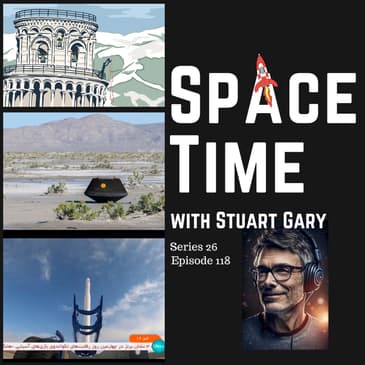
This is Spacetime Series twenty six, Episode one hundred and eighteen, we broadcast on the second of October twenty twenty three. Coming up on Spacetime, does anti matter fall up or down? As Osiris rex mission returns home and Irand's nuclear missile program advances another step? All that and more Coming up on Spacetime, Welcome to space Time with Stewart Gary. Does anti matter fall up or down under the influence of gravity? It's an age old question among first year physics students the world over, and now we finally have an answer. Yes, it falls down, just like where matter. And after all, why wouldn't it. Einstein's theory of general relativity says antimatter should behave exactly the same as normal matter. After all, the forces are acting on an antimatter particle by the effect of mass on space time don't change just because the particle now has an opposite charge. But somehow humans find it comforting to finally confirm the answer by way of a unique experiment using a cloud of antihydrogen atoms. Scitists observed the antihydrogen mostly took a downward path, just like regular hydrogen would. But although the answer seems simple. The experiment itself wasn't easy. According to the standard model of particle physics, the foundation stirred upon which sciences current understanding of the universe is based, equal amounts of matter and antimatter were produced when the universe burst into existence thirteen point eight billion years ago, in an event these days referred to as the Big Bang. Shows us there's almost no difference between matter and antimatter other than their charge, and when matter and antimatter come into contact, they annihilate each other, producing high intensity gamma radiation. And all this begs the question, if equal amounts of matter and antimatter were produced in the Big Bang, why didn't the universe annihilate itself in a sudden flash of purple light as soon as it came into being? And why do we live in a universe filled with matter rather than antimatter. In fact, we now have abundant evidence to show us that the observable universe is made up almost exclusively of matter. If there were large pockets of antimatter, it would annihilate as soon as it came into contact with the nearby matter, producing very highly detectable, high intensity gamma radiation and this has not been observed. Therefore, figuring out how and why our universe ended up with an abundance of only matter rather than antimatter is one of the biggest open questions in particle physics today. In confirming that antimatter, just like regular matter, is gravitationally attracted, the finding also rules out gravitational propulsion as the reason why atimatter is largely missing from the observable universe. The experiment was carried out by researchers from the International Anti Hydrogen Layer of Physics Apparatus or ALPHA Collaboration, located in Switzerland at CERN, the European Organization for Nuclear Research, and their findings have now been published in the journal Nature. Understanding the Nature of antimatter he not only helps scientists understand how the universe came into being, but it can also enable new innovations never before thought possible. And of course, beyond the practical and real, there's the imagined, such as the atimatter field, warp drives, and foote on torpedoes of Star Trek Fame. Antimatter is completely real, but it's mysteriously scarce. Alpha Collaboration member Jonathan would tell from the University of California, Berkeley, says many indirect measures indicate that gravity indirects with antimatter just as expected, But until this new experimental result came in, nobody had actually performed a direct observation that could rule out or, for example, that antihydrogen moved upwards as opposted downwards in a gravitational field. Your body, the Earth, and almost everything else scientists know about the universe are overwhelmingly made up of regular matter, consisting of things like protons and neutrons and electrons. On the other hand, antimatter is regular matters twin, though with some other su properties. For example, antimatter protons called antiprotons have a negative charge while regular protons have a positive charge, and antimatter electrons called positrons have a positive charge while regular electrons have a negative charge. But because they annihilate each other, antimatter is really hard to test because once you make antimatter, you've got no way of holding onto it. As soon as it touches as regular matter that could be a container, it could be the air, it'll immediately annihilate. Another Alpha Collaboration team member job for Jean, also from the University of California, Berkeley says that for a given mass, these annihilation events between matter and antimatter are the densest forms of energy release known, so in a very real sense, it would be the ultimate power source. The amount of matter used in the Alpha experiment was small, so small that the amount of energy created by antimatter annihilations could only be perceptible using very sensitive detectors, and so the team needed to manipulate the antimatter very carefully in order not to lose it. Broadly speaking, in the Alpha collaboration produced antimatter and then used it to conduct a leaning tower of Pizza type of experiment. Now, that term leaning tower of Pisa refers to the kind of experiment carried out by Galileo back in the sixteenth century. His experiment was designed to demonstrate the identical gravitational acceleration of two simile ten vinously dropped objects of similar volume but different mass Nassa Apollo fifteen as not. David Scott repeated the exact same experiment on the surface of the Moon. Can we copied a boat olver wind and in a commuter drum in the ETV? Not quite Yeah, I haven't put the solar wind in yet I will shortly. Oh, I'll watch this. I'll have a good picture there. I've got the beautiful picture Dame Well. In my left hand, I have a fetter in my right hand a hammer. And I guess one of the reasons we got here today was because of a gentleman named Galileo a long time ago who made a rather significant discovery about falling objects and gravity fields. And we thought that where would be a better place to confirm his findings and on the move, And so we thought we'd try it here for you. The feather happens to be appropriately a falcon fetter for our falcon, And I'll drop the two up here and hopefully go hit the ground at the same time. How about that was correct? And for the Alpha experiment, the anti hydrogen was contained within a tall, cylindrical vacuum chamber with a variable magnetic trap called Alpha G. The scientists reduced the strength of the trap's top and bottom magnetic fields until the anti hydrogen atoms could escape, and the relatively weak influence of gravity became apparent. As each anti hydrogen atom escaped the magnetic trap, it touched the chamber walls either above or below the trap and annihilated, which the scientists could then detect and count. The researchers repeated their experiment more than a dozen times, varying their magnetic field strength on the top and bottom traps in order to rule out any possible errors. They observed that when the weakened magnetic fields were precisely balanced at the top and bottom, about eighty percent of the anti hydrogen atoms nihilated beneath the trap, a result consistent with how a cloud of regular hydrogen would behave under the same conditions. In other words, gravity was causing the anti hydrogen to fall down, not up. Despite some modest sources of antimatter, like the positrons admitted from the decave potassium in bananas, sitists don't see much of it in the universe. However, the fact that the laws of physics predict that atimatter should exist in roughly equal amounts with regular matter remains a massive conundrum these days, referred to as the barrier genesis problem. One potential explanation was that atimatter was gravitationally repelled by regular matter during the Big Bang. The trouble is, these new findings suggest that theory no longer seems plausible. Wartel says that while they've ruled out atimatter being repelled by the gravitational force as opposed to attract it, that doesn't mean there isn't a difference in the gravitational force on antimatter, and only a more precise measurement will tell the Alpha collaboration will continue to probe the nature of antihydrogen. In addition to refining their measurement of the effect of gravity, they're also studying how anti hydrogen interacts with electromagnetic radiation through spectroscopy. If antihydrogen were somehow different from regular hydrogen, that would be a revolutionary thing because the physics laws both in the quantum mechanics would and gravity say that behavior should be the same. But worth All points out, we won't be sure until we actually do the experiment, and let's face it, that's what science is all about. This space time still to come, NASA's epic Assiris REX mission returns home, and Irand's nuclear missile program advances yet another sinister step. All that and more still to come on space time, NASA's first ever asteroid sample return mission has arrived safely back on Earth. Parachuting down onto a US military test range in the Utah Desert. The Osiris REX sample return capsule landed right on target, following at seven year six point two one billion kilometer return journey to the half kilometer wide nearer f asteroid BNOU recovery operations helicopters one and two. I've arrived at the herding location, so good news. Our helicopters are ready to go and begin those recovery operations just as soon as we have confirmation of touchdown here and as the sun begins to rise in the West Coast, the SRC is going to be streaking across the atmosphere above San Francisco, California, about eighty two miles in altitude. It's gonna becoming it hot over five thousand degrees fare knight almost a couple of seconds after it hits that atmosphere that's about half as warm as the surface of the Sun. To give you some context, but don't wear. Our sample will be safe and sound within. We have a heat shield which is made of a phinilic impregnated carbon ablater. It's a very fancy term to describe what's going on with this heat shield. It basically ablates away or burns away any kind of heat flux that develops on that outer shell, making sure that our sample is safe and cool within similar technology that we use with astronauts coming back from the Moon or any kind of other landers that we have going into planets and moons. So we're just a couple of moments away from this key moment. It's going to be very exciting next couple of thirteen minutes here and you'll hear a couple call outs come in from just next door and or emission operations team as they begin to get us ready for this key moment. It's a journey of three point eight six billion miles getting reduced to the scale of mirror miles eighty two miles above the surface of the Earth in San Francisco. A couple key events are going to happen as soon as we get into the Earth's atmosphere very quickly in we're going to deploy our drogue parachute. This is for stability, stabilizes our descent, and make sure that we are continuing to target that landing lips that is here in the Utah Test training range. It is a thirty six point five by eight mile landing lips that is here marked out for that recovery operation. This team, i'll remind you, just a few hours ago, gave that command to release the SRC on this long journey. It's been on its own for four hours. There's nothing we can do at this point. It's coming in rain or shine till SRC has entered the Ears atmosphere. ETTR TRACKI assets he require, and here we go. Start your top stopwatch. Right now we are thirteen minutes of entry, descent and landing as it enters into Earth's atmosphere. The punishing deceleration that spacecraft, that SRC is experienced right now as it comes in at about twenty seven thousand, six hundred and fifty miles an hour, glowing brightly in the sky, and in just a few moments we're going to reach peak heating and peak deceleration. That's at thirty two G forces punishing G force on our SARCO. At this point we've entered in over San Francisco, California, and are very quickly going to be approaching the Utah Test and Training Range just a little bit further to the east. Entry was at pole still is experiencing maximum eating and maximum deceleration. So you just heard right there. We're experiencing that five thousand degree fahrenheit maximum heating, burning scalding hot on that heat shield that is protecting our sample, with an end maximum deceleration that is at thirty two G force punishing deceleration from Earth's atmosphere, the drag forces that are acting on that SRC. Our next milestone will be expecting that drogue parachute deployment that'll be at about one hundred two thousand, three hundred feet altitude that will stabilize our descent and slow us from hypersonic to subsonic speeds as we continue to target the Utah test and training range expected e O milestone SRC commands drogue parachute deploy So we heard that command to deploy the drogue parachute. At this time eight forty four am Mountain time, the Ocyrius APEX spacecraft is at its closest approach to Earth that will be on to its extended mission visiting the asteroid Epophus in the year twenty twenty nine, continuing this incredible mission at another world, and in just a few moments we should enter into specially use airspace at approximately eight forty six am. That's going to be at ten miles off the deck here at Utaw testin Training Range. That SRC is nearly three feet wide one point six feet into small objects, so quite a challenge to track this as it comes Syrian to Earth's atmosphere. This area is specifically chosen for this mission. It's a wide open, vast desert space, relatively flat, perfect to land this sample today. Our next milestone we should be expecting main parachute deployment at around eight forty nine am mountain time ETL milestone. We have some firm wow and after an exhilarating streak across Earth's atmosphere, is that orange creamsicle colored parachute just to delight, A sweet delight to see in our sky here over the Utah testin Training Range, just a few minutes away from getting that sample from the other side of the Solar System. From the surface of Asteroid Benuit sample site Nightingale to the rugged terrain of the Utaw testin Training Range. Looks like winds are relatively low, not a lot of rocking back and forth. Those parachutes seem to be perfectly smooth coming down that parachute there continuing to descend the slight little bit of till back and forth of our SARC as it comes to its resting velocity of eleven miles per hours, it makes that final descent that parachute deployant was given internally by the spacecraft and once that successfully lands, the teams will begin the next crucial phase of this mission, the sample recovery operations. They've been rehearsing for this moment for months literally years really leading up to this key moment, and are ready to begin those operations to get that SRC into our portable clean room here and extract that sample canister within the ground. Really closing in now on that one as visual on the scar the shute that is phenomenal and once again just setting the context for this, when we first hit the top of the atmosphere we were at twenty seven thousand, six hundred fifty miles per hour. We are now leisurely decelerating under our orange parachute to eleven miles per hour. Incredible amount of deceleration there, as Earth's atmosphere really helped us out quite a bit getting that initial deceleration our drogue parachute initially stabilizing our descent, and then ultimately that main parachute bringing us home Town has touched down and touchdown of the Osarus Rex sampler Turn capsule, a journey of a billion miles to asteroid Benue and back, has come to an end, marking America's first sampler turnmission of its kind and opening a time capsule to our ancient Solar System. NASA chief Bill Nelson hailed the mission, saying the samples contained aboard the capsule will give scientists an extraordinary glimpse into the beginnings of the Solar System. The mission collected an estimated tajn fifty grams of regular from the ancient asteroid's rocky bouldesterns surface. The Saras Rex spacecraft released its re entry capsule just over a day before touchdown at a distance of over one hundred and eight thousand kilometers from Earth. The spacecraft itself then flew past the Earth to continue on with its mission. It'll study another asteroid called Apophus. Meanwhile, the re entry capsule hurtled down towards the Earth's surface at some forty five thousand kilometers per hour, using only atmospheric drag to slow down enough for two successive parachutes to be deployed, allowing the capsule to float down to a gentle desert landing. The only concerned during the re entry was the deployment of the main parachute, far higher than originally anticipated. It deployed at about twenty thousand feet or six thousand, one hundred meters instead of the five thousand feet or fifteen hundred meters originally planned. The now black and meat a wide tire size capsule, touched down gently under the rocky desert floor, only to be quickly surrounded by waiting scientists taking readings. After confirming the capsule survived its journey was not breached, meaning its contamination seals were still intact, the crew placed the device in a sling and transported it by a helicopter to especially prepared nasiclean room I. Meanwhile, the Asius Rex spacecraft is continuing with its mission. After releasing the re entry cap it fired up its engines and continued on to the next part of its journey, a rendezvous with the asteroid Apophus. Like Berneu, Apophus is a near Earth asteroid. It'll pass within thirty two thousand kilometers of the Earth in twenty twenty nine. Now it was originally listed as a potential Earth impactor, but as more and more data on its orbit came in, it showed that it will miss the planet, not by much less than the altitude of many satellites, but it will be amiss. Meanwhile, these samples from the asteroid Bernou, and they've been flown aboard a C seventeen globe mass to transport to the Johnson Space Center in Houston, Texas. That's where they'll be dipped up and studied. About seventy five percent of the samples will be conserved for study by future generations, with the remaining quarter handed out to scientific teams across the United States and even overseas, including Australia, with a team from Curtain University also getting some samples for experimentation. The Curtain team of six researchers or all members of the Osiris REX science team, will use sophisticated instruments to study the samples and gain invaluable insights into the origins of the Solar System and life itself. These asteroids are composed of the original materials of the Solar System, getting back some four point six billion years, and they've remained relatively intact ever since. Bnou surprise scientists in twenty twenty when the probe, during its spree of contact with the asteroid surface to collect its samples, shockingly sank over a meter in the regular, revealing an unexpected low density for the asteroid. Instead of solid rock, it's more like a kid's pool filled with plastic balls. Understanding Bernous composition is important, as this asteroid has a one in twenty seven hundred chants of catastrophically slamming into the Earth in twenty one eighty two. We now know Bernou is a rubble pile asteroid. That means it's entirely made up of fragments ranging in size from massive boulders bigger than ours and are tiny grains of dust. This detritus was all ejected during the destruction of a much larger parrot asteroid. The social professor Nick Timms from Curtain University's School of Earth and Planetary Sciences says Cyrus rex will reveal insights into the molecular precursors of the origins of life, and it contains water molecules locked in its minerals. Berneux is a lumpy C group asteroid, a carbonaceous and volatile rich group that has been relatively untouched since formed, and so this gives scientists a window to look back to the beginnings of the Solar System. These samples are some of the most pristine asteroid rocks available. Unlike meteorites that reach Earth and quickly become contaminated by the planet's atmosphere, surface material, water, and biota, the Bernous samples are pristine and unblemished. So with Berneu, scientists will be analyzing unsports samples from some of the oldest objects in the Solar System. Tim says, we'll be added to tell huge amounts about what happened when the Solar System was nothing more than dusting gas and the processes their broad planets together and created the ingredients for life on Earth. One of the benefits of flying a spacecraft to these space objects and asteroids is that we can bring these rocky materials back to Earth without being contaminated by the Earth. Problem with meteorites, isn't it no matter how fresh they are, they've still got earthly contamination on the outside. Yeah, I mean, meteorites are great, they're space rocks that made their own way to Earth, which is very handy for us, and we can go and collect them from the Earth's surface. But the longer they lie around on the Earth, then they can get earth contamination by water or Earth's biological organisms and things like that, And so the longer they lie around, and more difficult it is for us to tell what signals are from the space rock and what has come from the Earth contamination. So isolating the returned material from Benu is a really important thing because we can preserve its integrity in terms of the chemistry of the rock types and the particles and all of the molecules out there on the asteroid. We can then see what they're like without worry that it's been contaminated from it. There must be special precautions and procedures that need to be followed. Yeah, absolutely, there's a very long list of procedures that have been developed by the mission scientists to try and achieve that. One of the main things is being handled and adored in a special ultra clean laboratory. It's basically a huge what looks like a huge fish tank or glass tank with holes in the sides where there are sort of plastic gloves that people on the outside can reach inside the gloves then and handle the material inside the big tank and the tank that has been purged with nitrogen gas so that as atmosphere doesn't contaminate the sample, and that's a really important step in trying to curate these samples. So some of the sample will be stored away in very well sealed containers for future signs to look at. When you know, technology gets better and we can discover more and more things that we can't even fathom right now. They did that with the moon samples from the Apollo missions, too, didn't They absolutely yes, And we met over fifty years old. Even on that I think I'm a fiftieth anniversary of the Moon landings. They opened some of these samples for the first time, and technology has changed so much in fifty years that a whole array of new techniques can be employed to actually look at different types of analysis and the chemistry of the volatile elements and all sorts of things from the moon rocks that they recently opened. So the similar sort of thing will be happening to the Penu sample too. Now we've had samples from asteroids before. Curtain University were given samples from the High buss Or two mission, and also maybe did you get Highbusser as well? Were they samples from there? Yeah, we've been involved a curtain involved in every single sample return mission in the modern era. Really, we also have got a long track record at looking at the apollos amples from the Moon as well, which is the real privileged position to being. We've developed expertise along the way. So the first asteroid to be visited by the Japanese Space Agency, the Space Agency Jackson, was from an asteroid called Itakawa, and there were only fifteen hundred that's one thousand, five hundred specs of dust returned from that one, a really small amount of material, and we've been looking, yeah it didn't quite go right, but why when it arrived back and they put it in a similar clean laboratory and basically dusted out the inside of the sample canister and they found fifteen hundred specs of dust which were from the asteroid that's blown in there. And so we've been privileged enough to look at those and examine those and find quite a lot even though the tiny specs. Our instruments are so high tech and highly tuned that we can get lots out of material even that's small. And then more recently Ryugu, another asteroid, was visited by E. Jackson, and the here was returned from that only five point four grams, which is about the same weight as about three plane card from a deck of cards. So it's not very much material in terms of weight, but that has also been absolutely brilliant to see lots of new information being derived and analyzed from those materials as well. Virus Rex mission was very different. It almost got eaten up by the asteroid because the asteroid was so what's the term un dense, Yeah, sack into it. Yeah, I guess. I guess my view of an asteroid when I was as much younger as a kid, I guess was these are kind of solid blocks of rock that kind of make their way around the Solar System. Yeah, that kind of thing. But the more that we look out into space with telescopes and visit these asteroids with spacecraft and bring bits back, we realize that there are many of them are just piles of rubble, that's like bits of rock and dust, kind of leftover bits and bobs from the early times in the Solar System when the planets were first formed, they've basically accreted together. That means all of the bits of stuck together, and now they's sort of little bit round the Sun. And it's amazing that they're still around, to be honest, because they're so fragile and just collections of rubbles. They have little rock piles. Who've got to think of them as almost like piles of dust. Yeah, they call it soil, I guess, yeah, regulate exactly so, and that's what the REX part in Osiris REX stems boys regular explorer. It's quite a different type of material than I was envision as a kid, but that's where science goes. Even in my lifetime, I understanding has changed incredibly about a neighboring object. You'll be given a portion of this material itself. Must be a great honor to be selected as part of the scientific team to examine these things. Are there certainly criteria that NASA are looking forward or we want some of to examine the chemical composition of any atmosphere inside the asteroid or inside the regular thought in the magnetic field of the regular thought, origins of the regular composition. How does that all work? Yeah, that's a great question. Yes, that's how the mission scientists have assembled the analysis team. And when I say team, there are about two hundred and thirty of researchers from around the world who are closely involved in this the samples that have been returned, and everybody has a different role, and everyone is bringing their own expertise and instruments that they use in terms of measuring different aspects of these materials. So there are some of us who are looking at the geochemistry of the minerals in the in the rocks and the dust to understand more about, you know, how they formed and when they formed, to date them. There are some of us who are looking at the arrangement of all of the particles and texture and the micro structure of them and figure out how processes have happened to make all of these things stick together, and what's happened to them since and if they've been hit by other impacts and all of those sorts of questions. And there are yeah, lots of teams, not necessarily early at Curtain, but around the world who are looking at different aspects of this, including the magnetic properties, including the organic molecules that we can find. Are we're hoping to find in the sample, and so on and so forth, and together we can answer lots of different questions of which were posed right from the outset of the mission to start with. What are some of those questions? They include a whole array of things. I mean, there's quite there's a long list that we the scientists as it were, are privy too. So I'll just submarize some of them. I mean, the asteroid is meant to be. We think a relic from the early Solar System has formed, probably around about four point five billion years ago, when a very dynamic and violent part of the Solar System's history, and like I said, the leftovers of planet formations. So by looking at these articles and fragments, we can maybe get some insights into how planets formed and what happened to the bits that didn't end up being planets. Some of the carbon rich material and that we're hoping to see in the sample will for molecules and compounds, which are organics, things like amino acids and things which ultimately the precurse of building blocks or life as we know it on Earth. So we can hopefully get a glimpse of the variety and the types of organic molecules that are out there to help understand how Earth life might have evolved. We're also hoping to see if the materials can be seen to have water or other resources which can potentially be used in future missions to help us explore space. If we land on these asteroids, can we get water out of the rocks and the material to then sustain life to hop into another place, or helping to make fuel for refueling stations for those sorts of science fiction sounding things. And the other reason that we want to look at this material is to figure out its physical properties, it's strength, density, and so on and so forth. To link through to how we can interpret what we can see through telescopes. Are other asteroids that we can sense in their solar system and SOPO cander ground truth telescope observations with microscope observations and say, right, this rock to has that kind of response in the telescope, and therefore we can see all these other object we can make interpretations of those that were a lot more robust. And also if we understand about things about strength of the material and so on, then we can think about how we can maybe deflect asteroids in the future. If any of them end up being dangerous to the Earth by being in an orbit which may one day impact the Earth. We can send spacecraft up there to try and deflect asteroids out the way, to mitigate hazards that could be disastrous if a rig one of these things hit to be very destructed in day. They know, is of course one of those asteroids, one of those neuarth asteroids which do pose a creditable threat. What two thousand, seven hundred to one chance of fitting the Earth. That's not much, but it's there, and it's yeah, we'll see how it's orbit goes. That's where things like understanding the Yakovski effect comes into it. Yes, that's right. So the acecraft that ultimately delivered the sample back to Earth spent a long time orbit in the asteroid before it landed on it. Well, one to make measurements of the three dimensional nature of the asteroid surface to figure out exactly where to land, and that was a challenge in itself. These things have bolders bigger than cars, and no, they're very rough surfaces and quite a challenging thing to find a place for a spacecraft to go and sample without damaging it, but also to look at its orbital properties, and how things like the Sun illuminating one side of the asteroid and changes its orbital properties as it heats that side of the asteroid of and makes the dynamics shift. And like you say, those things were very poorly at the southern I think there've been leaps and bounds in our understanding of just by this spacecraft orbiting VENU for a long time to get a lot more information about how all that works and those kinds of phenomenon, and so it's really it's been a really successful mission. It's very quite phenomenal. One of the big miss stories about planet Earth is understanding where the water came from. We don't really know. Originally we thought it may have come with the planet when it formed. Then the idea was that probably came with comets. But when you study the water in comets and the water in Earth, the ratios of hydrogen to the ratios of hydrogen to a hydrogen isotope or deuterium weren't right. Well, we did find that there are lots of asteroids which had similar hydrogen to deuterium ratios to what we find here on Earth. That'll be one of the things I take at Situs we'll be looking for with Benou absolutely, and that's one thing that we can do very well here at Curtain University is we have an instrument called an atom probe which can basically reconstruct the chemistry, geochemistry and atomic structure on a nano scale, and we can look at the surface of the particles that have returned and see how the Sun has based planted radiation into the into the sample and cause the sample to change its geochemistry and that kind of process we've found out from looking at samples from asteroid Etokawa has been instrumental in planting things like hydrogen into the into the surface of these asteroid particles, which then if you think, then they get delivered to Earth and conform naturally as meteorites which build up over a long period of time. Is a very viable mechanism of getting hydrogen. Smuggling hydrogen from the Sun to Earth. So's it's interesting to think that maybe some of our water on Earth actually originated from the Sun. What else would you guys be looking for? Do you guys have a set list of target to Ramia. Well, we have a vast array of instruments which are very tuned to look at the kinds of problems that we might want to understand. We don't quite know what we're going to get. We're still the very early stages of unwrapping the capsule and seeing what samples there. So we're kind of ready for a whole range of things depending on what we get. But one thing that we've got great expertise in is dating rocks. We've been isn't the business of dating rocks for a long time and measuring the radioisotopes and radioactive decay, figuring out how old a particular mineral is, and then linking that back to how it formed and when it formed and what's happened to it since. And so we'll be looking forward to dating some bits of Benu and figuring out what happened to them when they formed and what happened to them, since it's something that we do very well, is it or Yeah? The zircon is a mineral that naturally contains a radioactive clock the uranium that decays to lead, and that's found not in abundance but quite commonly in rocks. From the type of rock that we're expecting to get from Benu. Isn't perhaps going to have lots of work on it in it, but there are other isotope systems such as potassium that decays to argon, which could be present in some of the materials and some of the minerals in the samples that we're going to retrieve from benu. And so we have a dating facility here from by a colleague of mine, which is absolutely geared up for that. It's very destructive. It involves sending the samples to nuclear reactor to it radiate them and then let them kind of cool down a little bit, and then they get blasted with a laser completely destructively to then release the all of the argon gas at which we can then measure and integure out hole that particle was. So that's one thing that we're hoping to do it curtain. Are you looking for things like CIS and now that's got nothing to do with the American Spy Organization. No, that's true. The AI stands for calcium aluminium inclusions and they are some of the earliest solids to form it in the solar system. There may even be tiny particles and fragments in these samples which predate our sun. Exotic particles have arrived and being embedded in the asteroid material from other solar systems and the solar processes, and these are called presolar grains, and they often stand out by being very very different from the particles that are a part of our solar system. They have different isotopes and different geochemistry that make them shine out in our instruments very well. And we can study those and figure out what kind of sun, what kind of star that these came from, and what was going on in those environments. But we don't exactly know what we're going to get yet. We're hoping all of these components will be in a sample from Benu and we'll just have to wait and see. Let's a socio professor Nick Timms from the Curtain University School of Earth and Planetary Sciences. And this space Time still the calm arounds deadly nuclear emiss our program advances another state, and later in the science report, new details from the Australian Bureau of Statistics show that COVID nineteen was the third leading cause of death in Australia last year. All that and more still to come on space Time. Iran says it's launched a new spy satellite into orbit. The seven kilogram Nor three Imaging Cube SAT was launched a border Quissade rocket by Iran's Revolutionary Guards. Tran says the satellite was placed into a four hundred and fifty kilometer high orbit. The Quissade is a three stage rocket based on existing Irani in a North Korean medium range ballistic missile technology. The launch vehicles being developed and tested as the delivery system for the Islamic Republic secret nuclear weapons prom That program recently received a six billion dollar boost in funding after the Biden administration released frozen Iranian assets as part of a deal broken by Sweden for the release of American hostages. That money had been frozen following repeated breaches of the twenty fifteen Vienna Nuclear Nonproliferation Treaty Accords agreed to by Teran. A similar release of frozen funds was carried out in twenty sixteen by the Obama administration when Biden was Vice president. That netted RAN somewhere between fifty and one hundred and fifty billion dollars. The true total amount was never disclosed. This latest launched by Iran was another direct violation of the Vienna Accords, which are designed to prevent tay Ran from developing nuclear weapons or the delivery systems to launch them, such as ballistic missiles. Last week, i Ran suddenly banned a third of all United Nations nuclear weapons inspectors from assessing the Islamic Republics suspected weapon sites. The International Atomic Energy Agency slam the unprecedented move as profoundly regrettable, warning that it would harm the agency's abilities to monitor the Islamic Republic's nuclear programs, and just last month, the UN Nuclear Watchdog said Iran had made no progress on several outstanding nuclear issues, including reactivating surveillance devices that were disconnected by Iran last year. The International Atomic Energy Agency says Iran's total stockball of enriched uranium is now more than eighteen times above the limits set by the twenty fifteen Vienna Accords. It's now estimated to be at least three thousand, seven hundred ninety six kilograms, well above the two hundred two kilograms agreed to under the Vienna Accords. The UN Nuclear Watchdog says the Islamic Republic began using advanced centri fusures to enrich uranium in September twenty nineteen and in February twenty twenty one, UN weapons inspectors found Iran had started producing uranium metal. Now that's a material which is only used in nuclear weapons. It has no other use. Then in April twenty twenty one, both the German and Swedish intelligence agencies warned of growing efforts by Iran to obtain nuclear weapons technology, and a report by the International Atomic Energy Agency in May twenty twenty two found traces of enriched geranium at three secret atomic weapons research facilities. Israeli intelligence says Iran now has enough weapons gray geranium to produce at least four atomic bombs. That's enough to destroy New York, Washington, London and Paris. This is space time and time that to take a brief look at some of the other story is making using science this week with a Science Report. New figures released by the Australian Bureau Statistics show that COVID nineteen was the third leading cause of death in Australia last year, the deadly virus accounting for more than one in twenty fatalities. This marks the first time and infectious diseases appeared in the top five leading causes of death since nineteen seventy, when influenza and pneumonia ranked fifth. The data shows COVID nineteen was among the top ten leading causes of death in all states and territories last year, ranging from the third leading cause in New South Wales, Victoria, South Australia and the Australian Capital Territory to the ninth leading cause in the Northern Territory. The virus was the sixth leading cause in Queensland, with an Australia and Tasmania. Official figures suggest some seven million people of now being killed by the COVID nineteen coronavirus since it was first detected near China's Wuhan Institute of Virology around September twenty nineteen. The World Health Organization estimates the true death toll is likely to be around eighteen million, with over seven hundred and seventy million confirmed cases. Globally, Antarctic sea ice has reached a new record low winter growth, its lowest maximum extent since records began. The findings, based on satellite data from NASA and the National Snow and Ice Data Center, show that sea ice reached a maximum extent at sixteen point nine six million square kilometers during a time when sea ice cover should have been growing at a much faster pace during the darkest and coldest months of the year. That's one point zero three million square kilometers below the previous record reached back in nineteen eighty six. The average maximum extent between nineteen eighty one and twenty ten was eighteen point seven one million square kilometers. Scientists are now working to try and better understand the cause of the meager sea ice growth, which could include a combination of factors including El Nino, wind patent changes and warming ocean temperatures. The fact that sis is melting at both poles reinforces warnings by scientists of a cycle called ice lbedo feedback. You see, bright sea ice acts like a mirror, reflecting most of the Sun's energy that shines upon it, setting it back into space. On the other hand, open ocean water is darker, so it ends up absorbing some ninety percent of the Sun's energy that reaches it. With greater areas of ocean exposed to solar energy, more heat can be absorbed. This warms the oceans and further delays s ice growth. The US Department of Energy Stanford Linear Accelerator Center has just achieved first light on the world's most powerful X ray laser. The upgraded line Act coherent light source too ashes in a new era of science, providing up to a million X ray flashes per second that's eight thousand times more than its predecessor. Work on the one point one billion dollar project began thirteen years ago involving thousands of scientists, engineers, and technicians. The new X ray free electron laser produces ultra bright, ultra short pulses of X ray light that allows scientists to capture the behavior of molecules, atoms, and electrons with unprecedented detail on the natural time scales on which chemistry, biology, and material changes occur. It transforms the ability of scientists to explore atomic scale, ultra fast phenomena that a key to understanding a broad range of applications. Scientists will now be able to examine the details of quantum materials with unprecedented resolution. Let's will drive new forms of computing and communications. It will reveal unprecedented and fleeting chemical events to teach how to create new sustainable industries and clean energy technologies. It will allows scientists to study how biological molecules carry out lice functions, to develop new types of pharmaceuticals, and to study the world on the fastest time scale, opening up entirely new fields of scientific investigation. In the process, opening up entirely new fields of scientific investigation, that's really in, Skeptics have finally answered a question on everyone's mind, just who is the nation's best psychic? And the answer is all of them called to their own descriptions. Following a recent flurry of self promotion among the psychic community, Australian skeptics decided to look at a number of well known psychics to see exactly how they rate. Timendum from Australian Skeptics says they found that each and every one of the dozens of psychics they examined insisted that they were the best, and many said all the others are a bit chunky. The skeptics, being skeptics, decided to look into the claims of various psychics. Now recently we had someone on TV who was promoting themselves as an Australia's best medium or Austraiths best psychic. I forget what he was saying, certainly simply the best thought, what are the rest like? And so we did a spit of a survey. We looked around websites and the media coverage of various psychics and things, and we were trying to find out who is Australia's best psychic and because what we found out is they all are lexed according to themselves. They all say that they are best astrais best psychic Australius best medium, most trusted clear voyant Australia's leading astrologer, and psychic Australia's most trusted psychic medium. And it goes and basically, no one says I'm the second best psychic in Australia, and certainly no one's going to say they're the worst. Because the other continuing theme you find among psychics is virtually all the ones you talk to will say, yes, there's a lot of shocks out there, a lot of dodgy practition, there's a lot of fakes, but because they're not one of them, that one said they were the only one who wasn't a fake. Just because you're the best psychic doesn't necessarily mean you're real. That's very true. And because there's a lot of people who have the phone in psychic lines that we've actually put skeptics into those psychic phone in lines. They went through the courses and got the endorsements, which from a couple of friends of this and because the courses didn't do anything, and they became psychics online psychics, and they were given a script as to what to read out and how to keep person on the line as long as possible because they're being changed by time and they had no real way of clarifying for the qualifications of a particular psychic. There qualifications of a psychic is a little bit they were noxy moron. But there's a course, well there's more a questionnaire of course you answer the question there are you psychic? Yet? So basically because the other thing about the skeptics being spoil sports, as were not just checked out, is the psychics are the best. We also checked out how good they are with us, not just quantity of e quality of their predictions, like what are their predictions like and being the spoil sports that we are. We went back through twenty one years of psychics predictions, the sort of things you see that come up at the start of the year in January and thinks they whether say what's going to happen? During the next twelve months. This was in magazines, on TV, and radio, on their own website. I've actually all claimed the queen was going to die, but they claimed the Queen was going to die every year apart from the actual years she died. They was that twenty year periods she was the poor queen was going to pop off all the time because they missed the actual years she did die, so with its silly because she was pretty old of the time. They think someone should have. They missed a lot of other things too. They missed nine to eleven. They missed the death of Michael Jackson. But the predictions they did make, we went through and sort of give you them up between vague like I feel there'll be an earthquake somewhere. Well, there'll be a problem in the royal family. Yeah, thank you. That's the bleeding obvious one. Sort of there'll be an earthquake in California. Okay, there is every day, but never mind. And those that you can't check up that McCole kiddon will be sick for a few days. We should not going to tell people basically something like that. And now that down to those that are actually accurate, and it was eleven percent, which is but we also, because being the sports we are, we also skeptics, made our own predictions. Gets us predictions. Please, we've bret a lot more scientific than that, and we've got a higher percentage right. We didn't do that good. I think it was about seventeen percent, but at least we sort have got more so were right than it's even the Professional Psychics Association members got less than eleven percent. It was a funny. I'll think. I always think that if my mechanic or my car mechanic or my neurosurgeon is right eleven percent at the time, I'm going to choose a differ one. But if they're all right only eleven percent of the time, I think there's something wrong with the industry. And that's what our story was on the psychic They all say they're the best, and yet they always get it. More times than not, they get it wrong. Is it a rich industry to be it? Is? It is a rich industry. This latest fellow who's been on a couple of TV shows and things, he charges eight hundred dollars an hour. Yeah, and he's booked out until twenty twenty five. Apparently he says, but he does do group sessons as well, so maybe you can get in there at a bit cheaper rate. Someone estimated a couple of years ago the American psychic industry there's worth about two billion dollars a year, and that was an underestimate because most psychics cash in hand, passed palm with silver, that sort of thing, so they don't exactly know how much was being spent on the psychic. That's what they could uncover. And yet there are firms there were being There's one firm that was being suited had raised two billion dollars over a few years of offering automated psyche readings and things, and because they've been found out, they gave back or canceled the debt of five hundred million dollars worth. That's one firm. It's a huge industry and its for a lot of people, very lucrative for some people. Probably your average neighborhood psychic with the crystal ball and things who charges you twenty bucks and those sort of people with a shawl on. It was a pretty ordinary sort it. But they probably believe it half the time. You know, I believe what they're doing. Yeah, I don't think they're making a fortune. But the person charging eight hundred bucks is either obviously Astray's best psychic or is the record. You don't want to say conky, but he is. He's the one who walks around with a frequency scanner from that little sort of sort of radio size things and scanning back and forth across the frequencies, not stopping, but then picks up. You pick up a little word here or there, or part of a word, because it doesn't stop on the station. It just keeps going back and forth. And he's using that in semeties to speak to the debt. He said, Oh I hear a word mark or something like that, or you know, actually do it a dog with a list. It could be dog with the speech impediment. Yeah, that's out and out obvious. Con He's been on two TV programs, rest and he's not be on seventh thirty Report and The Current Affair, which is a best when allegedly serious news program start into The seventh thirty Report was basically talking about supposed shanks and conment that they gave him a good run, and the character fea was about other people complain about someone impersonating him that's timendum from Australian Skeptics, and that's the show for now. Spacetime is available every Monday, Wednesday and Friday through Apple Podcasts, iTunes, Stitcher, Google podcast, pocket Casts, Spotify, Acast, Amazon Music, bytes dot com, SoundCloud, YouTube, your favorite podcast download provider, and from Spacetime with Stewart Gary dot com. Spacetimes also broadcast through the National Science Foundation, on Science Own Radio and on both iHeartRadio and tune In Radio. And you can help to support our show by visiting the Spacetime Store for a range of promotional merchandising goodies, or by becoming a Spacetime Patron, which gives you access to triple episode commercial free versions of the show, as well as lots of burnus audio content which doesn't go to air, access to our exclusive Facebook group, and other rewards. Just go to Spacetime with Stewart Gary dot com for full details. And if you want more Spacetime please check out our blog, where you'll find all the stuff we couldn't fit in the show, as well as heaps of images, news stories, loads of videos and things on the whereby find interesting or amusing. Just go to Spacetime with Stewart Gary dot Tumbler dot com. That's all one word and that's Tumbler without the E. You can also follow us through at Stewart Garry on Twitter, at Spacetime with Stewart Garry, on Instagram, through our Spacetime YouTube channel, and on Facebook. Just go to Facebook dot com. Forward slash Spacetime with Stewart Gary and Spacetime is brought to you in collaboration with Australian Sky and Telescope magazine. You're a window on the universe. You've been listening to space Time with Stewart Gary. This has been another quality podcast production from bites dot com.