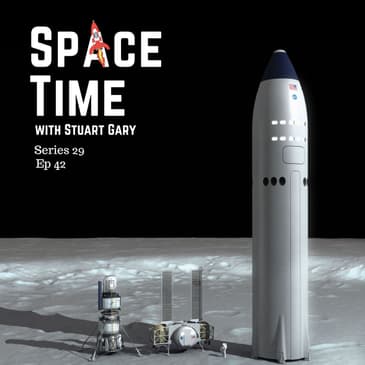
Versus Spacetime Series twenty nine, episode forty two, for broadcast on the eighth of April twenty twenty six. Coming up on space Time, NASA looking at nine possible landing sites or its Atomis fur mission returning humans to the lunar surface, and you study reveals satin's weird magnetic shield and growing concerns following another Starling satellite explosion in orbit. All that and more coming up on space Time. Welcome to space Time with Stewart Gary. NASA have narrowed down their list of possible landing sites for their return of humans to the lunar surface in twenty twenty eight. The atomist for mission will target one of nine possible landing sites around the lunar South Pole. Nasare yet to the decide which of the two landers, SpaceX's giant starship HLS or Blue Origins more moderately sized integrated lunar vehicle, will undertake that historic mission. Both will be tested next year in low Earth orbit, undertaking practice docking maneuvers during the Atomis three mission, and they'll each have to perform an unmanned landing and take off from the lunar surface for a final decisions made, of course. The announcement of lunar landing targets comes as the Artemis two crew continue their historic orbital journey around the Moon and back to Earth. The likely target sites four Artemis four, were presented at the fifty seventh Lunar and Planetary Science Conference in Texas. It follows an earlier selection of thirteen sites back in twenty twenty four. Each of the candidate sites is based on several mission requirements including manned land a vehicle design, communications availability, surface lighting safety, and surface mission duration, which is currently estimated to be between five and seven days. The nine sites represent a balance of operational feasibility, terrain safety, and science potential. The Luna's south pole location means communications would become crucial for staying in constant contact with the Earth. While planet Earth is tilted at some twenty three and a half degrees relative to the Sun, the Moon's only tilted at five degrees, and this much smaller angle means some regions of the lunar poles aren't directly in line of sight with Earth that will result in intermittent loss of signal. In fact, that very issue became apparent during the intuity of machines i AM two mission, which attempted to land near the lunar south pole but ended up tipping over sideways in a crater. The cause was traced to the spacecraft's telemetry and altitude monitoring experiencing significant changes during the descent, all because of the intermittent communications problems with Earth. It meant the vehicle didn't really know where it was as it passed behind a crater in or small hill, temporarily cutting communications with mission managers back on Earth. This has decided to target the more difficult lunar south pole terrain rather than the Moon's always Earth facing knee side because of the large water ized deposits in the permanently shadowed floors of the deck craters located there. That water would eventually be used both for drinking and also separated into hydrogen and oxygen fuses rocket fuel. This report from MESSATV. We learned a lot from the Apollo samples, but we still have a lot left to learn about the Moon. The Apollo missions visited only a pretty narrow swath of the Moon. All the missions were concentrated near the near side equator. Really interesting and really critical insights were unlocked with the Apollo samples. But we have so many questions still to answer about the Moon and the evolution of the Moon and lift off of Artemis one we rise together back to. The Moon and beyond. NASA's Artemis missions are NASA's plan to send people to the surface of the Moon. We'll be sending people and roving assets and scientific equipment to, among other things, answer a lot of really compelling science questions. Scientists have a lot to learn about the Moon. It's our nearest celestial neighbor here to Earth. So what the Moon has experienced, we've experienced. Except here on Earth we have things like plate tectonics, oceans, forests, people that erase the rock record, whereas on the Moon, that whole record of our planet's history, of the Moon's history is just kind of waiting there at the surface for us to explore. The south pole, which is where Artemis missions are going to target, is specifically interesting for a couple key reasons. We think there are volatiles at the south pole of the Moon that are not present near the equator, things like water and water ice that are trapped in the lunar regolith, which basically just means lunar soil that can easily become untrapped from that lunar regolith and scientists can scoop up and study for return to Earth. The lunar South Pole is a really exciting scientific target, and it also comes with some challenges for operating. For example, the lighting environment will change drastically within the course of one mission and even over sometimes the course of one spacewalk. Compairing the crew members, preparing the hardware that we're sending to the Moon, and preparing the mission control teams is really really important. The South full Achenbasin is particularly exciting. We think it's one of the oldest and largest impact basins in the Solar System. And if we can get the right rock from the South Full Achenbasin and bring it back to our labs here on Earth, we can use that sample to constrain the entire evolution of our Solar system and really understand the timing of how the Moon and our planet and the entire Solar system evolved. And in that report from MESSATV we had from Otamus Lunas science lead Kelsey Young from messa's godd Space Flight Center, this is space time still to come. Discovery of a weed magnetic shield around Satin, and concerns grow as another styling satellite explodes in orbit. All that and more still to come on space time, a new study has found that Satin's magnetosphere that's the magnetic bubble surrounding the ring world, is lopsided. The findings, reported in the journal Nature Communications, are based on data from Nasus Cassini spacecraft, which orbited Saturn between twenty four and twenty seventeen, studying many of its moons and deploying the European space agencies Huygen's lander down to the surface of the moon Titan. The studies authors say that discovery confirms that giant planets operate under a different magnetospheric regime compared to that of the Earth. In fact, this new finding backs up a long staining hypothesis that the rapid spin of massive planets like Jupiter and Satin would replace the solar wind the stream of church particle was flowing out from the Sun as the dominant force sculpting their magnetospheres. A magnetosphere is the region of near space environment around the planet where it's magnetic field axis is shield against the solar wind. However, near a planet's magnetic poles, funnel shaped openings known as magnetospheric cusps, allow charged particles from the Sun to leak directly into a planetary atmosphere. The authors analyzed Cassini data collected between two thy four and twenty ten to determine the precise location of Saturn's magnetospheric causp, and the results showed a clear difference from similar measurements here on Earth. It seems Saturn's immense rotational forces literally drag the cusp away from noon, stewing its average location significantly towards the afternoon sector, specifically between thirteen hundred and fifteen hundred local time, whiles sometimes extending that even further towards twenty hours local time. The dusk or into location of Saturn's cusp confirms that a planet's rotational rate can fundamentally change the structure of its a near space environment. In fact, the shifted cusp location fundamentally alters models of magnetic reconnection, high energy particle acceleration, and Saturn's powerful auroral activity. One of the studies authors, the Cray from Lancaster University, says these results will allow scientists to move forward with new and improved theories on how planetary magnetospheres interact with the solar wind. Earth spinds quite slowly compared to the gas giants, with one Earth day lasting twenty four hours. The dominant factor driving the shape of the magnetosphere is the balance between the pressure from the Sun, the solar wind, and the pressure from Earth's magnetic field, and so this balance aligns Earth's cust towards local high noon. But at Saturn, one day lasts just ten point seven hours and its magnetosphere is full of ionized material from its iceman and soladus, and these two effects mean that for Saturn, pressure from the magnetic field and a rapidly spinning disc of ionized material must be balanced against the solar wind pressure. Ray says the afternoon cusp locations as implications for how scientists interpret Saturn's bright aroa and where one can expect magnetic reconnection to occur. That's the explosive process that accelerates particles to very high energies. It also highlights the rich science that can still be done with Cassini data more than eight years after the end of the mission. This is space time still to come growing concerns as another Starlink satellite explodes in orbit, and later in the Science report, a new study shows that teenagers are turning to artificial intelligence for emotional support, validation, and companionship rather than their fellow humans. All that and more still to come on Space Time SpaceX are still trying to determine the exact cause of the sudden breakup of a Starlink broadband communications satellite last week. Starlink satellite four three four three unexpectedly disintegrated in low Earth orbit, approximately five hundred and sixty kilometers above the planet. Spacecraft had only been launched in May last year, so it was still fairly new, and the incident has sent shockwaves through the space community. This is not the first time this has happened to a startic satellite. LeoLabs, which acts as a sort of air traffic controller monitoring spacecraft positions from Earth using a network of global radar systems, says the break up scattered numerous fragments across a wide area. The company's network initially detected ten large fragments in the vicinity of the satellite after the event as it passed over Leolab's radar site in the Azores. The company says, due to the low altitude of the event, many fragments from this anomaly were likely deorbit within a few weeks. However, the presence of this debris could pose long term risks for spacecraft traveling through the area. Current speculation suggests the satellite's destruction was caused by some sort of internal energetic event anomaly. In other words, something inside the spacecraft exploded, possibly associated with its iron propulsion system or its fuel tank. The argon propellent used for orbital maneuvering is stored inside a composite overrapp pressure vessel, a number of which have already failed over the past few months. Leo Labs analysis indicates that this event is similar to a previous explosion involving Starling's satellite three five ninety five six back in December last year. The company says the Slurtest incident illustrates the need for rapid characterization of anomalous events in order to enable clarity of the operational environment this space. Time and time that to take another brief look at some of the other stories making news in science this week. With a science report, A new study warns that climate change will push more venomous snakes towards the highly populated Australian coast. A report in the General plus Neglected Tropical Diseases found that the venomous snakes species will have their ranges shifted away from the nation's arid center. The authors used a combination of public and private databases, citizen science platforms, museum records, scientific literature, and expert observations to model the habitats of all five hundred and eight medically important venomous snake species. They then use computer models to estimate how snakes and human populations currently overlap and project how that will shift by twenty fifty and again by twenty ninety due to climate change. They found that long term range expansion in Australia would shift towards the south, especially along the East coast or Central and Northern Australia will actually see a contraction of ranges as most of these species shift their distribution away from the arid center and towards the coastline, consequently into more highly populated human communities. The German Army is looking at purchasing a squadron of MQ two twenty eight ghost bat unmanned aerial combat vehicles designed and developed in Australia by the Australian Air Force and Boeing. The Ghost Spat is an autonomous force multiplier stealth aircraft designed to operate either independently or as a wingman for manned aircraft in military live fire exercises. MQ twenty eight has flown autonomously successfully shooting down a target drone using an AIM one twenty eight to eight missile while flying in formation with Australian Faight and super Hornet fighter aircraft and with E seven Wedgetail, a WAK advanced early warning control aircraft. The German interest comes as Berlin takes delivery of their first batch of Queensland built Boxer heavy weapons carriers and combat reconnaissance command and control vehicles. The Australian Army already operates two hundred and eleven Boxes in both combat reconnaissance and weapons carrier configurations. The reconnaissance variant differs by having a turret fitted with a thirty millimeter automatic cannon and an anti tank guided missile system. Scientists are raising concerns about adolescents turning to artificial intelligent chatbots for emotional support, validation, and companionship. The findings reported in the Journal of the American Medical Association suggest that it represents a societal shift in which personal development, which used to occur through human contact and relationships during the teenage years, is now being outsourced to technology. The authors are calling on parents to teach their teens to be more self aware, to recognize when AI use is becoming an emotional reliance and when AI relationships are eclipsing human connections, and that experiencing discomfort in human relationships is an important contributor to healthy development. The authors also suggest that doctors should routinely assess AI use among teens in order to flag emotional dependency in neglect of human connections early on. They conclude by warning that substituting human connections with AI may make teens more vulnerable to depression, anxiety, and loneliness, but they also acknowledge that for some teens, AI might be their only source of much needed emotional support. Intel have just released their new Core Ultra series three laptop CPU with the details were joined by technology editor alex Ahwervroyd from Take Advice, Start Live. Yeah, they just launched their Intel Core Ultra series three and laptops are already on sale. There's no desktops that I could see yet, but of course most people buy laptops these days. They had little thirteen inch models from zero point nine to eighty five kilograms under kilogram felt extremely light, as though it was a plastic toil on almost which is stunning. And we're talking about twenty seven hours of battery life on a single charge and up to forty hours if you're just watching Netflix with the screen dimmed. You could travel the world twise, I mean perfect environment for late at night or on a plane. And these laptops have a built in Intel graphics chip that is better with more frame rates than a computer with the separate discrete and videographic card inside. Now I've recorded the entire presentation. It'll be on it wire dot com. You can watch it there. And I went to all of the different stands, there were six of them, Dell hp MSI ass acer as well, and then know that's all six and I also did an interview with the local country general manager. And you know, these are the answer to both Apple's M five series, the notebooks and iPads, and also the AMD chips and AMD just announced today that there's a big event in San Francisco in July, which I've been invited to. I'll be going there and they'll have the new chips that will answer these ones from Intel. All the current ones are pretty amazing. I mean, Intel is catching up here and also their latest AI chip, so a good reason if you've got a four or five year old Windows PC that is a bit slow, and you know one of the keys is not working properly, or if it just hasn't got the battery life. You remember, I mean, these new machines are on the market, they're on sales. They're coming with things like sixteen or thirty two gig of RAM with five twelve gig or one tear about SSD, so that none of this is eight gig two fifty six big monthsons. I mean, these are quality machines and they have the battery power and when you put your hand on theeath they're not hot. So you know, this is using Intel's eighteen A process, which is catch up to some of the three nanometer type of technologies from the other guys. It's good to see Inteller is back. I mean they said they never left, but of course you know their technology was in catch up mode. Well yeah, their technology, well ignore this. Well they still sell the line's share of course PC. So it's not a's not as if they were forgotten. I mean it's the old ad age. You know, nobody ever got fired for buying IBM. Well nobody ever got fired for buying Intel either. As such. For consumers, I mean, they've been trained to think that an Intel ship is one. But plenty of people buy AMD chips because they've been whipping Intel's ass, as they say in America for quite some time. But they have caught up. And so that's good because it means consumers have a better range of technologies to buy from in the stores. And these are in stores now. And there's another couple of hundred models from different makes and sizes thirteen inch, fourteen inch, sixty inch, And it's nice to see Inteler's back. That's Alex Howrav right from Take Advice, Start Life, and this space Time, and that's the show for now. Spacetime is available every Monday, Wednesday and Friday through at bytes dot com, SoundCloud, YouTube, your favorite podcast download provider, and from space Time with Stuart Gary dot com. Space Time's also broadcast through the National Science Foundation, on Science Own Radio and on both iHeartRadio and tune in Radio. And you can help to support our show by visiting the Spacetime Store for a range of promotional merchandising goodies, or by becoming a Spacetime Patron, which gives you access to triple episode commercial free versions of the show, as well as lots of burnus audio content which doesn't go to weir, access to our exclusive Facebook group, and other rewards. Just go to space Time with Stuart Gary dot com for full details. You've been listening to Spacetime with Stuart Gary. This has been another quality podcast production from bytes dot com.