
*A New Planet Discovered Orbiting Barnard's Star
Astronomers have discovered a new exoplanet orbiting Barnard's Star, the closest single star to the Sun. This newly found planet, Barnard b, has about half the mass of Earth and completes an orbit around its host star every three Earth days. Located 5.96 light-years away, Barnard's Star is a small red dwarf in the constellation Ophiuchus. The discovery was made using the European Southern Observatory's Very Large Telescope and has sparked interest due to its low mass and proximity to its star. The study also hints at the existence of three more potential exoplanets in the system, although additional observations are needed for confirmation.
*ESA's Hera Mission Launch
The European Space Agency's Hera mission is set to launch, aimed at exploring the aftermath of NASA's DART mission impact on the asteroid Dimorphos. The mission will provide detailed analysis of the impact site and the asteroid's composition, mass, and structural changes. Hera will also deploy two cubesats, Milani and Juventus, to perform close-up observations and experiments. The mission is crucial for understanding how to protect Earth from potential asteroid threats in the future.
*Spectacular Annular Solar Eclipse
A stunning annular solar eclipse, known as a "ring of fire," has been witnessed by people across the eastern and southern Pacific, as well as parts of South America. The eclipse, which occurs when the Moon is slightly further from Earth, left a bright ring of sunlight visible around the Moon's silhouette. The event was best viewed from Easter Island and parts of Argentina and Chile, with partial views seen in other regions including Bolivia, Peru, and New Zealand.
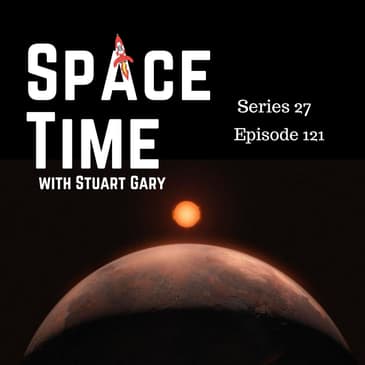
00:00:00 - This is spacetime series 27, episode 121, for broadcasts on 7 October 2024
00:00:47 - Astronomers have discovered a planet orbiting Barnard star, the closest single
00:04:48 - European Space Agency's Hera planetary defence mission slated for launch today
00:08:40 - NASA's Dart spacecraft crashed into the dimorphos asteroid in 2022
00:12:11 - The people of the east and South Pacific and South America witnessed an annual solar eclipse
00:14:07 - Scientists have developed a new drug delivery system for type two diabetes
00:17:02 - Women are turning to psychics to find out if their husbands are cheating
www.spacetimewithstuartgary.com
www.bitesz.com
🌏 Get Our Exclusive NordVPN deal here ➼ www.bitesz.com/nordvpn. The discount and bonuses are incredible! And it’s risk-free with Nord’s 30-day money-back guarantee! ✌
Check out our newest sponsor - Old Glory - Iconic Music and Sports Merch. Well worth a look....
Become a supporter of this podcast and access commercial-free episodes plus bonuses: https://www.spreaker.com/podcast/spacetime-with-stuart-gary--2458531/support.
[00:00:00] [SPEAKER_00]: This is SpaceTime Series 27, Episode 121, for broadcasts on the 7th of October 2024.
[00:00:07] [SPEAKER_00]: Coming up on SpaceTime, scientists discover a planet orbiting the nearest single start of the Sun,
[00:00:13] [SPEAKER_00]: the European Space Agency's Planetary Defence HERA mission slated for launch today,
[00:00:19] [SPEAKER_00]: and a spectacular ring of fire around the Sun.
[00:00:23] [SPEAKER_00]: All that and more coming up on SpaceTime.
[00:00:27] [SPEAKER_01]: Welcome to SpaceTime with Stuart Gary
[00:00:47] [SPEAKER_00]: Astronomers have discovered a planet orbiting Barnard Star, the closest single start of the Sun.
[00:00:52] [SPEAKER_00]: The newly discovered exoplanet has about half the mass of the Earth and orbits its host star in just over three Earth days.
[00:01:00] [SPEAKER_00]: Barnard Star is a small spectral type M red dwarf star in the constellation Afusius.
[00:01:06] [SPEAKER_00]: It's located some 5.96 light years from the Sun.
[00:01:09] [SPEAKER_00]: That makes it the nearest start of the Sun after the Alpha Centauri triple star system.
[00:01:15] [SPEAKER_00]: They're located around 4.3 light years away.
[00:01:18] [SPEAKER_00]: Barnard Star has a mass about 16% that of the Sun, and it has about 19% of the Sun's diameter.
[00:01:25] [SPEAKER_00]: The new planetary discovery, reported in the journal Astronomy and Astrophysics,
[00:01:29] [SPEAKER_00]: was made using the European Southern Observatory's very large telescope, the VLT.
[00:01:35] [SPEAKER_00]: And the observations don't end there.
[00:01:38] [SPEAKER_00]: There are also some tantalising hints at the possible existence of three more exoplanetary candidates in various orbits around the star.
[00:01:45] [SPEAKER_00]: And that could make this star system a reflection of our own solar system.
[00:01:49] [SPEAKER_00]: Despite a promising detection back in 2018,
[00:01:52] [SPEAKER_00]: no planet orbiting Barnard Star had been confirmed until now.
[00:01:57] [SPEAKER_00]: The study's lead author, Johnny Gonzalez Hernandez from the Astrophysics Institute of the Canary Islands,
[00:02:02] [SPEAKER_00]: says the new discovery was the result of more than five years of observations.
[00:02:07] [SPEAKER_00]: See, the team were looking for signals of possible exoplanets within the star's habitable zone.
[00:02:13] [SPEAKER_00]: That's the distance from the star where temperatures would allow liquid water,
[00:02:17] [SPEAKER_00]: essential for life as we know it, to exist on the planet's surface.
[00:02:20] [SPEAKER_00]: Red dwarves, like Barnard Star, are often targeted by astronomers
[00:02:25] [SPEAKER_00]: because their habitable zones are much closer into the star than hotter stars like our Sun.
[00:02:30] [SPEAKER_00]: That means the planets orbiting within this zone have shorter orbital periods,
[00:02:34] [SPEAKER_00]: allowing astronomers to monitor them over several days or weeks rather than years.
[00:02:39] [SPEAKER_00]: Also, because red dwarf stars are far less massive than the Sun,
[00:02:43] [SPEAKER_00]: they're more easily disturbed by the gravitational pull of an orbiting planet around them.
[00:02:48] [SPEAKER_00]: Therefore, their spectral movements towards and away from the observer are more easily identified.
[00:02:54] [SPEAKER_00]: In other words, they're easier to spot by the wobble method.
[00:02:57] [SPEAKER_00]: The new planet, which has been named Barnard B,
[00:03:00] [SPEAKER_00]: is about 20 times closer to Barnard Star than Mercury is to the Sun.
[00:03:05] [SPEAKER_00]: That gives it a surface temperature of around 125 degrees Celsius.
[00:03:09] [SPEAKER_00]: And that puts it inside the habitable zone,
[00:03:12] [SPEAKER_00]: a region where it's too hot for water to exist in a liquid state.
[00:03:15] [SPEAKER_00]: What makes this discovery really interesting is that Barnard B
[00:03:19] [SPEAKER_00]: is one of the lowest mass exoplanets found so far,
[00:03:23] [SPEAKER_00]: and one of only a few with less mass than the Earth.
[00:03:26] [SPEAKER_00]: For their observations, the authors used ESPRESSO.
[00:03:29] [SPEAKER_00]: That's a highly precise spectrometer,
[00:03:31] [SPEAKER_00]: specifically designed to measure the wobble of a star
[00:03:34] [SPEAKER_00]: caused by the gravitational pull of orbiting planets.
[00:03:37] [SPEAKER_00]: Interestingly, however, this new data doesn't support the existence
[00:03:40] [SPEAKER_00]: of the exoplanet first speculated to exist back in 2018.
[00:03:45] [SPEAKER_00]: The observations simply no longer support that.
[00:03:47] [SPEAKER_00]: As I mentioned earlier, in addition to the confirmed planet,
[00:03:51] [SPEAKER_00]: the authors also found hints of three more exoplanetary candidates orbiting the same star.
[00:03:55] [SPEAKER_00]: These candidates, however, will require additional observations to be confirmed.
[00:04:00] [SPEAKER_00]: It's also worth noting that Barnard's star is slowly getting closer to our own solar system.
[00:04:07] [SPEAKER_00]: Measurements of its proper motion through space
[00:04:10] [SPEAKER_00]: show that it has a relative lateral speed of around 90 kilometers per second,
[00:04:14] [SPEAKER_00]: and the star's radial velocity is 110 kilometers per second,
[00:04:18] [SPEAKER_00]: as measured from its blue shift due to its motion towards the Sun.
[00:04:22] [SPEAKER_00]: Now, combined with its proper motion and distance,
[00:04:25] [SPEAKER_00]: this gives it a space velocity, that is an actual speed relative to the motion of our Sun,
[00:04:30] [SPEAKER_00]: of 142.6 kilometers per second.
[00:04:33] [SPEAKER_00]: Now, when you work all that out,
[00:04:35] [SPEAKER_00]: it means Barnard's star will make its closest approach to the Sun
[00:04:38] [SPEAKER_00]: in around 9,800 years from now,
[00:04:40] [SPEAKER_00]: at which point it'll be within 3.75 light-years of the Earth.
[00:04:45] [SPEAKER_00]: That's closer than the Alpha Centauri star system is now.
[00:04:49] [SPEAKER_00]: This is space time.
[00:04:51] [SPEAKER_00]: Still to come,
[00:04:52] [SPEAKER_00]: The European Space Agency's HERA planetary defense mission is slated for launch today,
[00:04:57] [SPEAKER_00]: and a spectacular ring of fire seen around the Sun.
[00:05:01] [SPEAKER_00]: All that and more coming up on Space Time.
[00:05:19] [SPEAKER_00]: The European Space Agency's HERA planetary defense mission is slated for launch today.
[00:05:25] [SPEAKER_00]: The 1,125-kilogram spacecraft will fly aboard a SpaceX Falcon 9 rocket from the Cape Canaveral Space Force base in Florida
[00:05:34] [SPEAKER_00]: on a two-year journey to the near-Earth asteroid Didymos and its tiny moon Dimorphos.
[00:05:40] [SPEAKER_00]: Dimorphos was the target of NASA's DART double asteroid redirection test,
[00:05:44] [SPEAKER_00]: which was designed to slam an impactor spacecraft into an asteroid
[00:05:47] [SPEAKER_00]: to see if they could deflect it onto a different trajectory.
[00:05:50] [SPEAKER_00]: The DART spacecraft hit Dimorphos on September 26, 2022,
[00:05:55] [SPEAKER_00]: impacting the asteroid at a relative speed of 6.1 km per second.
[00:06:00] [SPEAKER_00]: And the crash was spectacular.
[00:06:03] [SPEAKER_00]: It altered Dimorphos's orbit around Didymos,
[00:06:06] [SPEAKER_00]: shortening its orbital period by around 32 minutes
[00:06:09] [SPEAKER_00]: and leaving a massive crater and debris cloud in its wake.
[00:06:12] [SPEAKER_00]: The test marked the first time humanity had demonstrated its ability to deflect an asteroid,
[00:06:18] [SPEAKER_00]: providing proof of concept that we might in the future be able to protect the Earth
[00:06:22] [SPEAKER_00]: from a potential asteroid impact simply by altering the asteroid's path.
[00:06:27] [SPEAKER_00]: Given enough time, of course.
[00:06:29] [SPEAKER_00]: HERA, which is named after the Greek goddess of marriage,
[00:06:32] [SPEAKER_00]: will undertake a forensic follow-up evaluation mission,
[00:06:35] [SPEAKER_00]: finding out exactly what happened in the wake of the impact.
[00:06:38] [SPEAKER_00]: Its payload includes a series of cameras, altimeters and spectrometers.
[00:06:44] [SPEAKER_00]: It'll help scientists answer some key outstanding questions,
[00:06:47] [SPEAKER_00]: such as the exact mass and composition of Dimorphos,
[00:06:50] [SPEAKER_00]: the structural effects of the impact,
[00:06:52] [SPEAKER_00]: the size of the crater formed by the collision,
[00:06:55] [SPEAKER_00]: an analysis of the expanding debris cloud caused by the impact,
[00:06:58] [SPEAKER_00]: and whether Dimorphos may have actually been fractured by the impact
[00:07:02] [SPEAKER_00]: and is now really nothing more than a bunch of rocks held together by weak gravity.
[00:07:07] [SPEAKER_00]: It'll also carry out technology demonstration experiments,
[00:07:11] [SPEAKER_00]: including the deployment of ESA's first deep space cubesats,
[00:07:15] [SPEAKER_00]: Melania and Juventus,
[00:07:16] [SPEAKER_00]: two small spacecraft that will approach the asteroid and eventually land on it.
[00:07:21] [SPEAKER_00]: As well as gathering crucial close-up data on the surface characteristics of the asteroid,
[00:07:26] [SPEAKER_00]: HERA will explore the binary system as a whole in unprecedented detail,
[00:07:30] [SPEAKER_00]: becoming the first mission to study a binary asteroid system in depth.
[00:07:33] [SPEAKER_00]: It'll study both asteroids' internal porosity and structure using a low-frequency radar aboard the CubeSat Juventus.
[00:07:41] [SPEAKER_00]: Meanwhile, Melania will help collect spectral data from the surface of both asteroids.
[00:07:46] [SPEAKER_00]: It'll also help identify the presence of debris dust in the surrounding space.
[00:07:51] [SPEAKER_00]: Dimorphos will be mapped completely with a spatial resolution of a few metres,
[00:07:55] [SPEAKER_00]: and the vicinity of the impact will be mapped with a resolution down to just 10 centimetres.
[00:07:59] [SPEAKER_00]: The mass of the moon Dimorphos will be estimated with high accuracy.
[00:08:04] [SPEAKER_00]: That will allow a direct estimate of the momentum transfer efficiency of the DART impact.
[00:08:09] [SPEAKER_00]: That's an important step, as binary asteroid systems make up some 15% of all-known asteroids.
[00:08:15] [SPEAKER_00]: The mission will also test advanced autonomous navigation technology based on visual data.
[00:08:21] [SPEAKER_00]: Before rendezvousing with Didymos and Dimorphos in December 2026,
[00:08:25] [SPEAKER_00]: HERA will undertake a gravity assist flyby of Mars in March next year.
[00:08:29] [SPEAKER_00]: And that will give scientists the chance to study the Marsha moon Dimorphos in some detail.
[00:08:35] [SPEAKER_00]: This report on the HERA mission from ESA-TV.
[00:08:39] [SPEAKER_01]: There's a mystery out there in deep space, and solving it will make Earth safer.
[00:08:45] [SPEAKER_01]: That's why the European Space Agency's HERA mission is taking shape,
[00:08:50] [SPEAKER_01]: to go where one particular spacecraft has gone before.
[00:08:53] [SPEAKER_01]: On the 26th of September 2022, at 6.1 kilometres per second,
[00:09:00] [SPEAKER_01]: NASA's DART spacecraft crashed into the Dimorphos asteroid.
[00:09:05] [SPEAKER_01]: Part of our solar system changed.
[00:09:10] [SPEAKER_01]: The impact shrunk the orbit of the great pyramid-sized Dimorphos around its parent asteroid,
[00:09:17] [SPEAKER_01]: the mountain-sized Didymus.
[00:09:19] [SPEAKER_01]: It also sent a plume of debris thousands of kilometres across space.
[00:09:25] [SPEAKER_01]: This grand experiment was performed to prove we could defend Earth against an incoming asteroid
[00:09:31] [SPEAKER_01]: by striking it with a spacecraft to deflect it.
[00:09:36] [SPEAKER_01]: DART succeeded, but that still leaves many things scientists don't know.
[00:09:41] [SPEAKER_01]: What is the precise mass and makeup of Dimorphos?
[00:09:46] [SPEAKER_01]: What did the impact do to the asteroid?
[00:09:49] [SPEAKER_01]: How big is the crater left by DART's collision?
[00:09:53] [SPEAKER_01]: Or has Dimorphos completely cracked apart, held together by its own weak gravity?
[00:10:00] [SPEAKER_01]: That's why we're going back with ESA's HERA mission.
[00:10:07] [SPEAKER_01]: After a two-year trek through space and a Mars flyby,
[00:10:12] [SPEAKER_01]: HERA will go into orbit around Dimorphos and begin its crash site investigation.
[00:10:19] [SPEAKER_01]: This will be a hazardous undertaking.
[00:10:22] [SPEAKER_01]: The impact might have left clouds of debris hanging in the asteroid's vicinity.
[00:10:27] [SPEAKER_01]: But HERA is not going alone.
[00:10:30] [SPEAKER_01]: It takes with it two briefcase-sized CubeSats to go in closer
[00:10:35] [SPEAKER_01]: and take more risks than their parent spacecraft.
[00:10:40] [SPEAKER_01]: One will identify the minerals making up Dimorphos,
[00:10:44] [SPEAKER_01]: while the other will unfurl a radar antenna
[00:10:47] [SPEAKER_01]: to make the first subsurface probe of an asteroid.
[00:10:51] [SPEAKER_01]: And they'll end their duties by touching down on Dimorphos
[00:10:56] [SPEAKER_01]: to gather extra data on its surface and gravity field.
[00:10:59] [SPEAKER_01]: By the end of HERA's observations,
[00:11:03] [SPEAKER_01]: Dimorphos will become the best-studied asteroid in history,
[00:11:08] [SPEAKER_01]: which is vital,
[00:11:09] [SPEAKER_01]: because if a body of this size ever struck Earth,
[00:11:13] [SPEAKER_01]: it could destroy a whole city.
[00:11:16] [SPEAKER_01]: The dinosaurs had no defense against asteroids,
[00:11:20] [SPEAKER_01]: because they never had a space agency.
[00:11:24] [SPEAKER_01]: But through HERA,
[00:11:26] [SPEAKER_01]: we are teaching ourselves what we can do to reduce this hazard
[00:11:30] [SPEAKER_01]: and make space safer.
[00:11:38] [SPEAKER_00]: This is Space Time.
[00:11:40] [SPEAKER_00]: Still to come, a spectacular ring of fire around the sun,
[00:11:44] [SPEAKER_00]: and later in the science report,
[00:11:46] [SPEAKER_00]: a new study finally explains why the Tonga volcano blast
[00:11:50] [SPEAKER_00]: was as powerful as it was.
[00:11:52] [SPEAKER_00]: All that and more still to come on Space Time.
[00:12:11] [SPEAKER_00]: The people of the East and South Pacific and South America
[00:12:14] [SPEAKER_00]: have been treated to a spectacular annulus solar eclipse.
[00:12:18] [SPEAKER_00]: An annulus solar eclipse occurs when the moon's elliptical orbit
[00:12:22] [SPEAKER_00]: is slightly further away from the Earth,
[00:12:24] [SPEAKER_00]: making it appear smaller.
[00:12:25] [SPEAKER_00]: And so, when it lines up between the sun and the Earth
[00:12:29] [SPEAKER_00]: to create a solar eclipse,
[00:12:31] [SPEAKER_00]: it doesn't quite block out all of the sun's disk,
[00:12:34] [SPEAKER_00]: but instead leaves a spectacular ring of fire in the darkened sky.
[00:12:38] [SPEAKER_00]: The event began over the East and South Pacific Ocean,
[00:12:42] [SPEAKER_00]: before making landfall across the southern tip of South America.
[00:12:46] [SPEAKER_00]: People on Easter Island and parts of Argentina and Chile
[00:12:49] [SPEAKER_00]: were in the best positions to witness the spectacular celestial show.
[00:12:53] [SPEAKER_00]: The narrow path of annularity then continued into the South Atlantic Ocean
[00:12:58] [SPEAKER_00]: before finally ending.
[00:13:00] [SPEAKER_00]: A partial eclipse was observed from Bolivia, Peru, Paraguay, Uruguay,
[00:13:05] [SPEAKER_00]: as well as parts of Brazil, Mexico, New Zealand,
[00:13:08] [SPEAKER_00]: and several islands in the Pacific and Atlantic Oceans.
[00:13:11] [SPEAKER_00]: It was the second solar eclipse this year.
[00:13:14] [SPEAKER_00]: April's total solar eclipse dazzled sky watches in parts of Mexico,
[00:13:18] [SPEAKER_00]: the United States, and eastern Canada.
[00:13:20] [SPEAKER_00]: The next total solar eclipse won't arrive until 2026,
[00:13:24] [SPEAKER_00]: and it'll pass over the northern fringes of Greenland, Iceland and Spain.
[00:13:28] [SPEAKER_00]: But before that, two more partial solar eclipses will take place next year,
[00:13:33] [SPEAKER_00]: one in March, the other in September.
[00:13:35] [SPEAKER_00]: The March event on the 29th will be visible mainly from eastern North America,
[00:13:40] [SPEAKER_00]: Europe, Siberia and northwestern Africa.
[00:13:42] [SPEAKER_00]: The year's second partial solar eclipse will take place on September the 21st,
[00:13:47] [SPEAKER_00]: and it'll be visible over Antarctica, New Zealand and the islands of the South Pacific.
[00:13:52] [SPEAKER_00]: People in Tasmania and along the east coast of Australia
[00:13:55] [SPEAKER_00]: will also be able to see just an ever-so-slight sliver of the sun covered by the moon.
[00:14:01] [SPEAKER_00]: It won't be till 2028 that Australians will get to see their next total solar eclipse.
[00:14:06] [SPEAKER_00]: This is Space Time.
[00:14:24] [SPEAKER_00]: And time now to take a brief look at some of the other stories
[00:14:27] [SPEAKER_00]: making news in science this week with a science report.
[00:14:30] [SPEAKER_00]: A new study has concluded that the Hunga Tonga underwater volcano,
[00:14:34] [SPEAKER_00]: one of the largest volcanic eruptions in recorded history,
[00:14:37] [SPEAKER_00]: was triggered by an explosion, most likely due to gas-compressed rock,
[00:14:41] [SPEAKER_00]: which released as much energy as five thermonuclear explosions.
[00:14:45] [SPEAKER_00]: The findings were reported in the journal Geophysical Research Letters,
[00:14:49] [SPEAKER_00]: and based on computer models suggesting gas-compressed rock
[00:14:52] [SPEAKER_00]: being trapped underneath a shallow sea,
[00:14:54] [SPEAKER_00]: acted as a sort of overcooked pressure cooker.
[00:14:58] [SPEAKER_00]: The study's authors from the Australian National University
[00:15:00] [SPEAKER_00]: analysed the cataclysmic event's noisy but valuable seismic records
[00:15:04] [SPEAKER_00]: in order to decipher its mysterious physical mechanism.
[00:15:08] [SPEAKER_00]: They found the explosion caused a massive vertical push of water upwards into the atmosphere,
[00:15:13] [SPEAKER_00]: causing tsunamis that reached as high as 45 metres on nearby islands.
[00:15:20] [SPEAKER_00]: Scientists have developed a version of a Zempic and Wigovie,
[00:15:23] [SPEAKER_00]: which could involve a once-a-month rather than weekly injection.
[00:15:27] [SPEAKER_00]: The study's authors, presenting their findings at the annual meeting
[00:15:30] [SPEAKER_00]: of the European Association for the Study of Diabetes,
[00:15:33] [SPEAKER_00]: say they've developed a new drug delivery system
[00:15:36] [SPEAKER_00]: that could cut the dosing schedule for the type 2 diabetes weight-controlled drug,
[00:15:40] [SPEAKER_00]: some eglotide, to just once a month.
[00:15:42] [SPEAKER_00]: The new drug delivery system involves a hydrogel composed of two biodegradable plastics.
[00:15:47] [SPEAKER_00]: These are injected under the skin and then release the drug slowly over 1-3 months.
[00:15:53] [SPEAKER_00]: Lab tests showed extended and consistent release rates over 3 months,
[00:15:57] [SPEAKER_00]: suggesting the hydrogel was well-tolerated and didn't cause any inflammation.
[00:16:03] [SPEAKER_00]: A new study claims those cutesy puppy voices people often use when speaking with their pets
[00:16:08] [SPEAKER_00]: might not just be because they're overwhelmed with love,
[00:16:11] [SPEAKER_00]: but could actually have evolved over time to help man's best friend understand you better.
[00:16:17] [SPEAKER_00]: A report in the journal Plus Biology analyzed the vocal sounds of 30 dogs
[00:16:22] [SPEAKER_00]: as well as 27 humans across 5 language groups speaking to other people
[00:16:26] [SPEAKER_00]: and 22 humans across those same language groups speaking to dogs.
[00:16:31] [SPEAKER_00]: They also looked at the brain responses to speech in both humans and dogs.
[00:16:35] [SPEAKER_00]: They found that humans are much faster talkers than dogs with a speech rate of about 4 syllables per second,
[00:16:42] [SPEAKER_00]: while dogs tend to bark and growl and woof and whine at about 2 vocalizations per second.
[00:16:47] [SPEAKER_00]: The brain scans also found that dogs were more responsive
[00:16:50] [SPEAKER_00]: to specific slower rhythms than humans usually speak.
[00:16:53] [SPEAKER_00]: The results imply that people could be changing their speech and tempo
[00:16:57] [SPEAKER_00]: in order to match what puppies can process.
[00:17:01] [SPEAKER_00]: In a finding that's about to make every man shake in their boots with fear,
[00:17:06] [SPEAKER_00]: a new study has shown that women are now more and more
[00:17:09] [SPEAKER_00]: turning to psychics to find out if their husbands are cheating on them.
[00:17:13] [SPEAKER_00]: But as Tim Mendham from Australian Skeptics explains,
[00:17:16] [SPEAKER_00]: the study was limited, confined to those interested in a specific type of extramarital activity.
[00:17:22] [SPEAKER_02]: This is a dangerous one mainly because of the source of the story actually.
[00:17:25] [SPEAKER_02]: It comes from a survey done by a romantic website dating service thing called Illicit Encounters,
[00:17:33] [SPEAKER_02]: which is actually for married couples and presumably for married couples or for members thereof
[00:17:38] [SPEAKER_02]: to go out and find alternative partners.
[00:17:40] [SPEAKER_02]: So leading to, you know...
[00:17:43] [SPEAKER_00]: You had a name for that back in the 70s and 80s, didn't they,
[00:17:46] [SPEAKER_00]: where you put your car keys in a dish or something?
[00:17:48] [SPEAKER_02]: A little wife swapping.
[00:17:49] [SPEAKER_00]: Wife swapping is what it's called.
[00:17:50] [SPEAKER_00]: Yeah, very sexist that term, but yeah.
[00:17:52] [SPEAKER_02]: I don't think anyone did husband swapping, you know.
[00:17:54] [SPEAKER_00]: Well, yummy mummies are always better looking than their husbands, aren't they?
[00:17:58] [SPEAKER_02]: Anyway, this website, this dating service called Illicit Encounters,
[00:18:02] [SPEAKER_02]: did a survey of its members, who are people, customers, if you like,
[00:18:05] [SPEAKER_02]: who are all there looking for affairs, et cetera,
[00:18:07] [SPEAKER_02]: and it found out that a lot of them are turned into psychics
[00:18:10] [SPEAKER_02]: to find out if their partner is wandering, is having an affair.
[00:18:14] [SPEAKER_02]: And according to this survey, 52% of those who took part of the survey
[00:18:18] [SPEAKER_02]: hoped to uncover infidelities from their partners,
[00:18:22] [SPEAKER_02]: and 58% of people had suspicion.
[00:18:24] [SPEAKER_02]: So people out there, based on this website,
[00:18:26] [SPEAKER_02]: are looking for wandering people that are sort of unsure.
[00:18:29] [SPEAKER_02]: So they're turning to psychics.
[00:18:31] [SPEAKER_02]: Once upon a time, it might have been a private investigator
[00:18:33] [SPEAKER_02]: to go around and sort of photograph your husband or wife
[00:18:36] [SPEAKER_02]: meeting up with other people.
[00:18:37] [SPEAKER_02]: Now they're turning to psychics for the answer.
[00:18:39] [SPEAKER_02]: Whether they're getting the answer that is correct,
[00:18:41] [SPEAKER_02]: they might get the answer they want,
[00:18:43] [SPEAKER_02]: but they're not necessarily getting a correct answer
[00:18:44] [SPEAKER_02]: is a bit uncertain.
[00:18:46] [SPEAKER_02]: But apparently it's very popular in Scotland.
[00:18:48] [SPEAKER_02]: This is the UK site.
[00:18:49] [SPEAKER_02]: So the largest number of people of this survey using it
[00:18:52] [SPEAKER_02]: was 43% of women admitting to seeking supernatural guidance
[00:18:55] [SPEAKER_02]: in Scotland, down to 31% in England, 16% in Wales,
[00:18:59] [SPEAKER_02]: and only 10% of people in Northern Ireland
[00:19:01] [SPEAKER_02]: looking for, you know, going to a psychic
[00:19:03] [SPEAKER_02]: to see if their partner was wandering.
[00:19:05] [SPEAKER_02]: It tends to be apparently women going to the psychics.
[00:19:08] [SPEAKER_00]: Well, we've covered that before, haven't we?
[00:19:10] [SPEAKER_00]: Women go to psychics and see ghosts and spirits.
[00:19:12] [SPEAKER_00]: Men see Bigfoot and UFOs.
[00:19:14] [SPEAKER_00]: UFOs.
[00:19:14] [SPEAKER_02]: That's right, yes.
[00:19:15] [SPEAKER_02]: It's almost like a gender division of these things.
[00:19:18] [SPEAKER_02]: Anyway, sort of one person, one particular case
[00:19:20] [SPEAKER_02]: that was quite amusing said,
[00:19:21] [SPEAKER_02]: I was worried about this, did everything to find out,
[00:19:23] [SPEAKER_02]: checking her phone, analysing behaviour,
[00:19:25] [SPEAKER_02]: installing a tracking app in her partner's phone.
[00:19:28] [SPEAKER_02]: And then she went to the psychic to find out.
[00:19:29] [SPEAKER_02]: The psychic said, yes, he's having an off with someone else.
[00:19:32] [SPEAKER_02]: And so she got her revenge by having her own affair.
[00:19:34] [SPEAKER_02]: So you justify what you're doing, yeah.
[00:19:36] [SPEAKER_02]: That's right, yeah.
[00:19:37] [SPEAKER_02]: So anyway, it's a survey based on a very niche group
[00:19:40] [SPEAKER_02]: who I think are already predisposed
[00:19:42] [SPEAKER_02]: for having illicit affairs anyway, as the name of the site is.
[00:19:45] [SPEAKER_00]: That's Tim Mendham from Australian Skeptics.
[00:19:49] [SPEAKER_00]: And that's the show for now.
[00:20:06] [SPEAKER_00]: Space Time is available every Monday, Wednesday and Friday
[00:20:09] [SPEAKER_00]: through Apple Podcasts, iTunes, Stitcher, Google Podcasts,
[00:20:13] [SPEAKER_00]: Pocket Casts, Spotify, Acast, Amazon Music,
[00:20:17] [SPEAKER_00]: Bytes.com, SoundCloud, YouTube,
[00:20:20] [SPEAKER_00]: your favourite podcast download provider
[00:20:22] [SPEAKER_00]: and from spacetimewithstuartgary.com.
[00:20:25] [SPEAKER_00]: Space Time's also broadcast through the National Science Foundation
[00:20:28] [SPEAKER_00]: on Science Zone Radio
[00:20:30] [SPEAKER_00]: and on both iHeart Radio and TuneIn Radio.
[00:20:33] [SPEAKER_00]: And you can help to support our show
[00:20:35] [SPEAKER_00]: by visiting the Space Time store
[00:20:37] [SPEAKER_00]: for a range of promotional merchandising goodies.
[00:20:40] [SPEAKER_00]: Or by becoming a Space Time patron,
[00:20:42] [SPEAKER_00]: which gives you access to triple episode
[00:20:44] [SPEAKER_00]: commercial free versions of the show,
[00:20:46] [SPEAKER_00]: as well as lots of bonus audio content
[00:20:48] [SPEAKER_00]: which doesn't go to air,
[00:20:49] [SPEAKER_00]: access to our exclusive Facebook group
[00:20:51] [SPEAKER_00]: and other rewards.
[00:20:53] [SPEAKER_00]: Just go to spacetimewithstuartgary.com
[00:20:56] [SPEAKER_00]: for full details.
[00:20:57] [SPEAKER_00]: And if you want more Space Time,
[00:20:59] [SPEAKER_00]: please check out our blog
[00:21:00] [SPEAKER_00]: where you'll find all the stuff
[00:21:01] [SPEAKER_00]: we couldn't fit in the show,
[00:21:03] [SPEAKER_00]: as well as heaps of images,
[00:21:04] [SPEAKER_00]: news stories, loads of videos
[00:21:06] [SPEAKER_00]: and things on the web
[00:21:07] [SPEAKER_00]: I find interesting or amusing.
[00:21:09] [SPEAKER_00]: Just go to spacetimewithstuartgary.tumblr.com.
[00:21:13] [SPEAKER_00]: That's all one word
[00:21:15] [SPEAKER_00]: and that's Tumblr without the E.
[00:21:16] [SPEAKER_00]: You can also follow us
[00:21:18] [SPEAKER_00]: through at Stuart Gary on Twitter,
[00:21:20] [SPEAKER_00]: at spacetimewithstuartgary on Instagram,
[00:21:23] [SPEAKER_00]: through our Space Time YouTube channel
[00:21:25] [SPEAKER_00]: and on Facebook.
[00:21:26] [SPEAKER_00]: Just go to facebook.com
[00:21:28] [SPEAKER_00]: forward slash spacetimewithstuartgary.
[00:21:31] [SPEAKER_00]: You've been listening
[00:21:32] [SPEAKER_00]: to Space Time with Stuart Gary.
[00:21:34] [SPEAKER_01]: This has been another
[00:21:35] [SPEAKER_01]: quality podcast production
[00:21:36] [SPEAKER_01]: from Bytes.com.