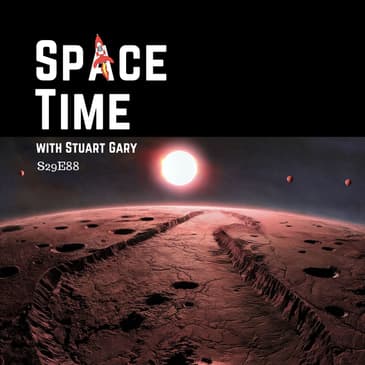
This is Spacetime Series twenty nine, Episode eighty eight, for broadcast on the twenty fourth July twenty twenty six. Coming up on space Time, the Hellish world's orbiting a nearby star, Australia's role in India's manned space program, and the latest mission to the International Space Station. All that and more coming up on Spacetime. Welcome to space Time with Stuart Gary. Astronomers have paid to the most detailed portrait yet of the planetary system orbiting Barnard Star, the Sun's closest still in neighbor after the Alpha Centaury star system. Barnard Star is located just under six light years away. In twenty twenty five, astronomers discovered four planets orbiting the star. All are smaller than the Earth but larger than Mars, and therefore represent a type of planet not fat in our Solar System. Are report in the Journal of the Monthly Notices of the Royal Astronomical Society says that by analyzing the chemical makeup of the star, the authors who are able to determine that these planets are rich in a rare mineral called pericles, which on Earth is only found handreds of kilome is below its surface. The Steadiesly author sand To Burn from Cambridge University, says Barnard Star as an enormous amount of the element magnesium compared to other stars, so its planets are also likely to be rich in magnesium. Burn says that here on Earth, magnesium goes into making minerals called olivines, which are really important for storing water within the planet. On the planets orbiting Barnard Star, however, the authors found that the abundance of magnesium creates huge quantities of pericles, which doesn't readily store water. The other point is that these planets all orbit really close in to their star, a red dwarf, so they're constantly being blasted by stellar winds and the occasional stellar flare, making them highly unlikely to retain any atmosphere. Burns says that even the outer most of these planets orbits ten times closer to Barnard's Star than Mercury orbits to the Sun pieces at merst the planets could have held onto their atmospheres for maybe two billion years, much shorter than the system's ten billion year age, and being so close to their host star has another consequence the planets are all tidly locked. Just like the same side of the Moon always faces the Earth. The planet's opening Barnard's Star always only ever showed the one face to their star, and as a result, each planet has one hemisphere locked in eternal daylight while the other is in everlasting night. Planetary systems as compact as the one around Barnard's Star are often unstable, with gravitational interactions between planets sometimes leading to them colliding, falling onto the star, or being ejected from the system completely. However, the authors found that the phenomenon known as orbital resonans might be helping to stabilize the planets in the Bernard Star system. It seems the length of the years for the inner three planets in the system are in a nine to twelve to sixteen ratio, and these are the same orbital harmonies that are responsible for stabilizing the orbits of the moons of Jupiter, and so it may also be protecting the Bernard Star system from gravitational disarray. This is space time still to come, Australia's role in India's manned space program and a new mission to the International Space Station. All that and more still to come on space time. India's manned space program is moving ahead with the commissioning of a new space tracking station on Australia's cocus Keeling Islands. Coordinated by the Australian Space Agency ASA for the Indian Space Research Organization, the facility will support the nation's Gaganyon human spaceflight program. The commissioning was a key feature of Indian Prime Minister Murdy's visit to Melbourne for the third Australia India Annual Summit. The new DSH will provide mission critical tracking support for four plant Gganyon missions. The flights will all launch aboard a human rated version of the GSLV Mark III rocket and carry a crew capsule fitted with its service module. The first of the unmanned test flights is expected to launch soon from india shatish Doant Space Center on the Bay of Bengal Coast. Eventually, a man mission will launch a crew of three astronauts into a four hundred kilometer high orbit what will initially be a three day mission, splashing down in the Indian Ocean. ASA worked with other government agencies as well as Australian Defense and Space company Nervous systems to establish telemetary terminals in the remote islands in order to track the four missions. The Kirkus Killing Islands are a remote Australian external territory in the Indian Ocean, comprising twenty seven coral islands across two adols. Located roughly three thousand kilometers northwest of Perth. The territory is a population of around six hundred and is a heaven for wildlife. This is space time still to come the latest mission to the International Space Station, and later in the science report, a new study is shown that five decades of pop music has slowly shifted towards becoming more self focused. All that and more still to come on space time. A Russian Sawyer's MS twenty nine spacecraft are successfully docked with the International Space Station three hours and two orbits after launching from the bike in all Cosmodrome in the Central Asian Republic of Kazakhstan. We are in the final moments of the launch countdown for the SIMS twenty nine spacecraft, which is encapsulated on top of these Soys two dot one a booster this rocket and is preparing to launch NASA Astra and Neil Minnen and Ross Cosmos cosmonauts Pyotor Do brav And on a Kikina on a two orbit, three hour journey to the International Space Station, where they will remain for an eight month mission. The booster's fuel tanks are now being pressurized for flight, which helps to optimize the flow of fuel and adgstructural support to the rocket. That liftoff schedule to take place at nine forty seven and forty three seconds AM Central Time ten forty seven and forty three seconds AM Eastern Time, which is seven forty three and forty three seconds in Bikanorm, just under T minus one and a half minutes away from today's liftoff. It is a ten second window, so now that we are inside that mark, the ground propellant feed has now been terminated to the soy's booster. In about fifteen seconds, the soys will officially be on internal power, and then once we get to the T minus thirty five second mark, the first umbilo tower will separate from the booster and we will have auto sequence start, which will be followed by the ground umbilical to the third stage disconnecting, and then around tea is fifteen seconds, the second umbilical tower will separate, which will initiate engine sequence start. We are less than a minute away from today's lift off of the soy Us MS twenty nine spacecraft, which means the Soyus is now on internal power, so. We go to internal power separation from the first umbilical towers on booster. The separation of the first umbilical tower has now separated from the booster, so we have auto sequence start and the second umbilical tower will separate momentarily which will initiate engine sequence start. We are under twenty seconds away from today's. Launch launch comm on issues for cognition. The launch command has been issued. Second both in tower separates, engine town, flight speed. Booster ignition now at full throttle and lift off. Men in do Brob and Keikana on their way to the International Space Station as part of a two orbit journey. We have a good roll, pitch and yaw as we head downrange engines of. The first and second stage a function of the lay. We have confirmation that the first and second stage engines have good performance. We have good. Structural parameter performance and the Soyuz is delivering to nine hundred and thirty thousand pounds of thrust from its four boosters and single engine. The first stage of the Soyuse measures sixty eight feet in length and twenty four feet in diameter, burning liquid fuel for the first two minutes and six seconds of flight. We're now a. Minute into today's flight. Everything continuing to proceed as planned, and the velocity is currently one thy one hundred miles per hour. The flight is not We're. Now a minute and twenty seconds into today's flight of the soyus MS twenty nine spacecraft on top that Souys two dot one A booster. We still have good first stage performance. The escape tower has been jettison in momently. The four there we say there, the four strap on boosters have been jettison and these have completed their job and have dropped away in an altitude of twenty eight statute miles. The Soyuz is now traveling at about three thousand, three hundred and fifty miles an hour, and that launch shroud has now been jettison and the rocket's altitude is now about forty eight miles high. Everything continuing to proceed as planned and receiving good reports from the blockhouse in Bikenore. The Soyuz is now traveling at a speed of about four thousand, seven hundred miles per hour. The Soy's core stage is performing as expected, and the core stage of the Soyuse is fifty six feet in length thirteen and a half feet in diameter, with this single engine with four fuel chambers providing between one hundred and seventy eight thousand and two hundred and twenty thousand pounds of thrust for its three minute and twenty eight seconds of operation. Control system parameters no. What the Soyuse as it continues its flight uphill it is about an eight minute and fifty second total ride to orbit of where we have that third stage separation, and the Soyu spacecraft will be on its way to chase the International Space Station. The core stage, once it was ignited, continues to burn until the four minute forty three second mark, which is coming up in about thirty seconds from now, and the Soyuz uses what's called a hot stage technique, and the third stage well thenic night while the second is still burning. And this is why the Soyuz has an open area in between the second and third stages. So the third stage did began igniting at that four minute forty five second mark, which means the second stage is now shutting down, and we do have confirmation of second stage separation. Clot based separation of second stage, the gloss in. That separation taking place at an altitude of one hundred and five miles. So the Soyuz is now being propelled by the single engine of the Soyuz third stage, and this engine is providing sixty seven thousand pounds of thrust and will burn for a total of four minutes and two seconds. That third stage shut down taking place about eight minutes and forty six seconds into today's launch about three minutes from now, shortly followed by that third stage separation. Three hundred and sixty seconds. Pay are all phenomenal, got they on board? Everything is fine. We are continuing to receive good reports of good pitch yaw of the space craft as it continues its journey uphill. In about a minute from now, the velocity of the spacecraft will reach about thirteen five hundred miles an hour. Again, all of those performance call outs that you're hearing, those are being reported by the engineers at the Blockhouse and bikenor after orbital insertion, the command will officially be transitioned to the Russian Michigan Control Center. Inquiry off right found outside of Moscow. Com has gotten is fine, on board got feeling great. Still com is not ideal, I don't hear you. Once the third stage delivers these sways to orbit and the module is separated, a series of pre programmed commands will be executed to prepare these soys for orbital operations. I think it's fun. These stored commands, called time tagged commands, allow many of the soyz's systems to be automatically activated by onboard computers at precise times stored in those computers. We are about fifteen seconds away from that third stage cutoff in separation, get it ready for separation, and we have confirmation of preliminary separation of that third stage. So again, that third stage cut off in separation taking place about eight minutes and fifty seconds into today's flight, and we have confirmation that the SOYS MS twenty nine spacecraft has been officially inserted into orbit. So the Soyuz capsule and its crew are now safely in orbit, and the spacecraft is automatically executing its pre programmed commands which then deployed those solar arrays. Those pre programmed controls also deploy the antennas. So now that the Soye spacecraft and its crew are safely in orbit, control of the spacecraft from here on out will be oversea from the Russian Michigan Control Center outside of Moscow and Koreyoff. So it is docked onto the DAA port of Russia's precal module. As A two spacecraft were flying at some four hundred and eighteen kilomet is above the Mediterranean Sea. Target is in the center of the periscope. Target crosses are aligned with eight meters. It's just eight meters now separating Soyuz and Prashaal Center copied perfect alignment reported by the flight controllers in Koreyoff. As we stand by for contact and capture of the International Space Station. Other than casanium waiting for contact. Targets is in the center. Contact confirmed, We have contact dogs. Capture confirm. At twelve fifty two pm Central time one fifty two pm Eastern time, Soyuz has reached the International Space Station after a flight of three hours and four minutes in duration. Let's switch to SS the docking occurring over the Mediterranean. That's docking at an altitude of two hundred and sixty statute miles. The new arrivals will form part of the Expedition seventy four to seventy five crew, spending the next eight months in orbit and replacing the current MS twenty eight crew, who have been on station since last November and will leave on Sunday for retend to Earth parachuting down under the Kazakhstan Step. While in orbit, the new crew will undertake a wide range of experiments along with the four NASA SpaceX Crew twelve members who are currently there and who launched the board a Falcon Dragon spacecraft from Cape Knaveralk back in February. Among the more than two hundred and fifty research experiments currently underway aboard the orbiting outpost are projects to refine in space production of semiconductor crystals, enabling large scale manufacture of components needed for high performance computers, artificial intelligence, and improved medical devices. They'll also perform ultrasound studies measuring how blood flows impacted by spaceflight, and they'll use augment reality in artificial intelligence programs that could eliminate the need for medical support from Earth on future space missions. Issues that will become more and more important as humans travel further into space on eventual missions to Mars and beyond. The team will also test BIA printing vascular constructs in microgravity to improve our understanding of the aging process in order to help advance new therapeutic treatments. The crew's arrival follows the departure of the SpaceX Dragon thirty four cargo ship mission, which was loaded with six and a half tons of completed experiments and equipment for return to Earth, Splashing down in the North Pacific Ocean off the coast of California. It was carrying bioprinted organ and cartilage tissue data on improving cryogenic fuel storage for future space missions, and DNA inspired materials to help with new cancer treatments. Also on board was an ocular imaging device which was used to monitor crew member's IE health, an absorbent bed that fillters trace contabinets from cabin air, and a separate a pump from the waist and hygiene compartment NASA Space for the cosmic commode or orbital outhouse. This is Space Time and Time Out of Tech another brief look at some of the other stories making news in science this week. With a science report. For years, people have been told not to worry about the health risks of electromagnetic radiation fields used for communications for things like cell towers or radio or television broadcasting. But now a new report in the New Zealand Medical Journal has examined evidence from thirteen major studies and it has found links with some animal studies, but the authors say the findings may not be relevant to humans, which is yet another good reason for not using sentient animals and scientific experiments. The study, sponsored by the World Health Organization, also included experiments on volunteers and on brain cancer. The author claimed the links that were identified in human studies at a very low level of confidence, and they claimed the information was too limited on some topics to allow for firm conclusions, pointing out that no science can prove the absence of any risk. In a first of its kind trial, a world koala has been given a chmmittee vaccine implant to help it survive the ever spreading disease. The eighty month old female koala named Bermese, which is Norwegi and for teddy bear, was captured in Burley and taken to the Crumb And Wildlife Hospital. There, she was given an initial vaccination injection and had a biodegradable implant inserted, which will gradually break down and supply it the second dose in about a month's time. Bames was also fitted with a GPS color and will be monitored for at least the next six months to assess the implant's effectiveness. Five other koalas from Burley have now also received the implant. The Worldwide Fund for Nature in Australia is backing the research with funding support from furniture brand Koala to help recover Koala populations. A quadriplegic patient has been able to feed himself and drink from a cap using his own hand thanks to microchips implanted in his brain. A report in the journal Nature Medicine claims the implants helped relink his brain to his body in spinal cord. The system, caught a double neurobypass, combines implants with non invasive, wearable stimulation patches on the skin that electrically stimulate the spinal cord and muscles, forming an electronic bridge between the man's paralyzed body and his brain. The system has been able to help the man move and feel his previously paralyzed hand, and it seems some of those effects have remained even when the implant was turned off, suggesting the system may help longer term recovery as well as helping movement in real time. Well, they say today's music isn't as good as what it was back in the day and now. A new study has found that over the last five decades, heart music, at least in the United States and Germany, has slowly shifted towards becoming more self focused, but this same trend wasn't found in music coming from Japan or Hong Kong. To work all this out, scientists analyze the top ten popular music songs in the United States, Germany, Japan, and Hong Kong for each year between nineteen seventy and twenty nineteen, looking for usage pronouns such as I, me, and mine. The findings reported in the journal plus one claims this upward trend was only seen in the US in Germany, which is likely because both countries are considered more individualistic, prioritizing autonomy, personal goals, self reliance, and independent decision making over the collective group cohesion compared to the other two. The United States War Department has released its fourth batch of UFO files. The material was released thanks to an executive order by President Donald Trump. This latest package includes forty files, fourteen documents, nineteen videos, four audio files, and three images. They came from a variety of agencies, including the Pedagogue, NASA, the CIA, the FBI, and the Department of Energy. One file from the Department of Energy describes an unidentified flying object intruding into the restricted airspace over the Pantex's nuclear weapons facility near Amarillo in Texas. That was back in September twenty fifteen, and it forced the facility to be placed in lockdown. Following the first release of files back on May the eighth, which included the now famous faaighten gun camera vision of the so called tic tac UFOs, additional releases were made on May the twenty second and June the twelfth, highlighting sightings near foreign submarines, objects moving at seemingly impossible speeds, and other reports of so called silent hovering orbs. The Skeptics timendum says this latest release includes a nineteen ninety six Columbia Space Shuttle photo of a rotating triangular object and a twenty twenty five five minute infrared military video tracking an erratic object over the East China Sea. Yeah, this is sort of part of the US administration's transparency, trying to prove how transparent they are. So they released the US Department of the themed slash War was called the piagone release a bunch of documents. Problems with it. Most of them weren't seeing. A lot of them were already known about, and a lot of those have been explained anyway, and there are a few others that need to be explained. One of the problems with the stuff that they've released recently the Pentagon is they're often redacted. There's often a lot of the films from aircraft that things have all those little do thats or whatnots around the screen showing how fast there going, direction, etc. They've been blacked out. The tick tak one is that one of the classes think let's look at a reason article that cropped up in The Conversation, which is an international online publication of short articles by academics and a whole wide range of topics. But there's one that came out about the UFO files recently, and quite frankly, it's very disappointing because it goes towards the thing. Yes, there are a lot of cases that have been explained. Yes there are a lot of cases that have come out before and not particularly new. But they said there's a lot of unresolved cases. And one of the ones he refers to is the TikTok one. Now, the tik Tak one came out a few years from the Pentagon Great Revelations. Part of their papers has actually come out years before, and everyone knew about it in the UFO communit. But this article says that the object in the tic tac videos but a little sit of round, overly shaped blob in the screen taken from a US fighter jet. That the video doesn't seem to behave how any kind of aircraft should showing those signs of propulsion. Where the trouble is, it has been investigated and all you're seeing is the sign of propulsion, think called thermal blooming, which comes from the jet engine. They've been looking from behind another plane, a jet plane, a fighter whatever, and all you're picking up is the glow from the engine. You're not seeing any detail of the shape of the craft, just that are blurring out because of this thermal blooming. The heat from the aircraft is creating this white blow and that's what the ticktack is. And so it has been explained quite simply, quite quickly too, as a matter of fact, despite the fact that Pentagon said, we can't find an explanation for them, which means the Pentagon is appallingly in that at trying to find explanations when others researchers that things can find an explanation within minutes literally. So anyway, there's a whole range of these videos that have come out sadly, even though a lot of the pro UFO community that they're not very impressive and they need more or they don't have context. Well, they're not clear in ursist to what they show. Therefore, they're really hard to investigate. So some of them will have to remain unidentified because no one knows what they are. That's the skeptics timendum, and this is Spacetime, and that's the show for now. Spacetime is available every Monday, Wednesday and Friday through at bytes dot com, SoundCloud, YouTube, your favorite podcast download Provider, and from space Time with Stuart Gary dot com. Space Time's also broadcast through the National Science Foundation, on Science Own Radio and on both iHeartRadio and tune in radio. And you can help to support our show by visiting the Spacetime Store for a range of promotional merchandising goodies, or by becoming a Spacetime Patron, which gives you access to triple episode commercial free versions of the show, as well as lots of bonnus audio content which doesn't go to weir, access to our exclusive Facebook group, and other rewards wards. Just go to space Time with Stewart Gary dot com for full details. You've been listening to space Time with Stuart Gary. This has been another quality podcast production from bytes dot com.