
#space #astronomy #science #podcast #spacetime
Become a supporter of this podcast: https://www.spreaker.com/podcast/spacetime-with-stuart-gary--2458531/support.
00:00:00
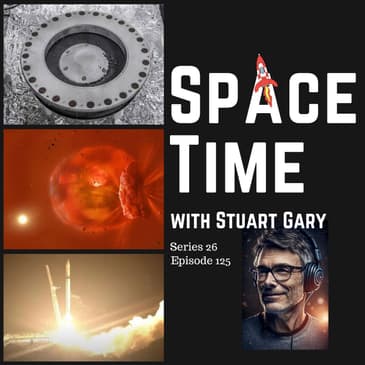
This is space time series 26 episode 100 and 25 for broadcast
00:00:04
on the 18th of October 2023. Coming up on SpaceTime carbon
00:00:10
and water discovered in the samples from the asteroid Banu
00:00:14
astronomers witness worlds colliding and Spain reaches for
00:00:18
the stars with its first successful domestic rocket
00:00:22
launch all that and more. Coming up on space time.
00:00:27
Welcome to space time with Stuart Gary.
00:00:47
An initial examination of the regular samples returned to
00:00:50
Earth from the asteroid Banu by the Osiris Rex mission are
00:00:53
showing evidence of high carbon content and water. The Osiris
00:00:57
Rex sample return capsule landed right on target in the Utah
00:01:01
military test range near Salt Lake City following a seven year
00:01:05
6.21 billion kilometer return voyage from the half kilometer
00:01:09
wide near Earth asteroid Banu.
00:01:12
Preliminary examinations of the 4.5 billion year old CTAP
00:01:16
asteroid show evidence of high carbon content and water which
00:01:19
together could indicate the building blocks of life on Earth
00:01:23
may be found in the rock.
00:01:25
Although more work is needed to fully understand the nature of
00:01:28
the carbon compounds found. The initial discovery all bodes well
00:01:32
for the analysis of future asteroid samples. The secrets
00:01:36
held within the rocks and dust from this asteroid will be
00:01:39
studied for decades to come.
00:01:41
Offering insights into how our solar system was formed, how the
00:01:44
precursor materials of life may have been seeded on Earth. And
00:01:48
what precautions need to be taken to avoid potential
00:01:51
asteroid collisions with our home planet in the future, the
00:01:55
mission collected over 60 g of regolith from the ancient
00:01:58
asteroid's rocky boulder strewn surface curation.
00:02:02
Experts at NASA's Johnson Space Center working in new clean
00:02:06
rooms built especially for the mission have spent 10 days so
00:02:09
far carefully disassembling the sample return hardware to obtain
00:02:13
a glimpse of the bulk samples within. And when the science
00:02:17
canister lid was first opened, scientists discovered bonus
00:02:21
asteroid material covering the outside of the collector head
00:02:24
canister lid and the base.
00:02:26
In fact, there was so much extra material. It slowed down the
00:02:30
careful process of collecting and containing the primary
00:02:33
sample material, collecting images from a scanning electron
00:02:36
microscope, infrared measurements, X ray diffraction
00:02:40
and chemical element analysis.
00:02:42
X ray computer tomography was also used to produce a 3d
00:02:46
computer model of one of the particles highlighting its
00:02:49
diverse interior. This early glimpse provided the evidence of
00:02:53
abundant carbon and water in the sample. Cyrus Rex, principal
00:02:57
investigator Dante Loretta from the University Of Arizona.
00:03:00
Tucson says that as they peered deep into the ancient secrets
00:03:05
preserved in the dust and rock of asteroid Banu, they're
00:03:08
unlocking a time capsule that offers profound insights into
00:03:12
the very origins of the solar system. The bounty of carbon
00:03:16
rich material and the abundant presence of water bearing clay
00:03:20
minerals are just the tip of the cosmic iceberg.
00:03:23
These discoveries are propelling scientists on the journey, not
00:03:26
just to understand the celestial neighborhood but also the
00:03:30
potential for life's beginnings. For the next two years. The
00:03:34
missions science team will continue characterizing the
00:03:37
samples and conduct the analysis needed to meet the missions
00:03:40
science goals.
00:03:42
NASA will preserve at least 70 per cent of the samples at
00:03:45
Johnson for future research by scientists worldwide including
00:03:49
future generations of scientists. As part of the
00:03:53
Osiris Rex Science program, a cohort of more than 200
00:03:56
scientists from around the world including Australia will be
00:03:59
given samples to explore the Regulus properties.
00:04:03
NASA Administrator Bill Nelson says the Osiris Rex samples
00:04:07
represent the biggest carbon rich asteroid samples ever
00:04:10
delivered to Earth and will help scientists investigate the
00:04:12
origins of life on our planet for generations to come.
00:04:16
So the first analysis shows samples that contain abundant
00:04:22
water in the form of hydrated clay minerals and they contain
00:04:29
carbon as both minerals and organic molecules and at nearly
00:04:36
5% carbon by weight, carbon being the central element of
00:04:42
life. A far exceeding our goal of 60 g. This is the biggest
00:04:49
carbon rich asteroid sample ever returned to Earth.
00:04:54
The carbon and water molecules are exactly the kinds of
00:04:58
material that we wanted to find they are crucial elements in the
00:05:02
formation of our own planet. And they're going to help us
00:05:06
determine the origin of elements that could have led to life. And
00:05:12
I mentioned that one of our missions, it's actually in
00:05:15
statute is to look for life.
00:05:17
That's why we're digging on Mars. That's why we go out into
00:05:21
the far regions of the very beginning returning capturing
00:05:26
light from the formation of the first Galaxies with James Webb.
00:05:31
Now we're looking at this and what you're seeing today. There
00:05:35
's so much more to learn and there's so much more now that we
00:05:39
have this sample to analyze and why are we doing this?
00:05:45
Because at NASA, we are trying to find out who we are, what we
00:05:51
are, where we came from, what is our place in this vastness
00:05:57
called the universe? And this mission will help our scientists
00:06:01
investigate planet formation for generations to come.
00:06:06
And it's going to deepen our understanding of our solar
00:06:09
system and it's going to improve our understanding of asteroids
00:06:14
that could threaten us here on Earth, helping us protect our
00:06:19
planet. And oh, by the way, do you remember D A RT we
00:06:23
intercepted it at 7 million miles away and it was bullseye
00:06:29
and we moved the trajectory of that asteroid.
00:06:34
So this sample return is proof again, that NASA does big
00:06:40
things, things that inspire us and unite us. NASA brings us
00:06:48
together in unity. And things that show that nothing is beyond
00:06:53
our reach when we work together. So now I want to take you to the
00:06:58
Curation lab here at JSC where a team of scientists are hard at
00:07:04
work since the sample arrived just two weeks ago.
00:07:12
Thank you, Administrator Nelson. Now I know you're all ready to
00:07:15
learn more about the sample and I am here with someone who can
00:07:18
make that all happen. I am joined today by NASA's Ooir
00:07:22
Curation Lead Dr Nicole running and we are standing just outside
00:07:27
of the pristine curation clean room before we get started. Can
00:07:32
you tell us a little bit more about where we're standing right
00:07:34
now? Yeah.
00:07:35
Thank you Courtney. So we're in front of the newest curation lab
00:07:38
in historic building 31 which is home to the largest collection
00:07:42
of astro materials in the world.
00:07:45
Now, the world just got its first look at this gorgeous
00:07:48
sample. Can you tell us about how the curation process has
00:07:51
been going so far?
00:07:52
Yeah, it's been incredible so far on Sunday, September 24th,
00:07:56
the sample return capsule landed safely in Utah and then it was
00:07:59
brought to a temporary clean room that we had set up there to
00:08:03
have certain parts removed. Specifically the heat shield
00:08:05
back show which are two large parts and that exposed the
00:08:08
sample canister inside which a nitrogen flow was attached to to
00:08:13
protect the sample.
00:08:15
And then with that nitrogen flow attached the next day Monday,
00:08:18
September 25th. It was flown from Utah to Ellington Air Force
00:08:23
a base and brought here to building 31 where we are now and
00:08:28
it was safely brought into one of our large glove boxes behind
00:08:31
us. On that first day. The next day, our team was able to remove
00:08:36
the canister lid and that gave us our first glimpse of the
00:08:39
tags.
00:08:40
Also a surprise in that there is sample outside of the tags and
00:08:43
had within that sample canister.
00:08:46
That was kind of an extra bonus sample for us.
00:08:48
So you mentioned that bonus sample, what have the initial
00:08:51
findings been for the curation team?
00:08:53
Yeah, it's a combination of fine dust as well as some what we
00:08:58
call intermediate size particles, particles that are
00:09:00
roughly the size of the short width of a grain of rice, which
00:09:04
we carefully collected and also have already allocated some to
00:09:07
the science, the sample analysis team.
00:09:09
And of course, this is not just a NASA mission. There have been
00:09:12
several partners along the way. Can you tell us a little bit
00:09:14
more about how many scientists are working on this?
00:09:17
Yes, we have two incredible international partners, Jackson
00:09:19
and CS A and also the sample analysis team includes over 230
00:09:23
scientists from around the world who will really intensely work
00:09:26
on studying some of the sample for the next two years will also
00:09:29
have three samples go to museums in the next couple of months.
00:09:33
So folks at home, they have opportunity to go and see the
00:09:36
sample themselves at the Smithsonian in Washington DC,
00:09:39
the University Of Arizona Museum in Tucson or at Space Center
00:09:43
Houston right here in Texas. So exciting.
00:09:46
So what does it mean for your team to have seen this clean
00:09:49
room built from the ground up and now to see the sample in it?
00:09:52
I'm sure it has to be so exciting. Oh, it's incredible.
00:09:54
So this clean room was constructed very specifically
00:09:57
for the IR sample. Since the scientific goals of this mission
00:10:01
are really tied to the building blocks, life and organics.
00:10:04
Organic contamination was a really detailed concern to us
00:10:08
throughout the entire design and construction process and
00:10:11
outfitting. So all everything you see in this lab was
00:10:13
carefully reviewed to make sure it wouldn't contaminate the
00:10:16
sample so we can get the most scientific benefit out of this
00:10:19
return.
00:10:19
So can you tell us a little bit about how long it will take to
00:10:22
fully reveal the sample and where the sample will live?
00:10:25
Yes. So the samples permanent home is this lab behind us. But
00:10:29
what actually happen next is we'll continue taking the tags
00:10:33
on the part. So right now, we have this incredible view of the
00:10:35
sample into the tags and we're looking into the part that
00:10:38
touched the asteroid venue.
00:10:40
We're actually going to take those parts off to get a little
00:10:42
further so that we can then distribute that sample into bulk
00:10:46
sample handling trays which are triangular and look sort of like
00:10:49
deep dish pizzas.
00:10:51
And for scientists interested, how will they eventually be able
00:10:54
to request a sample?
00:10:55
So in about six months, we will release a catalog which will
00:10:59
give scientists from all around even beyond the sample analysis
00:11:03
team enough information to start to think about what science
00:11:07
questions they want to ask and they can propose studies and
00:11:09
specific quantities of sample they would like to use.
00:11:12
And then those requests will be reviewed by a peer review
00:11:15
allocation board and then those who are granted, their requests
00:11:21
will get samples in the next nine months or so.
00:11:23
This is space time still to come. Astronomers witness what
00:11:28
happens when worlds collide and Spain reaches for the stars with
00:11:33
its first domestically built rocket. All that and more still
00:11:37
to come on space time.
00:11:54
Astronomers have captured the first ever afterglow of a
00:11:57
massive planetary collision between two worlds. The
00:12:01
observations reported in the journal nature show two ice
00:12:05
giant exoplanets colliding with each other around a sun like
00:12:09
star in the process, creating a blaze of light and plumes of
00:12:13
dust.
00:12:14
The findings showed the bright heat afterglow and resulting
00:12:18
dust cloud which moved in front of the parent star dimming its
00:12:21
light over time. Astronomers were alerted to the event by a
00:12:25
citizen scientist who noticed a strange stellar light curve and
00:12:29
realized that something unusual was unfolding.
00:12:32
The observations showed that the system doubled in brightness at
00:12:35
infrared wavelengths some three Earth years before the star
00:12:39
started to fade in visible light.
00:12:41
One of the study's authors, Matthew Kenworthy from Leiden
00:12:44
University says the observations were a complete surprise. The
00:12:49
star has been named Assassin 21 Q I.
00:12:52
After the network of telescopes that first detected the fading
00:12:55
of the star at visible wavelengths, astronomers think
00:12:58
the most likely explanation for what they're seeing is that two
00:13:02
ice giant exoplanets planets simmer in size to Neptune and
00:13:06
Uranus have collided, producing an infrared glow which has been
00:13:10
detected by NASA's Neo mission which uses a space telescope to
00:13:14
hunt for asteroids and comets.
00:13:17
The calculations, computer models indicate the temperature
00:13:20
and size of the glowing material as well as the amount of time
00:13:23
the glow has lasted is all consistent with the collision of
00:13:26
two ice giant exoplanets.
00:13:28
The resulting expanding billowing debris cloud from the
00:13:32
impact then traveled in front of the star some three Earth years
00:13:35
later, causing the star's light to dim in brightness as visible
00:13:39
from Earth over the next few years. This cloud of dust is
00:13:43
expected to start smearing out along the orbit of the collision
00:13:46
remnant.
00:13:47
And a telltale scattering of light from this cloud could be
00:13:51
detected both with ground based telescopes and the web space
00:13:54
telescope. It's even possible chunks of debris will accrete to
00:13:58
begin forming a new planet while other material may condense to
00:14:02
form a retinue of moons that will orbit around the newly
00:14:05
formed planet.
00:14:07
And in fact, we know this has happened before, after all, that
00:14:11
's what happened 4.5 billion years ago in our solar system,
00:14:14
when a Mars sized planet called thea collided with the early
00:14:18
proto Earth forming a magma ocean which eventually it
00:14:21
created together to form the Earth with debris ejector flung
00:14:25
up into orbit by the force of the impact gradually coalescing
00:14:29
to form the moon.
00:14:31
Astronomers plan on watching closely to see what happens
00:14:34
next. Whatever it is, it'll be fascinating to observe future
00:14:38
developments this space time still to come.
00:14:43
Spain reaches for the stars with its first successful
00:14:46
domestically launched rocket. And later in the science report,
00:14:49
the oldest known human footprints ever found in the
00:14:52
Americas. All that and more still to come on space time.
00:15:12
Spain has launched its first locally built rocket, an
00:15:16
important step in establishing its own orbital launch system. A
00:15:19
12 beer tour mua one was launched from a military base in
00:15:23
the southern region of Andalusia by a private company PLD Space.
00:15:28
The sub orbital ballistic test flight trajectory reached an
00:15:31
altitude of 46 kilometers above the Gulf Of Cadiz.
00:15:35
Mission managers say the flight was successful, achieving all
00:15:39
its technical objectives. After its five minute flight, the
00:15:42
launch vehicle eventually splashed down in the North
00:15:45
Atlantic Ocean where PLD Space planned to send a recovery team
00:15:48
to retrieve it. Mural one is the first rocket built with 100 per
00:15:53
cent Spanish technology and it's considered a successful
00:15:56
milestone for Spanish research development and innovation.
00:16:00
The successful launch followed an early emissions scrub back in
00:16:04
May due to high winds. And another in June when the
00:16:07
umbilical cables providing fuel and power supply to the rocket
00:16:11
failed to release and retract on time. Mira One is seen as the
00:16:15
first step in the development of the mirror five.
00:16:19
It'll be a 35 m tall two stage launch vehicle designed to place
00:16:23
satellites weighing less than 500 kg into low Earth orbit
00:16:27
within two years. Pd space say 70 per cent of the components
00:16:31
developed for the Miura. One will be used for the mirror five
00:16:35
launch vehicle. Once in commercial operation mirror five
00:16:39
will launch from the European Space Agency's Kura Spaceport in
00:16:42
French Guiana.
00:16:43
It'll be competing directly with new Zealand's electron rocket in
00:16:47
the fast growing small satellite launch market. This is space
00:16:52
time and time now to take another brief look at some of
00:17:11
the other stories making news in science this week with the
00:17:13
science report, a new study claims that drinking dark tea
00:17:18
every day may help to mitigate type two diabetes risk and
00:17:21
progression in adults through better blood sugar control.
00:17:25
The findings presented at the annual meeting of the European
00:17:28
Association For The Study of diabetes suggest that compared
00:17:32
with people who don't drink tea daily, consumers of dark tea at
00:17:36
a 53 per cent lower risk of pre diabetes and a 47 per cent
00:17:40
reduced risk of type two diabetes even after taking into
00:17:44
account established risk factors known to drive the risk of
00:17:48
diabetes.
00:17:49
The authors caution that this was an observational study. The
00:17:53
findings cannot prove that drinking black tea every day
00:17:56
improves blood sugar control, but they do suggest that it is
00:18:00
likely to contribute.
00:18:03
A new study has shown that renting has a stronger link to
00:18:07
faster biological aging than unemployment or being a former
00:18:11
smoker. The findings were reported in the journal
00:18:14
epidemiology and community health used blood samples to
00:18:17
measure people's biological age that is the cumulative damage to
00:18:22
the body's tissues and cells.
00:18:24
The results were then compared with subjects housing situation.
00:18:29
The researchers say that living in a privately rented home is
00:18:32
associated with faster biological aging compared to
00:18:35
home ownership and the association was almost double
00:18:39
that of unemployment compared to employment, repeatedly falling
00:18:43
behind on rent and exposure to pollution were also associated
00:18:47
with faster aging.
00:18:50
Anthropologists have used new dating techniques to confirm the
00:18:53
age of ancient human footprints found in New Mexico. Finding
00:18:57
that they may be the oldest in the Americas.
00:19:00
The tracks discovered in the White Sands National Park
00:19:03
sparked controversy two years ago when scientists suggested
00:19:07
the prints date back to around 22 years. Now, a report in
00:19:12
the journal science has found two other ways of dead in the
00:19:15
fossilized tracks are converging on similar ages.
00:19:18
As the first estimate, the findings add to mounting
00:19:21
evidence that humans arrived in North America, thousands of
00:19:25
years earlier than previously thought back in 2021 scientists
00:19:30
described more than 60 footprints embedded in what was
00:19:33
once mud alongside an ancient lake in what's now New Mexico
00:19:38
radiocarbon dating of an aquatic plant seeds in and around the
00:19:41
footprints suggests that people were roaming along there for
00:19:44
some two millennia between 44 years ago.
00:19:49
The results add to other evidence which is pushing back
00:19:52
on the long held theory that the first humans in North America
00:19:56
came from Siberia by way of a land bridge around 16 to
00:20:00
14 years ago. However, other scientists have pointed out that
00:20:04
the aquatic plants used for this latest study could have absorbed
00:20:08
ancient carbon in groundwater resulting in exaggerated age
00:20:11
perspectives.
00:20:13
So to add to their past work, the authors also radio carbon
00:20:16
dated pollen stuck to the same layers as some of the
00:20:19
footprints. The researchers also collected quartz grades above
00:20:23
the lowered footprints and used a dating method that estimates
00:20:27
how long that quart has been buried. The pollen yielded an
00:20:31
age of roughly 23 to 22 years and the quartz gave an age
00:20:37
minimum of around 21 years.
00:20:41
So both results are echoing the previous age estimate, the
00:20:47
dangers of lithium ion batteries are becoming more apparent. With
00:20:50
electric cars, e bikes, community batteries and even
00:20:54
common household consumer electronics powered by them all
00:20:57
becoming potential fire hazards. The AC CC has now issued a
00:21:02
warning following a major recall with the details. We're joined
00:21:06
by technology editor Alex Sarov Roy from tech advice, start
00:21:10
live.
00:21:10
The ACC. The Australian competition and consumer
00:21:13
commission has put out a warning for LG battery owners who have
00:21:18
the solar powered battery systems in their homes to
00:21:21
immediately switch off these potentially dangerous LG solar
00:21:25
batteries and contact LG for either a refund or a software
00:21:28
update.
00:21:29
And in fact LG will even reimburse you for the energy
00:21:32
that you weren't able to generate and store your battery.
00:21:34
The ACC is warning that just because your battery system
00:21:37
doesn't say the word LG on, it doesn't mean that it doesn't
00:21:40
have LG batteries inside there. The brands are LG itself, solar
00:21:44
X Opal red Earth Iguana Vata and these recalls have stretched
00:21:48
back to the year 2000.
00:21:50
The recalls are happening in the US as well. In fact, there's
00:21:52
even one energy company in the US that is reusing recalled car
00:21:57
batteries in its energy battery system, which to me is
00:22:00
absolutely crazy. And in fact, the ac also put out another
00:22:04
warning just to people who are using lithium ion batteries in
00:22:07
general in their smart phones and tablets and electric tools,
00:22:10
e scooters, e bikes, etc.
00:22:11
And they're saying that these batteries can overheat and
00:22:14
explode if they're used, charged or disposed of incorrectly or if
00:22:17
they're damaged. And you can imagine with things like e
00:22:20
scooters that they can be quite roughly handled and thrown
00:22:22
around and saw a fire.
00:22:23
In an E scooter just the other day in Kings Cross, which was a
00:22:27
backpacker hostel. And we saw a similar incident in a community
00:22:30
battery in Rockhampton in Queensland where the same thing
00:22:34
happened.
00:22:34
And they were actually told to let the fire burn out. It didn't
00:22:37
matter how much. That's right. Well, there's so much energy in
00:22:40
the you can't. Yeah, and there's so much energy in these
00:22:42
batteries. It, it really does have to burn itself out. In
00:22:45
fact, if the fire is, you know, if energy isn't all used, the
00:22:48
fire can reignite.
00:22:49
This happened in New York in the E scooter shop. They were
00:22:51
talking to somebody who said, look, it might restart in a
00:22:53
couple of days and it did exactly that. And so part of the
00:22:56
reason is because people are using third party chargers,
00:22:59
they're buying cheaper party batteries.
00:23:01
And I mean, there have been 23 recalls affecting an estimated
00:23:04
89 products in the market. So the lithium ion batteries can
00:23:07
be quite dangerous and someone actually died, the toxic fumes
00:23:10
that were spewing out like a jet of the burning battery. So it's
00:23:13
really quite dangerous. Now, on my site, Tech advice dot life, I
00:23:16
have a video interview with a gentleman called Charlie Welch
00:23:20
from a company called Zap Bat Z A PB att dot com.
00:23:24
And he's developed lithium titanate batteries. These have
00:23:28
been in use by the military NASA for decades. Unfortunately,
00:23:31
they've been much more expensive and they didn't have the correct
00:23:34
battery operating system or the voltages. But this has all been
00:23:37
solved.
00:23:37
The voltages can mimic lithium ion batteries. The price is
00:23:40
coming down to be very similar to lithium ion. The batteries
00:23:43
will recharge to full in less than 15 minutes. They have
00:23:47
15 charge cycles which equates to about 25 years of
00:23:51
use. And then it only goes down to 90 per cent of the charge
00:23:54
capacity that can be.
00:23:55
Used for solar panels on your roof.
00:23:57
Well, it can be used for decades longer than traditional
00:23:59
batteries. And if they get damaged, there's no thermal
00:24:02
runaway reaction that causes this sort of fire. So in the
00:24:05
future, these will be the standard batteries and and this
00:24:08
problem will cease to be.
00:24:10
But over the next two or three years, this problem is going to
00:24:12
increase more of these batteries are going to go bad and there'll
00:24:14
be more fires. And in fact, people are are are suggesting
00:24:17
don't charge your esco in the house, don't charge your golf,
00:24:20
don't charge your electric car in your garage. Make sure it's
00:24:22
all done outside as William Gibson in the famous author of
00:24:27
Neuromancer said the future has already been invented.
00:24:29
It just hasn't been widely distributed yet. Well, the
00:24:32
future batteries that are going to charge in minutes to full and
00:24:35
last decades are here and they're just being
00:24:37
commercialized now and within a decade, lithium ion will just be
00:24:41
a thing as a part.
00:24:41
That's Alex Sahara Reut from tech advice, Start Life.
00:25:01
And that's the show for now. SpaceTime is available every
00:25:04
Monday, Wednesday and Friday through Apple Podcasts, itunes,
00:25:08
Stitcher, Google Podcast Podcasts, Spotify, Acast, Amazon
00:25:13
music bits dot com. Soundcloud, YouTube, your favorite podcast
00:25:18
download provider.
00:25:19
And from space time with Stuart Gary dot com. SpaceTime is also
00:25:23
broadcast through the National Science Foundation on Science
00:25:26
Zone Radio and on both iheartradio and Tune In Radio.
00:25:30
And you can help to support our show by visiting the SpaceTime
00:25:34
store for a range of promotional merchandizing goodies or by
00:25:37
becoming a SpaceTime patron, which gives you access to triple
00:25:41
episode commercial free versions of the show as well as lots of
00:25:44
bonus audio content which doesn't go to air access to our
00:25:47
exclusive Facebook group and other rewards.
00:25:50
Just go to space time with Stuart Gary dot com for full
00:25:53
details. And if you want more space time, please check out our
00:25:57
blog where you'll find all the stuff we couldn't fit in the
00:25:59
show as well as heaps of images, news stories, loads of videos
00:26:03
and things on the web.
00:26:04
I find interesting or amusing. Just go to space time with
00:26:07
Stuart Gary dot tumblr dot com. That's all one word.
00:26:12
And that's Tumblr without the E you can also follow us through
00:26:15
at Stuart Gary on Twitter at SpaceTime with Stuart Gary on
00:26:19
Instagram through our space time YouTube channel and on Facebook,
00:26:23
just go to Facebook dot com forward slash space time with
00:26:26
Stuart Gary. And SpaceTime is brought to you in collaboration
00:26:30
with Australian Sky and Telescope Magazine, Your Window
00:26:33
on the Universe.
00:26:35
You've been listening to Space Time with Stuart Garry. This has
00:26:38
been another quality podcast production from bytes dot com.