
00:00:00
This is Space Time Series 28 Episode 119 for broadcast on the
00:00:04
3rd of October 2025. Coming up on Space Time, could the dwarf
00:00:09
planet Ceres once have supported life? NASA's new mission to
00:00:14
study the heliosphere? And the University Of Melbourne's SPIRIT
00:00:17
Dinosat snaps a selfie? All that and more coming up on Space
00:00:22
Time.
00:00:24
Welcome to Space Time with Stuart Gary.
00:00:43
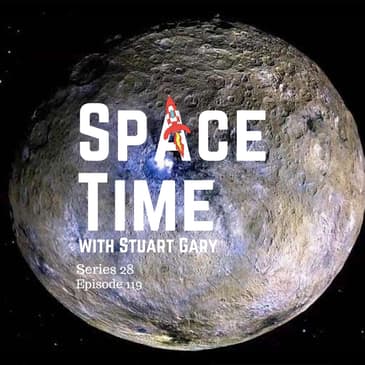
A new study claims that the dwarf planet Ceres, which today
00:00:47
is a cold, frozen world, could once have been habitable enough
00:00:50
to support life. A report in the journal Science Advances paints
00:00:54
a picture of Ceres hosting a deep, long-lived energy source
00:00:58
that may have maintained habitable conditions for long
00:01:01
periods of time in the past.
00:01:03
The new research by NASA found that Ceres may have had a
00:01:06
long-lasting source of chemical energy, the right types of
00:01:09
molecules needed to fuel microbial metabolisms. Now
00:01:13
before you get too carried away, there is no evidence at all that
00:01:17
microorganisms ever existed on Ceres.
00:01:19
But the findings do support theories that this intriguing
00:01:22
dwarf planet, which is the largest body in the main
00:01:25
asteroid belt between Mars and Jupiter, may once have had
00:01:27
conditions suitable for supporting single-cell
00:01:30
lifeforms.
00:01:32
Data from NASA's Dawn mission, which ended in 2018, previously
00:01:35
showed that the bright, reflective regions on Ceres'
00:01:38
surface are mostly made of salts left over from liquid that
00:01:41
percolated up from deep underground.
00:01:44
Later analysis in 2020 found that the source of this liquid
00:01:48
was an enormous reservoir of brine, that is, salty water,
00:01:51
deep below the surface. Dawn also revealed evidence that
00:01:55
Ceres had organic material in the form of carbon molecules,
00:01:58
essential, although not sufficient on its own. To
00:02:00
support microbial life.
00:02:02
The presence of water and carbon molecules are two of the key
00:02:06
critical components necessary for habitability. And the
00:02:09
findings also offer the third, a long-lasting source of chemical
00:02:13
energy in Ceres' ancient past that could have made it possible
00:02:16
for microorganisms to survive.
00:02:19
Now, once again, this result doesn't mean Ceres had life, but
00:02:24
rather that there was likely to have been food available should
00:02:27
life ever have arisen on Ceres. Now to reach their conclusions,
00:02:30
the study's authors built thermal and chemical models
00:02:33
mimicking the temperatures and composition of Ceres' interior
00:02:36
over long time spans.
00:02:38
They found that around 2.5 billion years ago, Ceres'
00:02:42
subsurface ocean may have had a steady supply of hot water
00:02:45
containing dissolved gases travelling up from
00:02:47
metamorphosized rocks on the seafloor. The heat would have
00:02:51
come through the decay of radioactive elements within the
00:02:53
dwarf planet's interior, which occurred when Ceres was still
00:02:56
quite young.
00:02:57
That's an internal process thought to be common throughout
00:02:59
the solar system. The study's lead author Sam Corville from
00:03:03
Arizona State University worked on the Dawn mission while with
00:03:06
NASA's Jet Propulsion Laboratory in Pasadena, California.
00:03:10
He says that here on Earth, when hot water from deep underground
00:03:13
mixes with the ocean deep-sea hydrothermal vents, the result
00:03:16
is often a buffet for microbes, a feast of chemical energy. So
00:03:21
this could have big implications. If Corville and
00:03:23
colleagues determined that Ceres' ocean had an influx of
00:03:26
hydrothermal fluid in the past.
00:03:29
Of course, the Ceres astronomers know today is likely to be
00:03:32
completely uninhabitable. It's cooler, with a lot more ice and
00:03:35
far less water than what it had in the past. And there's
00:03:39
currently insufficient heat from radioactive decay within Ceres
00:03:42
to keep that water from freezing.
00:03:44
And what liquid remains has now become a concentrated brine. The
00:03:49
period when Ceres would most likely have been habitable would
00:03:52
have been between half a billion and two billion years after it
00:03:54
formed. That's about two and a half to four billion years ago,
00:03:58
when its rocky core reached its peak temperature.
00:04:00
That's when warm fluids would have been introduced into Ceres'
00:04:03
underground water supply. And the dwarf planet also doesn't
00:04:07
have the benefit of present-day internal heating generated by
00:04:10
gravitational tidal actions through the push and pull of
00:04:13
orbiting a large planet, like we see in Saturn's moon Enceladus
00:04:16
and the Jovian Moon Europa.
00:04:19
So, Ceres' greatest potential for habitability, fueling
00:04:22
energy, was well in the past. But the results have
00:04:25
implications for water-rich objects throughout the outer
00:04:28
solar system. There are many other icy moons and dwarf
00:04:31
planets that are of similar size to the 940 km wide Ceres and
00:04:35
which also lack the internal heating from the gravitational
00:04:38
pull of planets, but could also have had a period of
00:04:41
habitability way in their past.
00:04:43
This is Space Time. Still to come, NASA's new mission to
00:04:47
study the heliosphere, And the University Of Melbourne SPIRIT
00:04:50
Nanosat successfully completes the initial phase of its
00:04:53
mission, the search for gamma-ray bursts. All that and
00:04:56
more still to come. On Space Time, NASA's launched a new
00:05:16
mission to study the Sun's magnetic bubble, the
00:05:18
heliosphere.
00:05:19
The heliosphere fills the entire solar system, and it helps
00:05:23
shield it from interstellar particles and radiation. The new
00:05:26
mission... Called the Interstellar Mapping And
00:05:28
Acceleration Probe IMAP will help astronomers develop a
00:05:31
better understanding of this tenuous solar atmosphere and how
00:05:34
events like space weather interact with it.
00:05:37
IMAP was launched aboard a SpaceX Falcon 9 rocket together
00:05:41
with NASA's Carruthers GeoCorona Observatory and NOAA's SWIFO L1
00:05:45
spacecraft from Pad 39A at the Kennedy Space Center in Florida.
00:05:49
IMAP sensors and detectors will sample, analyze and map
00:05:53
particles streaming towards the Earth from the very edges of our
00:05:56
solar system and beyond. The mission will also help
00:05:59
scientists learn more about the solar wind, the continuous
00:06:02
stream of particles flowing out from the Sun, and about
00:06:05
energetic particles in the heliosphere.
00:06:07
These particles can affect humans in space. They can damage
00:06:11
spacecraft systems, and may even have played a role in the
00:06:14
presence of life in the solar system.
00:06:17
The Johns Hopkins Applied Physics Laboratory in L'Oreal,
00:06:19
Maryland, built the spacecraft, which is flying 10 instruments
00:06:22
to study the solar wind, interstellar dust and other
00:06:25
particles, magnetic fields and ultraviolet light in space.
00:06:29
Following its launch, the 900kg spacecraft, together with both
00:06:33
the Carruthers GeoCorona Observatory and SWIFO L1, have
00:06:36
commenced their four-month cruise phase to the Lagrangian
00:06:39
L1 position some 1.6 million kilometres away.
00:06:44
Located between the Earth and the Sun, L1 is a sort of
00:06:47
gravitational well, where the pull of the Earth and Sun cancel
00:06:50
each other out. Allowing a spacecraft in that position to
00:06:53
remain there in a stable orbit without expending a great degree
00:06:56
of fuel.
00:06:58
From L1, IMAP will have an uninterrupted view of activities
00:07:01
at the interstellar boundary in the Sun.
00:07:04
Meanwhile, the third member of the launch trio, the National
00:07:07
Oceanographic And Atmospheric Administration's SWIFO L1
00:07:10
spacecraft, is the first NOAA observatory designed
00:07:13
specifically for and fully dedicated to operational Space
00:07:16
Weather Observations.
00:07:18
It's stationed at the L1 position, will allow
00:07:21
unobstructed observations of the Sun's outer atmosphere, the
00:07:24
corona, enabling upstream measurements of solar wind
00:07:27
disturbances before they reach the Earth. This will allow the
00:07:30
spacecraft to serve as an early warning beacon for geomagnetic
00:07:34
storms.
00:07:35
The probe's primary instrument is the Core 2 Compact
00:07:38
Chronograph, which will monitor the Sun's surroundings to
00:07:41
provide data for enhanced forecasting and improve science
00:07:44
's understanding of the complex dynamics of the solar corona and
00:07:47
disruptive space weather events like coronal mass ejections,
00:07:50
blasts of plasma and magnetic field exploding out from the
00:07:53
Sun.
00:07:54
Core 2 employs a single external occulter, a cylindrical device
00:07:59
that blocks the direct sunlight creating an artificial eclipse.
00:08:02
This allows the telescope to exclusively focus on faint
00:08:06
details in the corona itself. Core 2 builds upon the earlier
00:08:10
Core 1 instrument, currently operational on NOAA's GOES-19
00:08:13
satellite in geostationary orbit.
00:08:16
While Core 1 experiences daily eclipses as the Earth passes
00:08:19
between the satellite and the Sun, Core 2 at the L1 position
00:08:23
will be able to provide a continuous 24-7 view of the Sun.
00:08:26
This location, coupled with a larger field of view and the
00:08:29
ability to observe closer to the solar surface, allows Core 2 to
00:08:33
capture slightly more images and more rapidly detect coronal mass
00:08:36
ejections closer to the solar disk. This means scientists can
00:08:40
determine their trajectory, mass and speed with greater accuracy.
00:08:43
With the goal of predicting any space weather impact on Earth.
00:08:47
Space weather events, also known as geomagnetic storms, are
00:08:50
triggered by sustained periods of high-speed solar wind coupled
00:08:53
with a southward-directed interplanetary magnetic field
00:08:56
component which facilitates magnetic reconnection and energy
00:08:59
transfer at Earth's magnetopause.
00:09:02
Understanding the initiation and propagation of coronal mass
00:09:05
ejections and their subsequent impact on Earth's magnetosphere
00:09:08
is crucial for predicting and mitigating the adverse effects
00:09:12
of space weather. The repercussions of geomagnetic
00:09:15
storms can range from temporary operational anomalies to
00:09:18
significant infrastructure damage.
00:09:20
These disturbances can disrupt satellite communications and
00:09:23
navigation systems, cause geomagnetically induced currents
00:09:26
in power grids, impacting their stability and reliability,
00:09:30
increase atmospheric drag on low-Earth orbit satellites,
00:09:33
potentially shortening their operational lifespans, and
00:09:36
interfere with high-frequency radio communications.
00:09:39
While coronal mass ejections typically require several days
00:09:42
to transit from the Sun to the Earth, the most energetic events
00:09:45
have been observed to arrive at Earth in as little as 18 hours'
00:09:48
time. Therefore, timely and accurate observations of
00:09:52
instruments like Core 2 are essential.
00:09:55
Once in its final orbit at L1, SWIFO L1 will be renamed Space
00:09:59
Weather Observations at L1 to Advanced Readiness or Solar 1
00:10:03
spacecraft.
00:10:04
This report from NASA TV.
00:10:06
From here on Earth, our Sun looks steady and unchanging. But
00:10:11
close up, it's a dynamic, active place. And sometimes you'd see
00:10:16
bursts of radiation called solar flares, and explosions of plasma
00:10:21
and magnetic fields called coronal mass ejections.
00:10:24
But when the coronal mass ejections hit Earth, our
00:10:27
magnetic field can go haywire. Powerful electromagnetic
00:10:31
currents generated during these storms can harm our power grids,
00:10:35
global positioning systems, communications networks, and
00:10:39
spacecraft and astronauts on orbit.
00:10:42
Meet SWIFO L1, NOAA's first purpose-built space weather
00:10:46
observatory. From its unique vantage point at Lagrange Point
00:10:50
1, a million and a half kilometers from Earth.
00:10:53
SWIFO L1 keeps an eye on the Sun 's corona 24-7, without
00:10:58
interruption, to provide early warning of solar storms heading
00:11:02
our way.
00:11:03
The spacecraft's crown jewel is its compact coronagraph, its eye
00:11:08
on the Sun.
00:11:10
Just like the GOES-19 coronagraph, it allows SWIFO L1
00:11:14
to detect even the fastest coronal mass ejections right as
00:11:18
they happen. The spacecraft is also packed with a suite of new
00:11:21
instruments. That allow it to make real-time measurements of
00:11:25
the solar wind's velocity, density, and temperature, and
00:11:29
variations in the interplanetary magnetic field, all to provide
00:11:33
better forecasts of incoming space weather than ever before.
00:11:38
All of that technology floating out in space on SWIFO L1 works
00:11:43
together closely to keep us safe back here on Earth.
00:11:47
Here's how it works. When a solar storm erupts from the Sun,
00:11:51
SWIFO L1'S coronagraph observes the event right away and sends
00:11:55
the data back to the SWIFO ground segment, a network of
00:11:59
antenna stations all over the world with the SWIFO command and
00:12:02
control in Maryland.
00:12:04
But spotting a storm is one thing. Actually measuring it
00:12:08
close up is another.
00:12:11
It's the difference between tracking a growing hurricane on
00:12:13
radar and flying through the storm on a Hurricane Hunter
00:12:17
aircraft.
00:12:19
SWIFO L1 does you both.
00:12:22
After the spacecraft spots a storm with its coronagraph, it
00:12:25
watches the approaching weather and waits.
00:12:29
Somewhere between 18 and 70 hours later, the incoming storm
00:12:33
passes over SWIFO L1.
00:12:35
Then, the spacecraft's instrument suite measures the
00:12:38
storm's severity and speed, and sends that data home too, giving
00:12:43
NOAA early warning somewhere between 15 and 60 minutes before
00:12:47
the storm arrives at Earth.
00:12:50
NOAA's Space Weather Prediction Center in Colorado is constantly
00:12:54
on the alert, using all the data SWIFO L1 collects to develop and
00:12:59
communicate real-time forecasts and warnings to industry,
00:13:03
government agencies, and the public, so they can take action
00:13:07
before the storm arrives to minimize its impact.
00:13:10
Those actions might include putting satellites into safe
00:13:13
mode, rerouting polar airline flights, sheltering in a safe
00:13:18
area on the International Space Station, or changing loads on
00:13:21
the power grid. In our increasingly technology
00:13:24
dependent world, we're more vulnerable than ever to solar
00:13:28
storms.
00:13:29
But at the same time, our fleet of space weather satellites is
00:13:33
aging out of service after many years of work in the harsh
00:13:37
environment of outer space. That 's why SWIFO L1 is the first of
00:13:42
a new generation of Sun observing spacecraft that NOAA
00:13:46
is launching.
00:13:47
SWIFO L1 will use its cutting-edge observing
00:13:50
technology to provide NOAA forecasters the best and most
00:13:53
reliable data available and ensure our nation doesn't go a
00:13:58
minute without eyes on the Sun, our life-giving but turbulent
00:14:02
neighborhood star.
00:14:07
This is space-time. Still to come, the University Of
00:14:10
Melbourne's SPIRIT satellite snaps a selfie. And later in the
00:14:14
science report, a new study has found that tropical fish are now
00:14:18
colonizing new habitats in temperate waters. All that and
00:14:22
more still to come on Space Time.
00:14:39
The University Of Melbourne SPIRIT Nano Satellite has
00:14:42
successfully completed the initial phase of its mission.
00:14:46
The Space Industry Responsive Intelligent Thermal
00:14:48
Nanosatellite, SPIRIT, is the first space telescope funded by
00:14:52
ASA, the Australian Space Agency, to carry a foreign space
00:14:55
agency's scientific instrument as its primary payload.
00:14:59
The spacecraft was launched aboard a Falcon 9 rocket from
00:15:02
the Vandenberg Space Force Base in California back in December
00:15:05
2023.
00:15:07
Since its launch, SPIRIT's circled the Earth more than
00:15:09
9 times, traveling a distance comparable with a trip
00:15:12
between the Earth and Mars, and has been in orbit for over 600
00:15:15
days. The completion of the first phase of SPIRIT's mission
00:15:19
was marked with the deployment of its wing thermal management
00:15:22
system and selfie stick, which it then used to take a selfie in
00:15:25
space.
00:15:27
SPIRIT will be scanning large areas of space using its Hermes
00:15:30
X-Ray detector to search for gamma-ray bursts, providing an
00:15:33
early warning system for astronomers studying these
00:15:36
stellar explosions.
00:15:38
SPIRIT's unique wings, designed by the University Of Melbourne,
00:15:40
helps keep the space telescope cool and increases science
00:15:44
instrument performance. The prototype miniaturized gamma-ray
00:15:47
detector on board was developed by the Italian Space Agency. It
00:15:51
was tested by targeting the Crab Nebula Pulsar. Detecting the
00:15:54
supernova remnant in 700 seconds of observation. This is Space
00:15:59
Time.
00:16:16
And time now to take another brief look at some of the other
00:16:18
stories making news in science this week with a science report.
00:16:22
A new study has found that tropical fish are now colonizing
00:16:25
new habitats in temperate oceans made available to them because
00:16:29
of ocean warming.
00:16:30
A report in the journal Animal Ecology found that those who
00:16:34
shoal alongside neighbors that are native to temperate waters
00:16:37
learn local behaviors that help them thrive. The authors found
00:16:41
that tropical fish species that live in mixed shoals, not solely
00:16:44
among other tropical fishes, become bolder and feed more,
00:16:47
which may aid them in surviving for longer and growing larger on
00:16:51
temperate reefs.
00:16:52
The southward migration of tropical fish isn't new. More
00:16:56
than a decade ago, studies found fish normally restricted to the
00:16:59
Great Barrier Reef were now swimming happily in Sydney
00:17:02
Harbour.
00:17:04
New research has found that children have a similar risk of
00:17:07
dehydration and hypothermia in extreme heat as what adults do.
00:17:11
The findings, reported in the British Journal Of Sports
00:17:14
Medicine, contradicts previous advice that kids were more
00:17:17
susceptible to heat-related illnesses.
00:17:19
The research represents the largest controlled study of its
00:17:22
kind, looking at the effects of high temperatures up to 40
00:17:25
degrees Celsius on 68 kids between the ages of 10 and 16.
00:17:32
After more than two decades of digging and analysing fossils in
00:17:35
central Otago, a trans-Tasman team of scientists have now
00:17:39
found enough fragments to describe a new species of
00:17:41
carawong, an ancient ancestor of the bird that menaces New
00:17:45
Zealand today.
00:17:46
The findings, reported in the journal PAL-Z, suggest that the
00:17:49
ancient bird would have been about the same size as the
00:17:52
Australian magpie found in New Zealand today, but was probably
00:17:55
all black. I think that's meant to be a sports reference. The
00:17:59
authors say these fossils show that these magpie ancestors
00:18:02
lived in New Zealand some 19 million years ago.
00:18:06
And time now for our silliest story of the week. And we've
00:18:10
kept them at bay until now, but the time has finally come when
00:18:13
one of the Kardashians, and no, we don't mean the lizard people
00:18:17
from Star Trek Deep Space Nine, has started talking about her
00:18:20
encounters with UFOs, ghosts and spooky voices.
00:18:24
Tim Mendham from Australian Skeptics says Khloe Kardashian
00:18:27
believes she's not only seen UFOs but has experienced
00:18:30
paranormal activity in her own home.
00:18:33
Well, obviously Khloe believes it, so it's all game over, isn't
00:18:36
it? It's all proof. I'm sorry. I do not take any of the
00:18:38
Kardashians that seriously, apart from their ability to...
00:18:41
To promote themselves and make a lot of money.
00:18:43
I'm sorry to say this, but I'm probably one of the few people
00:18:46
in the world who have never ever watched an episode of the
00:18:48
Kardashians and consequently I don't know who Khloe Kardashian
00:18:51
is.
00:18:52
I'm in the same club, by the way. I'm not a follower. But
00:18:54
this is a celebrity. They're very famous. They're very rich.
00:18:57
The whole bunch of them. And everyone seems to find them very
00:18:59
convincing. They're famous for being famous. So Khloe reckons
00:19:03
she's witnessed UFOs and she's had voices whispering in her
00:19:06
ear. This is one of the weird phenomena, right?
00:19:08
That people who are famous... Tend to have more credence given
00:19:11
to their ideas. If it was Joe Blow down at the pub, had too
00:19:14
much to drink, and he was saying he sort of was taken up by a
00:19:17
UFO, you go, uh-huh, yes, because Khloe Kardashian and the
00:19:20
other people are famous, people give it more credence or it's
00:19:22
more interesting. I suppose that 's the thing. The media boosted.
00:19:25
That's why Hollywood actors are getting credibility for their
00:19:28
political views, when no-one really cares what their
00:19:30
political views are other than other Hollywood actors, but they
00:19:34
get credibility for it because the media hypes them up.
00:19:36
Media hypes them up. They're famous and therefore people say,
00:19:38
well, they must know what they're talking about. No, the
00:19:40
Hollywood actors and the famous Kardashian family and all these
00:19:43
sort of celebrities are no more or less intelligent than the
00:19:46
bulk of the people, I dare say. But because someone's famous
00:19:49
doesn't mean that they're worth listening to, certainly about
00:19:53
things like UFOs and ghosts and voices in their ear.
00:19:56
That's Tim Mendham from Australian Skeptics.
00:20:14
And that's the show for now. Space Time is available every
00:20:18
Monday, Wednesday and Friday through Apple Podcasts, ITunes,
00:20:21
Stitcher, Google Podcasts, Pocket Casts, Spotify, Acast,
00:20:26
Amazon Music, Bytes.Com, SoundCloud, YouTube, your
00:20:30
favorite podcast download provider and from
00:20:33
spacetimewithstuartgarry.com.
00:20:36
Space Time is also broadcast through the National Science
00:20:38
Foundation on Science Zone Radio. And on both IHeartRadio
00:20:42
and TuneIn Radio. And you can help to support our show by
00:20:46
visiting the SpaceTime store for a range of promotional
00:20:49
merchandising goodies.
00:20:50
Or by becoming a SpaceTime patron, which gives you access
00:20:53
to triple episode commercial free versions of the show, as
00:20:56
well as lots of bonus audio content which doesn't go to air,
00:21:00
access to our exclusive Facebook group and other rewards. Just go
00:21:04
to spacetimewithstuartgarry.com for full details.
00:21:08
You've been listening to Space Time with Stuart Gary.
00:21:11
This has been another quality podcast production from
00:21:14
Bytes.Com.