
00:00:00 --> 00:00:02 Stuart Gary: This is space time series 29 episode
00:00:02 --> 00:00:05 115 full broadcast on 25
00:00:05 --> 00:00:08 September 2026 coming up on
00:00:08 --> 00:00:10 Space, a comet older than the
00:00:10 --> 00:00:13 sun, the nearby super Earth planet
00:00:13 --> 00:00:16 that might be a candidate for life, and a
00:00:16 --> 00:00:18 new way to study the birth of the universe.
00:00:19 --> 00:00:22 All that and more coming up on, uh, Space
00:00:22 --> 00:00:25 Time. Welcome to
00:00:25 --> 00:00:27 Space Time with Stuart G.
00:00:43 --> 00:00:45 Astronomers have found new clues about the
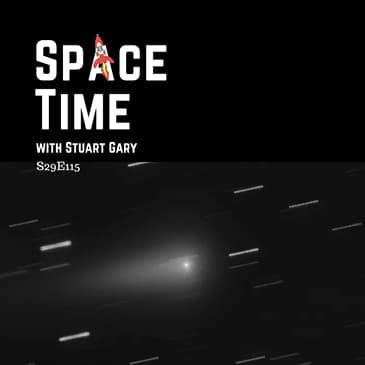
00:00:45 --> 00:00:48 origin of interstellar comet 3I ATLAS,
00:00:48 --> 00:00:50 suggesting it may be more than twice as old
00:00:50 --> 00:00:53 as our sun and solar system. The
00:00:53 --> 00:00:55 findings, reported in the journal Nature
00:00:55 --> 00:00:57 Astronomy, are based on observations by the
00:00:57 --> 00:00:59 European Southern Observatory's Very Large
00:00:59 --> 00:01:01 Telescope in Chile, which studied the
00:01:01 --> 00:01:03 composition of the alien visitor, which is
00:01:03 --> 00:01:05 now considered to be the brightest
00:01:05 --> 00:01:07 interstellar object ever seen in detail.
00:01:08 --> 00:01:11 By measuring specific chemical fingerprints,
00:01:11 --> 00:01:13 the first observations of this kind for a
00:01:13 --> 00:01:15 comet formed outside our solar system, the
00:01:15 --> 00:01:17 authors found that 3i Atlas likely
00:01:17 --> 00:01:20 originated in the outskirts of an older star
00:01:20 --> 00:01:22 system. One of the study's authors,
00:01:22 --> 00:01:24 Cyril Opitum from the University of
00:01:24 --> 00:01:26 Edinburgh, says the findings are shining new
00:01:26 --> 00:01:29 light on the formation history of this comet.
00:01:29 --> 00:01:31 Interstellar comets are icy objects formed
00:01:31 --> 00:01:33 around stars other than the sun that have
00:01:33 --> 00:01:36 occasionally wandered into our solar system.
00:01:36 --> 00:01:39 Opidib says. They're sort of fossils from a
00:01:39 --> 00:01:41 planetary formation process that happen far
00:01:41 --> 00:01:43 away but, uh, which give scientists a chance
00:01:43 --> 00:01:46 to study them up close. Three Eye Atlas is
00:01:46 --> 00:01:48 the third interstellar object ever
00:01:48 --> 00:01:51 discovered. It follows One Eye Omau Maua back
00:01:51 --> 00:01:53 in 2017 and two I Borisov in
00:01:53 --> 00:01:56 2019. It was found as it was approaching
00:01:56 --> 00:01:58 the sun, spending enough time in our solar
00:01:58 --> 00:02:01 system for astronomers to study it in some
00:02:01 --> 00:02:03 detail. While it was difficult to measure the
00:02:03 --> 00:02:05 composition of the first two interstellar
00:02:05 --> 00:02:07 objects, with no gas detected from A MAU Maua
00:02:07 --> 00:02:10 and Borisov being too faint, this was not the
00:02:10 --> 00:02:13 case for 3i Atlas. Thanks to the object's
00:02:13 --> 00:02:15 unprecedented brightness, the authors were
00:02:15 --> 00:02:17 able to measure the comet's isotopic ratios,
00:02:17 --> 00:02:19 the relative amounts of different forms of
00:02:19 --> 00:02:22 the same element. They measured the ratios of
00:02:22 --> 00:02:25 carbon and nitrogen isotopes in cyanide
00:02:25 --> 00:02:27 molecules present in the gas around the
00:02:27 --> 00:02:30 comet. These ratios are a good indicator of a
00:02:30 --> 00:02:32 comet's origin, as they're sensitive to the
00:02:32 --> 00:02:33 physical conditions in the formation
00:02:33 --> 00:02:36 environment and not expected to change much
00:02:36 --> 00:02:38 as the comet travels through space. Unlike
00:02:38 --> 00:02:41 comets from our solar system, three EYE Atlas
00:02:41 --> 00:02:43 was found to carry unusually high carbon and
00:02:43 --> 00:02:45 nitrogen isotopic ratios.
00:02:46 --> 00:02:48 A similar study led by Martin Cordinna from
00:02:48 --> 00:02:50 NASA's Goddard Space Flight Centre in
00:02:50 --> 00:02:52 Greenbelt, Maryland, which was published in
00:02:52 --> 00:02:54 last month's Nature, found a similar isotopic
00:02:54 --> 00:02:56 ratio for carbon, as well as elevated levels
00:02:56 --> 00:02:59 of deuterium, a heavy form of hydrogen.
00:02:59 --> 00:03:01 That study used data from NASA's Webb Space
00:03:01 --> 00:03:04 Telescope. Overall, the findings by
00:03:04 --> 00:03:07 OPITIM's team indicate that the comet likely
00:03:07 --> 00:03:09 formed in the outer regions of an old low
00:03:09 --> 00:03:12 metallicity star. Low metallicity
00:03:12 --> 00:03:14 stars are ones with compositions containing
00:03:14 --> 00:03:16 few elements heavier than hydrogen and
00:03:16 --> 00:03:19 helium. These types of stars are thought to
00:03:19 --> 00:03:21 have formed when the universe was much
00:03:21 --> 00:03:23 younger and less chemically rich than what it
00:03:23 --> 00:03:26 is now. Therefore, the authors suspect Thria
00:03:26 --> 00:03:28 ATLAS originated around a star much older
00:03:28 --> 00:03:30 than our sun and may be more than twice as
00:03:30 --> 00:03:33 old as the solar system. This
00:03:33 --> 00:03:35 interstellar traveller was first detected by
00:03:35 --> 00:03:38 NASA's Asteroid Terrestrial Impact Last Alert
00:03:38 --> 00:03:41 System back on July 1,
00:03:41 --> 00:03:43 2025. David Finossia from
00:03:43 --> 00:03:46 NASA's Jet Propulsion Laboratory in Pasadena,
00:03:46 --> 00:03:48 California says It was about 670 million
00:03:48 --> 00:03:50 kilometres the sun within the orbit of
00:03:50 --> 00:03:52 Jupiter when it was first discovered.
00:03:52 --> 00:03:55 David Finacia: 3i Atlas was discovered on July 1st by the
00:03:55 --> 00:03:58 NASA funded Atlas Survey. Uh, it was
00:03:58 --> 00:04:00 discovered using their uh, telescope at Rio
00:04:00 --> 00:04:03 Hurtado in Chile and it was first detected as
00:04:03 --> 00:04:04 a speckled light moving relative to
00:04:04 --> 00:04:07 background stars. We collected a good amount
00:04:07 --> 00:04:10 of data, more than 100 observations. We know
00:04:10 --> 00:04:12 its trajectory fairly well. We know it came
00:04:12 --> 00:04:14 from outside the solar system. Uh, from
00:04:14 --> 00:04:16 images we also saw that this object is
00:04:16 --> 00:04:18 active. We, which means that around the
00:04:18 --> 00:04:20 nucleus there is some coma, which is an
00:04:20 --> 00:04:22 indication that this object is in fact a
00:04:22 --> 00:04:24 comet. Right now it's hard to say how big
00:04:24 --> 00:04:26 this object is because being active, the
00:04:26 --> 00:04:29 brightness that we see is partially due to
00:04:29 --> 00:04:31 the size of the object, but also, uh, is
00:04:31 --> 00:04:33 partially due to the activity. And so we
00:04:33 --> 00:04:36 cannot really pinpoint the nucleus, uh, size
00:04:36 --> 00:04:38 directly. We have to better understand how
00:04:38 --> 00:04:41 active this object is and then uh, we can
00:04:41 --> 00:04:43 refine the size estimate and get a good idea.
00:04:43 --> 00:04:45 It's moving at a velocity of about
00:04:45 --> 00:04:48 135 miles per hour. So it's going
00:04:48 --> 00:04:50 really fast for that distance from the sun.
00:04:51 --> 00:04:52 This is really exceptional. You have to be an
00:04:52 --> 00:04:54 interstellar object to be going that fast at
00:04:54 --> 00:04:56 that distance from the sun. The more data we
00:04:56 --> 00:04:59 get, the better we can measure the position
00:04:59 --> 00:05:01 of this object as it travels through the
00:05:01 --> 00:05:04 solar system and it moves out of it. But
00:05:04 --> 00:05:05 we also want to collect physical
00:05:05 --> 00:05:07 characterization data. For instance, we would
00:05:07 --> 00:05:09 like to understand better what the size of
00:05:09 --> 00:05:11 this object could the levels of activity.
00:05:11 --> 00:05:13 We're just bracing ourselves to get as much
00:05:13 --> 00:05:15 information as possible. We're really excited
00:05:15 --> 00:05:16 about these objects. So far we've discovered
00:05:16 --> 00:05:18 three interstellar objects. The first one was
00:05:18 --> 00:05:21 Oumuamua, um, in 2017, the second one
00:05:21 --> 00:05:23 Borisov in 2019 and now we have the third
00:05:23 --> 00:05:26 one, 3i Atlas. So it's a rare
00:05:26 --> 00:05:28 opportunity and uh, as a scientific community
00:05:28 --> 00:05:30 we want to collect as many data as possible
00:05:30 --> 00:05:33 to uh, characterise this object and learn as
00:05:33 --> 00:05:34 much as we can.
00:05:34 --> 00:05:36 Stuart Gary: That's David Fanasia from NASA's Jet
00:05:36 --> 00:05:38 Propulsion Laboratory in Pasadena,
00:05:38 --> 00:05:41 California. And this is space
00:05:41 --> 00:05:44 time still to come, the nearby
00:05:44 --> 00:05:46 super Earth planet that may be a candidate
00:05:46 --> 00:05:49 for life and a new way to study the birth of
00:05:49 --> 00:05:51 the universe. All that and more still to come
00:05:52 --> 00:05:53 on, um, space time.
00:06:09 --> 00:06:11 Astronomers have taken a closer look at a
00:06:11 --> 00:06:13 nearby exoplanet, finding it may be more
00:06:13 --> 00:06:15 Earth like than previously thought. The
00:06:15 --> 00:06:17 planet, catalogued as GJ
00:06:17 --> 00:06:20 3378b, orbits a small
00:06:20 --> 00:06:23 spectral type M red dwarf star 25 light years
00:06:23 --> 00:06:24 away in the direction of the northern
00:06:24 --> 00:06:27 constellation Camilla Padalis. A report in
00:06:27 --> 00:06:30 the Astrophysical Journal claims the planet
00:06:30 --> 00:06:32 orbits within the star's habitable zone.
00:06:32 --> 00:06:33 That's the region where temperatures could
00:06:33 --> 00:06:35 allow liquid water to exist on a planet's
00:06:35 --> 00:06:38 surface, thereby making this planet a
00:06:38 --> 00:06:40 candidate to host life. The
00:06:40 --> 00:06:42 study's lead author, Paul Robertson from the
00:06:42 --> 00:06:45 University of California, Irvine, says the
00:06:45 --> 00:06:48 mantra is follow the water. It's the one
00:06:48 --> 00:06:50 thing every known living thing on Earth
00:06:50 --> 00:06:52 needs. So that's the first thing astronomers
00:06:52 --> 00:06:54 look for when trying to find environments
00:06:54 --> 00:06:57 that could sustain life, at least life as we
00:06:57 --> 00:06:59 know it. So Robertson and colleagues took
00:06:59 --> 00:07:01 a closer look and found that it may be more
00:07:01 --> 00:07:04 Earth like than they previously thought. Red
00:07:04 --> 00:07:06 dwarfs are the smallest, coolest group of
00:07:06 --> 00:07:08 stars. They have surface temperatures of
00:07:08 --> 00:07:11 around 2 to 3 degrees
00:07:11 --> 00:07:13 degrees that compares to the sun's 6
00:07:13 --> 00:07:16 degrees. They're also much smaller and dimmer
00:07:16 --> 00:07:19 than our sun and often appear reddish, hence
00:07:19 --> 00:07:21 their name. But red dwarfs are the most
00:07:21 --> 00:07:24 common type of star in the galaxy, making up
00:07:24 --> 00:07:27 some 70% of the entire galactic stellar
00:07:27 --> 00:07:29 population. However, the problem with red
00:07:29 --> 00:07:32 dwarfs is they tend to launch stellar flares
00:07:32 --> 00:07:35 far more often than sun like stars. And this
00:07:35 --> 00:07:37 intense stellar flare activity can erode a
00:07:37 --> 00:07:39 planet's atmosphere, irradiating its surface
00:07:39 --> 00:07:42 and any life that may be on that surface.
00:07:42 --> 00:07:44 Also, because these stars are so dim and
00:07:44 --> 00:07:47 Earth like planets are so small, they can be
00:07:47 --> 00:07:48 very difficult to detect and require
00:07:48 --> 00:07:51 specialised instrumentation. So to Learn
00:07:51 --> 00:07:54 more about JG3378B, the
00:07:54 --> 00:07:56 authors used the Habitable Zone Planet Finder
00:07:56 --> 00:07:58 instrument on the Hobby Eberley telescope at
00:07:58 --> 00:08:01 the McDonald Observatory in order to study
00:08:01 --> 00:08:04 its host star. As the planet orbits
00:08:04 --> 00:08:06 the star, its gravitational force tugs on the
00:08:06 --> 00:08:09 star. This creates a slight wobble, a
00:08:09 --> 00:08:11 Doppler shift, which is visible on the host
00:08:11 --> 00:08:14 star. And that Doppler shift can be used to
00:08:14 --> 00:08:16 calculate a planet's mass and orbit. The
00:08:16 --> 00:08:19 habitable zone Planet Finder is optimised to
00:08:19 --> 00:08:22 use infrared light. As a star gets smaller
00:08:22 --> 00:08:23 and they get cooler, most of their energy
00:08:23 --> 00:08:26 comes out in infrared wavelengths. So
00:08:26 --> 00:08:28 astronomers put an infrared spectrometer on
00:08:28 --> 00:08:31 the 10 metre telescope, giving them more raw
00:08:31 --> 00:08:33 light collecting power to observe these faint
00:08:33 --> 00:08:35 stars. GJ
00:08:35 --> 00:08:38 3378b is described as a super
00:08:38 --> 00:08:40 earth that is a terrestrial or rocky planet,
00:08:40 --> 00:08:43 larger than the Earth, but not so big as to
00:08:43 --> 00:08:45 hold onto a thick atmosphere that would crush
00:08:45 --> 00:08:47 any life on its surface. When the planet was
00:08:47 --> 00:08:50 first discovered in 2024, it was thought to
00:08:50 --> 00:08:52 be about five times the mass of the Earth.
00:08:52 --> 00:08:54 But this new analysis shows it's closer to
00:08:54 --> 00:08:57 around 2.3 times Earth's mass. And that
00:08:57 --> 00:08:59 change increases the likelihood that the
00:08:59 --> 00:09:02 planet doesn't hold a smothering atmosphere.
00:09:02 --> 00:09:04 The authors also refined the planet's orbit
00:09:04 --> 00:09:06 down from 25 Earth days to 21.
00:09:07 --> 00:09:09 Uh, even though both of these are tiny orbits
00:09:09 --> 00:09:10 compared to, in comparison, the Earth has a
00:09:10 --> 00:09:13 365 day orbit with a host star roughly a
00:09:13 --> 00:09:16 third the size of our sun. That proximity is
00:09:16 --> 00:09:18 necessary to place the planet within that
00:09:18 --> 00:09:20 star's habitable zone. Now, that said,
00:09:20 --> 00:09:23 its smaller orbit also subjects the planet to
00:09:23 --> 00:09:25 intense radiation which could evaporate any
00:09:25 --> 00:09:27 atmosphere present. So more
00:09:27 --> 00:09:30 observations will be needed for astronomers
00:09:30 --> 00:09:32 to be sure. This, uh, is space time
00:09:33 --> 00:09:36 still to come. A new way to study the birth
00:09:36 --> 00:09:38 of the universe. And later in the Science
00:09:38 --> 00:09:40 report, the discovery of a half billion year
00:09:40 --> 00:09:43 old fossil which has rewritten the origin
00:09:43 --> 00:09:46 storey of starfish. All that and more still
00:09:46 --> 00:09:48 to come on, um, space time.
00:09:53 --> 00:09:55 Scientists have discovered a new way to
00:09:55 --> 00:09:58 create a glide gluon plasma, the first matter
00:09:58 --> 00:10:01 to form in our universe. The findings,
00:10:01 --> 00:10:02 reported in the journal Physical Review
00:10:02 --> 00:10:05 Letters, opens a new window on the first
00:10:05 --> 00:10:08 microseconds after the big bang, 13.8
00:10:08 --> 00:10:10 billion years ago. What happened in those
00:10:10 --> 00:10:13 first moments of the universe, before the
00:10:13 --> 00:10:14 building blocks of life and the world as we
00:10:14 --> 00:10:17 know it came into existence? Physicists at
00:10:17 --> 00:10:20 cern, the European Organisation for Nuclear
00:10:20 --> 00:10:22 Research, are trying to answer this question
00:10:22 --> 00:10:24 by recreating some of the extreme conditions
00:10:24 --> 00:10:26 that prevailed in the universe at the very
00:10:26 --> 00:10:29 beginning of time. Now, researchers from the
00:10:29 --> 00:10:31 Niels Bohr Institute, together with
00:10:31 --> 00:10:33 colleagues from the alice collaboration at
00:10:33 --> 00:10:35 CERN's Large Hadron Collider, the world's
00:10:35 --> 00:10:37 biggest atom smasher have come one step
00:10:37 --> 00:10:39 closer to understanding those conditions.
00:10:40 --> 00:10:42 At CERN, uh, physicists collide atomic nuclei
00:10:42 --> 00:10:45 at some 999%
00:10:45 --> 00:10:47 the speed of light, in the process creating
00:10:47 --> 00:10:50 the tiny droplets of primordial matter that
00:10:50 --> 00:10:51 filled the universe during its first
00:10:51 --> 00:10:54 millionth of a second of creation. This
00:10:54 --> 00:10:57 substance is known as quark gluon plasma, and
00:10:57 --> 00:10:58 it's thought to have been the earliest form
00:10:58 --> 00:11:01 of matter in our universe. For many
00:11:01 --> 00:11:04 years, scientists have assumed that creating
00:11:04 --> 00:11:06 this plasma required collisions between very
00:11:06 --> 00:11:09 heavy atomic nuclei, such as leading.
00:11:09 --> 00:11:11 But physicists from the Niels Bohr Institute
00:11:11 --> 00:11:13 have now succeeded in creating this
00:11:13 --> 00:11:16 primordial matter by smashing much smaller
00:11:16 --> 00:11:18 nuclei of oxygen 16 and neon 20
00:11:18 --> 00:11:21 together. The study's lead author, uh Xiao
00:11:21 --> 00:11:23 Xu from the Niels Bohr Institute and the
00:11:23 --> 00:11:25 University of Copenhagen, says they've pushed
00:11:25 --> 00:11:27 the boundaries for how small the atomic
00:11:27 --> 00:11:30 nuclei can be while still recreating this
00:11:30 --> 00:11:33 quark gluon plasma. The discovery
00:11:33 --> 00:11:35 means scientists now know more about the
00:11:35 --> 00:11:37 fundamental conditions required required for
00:11:37 --> 00:11:40 matter to transition into this extreme state.
00:11:40 --> 00:11:42 This in turn will help researchers better
00:11:42 --> 00:11:45 understand how plasma behaved during the
00:11:45 --> 00:11:47 first moments of the universe and how it
00:11:47 --> 00:11:49 later evolved into the forms of matter that
00:11:49 --> 00:11:52 everything we see around us today is made of.
00:11:53 --> 00:11:55 When the atomic nuclei collide, their
00:11:55 --> 00:11:57 constituents, ah, are transformed into tiny
00:11:57 --> 00:12:00 droplets of quark gluon plasma that exist for
00:12:00 --> 00:12:03 just a fraction of a second. This droplet of
00:12:03 --> 00:12:05 extremely hot matter then expands.
00:12:06 --> 00:12:08 Researchers can't observe the plasma
00:12:08 --> 00:12:10 directly, but they can measure the particles
00:12:10 --> 00:12:12 that this matter turns into shortly
00:12:12 --> 00:12:15 afterwards. And the movement pattern of these
00:12:15 --> 00:12:17 particles reveals the shape of the atomic
00:12:17 --> 00:12:20 nucleus. Collisions between two oxygen
00:12:20 --> 00:12:22 nuclei produce a more rounded pattern, While
00:12:22 --> 00:12:25 collisions involving neon produce a more
00:12:25 --> 00:12:27 boiling pin shaped pattern. The particles
00:12:27 --> 00:12:29 from the primordial matter are, uh, directly
00:12:29 --> 00:12:31 governed by the geometric shape of their
00:12:31 --> 00:12:34 atomic nucleus. So if two atomic
00:12:34 --> 00:12:36 nuclei being smashed together are spherical,
00:12:36 --> 00:12:38 they'll produce one pattern. And if they're
00:12:38 --> 00:12:40 shaped like bowling pins, they'll produce
00:12:40 --> 00:12:42 another. By studying how the particles move
00:12:42 --> 00:12:44 after the collision, scientists can gain
00:12:44 --> 00:12:46 fresh insights into atomic nuclei that would
00:12:46 --> 00:12:49 otherwise be difficult to obtain. The authors
00:12:49 --> 00:12:51 describe it as being like shining a light on
00:12:51 --> 00:12:54 an object and seeing its shadow. You can't
00:12:54 --> 00:12:56 see the object directly, but its shadow
00:12:56 --> 00:12:58 reveals its shape. In the same way, the
00:12:58 --> 00:13:00 movement of these particles reveals reveals
00:13:00 --> 00:13:02 the geometric shape of the atomic nuclei
00:13:02 --> 00:13:04 present at the beginning of the collision.
00:13:04 --> 00:13:07 The shape of an atomic nucleus is not merely
00:13:07 --> 00:13:09 a matter of geometry. It reveals how
00:13:09 --> 00:13:11 protons and neutrons are organised and
00:13:11 --> 00:13:14 provides important information about the
00:13:14 --> 00:13:16 strong nuclear force, One of nature's four
00:13:16 --> 00:13:18 fundamental forces which scientists are still
00:13:18 --> 00:13:20 trying to fully understand. The others being
00:13:20 --> 00:13:22 the weak nuclear force, the electromagnetic
00:13:22 --> 00:13:25 force and gravity. That assumes, of course,
00:13:25 --> 00:13:28 that gravity really is a force, which it's
00:13:28 --> 00:13:30 probably not. Until now,
00:13:30 --> 00:13:32 physicists have primarily investigated
00:13:32 --> 00:13:34 nuclear structure at low energies by studying
00:13:34 --> 00:13:37 things like the rotation and vibration of
00:13:37 --> 00:13:40 atomic nuclei. Zhao says the precise
00:13:40 --> 00:13:42 understanding of nuclear structure helps
00:13:42 --> 00:13:44 scientists understand the strong nuclear
00:13:44 --> 00:13:46 force. But instead of carefully investigating
00:13:46 --> 00:13:48 nuclei at low energies, they've smashed
00:13:48 --> 00:13:50 together at the highest energies, allowing
00:13:50 --> 00:13:52 scientists to read their shape from the
00:13:52 --> 00:13:55 imprint they leave behind. Researchers still
00:13:55 --> 00:13:57 don't know the exact boundary when a quark,
00:13:57 --> 00:14:00 gluon, um, plasma can be created. So the next
00:14:00 --> 00:14:02 step will be to try experiments with even
00:14:02 --> 00:14:04 lighter nuclei, such as helium 4. The
00:14:04 --> 00:14:07 experiment will allow scientists to both
00:14:07 --> 00:14:09 learn about the structure of atomic nuclei
00:14:09 --> 00:14:11 and to gain a better understanding of what
00:14:11 --> 00:14:13 happened during the birth of the universe.
00:14:14 --> 00:14:16 And it turns out these two things may be much
00:14:16 --> 00:14:19 more closely connected than previously
00:14:19 --> 00:14:19 thought.
00:14:21 --> 00:14:22 This is space, time.
00:14:38 --> 00:14:40 And time outta. Take another brief look at
00:14:40 --> 00:14:41 some of the other storeys making news in
00:14:41 --> 00:14:43 Science this week with the Science Report.
00:14:44 --> 00:14:47 A major sexual health clinic in Melbourne has
00:14:47 --> 00:14:49 seen an almost doubling over the past decade
00:14:49 --> 00:14:51 of women testing positive for gonorrhoea.
00:14:52 --> 00:14:53 The authors analysed data from the clinic
00:14:53 --> 00:14:56 between 2015 and 2024, looking for the
00:14:56 --> 00:14:58 characteristics of women contracting
00:14:58 --> 00:15:00 gonorrhoea amid a rise in sexually
00:15:00 --> 00:15:02 transmitted diseases among women in Melbourne
00:15:02 --> 00:15:05 in recent years. The findings reported in the
00:15:05 --> 00:15:07 journal Sexual Health Cher gonorrhoea cases
00:15:07 --> 00:15:10 increased from 1.3% in 2015 to
00:15:10 --> 00:15:13 2.3% in 2024. The
00:15:13 --> 00:15:15 authors say the women diagnosed were
00:15:15 --> 00:15:17 predominantly young, had multiple casual male
00:15:17 --> 00:15:19 partners and used condoms in contemporary
00:15:19 --> 00:15:22 Consistently oral gonorrhoea saw the largest
00:15:22 --> 00:15:25 increase in cases during the study. Most of
00:15:25 --> 00:15:27 these cases are asymptomatic and can only be
00:15:27 --> 00:15:29 picked up through regular screening.
00:15:30 --> 00:15:32 The New South Wales State government has just
00:15:32 --> 00:15:34 passed new legislation allowing people to
00:15:34 --> 00:15:37 drive when under the influence of medicinal
00:15:37 --> 00:15:40 cannabis. The passing of this bill comes as
00:15:40 --> 00:15:42 Canadian researchers have analysed 40 regular
00:15:42 --> 00:15:45 edible cannabis users testing their driving
00:15:45 --> 00:15:47 skills in a simulator before and after eating
00:15:47 --> 00:15:50 THC gummies. The findings reported
00:15:50 --> 00:15:52 in the Journal of the American Medical
00:15:52 --> 00:15:54 association show that higher doses of
00:15:54 --> 00:15:57 THC led to poorer lane control, slower
00:15:57 --> 00:16:00 reaction times and less consistent speeds.
00:16:00 --> 00:16:02 And um, that's despite the participants blood
00:16:02 --> 00:16:04 tests showed they remained below the legal
00:16:04 --> 00:16:07 thresholds for driving with cannabis in
00:16:07 --> 00:16:09 Canada, New Zealand and now New South Wales.
00:16:09 --> 00:16:12 That legal limit is 5 nanograms per
00:16:12 --> 00:16:14 millilitre. Human
00:16:14 --> 00:16:17 pollution affects our entire planet,
00:16:17 --> 00:16:19 destroying environments wherever people go
00:16:20 --> 00:16:22 Now a report in the journal PLOS ONE
00:16:22 --> 00:16:24 describes how researchers have found plastic
00:16:24 --> 00:16:26 litter on more than half of their remotely
00:16:26 --> 00:16:28 operated dives to the bottom of the Mardel
00:16:28 --> 00:16:31 Plata canyon near Argentina, three kilometres
00:16:31 --> 00:16:34 below the sea surface. After 17
00:16:34 --> 00:16:37 dives in 2025, scientists analysed
00:16:37 --> 00:16:39 approximately 240 hours of video footage,
00:16:39 --> 00:16:41 finding some stationary creatures like
00:16:41 --> 00:16:44 starfish and corals had attached to the trash
00:16:44 --> 00:16:46 dumped by humans, including packets of fried
00:16:46 --> 00:16:49 noodles, plastic cups and even old boots.
00:16:49 --> 00:16:51 A few months earlier, expeditions found cans
00:16:51 --> 00:16:53 and plastic bags on the bottom of the Mariana
00:16:53 --> 00:16:56 Trench, the planet's deepest fissure in the
00:16:56 --> 00:16:57 western Pacific Ocean.
00:16:59 --> 00:17:01 The discovery of a half billion year old
00:17:01 --> 00:17:03 fossil has rewritten the origin history of
00:17:03 --> 00:17:06 starfish. Palaeontologists uncovered the
00:17:06 --> 00:17:09 518 million year old remains in southwestern
00:17:09 --> 00:17:11 China. It comes from a period of rapid
00:17:11 --> 00:17:13 evolutionary development known as the
00:17:13 --> 00:17:15 Cambrian Explosion, when most major animal
00:17:15 --> 00:17:17 groups first appeared in the fossil record.
00:17:18 --> 00:17:20 The new find, named Eugenia glunitotinica,
00:17:20 --> 00:17:23 uh, are thought to be closely related to the
00:17:23 --> 00:17:25 last common ancestor of Ambula clarians, the
00:17:25 --> 00:17:28 modern group that includes starfish, sea
00:17:28 --> 00:17:30 stars, sea urchins and acorn worms.
00:17:30 --> 00:17:33 A report in the journal Current Biology shows
00:17:33 --> 00:17:35 the new discovery ate their food using
00:17:35 --> 00:17:37 tentacles and not passively using their gills
00:17:37 --> 00:17:40 as previously thought. A,
00:17:40 --> 00:17:42 uh, pseudoscience and UFO researcher says
00:17:42 --> 00:17:45 he's uncovered evidence that four different
00:17:45 --> 00:17:47 types of extraterrestrial alien species have
00:17:47 --> 00:17:50 visited our planet. Hal Putoff, a
00:17:50 --> 00:17:52 former Advanced Aerospace Weapons System
00:17:52 --> 00:17:55 Applications programme advisor and CIA funded
00:17:55 --> 00:17:57 researcher, uh, claims bodies of four
00:17:57 --> 00:17:59 different species have been recovered from
00:17:59 --> 00:18:01 various UFO crashes by the US government.
00:18:01 --> 00:18:03 But as the sceptics Timms Mendham points out,
00:18:03 --> 00:18:06 uh, he's provided no evidence to support his
00:18:06 --> 00:18:06 claims.
00:18:06 --> 00:18:08 Tim Mendham: They all look a bit humanoid, which is, I
00:18:08 --> 00:18:09 don't know, to me, surprising. I don't know
00:18:09 --> 00:18:11 why aliens always have to look like humans.
00:18:11 --> 00:18:13 Now to our octopus people. No, no, no
00:18:14 --> 00:18:16 sentient bacteria or anything like that.
00:18:16 --> 00:18:17 There's the lizard people who look like
00:18:17 --> 00:18:19 lizards have tails. Uh, there's the Nordic
00:18:19 --> 00:18:21 who look very sort of glamour Norwegian
00:18:21 --> 00:18:23 looking people. There's the insect people who
00:18:23 --> 00:18:25 are a bit scary, look like praying mantises,
00:18:25 --> 00:18:27 um, and of course there's the greys, the
00:18:27 --> 00:18:30 cliched modern looking little people, big
00:18:30 --> 00:18:31 heads, big eyes, that sort of thing. They all
00:18:31 --> 00:18:34 have sort of hands, fingers, five, obviously
00:18:34 --> 00:18:37 scary in some cases, some cases benign. You
00:18:37 --> 00:18:38 got to look at the people who are promoting
00:18:38 --> 00:18:39 this stuff. I mean, obviously there's no
00:18:39 --> 00:18:41 evidence for it at all. There's just
00:18:41 --> 00:18:43 conjecture, made up, cliches, memes,
00:18:43 --> 00:18:45 whatever. Some of the people promoting it,
00:18:45 --> 00:18:47 one in particular recently is Dr. Hal
00:18:47 --> 00:18:50 Puthoff, who was a former
00:18:50 --> 00:18:52 Advanced Aerospace Weapons Systems
00:18:52 --> 00:18:54 Application programme revisor for it. He was
00:18:54 --> 00:18:56 also involved in a place called the Stanford
00:18:56 --> 00:18:59 Research Institute back in the 70s with a uh,
00:18:59 --> 00:19:00 Harold Targ partner, uh, who were
00:19:00 --> 00:19:02 investigating Uri Geller. And they came out
00:19:02 --> 00:19:04 very much in favour of Uri Geller, saying he
00:19:04 --> 00:19:06 had definite spoon bending talents and all
00:19:06 --> 00:19:08 sorts of psychic powers and things. The
00:19:08 --> 00:19:10 protocols that they used in their laboratory
00:19:10 --> 00:19:12 testing were very dodgy or at least
00:19:12 --> 00:19:13 questionable, let's put it that way. And
00:19:13 --> 00:19:15 certainly someone as sceptic is noted as
00:19:15 --> 00:19:17 James Randi. The late James Randi described
00:19:17 --> 00:19:19 them as the Laurel and Hardy of uh,
00:19:19 --> 00:19:22 parapsychology research. But he has come out
00:19:22 --> 00:19:23 recently and said that there is definitely
00:19:23 --> 00:19:26 these four types of UFO occupants. He
00:19:26 --> 00:19:28 hasn't seen them of course, but he's heard of
00:19:28 --> 00:19:31 them. He said testimony from members of
00:19:31 --> 00:19:33 supposed crash retrieval programmes who tend
00:19:33 --> 00:19:35 not to come forward to actually talk about
00:19:35 --> 00:19:37 their work because they fear for their lives.
00:19:37 --> 00:19:38 It's annoying that all these people with
00:19:38 --> 00:19:40 evidence don't come forward with it. So
00:19:40 --> 00:19:42 therefore you have to say, well what evidence
00:19:42 --> 00:19:43 do they have? I could say the, the moon is
00:19:43 --> 00:19:45 made of cheese. And people say where's the
00:19:45 --> 00:19:46 evidence? Well I can't give it to you because
00:19:46 --> 00:19:48 it's secret, you know. And you say right,
00:19:48 --> 00:19:50 okay, I'm supposed to believe that. So all
00:19:50 --> 00:19:52 these people who are claiming UFOs and they
00:19:52 --> 00:19:54 know of someone who know of someone who knows
00:19:54 --> 00:19:56 of someone who has seen these occupants of
00:19:57 --> 00:19:59 interplanetary uh, craft, there's no evidence
00:19:59 --> 00:19:59 for it.
00:19:59 --> 00:20:01 And you get people like Al Puthoff who might
00:20:01 --> 00:20:03 be going through attention deficit disorder.
00:20:03 --> 00:20:05 He wants to sort of put his hand up again
00:20:05 --> 00:20:07 even in his aged years or something because
00:20:07 --> 00:20:09 he has been around a long time, since the
00:20:09 --> 00:20:12 early 70s. His record is not crash shot. So
00:20:12 --> 00:20:14 as a source of information, despite the fact
00:20:14 --> 00:20:16 he supposedly has this sort of research
00:20:16 --> 00:20:18 background, it's not necessarily as exciting
00:20:18 --> 00:20:20 as it might sound to be. Not necessarily as
00:20:20 --> 00:20:22 respectable, uh, or reliable as it might
00:20:22 --> 00:20:24 sound to be. Saying I worked with the CIA on
00:20:24 --> 00:20:26 uh, projects in the 70s is nothing
00:20:26 --> 00:20:28 particularly exciting. So you see I was
00:20:28 --> 00:20:30 funding anything going and came out with
00:20:30 --> 00:20:32 nothing at the end. But anyway, Hal put off
00:20:32 --> 00:20:33 you're saying there's four, um, different
00:20:33 --> 00:20:36 types of aliens, all of whom look humanish.
00:20:36 --> 00:20:38 And uh, none of them any evidence for them at
00:20:38 --> 00:20:40 all. There was a documentary made about
00:20:40 --> 00:20:42 disclosure things. This is before the.
00:20:42 --> 00:20:43 Stuart Gary: Let's call it a mockumentary.
00:20:43 --> 00:20:45 Tim Mendham: It's a, it's a mockumentary with nothing new.
00:20:45 --> 00:20:48 It's Age of Disclosure had a lot of puffery
00:20:48 --> 00:20:50 before it came out and people have seen it
00:20:50 --> 00:20:52 say there's nothing new there. It's all the
00:20:52 --> 00:20:54 same old same old, same characters who keep
00:20:54 --> 00:20:55 appearing and being interviewed. Of course
00:20:55 --> 00:20:57 it's going to it's a preamble to the film,
00:20:57 --> 00:20:59 Spielberg film called Disclosure talks about
00:20:59 --> 00:21:01 alien interaction with people, etc. All sorts
00:21:01 --> 00:21:03 of, you know, they walk among us type things.
00:21:03 --> 00:21:05 No real evidence and a lot of claims but no
00:21:05 --> 00:21:07 evidence. And that goes on has been going on
00:21:07 --> 00:21:10 since the 1940s and every researcher of UFOs
00:21:10 --> 00:21:12 has always said any day now is going to be
00:21:12 --> 00:21:15 the great reveal. And that day has never
00:21:15 --> 00:21:17 arisen. So we're waiting. They've never
00:21:17 --> 00:21:20 presented, never presented any irrefutable
00:21:20 --> 00:21:22 anything close to irrefutable evidence. Just
00:21:22 --> 00:21:22 claims.
00:21:22 --> 00:21:24 Stuart Gary: That's the sceptics. Timms Mendham and this
00:21:24 --> 00:21:25 is Space Time.
00:21:41 --> 00:21:44 And that's the show for now. Space Time
00:21:44 --> 00:21:46 is available every Monday, Wednesday and
00:21:46 --> 00:21:49 Friday through bytes.com soundcloud,
00:21:49 --> 00:21:51 YouTube, your favourite podcast download
00:21:51 --> 00:21:52 provider, and from
00:21:52 --> 00:21:54 spacetimewithstuartgarry.com
00:21:55 --> 00:21:57 spacetime is also broadcast through the
00:21:57 --> 00:21:59 National Science foundation on Science Zone
00:21:59 --> 00:22:02 Radio and on both iHeartradio and
00:22:02 --> 00:22:05 TuneIn radio. And you can help to support our
00:22:05 --> 00:22:07 show by visiting the Space Store for a range
00:22:07 --> 00:22:10 of promotional merchandising goodies or by
00:22:10 --> 00:22:12 becoming a Space patron, which gives you
00:22:12 --> 00:22:14 access to triple episode commercial free
00:22:14 --> 00:22:17 versions of the show, as well as lots of
00:22:17 --> 00:22:19 bonus audio content which doesn't go to air,
00:22:19 --> 00:22:21 access to our exclusive Facebook group, and
00:22:21 --> 00:22:24 other rewards. Just go to
00:22:24 --> 00:22:26 spacetimewithstuartgarry.com for full
00:22:26 --> 00:22:29 details. You've been listening to Space Time
00:22:29 --> 00:22:31 with Stuart Gary. This has been another
00:22:32 --> 00:22:34 quality podcast production from bytes.com.