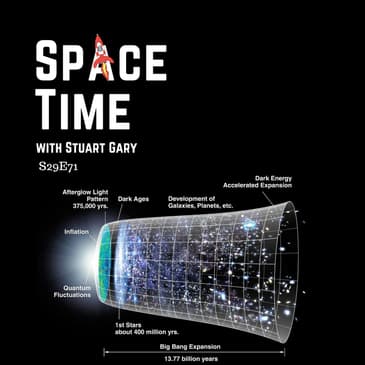
This is Spacetime Series twenty nine, episode seventy one, for broadcast on the fifteenth of June twenty twenty six. Coming up on Space Time, The expansion of the universe is still accelerating after all, mysterious cosmic signals finally explained, and what made last week's New England media incident so rare? All that and more Coming up on space Time. Welcome to Space Time with Stuart Gary. A new study is confirmed that the universe is continuing to expand at an ever accelerating rate under the force of dark energy, and that means we're heading for a cold, dark and empty fate. The findings reported in the Journal and the Monthly Notices of the Royal Astronomer Society the Bunk's last year's study, which suggested that the strength of dark energy was weakening and as a result, the rate of cosmic expansion was either slowing down or may even have stopped completely. The authors of the original study had suggested that the methods used to measure the universe's expansion using type one A supernervae exploding stars, which all blow up with roughly the same amount of energy and hence same luminosity, was fundamentally flawed, but the new studies lead author Phil Wiseman from the University of Southampton says the re evaluated data shows that the universe is behaving exactly is expected. He says last year's revelations were the result of a scientific misunderstanding, rather than the floor in the universe itself. That means the original and well accepted measurements were in fact fine and our current understanding of the fate of the universe remains robust. Wiseman says. By proving the original measurements were correct, astronomers can now get back to trying to understand what dark energy actually is, rather. Than one whether it exists at all. The original discovery of the accelerating expansion of the universe, made by Adam Maurice, Brian Schmidt and Saul Perlmwater, won them the Nobel Prize for Physics in twenty eleven. If the twenty twenty five claims had been true, it would have dismantled their findings, as well as nearly three decades of astronomical progress. The authors found that when they calibrated these supernovae cuting for the different host environments and populations, the evidence for cosmic acceleration remained remarkably consistent. The twenty twenty five study had claimed that as the universe aged the supernova, they had different maximum brightnesses, tricking astronomers in the thinking that cosmos was accelerating was actually slowing. However, the new Southampton study found the error lay in how the age of these stars was estimated. They proved that the previous findings incorrectly assumed the age of a galaxy was the same as the age of the star that exploded in it. The authors also say that twenty twenty five paper failed to for the mass of the hearst galaxies, a standard correction used in modern cosmology to prove accuracy. The twenty twenty five findings led to speculation that instead of the universe ending up in a big freeze or worse, a big rip, it might end up in a steady state, possibly a big crunch. A big crunch is where gravity eventually overcomes the outward expansion of the universe, resulting in the cosmos ultimately collapsing back in on itself. That could have led to another big bang, followed by another big crunch, followed by another big bang, and so on. The steady stage universe would have seen the outward expansion eventually slow down and lie to a stop, but the new findings show dark energy is continuing to accelerate the expansion of the universe. That means we're in for a big freeze the heat depth of the universe, where eventually all the galaxies will move so far away from each other they'll disappear beyond what's called the cosmic horizon, so far away that even at the speed of light, light from these distant galaxies can never reach us, consequently leaving a salon in the dark empty cosmos where the stars will eventually run out of fuel and one by one turn off, leaving only the cold, dark blackness of space. It means star formation will probably end in about one hundred trillion years from now. Black holes will then begin to evaporate at about ten to forty years, and by ten to the one hundred years, known as the Google Yes, that's where the word Google comes from, the universe will be nothing more than a uniform soup of subatomic particles and photons with a temperature hovering just above absolute zero. An even worse fate would be the so called Big Rip, and that would see the power of dark energy continuing to increase. Consequently, the expansion of the universe would continue to accelerate, depending on the existence of phantom energy and accelerated version of dark energy, and that would see not only galaxies disappear beyond the cosmic horizon, but star systems would be torn out of their galaxies. Planets would be torn away from their host stars, and ultimately atoms would be ripped apart from each other. And eventually the electrons, protons and neutrons would be torn away, leaving an ionized plasma which theoretically could even see the quarks inside protons and neutrons ripped apart from each other. But that wouldn't take a google years. That could happen as soon as one hundred and fifty billion years from now. This is space time still to come. Mysterious cosmic signals that have baffled scientists finally explained, and one made last week's New England metior incident, which we reported on so rare. All that and more still to come on space time, astronomers have discovered that it did. Stars known as white dwarfs, which are located inside binary star systems, are a primary source of mysterious signals from deep space, known as long period radio transience. Long period radio transients are cosmic pulses of energy emitting from just a few remote regions of the sky. The new findings, reported in the journal Nature Astronomy, provide the best evidence yet for these unusual cosmic events, which have been battling scientists for years. Using the Australian square kilometer array path find a radio telescope in outback Western Australia, the authors detect that a white dwarf the core of a dead sun like star, dragging material off its larger but less dense companion star, and as this still a material spirals into the white dwarf, it produces powerful bursts of radio waves and X rays in a cycle that repeats every one point four hours. The discovery now provides astronomers with a natural laboratory to examine extreme physics the steadies. Lead author Coved Rose from the University of Sydney says it's the first time anyone's pinpointed the origin of these signals, confirming the source to be a cataclysmic variable and creating white dwarf star. Rose says long period radio transients have puzzled astronomers for years. Only a dozen or so have ever been found, and their origins have always been unclear until now. The newly identified system, named as cap J seventeen forty five and minus fifty to fifty one, consists of a white dwarf, a dense stellar remnant with roughly the diameter of the Earth, but with a mass closer to that of the Sun, paired with a larger but lower mass, red dwarf star about one tenth the Son's mass. These two objects orbit each other extremely closely, completing a full orbit in just over an hour. As material from the less massive star is drawn towards the white dwarf, it heats up and emits X rays. Now at the same time, interactions between the two stars magnetic fields generates regular radio bursts, resulting in a signal which occurs at very specific intervals. Rose says these emissions are all tied to the orbital motion of the system, but interestingly, the radio and X ray signals don't peak at the same time, and that tell scientists they're being produced in different regions of the system. The authors found that the radio emissions likely originate from the magnetic field of the two stars meeting and interacting, with the chart's material being ripped off the companion star by the white dwarf, resulting in highly being bursts of radiation. Long period radio transients were originally thought to be slow spinning neutron stars pulsars. However, current models suggest that neutron stars were attating this slowly shouldn't be able to produce such signals, so the new discovery strengthens an alternative explanation that at least some of these mysterious bursts come from systems of two stars involving white dwarfs. Some similar objects had been linked to binary systems before, but this is the first observation that clearly shows both of the stars and the accretion process itself in action. The systems also only the second known long period radio transient to emit regular X rays, and the first where the cause of this regularity has been confirmed as cap J seventeen forty five fifty fifty one could act as a reference point for understanding other long period transients. You see, the system gives astronomers a way to decode the signals. Rose says it could help determine whether other long period transients are more like pulsars or like white dwarf systems. In that way, it acts like a sort of stellar Rosetta Stone, the famous archaeological stellar discovered in Egypt that allowed scientists to finally translate ancient Egyptian hieroglyphics. The discovery also provides a unique opportunity to study extreme plasma physics and magnetic interactions under the sorts of conditions that simply can't be replicated here on Earth. Rose says these natural laboratories will allow astronomers to test our understanding of how matter behaves in a strong magnetic field under intense gravitational force. The goal here was never to target the white dwarfs or anything like that. What we've been looking at is finding these astrophysical transience, things that go bump in the night. And I think what's really unique about this research is that we've been able to figure out, as you said, that it is a white dwarf binary system that is producing these otherwise mysterious radio births. These are long period radio transients. So historically, the first kind of clear repetition that was seen in radio signals was discovered from pulsars, which are these rapidly rotating neutron stars that produce births of radio light every time they spin around, normally on orders of milliseconds or second and long period transients kind of looked very similar to pulsars when they were first discovered, but tended to repeat on timescales more like minutes to hours. Since the long period. Name now once you realize it was coming from a white dwarf, this is a sun like star that's reached the end of its life and shed off its out of layers, exposing its core. So with pulsars, we're still trying to figure out the exact mechanism, but it seems to be that every time they rotate, we see a burst of life that's kind of a beam of radio light coming from. Near the poles of the pulsar, kind. Of like the northern South, like a lighthouse shining in the night. Exactly to it. Yeah, and with long period transient, so I should say that some long period transient still might be you know, when it all comes out in a few years that we learn more and more about these things, some of them may be sort of weird and wacky pulsars, but at least for the binary ones, what we've seemed to be finding. And I think what was really great about this discovery is we were able to figure out that the point that the radio light is coming from is actually with a magnetic field of the white dwarf and its companion star meet the X ray signal, which also repeats in this same one point three hour period, which is the same as the time it takes for the start to do in orbit around one another. The X ray seems to be coming from accretion, which is basically as the dwarf, which is more massive bulls material the gravitational forces from the companion as that material rapidly accelerates down towards the white dwarf surface to get to eat it up and ironized electrically charged, and that is what we believe is producing the X ray signal that we see that's repeating, as well as some additional ultraviolet light that we. Detected from the system. You based these findings on one very specific white wolf finery tell us. About the system. So this is a system that was discovered as a weird radio transient. There wasn't a lot of information available on what it was. You know, sometimes radio astronomers will we'll find a weird thing in the sky, we'll say, oh, that radio point wasn't there before. And when you compare to other catalogues of let's say, you know, optical telescopes that are in space, like the guy a satellite, you can see, oh, this is a known star or this is a known supernova from. Some other catalog. In this case, there wasn't a lot of information to go on, so it was kind of a mystery to build up all these little scraps of information to figure out what it wants. So we used Gaya, an optical telescope to figure out that there was some faint optical source there and that could help us understand that, you know, it wasn't a nearby or bright star. We used other telescopes to figure out, like I mentioned that there's ultra violet emission and there's X ray emission. I think the real crucial part to figuring out that it was a white dwarf binary system was getting optical spectroscopy, so basically breaking down the rainbow of light that's coming from this system. And what was really cool when we did that was that we saw there were these signals. It's kind of characteristic signals of hydrogen emission and helium emission, and these end to come at a particular wavelength. This is kind of a fundamental thing based on the properties of hydrogen and helium, so it should be the same throughout the universe, and there's a set wavelength of light that we should see this hydrogen and helium signature. Apt So what was crazy was that we were noticing this signal shift back and forth in wavelengths, basically a Doppler shift that was happening, and that is what let us know that we were looking at not just a white dwarf, but a white dwarf in. A binary, a low mass binary. Yeah, exactly. So there are characteristic colors and temperatures that you expect for different stars. So, for example, you could look at a star like our sun and that's kind of a very average star, and that's not by accident. We do tend to compare the other stars in the universe that we discover relative to our Sun. So if you imagine our sun is kind of like an average point, you could have a star that is, let's say, much colder than our sun, and that would have a lower brightness. It would also have a redder color. Basically, just like you can imagine when you look at a flame from your stover from a campfire, you see the red hot bit that the kind of white hot is a hotter temperature. And so in astronomy we have not just red to white, but we also have blue. Right, we have stars that are bluer in color, so to speak, which means that they are hotter. So white dwarfs and extremely hot and white stars are often quite blue in their color temperature. These are things that tend to have temperatures of the order of tens of thousands of degrees, and then on the colder or redder end, you have things that have temperatures of maybe a few hundred or a few thousand degrees. So in this system we were able to see that there are two things. We have something that has a temperature that's very blue and has a temperature of several tens of thousands of degrees. And that's the white dwarf. And then we also have something separately that is of the order of a couple thousand degrees and it's a lot redder, and. That's the low mass companion. So by piecing together all the different information that we. Have, we were able to figure out that we have these two different unique stars in the system. Used as cats for that, didn't you. Yeah, So ASCAP was critical for the initial discovery. All the work that I've been doing over the past few years have been finding weird and wacky things using ASCAP, which is an incredible telescope located here in Australia at in Yarimana Ilgrise Blunderer that CSR and that's just an observatory in Western Australia. And ASCAP is a great survey instrument. It covers huge parts of the sky and it kind of gives us a map of all the things that are there. And by seeing what's there we can figure out what's changing, we can figure out what's appearing. So the initial discovery was made with ASKAP, and then I did follow up observations using both MEACAT which is a radio telescope in South Africa, and also AFKA, the Australia Telescope Compact Array, which is a lovely telescope here in New South Wales Hre I'm calling Front and AKKA is just incredible for kind of long tracks, really precise measurements to see not just is there a radio source there that we're seeing in the sky, But how is it changing over time? All right, you've got one that's lovely, but really to be comfortable, you want to find a few more examples of this, wouldn't you. Yeah, this has been the tricky thing with long period transient. So the first official discovery was I think only in twenty twenty two, so only only about four or five years ago were we first finding these weird lpts as they're called. And most of them have been found in a region of our galaxy that's us to the galactic plane, which is kind of a much dustier area, and that does tend to obscure a lot of these optical lights that we would otherwise measure from space, and that has meant that it's been kind of difficult to figure out what is producing, what systems or what objects are producing the radio light. And so what's great about this system is that while in the past we've had things where we'll have radio and optical but no X ray or radio, an X ray but no. Optical or just radio, in this case we have the radio. The X rays are optical. And even ultra violet and like forming kind of a more complete picture with this one LPT. It's going to allow us to use it as a kind of a Rosetta stone to decode maybe fast discoveries, but also future discovery. So we keep discovering more and more of these weird transients, we'll be able to maybe understand a bit more about them. What's likely to be the ultimate fat of this white red dwarf binary? Are we likely to say an ova, maybe even a supernova? Ultimately? Yeah, that's a really good question. I think in some cases we can see type one A supernova when you have a star that's accreding onto a white dwarf, and if there's too much material that it gets accreted onto it, you can end up with that white dwarf exploding as a Type one A souperova. But I think what's also quite interesting about this class of accreating white dwarf binaries that we've been learning recently is that they can actually have this really strange phenomenon called a period bound. So the period refers to the orbital period. Right. You start with let's say a main sequence star like our Sun, slightly less massive, and it's orbiting around with a white dwarf and as they get closer and closer together, the orbital period gets lower and lower, and around the eighty minute mark, what we often see is that the white dwarf has stripped so much material through its gravity. It's pulled so much material from its companions that the companion is no longer a main sequence star like our sun or a low mass star, but is a brown dwarf, which is kind of like a missing link between prime mass. Planets and low mass stars. And when you have a brown dwarf that can't keep doing the nuclear fusion that keeps starts going, and so what will happen at that point? This period bounce that I mentioned a moment ago is when the system stops all being closer and closer together, and then suddenly instead orbits get further and further apart. Basically, the stars will drift away. So the end states for systems like this could in some cases not necessarily be a supernerva, but instead they slowly drift apart, and you've gone from having a massive star and a white dwarf to a massive star and a brown dwarf. Brown dwarves come into existence either by financial size objects getting bigger and bigger and bigger, or alternatively by red dwarfs losing too much mass through fusion and simply burning off most of their mass. So this is a third way we can get a brown dwarf. Yeah, exactly. I'd always thought of brown dwarf as failed stars, which seems a bit harsh, but it's quite interesting to think about this new way for brown dwarfs to form. That's Kirby Rose from the University of Sydney, and this is space time still to come. Last week we were reported on the medior that rocked the afternoon spring skies of New England. Now it turns out that was a very rare event. And later in the science report, a new study is confirmed that sugar sweetened drinks increase your risk of two types of liver cancer. All that and more still to come on space time. In last week's space Time, we were reported on the meteor that rocked the afternoon spring skies over New England. Well, and now it turns out that was a very rare event. Residents reported allowed explosions, sending emergency services scrambling to try and understand what caused the blast that chook buildings across Massachusetts and Rhode Island. It turns out the explosion was the double sign boom what was thought to be a meter wide meteor entering its atmosphere and the skies above the New Hampshire border with Massachusetts north of Boston. Later, NASA was able to confirm the event was a meteor traveling around one hundred and twenty one thousand kilometis per hour, which likely air burst with a force of around three undred tons of TNT, fragmenting in an altitude of about sixty kilometers, with the remains falling into Cape Cod Bay. But it now turns out, with the addition of extra data, that meteor was much larger than previously estimated, possibly almost double the size and at least six tons in mass. Robert Lansford from the American Meteor Society says this type of meteor is rare for its size, its brightness, and the fact that it happened during the day. He says a lot of light has to be produced by an extraordinary large meteor to be visible in the daylight skies. Lunsford says, for those witnessing the encounter, it was a once in a generation event. This is space time and time out to take a brief look at some of the other stories making using science this week with a science report. A new study has shown that sugar sweetened drinks appear to increase the risk of two types of liver cancer, well artificially sweetened drinks don't. The findings were reported in the Journal of the American Medical Association found that even a one beverage a day increase in sugar sweetened drinks increases the risk of the most common type of primary liver cancer. The new research analyzed data from eleven previous studies, which included more than one and a half million adults, in order to assess the liver cancer risk of people drinking sugar sweeten drinks compared to those consuming artificially sweetened beverages. The authors found that while sugar sweetened drinks were associated with increased liver cancer risk, artificially sweetened drinks were found not to increase liver cancer risk. Scientists have discovered a new species of fish swimming in the warm tropical waters of the Great Barrier reef. It seems the bright orange, red, hairy long snarted ghost pipefish is a new species that had actually been hiding in plain sight among the colorful corals for years, but was often confused with other ghost pipefish. The reason for the confusion is that ghost pipefish are masters of camouflage that can easily meld into the background. These close relatives of seahorses and sea dragons often closely matched the color of their surroundings and developed skin filaments that look like algine coral. The findings reported in the journal Fish Biology show that the new species, now called the hairy ghost pipefish has actually been known about for years, with divers and underwater photographers uploading images and videos to social media. However, marine biologists noticed a consistent morphological difference between this fish in the photographs and museum specimens they had examined and decided to investigate. They analyzed mitochondrical with DNA from two specimens collected from the Great Barrier reef and compared them with DNA records of the rough ghost pipefish, and they found a twenty two percent guity difference between them, strong evidence that they were in fact looking at two different species. A new study has found that living with cats weren't worse than asthma allergies in children. The findings reported in the journal Frontiers analogy looked at more than thirty thousand children between the ages of four and seventeen. The authors studied asthma's severity and lung function and children who already had asthma in homes with at least one cat, and compared that to children with asthma living in households with no cats, and they found there was no association between asthma outcomes and the presence of cats in the household. They found that moderate to severe asthma occurred in nine point six percent of cat exposed children and ten point one percent of non cat exposed kids. Well, asthma attacks occurred in three point three percent of cat expers children but three point five percent of non exposed kids. A new study warns that nearly half of all American consumers act on guidance from social media influences or AI tools, often without any fact checking or professional input. The findings by the Academy of Nutrition and Dietetics also found that eighty percent of Americans struggle to tell fact from fiction when it comes to nutrition, often driven by clickbait, viral wellness trends, and pure pseudo science. The Skeptics timendum says the results show a serious problem. A lot of people believe influencers. That's why they call influencers. It's a huge industry these days of every pick in person has their little TikTok clip somewhere to the making ads on that for TV and in the shape of a TikTok influencer. Things just that think people feel comfortable they're saying. A survey has said that nearly half of US consumers don guidance from social media influencers or AI tools, often without tact checking or professional input. People are listen to this and there's all sorts of things on TikTok. There are people who are represented as the alien civilizations on TikTok. There are people who say, well everything conceivable basically you can find it somewhere on TikTok, and they're very influential. There was a. Story a number of years ago. If someone's claiming that if you swallowed cotton cotton will balls, it would actually help your digestion or something. What about ti to take some dishwashing liquid or something. Yeah, yeah, yeah, Well, hydroxychloricoine and all sort of sort of things. There were sort of bleach sort of promoted and these were just influencers and things and people doing stuff. But what started up as a joke with the cotton balls and ended up being people sort of following it, and they can makes you damage their health very badly. Anyway, what this service says was that eighteen ten Americans, which is eighty percent, struggles to tell fact from fiction in nutrition. They're driven by click bait, which is sort of saying that I can cure your own so viral wellness trends and sue their science. These peoples that are half of them are not interested in following up and finding out are from qualified thoughts, as they'll believe the influencer, or they'll go online as you say, as you said, Google doctor, Google or any sort of things and saying what's the cure for this? Going to get a response from an AI dot for an AI sort of app of some sort of another and they believe it. That's a large number of people who act on totally unqualified advice coming from someone who's a young girl who looks nice for instance, a young woman say looks looks attractive, et cetera, giving you health advice, pitching their latest cure, or they're their selling so worthy. This is not a fringe group. It's a large percentage of the populations who are following these things with the consequence of that whether they have a condition or not, whether it's believe, whether it's an imaginary condition or a real one, they're not getting the help they may. Now that's a danger, that's just the real danger there. Therefore, people will continue to be sick or they get checked by not getting proper treatment, or because they believe someone has no qualifications. Just telling you in a nice voice that this is what is a major issue that is getting worse and worse and worse. That's the skeptics timendum, and this is space Time, and that's the show for now. Spacetime is available every Monday, Wednesday and Friday through at bytes dot com, SoundCloud, YouTube, your favorite podcast download provider, and from space Time with Stuart Gary dot com. Space Time's also broadcast through the National Science Foundation, on Science Own Radio and on both iHeartRadio and tune In Radio. And you can help to support our show by visiting the Spacetime Store for a range of promotional merchandising goodies, or by becoming a Spacetime Patron, which gives you access to triple episode, commercial free versions of the show, as well as lots of burnus audio content which doesn't go to air, access to our exclusive Facebook group, and other rewards. Just go to space Time with Stuart Gary dot com for full details. You've been listening to space Time with Stuart Gary. This has been another quality podcast production from bytes dot com.