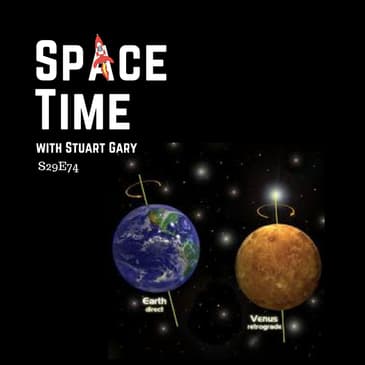
This is Spacetime Series twenty nine, Episode seventy four, or broadcast on the twenty second of June twenty twenty six. Coming up on space Time, Why Venus spins backwards could matter, Explain what's happening at the center of our galaxy, and trying to solve a meteor cold case. All that and more coming up on space Time. Welcome to space Time with Stuart Gary. A new study suggest that the strange Richi grade spin of the planet Venus could be the result of a massive impact event. Unlike most other planets in our Solar System, Venus rotates in reverse, with the sun rising in the west and setting in the east, and the planet's rotation is that Venusian day takes two hundred and forty three Earth days. That's longer than its year, which is two hundred and twenty five earth days. The planet's bizarre and extraordinary slow retrograde rotation as long puzzled astronomers. The new findings, presented at the European Geosciences Union General Assembly in Vienna, suggest that the planet may have been hit by a high angle, moon sized, high velocity impact, probably within the first fifty million years of its formation. The studies, lead author Cedric Gilman from eighty h Zeurish says computer simulations show that just such a collision could have significantly modified the rotation of the planet's initial spin. Gilman and colleagues found that an initial impact with about a tenth the mass of Venus hitting the planet at just the right angle could drastically change its rotation. Venus is often called Earth's sister planet because it's almost the same size as the Earth and was formed in the same part of the Solar System out of the same materials and under similar conditions. But Venus evolved very differently compared to the habitable world we call home. Venus is an average surface temperature four hundred and sixty seven degrees celsius that's hot enough to melt lead, and its atmospheric surface pressure is a crushing ninety two times that of Earth. Its dense carbon dioxide atmosphere is blanketed under a twenty kilometer thick global cloud cover. On Venus, it's always overcast, but it doesn't rain water on Venus. Instead, the rainy sulfuric acid with the metallic snow caps covering the planet's talless mountains now According to Gilman and colleagues, depending on the impact parameters, a collision could have either slowed down a rapidly rotating early Venus to a slow spinning planet, or alternatively, with a large enough tangential energetic impact, it could have caused a faster retrograde rotation. The computer models show that any major impact would have produced vast surface magnations, with milt layers ranging from one hundred kilometers thick right down to a fully molted mantle depending on impact properties. The simulation most likely to cause the planet's current retrograde rotation likely melted some ninety nine percent of Venus's mantle. Only a slightly larger impact might have been enough to destroy the planet completely, and that means the Inner Solar System would have been a very different place, possibly one inhospitable for life. Now, this study doesn't explain Venus's lack of plate tectonics. That could be due to the crust soaking heat keeping it all soft and malleable, resulting in vulcanism being the primary heat dissipation source. Now, these are any computer simulations as to what may have happened, but it does provide an explanation for what we're seeing in this strange, twisted sister of a planet where neighbors with this is space time still to come? Could dark matter explain what's happening at the center of our galaxy? And trying to solve a meteor cold case? All that and more still to come on space time. A new study has failed to rule out dark matter as the potential source of the so called galactic center excess at the heart of our Milky Way galaxy. The galactic center excess is a roughly spherical glow of gamma rays extending over thousands of light years around the center of the Milky Way, and its origins are among the most hotly debated issues in astrophysics. Several explanations have been put forward to try and explain this unusual signal, and some theoretical predictions are consistent with self annihilating dark matter, a mysterious invisible substance that makes up eighty percent of all the matter in the universe. Of course, the problem is scientists have no idea what dark matter really is. They know it exists because they can see its gravitational interaction with normal matter, preventing galaxies from spinning. A part of s they rotate and magnifying background objects through gravitational lensing, but really that's about it other than dark matter. Another possibility is a large population of rapidly rotating neutron stars known as millisecond pulsars, but again that's just a hypothesis for now. The origin of the signal at the center of our galaxy remains unresolved, and that's where this new study comes in. The research, reported in the journal Physical Review Letters used a new machine learning method incorporating for the first time the energy of photons to try and resolve the mystery, and these new results suggest that an explanation in terms of dark matter can't be ruled out. The studies lead author, Foreign list from the University of Vienna says interpreting the signals especially difficult because the galactic center is an exceptionally bright and crowded region of the gamma ray sky. The pulsa hypothesis has been supported by previous statistical studies. The problem is earlier analyses haven't included a crucial piece of information, the energy of each individually detected photon. In this new study, Listing colleagues developed a machine learning method trained in more than a million simulated gamma ray observations in order to evaluate spatial and spectual information simultaneously for the first time, and including this new photon energy information changes the picture substantially. Whereas earlier analyzes pointed to comparatively bright, unresolved light sources, the new results showed that these points sources would have to be extremely faint, in fact, so faint that'd be almost indistinguishable from the emissions expected from annihilating dark matter, And for the pulsa hypothesis, it would imply there must be at least thirty five thousand such sources at the center of the galaxy, and that significantly more than the few one hundred to a few thousand sources assumed in previous studies. Liszt admits the newer doesn't show that dark matter is responsible for the gamma ray signal, but it does suggest that it's still far too early to rule it out. This is space time still to come trying to solve a meteor cold case, and later in the science report, a new study is confirmed the risk of suicide among males can linger for years following the breakup of a relationship. All that and more still to come on space time. Last month, astronomers detected the small nearest meteoroid on a collision course without planet. The object was estimated to only be about half a meter wide, and I was expected to impact somewhere between Papa, New Guinea and northern Western Australia. The head of the Desert Fireball Network, Hadrian dev Pois from the Curtain University School of Earth and Planetary Sciences and the Curtain Institute of Radio Astronomy, says the object is traveling at some thirteen kilometres per second and would have been visible up to nine hundred kilometers away. However, that's where this story ended. The spider heads up to space researchers and citizens scientists. There were no sightings or impact reports, at least that was until a few days ago when a report suddenly surfaced on social media. Apparently a man fishing with his father along the Northern Territory's Adelaide River estuary posted at a possible sighting of the media as it streaked across the late night tropical skies. Debbie Pis says, well, we now have telescopes that can detect asteroids before they hit the Earth. Once they get really close to the planet and hit the atmosphere, we lose track of them, and he says that's where citizen scientist reports could really help. So he's calling for people across the territory's top end who may have seen a bright fireball, an unusually bright flash on the horizon, or heard a sotomic boom from the impact to get in touch with the network. So basically, as we get better telescopes for discovering pasteroids, like we're discovering small and small objects. And as we're discovering small and small objects, we're starting to discover the ones that like regularly like h the hit the Earth. So people be used to seeing like meteors at night time, so those are like like really really small. Before we kind of like milime to to centimeter stuff, But those telescopes signed to discover the objects maybe half metocross and these typically impact the Earth on the order of like maybe like fifty hundred times a year, so it's pretty fun. We're at a point where like astronomy is kind of like meeting like meteor science to sign to the same objects. So yeah, pretty tin thing. So far, I've only seen twelve objects before they impacted, so the twelve small afterids. That was the twelfth one, the one that was discovered on May fifteen, and for all the previous one, the eleven before, we had some confirmation impact the telescope saw its we go on alerts and then somebody on the ground either say optically acoustically they see gods and dication that the impact actually happened. So the cool thing this one, like, we got no confirmation. The telescope down tells us, yeah, it should have impacted somewhere like the north of Australia, but we've got no proof basically. And then all of a sudden, this guy from Adelaide River in the Northern Territory, he made a post on Facebook. Yeah so it was was it almost three weeks after the fact, So he was actually on nothing, on holiday fishing in Northern Territory and uh and yeah, apparently on his boat and so saw big table. So yeah, we were on the lookout for the reports of people seeing this thing, and we didn't know we're saw exactly where it was going to be, so we didn't like really send them send them alerts to tell people to look out because in the area it would be, it would have been pretty massive. They would impacted anywhere between like Papa and New Guinea to North w so it would be hard to tell people, Hey, looked out, you might see something interesting, because the probability of people seeing stuff at any one point was pretty small. But yeah, we looked out for reports and didn't see anything coming. We're like, oh, okay, he must have happened over the ocean or something, and yeah, and then James reports, Yeah, pretty cool, basically describing exactly what I would have expected far ball this side. To be based on the report. What was the description he gave you? So yes, it was nighttime in nighttime, eleven pm, Northern Territory time, just after eleven pm, and James was saying that from where he was, the sky was was really clear, and that's quite important because sometimes where you can see like distant clashes from like I don't know, nearby or not from nearby lightning storm. But yeah, he described it really, really well. So I saw the sort of fireball quite low on the horizon and then the two big flashes at the end At that point, they would indicate that the object have fragmented significantly towards the towards the end of its lights in the atmosphere, the. Fact that it was a fireball rather than a media What does that tell you about it? Well, it tells us it packs quite a bit of energy. So the brightness relates to basically how much kinetic energy the object has, which is kind of a mass times velocity squared, So basically, the faster it goes, the more light you get. Also, the more mass you have, the more light you get. So itcause us it was either super fast or quite massive. But like big fible like this that you see on the like low on the rising probably from the distance, means it would have been pretty pretty energetic, so not your typical meteor though you might see. Like every night. And what about color? Were you able to determine a color? So James described what he saw was green, which is pretty normal for a meteor of like dis sour speed because the impact speed would have been the Camember exactly. It was somewhere between thirteen and fifteen kilometers per second, which sounds really fast, but a fast meteors go that's not super fast, but you can get meteors they go up to like seventy two kilometers per second, that's pretty fast. So in color it doesn't we tell you too much about composition slower objects. If he gets space to breed, that's just the orbiting from lower fourbits they have like seven to eighty dollars per second. They tend to be a bit redder, a bit more orange, and then in that mid speed range a bit higher, like they're beyond twelve thirteen to last the second year, they'll go a bit green and as they get really really are still a bit bluer. Birth that's mostly a temperature things due to due to speed. That doesn't really tell you much about about the composition. That's Doctor Hadrian debuspois from the Desert Fireball Network and you can get in touch through their website or through a curtain University. This is space time and time that to take a brief look at some of the other stories making us in science this week with the Science Report. The first Australian mainland cases of the deadly H five N one strain of bird flu have been detected in marketry birds in Western Australia. The Avian influencer variant was confirmed in Bertha brown Skewer and a southern petrel found on a remote beach at the Cape LaGrand National Park in the Esperance, seven hundred kilomet southeast of Perth. That hovery means the highly contagious virus, which has infected millions of birds globally, has now spread to every continent on the planet. The H five N one variat had already impacted the remote Australian Southern Ocean territories of the McDonnell Islands and Herd Island, where it's killed tens of thousands of elephants seal cubs. The disease can also infect other mammals, including humans, with death rates higher than normal seasonal influenza. Australia's Bureau of Mineralogy has officially declared al Nina active, and it warns that its modeling suggests this one could be the strongest such pattern of modern times. Elmina weather patterns are characterized by extended periods of warmer than average waters in the central eastern tropical Pacific Ocean and a drop in the Southern oscillation index. This disrupts climatic conditions across the globe, including extended drought periods in Eastern Australia and an increase in the risk of bushfires, and the weather Bureau is warning of reduced mid to late spring rains typically cause warm at daytime temperatures across southern Australia through winter, spring and summer, with a longer harsher fire season and a delayed wet season in the top end. With fewer tropical cyclones, it also means cooler nighttime temperatures in the winter with increased frost, but a shorter snow season. Importantly, since morst el ninos typically peak between November and January, an event emerging this early in the season will have a full six months to intensify. The Bureau says the rate of warming is already the fastest since nineteen forty three, and the modeling forecast temperatures in the Equatorial Pacific will continue to rise rapidly in coming months, possibly setting an all time record later this year with a peak warming and excess of three degrees above average, and that would be will in excess of the previous post nineteen hundred high of two point sixty five degrees celsius recorded way back in November nineteen oh two. A new study has shown that the risk of suicide among males can assist for years following a relationship breakup. The findings by the Australian Institute of Family Studies show that men who experience an intimate partner relationship breakup or separation have significantly higher rates of suicidal thoughts and attempts commit of those who would not even years later. The new research is based on data from Ten to Men, the world's largest longitudinal study on male health, which examined the experiences of more than twenty thousand men aged between eighteen and sixty seven. Well, it sounds like a dream come true that researchers really are working on the creation of a nuclear diamond battery which could last thousands of years. The research by scientists at the University of Bristol and the UK Atomic Energy Authority is based on the use of radioactive carbon fourteen from nuclear waste. As the carbon slowly decays, it generates a tiny but steady amount of electricity, while the diamond would safely contain the radiation. The result would be a battery capable of paramedically in planting its sensors even spacecraft thousands of years. Scientists have identified a new species of shark in the tropical North Pacific waters off Australia. The discovery, named dungeons walking shark and Massilium dungeoni, has now been described in the Journal of the Ocean Sites Foundation. The meat along animal was discovered during a nighttime dive at Milne Bay of southeastern Papua New Guinea. Looking sort of like something between a wabbi gong and a poor jackson shark. These nocturnal epaulet sharks eat invertebrates off the sea floor and are not dangerous to humans. Fascinatingly, the capital of using their four fins as limbs, allowing them to amble across reflats at low tide. Similar species are found further south in Queensland's Great Barrier Reef. The findings of raised concerns about the new shark's vulnerability due to its restricted home range, habitat, degradation, local fishing activity, and of course, climate change. The challenge of trying to understand how to separate fact from fiction. It's nothing new. The ancient Greeks and Romans were letting down the basics two and a half thousand years ago. Mind you, they didn't always get it right. They often failed, but they did learn from their mistakes, and that paved the way for today scientists skeptics. Ten Mendum says there are five lessons from ancient Greek and Roman science that ring surprisingly true in the face of misinformation in the modern world. The ancient Greeks and the ancient Romans, they understood a lot about the world. They did philosophy really well, and they did attitudes towards how you look at the world, even if they didn't always get the right answers. In their philosophical discussions in the schools of academs, they would sort of discussed the various things you need to do to assess claims. There were no dumb bunnies. They understood all this stuff. Their life on sharing knowledge and getting informed decisions and how to assess such things is basic. It's pretty straightforward. It's the sort of thing skeptic could promote now two and two and a half thousand years later, and they have still correct and they still faced the same problems. The first one is that start with observations. You don't take anecdotes, you don't take someone's word for it. You look at what they've actually presented and the observation and collecting data before making a decision. Good Heavens you think you do that, but as we know from a lot of surveys, people don't. They just look at what someone tells them and think, oh, that must be true. The second thing is think critically. Critical thinking is the basis of skepticism, is the basis of science. It should be the basis of everything you do in life, but it's not. The idea is that you look at potential sources of information, other authors and other people. That's where they came from. They didn't have TikTok and social media in the ancient Greek and ancient Roman world, but they certainly had people promoting stuff, and you've got to look at what they say and think about it. You don't just jump in and sort of follow them at welly nearly. Another thing is acknowledging what you don't know. This is a human trait. You don't know everything. Even New Stewart don't know everything, but your acknowledge it. You can't know everything, and there's nothing wrong with that. It's not just I don't know everything, although I want to. It's that I don't know what I don't know. That's exactly right. But you acknowledge that. You don't think you've got an answer straight away. You don't think everyone has an answer. One person especially had an answer to every question. When you say things need a bit more thinking about, and there might be multiple explanations to things that really don't neither. So just go back to that second lesson, think critically, fill in the gaps as you have. Fourth one, sort of science as part of culture, but by which they mean that science is influenced by the environment in which it's presented. This is a thing that worries everybody. You would think that science is independent of cultural thinking at the time. Not necessarily you would like it to be, but it is influenced by what's around, what's important, what's not important, what's the current thinking. And the things that I was thinking about particularly was things there were sort of sacred knowledge about things like epilepsy and other illnesses. And what they did was they looked at it. They found out that well, it wasn't so sacred, it wasn't something you can't look at, it wasn't something that came out of the sky from the gods or whatever. They can actually look at it, understand the way that people are thinking about it, and go beneath that. So you have to sort of always weigh what you hear and saying that if part of culture rather than separate from it, that science is that of individual beliefs and values, would have a significant packed on the information they promote our factoral or truthful. And that is actually what the scientific method is supposed to weed out, the individual attitude, the biases. If by pointing out that what you're saying here is not necessarily true, you're just hoping it to be true, and that's the way science woric. So it is the opposite of seidose science, which works on this is what I say is true. The last point where I make is that scientist for everyone. You don't have to be a scientist to look at science. It's a teachable topics. It certainly a teachable from critical thinking and foreign critical thinking. There's the actual knowledge and the results of critical thinking. What they say is that the ability to acquire new knowledge is all about interest and willingness to learn, rather than possessing any innate skill. You too can be a scientist, or at least you two can have a go at looking at how the world works. You don't have to leave it to somebody else. Be careful of leaving it to people who don't know what they're talking about, because that's a totally different thing. That's the skeptics tremendum, and this is space Time, and that's the show for now. Spacetime is available every Monday, Wednesday and Friday through at bytes dot com, SoundCloud, YouTube, your favorite podcast download provider, and from space Time with Stuart Gary dot com. Space Time's also broadcast through the National Science Foundation, on Science Own Radio and on both iHeartRadio and tune In Radio. And you can help to support our show by visiting the Spacetime Store for a range of promotional merchandising goodies, or by becoming a Spacetime Patron, which gives you access to triple episode commercial free versions of the show, as well as lots of bonnus audio content which doesn't go to weir, access to our exclusive Facebook group, and other rewards. Just go to space Time with Stuart Gary dot com for full details. You've been listening to Spacetime with Stuart Gary. This has been another quality podcast production from bytes dot com.