
Become a supporter of this podcast: https://www.spreaker.com/podcast/spacetime-with-stuart-gary--2458531/support.
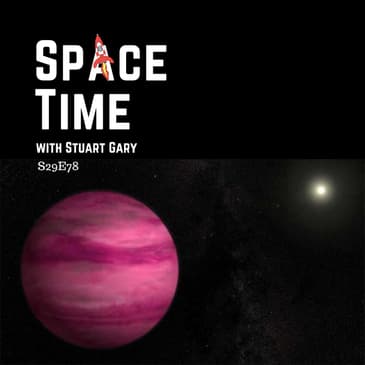
This is Spacetime Series twenty nine, Episode seventy eight, for broadcast on the first of July twenty twenty six. Coming up on Space Time, discovering how the Cosmic Dark Age has ended, new clues about the origins of interstellar comet Tree I Atlas, and the pink planet with a Salty Surprise. All that and more coming up on space Time. Welcome to Space Time with Stuart Gary. Astronomers have discovered an early galaxy dating back to the era of realization, when the universe was transformed from the cosmic dark Ages, when the cosmos went from being opaque becoming transparent like it is today. The galaxy, cataloged as MXDFZ four point four, existed some one point four billion years after the Big Bang. Observations by the Hubbled Space telescopture ultraviolet light from tightly clustered young stars in this galaxy are ionizing the opaque neutral hydrogen gas within and immediately around the galaxy, clearing our view. The findings reported in the Astrophysical Journal suggest that similar galaxies in the early universe were also responsible for clearing the neutral fog of hydrogen gas that once filled the cosmos. The galaxy existed at the end of the era of realization, a transformative period in the universe. During roughly the first billion or so years of the cosmos, the gas between stars and galaxies was opaque, but as more and more stars began to shine, generating ultraviolet energy, the gas everywhere was ionized and became transparent. Now, this changeover wasn't like an on off switch. Astronomers are still collecting evidence to fully understand how it happened, which is why this discovery is so important. The studies lead all the earliest givariates from the Space Telescope Science Institute in Baltimore. Marryland says observing a galaxy like this was thought to be impossible. Researchers expected the fog of neutral hydrogen filled the early universe would simply be too thick, obscuring our view of its ionizing light. But Hubble not only spotted that light, it also helped reveal incredible details about the galaxy's characteristics. Young massive stars emit loads of ultraviolet light capable of ionizing hydrogen atoms. As this light traveled for more than twelve billion years to reach the Hubble Space Telescope, space time itself expanded and the light waves themselves were stretched or red shifted from the ultraviolet into visible wavelengths. Hubble's wavelength coverage, combined with the sensitivity and resolution of its space vantage point, makes it the only telescope capable of capturing this ultraviolet light from the early universe. Astronomers have found many galaxies that existed at this point of history in the early universe, but they haven't detected ionizing photons from end any of them, making this discovery are one of its kind. Hubble revealed that the young galaxy's massive stars were the source of the ultraviolet light which cleared the surrounding space. These stars formed in bursts within the last few million years of MXDFZ four point four's existence, and they're all crammed together, amplifying this crowding effect. The galaxy itself is about one hundred times smaller by area than, for example, our own Milky Way galaxy, but it's forming stars ten times faster. Gavarrez says that a lot of young stars hot massive stars in a small space do a better job of blasting through a pet gas and the massive stars lifetimes also play a role, since they live at most for only a few million years, burning through their fuel supply much quicker and smaller stars like our Sun. Many of these big stars exploded to supernovae in the process, releasing gigantic amounts of energy and blowing coloss or holes that allow even more light to escape. Following their Hubble discovery, authors use the WEBS space telescope to determine the galaxy's mass, analys its older stars, and measure the galaxy star forming history. They found the galaxy's older stars are less massive and cooler, and therefore not responsible for changing the gas around them. Comparing Hubble and Web data also showed that the recent star formation happened in bursts. Meanwhile, data from the ground based Very Large telescope in Chile pinpointed exactly when MXDFZ four point four existed one point four billion years after the Big Bang. Before this discovery, researchers that identified only one galaxy emitting ionizing light from this time period. That was when the universe was one point six billion years old. Only a few additional examples have been identified, and all those existed when the universe was already around two billion years old. MXDFZ four point four brings astronomers closer to drawing firm conclusions about how the era of realization unfolded. Back in twenty twenty three, astronomers using web show that galaxy stars enough light to hate nine eyes gas around them nine hundred million years after the Big Bang. That was a breakthrough, but astronomer's needed galaxies like NXDFC four point four to fully explain how the process actually happened. That's because it shows how the highlyglight from young stars managed to escape the gas and dust within the galaxy itself. This report from mess. TV, astronomers using mass As Hubble space telescope have observed ultraviolet light escaping from a galaxy that has existed since only one point four billion years after the Big Bang. The galaxy, called MXDFZ four point four, appears during a critical period known as the era of reionization, when the universe transformed from a dense cosmic fog into the clear cosmos we see today. Hubble revealed tightly packed clusters of young massive stars blasting energetic radiation into space, carving holes through thick clouds of hydrogen gas. Researchers estimate that as much as fifty to one hundred percent of this ionizing light escape the galaxy, despite being about one hundred times smaller than the Milky Way MXDFZ four point four is forming stars ten times faster. Hubble's visible light observations were combined with infrared data from NASA's James web Space Telescope and observations from the European Southern Observatories Very Large Telescope. This finding implies that similar galaxies in the distant early Universe were responsible for clearing the neutral fog of hydrogen gas that once filled the cosmos. This is space time still to come. He includes about the origins of interstellarcomat tri Atlas and a pink planet with a salty surprise. All that and most still to come on space time. Astronomers using NASA's web Space Telescope have discovered new clues about the origins of interstellar Comet three I outlets as it began moving away from the Sun back in December twenty twenty five, astronomers captured detailed measurements of its chemical components. The comet was freshly warmed by its close encounter with the Sun, allowing its ancient isis to sublimate and degas into space. In the process, forming a bright coma around the nucleus ideal for study. Web captured detailed data including chemical ratios of carbon, deuterium, and isotope of hydrogen. The results reported in the journal Nature surprised astronomers. Working backwards. The authors used the components to make up the comet understand the environment in which it formed. The studies lead author Martin Cordiner from NASAs got Out Space Flight Center in green Belt, Maryland, says it was a unique opportunity to study an ancient object from the distant parts of the galaxy, probably pre dating the existence of our Sun and Solar system. Could in neu A colleagues for exceptionally higher levels of deityrium, about thirty times more than what's seen in Solar System commets now. This implies that three I outlasts must have originated in a very cold star system much earlier in the history of our galaxy. During its formation, the material that became incorporated into three I outleats was likely exposed to plenty of radiation, but not any long term warmth that would have reprocessed its heavier water ice filled with deuetyrium to the type of H two O ice we're familiar with here on Earth. Additionally, webshired only traces of carbon thirteen compared to lighterweight carbon twelve, and that also points to a very old origin. Still, the system's become enriched with carbon thirteen over time as generations of stars are born and die in the galaxy. That's why there are higher levels of carbon thirteen in our system around the Sun, which formed relatively recently, some four point six billion years ago. In fact, the authors are now estimating three eye outlasts could have formed as long as ten to twelve billion years ago during the so called universe Cosmic Noon, when star formation was at its height. Its young origin system was likely ensconced in a relatively cold, dense cloud, and the abundance of heavy water shows that throughout out the spent its formative years in a deeply frozen state. This is space time still to come. A pink planet with a salty surprise, and later in the science report claims that the great apes, including humans, have been laughing for at least fifteen million years. All that and more still to come on space time, astronomers have discovered exotic salt clouds unlike anything ever seen before, surrounding a distant peak planet considered one of the coldest objects ever studied. The findings reported in the Astronomical Journal provided some of the first direct evidence of salt clouds in a cold object's atmosphere. The pink planet, cataloged as GJ five oh four B, orbits the sun like star fifty seven light years away. Despite its description, astronomers really aren't sure if it's a planet. It's roughly twenty five times the mass of Jupiter, meaning it sits in the sort of hazy boundary area between the largest planets and the smallest failed stars known as brown dwarves. To be safe, astronomers often refer to these things as planetary mass objects, meaning that it's a planet size object opening a star. It was first discovered back in twenty thirteen. The studies lead author Anish Baberga from Northwestern University says the pink planet appeared to be the coldest planet size object ever discovered. Is in ground based telescopes. While most directly imaged exo planets are around five hundred to one thousand degrees celsius, this hazy rose colored world was only around two hundred and ninety degrees celsius. The authors say its chilly temperature is due to its age. They say giant planets are born blisteringly hot, but cool as they age, and based on their estimates, GJ five O four B is somewhere between two and a half and four billion years old. That makes it a lot younger than the Earth. Many astronomers around the world perform follow up observations to study the planet's light, but it was simply too faint for ground based telescopes, but that made it a perfect target for NASA's web Space telescope. The authors say when they finally obtained its spectrum, it immediately looked interesting, and once they started digging deeper into the data, they realized it was like nothing ever analyzed before. Different patterns of elemental lines and a spectrum's rainbow reveals details about its chemical composition, and the data for the pink planet reveal a rich mix of chemicals, including water, vapor, methane, carbon dioxide, ammonia, and other molecules that something didn't add up. The data only matched the observations if it contained unusual physically implausible features, so the authors added clouds of different chemical compositions to their models to see if they could make these unusual characteristics vanish. They found that salt clouds likely veld the planet's deeper layers, shaping the light that reached web. The spectra also suggested that GJ five oh four B is unusually rich in heavy elements or metals astronomers refer to all elements other than hydrogen and heliumus metals. However, the mystery of this object's formation still persists. Current data suggest it could have formed either as a planet or as a small star. Only furthermore detailed observations will provide an answer this space time and time that to take another brief look at some of the other stories making us in science this week with a science report. A new study warns that WEGOV, one of the ozempic like gop one agnetus for weight loss and diabetes, may carry the highest risk of eyestroke and sudden loss of sight compared to other semaglatitte drugs. The findings, reported in the British Journal of Ophthalmology, looked at unintended side effects of the cemglatarte drugs and found that the risk of a schemic optical neuropathy or eyestroke caused by an adequate blood flow to the eye and resulting sudden vision loss is rare, but among the rare cases it's almost five times higher with WGOV compared to a ZEENPIC and three times greater in men than women. A new study is identified a biological signature within kidneys that could predict age related organ failure. A report in the journal Cardiovascular Research shows that the short of the telemerase within the kidney cells may contribute to the development of nephroskerosis, a major contributor to chronic kidney disease. Largely irreversible and asymptomatic until it reaches an advanced stage, chronic kidney disease is often called a silent killer. By identifying the specific pattern link to kidney damage, the findings could allow doctors to identify high risk patients early. A new study claims that the great apes, including humans, have been laughing for almost fifteen million years. The finding is reported in the journal Communications Biology. Analyst recordings of one hundred and forty sequences of laughter from four orangutangs, two gorillas, three bernabos, four chimpanzees, and four humans aged between six months and seven years. They found that laughter seemed to follow regular rhythmic patterns with evenly spaced intervals between successive sounds, and because the same pattern was present across all the species studied, the authors say it was probably already present in some commonly shared ancestor some fifth efteen million years ago. A decade long study has found that young people who spend two hours or more a day on social media are far more likely to experience depressive symptoms and poorer well being than those who limit their use online to an hour or less. The research, reported in the Medical Journal of Australia, involved twelve hundred kids from Melbourne. They found the strongest impact on mental health was among girls aged twelve and thirteen, although small but noticeable increases in mental problems were seeing birth genders twin the ages of twelve and eighteen. Although this increased risk is small, studies authors say it could affect significant numbers of people at a population level, and so follow up studies essential. Well. It's now been six months since Australia's social media banned for under sixteen year olds came into effect, and new studies have found that eighty five percent of kids are still able to access child restricted sites online. In December last year, the Australian government became the first nation on Earth to ban social media for children under sixteen, prohibiting them from having accounts with many social media platforms including TikTok x, Facebook, Instagram, YouTube and Snapchat. Interestingly, however, Australia's left wing labor government continue to allow children to access socialist platforms like Blue Sky, which are often echo chambers for farlift conspiracy theorists. Britain's own proposed social media band for under sixteens will come into force next year, blocking kids access to Snapchat, TikTok, YouTube, Instagram X and Facebook, and from live streaming or communicating with strangers on gaming sites such as Roadblocks. Now, a new study by the University of Newcastle looking at online activities more than four hundred Australian teens aged twelve to seventeen, found only limited compliance with the social media minimum age legislation and little reduction in social media usage by kids. The kids are easily getting around it. Some of the problems to software itself. Kids often pass age checks using their own accounts, but if that does fail, they usually resort to fake accounts, parents IDs, fake facial ID scans or by using VPNs or browsers like tor and Brave. While everyone wants to save the children, the main community concerns about the social media restrictions center around requirements to provide digital ID to access accounts. That's because this allows governments, politicians, and bureaucrats to build up detailed data sets on your digital information and history, monitoring your digital footprint, including the sites you visit, the images you look at, and for how long you're looking to see this stuff you're posting online and where, tracing where you travel, even accessing your medical, employment, banking, and taxation records, as well as any traffic violations, criminal or misdemeanor history you may have. It also provides a one stop shop for hackers to access your personal information and muldible. Previous experiences have shown us all how easy and often that happens. China's communist government uses digital ID as a big brother, tracking people's movements using facial ID and enforcing its universal social credit scheme, which rewards you for correct thinking it punishes those who question government policy. The social credit scheme dictates where you can live, where you can work, where you can travel to, and even the types of healthcare you get and the skills your kids can attend. And it's not just Beijing. Canada use digital ID to first identify and then freeze the bank accounts of protesting truck drivers, and when the Australian government forced citizens to get special COVID digital IDs, police use them detract people's movements despite government assurances that couldn't happen. Technology editor Alex Haervryt from tech advice Start Life says digital ID is a golden treasure chest authorities dream of. Yeah. Reports said that plenty of kids are still on social media. They can use a photo of somebody else to use some AI to make themselves look colder, and then hold a photo up on one phone to another phone. I mean, this is all sort of ham fisted that the protection of the children isn't the real concerning The real concern from the government is to identify everybody on the Internet and force them through who you know, false claims of protecting the children, to identify themselves and then be trackable. So we have to be really careful to allow governments to do this and erode our freedoms. You know, the kids find a way around these VPNs. They use services like blue Sky, which in Australia are not part of the under sixteen social media age bands. So there's a lot of inconsistencies. Certainly that you don't want your kids there. You know, if you think extras that, then some of these other ones are worse. So there's this hypocrisy that the government tries to do one thing and the kids find a way around it. And yeah, you know, this ban has been an abject failure. Now there is calls from some in the industry and the community to clamp down and make this a stronger band, but that's only going to fuel people to continue finding ways around it. And I mean, personally, I'm just not impressed. I'm not a fan of these bands. That's Alexa Haav wrote from Take Advice to Life and this space Time, and that's the show for now. Spacetime is available every Monday, Wednesday and Friday through at bytes dot com, SoundCloud, YouTube, your favorite podcast download provider, and from space Time with Stuart Gary dot com. Space Time's also broadcast through the National Science Foundation, on Science Own Radio and on both iHeartRadio and tune In Radio. And you can help to support our show by visiting the Spacetime Store for a range of promotional merchandising goodies, or by becoming a Spacetime Patron, which gives you access to triple episode commercial free versions of the show, as well as lots of burness audio content which doesn't go to wear, access to our exclusive Facebook group, and other rewards. Just go to space Time with Stuart Gary dot com for full details. You've been listening to Spacetime with Stuart Gary. This has been another quality podcast production from bytes dot com.