
Become a supporter of this podcast: https://www.spreaker.com/podcast/spacetime-with-stuart-gary--2458531/support.
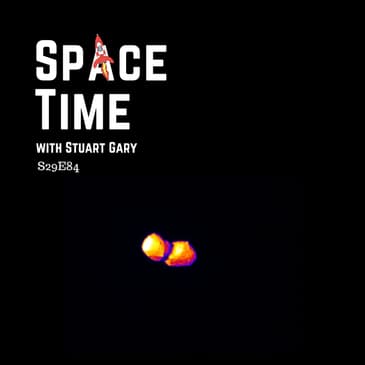
It's is Spacetime Series twenty nine, episode eighty four, for broadcast on the fifteenth of July twenty twenty six. Coming up on Spacetime, Japan swoops past a cosmic snowman shaped asteroid, revealing the secrets of the ice moon Europa and what will happen to the planet Earth when our Sun dies? All that and more coming up on Spacetime. Welcome to space Time with Stuart Gary. Japan's Hiblsit spacecraft has just swooped past a tiny asteroid in deep space that shed like a snowman. Traveling at more than eighteen thousand kilometers an hour, the probe flew within eight hundred meters of the tiny Earth asteroid. The asteroid, called Torri Foon, was known to have an elongated shape, but its exact details were unknown until this flyby. Ground based observations suggested that it was a stony or silicon S type asteroid around four inch and fifty meters wide. These are high density asteroids that make him about seventeen percent of the entire asteroid population of our Solar System, making them the second most common type after carbonaceous C type asteroids. Images of the space rock taken by the hybris. The two spacecraft revealed what appeared to be a contact binary, two round objects, one bigger than the other, joined together and strewn with surface rocks and boulders. Contact binaries are composed of two separate asteroids that previously orbited a common center of gravity, eventually spiraling in towards each other and then molding together to form a single body. The Hibers two mission by JACKSA the Japan Aerospace Exploration Agency was designed to demonstrate our mission managers could precisely control the dejectory of the spacecraft ever be needed to perform an asteroid deflection maneuver. It follows NASA's successful twenty twenty two dart Or double asteroid redirection test that changed the orbit of one hundred and sixty meters white asteroid Dimorphous by deliberately smashing into it with a spacecraft. Impact cameras Abord hier Bussa II studied Toifin's surface, including geographical features, its texture, and temperature, vital information for future planetary defense missions. See If astronomers need to deflect an asteroid at some time in the future by impact, the response won't be the same for every asteroid. It depends on whether the asteroid's a rubble pile or a solid rock, and this is in the end of Jack's punetary defense efforts. The agency, together with the European Space Agency, are teeming up on another planetary defense mission, this one to explore the asteroid of Offits, which will pass close to the Earth in April twenty twenty nine. Launched back in twenty fourteen, Hibusat is already scientists by landing on and gathering material from the asteroid Rayugu, which was some three hundred million kilometers from the Earth. Six years later, it brought those samples to Earth, providing scientists with clues about what the Solar System was like at its birth some four point six. Billion years ago. After the Tory food mission, Hybussitu's next milestone will be in December twenty twenty seven, when it swings past the Earth on a gravity assist maneuver. Then in June twenty twenty eight, they'll swing past the Earth again and that will set it up for its next rendezvous with the asteroid nineteen ninety eight k Y twenty six in July twenty thirty one. A little bit the asteroid for a while and eventually land on it. The exact nature of nineteen ninety eight k Y twenty six is still unclear. Optical and radar observations suggest it's a water rich world, and since it's known to be a fast rotator, it's likely there'd be a single chunk of rock rather than a rubble pile asteroid. Needless to say, we'll keep you in form owned this is space time still to calm. Revealing the secrets of the ice moon Europa and what will happen to the Earth when our sun dies. Scientists may have gotten a bit of a glimpse from a distant star system. All that and more still to calm on space time. A new study has shown that the Jervian ice moon Europa is reflecting radio signals in a strange and unexpected way. The findings are providing intriguing new clues about this frozen world, which contains a global subsurface liquid water ocean hidden below an estimated twenty five kilometer thick ice sheet. The ocean is kept liquid by tidal heating caused by constant gravitational pulling and pushing on Europa as it orbits its giant host plot Jupiter and similar smaller gravitational perturbations caused by its many sister moons. These tidal interactions cause internal friction inside Europa, which is generating enough heat to melt the ice into water, producing more water than all the Earth's oceans combined, and it doesn't end there. Sighters speculate that that tidal heating could also be generating geological features similar to the mid ocean ridges common in seas on Earth. On Earth, these mid ocean ridges are but unique life forms feeding on the chemicals being pumped out through formations such as hot springs and black smokers. Many sighters speculate that this hot chemical soup might be where life on Earth first began, and that raises the interesting possibility of whether the same thing is happening in the oceans of Europa. You see, if we do find life on Mars past or present, that could have been the result of meteorite contamination from the Earth. Or on the other hand, life on Earth may well have originated on Mars. That's because Mars and the Earth have been squat rocks for billions of years, so the possibility of cross contamination is always there. But the Jervian system is much too far away, so any life found there would likely have started independently, and if it starts independently on Europa, that means life could start anywhere in the universe. The preponderance of. Life we see in Star Trek might well be real. To discover more about Europa, astronomers use NASA's Goldstone radar and the US National Science Foundation's Greenbank radio telescope to carry out the most extensive radar study yet of the ice moon. By repeatedly pinging Europa with three point five centimeter radio waves, the authors measure how the moon reflects radar signals and confirm that its icy surface scatters radio energy in an unusually strong and complex way not seen on rocky worlds. Jupiter has four big Galilean moons i Owe Europa Ganny meaning Callisto, and those last three, Europa Gany meaning Colie, are especially intriguing to scientists because they all have icy outer shells and are thought to hide oceans of liquid water underneath. Of the three, Europa is a prime target in the search for habitable environments beyond Earth. Geologic features provide clues to how the ice shall underlying oceans interact, but these features only reveal what's happening at or near the surface. One of the studies authors, Tng from the University of California, Los Angeles, says radio waves can penetrate deep into the ice and determined features about its internal structure and purity. These new observations show that Europa's radar albedo, that is a measure of how bright it appears in radar, is much higher than that of typical planets and asteroids. The returning radar signal is dominated by the same circular polarization as the transmitted beam, and that's a hallmark of modible scattering inside clean. Porous ice. These properties strongly support an explanation known as the coherent backscatter opposition affair, in which radio waves bounce around inside the ice before returning to the telescope, dramatically boosting the echo. Because Gene colleagues observed Europa as a bistatic configuration with Goldstone transmitting in both goldstone and greenback receiving, it could also test how the coherent backscatter effect changes with the angle between transmitter Europa and receiver, and the authors found Europa's radar brightness stayed roughly consistent even when the angle increased. That implies that the bright back scattered peak must be broader than the range of the angles it's sampled, placing a limit on the depth that the radio waves diffused before being absorbed, and that depth limit offers a new constraint on how transparent Europa's ice is and that will help scientists interpret upcoming ice penetration radar data from mass is europa Clipper mission and the European Space Agency's Due spacecraft, which are both now on their way to the Jovian System. The new results also fill a three decades long gap is the last major radar study of your Back in the nineteen eighties and early nineties, and the authors found strong agreement between their measurements and those of the earlier results That reinforces the picture of Europa as an object with a very high radar reflectivity and strongly diffuse scattering, rather than the mirror like reflections seen on many rocky surfaces. This consistency increases the confidence that Europa's radar properties are stable over time and that both earth based and spacecraft radar measurements can be interpreted within a unified physical framework. Because the observing campaigns spanned many years. In viewing geometries, the authors asked whether Europe's radar brightness changed from one hemisphere to the other or with longitude, and they found that Europea's disc integrated radar properties are statistically consistent with remaining nearly constant as the moon rotates, which also agreed with the earlier observations. However, when the authors divided the data into leading and trailing hemispheres and performed statistical analysis, they saw a hint and not statistically conclusive, that the trailing hemisphere could be slightly brighter in one polarizing state. Now, if confirmed by future observations, that subtle difference could be related to how charged particles from Jupiter's magnetosphy a modifying the ice or affecting the formation of small scale surface structures that absorb le scatter radio waves. Whether that provides a catalyst for the formation of life is another question. In fact, the entire question of whether life does exist in the depths of the global seas beneath the Europe's icy surface is still open for debate. This report from MESSERTV. That's a great question, and it's a question that NASA will seek to answer with the Europa Clipper spacecraft. Europa is a moon of Jupiter. It's about the same size as Earth's moon, but its surface looks very different. The surface of Europa is covered with a layer of ice, and below that ice, we think there's a layer of liquid water, with more water than all of Earth's oceans combined. So because of this giant ocean, we think that Europa is actually one of the best places in the Solar System to look for life beyond the Earth. Life as we know it has three main requirements. Liquid water. All life here on Earth uses liquid water as a basis. The second is the right chemical elements. These are elements like carbon, hydrogen, nitrogen, oxygen, phosphorus, sulfur. They're elements that create the building blocks for life as we know it on Earth. We think that those elements exist on Europa. The third component is an energy source. As Europa orbits around Jupiter, Jupiter's strong gravity tugs and pulls on it. It actually stretches out the surface and it produces a heat source called tidal heating. So it's possible that hydrothermal systems could exist at the bottom of Europa's ocean and it's possible that those could be locations for abundant life. So could there be life on Europa? It's possible, and Europa Clipper is going to explore Europa to help try to answer that question. That report from that's a TV we heard from the agency's punetary geologist, Cynthia Phillips. This is space time still to come what happens to the Earth when the Sun dies? And later in the science report, a new study found that data centers far more massive carbon footprints than previously thought. Seems they may be great for technology's advancement, but they're not good for the environment. All that and more still to come on space time. A new study that's provided astronomers with a glimpse of the future we're likely to face when our Sun dies in around seven billion years from now. The Sun will eventually run out of the core hydrogen it uses the fuse into helium, the process that makes the sun shine. When that happens, the core will contract, increasing in temperature and pressure until it gets hot enough to begin fusing helium in the core into carbon and oxygen. At the same time, a shell of hydrogen outside the core will begin burning. Now, all this increased temperature will cause the Sun's auter atmosphere to expand, becoming one hundred times bigger than it is now. As it expands outwards, the Sun's now bloated surface, being further away from the core, will start to cool down, turning our star into a red giant. Finally, then our bloated Sun will puff off its outer gaseous layers, which will float away as a planetary nebula, leaving behind its searingly hot stellar core about the size of the Earth called a white dwarf. Now, as the Sun transforms into a red giant, it will consume the inner planets of our Solar system, Mercury and Venus, and most likely the Earth as well. Even if the Earth does survive, it'll be roasted to a crisp. However, the fate of the more distant planets, especially the gas giants, is still unclear. Finding and studying planets that orbit around the remnants of Sun like stars after their death is a means astronomers have for learning what might happen to our Solar System in the far distant future. So astronomers using NASA's web Space Telescope now studied a distant star system made up of a white dwarf star about ten million years old, which is being orbited by a gas giant planet named w D eighteen fifty six B, which is somewhere between four point three and ten point nine times the mass of Jupiter. Their five dings are reported in the journal Nature. So this gas giant has a thick methane aerosol atmosphere and a Balmi temperature of between one hundred and seventeen and one hundred and thirty nine degrees celsius, which the authors say is quite a lot hotter than expected for a planet of the size. WD eighteen fifty six B was discovered in twenty twenty by scientists using NASA's tests Transitting Exoplanet Survey satellite and the Spitzer Space Telescope. It's orbiting its host white dwarf. Star WD eighteen fifty six plus five point thirty four, which is about eighty light years away from US. The studies lead author Ryan McDonald from the University of s Andrews says this planet is quite an odd ball. This is the first such discovery of an intact planet so closely orbiting its white dwarf host some fifty times closer than the Earth's orbit around the Sun. Now without doubt, had WD eighteen fifty six B originally been orbiting at that distance from its host, it would have been obliterated by the star. While it was a red giant sir begs the question how did it survive the death of its host star and end up in its current position. That's where McDonald and colleagues turned to the web space telescope to watch the planet passing in front of its star in a so called grazing transit. At the very top of the planet partially overlaps the star, and it was this transit which yielded the unique information about the planet's mass and temperature. Light from the star passed directly through the planet's atmosphere, picking up information about the atmosphere's chemical composition for arriving at the spectrographs the board web Also, during the transit, light from the star was partially blocked, but infrared light was blocked less than other wavelengths, and that difference was caused by infrared light being emitted by the planet from its own heat. The data indicated that the planet had a temperature of around four hundred kelvin about two hundred and forty degrees hotter than it should be if the only heat source was the light coming from the white dwarf. And it was this puzzling discovery that turned out to be the key which indicated how the planet must have reached its current orbit. Now there are two hypotheses to try and explain what happened. One is that the planet was swallowed by the host star as it was dying, but somehow managed to survive inside that bloated atmosphere. The other is that planetary. Migration took place due to the gravitational effect of other objects in the system. Now, this white Dwarf is actually part of a triple star system, and the two other companion stars could have influenced WD eighteen fifty six bees orbit. Now, the authors realized there was no source of energy present to generate the sort of heat the planets delivering today, so it must have been residual energy from an earlier time when the planet was heated, either from being engulfed within the Red Giant or during an inward migration. Using models of how substellar objects like WD eighteen fifty six be cooled down over time, coupled with a new data from web about the planet's mass and current temperature, the authors were able to project its temperature back in time and deduce how long ago heating must have happened. They concluded that the heating most likely happened between three and five point five billion years after the star became a white dwarf. So in this scenario, the planet was on a wide orbit that kept it safe from the star during its destructive red giant phase, but then migrated inwards to its present location much later on. And as the planet moved inwards, its interactions with a strong gravity of the white dwarf would have caused it to warm up considerably, and it's been cooling down again ever since. This is Space Time and time Out of Tech. Another brief look at some of the other stories making news in science this week with a Science report, Well, if you're a night owl like me, take heed. A new study claims early rises have more nutritious diets and use up more energy than people who prefer staying up late. A report in the journal Frontiers in Nutrition looked at diets, sleep times, and the health of some three hundred European and Pacific New Zealand women, finding a third, where evening people, over a tenth were early morning rises and more than half were in between us. Now, all their diets had similar amounts of fat pros in in carbs, but it turns out the night ours consumed less vitamins and minerals and they had higher health risks. The authors say this could be from eating and digesting at a time when buddies store rather than use energy, and that shows how your sleeping patterns relative to the day nights cycle can affect your health. A new study of sea grasses around the world has revealed that Australia is home to a large chunk of the world's sea grasses, but it's rapidly losing them. The findings, reported in the journal Nature, show that almost seventy percent of the world's shallow water sea grasses occur in five countries, the Bahamas, Cuba, Australia, the United States and Indonesia. The authors found that between twenty nineteen and twenty twenty, and again between twenty twenty three and twenty four, sea grasses declined by around one percent per year, with Australia and the Bahamas among the biggest losers. The authors found the majority of the world's sea grasses remain in areas which are outside protected marine parks. A new study has shown that Meta's AI smart glasses could help people with low vision, although they may be better for some task than others. A report in the Journal of the American Medical Association involved the study six authors acting as their own subjects, testing the glasses for accuracy when performing various daily tasks. They found that smart glasses could identify common objects with ninety nine percent accuracy, but were less accurate in discriminating colors, the direction of objects, or how many objects there were. For reading, they are the highest accuracy with children's books, less accuracy with standard text and handwriting. In individual money identification, they were accurate with paper money, not so good with coins. A new study has found that data centers, its dramatic expansion has been fueled by the artificial intelligence boom, have a far bigger carbon footprint than previously thought. The research by Alliance Trade showed that the sprawling, power hungry sites used to store critical IT infrastructure, such as servers, emitted some two hundred and eighty six million tons of carbon dioxide last year. It's fifty seven percent higher than estimates by the International Energy Agency. The study also found that AI, which currently accounts for between fifteen and twenty percent of the power consumption at data centers, is likely to climb that forty percent twenty thirty. Data center emissions are likely to more than double by twenty thirty, leading to an estimated one hundred and fifty four billion dollars in annual climate damages. That's up from sixty eight billion today. They're required between one point three and one point eight trillion liters of water by twenty thirty. It's comparable the Switzerland's annual water consumption. Seventy percent of global data emissions are currently concentrated in the United States and China. Samsung's about to launch it's new Galaxy Z Fold eight and Fold eight ultra cell phones. With the details, we're joined by technology editor Alex haharov Royd from Tech Advice Start Life. The actual launch is going to happen on July twenty seconds, so that's why we're going to find out the real news. But what is heavily rumored by all sorts of leaks is that Samsung will launch a phone that is going to be similar in dimensions to the iPhone fild or the iPhone Ultra that will come later this year, and it's a bit like a passport, So instead of having this taller aspect ratio than unfolds into a square, it's going to be like a passport where it's sort of shorter and squat and then we'll open up into like this little mini book and that is supposed to be more easier to hold in the hands. It's the style that Apple is going to launch. So of course Samsung, which is believed to make the screens for the iPhone Ultra when it launches later this year, I mean they know, but actually Samsung and Apple were not the first with this form factor. Huawei had this form factor previously, so Samsung was also still supposed to have the squarish design of the Galaxy Fold. The question that nobody knows it is whether it will have stylus support, something that Samsung removed from the Galaxy Fold seven, which was very very thin, and they removed the digitizer layer. So look, we're going to find out more details about exactly what benefits of this particular form factor are from Samsung and how it intends to showcase multitasking, Whether the Stylus is back, but this is going to be the new hyper foldable, this passport style device that opens up, and it's a different aspec rassure to what we've used to be seeing before. It's also expected to measure four point five millimeters thick and nine point five seven millimeters when folded, so it's definitely going to be an eye catching phone, and it will transform from having a smaller outside screen to having this much larger tablet size screen. And the way these things are going to be priced, it'll be cheaper for people to buy a standard phone and a standard tablet than it will be to buy the two in one device. But you know, the two one device is going to be very popular. Everyone's going to be wanting to have. Everyone's going to want to see it. The rumors are that Apple will actually not have enough made when they launch in September, but we see that not only is Samsung going to jump the gun and have their launch in July, but we also have news that Google is going to launch their phones in August. So they are very aware of the fact that Apple sucks all the oxygen out of the room when they launch their devices, and the best way for them to get ahead is by launching ahead. Problem for Apple, of course, is no one can afford a three and a half thousand dollar phone. Well that is a problem, yeah, especially with prices having gone up globally. I mean Apple just launched a whole series of price increases across fourteen different lines because even their ability to buy noodles of RAM in advance is curtail when the data centers sucking down much more expensive RAM and the RAM the memory makers, some of them have decided to stop making consumer memory altogether and just focus on data centers. Now in three or four years is going to be some sort of a glut that at the moment the prices are going up and the only real way to get around it is to buy a phone on a plan pay it off over twenty four to thirty six months. I mean, it doesn't make the phone any cheaper, but it just makes the payments more manageable. And yeah, your phone costing more than a laptop has been something that's been real for many years now, and for most people, their phone is their most personal computer of all. So being able to have a smaller device that can instantly transform into a larger device to make reading books or looking at maps or taking photos or editing or whatever it might be an easier task. Well, this is twenty twenty six. This is the new reality, and eight years after the Samsung first launched his folding phone, this should be the year when we start seeing them in many more people's hands. That's probably more to do with Apple than it is to do with Samsung, although Samsung has indeed paved the way and made the technology cheaper and more accessible, and if Chamsung hadn't done that, we wouldn't have the iPhone fold on. The big test, of course, was always the hinge. The problem with the hinge has always been that you have to have this sort of tear drop effect for the glass that folds in the middle, so that it can't just fold directly against itself because it would break, and there's always been a crease. Now Apple has been said to want to have a phone with no crease, and part of the way they're doing that is with liquid glass. So this is a type of glass that's got metallic items inside of it that can be very strong and sturdy. Apple has had the rights to use this for nearly twenty years, and apparently the first time they ever used it was with the sim ejector tool in the very first iPhone, But otherwise we don't see a lot of this liquid glass that Apple has had the rights to use. But apparently it will be using this liquid glass construction and material with the hinge. So hopefully all the rumors and the promises that we've read about where Apple's folding phone will be creased free will be true, but we yet to see. By the way, this is the first time you've actually confirmed that there is an Apple fold on its way. Yeah. Well, look, the rumors have been around for a few years, but Apple always wanted to have a crease free display. But the rumors are very strong, and people have found in the lattice iOS twenty seven beta versions references to the fold being a real thing. So I'm sure we're going to see this fold. There's all sort of dummy units out there. There can't be all this emotion over something that's totally fake. So I really do think we're going to see Apple's folding phone. And Apple is eight years late to the game, but they're probably going to end up with the most popular folding phone out there, and that will really kickstart everyone else into selling more of their devices, im In Oppo, Huahwei, Samsung. Various companies have had folding phones for years, and you see them out there honor as another one, but you don't see them as regularly as regular rectangular phones. But I think over the next few months you're going to see them everywhere. That's Alex seharav Royd from Take Advice, Art Life and This space Time. And that's the show for now. Spacetime is available every Monday, Wednesday and Friday through at bites dot com, SoundCloud, YouTube, your favorite podcast download provider, and from space Time with Stuart Gary dot com. Space Time's also broadcast through the National Science Foundation, on Science Own Radio and on both iHeartRadio and tune In Radio. And you can help to support our show by visiting the Spacetime Store for a range of promotional merchandising goodies, or by becoming a Spacetime Patron, which gives you access to triple episode commercial free versions of the show, as well as lots of bonnus audio content which doesn't go to weir, access to our exclusive Facebook group, and other rewards. Just go to space Time with Stuart Gary dot com for full details. You've been listening to Space Time with Stuart Gary. This has been another quality podcast production from bytes dot com