
Our Guests This Week: Astronomical Society of Australia Page Medal winner Jonathan Bradshaw Purdue University engineer Carolin Frueh And our regular guests: Alex Zaharov-Reutt from techadvice.life Tim Mendham from Australian Skeptics 🌏 Get Our Exclusive NordVPN deal here ➼ www.bitesz.com/nordvpn . The discounts and bonuses are incredible! And it’s risk-free with Nord’s 30-day money-back guarantee! ✌ If you’d like to support the podcast and gain access to bonus content by becoming a SpaceTime crew member, you can do just that through premium versions on Patreon, Spotify and Apple Podcasts. Details on the Support page on our website https://www.bitesz.com/show/spacetime/support/ For more SpaceTime and show links: https://linktr.ee/biteszHQ If you love this podcast, please get someone else to listen to. Thank you… For more podcasts visit our HQ at https://bitesz.com
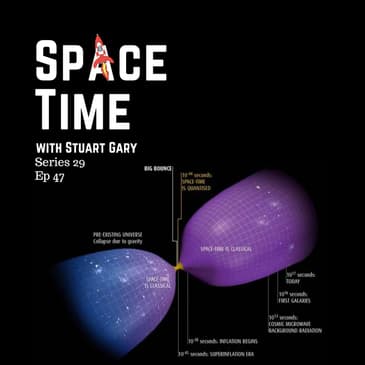
This is Spacetime Series twenty nine, episode forty seven, for broadcast on the twentieth of April twenty twenty six. Coming up on Space Time are black holes from before the Big Bang shaping our universe, the Bathtub Ring hinting at an ancient Martian ocean, and a just Award for studying the stars. All that and more coming up on space Time. Welcome to Space Time with Stuart Gary. A new study suggests that ancient black holes from before the Big Bang may be shaping our universe. The idea is that the cosmos goes through eternal, never ending cycles of expanding up from the Big Bang and then eventually collapsing again into a big crunch, which then triggers another Big Bang, followed by another big crunch, and so on. The key to supporting this hypothesis would be black holes that form before the Big Bang, which could still exist today as cosmic fossils. The study behind the hypothesis, reported in the journal Physical Review D, suggest that these relic black holes could potentially help explain that mysterious invisible substance known as dark matter, which shapes galaxies and the large scale structure of our universe. The Studies. Lead author Enrico Goes Tangagar from Portsmouth University says the universe may not have a beginning with a single explosive event, which we these days called the Big Bang, but instead may align with more of a cosmic bounce model, in which the universe emerged from an earlier contraction and left behind relic black holes that have survived that contraction and expansion right through to the present day as cosmic fossils. Now. If correct, these amordial objects could help explain long standing mysteries in cosmology, including the nature of dark matter and the process which ceeded the formation of galaxies. Iss Tangage says that for almost a century now, cosmologists have traced the history of the universe back to a single dramatic event, which we call the Big Bang. In this standard model of cosmology, space and time emerge from an extremely hot, dense state around thirteen point eight billion years ago, followed by billions of years of cosmic expansion and galaxy formation. He points out, this model has been remarkably successful. It explains the cosmic microwave background radiation, the faint heat left over from the early universe, now down to two point seven degrees above absolute zero, and it also predicts how galaxies are distributed across the vast cosmic web. But some of the deepest mysteries in physics remain unresolved. For example, we still don't know what triggered the Big Bang in the first place, or, for that matter, what happened before it. If anything, why the universe began in such a special state, what caused the brief sudden burst of rapid expansion known as cosmic inflation, needed to explain why the universe looks the way it does today, and what this invisible mysterious substance dark matter really is, a substance which outweighs ordinary matter by about five to one, and so this new hypothesis explores the possibility that could connect several of these puzzles. The universe may not have begun with a single Big Bang, but instead emerged from a cosmic bounce mimicking inflation, with some of the oldest objects in the universe potentially serving as relics for what happened before. It means some black holes may well have formed during the earlier cosmic phase before the Big Bang and survived the bounce, leaving behind relic objects that may still influence the structure of galaxies billions of years later. Others could have formed shortly after the bounce from amplified density fluctuations were Matter in the early universe was unevenly distributed in stronger, more pronounced clumps than usual, and these enhanced clumps of matter would collapse more easily under their own gravity, making it more likely for large cosmic structures and black holes to form early on. In Albert Einstein's theory of general relativity, the Big Bang corresponds with what's known as the singularity, a point where density becomes infinite, volume becomes zero, and the laws of physics as we understand them break down, and of course, that also describes the singularity at the center of a black hole. Many physicists interpret this as a sign that our current description of the earliest moments of the universe is incomplete. A bounce, we call it the Big Bang, provides a way for the universe to transition from contraction to expansion without requiring new exotic physics, and the authors suggest this bounce could have arisen naturally through quantum physics. They say, at extreme densities, quantum effects yet a powerful pressure which prevents matter from being compressed indefinitely, a phenomenon that already stabilizes dense objects such as white dwarfs and neutron stars and reproduces the inflationary expansion phase in the new model, a similar effect could be occurring on cosmic scales. As the universe contracts. This quantum pressure could halt the collapse and trigger a rebound into expansion. And this bounce could explain two of the biggest mistress in cosmology. First, it may account for why the universe expanded so rapidly and evenly in all directions, and secondly, it could shed light on why the universe appears to be expanding at an ever accelerating rate, an effect currently attributed to a poor understanding of a mysterious force we call duck energy. One striking implication is that some structures formed during the collapse phase may have survived the bounce. The author's calculation suggests that compact objects larger than roughly ninety meters in size could pass through the transition and reappear in the expanding universe as fossils from before. Possible relics include things like gravitational waves, density, fluctuations and ancient black holes. These relic black holes could have explained dark matter, and if large numbers formed during the bounce, they might even make up a significant fraction, possibly even all of the dark matter in the universe today, and it doesn't end there. This idea may also have explained recent discoveries by the James Webspace Telescope, which has captured images of unexpectedly massive objects in the early universe nicknamed little red dots. The leading hypothesis to explain these little red dots are rapidly growing black holes in the early universe which are burning through the surrounding gas gas. Tangaga says, if massive black holes already existed immediately after the bounce, the early universe wouldn't need to start from scratch when't building the first galaxies. The theory also makes predictions that can be tested with future observations, and that's an important part of it science. Astronomers could search for really gravitational waves from previous cosmic faces or subtle patterns in the cosmic microwave background radiation, preserving a trace of the universe before the Big Bang. It's a fascinating insight and one which I'm sure will spark lots of debate. This is space time still to come, the bathtub bring hinting at an ancient Martian ocean, and a just reward for studying the stars. All that and more still to come on space time. Scientists have identified geological features on Mars that appear to point to a vast seashore or coastline stretching around the red planet's northern hemisphere. The findings were reported in the journal Nature, support the idea of an ancient Martian ocean which once covered a third of the planet's northern hemisphere. Low Lands, one of the studies author's, Michael lamp from cow Tech, says that as a key ingredient for life, water and other bodies in our Solar system is a major area of research now. While it's widely accepted that Mars once had some liquid water on its surface, it's still uncly whether that water was limited to leaks and streams, or if there was sufficient to form a long lasting ocean. Past Mars missions have discovered geological features that look like beaches and shorelines, but they're subtle and are found at varying elevations across the planet. Now, if they're true signatures of a stable, long lasting ocean. These shorelines will need to albeit roughly the same elevation, in the same way that sea levels here on Earth are consistent across the planet. Lamb says, if Mars did have an ocean, must have dried up long ago, possibly several billion years ago, more than half the age of the planet itself. He points out there's hardly anything on Earth that old. Anything on Mars from that time would have been eroded by billions of years of wind blowing, volcanoes erupting in other disturbances, removing subtle features. So Lambing colleagues needed to find a better topographical feature than shorelines, a feature that could be evidence of an ocean. They started by first looking to the Earth to determine which geological features are indicative of an ocean. Here, they use computer simulations to dry up the Earth's oceans and see what topographical features remained. The model showed the most distinct feature of the oceans is a flat band of lad up to several hundred kilometers wide, wrapping around the contours where land meets ocean, like a ring that remains around a drained bathtub. This band is called the continental shelf. Those sea levels on Earth and thus the location of the seashells, have fluctuated over many years. The continental shelf is a large landform that's relatively stable over to iological time. The authors then looked at topographical data for Mars taken by orbiters and found an analogous band that is suggestive of an ocean in the northern Martian hemisphere, covering about a third of the planet's surface. Lamb points out that a landform like this takes time to form, and notably it's not found around lakes. That indicates the ocean must have existed stably for possibly millions of years. Lamb and colleagues also saw evidence that river deltas, the triangular plains of sediment created where rivers spill into the oceans, lined up with the bathtub ring itself. So this shelf is a new observation that ties together evidence of what the coastal zone would have looked like, and the thing is, no one's really looked for it before. Consequently, this study suggests new targets for future missions, and the interesting point is this, if there ever was life on Mars, sedimentary deposits on the Martian coastlines may well have preserved signatures in the same way that coastal sediments here on Earth contain a real historic record of fossils from the early continents. It's a fascinating target and one which run Dadley be studied in great detail. This is space time still to come a just reward for studying the stars, and later in the Science report ancient rock art showing that Tasmanian tigers thylocenes may have roam the Australian mainland as recently as one thousand years ago. All that and more still to come on space time. Today, citizens, scientists astronomers play a crucial role in our study of the heavens. As well as making their own discoveries, which they've always done, they provide additional supplementary observations which help the universities and astronomical agencies fill in the gaps in their own research. In recognition of this important work, every two years, the Astronomical Society of Australia awards a medal to those who have worked hard to help advance sciences understanding of the cosmos. The bi annual Berenice and Arthur Page Medal winners for excellence in Amateur Astronomy for twenty twenty six have been presented to Chris Stockdale, Jonathan Bradshaw and Renato Langerzek at the annual National Australian Convention of Amateur Astronomers held in Tamworth. Stockdale co discovered an ultra hot neptune for super Jupiters and several potential earthlike planets orbiting distant stars Oliver using a telescope housed in his backyard, Doman Hazelwood in Victorious, Gippsland. He's co authored over a hundred planetary discovery papers in science journals including Nature. Bradshaw and Langazec, together with past Page Medal winner John Broughton, discovered a debris ring around the arter Krper Belt dwarf planet Quahor, and the fascinating thing is this ring wasn't detected close to the dwarf planet, but some four thousand killer it is above the surface of the frozen world, far beyond the roch limit, the point where a celestial bodies gravity should tear an orbiting body apart or prevent the breed from cold lissen together to former Moon. They work using their own backyard telescopes on the Gold Coast and the Brisbane suburb of Sanford was also reported in the journal Nature. Bradshaw says that discovery was made thanks on occultation as the Pluto sized dwarf planet passed in front of a distant background star. What we did is we are all keen ocultation observers, and ocultations are simply when a dark body object such as an asteroid, goes in front of an innocent star out there and it blocks it out for a short period of time, actually cast a shadow on the Earth. The shadows pretty much the size of the object inquires about a thousand longters across, and we were looking to see if we could detect the position of Quaha. But in our particular case, it was predicted to vex miss us altogether. It was going to hit The shadow was going to go across New Zealand, and it was going to go across southeastern Australia, but not Queensland where we were. So we went hunting. We went hunting for a moon, which was a one in a billion chance, but we thought we'd give it a go anyway because it's already got one known moon. So we were calling nice and early and we didn't discover a moon. We discovered a ring, and the ring was in the wrong place. And that's what made it so particularly interesting. It's actually defying the theoretical physics where a ring sould be. This ring was discovered four thousand killing. It is above this twolf planet. Well would normally assume that's will beyond the Roch limits. That's too far away. Oh, absolutely so. I mean when Edward Roche first proposed a limit, he had a sample of one thing in the universe at the time, which was Saturn, and they did the physics. The clever fell up did the physics and worked out that pretty much anything outside further away than the current limit of Saturn's ring that we can see any matter that was coalescing there would form a moon, and anything inside that limit would be torn apart by the gravitational forces of the main body and would be a ring. And that was just fine because they went and discovered other rings. So there was some rings around Uranus, and ring fragments around Neptune and then Shariquo. So all in all, up until our discovery, there were five ring systems known, and they all conformed beautifully to the roach limit. All of those rings were just in the right place. But along comes three amateurs from southeast Queensland and upturned that limit entirely because it's almost twice as far away as it could be, so nobody was looking out there. And the honorable mention John Broughton. He's got quite a reputation of his own, isn't he. Oh yeah, absolutely so. He's been in the game for a lot longer than I have. Is Australia's most prolific discoverer of asteroids and comic Solar System bodies. I think he's got over twelve hundred asteroids to his name and a couple of comets, so we've got We've got other great discoverers who have been finding more more comets and supernovae and the like that John is just had an amazing amateur career of discovery. Is there still a big difference between the citizen scientist, amateur astronomer and the professional astronomer, because that line seems to me at least to be very blurry these days, considering the sort of equipment that's available it is. It's very blurry, and in fact, in the occuls in my field in occultation astronomy, we actually have a fairly big advantage over professional For a star the objects are looking at usually at brighter stars, and those enormous big telescopes have difficulty with bright stars. They're used looking at teeny teeny's incredibly faint things. Also, we can move around with our amateur equipment should we want to get under the path of one of these objects, which is like a solar eclipse. They go where they want to and you have to travel to them if you want to get under a better event, and amateurs can do that, and you ain't going to be moving the Anglo Australian telescope in a hurry. And secondly, we can afford little bits of time all over the place so we don't get paid nothing. So we get to get up at two o'clock in the morning to record an event, go about to beat et cetera, et cetera. Whereas it doesn't fit into a normal shift pattern for a jobbing astronomer or astrophysicist, so it's directed research which really does fit into nicely into the amateur realm. In the way we operate some of. The equipment, you guys, is pretty sophisticated as well. There are astronomers living in Australia, so telescopes housed inside domes set up in the United States. Yeah, yeah, no, absolutely and vice versa. Actually, one of our key and most prolific observers of Australian occultations lives in Montana and he's got a dome or he's got a telescope posters in yak near camera and it means due to the time different he can get up in the morning, have a nice cup of tea or a cup of cop he sit in his desk and log onto the night sky in Australia and he's got all day long. He's retired now all day long he can do occultation research brilliant. Actually, it's a great thing to do. It's much much better way of doing it. The Internet's really changed astronomy, hasn't it. Yeah, I mean all technology is the advent of cameras, for the advent of the CCD and the seams chip. The cameras we've got now are a new level of sensitivity and it's called quantum efficiency, and it's the ability to turn a photon of light that teenius part of light into an electron, and the electron is the thingram we're going to capture and record and digitize. Now, once upon a time you'd have to have a whole shower of photons to get one electron out, which means you have a bigger, bigger camera or longer, longer explosions to get the data. And now we've got cameras with kewe's nearing one hundred percent, you know, so that one photon practically is turning into one electron and that's just incredible. It really allows amazing amounts the work to be done by smaller telescopes. You don't need to have a massive telescope anymore. You can have a really really sensitive camera. That's Jonathan Bradshaw, one of the winners of the Page Medal. And this is Space Time and time out to take a brief look at some of the other stories making us in science this week with a science report. A new study has shown that the heart, metabolic and inflammatory risk patterns for obesity differ between men and women. The findings presented at the European Congress on Obesity the Turkeish city of Istanbul, found that men with obesity a pit to be more susceptible to developing abdominal visceral fat, a key factor in developing heart and metabolic health risks, as well as elevated levels of liver enzymes and indicator of liver damage. Now in contrast, women with obesity appear more likely to develop systemic inflammation and high cholesterol, which can lead to heart disease and type two diabetes. The Tasmanian tiger or Thylacene has long been surrounded by both mystery and scientific curiosity. The species was made extinct in the early part of the last century thanks to ill informed farmers and governments. Now newly discovered First Nations rock art depicting both Tasmanian tigers and Tasmanian devils in the northern territories arnhem Land is providing fresh insights into their cultural importance and also when they may have last roamed on the Australian mainland. A report in the General Archaeology in Oceania has documented fourteen new images of the Tasmanian tiger and two of Tasmanian devils. It was widely believed that Thylocenes disappeared from mainland Australia about three thousand years ago, but the newly documented artwork, some of which is thought to be less than one thousand years old, raise the possibility that these species may have survived a lot longer in northern regions of Australia than previously thought. The paintings were in various different Aboriginal art styles, made with red sometimes yellow ochre, and were originally dated to around fifteen thousand years ago. However, the thing is the artists also used white pipe clay, which doesn't last as long or stain rocks as red as oka does, and that suggests that most paintings with white could have been less than a thousand years old, although it's also possible the artists may simply have been inspired by earlier paintings. In a surprising news study, palaeontologists say Australia's most famous plant eating dinosaur, Matabarosaurus, may have been a picky eater with a nose for good food. These giant eight met a long three ton on netropods or duckbilled dinosaurs, roam the Australian continent during the Cretaceous around ninety six million years ago. The new findings, reported in the journal peer j are based on an examination of newly identified fire moss or bones from the herbivorous skull. The new CT scans suggest that the archer saw had a thin and more slender beak than previously thought, and bigger airway chambers with highly enlarged olfactory bulbs, suggesting a very strong sense of smell that could evaded in defense avoiding predator dinosaurs, but it could also have been used to sniff out where the best food was. The findings also place matter Borosaurus further away on the genetic tree from Iguanodon hydrosaurs than what was previously thought. There have been new reports across the news media over the past few weeks of revelations that the former Soviet Union had been investigating UFO sightings since the early nineteen seventies. But as the skeptics timendum points out, the existence of these long standing investigations isn't really new, and those investigations found no evidence confirming the existence of any extraterrestrial spacecraft or people. It's not all these stories coming out or giving it the inference that it now right that there's all these stories coming out now, like the current mania of UFO them in the US. The story is actually old. There's always been that have people saying strange things in the sky and not knowing what they are, and that's not particularly new. But there was in nineteen seventy seven a strange event which is referred to and pologized for my pronunciation, the Petrozavodsk incident, which is in northwestern Russia, very very bright lights in the sky which was pulsating and stayed up there for a long time I'm talking to about minutes and minutes minute, and gradually disappeared, and people in Finland, which is bordering on that part of Russia could see it as well. It caused a lot of fuss. It turned out later to be revealed to be a rocket launch, and the rocket, as your listeners would know about rocket launches happening at sunset and the light the setting sun reflecting off exhaust in the sky, which is why it stays up there for a while and then disappears. But at at the time it was unknown, people didn't know what it was. Seventy seven, so they set up in an organization. The Academy of Science set up for an organization with the military, and they would investigate every sort. Of sighting version of the blue Book. It is much. It wasn't very well funded, but nonetheless they collected it several thousand reports, especially from military who were there sort of taking disguise for something strange. So this was a state program looking everything. It ran for until nineteen ninety, which is of course when the US star started breaking up, and they had reports of all these UFOs in the same way as the CIA and various sort of other organizations around the world had these blue book as you said, about the listing of fightings and events and encounters whatever. So it's nothing new. It was probably quite justified at the time. Capells are Cold War worried about sort of inturasons by other crafts from other countries, not specific from out of space, so that was a big factor. They put it down to about three different things. One was a sort of unknown craft otherwise the natural phenomena, and then the third one is haighly intelligence, extraterrestrial all that sort of stuff. The vast majority of cases were identified ninety odd percent, and the rest were unknown, which they should stay as unknown because they're unknown, no not evident to pin it down for anything in particular, but because we're soon to get an unknown flying object or an unknown areal phenomenon becomes extraterrestrial intelligence from as a logical jump, which is very iological and denies the whole nature of UFO. They gave up after World, they're not worth while doing, not enough money probably to follow it up anyway, and therefore it lay there and it's now that this information does it leaks out and sort of reveals suddenly that the Russians were investigating the UFOs, which is fair enough to see that demsates its proof of anything is not valid because they didn't prove anything. So this Russian extraordinary headlines Russia investigates the UFOs was this, They did that a while ago and they didn't find anything. So there's nothing to see here, folks, really literally, but it still crops up the fact of investigating does not prove the existence of something, and that's the problem with this. Yeah, but it makes great clickbait, which is what it's all about. And there's a lot of headlines. There was a lot of headlines when this was sort of released revealed. It was everywhere, and you think, if it's the same story, same non story that's been around and people have known about this case there's an article publishing in a skeptical magazine in two thousand, which is not that long after they closed the program, talking about what it was doing. So it's nothing particularly secret or hidden. Is just able to cou be bothered and then someone picked it up and then everyone can be bothered, and then it'll disappear again like the old. That's the skeptics to mindum and this is space Time, and that's the show for now. Spacetime is available every Monday, Wednesday and Friday through bytes dot com, SoundCloud, YouTube, your favorite podcast download provider, and from space Time with Stuart Gary dot com. Space Time's also broadcast through the National Science Foundation, on Science Own Radio and on both iHeartRadio and tune In Radio. And you can help to support our show by visiting the space Time Store for a range of promotional merchandising goodies, or by becoming a Spacetime Patron, which gives you access to triple episode commercial free versions of the show, as well as lots of burnus audio content which doesn't go to weir, access to our exclusive Facebook group, and other rewards. Just go to space Time with Stewart Gary dot com for full details. You've been listening to Space Time with Stuart Gary. This has been another quality podcast production from bytes dot com