
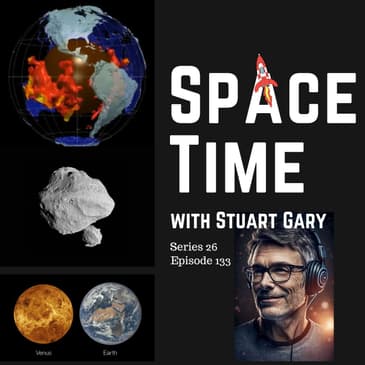
Become a supporter of this podcast: https://www.spreaker.com/podcast/spacetime-with-stuart-gary--2458531/support.
[00:00:00] [SPEAKER_01]: This is SpaceTime, Series 26, Episode 133, for broadcast on the 6th of November 2023.
[00:00:08] [SPEAKER_01]: Coming up on SpaceTime...
[00:00:10] [SPEAKER_01]: Could the remains of an ancient planet be lying deep within the Earth's interior?
[00:00:15] [SPEAKER_01]: Spacecraft Lucy's first asteroid encounter discovers a new moonlet.
[00:00:20] [SPEAKER_01]: And a new theory that Venus once had Earth-like plate tectonics billions of years ago.
[00:00:26] [SPEAKER_01]: All that and more coming up on SpaceTime...
[00:00:31] [SPEAKER_03]: Welcome to SpaceTime with Stuart Gary
[00:00:51] [SPEAKER_01]: Back in the 1980s, geophysicists discovered two continent-sized blobs of unusual material buried deep within the Earth's mantle.
[00:01:00] [SPEAKER_01]: One was detected roughly beneath the African continent, while the other is below what is now the Pacific Ocean.
[00:01:07] [SPEAKER_01]: Each blob, formerly known as a large low-velocity province, is about twice the size of the moon.
[00:01:13] [SPEAKER_01]: And each appears to be composed of different proportions of elements compared to the surrounding mantle.
[00:01:20] [SPEAKER_01]: Scientists first discovered the large low-velocity provinces by measuring seismic waves as they travelled through the Earth.
[00:01:27] [SPEAKER_01]: Seismic waves travel at different speeds through different materials.
[00:01:30] [SPEAKER_01]: And in the 1980s, the first hints emerged of large-scale three-dimensional variations deep within the structure of the Earth.
[00:01:39] [SPEAKER_01]: In the deepest mantle, a seismic wave pattern is dominated by the signatures of these two large structures near the Earth's core mantle boundary,
[00:01:47] [SPEAKER_01]: which scientists believe possess unusually high levels of iron.
[00:01:52] [SPEAKER_01]: The high iron content means these regions are denser than their surroundings,
[00:01:56] [SPEAKER_01]: and that's what causes the seismic waves passing through them to slow down,
[00:02:00] [SPEAKER_01]: which leads to the name large low-velocity provinces.
[00:02:04] [SPEAKER_01]: Ever since their discovery, the origins of these strange blobs have been a mystery.
[00:02:09] [SPEAKER_01]: Now, a new study reported in the journal Nature suggests that they could well be the remnants of the ancient planet Thea.
[00:02:16] [SPEAKER_01]: Thea collided with the Earth four and a half billion years ago, creating the moon.
[00:02:21] [SPEAKER_01]: According to the Giant Impact Theory, Thea was a Mars-sized body about a third the size of the proto-Earth.
[00:02:28] [SPEAKER_01]: The collision between Thea and proto-Earth turned both bodies into a vast magma ocean,
[00:02:34] [SPEAKER_01]: which slowly differentiated and solidified to create the Earth as we know it today.
[00:02:40] [SPEAKER_01]: Ejected debris from that collision was flung up into orbit around the Earth, eventually coalescing and accreting to form the moon.
[00:02:48] [SPEAKER_01]: The new study's lead author, Quyen Nguyen from the California Institute of Technology, Caltech,
[00:02:53] [SPEAKER_01]: says simulations have confirmed that the physics of the collision between Thea and the Earth
[00:02:58] [SPEAKER_01]: could well have led to the formation of both large low-velocity provinces and the moon as well.
[00:03:05] [SPEAKER_01]: Ewen says some of Thea's mantle could have become incorporated into the Earth's own mantle,
[00:03:10] [SPEAKER_01]: where it ultimately clumped and crystallized together to form the two distinct blobs,
[00:03:15] [SPEAKER_01]: detectable today at the Earth's core mantle boundary.
[00:03:18] [SPEAKER_01]: Meanwhile, other debris from the collision mixed together to form the moon.
[00:03:22] [SPEAKER_01]: But there's still one nagging question.
[00:03:25] [SPEAKER_01]: Why did Thea's material clump together in two distinct blobs inside the Earth's mantle,
[00:03:30] [SPEAKER_01]: rather than mixing thoroughly together to form the rest of the planet?
[00:03:34] [SPEAKER_01]: And remember, just as much of the Earth was flung up into space to form the moon.
[00:03:39] [SPEAKER_01]: Well, the author's simulations are showing that much of the energy derived from the Thea impact
[00:03:44] [SPEAKER_01]: remained in the upper half of the mantle, leaving Earth's lower mantle cooler than that
[00:03:49] [SPEAKER_01]: estimated by earlier low-resolution impact models.
[00:03:53] [SPEAKER_01]: Because the lower mantle wasn't totally melted by the impact,
[00:03:56] [SPEAKER_01]: the blobs of iron-rich material from Thea stayed largely intact as they sifted down to the base of the mantle.
[00:04:04] [SPEAKER_01]: Ewen says you should think of it like colored masses of paraffin wax in a turned-off lava lamp.
[00:04:09] [SPEAKER_01]: But had the lower mantle been hotter, Ewen says it would have received more energy from the impact,
[00:04:15] [SPEAKER_01]: and it would therefore have mixed more thoroughly with the iron-rich material,
[00:04:18] [SPEAKER_01]: sort of like different colors in a stirred pot of paint.
[00:04:22] [SPEAKER_01]: The next step of the study is to examine how the early presence of Thea's heterogeneous material
[00:04:27] [SPEAKER_01]: deep within the Earth's mantle might have influenced the Earth's interior processes, including platech tonics.
[00:04:34] [SPEAKER_01]: A logical consequence of the idea that the large low-velocity provinces are remnants of Thea
[00:04:39] [SPEAKER_01]: is that they must be very ancient, at least 4.5 billion years.
[00:04:44] [SPEAKER_01]: It therefore makes sense to investigate what next consequences they had for Earth's earliest evolution,
[00:04:50] [SPEAKER_01]: such as the onset of subduction before conditions were suitable for modern-style platech tonics,
[00:04:55] [SPEAKER_01]: a formation of the first continents, and the origin of the very oldest surviving terrestrial minerals.
[00:05:03] [SPEAKER_01]: This is space time. Still to come.
[00:05:07] [SPEAKER_01]: Lucy's first asteroid encounter discovers a new moonlet,
[00:05:10] [SPEAKER_01]: and a new hypothesis suggests that Venus once had Earth-like plate tectonics billions of years ago.
[00:05:17] [SPEAKER_01]: All that and more still to come on Space Time.
[00:05:37] [SPEAKER_01]: NASA's Lucy spacecraft has just completed its first asteroid encounter,
[00:05:41] [SPEAKER_01]: flying by the small mainboard asteroid 152830 Dinkinesh and discovering that it's actually a binary system.
[00:05:49] [SPEAKER_01]: The probe passed the potato-shaped space rocks at a distance of 425 kilometers,
[00:05:53] [SPEAKER_01]: travelling at a relative speed of 4.5 meters per second.
[00:05:58] [SPEAKER_01]: Back in late September, Lucy's optical navigation team undertook a slight course correction maneuver
[00:06:04] [SPEAKER_01]: in order to target the spacecraft on the right trajectory for its close encounter with the asteroid.
[00:06:10] [SPEAKER_01]: Then last week, mission managers sent the spacecraft what's known as the Final Knowledge Update,
[00:06:16] [SPEAKER_01]: a package of data with the most up-to-date information about the relative positions of the spacecraft and the asteroid.
[00:06:22] [SPEAKER_01]: That data set was precise enough to guide Lucy over the following 800,000 kilometers towards the tiny asteroid.
[00:06:31] [SPEAKER_01]: About an hour before the spacecraft's closest approach, when it was approximately 16,000 kilometers from Dinkinesh,
[00:06:37] [SPEAKER_01]: Lucy began actively monitoring the position of the asteroid using its terminal tracking system.
[00:06:42] [SPEAKER_01]: The system autonomously reorients the spacecraft so as to keep Dinkinesh within the field of view of its science instruments as the spacecraft speeds past.
[00:06:50] [SPEAKER_01]: Now this maneuver moves the high-gain antenna away from Earth,
[00:06:56] [SPEAKER_01]: preventing the spacecraft from communicating with mission managers until it's completed the encounter sequence
[00:07:01] [SPEAKER_01]: and then reoriented itself so that its high-gain antenna was once again pointing back towards the Earth.
[00:07:07] [SPEAKER_01]: And it accomplished that task successfully,
[00:07:10] [SPEAKER_01]: marking the first use of the terminal tracking system and a successful operation to test the system in real spaceflight conditions.
[00:07:17] [SPEAKER_01]: Dinkinesh was meant to be the first of 10, now 11, asteroids the spacecraft's visiting during its primary 12-year, 6.5 billion kilometer voyage of discovery.
[00:07:28] [SPEAKER_01]: First identified in 1999, the asteroid rotates with a period of 52.67 hours.
[00:07:36] [SPEAKER_01]: It circles the Sun on an elliptical orbit with an average distance of 2.19 astronomical units.
[00:07:42] [SPEAKER_01]: That's equivalent to 328 million kilometers and an orbital period of 3.24 Earth years.
[00:07:49] [SPEAKER_01]: By the way, that name Dinkinesh?
[00:07:51] [SPEAKER_01]: Well, it's the Ethiopian name for the Lucy fossil after which NASA's Lucy mission is named.
[00:07:57] [SPEAKER_01]: In the Amharic language, the name means you are wonderful.
[00:08:00] [SPEAKER_01]: The asteroid was still unnamed when it was selected for exploration by Lucy's mission managers.
[00:08:06] [SPEAKER_01]: And it was they who proposed the name Dinkinesh to the International Astronomical Union, which approved it in February this year.
[00:08:14] [SPEAKER_01]: Of course, the Lucy spacecraft is named after the famous 3.2 million-euro-autrolipithecus hominid fossil Lucy discovered in Ethiopia in 1974.
[00:08:24] [SPEAKER_01]: Because like Lucy, Jupiter's Trojan asteroids, which are the target of the mission, are fossils of the solar system's early history.
[00:08:31] [SPEAKER_01]: The mission's principal investigator, Hal Leveson from the Southwest Research Institute in San Antonio, Texas, says Dinkinesh really did live up to its name.
[00:08:42] [SPEAKER_01]: It really is marvelous.
[00:08:44] [SPEAKER_01]: In the weeks prior to the spacecraft's encounter with Dinkinesh, the Lucy team had already been wondering whether Dinkinesh might be a binary system
[00:08:51] [SPEAKER_01]: given how Lucy's instruments were seeing the asteroid's brightness change with time.
[00:08:56] [SPEAKER_01]: And the first images of the close encounter removed all doubt.
[00:09:00] [SPEAKER_01]: Dinkinesh was indeed a close binary system.
[00:09:04] [SPEAKER_01]: From a preliminary analysis of the first available images, the science team estimates that the larger body is approximately 790 meters wide,
[00:09:12] [SPEAKER_01]: while the smaller, the moonlet if you will, is 220 meters across.
[00:09:17] [SPEAKER_01]: Of course, the real prize of this mission will be arrival at the Trojans.
[00:09:22] [SPEAKER_01]: Leveson says the Trojans are leftovers from the early days of the solar system, effectively fossils of the planet formation process.
[00:09:30] [SPEAKER_01]: And therefore they hold valuable clues which will help decipher the solar system's early history.
[00:09:36] [SPEAKER_01]: He says Lucy, like the human ancestor fossil for which it's named, will revolutionize science's understanding of our origins.
[00:09:44] [SPEAKER_01]: Named after characters in Greek mythology, the Jovian Trojan asteroids circle the Sun in two swarms.
[00:09:51] [SPEAKER_01]: One cloud leading 60 degrees ahead of Jupiter in its orbital path around the Sun in a gravitational well known as Lagrangian L4 position,
[00:10:01] [SPEAKER_01]: while the other cloud trailed 60 degrees behind the gas giant in another gravitational well known as the Lagrangian L5 position.
[00:10:09] [SPEAKER_01]: Lucy will be the first spacecraft to visit these vast asteroid fields.
[00:10:14] [SPEAKER_01]: By studying them close up, scientists hope to hone their theories on how the solar system's planets were formed 4.6 billion years ago
[00:10:22] [SPEAKER_01]: and also how they've ended up in their current configuration.
[00:10:26] [SPEAKER_01]: In order to reach its targets, the 1,500 kilogram Lucy spacecraft is using a series of slingshot gravity-assist maneuvers of the Earth,
[00:10:35] [SPEAKER_01]: one of which took place last year and a second which is later for next year.
[00:10:39] [SPEAKER_01]: These will give it enough energy in order to reach its destination.
[00:10:44] [SPEAKER_01]: Then in 2025, Lucy will fly past the inner main belt asteroid 52-246 Donald Johanson, which is named after the discoverer of the Lucy hominid.
[00:10:55] [SPEAKER_01]: And finally in 2027, it'll arrive at the Lagrangian L4 Trojan asteroid cloud which orbits ahead of Jupiter.
[00:11:02] [SPEAKER_01]: There the spacecraft will fly by four Trojan asteroids, 3548 Euripides and its tiny moon, 15094 Polymyll, 11351 Lucius and 21900 Auris.
[00:11:18] [SPEAKER_01]: After these flybys are complete, Lucy will again swoop past the Earth in 2031,
[00:11:23] [SPEAKER_01]: whereupon it'll receive a third gravity-assist slingshot, flinging it out to Jupiter's Lagrangian L5 asteroid cloud which trails behind the gas giant.
[00:11:33] [SPEAKER_01]: There it will visit the binary Trojan asteroid 617 Petroclus and its satellite Menoetius in 2033.
[00:11:42] [SPEAKER_01]: The 12 year mission may end with a Petroclus-Menoetius flyby,
[00:11:46] [SPEAKER_01]: but at that point Lucy will be in a stable six-year orbit between the L5 and L4 clouds, and mission managers may well decide an extension will be possible.
[00:11:57] [SPEAKER_01]: Lucy's science package includes a panchromatic and colour visible imager and infrared spectrometer mapper in order to measure silicates, ices and organics on the asteroid surfaces.
[00:12:08] [SPEAKER_01]: There's also a higher resolution visible imager to provide the most detailed images of the surface of the Trojans,
[00:12:14] [SPEAKER_01]: a thermal infrared spectrometer to study their thermal characteristics and provide data on the composition and structure of surface material,
[00:12:22] [SPEAKER_01]: and a radio science investigation to determine the mass of the Trojans by using the spacecraft's radio telecommunications hardware and high-gain antenna to measure Doppler shifts.
[00:12:33] [SPEAKER_01]: Now we can't leave this story without giving you some more details on what Lagrangian points are all about.
[00:12:40] [SPEAKER_01]: Well, they're named in honour of the Italian-French mathematician Giuseppe Louis Lagrange,
[00:12:44] [SPEAKER_01]: who had been working on the general three-body problem of orbital mechanics,
[00:12:48] [SPEAKER_01]: one which I can assure you still poses head-scratching for first year physicists today.
[00:12:54] [SPEAKER_01]: And yes, I do speak from personal experience.
[00:12:56] [SPEAKER_01]: The Lagrangian points are positions in space where the gravitational pull of two bodies,
[00:13:02] [SPEAKER_01]: such as the Sun and the Earth or the Earth and the Moon, tends to cancel each other out
[00:13:07] [SPEAKER_01]: while equalising the centripetal forces needed for a small object to move relative to the two larger bodies
[00:13:13] [SPEAKER_01]: and so allowing the smaller object to remain there for extended periods of time.
[00:13:18] [SPEAKER_01]: Basically it's a gravitational well.
[00:13:21] [SPEAKER_01]: Once you're in there, you don't need to use much energy in order to stay there.
[00:13:25] [SPEAKER_01]: There are five Lagrangian points, known as the L1, L2, L3, L4 and L5 positions.
[00:13:34] [SPEAKER_01]: L1, 2 and 3 are along a line connecting two bodies, say the Earth and the Sun.
[00:13:40] [SPEAKER_01]: L1 is between the Earth and the Sun.
[00:13:42] [SPEAKER_01]: It's often used by spacecraft needing uninterrupted views of the Sun,
[00:13:46] [SPEAKER_01]: such as the solar and heliosphere observatory satellite SOHO.
[00:13:49] [SPEAKER_01]: The L2 position is on the opposite side of the Earth to the Sun.
[00:13:53] [SPEAKER_01]: In other words, it's in perpetual darkness.
[00:13:56] [SPEAKER_01]: It's home to the Planck spacecraft and the James Webb spacecraft
[00:14:00] [SPEAKER_01]: because it's ideal for astronomy,
[00:14:02] [SPEAKER_01]: because it's close enough to communicate with the Earth
[00:14:04] [SPEAKER_01]: and it's still in the Earth's shadow keeping the Sun, Earth and Moon behind it.
[00:14:09] [SPEAKER_01]: The L3 position is on the opposite side of the Sun to the Earth.
[00:14:14] [SPEAKER_01]: Because the L3 position is always hidden from the Earth by the Sun,
[00:14:17] [SPEAKER_01]: it's become popular in science fiction as the location for hypothetical second Earth planets.
[00:14:23] [SPEAKER_01]: L4 and L5 provide stable orbits around 60 degrees ahead and behind Earth as it orbits the Sun.
[00:14:30] [SPEAKER_01]: And these are where Trojan asteroids, such as those around Jupiter, are commonly found.
[00:14:36] [SPEAKER_01]: This report from NASA TV.
[00:14:39] [SPEAKER_02]: We are going through an amazing variety of objects with this mission.
[00:14:43] [SPEAKER_02]: And it's really almost pure luck that allowed us to get as many rich targets as we are.
[00:14:50] [SPEAKER_02]: Literally the planets were aligned to allow us to do this mission.
[00:14:55] [SPEAKER_00]: The Lucy mission is named after the Lucy fossil,
[00:14:58] [SPEAKER_00]: the Australopithecus fossil that was discovered in the 1970s in Ethiopia.
[00:15:03] [SPEAKER_00]: And just like the Lucy fossil transformed our understanding of hominid evolution,
[00:15:08] [SPEAKER_00]: the Lucy mission will transform our understanding of solar system evolution.
[00:15:12] [SPEAKER_02]: Trojan asteroids are an interesting population of small bodies that are left over from the formation of the planets.
[00:15:20] [SPEAKER_02]: And they lead or follow Jupiter in its orbit by roughly 60 degrees.
[00:15:26] [SPEAKER_02]: If you just look at the gravitational attraction of the Sun and Jupiter
[00:15:30] [SPEAKER_02]: and put something exactly 60 degrees in front of Jupiter, it's stable forever.
[00:15:35] [SPEAKER_02]: So as a result these objects are really the leftovers of planet formation,
[00:15:40] [SPEAKER_02]: the stuff that went into growing Jupiter and Saturn are now trapped in these locations.
[00:15:47] [SPEAKER_02]: We're visiting both of the Trojan swarms.
[00:15:50] [SPEAKER_02]: In the first orbit we're going into the leading swarm,
[00:15:52] [SPEAKER_02]: and we're going to encounter four Trojan targets.
[00:15:56] [SPEAKER_00]: Air babies, Palomé, Lucas, and Oris.
[00:15:59] [SPEAKER_00]: And from this we're going to sample the diversity in sizes and colors and compositions.
[00:16:04] [SPEAKER_00]: The first two flybys happen just about 30 days apart,
[00:16:08] [SPEAKER_00]: so it's going to be a pretty busy kickoff to the season of exploring the asteroids in the L4 swarm.
[00:16:15] [SPEAKER_00]: And then we'll fly past Earth again and out to the L5 swarm.
[00:16:19] [SPEAKER_02]: The final object we're visiting, which I must admit is my favorite, is a binary object.
[00:16:25] [SPEAKER_00]: So that's two Trojans that orbit a common center of mass.
[00:16:28] [SPEAKER_00]: It's called Patroclus and Manetius.
[00:16:30] [SPEAKER_02]: These objects are nearly identical in size that orbit one another.
[00:16:35] [SPEAKER_00]: From the Lucy mission, we're going to study the diversity of our targets
[00:16:39] [SPEAKER_00]: because that tells us something about their origin and where they came from.
[00:16:43] [SPEAKER_02]: The interesting thing about small bodies in general is they are the leftovers of planet formation.
[00:16:48] [SPEAKER_02]: If you look at the eight planets that we know about, for example,
[00:16:51] [SPEAKER_02]: they are highly processed because of internal processing.
[00:16:54] [SPEAKER_02]: These asteroids are objects that really haven't changed much from when the planets assembled themselves.
[00:17:02] [SPEAKER_02]: And as a result, by studying them, we can figure out the physical conditions of the early solar system
[00:17:09] [SPEAKER_02]: as well as how the planets grew and how they moved around early on.
[00:17:15] [SPEAKER_00]: All of that will help us form a detailed picture of what these objects really look like.
[00:17:21] [SPEAKER_00]: Because right now, our best images are just a point of light.
[00:17:25] [SPEAKER_00]: Even using the Hubble Space Telescope or adaptive optics on large ground-based telescopes,
[00:17:31] [SPEAKER_00]: we can't see surface details.
[00:17:34] [SPEAKER_00]: And it's going to take the Lucy mission to go to these targets
[00:17:37] [SPEAKER_00]: and see what they're really made of and what they look like.
[00:17:48] [SPEAKER_01]: And in that report from NASA TV,
[00:17:50] [SPEAKER_01]: we heard from Lucy Mission Principal Investigator Hal Leverson
[00:17:53] [SPEAKER_01]: from the Southwest Research Institute in San Antonio, Texas,
[00:17:57] [SPEAKER_01]: and Lucy Mission Deputy Principal Investigator Kath Olkin,
[00:18:01] [SPEAKER_01]: also from the Southwest Research Institute.
[00:18:03] [SPEAKER_01]: This is space time.
[00:18:05] [SPEAKER_01]: Still to come.
[00:18:06] [SPEAKER_01]: A new hypothesis suggests that Venus once had Earth-like plate tectonics billions of years ago,
[00:18:12] [SPEAKER_01]: and later in the science report, a new study has found a link between cell phone usage and semen quality.
[00:18:20] [SPEAKER_01]: All that and more still to come on space time.
[00:18:39] [SPEAKER_01]: A new hypothesis suggests that Venus may once have had plate tectonic movements
[00:18:43] [SPEAKER_01]: similar to those believed to have occurred on the early Earth.
[00:18:46] [SPEAKER_01]: The findings reported in the journal Nature Astronomy
[00:18:49] [SPEAKER_01]: sets up tantalizing scenarios regarding the possibility of early life on Venus,
[00:18:55] [SPEAKER_01]: as well as its evolutionary past and the history of the solar system.
[00:18:59] [SPEAKER_01]: The study's authors combine atmospheric data from Venus with computer modelling
[00:19:04] [SPEAKER_01]: to show that the composition of the planet's current atmosphere and surface pressure
[00:19:08] [SPEAKER_01]: could only be possible as a result of the early formation of some type of plate tectonics,
[00:19:13] [SPEAKER_01]: a process that involves multiple continental plates pushing and pulling
[00:19:17] [SPEAKER_01]: and sliding past or beneath one another.
[00:19:20] [SPEAKER_01]: On Earth, this process intensified over billions of years,
[00:19:24] [SPEAKER_01]: forming new continents and mountains and leading to chemical reactions
[00:19:27] [SPEAKER_01]: that stabilised the planet's surface temperature,
[00:19:30] [SPEAKER_01]: resulting in an environment that was more conducive to the development of life.
[00:19:35] [SPEAKER_01]: Venus on the other hand may well be Earth's nearest neighbour and sister planet,
[00:19:39] [SPEAKER_01]: but it's gone in the opposite direction
[00:19:41] [SPEAKER_01]: and it today has surface temperatures hot enough to melt lead
[00:19:45] [SPEAKER_01]: and surface pressures 100 times greater than that found at sea level on Earth.
[00:19:50] [SPEAKER_01]: And that's all a bit confusing.
[00:19:51] [SPEAKER_01]: After all, both Venus and Earth were made at the same time,
[00:19:55] [SPEAKER_01]: they're the same size, they were made out of the same material
[00:19:58] [SPEAKER_01]: and under the same conditions,
[00:20:00] [SPEAKER_01]: but for some reason they've turned out totally different.
[00:20:04] [SPEAKER_01]: Now, Venus does rotate backwards compared to the other planets in the solar system
[00:20:08] [SPEAKER_01]: and that may have something to do with it all,
[00:20:11] [SPEAKER_01]: but that's for another story.
[00:20:14] [SPEAKER_01]: The explanation for the difference being posed by this paper
[00:20:17] [SPEAKER_01]: suggests that the planet's gone the way it has
[00:20:19] [SPEAKER_01]: because it has what's known as a stagnant lid,
[00:20:22] [SPEAKER_01]: meaning the planet's surface is just one single plate
[00:20:25] [SPEAKER_01]: with minimal amounts of give, movement and gases being released into the atmosphere.
[00:20:30] [SPEAKER_01]: And the new study suggests this wasn't always the case.
[00:20:34] [SPEAKER_01]: To reach their conclusions,
[00:20:35] [SPEAKER_01]: the authors used the current data on Venus' atmosphere
[00:20:38] [SPEAKER_01]: as the endpoint for their model,
[00:20:40] [SPEAKER_01]: and they started by assuming that Venus had a stagnant lid
[00:20:44] [SPEAKER_01]: throughout its entire history.
[00:20:46] [SPEAKER_01]: Now using this as the base,
[00:20:47] [SPEAKER_01]: their simulations found recreating the planet's current atmosphere
[00:20:51] [SPEAKER_01]: didn't match up with where the planet is now
[00:20:53] [SPEAKER_01]: in terms of the amount of nitrogen and carbon dioxide present
[00:20:57] [SPEAKER_01]: in the current atmosphere and its resulting surface pressure.
[00:21:00] [SPEAKER_01]: The researchers then simulated what would have had to have happened
[00:21:04] [SPEAKER_01]: for the planet to get to where it is today.
[00:21:06] [SPEAKER_01]: And eventually, after a lot of trial and error,
[00:21:09] [SPEAKER_01]: they were able to match the numbers almost exactly
[00:21:11] [SPEAKER_01]: when they accounted for limited tectonic movement
[00:21:14] [SPEAKER_01]: early in Venus' history
[00:21:15] [SPEAKER_01]: followed by the stagnant lid model that exists today.
[00:21:20] [SPEAKER_01]: Their paper suggests that the early tectonic movement on Venus,
[00:21:23] [SPEAKER_01]: like on Earth at the time,
[00:21:24] [SPEAKER_01]: would have been limited in terms of the number of plates moving
[00:21:27] [SPEAKER_01]: and how much they shifted.
[00:21:29] [SPEAKER_01]: And of course, it would have been happening
[00:21:31] [SPEAKER_01]: on both Earth and Venus simultaneously.
[00:21:33] [SPEAKER_01]: And that's led the study's lead author, Matt Weller,
[00:21:36] [SPEAKER_01]: from Brown University to say,
[00:21:38] [SPEAKER_01]: one of the big picture takeaways from the study
[00:21:40] [SPEAKER_01]: was that there were likely to have been two planets
[00:21:42] [SPEAKER_01]: at the same time in the same solar system
[00:21:45] [SPEAKER_01]: operating in a tectonic regime,
[00:21:47] [SPEAKER_01]: the same mode of tectonics
[00:21:49] [SPEAKER_01]: that allowed life to exist on Earth today.
[00:21:53] [SPEAKER_01]: He says this bolsters the possibility
[00:21:55] [SPEAKER_01]: of ancient microbial life on early Venus,
[00:21:59] [SPEAKER_01]: which shows that at one point
[00:22:00] [SPEAKER_01]: the two planets were more alike than previously thought.
[00:22:04] [SPEAKER_01]: The work also suggests that the planets may transition
[00:22:07] [SPEAKER_01]: in and out of different tectonic states
[00:22:09] [SPEAKER_01]: and that this may actually be fairly common.
[00:22:12] [SPEAKER_01]: In fact, Earth may be the outlier.
[00:22:15] [SPEAKER_01]: But of course this also means that we may have planets
[00:22:18] [SPEAKER_01]: which transition in and out of habitability
[00:22:20] [SPEAKER_01]: rather than just being continuously habitable.
[00:22:23] [SPEAKER_01]: As far as we know,
[00:22:25] [SPEAKER_01]: Earth is the only place in the solar system
[00:22:27] [SPEAKER_01]: which currently experiences plate tectonics
[00:22:29] [SPEAKER_01]: and consequently the only planet known to have life.
[00:22:34] [SPEAKER_01]: This is space time.
[00:22:52] [SPEAKER_01]: And time now to take a brief look at some of the other stories
[00:22:55] [SPEAKER_01]: making news in science this week with a science report.
[00:22:59] [SPEAKER_01]: A new study has found a link
[00:23:00] [SPEAKER_01]: between cell phone usage and semen quality.
[00:23:04] [SPEAKER_01]: The findings reported in the journal
[00:23:05] [SPEAKER_01]: Fertility and Sterility are based on UK research
[00:23:08] [SPEAKER_01]: of 2,500 men over a 13-year period.
[00:23:12] [SPEAKER_01]: The study looked at the possible association
[00:23:15] [SPEAKER_01]: of radio frequency, electromagnetic fields
[00:23:17] [SPEAKER_01]: and semen parameters.
[00:23:20] [SPEAKER_01]: The authors found decreasing sperm numbers
[00:23:22] [SPEAKER_01]: with increasing mobile phone usage.
[00:23:25] [SPEAKER_01]: Professor Alison Campbell,
[00:23:26] [SPEAKER_01]: Chief Scientific Officer with Care Fertility,
[00:23:29] [SPEAKER_01]: says there's no confirmed explanation for the findings.
[00:23:33] [SPEAKER_01]: Campbell says sperm morphology and mortidity
[00:23:35] [SPEAKER_01]: were not seen to decline with increased use of cell phones
[00:23:38] [SPEAKER_01]: as the sperm numbers did.
[00:23:40] [SPEAKER_01]: She says while sperm numbers matter,
[00:23:43] [SPEAKER_01]: the ability of sperm to swim, have healthy intact DNA
[00:23:46] [SPEAKER_01]: and be the right shape is at least just as important.
[00:23:50] [SPEAKER_01]: Meanwhile, Andrology professor Alan Pacey
[00:23:53] [SPEAKER_01]: from the University of Manchester says
[00:23:55] [SPEAKER_01]: one of the study's main criticisms
[00:23:57] [SPEAKER_01]: was that the cell phones were self-reported.
[00:24:00] [SPEAKER_01]: Nor could the study determine
[00:24:01] [SPEAKER_01]: whether cell phones were just a surrogate marker
[00:24:03] [SPEAKER_01]: for another aspect of men's lifestyle or occupation
[00:24:07] [SPEAKER_01]: that was the real cause of changes in their sperm quality.
[00:24:10] [SPEAKER_01]: For example, men usually keep their cell phones
[00:24:13] [SPEAKER_01]: in their pants pocket, thereby causing an increase
[00:24:15] [SPEAKER_01]: in temperature in the testicular area.
[00:24:18] [SPEAKER_01]: However, Pacey says he was still intrigued by the findings,
[00:24:22] [SPEAKER_01]: with the biggest effect being apparently seen
[00:24:24] [SPEAKER_01]: with older 2G and 3G phones
[00:24:26] [SPEAKER_01]: compared to more modern 4G and 5G versions.
[00:24:31] [SPEAKER_01]: A new study warns that the impacts of marine heatwaves
[00:24:34] [SPEAKER_01]: on marine life may be worse deeper down in the ocean.
[00:24:38] [SPEAKER_01]: The findings reported in the journal Nature
[00:24:41] [SPEAKER_01]: are based on a study looking at the duration
[00:24:43] [SPEAKER_01]: and intensity of heatwaves which have been found
[00:24:45] [SPEAKER_01]: to persist longer in deeper waters.
[00:24:48] [SPEAKER_01]: The authors say marine temperatures
[00:24:50] [SPEAKER_01]: are often measured at the sea surface,
[00:24:52] [SPEAKER_01]: but re-analyzing data and observations
[00:24:54] [SPEAKER_01]: of marine heatwaves from between 1993 and 2019
[00:24:58] [SPEAKER_01]: at depths of up to 2,000 metres
[00:25:00] [SPEAKER_01]: found these heatwaves can lead to repercussions
[00:25:03] [SPEAKER_01]: for up to two years after the surface event had ended.
[00:25:08] [SPEAKER_01]: Scientists now say that the 2022
[00:25:10] [SPEAKER_01]: Hunga Tonga Hunga Hape volcanic eruption
[00:25:13] [SPEAKER_01]: shot an unprecedented amount of water vapour into the sky,
[00:25:16] [SPEAKER_01]: reaching heights of up to 55 kilometres
[00:25:19] [SPEAKER_01]: and depleting 5% of the ozone layer in some regions
[00:25:22] [SPEAKER_01]: in just a week.
[00:25:24] [SPEAKER_01]: A report in the journal Science
[00:25:26] [SPEAKER_01]: details balloon measurements taken all the way over
[00:25:28] [SPEAKER_01]: at the Reunion Islands in the Indian Ocean
[00:25:31] [SPEAKER_01]: half a world away from Tonga in the South Pacific.
[00:25:34] [SPEAKER_01]: The readings are helping scientists understand
[00:25:36] [SPEAKER_01]: how volcanic eruptions influence climate and ozone chemistry.
[00:25:41] [SPEAKER_01]: The authors say the increased humidity
[00:25:42] [SPEAKER_01]: in the stratosphere from the eruption
[00:25:44] [SPEAKER_01]: led to a series of interactions
[00:25:46] [SPEAKER_01]: between other materials shot out by the volcano
[00:25:49] [SPEAKER_01]: and that ultimately broke down the ozone
[00:25:52] [SPEAKER_01]: both over the tropical southwestern Pacific
[00:25:54] [SPEAKER_01]: and Indian Ocean regions.
[00:25:57] [SPEAKER_01]: Well, there's been another Bigfoot sighting
[00:26:00] [SPEAKER_01]: in the United States.
[00:26:01] [SPEAKER_01]: The latest by a dude from Vermont is drone footage.
[00:26:05] [SPEAKER_01]: But as Tim Mendham from Australian Skeptics points out,
[00:26:08] [SPEAKER_01]: the vision of the suspicious Sasquatch has a few problems.
[00:26:26] [SPEAKER_04]: There were two issues with this.
[00:26:28] [SPEAKER_04]: One, it looked very much like a man in a gorilla suit
[00:26:30] [SPEAKER_04]: and two, he didn't follow it all the way
[00:26:33] [SPEAKER_04]: when he was guiding his drone.
[00:26:35] [SPEAKER_04]: He let it walk out of frame and totally disappeared.
[00:26:37] [SPEAKER_04]: You think, hang on, you should be following this for hours.
[00:26:40] [SPEAKER_04]: However long your drone's going to last.
[00:26:41] [SPEAKER_04]: No, he sort of had a very brief filming of it.
[00:26:44] [SPEAKER_04]: It wasn't like it was hidden by the trees.
[00:26:46] [SPEAKER_04]: He was looking straight down and he could still see it.
[00:26:47] [SPEAKER_04]: The second thing is this fella talks to himself a lot, obviously.
[00:26:50] [SPEAKER_04]: When he's filming, he keeps saying these things out loud
[00:26:52] [SPEAKER_04]: and you think they don't really sound like someone
[00:26:54] [SPEAKER_04]: who's totally flummoxed and stunned by what he's seeing.
[00:26:57] [SPEAKER_04]: It's someone who's sort of making statements,
[00:26:59] [SPEAKER_04]: you know, no way, are you serious?
[00:27:02] [SPEAKER_04]: He says, he's quoted on this thing,
[00:27:03] [SPEAKER_04]: that's incredible and it just doesn't ring true, unfortunately.
[00:27:06] [SPEAKER_01]: Well, there are a couple of other problems with it as well.
[00:27:08] [SPEAKER_01]: One is the fact that it's daylight,
[00:27:11] [SPEAKER_01]: clearly daylight when this was taken.
[00:27:12] [SPEAKER_01]: And if you've ever watched Fighting Bigfoot,
[00:27:15] [SPEAKER_01]: you know they only come out at night.
[00:27:17] [SPEAKER_01]: That's where you get all the night goggles
[00:27:19] [SPEAKER_01]: and things like that.
[00:27:19] [SPEAKER_01]: And also, they don't walk like this.
[00:27:22] [SPEAKER_01]: He was walking like a homo sapien,
[00:27:24] [SPEAKER_01]: not like a 10-foot tall creature that's twice as wide as a human.
[00:27:28] [SPEAKER_01]: And that's the other thing, he wasn't wide enough either.
[00:27:30] [SPEAKER_04]: Wasn't wide enough?
[00:27:31] [SPEAKER_01]: Wide, wide, fat, muscular.
[00:27:34] [SPEAKER_01]: And the suit was flopping on him as well, you'll notice.
[00:27:37] [SPEAKER_04]: There's actually a lot of examples
[00:27:39] [SPEAKER_04]: of people who are mistaking certain animals for Bigfoot
[00:27:43] [SPEAKER_04]: or weird things you see in America.
[00:27:44] [SPEAKER_01]: Well, we've had a study recently
[00:27:46] [SPEAKER_01]: where they've found a correlation between Bigfoot sightings
[00:27:49] [SPEAKER_01]: and sightings of black bears.
[00:27:50] [SPEAKER_01]: As the black bear population increases,
[00:27:53] [SPEAKER_01]: Bigfoot sightings increase.
[00:27:54] [SPEAKER_04]: Yeah, there's also cases of people mistaking deer
[00:27:56] [SPEAKER_04]: who can stand up on their back legs and seeing them as a...
[00:27:58] [SPEAKER_04]: Antlers are a giveaway, but...
[00:28:00] [SPEAKER_04]: Not necessarily with antlers,
[00:28:01] [SPEAKER_04]: but I mean 10-foot tall creatures with long skinny arms, et cetera.
[00:28:05] [SPEAKER_04]: And they've actually shown that these things
[00:28:07] [SPEAKER_04]: are deer standing up on their hind legs
[00:28:09] [SPEAKER_04]: and they can do it for a while.
[00:28:10] [SPEAKER_04]: Because most films of these things are fleeting.
[00:28:13] [SPEAKER_01]: That's Tim Mendham from Australian Skeptics.
[00:28:31] [SPEAKER_01]: And that's the show for now.
[00:28:33] [SPEAKER_01]: Spacetime is available every Monday, Wednesday and Friday
[00:28:36] [SPEAKER_01]: through Apple Podcasts, iTunes, Stitcher, Google Podcasts,
[00:28:41] [SPEAKER_01]: Pocket Casts, Spotify, Acast, Amazon Music, Bytes.com,
[00:28:46] [SPEAKER_01]: SoundCloud, YouTube, your favourite podcast download provider
[00:28:49] [SPEAKER_01]: and from spacetimewithstuartgarry.com.
[00:28:53] [SPEAKER_01]: Spacetime's also broadcast
[00:28:54] [SPEAKER_01]: through the National Science Foundation on Science Zone Radio
[00:28:57] [SPEAKER_01]: and on both iHeart Radio and TuneIn Radio.
[00:29:01] [SPEAKER_01]: And you can help to support our show
[00:29:03] [SPEAKER_01]: by visiting the Spacetime store
[00:29:04] [SPEAKER_01]: for a range of promotional merchandising goodies.
[00:29:07] [SPEAKER_01]: Or by becoming a Spacetime patron,
[00:29:10] [SPEAKER_01]: which gives you access to triple episode commercial free versions of the show
[00:29:13] [SPEAKER_01]: as well as lots of bonus audio content which doesn't go to air,
[00:29:17] [SPEAKER_01]: access to our exclusive Facebook group and other rewards.
[00:29:21] [SPEAKER_01]: Just go to spacetimewithstuartgarry.com for full details.
[00:29:25] [SPEAKER_01]: And if you want more Spacetime, please check out our blog
[00:29:28] [SPEAKER_01]: where you'll find all the stuff we couldn't fit in the show
[00:29:30] [SPEAKER_01]: as well as heaps of images, news stories, loads of videos
[00:29:34] [SPEAKER_01]: and things on the web I find interesting or amusing.
[00:29:37] [SPEAKER_01]: Just go to spacetimewithstuartgarry.tumblr.com
[00:29:41] [SPEAKER_01]: That's all one word and that's Tumblr without the E.
[00:29:45] [SPEAKER_01]: You can also follow us through at Stuart Gary on Twitter,
[00:29:48] [SPEAKER_01]: at Spacetime with Stuart Gary on Instagram,
[00:29:50] [SPEAKER_01]: through our Spacetime YouTube channel
[00:29:52] [SPEAKER_01]: and on Facebook just go to
[00:29:54] [SPEAKER_01]: facebook.com forward slash spacetimewithstuartgarry.
[00:29:58] [SPEAKER_01]: You've been listening to Spacetime with Stuart Gary.
[00:30:02] [SPEAKER_03]: This has been another quality podcast production from Bytes.com.