
Become a supporter of this podcast: https://www.spreaker.com/podcast/spacetime-with-stuart-gary--2458531/support.
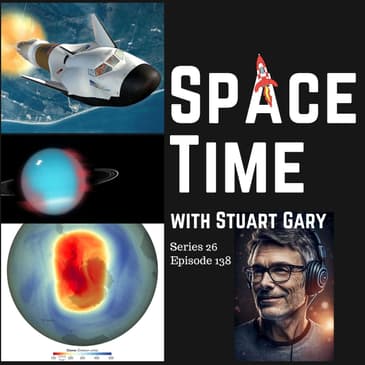
[00:00:00] This is SpaceTime Series 26 Episode 138 for broadcast on the 17th of November 2023. Coming up on SpaceTime, the first Dream Chaser space plane delivered to NASA, infrared Aurora discovered on Uranus, and NASA's report on the 2023 Antarctic Ozone Hole. All that and more coming up on SpaceTime.
[00:00:25] Welcome to SpaceTime with Stuart Gary. Sierra Nevada's first operational Dream Chaser space plane has left its production facility in preparation for its first flight early next year. The winged spacecraft, named Tenacity, was constructed at the company's Louisville, Colorado
[00:01:00] facility. When it does finally fly into space, the lightweight lifting body design will be launched aboard the United Launch Alliance's new Vulcan Centaur rocket. Dream Chaser was designed to carry a crew of up to seven astronauts, but will initially be used as
[00:01:16] an unmanned cargo ship. It's being contracted by NASA for an initial seven supply missions to the International Space Station, joining SpaceX's Dragon and Northrop Grumman Cygnus cargo ships, which are already undertaking commercial resupply missions for the agency.
[00:01:33] The first Dream Chaser space plane is being transported to NASA's Neil Armstrong test facility in Ohio. They will undergo several months of vigorous testing before being taken to the Kennedy Space Center at Cape Canaveral in Florida. Tenacity is slated to be the Certification
[00:01:49] 2 mission for the United Launch Alliance's Vulcan Centaur rocket. The Vulcan Centaur's maiden flight, Certification 1, will fly the astrobotic Peregrine Lunar lander to the Moon, possibly as early as December 24th. The new Vulcan Centaur is replacing the United Launch Alliance's existing Atlas V and Delta IV family of rockets.
[00:02:10] Each 10-meter long Dream Chaser space plane will be capable of carrying five tons of cargo, and it will include a 5-meter long expendable pressurized cargo module called the Shooting Star, which will be attached behind the space plane and will add an additional four and a
[00:02:25] half tons of cargo capacity. Dream Chaser will return to Earth landing conventionally on the former Kennedy Space Center space shuttle runway, carrying 1,750 kilograms of returned experiments and equipment. The gentler runway landing will allow the return to Earth of more delicate
[00:02:43] technology, which could be damaged during a rougher high-G splashdown landing. As well as Tenacity, a second Dream Chaser is now currently under construction, while a third was built as an engineering demonstrator on the ground and for flight verification and validation
[00:02:59] tests. Each of the Dream Chasers will be able to fly at least 15 missions over a 10-year lifespan. Sierra Nevada, now called Sierra Space, also plans to use Dream Chaser to launch and build its own orbiting habitat in space before NASA retires the International Space Station around
[00:03:17] 2030. The Dream Chaser design goes back well over 60 years, with its origins in the planned United States Air Force 1957-era X-20 Dinosaur manned spacecraft launched on top of a modified Titan III rocket. NASA continued with its development in the 1960s and early 70s with
[00:03:37] a range of experimental spacecraft. These included the Northrop M-2, the Martin X-23 Prime, the Martin Marietta X-24, and the Northrop HL-10. Then during the 1990s, NASA used the same basic lifting body design to develop the HL-20 experimental spaceplane, which eventually evolved into the X-38
[00:04:00] Emergency Crew Return Vehicle. It was to be used as an emergency escape pod, transported to the International Space Station in the payload bay of the space shuttle and then docked to the orbiting outpost until needed. However, that project was cancelled in 2002 following budget cuts.
[00:04:19] This is Space Time. Still to come, an infrared aurora discovered on Uranus, and NASA issues its report card on the 2023 Antarctic ozone hole. All that and more still to come on Space Time. Astronomers have confirmed the presence of an infrared aurora on the cold ice giant Uranus.
[00:04:56] The discovery, reported in the journal Nature Astronomy, could shed new light on the mysteries behind the magnetic fields of the planets of our solar system and even on whether distant worlds orbiting other stars could support life. While an ultraviolet aurora has been observed
[00:05:13] around Uranus since 1986, no confirmation of an infrared aurora had been observed until now. The ice giants Uranus and Neptune are unusual planets in our outer solar system. That's because they both have magnetic fields which misalign with the axis of their spin. Now the Earth's is as well,
[00:05:34] but only by a few degrees. Nothing like that which we find in Uranus and Neptune. While scientists are yet to find an explanation for this, the clues may well lie in Uranus' aurora. Aurorae are caused by highly energetic charged particles which are funneled down a planet's
[00:05:51] magnetic field lines and collide with molecules and atoms in a planet's atmosphere. On Earth, the most famous result of this process are the spectacular northern and southern lights, the aurora borealis and aurora australis. But on planets such as Uranus, where the atmosphere is
[00:06:09] primarily a mix of hydrogen and helium, the aurora is emitted outside the visible light part of the spectrum and often in wavelengths such as the infrared. The authors made their discovery using infrared auroral measurements taken by analyzing specific wavelengths of light emitted
[00:06:26] by Uranus using the Keck 2 telescope upon Mauna Kea in Hawaii. From this, they were able to analyze the spectra of the emission lines from the planet. In the infrared spectrum, the lines emitted by a
[00:06:39] charged particle known as hydrogen-3 will vary in brightness depending on how hot or cold the particle is and how dense this layer of the atmosphere is. Hence, the lines can act as a thermometer into the planet. And the observations revealed distinct increases in hydrogen-3 density
[00:06:56] in Uranus' atmosphere with little change in temperature consistent with ionization caused by the presence of an infrared aurora. Not only does this help us better understand the magnetic fields of the outer planets of our own solar system, but it may also help in identifying exoplanets that
[00:07:13] are suitable for supporting life. The study's lead author Emma Thomas from the University of Leicester says the temperature of all the gas giant planets including Uranus are hundreds of degrees hotter than what they should be, far above the sorts of temperatures being predicted by models where they
[00:07:29] only being heated by the sun. And that leaves scientists with a big question of why these planets are all so much hotter than expected. One theory suggests that the energetic aurora could be
[00:07:41] the cause. That's because they could be generating and pushing heat from the aurora down towards the magnetic equator, in the process heating the surrounding atmosphere. This is space-time, still to come. NASA's report on the 2023 Antarctic ozone hole and later in the science report,
[00:08:02] a new study shows that elderly women who look after the sick and frail tend to live longer. All that and more still to come on Space Time. New satellite and high altitude balloon data by
[00:08:30] NASA and NOAA showed that this year's Antarctic ozone hole reached its maximum extent on September the 21st. On that day, the hole reached a maximum size of 26 million square kilometers, making it the 12th biggest since 1979. The ozone hole usually starts to form significant structure between
[00:08:50] September the 7th and October the 13th, a period known as peak depletion. And this year's peak depletion averaged around 23.1 million square kilometers. Now to put that in perspective, it's about the same size as all of the North American continent. And that makes this year's
[00:09:09] ozone hole over Antarctica the 16th largest ever observed. The head of NASA's ozone research team and chief of earth sciences, Paul Newman from NASA's Goddard Space Flight Center in Greenbelt, Maryland says this year's ozone hole was modest and declining levels of human-produced chlorine
[00:09:27] compounds along with help from active Antarctic stratospheric weather all helped to improve ozone levels. Located in the stratosphere, the ozone layer acts like Earth's natural sunscreen, shielding the planet from the sun's harmful ultraviolet radiation. A thinning ozone layer
[00:09:45] means less protection from ultraviolet rays which can cause sunburns, cataracts and skin cancer. Every September, the ozone layer thins to form an ozone hole above the Antarctic continent. Now calling it a hole is a bit of a misnomer. It's not a complete void of ozone.
[00:10:02] Scientists use the term ozone hole as a metaphor for an area where the ozone concentrations above Antarctica drop well below the historical threshold of 220 Dobson units. Scientists first reported evidence of ozone depletion back in 1985. They've been tracking ozone Antarctic
[00:10:21] levels every year since 1979. The Antarctic ozone depletion occurs because human-made chemicals containing bromine and chlorine rise into the stratosphere. These chemicals are broken down, releasing their chlorine and bromine which then initiate chemical reactions that destroy the ozone molecules. The main ozone-depleting chemicals including chlorofluorocarbons were once widely
[00:10:45] used in aerosol sprays, foams, air conditioners, fire suppressants and refrigerators. And the problem is chlorofluorocarbons have atmospheric lifetimes of 50 to more than 100 years. The 1987 Montreal Protocol and subsequent amendments have banned the production of chlorofluorocarbons and other ozone-depleting chemicals worldwide since 2010. The main ozone
[00:11:10] depleting chemical emissions since then have come from factories in China which are ignoring the protocols. The reduction in emissions by the rest of the world has seen a decline in ozone-destroying chemicals and at least some signs of stratospheric ozone recovery. NASA and NOAA monitor the ozone
[00:11:28] layer over the pole and globally using instruments aboard a series of satellites including NASA's Aura, the joint NOAA-NASA-Tsunami and the NOAA-20. Aura's microwave limb sounder can also estimate levels of ozone-depleting chlorine. Scientists also track the average amount of
[00:11:46] depletion by measuring the concentration of ozone inside the hole. At NOAA's South Pole Baseline Atmospheric Observatory, scientists measure the layer's thickness by releasing weather balloons carrying ozone sonodes and by making ground-based measurements using a Dobson spectrophotometer. NOAA's measurements showed a low value of 111 Dobson units over
[00:12:07] the South Pole on October 3. NASA's measurements measured over a wider area recorded a low of 99 Dobson units on the same date. Back in 1979, the average concentration above Antarctica was more like 225 Dobson units. So there's a long way to go. Although the total column volume of ozone never
[00:12:28] reaches zero, in most years scientists do typically see zero ozone at some altitudes within the stratosphere, especially directly over the South Pole. And this year there was a 95 percent depletion level where there's often close to 100 percent ozone loss within the stratosphere. The Hungatonga
[00:12:46] Hungahape volcano, which violently erupted in January 2022 and blasted an enormous plume of water into the stratosphere, also contributed to this year's ozone depletion. That water vapor enhanced ozone depletion reactions over the Antarctic early in the season. Newman says that
[00:13:04] if Hungatonga didn't go off, the ozone hole would likely have been a lot smaller this year. This report from NASA TV. Have you ever heard that something called the ozone layer is thinning,
[00:13:17] or that your aerosol hairspray is what's causing it, or that it leads to more severe sunburns and UV rays? This is referring to the ozone hole. But what exactly does it all mean? Welcome to Ozone
[00:13:29] 101. The ozone hole's proper name is actually the Antarctic ozone hole because when it forms, it forms over Antarctica. But before we get into what that is, let's first talk about what ozone itself is. Ozone is a gas comprised of three oxygen atoms. About 90 percent of the Earth's ozone
[00:13:51] exists in the stratosphere, the layer of the atmosphere that extends from 8 to about 30 miles above the Earth's surface. In fact, the stratosphere is often referred to as the ozone layer. Ozone acts as a sunscreen around the Earth, filtering out harmful ultraviolet radiation,
[00:14:08] or UV rays, which are mainly absorbed in the stratosphere. Without an ozone layer, UV radiation would sterilize the Earth. With a damaged but still present ozone layer, there would be more sunburns, more skin cancer cases, increased cases of eye damage, the wilting and
[00:14:24] loss of trees and plants, and significantly lessened crop yields. Suffice it to say, ozone is pretty important for the planet. So what causes the ozone hole? There are several major factors that together lead to the destruction of ozone, thus creating the ozone hole. Those
[00:14:43] factors are 1. Very strong winds around the South Pole or the polar vortex. 2. The sun's rays. 3. Chlorine and bromine compounds from ozone-depleting substances. And 4. Cold temperatures below negative 109 degrees Fahrenheit in the stratosphere, which form a specific kind of cloud, polar
[00:15:05] stratospheric clouds. The polar vortex forms in the southern hemisphere stratosphere during the winter as temperatures drop. And when sunlight returns to Antarctica in late winter and early spring, temperatures are still cold enough to form polar stratospheric clouds. And now there's also sunlight.
[00:15:23] Chemical reactions take place on the cloud particle surfaces, converting unreactive forms of chlorine and bromine into reactive chemicals. The vortex acts as a sort of container, confining the contents of the Antarctic stratosphere within its bounds, allowing the reactive chlorine and
[00:15:40] bromine compounds to destroy ozone molecules. That's when depletion can occur on a large scale. With the presence of sunlight, the reactive chlorine and bromine compounds produced during winter begin to deplete ozone molecules by stealing one of their oxygen atoms,
[00:15:56] leaving just oxygen gas or O2 in its wake. As long as the polar stratospheric clouds are present, these reactions will occur over and over again until the ozone is nearly gone. This forms what
[00:16:09] we call the ozone hole, but that's really a misnomer. It's actually more of a thinned layer. In mid to late spring, the vortex begins to break up and the polar air depleted of ozone is mixed
[00:16:22] back into the rest of the southern hemisphere. The ozone hole is gone. Ozone depletion has still occurred, it's just no longer all concentrated in one small area. It's spread around the atmosphere.
[00:16:36] So why is the ozone hole bigger and longer lasting in certain years? Well, it all comes down to weather. Just like some winters are colder and longer than others on the Earth's surface, the
[00:16:46] same goes for weather in the stratosphere. If the Antarctic stratosphere stays cold, the polar vortex and the ozone hole within it will persist. And in years with cold springtime temperatures, the polar vortex and the ozone hole are large. Make no mistake, ozone depletion is not a natural thing.
[00:17:06] It stems from human emissions of chemicals called chlorofluorocarbons or CFCs. In the early 1900s, refrigerators used toxic gases like ammonia and methyl chloride as refrigerants. Unfortunately, this led to fatalities as the toxic gases leaked out of the appliances.
[00:17:24] So the search began for a non-toxic and non-flammable chemical that could be used as a refrigerant. Thus, the CFC was born. There are many types of CFCs, but the two most common are CFC-11 and CFC-12. In the 1930s, the production and consumption of CFCs began to skyrocket.
[00:17:44] By the early 1980s, over 300 million pounds of CFC-11 alone were being released into the atmosphere each year. Then in 1985, British researcher Joe Farman and his colleagues published their research on large seasonal ozone losses over Antarctica. Thanks to the combined efforts
[00:18:03] of the quick-acting science community, industry and policymakers, the Montreal Protocol was signed in 1987, restricting the production and consumption of CFCs. Every nation on earth has now signed the Montreal Protocol. So for the record, your hairspray and aerosol deodorant hasn't been
[00:18:21] harming ozone since these laws went into effect in the 80s. But why do we still see an ozone hole today? First, CFCs have lifetimes of 50 to 100 plus years and it will take some time for the concentration of CFCs in the atmosphere to drastically decline. Second, there are still
[00:18:40] CFCs being released into the atmosphere today. For example, as an old refrigerator or air conditioning unit deteriorates in a landfill, the CFCs within are slowly released. From the time a CFC is released into the air, it takes about five years for its impact to be felt over Antarctica,
[00:18:59] where depletion will occur. The CFCs emitted at the surface eventually rise into the tropical stratosphere. The ozone in the stratosphere blocks most of the sun's UV radiation, so the CFCs have to rise above most of the ozone layer before sunlight can then break them down. Once they get
[00:19:17] high enough, solar radiation releases the chlorine, most of which eventually goes into ozone-safe forms like hydrochloric acid and chlorine nitrate. When these compounds make their way to Antarctica, those chemical reactions start up. And if you're wondering why Antarctica, these reactions are unique to the
[00:19:35] polar regions because of their extreme low temperatures and presence of polar stratospheric clouds. One chlorine atom can destroy thousands of ozone molecules, and millions of tons of CFCs were pumped into the atmosphere from the 1920s through the early 1990s. As CFC concentrations in the
[00:19:55] atmosphere continue to decline, the ozone hole is expected to gradually become less severe, and scientists expect the Antarctic ozone to recover back to healthy levels around the year 2070. This is Space Time, and time now to take another brief look at some of the other
[00:20:27] stories making news in science this week with a science report. A new study has found that the heart condition known as atrial fibrillation is associated with a 45% higher risk of memory loss than other brain function decline. Atrial fibrillation is a type of arrhythmia which involves
[00:20:45] irregular and often fast heartbeat. The findings reported in the journal JACC Heart Failure used UK health data from over 4.3 million people to look at the rate of mild cognitive impairment after atrial fibrillation diagnosis, and found an increased risk following the condition,
[00:21:02] as well as increased risks related to depression, stroke, combined long-term health conditions, and socioeconomic deprivation. The good news is there was no increased risk of mild cognitive impairment in patients who had already received treatment for atrial fibrillation.
[00:21:20] A new study has found there's a lot more that people could be doing in order to reduce the number of marine animals being killed or injured after being hit by ships. A report in the journal
[00:21:31] Nature has found that the current evidence shows that ship strikes could well be helping to drive declines in marine animal populations, and as shipping networks continue to grow so does the problem. The researchers say there are simple steps that people could take to reduce the number
[00:21:48] of ship strikes, starting with getting better data on where most of the animals are being hit. From there, researchers say there's an opportunity to implement speed restrictions and route changes in problem areas. A new study shows that older women who take on the responsibility of helping
[00:22:06] sick or frail friends or family members tend to live longer. The findings reported in the Journal of the American Geriatric Society recorded the self-reported caregiver status of nearly 160,000 women aged between 50 and 79. The readings were taken from the mid-1990s through into the mid-2000s
[00:22:28] and they then looked at the death rates of people within that group in 2019. The authors found the rate of death of any cause was 9% lower among caregivers compared to those who didn't identify as caregivers. The researchers say the reason for this is unknown, but they suggest healthier women
[00:22:46] may be more likely to take on a caregiver role and the role itself may encourage them to maintain their health better. A new religious paper claims that despite popular belief, ghosts are not the
[00:22:59] spirits of the dead, but rather they're all demons. At least that's the view of Jean-Marie Cooper who holds a licentiate in canon law and is a consecrated virgin and canonist. Tim Mendham from Australian Skeptic says it can all be very confusing for us lay folk.
[00:23:17] It is very silly. I'm surprised you ever sort of even believe it. Now ghosts aren't human spirits. They would be silly. No, they're demons. So naturally that's what the church believes, or the Catholic Church anyway. A paper recently that came out was saying that ghosts don't exist,
[00:23:29] it goes against all the beliefs of the Catholic Church. Certainly there are people in purgatory who are waiting to go to heaven after a purification that they need to go through. They won't necessarily get there straight away. Are they people wandering in spirit land who
[00:23:42] have not gone to heaven yet? No, according to this thing, they are actually all paranormal activity. Paranormal ghostly activity is connected to demons or demonic activity. So you've been possessed, which rather sort of strikes me as ironic that someone who's saying
[00:23:56] it's not paranormal, it's demons, it's falling towards that theory is moving from one supernatural to the other. And of course, naturally they want to be on Ouija boards, seances, palm readings, tarot cards or psychic mediums as putting you in at risk of being put under demonic control.
[00:24:11] Well, that's all straight out of the Bible. I don't think Ouija boards are. No, but the whole idea of soothsayers and all that. Yes, if you... yes. Well, that's what they're quoting. They're quoting the Bible about this
[00:24:19] and saying that it's biblical writ that you will be attacked by or taken over by demons. So it's not ghosts. They do add though that the only real ghost is our blessed mother, Mary. It's about the Holy Ghost. I know.
[00:24:31] They left her out, didn't they? It's a problem. You go through 2,000 years of biblical dialectic and discussion and trying to understand what the Holy Ghost is, whether it's a trinity or it's all in one. It's all in one.
[00:24:44] All sorts of theories about... I know. But basically, no, the only ghost worth putting the name on is visions of Mary, and Lord, and Fatima, and that sort of thing. That's Tim Endam from Australian Skeptics. And that's the show for now.
[00:25:15] Spacetime is available every Monday, Wednesday and Friday through Apple Podcasts iTunes, Stitcher, Google Podcasts, Pocket Casts, Spotify, Acast, Amazon Music, Bytes.com, SoundCloud, YouTube, your favourite podcast download provider, and from Spacetime with Stuart Garry.com. Spacetime is also broadcast through the
[00:25:36] National Science Foundation on Science Zone Radio, and on both iHeart Radio and TuneIn Radio. And you can help to support our show by visiting the Spacetime store for a range of promotional merchandising goodies. Or by becoming a Spacetime Patron,
[00:25:51] which gives you access to triple episode commercial-free versions of the show, as well as lots of bonus audio content which doesn't go to air, access to our exclusive Facebook group and other rewards. Just go to Spacetime with Stuart Garry.com for full details.
[00:26:07] And if you want more Spacetime, please check out our blog, where you'll find all the stuff we couldn't fit in the show, as well as heaps of images, news stories, loads of videos, and things on the web I find interesting or amusing. Just go to Spacetime with Stuart
[00:26:20] Garry dot Tumblr dot com. That's all one word, and that's Tumblr without the E. You can also follow us through at Stuart Garry on Twitter, at Spacetime with Stuart Garry on Instagram, through our Spacetime YouTube channel,
[00:26:34] and on Facebook, just go to Facebook dot com forward slash Spacetime with Stuart Garry.